
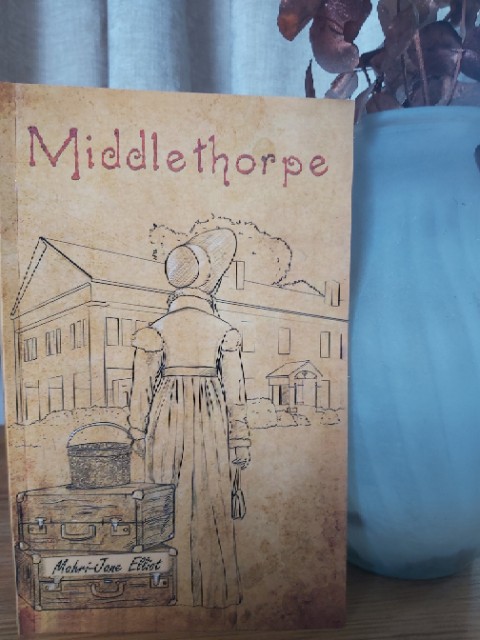
It is a truth, not universally acknowledged, that one can come across an absolute gem of a novel, or novella, in which the author tucks herself up into the world of Jane Austen with panache, and socks it to us in the most pacey style. Middlethorpe is, as Mahri-Jane Elliot says, her attempt to fill the void left by Jane Austen’s untimely death, and consequently the cessation of her novels. And does she fill it?
Written much as Jane Austen might have continued to do, I feel Elliot has a shrewd eye on today as well as yesteryear, and pursues Middlethorpe’s characters with a deep knowledge of Austen’s world: the mores of which dictated behaviour – but not necessarily the innermost thoughts. It is this depth of thinking that could, perhaps, result in the delicate manipulation of these mores into something echoing rebellion, or at least into caring little for them?
So, shall we look at the blurb, pray? Oh dear, sorry about that but one does become so absorbed…
The first duty of any female was to marry well and bear children, particularly an heir. Failure to achieve this was a cause of contempt, no one respects ‘the Old Maid’. Spinsters for life were expected to nurse their elderly relative or to care for their sibling’s children or worse still, become a governess. So when a beloved member of one’s family attempts to force spinsterhood upon another for their own ends, the wickedness is all the more wicked.
I loved the Forward, something I usually race through, in which Austen and the Bronte’s, with their harsher Yorkshire background, were not so much compared but discussed which gave great food for thought, and was, incidentally laugh aloud amusing in many places.
Then, off we jumped, into the world of correspondence, for Middlethorpe is written in the form of letters, which I confess I usually dislike. I fell, however, hook line and sinker for Middlethorpe – which from the first line, draws us into the family and the problem it apparently faces on two levels: the safety of the brother, and the problem of Athena, the spinster eldest daughter. From the start this novella absorbs, amuses, emotionally moves. Always written in the vogue of Austen it is sufficiently modern to be relatable, thankfully wryly amusing at one minute, at others laugh aloud – As an example, ‘from a brother to a sister, about an unmarried fairly independent sister. ‘Pretty her up and tell her to keep her mouth shut and simper a bit…’
Underpinning everything, though, is an evocation of heartache, of unfairness, and importantly a sense of betrayal as regards the family’s and society’s attitudes (I should think so) to single women. What, therefore, is Athena expected to do, but attempt to be useful in some capacity? Babysitting an elderly relative, becoming a governess, slipping around a sister’s family, essentially being invisible. Oh, the humiliation, the pain, the lack of hope… Unless of course, this particular spinster has a core, in which lurks incipient rebellion, determination… And unless the elderly relative she toddles off to ‘care for’ has a similar core… Unless a younger sister stays in support…
Will there be love? Will there be acknowledgement of her value? Will there be further betrayal…? Well, read Middlethorpe, you simply must. Bravo Mahrie-Jane Elliot. I just loved it. Ate it in one bite – well, you know what I mean.