Well I finally did it. I managed to find someone who will put up with me for the rest of my life. Most little girls dream came true when my boyfriend of three years whisked my off to Paris on the Eurostar for our anniversary and proposed. I ecstatically said yes and upon our return bought far too many wedding magazines, and realised just how hard planning a wedding was going to be. Don’t get me wrong. I am not exactly fazed by planning big things. I planned the launch party for Frost Magazine and had over 300 guests. It went off without a hitch even though the venue canceled on us a few days before. I have also made a full length feature film. I have the skills and the staying power but what I don’t have is £21,000 to spend on a party. Only one person has mentioned the outdated thing of the women’s parents paying, all of my friends paid for their own wedding and I am not asking my parents for money. I am the editor of this magazine, a freelance writer and actor.
Somehow this is not even the issue. Neither my fiancee or I think it is reasonable to spend that amount of money on one day of your life. Other difficulties are that my family live in Scotland and my fiance’s family live in England. Getting all of these people together in a convenient, reasonably priced venue doesn’t feel like the easiest thing.
Also as a half catholic, half protestant agnostic I have found out that I cannot even get married in a church because I was not christened as my parents, quite rightly, wanted me to choose my own religion. If I want to get married I will have to attend church or do a course. Neither of these seem appealing and I don’t have a lot of free time.
So join my on my journey from engaged woman to bride. I will be writing lots of wedding articles and advice to go along with my personal experience. Please comment and tell me your thoughts and give any advice. We are planning to get married in June of next year so we don’t actually have much time to get everything done. It is all quite exciting and scary.
We have a brillaint article on buying the perfect engagement ring if you want to send it to your boyfriend to drop some hints.
Mind, the mental health charity, today expressed alarm as new figures from its national telephone service show a 50% call increase within twelve months. The number of calls rose to over 68,000 in 2012/13[1], from 46,000 in 2011/2012.
The Mind Infoline has seen a corresponding shift in the nature of calls, with people presenting more acute and complex problems, many stemming from severe financial worries. This is reflected in a concerning 30% rise in calls relating to suicide: In 2012/13 there were 1,546 calls from people who had experienced suicidal thoughts, had taken steps to end their own life, or had concerns about a loved one, this was up from the 1,185 contacts received the previous year.
In response to the worrying figures, Mind acknowledges the increased need for its services, and urges people not to wait until they hit crisis point before getting in touch. As the charity announces the appointment of a new celebrity ambassador, TV presenter Anna Williamson, it hopes she will help raise crucial awareness through her role to ensure no one has to face a mental health problem alone.
Anna Williamson, who this week starts her new summer role offering viewers advice on ITV’s This Morning, has battled severe anxiety and panic attacks for many years. She now talks openly about her experiences and the vital first step of asking for help. Anna will play a key role as a Mind ambassador, encouraging others to seek support as soon as they need it.
Anna Williamson said: “I know just how scary it can be to start the conversation – worrying what friends or colleagues will think. But I also now know that opening up is the key to getting better. Since I first shared my own experiences, I’ve heard from so many others in the same position. It’s easy to forget you’re not alone, that actually 1 in 4 people experience a mental health problem every year.
“I am passionate about raising awareness and thrilled to be joining Mind as an ambassador. Through my new role I’m determined to let people know its OK to ask for help.”
Paul Farmer, CEO for Mind says:
“Today many people face the stark reality of severe financial pressures, be it through employment worries, benefit cuts, increased cost of living, or a lethal combination of all three. It’s therefore no surprise that people need Mind more than ever. We urge anyone who needs our support to pick up the phone and to do it today.
“We know that when people in the public eye speak out, it inspires others to seek help. We are delighted to have Anna Williamson’s support and are confident her honesty and candour will strike a chord with many others across the country and prompt them to get in touch.”
The Mindinfoline is a confidential telephone service providing information about mental health diagnosis, treatment, medication, local service provision and advocacy. Open from 9am – 6pm Monday – Friday, calls to the service are charged at a local rate and can be reached on 0300 123 3393.
Campfire singalong ‘Michael Finnegan’ has been named by parents as the most irritating nursery rhyme of all time.
The tune and its lyrics were said to be so “utterly catchy” that mums and dads found it impossible to stop humming it for the rest of the day.
It has 10 known verses but continues on a perpetual loop. Parents say this puts them in an impossible position of either starting again or ending it abruptly and sparking a tantrum.
Old MacDonald, meanwhile, was voted the nation’s parents’ favourite nursery rhyme, beating Row, Row, Row Your Boat, She’ll Be Coming Round the Mountain and Pop Goes the Weasel to the top spot.
The farmyard classic was said to strike “the perfect balance” between educational benefit and adult interaction.
Unlike Michael Finnegan, which was said to wind kids up “into a frenzy” just before bedtime, Old MacDonald was found to have a surprisingly soothing and soporific effect.
The research was carried out by AudioGO to mark this week’s release of its new ‘Wheels on the Bus Singalong’ audiobook.
It polled 1,000 parents with children aged five and under, and asked them to name their 10 favourite and 10 most irritating pre-school songs.
· HL analysis shows only 3 out of 77 large cap US funds beat their benchmark
Adrian Lowcock, Senior Investment Manager of Hargreaves Lansdown, looks at the prospects for the US economy on the eve of Independence Day;
“The US economy is much further down the road to recovery than the UK and Europe. The banking system has been fixed and the country does not have the problems that still exist in Europe. We can see the light at the end of the tunnel in the US and sustainable growth may be achievable.
“Many US companies benefit from strong management teams, are profitable businesses and operate in an environment of improving growth. Many American companies have a consistent and long term track record of being able to grow profits. In the world of uncertainty a premium is being attached to those businesses that can continue to grow.
“Whilst overall the US stockmarket is not cheap, there are still areas which offer value and investors get access to companies with huge growth potential. The US has a long history of encouraging entrepreneurs to develop and grow business. The US has a large smaller companies sector which is full of businesses looking to grow into global leaders. Investors should make sure they have some investment in the US Market within their portfolio.”
US Economy
The US Economy accounts for 19% or nearly 1/5th of the world’s gross domestic product. Economic outlook in the US is improving with GDP growth forecast by the IMF at 1.9% for 2013 and 3% in 2014. The threat of a “fiscal cliff” was largely delayed; bank lending conditions have improved from low levels.
Household debt as proportion of disposable income has fallen back to 2004 levels. House prices started to rise in 2012 and investment in residential property has followed.
Unemployment is falling with major banks* predicting the unemployment rate will be around 7% by the end of 2013.
Rising house prices should help rebuild household finances, as will improving employment, providing support to personal consumption. Low borrowing rates should be supportive of increased spending, while businesses encouraged by the improving financial conditions and healthy profits may well increase investment.
Shale gas could be transformative for the US economy. According to the U.S. Energy Information Administration it will keep market gas prices low at around $4 per million Btu until 2019 with prices rising slowly thereafter. This could rejuvenate the industrial sector.
Risks to US Recovery
The biggest risk is the early withdrawal of the Quantitative Easing programme. As the economic data, such as unemployment falling below 7%, improves it puts pressure for the Federal Reserve to roll back on further QE. The US has not addressed its budget deficit and the US lacks a plan to reduce the debt. As such there are risks of further political entanglements over raising the debt ceiling, both of which result in a higher sovereign risk premium.
Investing in the US
The US stock market has performed well in recent years recovering from the financial crisis having returned 103% since March 2009 compared to the FTSE 100 and the FTSE Europe Ex UK returning 80% and 62% respectively. The US stock market is around its long term average valuation with a P/E at 21.98 compared to its long term average of 23.8 times earnings. Even so there are areas of the US Market that remain attractive.
The challenge for investors is how to access the US market. Analysis by Hargreaves Lansdown shows that large cap active managers continue to struggle in the region with only 3 out of 77 funds in the IMA North American sector out-performing the S&P 500 over 3 years and 6 out 68 able to do so over a 5 five year period.
Investors looking for large cap exposure should consider US tracker funds, , such as HBSC American Index or I-Shares S&P 500, to give access to the world’s largest stock market whilst keeping fees low. For those wishing to access US smaller companies our preferred fund is Legg Mason US Smaller Companies.
* Bank of Tokyo-Mitsubishi, Barclays, Citigroup, Deutsche Bank and UBS
Recent actions by the Chinese regulators to curb lending has further unnerved investors already unsettled by recent comments from Ben Bernanke. The interest rates Chinese banks charge each other surged last week to record highs before falling back. And following a recent statement by the People’s Bank of China, the Shanghai Composite Index fell 5.3% Monday night.
Adrian Lowcock, Senior Investment Manager, at Hargreaves Lansdown;-
“China’s new leadership is addressing some of the risks that have been building up in the banking system, inevitably this could result in some short term pain, possibly impacting on growth but it should benefit China in the longer run. Chinese stock markets do look cheap at present, based on 20 years of information. In addition it is important to remember that China is a state-controlled economy and therefore it is very difficult to make a clear judgement on the accuracy of the information being provided. There are some concerns China’s shadow banking system will spiral out of control, however it seems unlikely the People’s Bank of China will let the system fail.“
“In line with their 5 year plan China is undergoing a change from an export driven manufacturer to a consumer focused economy. This transition is not going to be smooth and there will be some bumps along the way. China continues to grow, at around 6 to 7% per annum, but like all emerging markets this does not lead to a smooth rise in the equity market.
In 2007 investing in China was very popular and as a result valuations rose to very high levels. The market has underperformed both developed and emerging markets since. There are clearly issues in China’s financial system and authorities are now taking action to deal with these. For long term investors that want to have exposure to China this setback could be providing an opportunity to invest. Company earnings are rising and valuations are looking much more attractive. Most investors can get sufficient exposure through a well-diversified emerging markets fund such as First State Asia Pacific Leaders which has 23.9% in the region or Aberdeen Asia Pacific which has 18.47% in the area. For investors wishing to take a more adventurous approach and are able to tolerate a higher level of risk then Jupiter China, managed by Philip Ehrmann, provides exposure.”
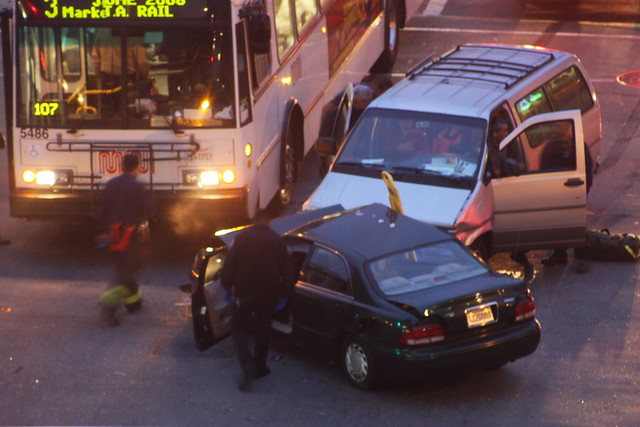
Accidents happen in a tenth of a second, and just like that, they can change your world forever. After an accident, you can count on being physically shaken up, mentally stressed, and perhaps in shock.
But what you do in these critical moments after the accident determines how fast (and how well) you recover financially, and physically. It can even save you from a nasty lawsuit. So, commit these steps to memory and you’ll be totally prepared when an accident happens!
Check yourself for injury. Touch your face, arms, legs and body to see if anything hurts, and visually check yourself for signs of bruising, cuts, or even broken bones. Remember, if you’re in shock or if adrenaline is flowing, you may not feel pain right away.
Write down all your injuries, even if they seem minor. Some minor injuries (like back and neck pain) can intensify the next day, or over a matter of days. Immediately call for medical help if you need it. Do not wait to call an ambulance, and do not opt to call the police first. Your health and the health of the other person involved is the most important thing. And even if you don’t see a doctor immediately following the accident, make sure you visit one as soon as possible.
Secure the Accident Scene Right Away
Secure the scene so you don’t cause another accident. If you’re able and your car is driveable, move to the shoulder and away from traffic. If you can’t drive the car, turn on the emergency flashers or set out road flares to warn oncoming traffic.
Once the scene is secure, call the police and report the accident, even if it’s a minor fender bender. Call local city or town police if the accident is in the city or on a municipal road. Contact the state police if the accident is on the highway or interstate. Police will make an official report, and this will protect you from any false claims made by the other driver after the accident.
Document and Photograph the Wreck
Document the accident yourself. Note the time of day, traffic conditions, and describe how the accident happened from your point of view. Snap pictures using your cell phone or digital camera for your own records. This will help when you file your claim.
Next, write down the other driver’s license plate number, full name, address, phone number, driver’s license number, and vehicle registration. Make sure to copy the other driver’s insurance information from their insurance ID card. Keep all of this information together, so you have it handy when you contact your insurance company.
Hire a Lawyer if Necessary
If you have serious injuries and need medical treatment, find a lawyer. Insurance companies are notorious for offering cheap settlements, and refusing to pay for everything. Search for injury attorneys online and find a good in the area the accident occurred. For instance, if your wreck happened in Carrollton, search for Carrollton personal injury attorneys.
Always follow these steps after an accident, and you’ll get back on the road safely and securely in no time at all. Are there any other steps you would recommend taking immediately following an accident?
1) Have an antivirus. You will need antivirus software. This is the best thing you can do for your computer. It will block viruses and stop you losing all of your data, or having your identity stolen through your data on your computer. Make sure your antivirus is scheduled to download updates and does a daily scan of your computer.
2) Keep your hard drive clean. There is software you can download to do this. Check out Cleaner. Also try and keep your digital life tidy. Go through your computer and delete things you do not need anymore. You can run a disk cleanup to remove temporary, unnecessary files. You can also run disk defragment about once a month. You do not need to overdo it. Remember to empty the trash too.
3) Be careful what you download. If you are unsure then do not download anything. If someone sends you a link with nothing else in the body of the email, or just a link on Twitter or Facebook, then do not click on it. They have probably been hacked and the link will not be genuine. Be aware that the link will be designed to get you to click on it. For example it might say ‘check out this funny picture of you’. Don’t believe it and don’t click.
4) Use a secure website brower. I am a Mac person and use Firefox (you can also use Firefox on a PC) or Safari. For windows Google Chrome or Internet Explorer.
5) Set up a Firewall. Firewalls control the information that goes in and out of your computer. This is essential for keeping out hackers. They also prevent Malware. PCs and Macs come with a basic Firewall installed so make sure it is turned on.
And finally….
Have a good, strong password.
What do you do to protect your computer and make it secure?
Buying the perfect diamond engagement ring is not easy. There are serious hurdles to navigate and hopefully this article will help you with some of them. You’re about to spend a serious amount of money you need to keep her happy, remember she’s going to be wearing this thing for the rest of her life but you also don’t want to get ripped off!
How much should you spend?
The first thing to remember with this is that everyone will try and bully you into spending as much money as possible. No matter how much your actually planning to spend you will be made to feel like its not enough. Walk into a jewelers planning to spend £5000 and they will gently make you feel as though your budget is inadequate and encourage you to spend more. Magazines will insist that you spend a minimum of three months salary. The industry is very cleverly set up to make you spend as much as possible. Don’t feel pressured. Set a budget on what your happy to spend and stick with it. Remember you’ve got a wedding to pay for! If she loves you she will love the ring no matter what. If she’s the sort of women who checks the size of the ring before saying yes or no shes not worth marrying in the first place. That all being said know one likes a cheap skate so a £10 ring from Tesco is not going to cut it so keep reading.
Online or Not Online?
I love to make savings buying stuff online but diamond engagement rings are a definite exception. Every stone looks different and you must see it in person before you buy it, no picture will ever tell the story so forget about buying online. It also will sound very unromantic when your fiancee asks where you bought the ring and your forced to tell her it’s from online.
With Her or Without Her?
If your worried about making a mistake you can buy a plain band for when you propose and then buy the ring with her so you can be sure you get one she likes. There are advantages and disadvantages to this. The advantage is you can be sure she gets what she wants.
The disadvantage is that your going to have to fork out if she falls in love with a ring. It also makes it much harder to negotiate when the jeweler knows you really want something. Proposing with a plain ring is also not as special and may detract from the moment.
Research
Doing your research is vital of you don’t want to make a mistake. It will mean you get the right ring and it could save you a fortune. The more you know the easier its going to be to negotiate and the more a jeweler will respect you.
Understanding the Four Cs
The look and value of a diamond is determined by four factors. Cut, Clarity, Carat and Colour
Cut
The cut is the only characteristic not determined by nature. A poorly cut diamond may have a compromised sparkle. The most common type of cut is the ’round cut’. In my opinion the traditional round cut or variations of it are by far the best cut because they sparkle the most, a lot more for example than the princess cut. However you should see all the cuts before making a decision. Types of cut include the the emerald, the pear, the marquise, the princess, the oval and the heart shape.
Clarity
The clarity is how perfectly the diamond has been formed in nature. Yes very few diamonds are perfectly flawless most will have little flaws which you can see under a magnifying glass. These flaws are called inclusions. Inclusions have a big impact on the value of a diamond
The grading of clarity according to the GIA (Gemmological Institute of America)
IF – Internally Flawless
VVS1 and VVS2 Very very slightly included inculsions which are very difficult to see even under 10x magnification
VS1 and VS2 – Very Slighty Included – Difficult to see under 10x magnification
SI1 and SI2 – Slightly Included – Easy for a trained grader to see under 10x magnification
I1, I2 – Included obvious inclusions usually visible to the naked eye
I3 – Large inclusions that typically impact the fire of the diamond and potentially threaten the structure of the stone
Inclusions are a big part of why you need to see a diamond in person. Inclusions can affect the sparkle or fire of a diamond. Sometimes a diamond which has a higher grade may actually have a bigger impact on sparkle than a lower grade. People can make to bigger deal about inclusions. Remember a diamonds inclusion make it unique. Personally I think the money you would spend to buy a VS diamond would be better spent on carat or colour. You should however try to avoid severe inclusions which might compromise a stones sparkle or structure. Again this a personal choice and you must find for yourself what you want but I think the SI categories often offers the best value. Remember though that two diamonds from the same category might look completely different. You must judge how the stone looks.
Colour
The most valuable and rare diamonds are colourless and are graded D. The colour scale runs from D to Z. Diamonds with a very distinct colour are rare and are called fancies. Diamonds typically get more yellowish as you move down the scale. Colour is important but again it is not something I would obsess over as long as you get a reasonable grade. You or your fiancee are not going to tell the difference between an F and an H. In my opinion I would suggest you can probably go up to a J without really having much idea that your diamond was slightly yellow. For me an I or H rating represent the best value but again these are all personal opinions you might find that for you only a D or E grade will do. Remember every stone is different trust your eyes don’t just focus on the grades.
Carat
The Carat or the weight and therefore size of the diamond. Not to be confused with karats the purity measure for gold. The carat has a big effect on value and is the first thing everyone will notice. As the size of the carat increases the price grows exponentially. Most diamonds for engagement rings fall between 0.25-2 carats. You will want to get as bigger carat as you can within your budget without compromising too much on the other Cs. Don’t believe everything your told by jewelers when it comes to carat. For example they may say to you on that budget you won’t be able to buy a carat bigger than X. I was initially shown much smaller diamonds than the one I was eventually able to buy.
Certified or Uncertified
A certified stone is – a diamond that has been assessed, graded and coded with a laser by an independent gemological laboratory. The most well known and recognised is GIA. Other popular certificates include HRD, IGL, EGL and AGS. The disadvantage of an uncertified stone is that you are trusting the jeweler. However a cert stone is usually a few hundred pounds more expensive. A cert stone will also ensure you have not been sold a fake. If you are buying a very expensive stone having a cert stone is probably worth it. If you have a smaller budget you may prefer to risk going without a cert stone. The decision must be yours. Diamonds can be artificially treated or fracture filled and sold legally although you must be told. Avoid these and avoid anything which is ‘clarity enhanced’.
Looking Out for Fakes
The ring itself
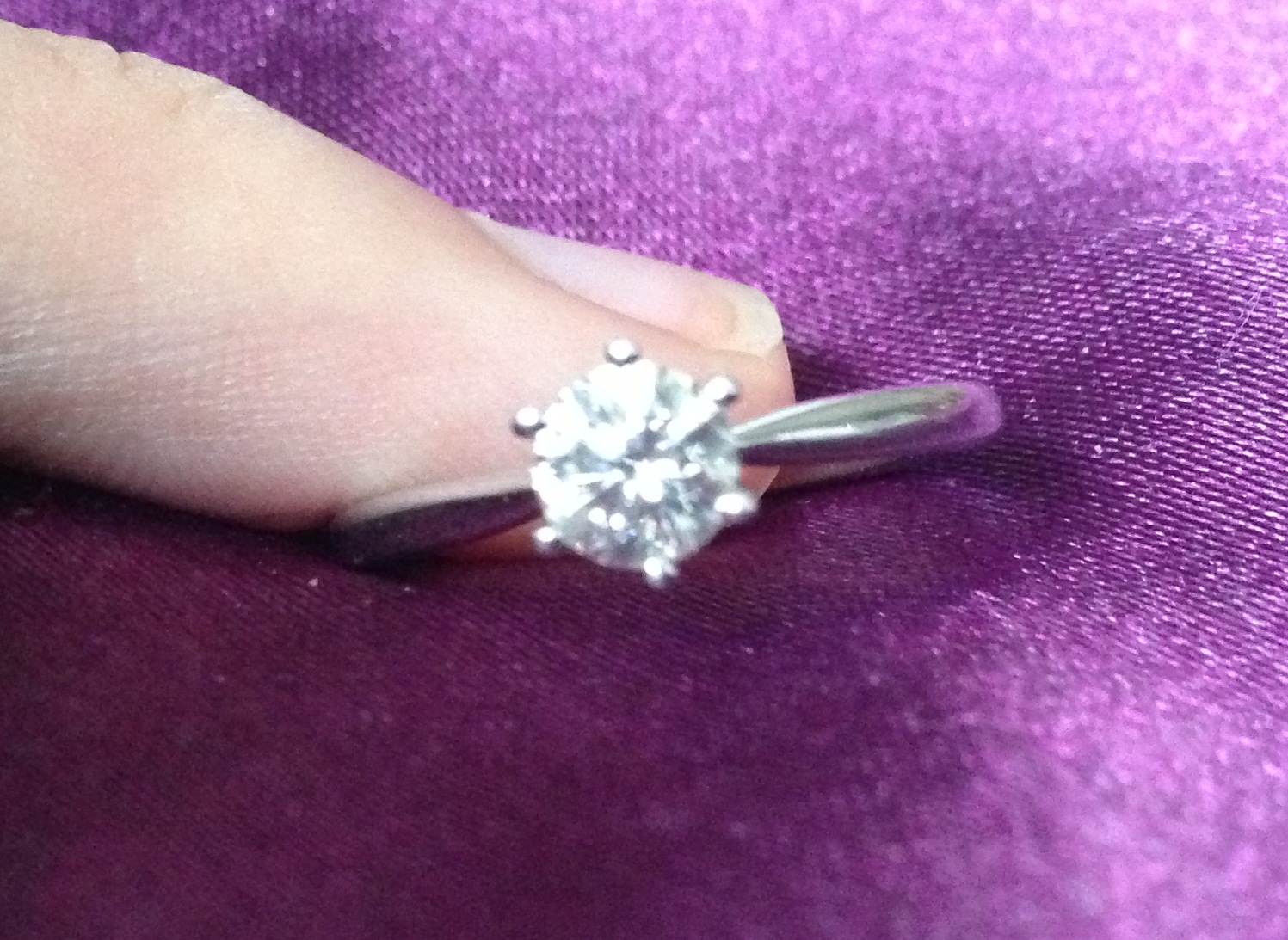
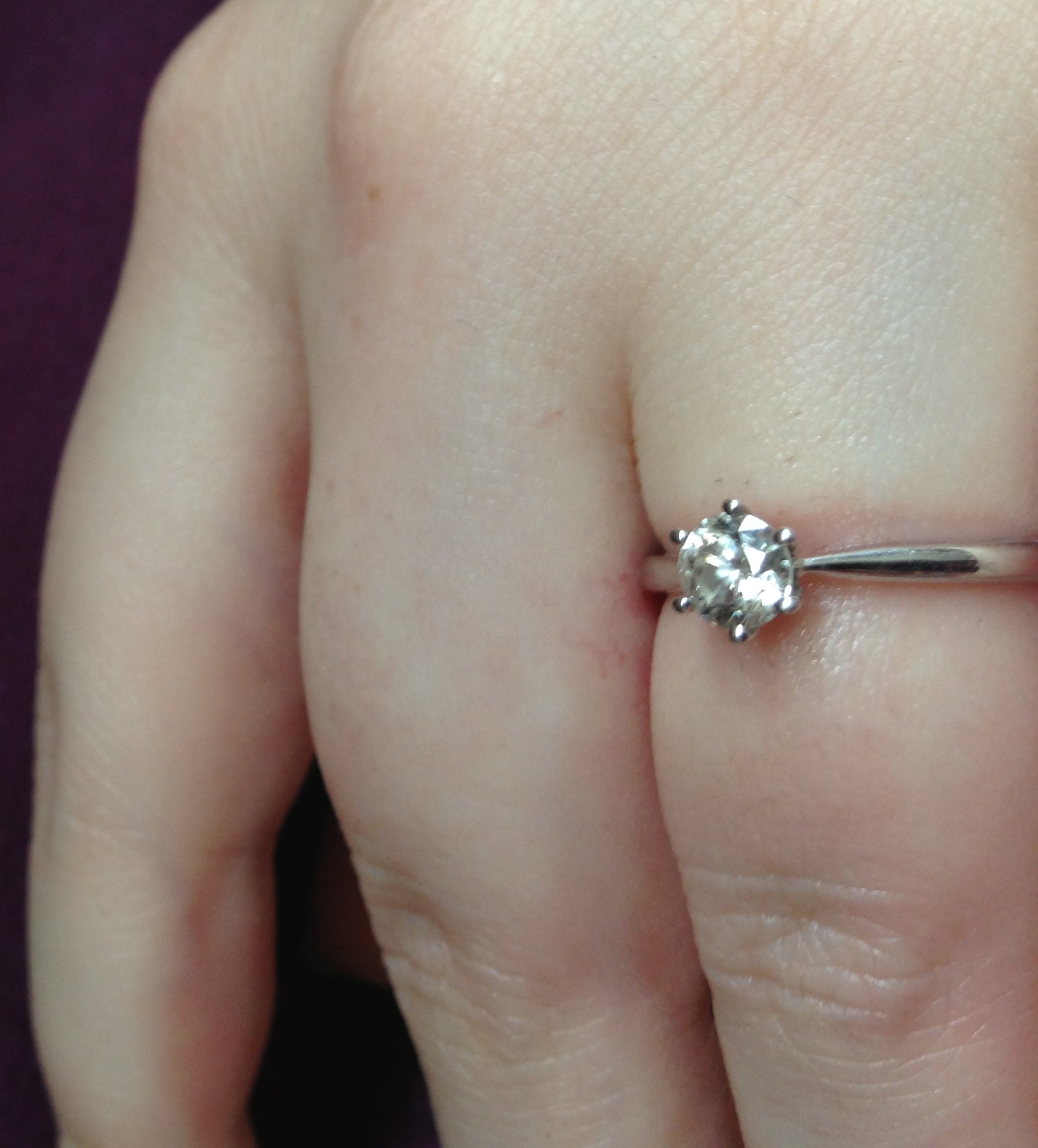
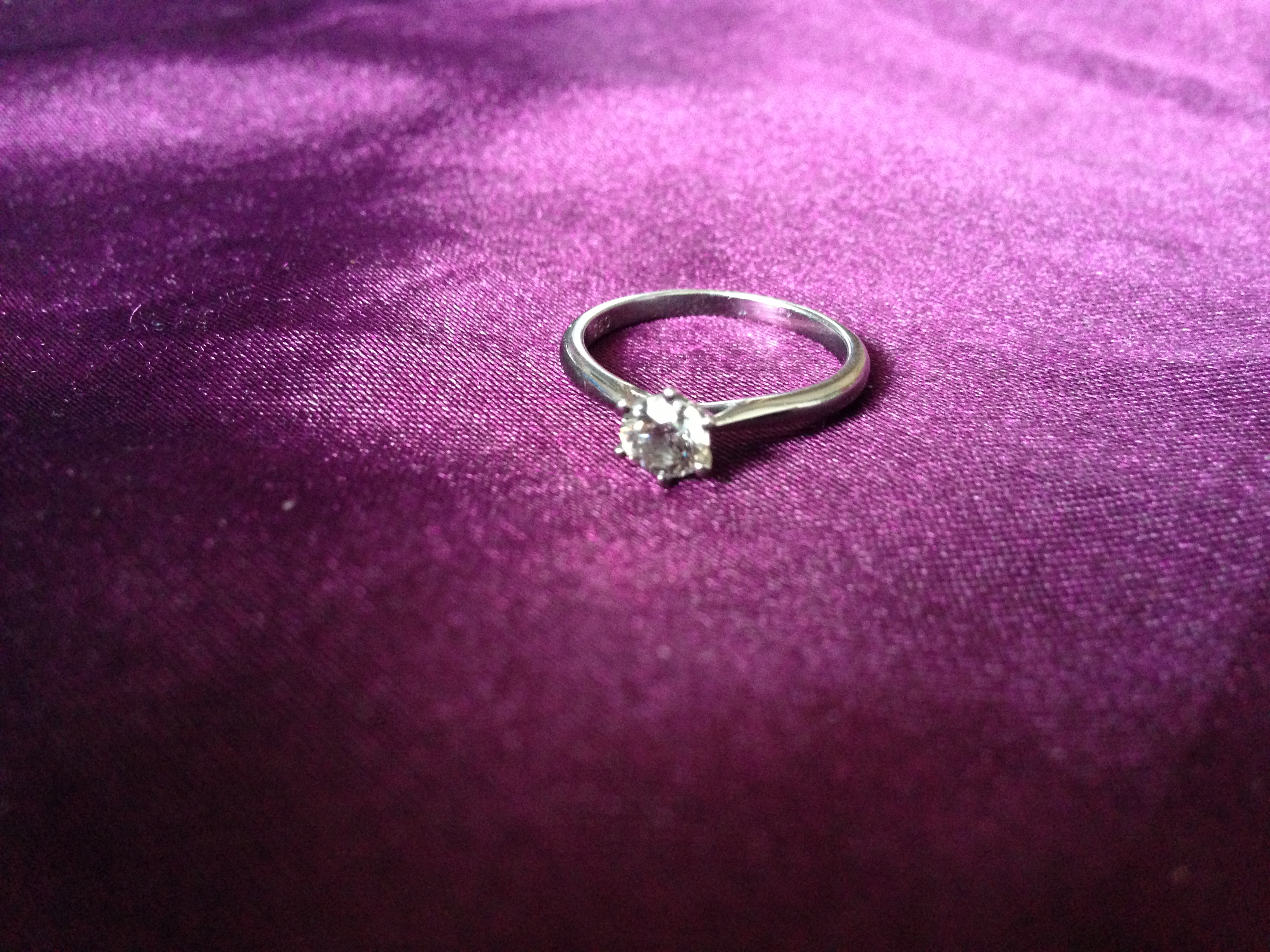
The most common rings today seem to be from white gold and platinum which both look quite similar. You can also go for a yellow gold or a white and yellow gold mix although personally i prefer the platinum or white gold look. Platinum is slightly more expensive than 18 karat white gold. Try and go for at at least 18 karats if you can, no one wants 9 karat gold for an engagement ring. Remember 9 karat gold is just 37.5% pure compared to 75% for 18 karat. If they can keep a secret try and glean information from your fiances family and friends as to what her taste is. You can differentiate your ring by choosing a variety of different settings although the diamond solitaire seen in the pictures above is the most common. If you can try and find out what size ring she takes from her friends or family. If you can’t, don’t worry too much any reputable jeweler will allow you to get it refitted although this may cost extra.
Buying the Diamond Ring
Where to Buy?
First of all set aside at least half a day don’t buy a ring in a rush. Do not buy from a high street jeweler you will almost certainly get ripped off and you will have limited choice. If you can try and go to an area where there are a lot of jewelers in one place. Hatton Gardens in London is the best place to go to. There are at least 30 jewelers next to each other. You can be assured of competition and a wide choice. Most of the jewelers also have good reputations.
Don’t Get Sucked In
First go around every store and check the windows to get an idea. People will probably come out and try and get you to come inside. Talk to them to get more information if you want but don’t go inside yet. Try and work out which shops are offering the best deals. Bear in mind that jewelers will display their best and usually most expensive wares. They will usually have more inside the store. Take pictures of any rings which catch your eye and move on.
When you’re ready choose a ring which you liked and go into the store and ask to have a look at it. Here’s where you can make use of all that research you’ve done. Ask the jeweler about the cut carat etc. Ask to see the ring under 10x jewelers loupe and on a white background (a black background can hinder the eyes perception of a diamonds colour). Ask if the ring is certified and who did the grading. Remember that an uncertified ring is not necessarily a bad thing and will usually mean a cheaper ring but is something you need to be aware of. Ask the jeweler what guarantees and warranties they offer.
Then ask if the jeweler has any similar rings to compare it to. All this will make it clear to the jeweler that you know what your talking about and it will make it easier to negotiate later. Don’t be afraid to take your time. Choose the ring which you like the most and ask the jeweler for his best price on that ring. Thank the jeweler make a note of the details of the ring and tell him/her you’ll be back if you don’t find anything better. Also remember to ask the jeweler about re-sizing costs, the setting and the material of the actual ring.
Go into the next shop and repeat until you have a really good picture of whats available and you know what you want.
How to Negotiate
Negotiating can be uncomfortable but you absolutely must do it. Remember they are the ones profiting from you and you have the power to go elsewhere. A general rule is to get at least 15%-20% off the list price at a minimum. Don’t seem too keen if you really want a particular ring.
A good first move is to ask the jeweler what his or her best price is. That should be your starting point for negotiations. Use your budget as a negotiating tool. When you’ve clinched the deal remember to get a receipt and remember to ask about fittings.Try and get one for free if you can.

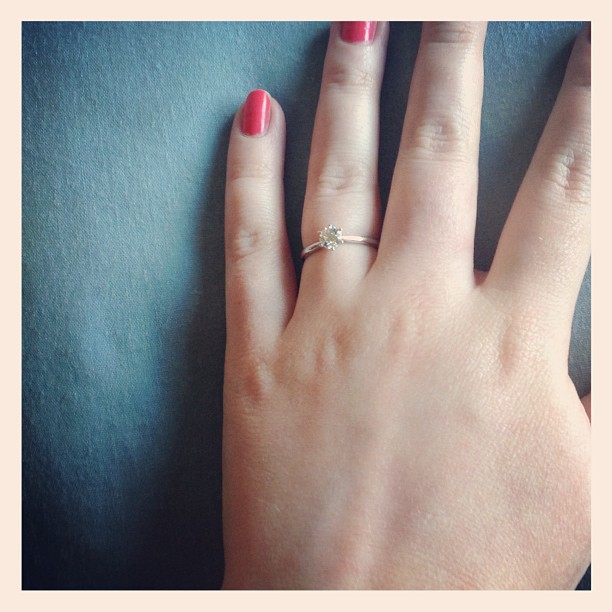 Well I finally did it. I managed to find someone who will put up with me for the rest of my life. Most little girls dream came true when my boyfriend of three years whisked my off to Paris on the Eurostar for our anniversary and proposed. I ecstatically said yes and upon our return bought far too many wedding magazines, and realised just how hard planning a wedding was going to be. Don’t get me wrong. I am not exactly fazed by planning big things. I planned the launch party for Frost Magazine and had over 300 guests. It went off without a hitch even though the venue canceled on us a few days before. I have also made a full length feature film. I have the skills and the staying power but what I don’t have is £21,000 to spend on a party. Only one person has mentioned the outdated thing of the women’s parents paying, all of my friends paid for their own wedding and I am not asking my parents for money. I am the editor of this magazine, a freelance writer and actor.