SHEILA CRIGHTON ON ‘THE PRO’S AND CON’FERENCE’ OF 2020

Conference planning time reminds me of Christmas. Perhaps it’s because the planning begins around October when, life becomes a bit more twinkly. Or perhaps it’s because I get to open up a new spreadsheet and start putting together another buzzy, creative, inspiration-filled roster of sessions with which to lure people along to our next venue (Leeds Trinity in 2021, if you’re asking).

When I first started attending in 2015, the extraordinary Jan Jones was the doyenne of all things conference. And when I say all things, I literally mean all the things. She booked the speakers, the delegates, the venues (booking venues happens years in advance to make sure we get our early-July slot). She put up the signs pointing us up stairs and down corridors and around the corner to the loos. She knows where to get wine. Who can help make the microphones work (thank you, Janet Gover!). She knows who likes to sleep on a quiet floor and who needs a kitchen that parties into the wee hours. She did it all. Yes, there are helpers. People who greet lovely newbies (cheers, Kate Thomson) and people who schedule the industry appointment allocations (thank you, Elaine Everest). People who chair the RNA (kisses to Alison May and all past leaders), and of course the scads of folk who help stuff those lovely goodie bags, but still. Organising a conference for well over two hundred delegates and some thirty-plus speakers as well as the venue, the catering, the glitter on the tables for Saturday night etc etc is a big task.
So, a couple of years ago before I’d even had a sip of wine, I volunteered to help. I’d book the speakers and one-to-one industry experts and Jan would oversee the venue logistics (of which there is a mind-boggling amount to consider) and book the delegates (another epic job including, but not limited to, getting those lovely glittery first-time Conference attendee flowers on name tags).

Booking speakers is akin to picking thirty-six shiny candies from a huge jar filled with thousands of impossibly wonderful candies. The previous year’s speakers have to be considered. Delegate’s feedback is pored over (yes, we really do consider it). All this and more to create that all important balance for the myriad of novelists who make up our membership. We put a lot of thought into creating sessions that meet everyone’s needs and perspectives, headlining the RNA’s passion for inclusivity. As such, the speakers should showcase the variety in modern romantic fiction including: romcom, historical, SCIFI, saga with BAME, LGBTQ and all of the other protagonists in between seeking their Happily Ever Afters. After all, love matters to everyone. And then, of course, there are the one-to-one industry feedback sessions. The feedback – no matter the outcome – is unbelievably useful. It’s definitely taught me to take some constructive criticism on the chin!

This year, just as everything was getting exciting and I thought we’d nailed it, Covid-19 happened and we couldn’t hold the shiny conference I’d just organised and Jan had already taken over a hundred bookings for. Then our chairwoman Zoomed me (because that’s now a verb) and said “virtual conference.” I said no, no, no because I was mourning the conference we couldn’t have. When booking opened for the virtual conference Alison persuaded me to book speakers and industry professionals for despite my reservations, scores of you signed up. Which is just the juice we need, come autumn, to open up a shiny new spreadsheet and do it all again. Happy virtual conference everyone!!


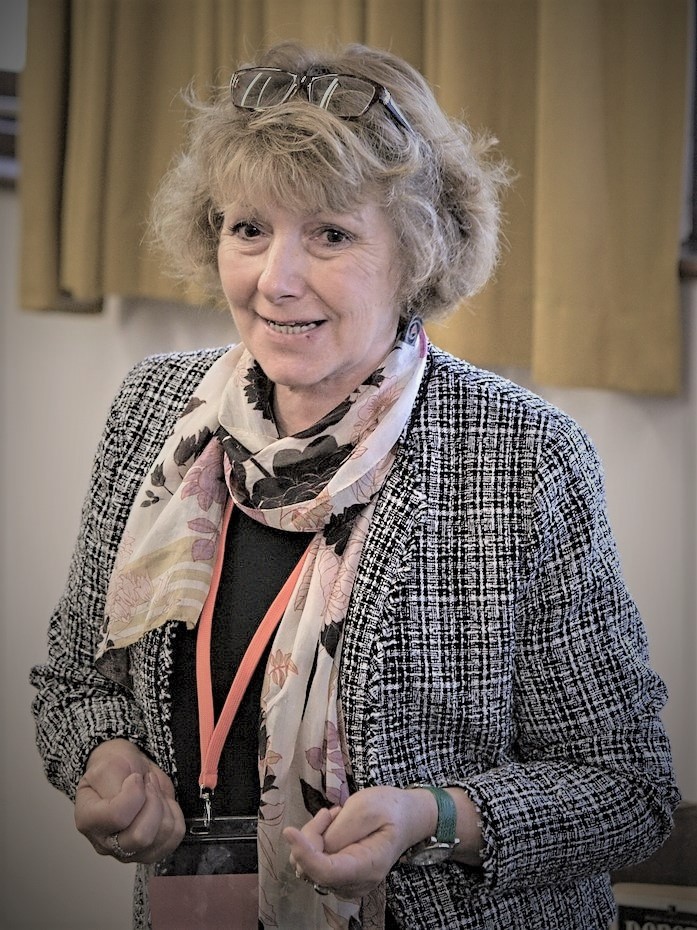
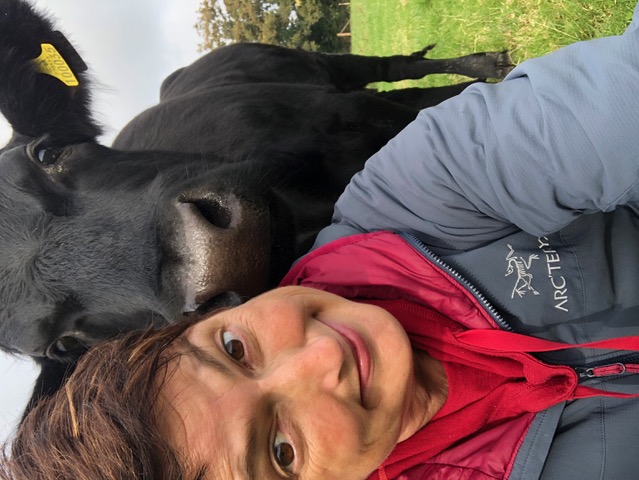
Sheila Crighton’s first job was selling popcorn at an arthouse cinema. She later became a cameraman and news producer for Associated Press TV, made a few TV programmes, then gave it up to raise stripy cows and write books as Annie O’Neil and Daisy Tate. One of her gazillion dreams is to write a Hallmark Christmas movie.
 

SISTER SCRIBES: KITTY WILSON ON HANDLING DIFFICULT TOPICS IN LIGHT HEARTED ROMANCE

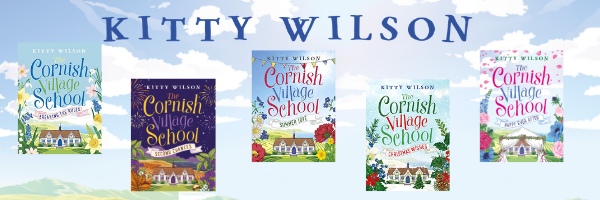
I had planned to write about Happy Ever after for this month’s post, the last in my Cornish Village School series and out last Thursday.

However, I had a lovely review today that has changed my train of thought. The reader kindly said that she really liked the way I handled difficult topics in an easy way. And this made me want to write about that…handling difficult topics within the confines of light-hearted feelgood reads.

And I ram them in.

So far across five books I have dealt with all sorts of real-life issues, including coercive relationships, maternal loss, war, marital breakdowns, parents with addiction issues, neglect.

I will forever remember my editor’s reaction when pitching the second in the series I dropped into conversation that I wanted to bring in the South Sudanese Civil War. I thought she was going to have a heart attack. I had to reassure her that yes, I was still writing a light-hearted romcom set in Penmenna and that she could a) trust me b) gamble knowing she could always edit it out later.

Why have I insisted on featuring these things? How do I justify including such things in feelgood books? The answer is simple. I love the romance of a romance novel, the sighs, the highs, the hopes and desires and the guaranteed happy-ever-after. But I also like real and relatable characters, people I can empathise with, bond with and enjoy writing about and then reading about (honestly, we have to read our own books so many times before they come to you). And the truth is I don’t know a single person in real life that hasn’t had to deal with trauma in one way or another, and many people who have to deal with far more than their fair share. Therefore, I need my characters to reflect the people I know and love in real life. Bad things frequently happen to good people, they just do. And whilst I love writing about a fictional village that features the best of Cornwall – beautiful beaches, picture postcard cottages and strong community I do need a smattering of something to balance that out. In the county I love we have all those things but it doesn’t mean that behind closed doors that life is as perfect as it is pretty.

My poor children have always had it rammed home that it’s not the things that life throws at you that are important, it’s the way that you deal with them that counts. And that has to be true in fiction as well. We need to see how our characters respond to real-life situations, to the tough things that real people have to face every single day. I want to recognise when I write that everyday people are as heroic and wonderful as characters in books, that they too have to deal with the most dreadful things and, apart from an occasional understandable wallow, they get up and keep going.

On the flipside are the joyful things about life, the big stuff – people we love, personal achievements and the everyday stuff, the hedgerows and the birds, a good book and delicious things to eat, or whatever your little joys are. The happy keeps us going when we have the awful, the awful makes us appreciate the happy.

I hope by bringing these subjects into my books, I am reflecting this balance and also acknowledging the heroic nature of what people have to deal with every day, and how I am in awe of the sheer resilience and goodness of human beings and life in general.


All love, Kitty.

SISTER SCRIBES: KIRSTEN HESKETH ON BEING A PUBLISHED AUTHOR

It’s three weeks since my debut Another Us launched and what a strange, exhilarating, fabulous, scary three weeks it has been.

What with that – and, of course, ‘real life’ overlaid over the top – it’s all been rather overwhelming and I think it’s only now that I am beginning to sit back and play it all over in my mind. So – if it’s not too self-indulgent – I thought I might devote this post to my recollections of the big day.

I had wondered that the day itself might feel like an anti-climax. After all, my very first book was being sent off into the world to fend for itself in the middle of a global pandemic! Publishers and agent were working from home, decisions over a paperback edition had been put on hold at the last minute, and it was proving difficult to get physical review copies out to the lovely writers and bloggers who had offered to read and potentially review the book. It all looked like it might be one great big wash-out.

In fact, the day itself was absolutely wonderful. The outpouring of support on social media was absolutely incredible and I literally couldn’t keep up with all the tweets and RTs coming through on Twitter. Several days later. I stumbled across about twenty messages I hadn’t seen before. (I do hope the kind senders didn’t think I was terribly rude.)

And then there were the gifts. The doorbell rang all day with flowers and chocolates and cards. My lovely friend Debbie made this incredible cake. My fellow Sister Scribes not only sent flowers and an 48-pack (!) of Curly Wurlies (how well they know me!) but have arranged for flowers to be sent for the next two months as well – so the celebrations can go on and on. My Coppa Club friends – Claire, Becci, Moira and Marilyn – sent a magnificent afternoon tea. My chums at Reading Writers sent flowers and chocolates.

How lucky am I?

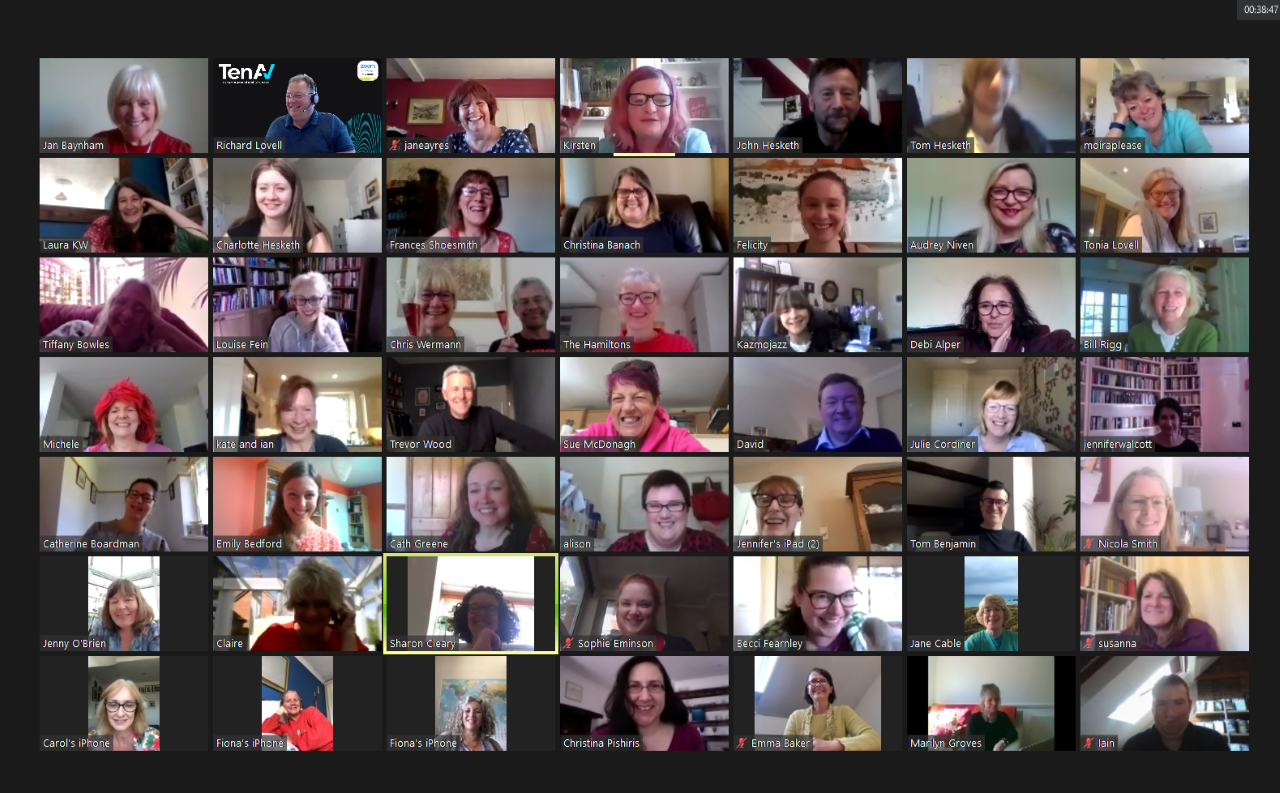
I hadn’t been sure what to do about the launch party. I had planned a very small afternoon tea at the Lanesborough Hotel for ten, but that was scuppered by Covid. In the end, I plumped for a Zoom launch which was brilliant and surprisingly emotional. As some of you may know, I dyed my hair red to match the book cover in order to raise money for Mind, and everyone got in the act. There were red tops and red wigs and Jane Ayres dyed her hair red too in solidarity. There was also a red drink competition judged by my children and I know Sue won but I’d slightly lost the plot by this point and I’ve no idea what she was drinking – or if she’d just made something up! More seriously, my editor Emily and agent Felicity both made wonderful speeches and I had a genuine lump in my throat when I came to reply to them.

So all in all it was a wonderful day and thank you to everyone who helped me celebrate and who has supported me in my journey.

And now Another Us is out there in the world and, as I write, has 42 fabulous 4* and 5* reviews. I have had lovely messages from people I know and don’t know saying how much they’ve enjoyed Another Us – including one from a Hollywood actress. I have no idea how many the copies the book has sold but it has been the most wonderful whirlwind!

Next time: the inevitable party hangover and the first 1* review!


SISTER SCRIBES GUEST: LINDA HUBER ON FAMILY SECRETS

I’m delighted to welcome the lovely Linda Huber, a prolific author and fellow Swiss resident, to Frost Magazine today, where she’s talking about how family secrets inspired her writing.

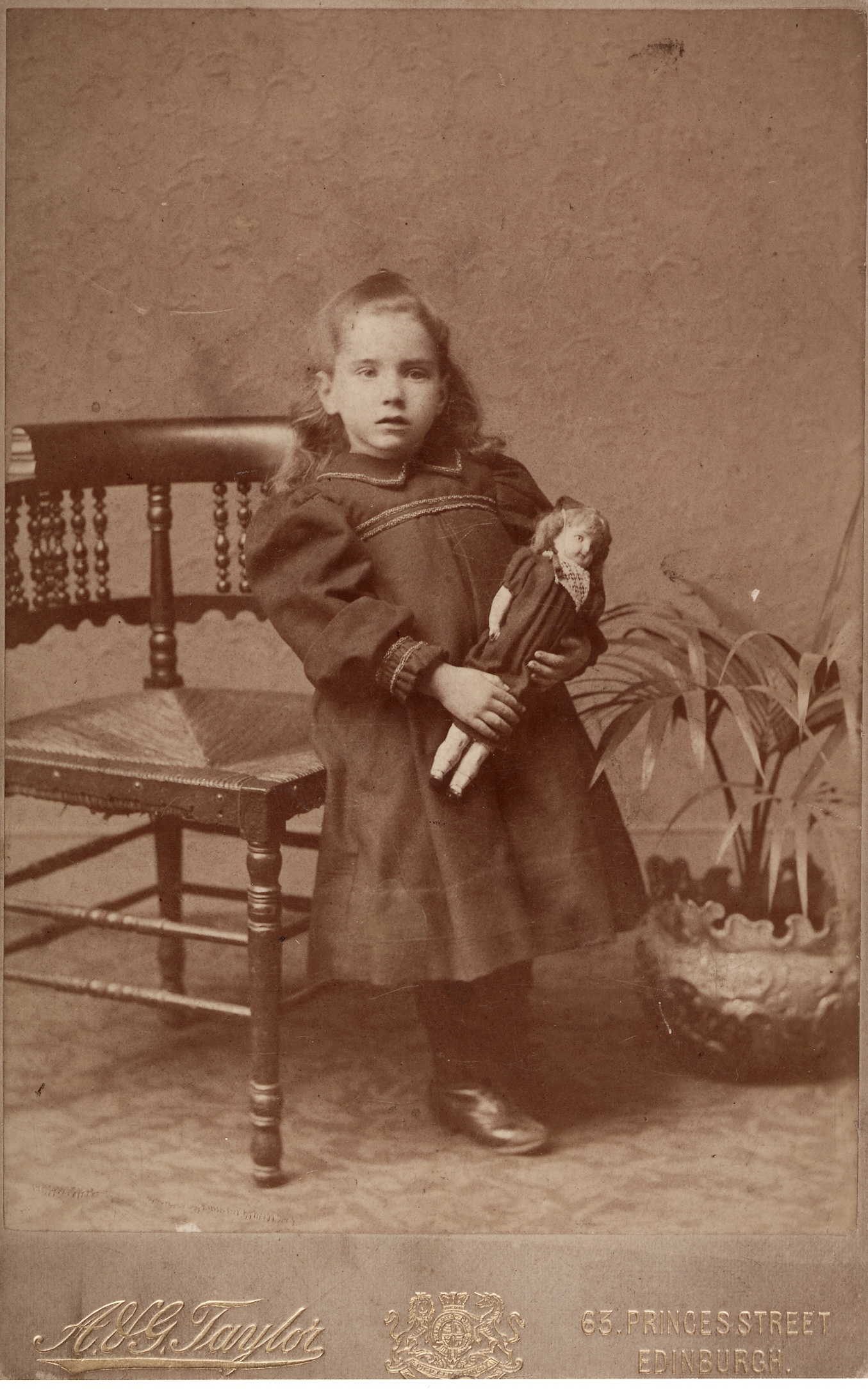
It’s always fascinating, talking to older family members and hearing their stories of days gone by. I remember my grandmother talking about her life growing up in Edinburgh with her parents and brothers. The family were keen photographers so we have a wealth of photos ranging from Granny as a toddler in 1890-something, all the way up to her last years, when she lived in Glasgow with her younger brother.

What she never mentioned was either of the wars she lived through, apart from the odd comment about food rationing. Another taboo was the death of my grandfather when my mother was just fourteen. He died in an industrial accident on the railway, where he worked, so Granny was given compensation – a return train ticket to London. It was her first and only trip outside Scotland. How I wish I’d been old enough to know I should be questioning her greedily, saving up her answers for my own children. I was still a teenager when she died, and there was too much Mum didn’t know either.

That’s how it is with family secrets, I think – usually, they’re not so much grisly skeletons in the closet as things that are just too hard to speak about. Or maybe, details are simply forgotten over time, not mentioned because nobody thinks to. When I was researching my family tree, I came across a distant little cousin who’d drowned in a Glasgow swimming pool in the 1940s, aged eleven. I’d never heard of her, and my mother could only just remember hearing her talked of. It was a tragedy lost over generations, though I’m sure little Agnes’s close family still remember.

Other secrets are grisly and terrible. A few years ago, I read a news story where someone had kept something truly awful from his nearest and dearest for over twenty years. I won’t say more because they are real people, but this man’s wife and children had no idea that the person they were living with was capable of what he had done. That started me thinking… and the end result is my ninth psychological suspense novel, The Runaway.

Cass (left) and Linda (right)

In the book, Nicola, Ed and Kelly Seaton relocate from London to lovely Cornwall. It should be a fresh start for them all – teenager Kelly had got in with a bad crowd, Ed had lost his job and Nicola was struggling to keep the family on an even keel. So they moved into Ed’s old family home by the sea. Nicola was determined to make a success of the new life, but little did she suspect what had happened in the house when Ed was growing up. He’d kept his secret well…

This is the third book I’ve set in Cornwall; I’m making no secret of the fact that I love the place! The Seaton family’s new home is near St Ives, which has fabulous beaches and a beautiful old town. It’s years now since I’ve been there, but one day I’ll go back. And meanwhile, I can write about it.


Linda Huber grew up in Glasgow but went to work in Switzerland for a year aged twenty-two, and has lived there ever since. Her day jobs have included working as a physiotherapist in hospitals and schools for handicapped children, and teaching English in a medieval castle.

Her writing career began in the nineties, when she had over fifty short stories published in women’s magazines before turning to longer fiction. The Runaway is her ninth psychological suspense novel.

Find out more about Linda at www.lindahuber.net or follow her on Twitter @LindaHuber19

SISTER SCRIBES GUEST: KIRSTEN INTERVIEWS WRITER AND TUTOR CHRIS MANBY

Today I ask the questions of Chris Manby.  Chris was the tutor on my very first retreat and we have since become good friends. Over to you, Chris.

  • First off the blocks. Plotter or pantser?

Definitely a plotter! I used to be a pantser but a series of short deadlines meant I had to get a strategy. I use screenplay principles to work out what needs to happen when though of course I often stray from my plan

  • How do you organise your work?

I’m a real geek.  When I get my deadline, I work out a timetable with daily word count based on the average length of a novel.  I make sure I allow myself weekends off (though rarely take them).  Then I just get writing.  I don’t stick to rigid hours but I do stick to daily word counts.

  • What is the hardest part of writing?

Getting through the mid-section of a book without losing pace and enthusiasm. Plotting helps as it means I can write something from the end instead and often that will inform what needs to happen in the middle.

  • And what is the most rewarding?

Most rewarding is returning to a manuscript after a week or so away from it and thinking “that’s actually not so bad”.

  • How has your writing style developed over time?

Photo credit: Michael Pilkington

I’m not sure my style has developed much at all!  I still think the first short story I had published –when I was fourteen – is one of the most elegant things I’ve ever written.  But I do now avoid swearing in my books. American readers in particular don’t like it.

  • What do you see as the greatest success of your writing career?

In the noughties, I had a few top ten bestsellers. That was wonderful.  But what felt like real success was when my sister said she loved one of my novels! It was The Worst Case Scenario Cookery Club.

  • And what was the deepest disappointment?

Any book that doesn’t sell is a disappointment but after twenty years I’m learning not to equate sales figures with a book’s intrinsic merits. I know my best-selling books are far from my best work!

  • Talk us through how you develop your characters.

In the same way we get to know a new friend.  The more time you spend with them, the better you know their quirks, their hopes and their dreams. Sometimes characters surprise me.

  • Sister Scribes is all about women writers supporting each other. Do you have a ‘go to’ bunch of fellow female writers you value and rely on?

I met a wonderful bunch of women in 2000 when, together with Fiona Walker and Jessica Adams, I edited an anthology called Girls’ Night In for War Child. Lucy Dillon and Alexandra Potter are two great friends from those days.  They’re always up for a glass of fizz and a chinwag.  More recently, through the Place To Write I’ve made some fantastic new friends, who are always ready with a word of encouragement. I don’t often show writer friends my work in progress though. I’m easily discouraged by faint praise. Better not to risk it.

  • Can you tell us anything about your next project(s)

I’ve just finished a ghost-writing project and now have three months to write a novel.  Fortunately, it’s already planned to the “nth” degree.  It’s called “What the Heart Sees” and the hero is… well, he’s small, dark and very, very hairy.


JANET GOVER INTRODUCES THE RNA’S ONLINE WRITING COURSES

Writers might be solitary creatures much of the time, but that doesn’t mean we are finding the current restrictions any easier to deal with. Our nature leads us to keeping our minds active, and like everyone else, we are missing being with friends and colleagues at social gatherings, conferences and events.

Purely by chance, a project I’ve been working on for a while now is coming to fruition at just the right time. I’m talking about the Romantic Novelists’ Association’s new online learning programme #RNALearning.

Teaching and writing are two things I’ve done all my life, and I’m also a bit of a geek. When online training was first suggested to me in my day job as an IT trainer, I wasn’t too thrilled. I like face to face contact with people I’m teaching. They are more likely to laugh at my jokes that way. But once I started training online, I soon became a convert.

It’s so easy to attend an online course. There’s no special technology needed – just the internet. If you can watch a cute cat video online and send an email, you can do an online course. And in the current world, it’s a great way to keep our minds active in a lockdown.

Online courses can include watching videos (and not feeling guilty about it), joining online chat (see previous comment re guilt), downloading notes and doing exercises. It’s a great way to maintain contact with other writers, and because it’s online you can make it fit into whatever your time commitments are.

The RNA’s courses are open to anyone to join, whatever genre they are writing. Tutors will cover topics of interest for writers at all stages of their career, using the RNA’s online learning portal, via Moodle, a standard teaching tool used in many colleges and universities.

It’s my great joy to be the tutor for the scheme’s pilot course: Taking the Plunge – Your Submission Pack – which runs for the entire month of May. This is aimed at anyone who wants to follow a traditional publishing route and submit their work to an agent or traditional publisher. I’ll be talking about giving a book the best possible chance with agents and editors: preparing the MS, writing a synopsis and cover letter and what to do when the answer is no – or what to expect if it’s yes. Most importantly, there’ll be exercises and feedback for everyone. At the end of the course, participants should have their submission pack ready to go.

We started planning this last year – and never expected to be launching it in a world turned upside down by crisis. I hope it will be more than just a learning experience full of useful information for writers – I also hope it will help us all feel more positive in this difficult time.

Bookings are now being taken for the first course. Details can be found at:

https://romanticnovelistsassociation.org/rna-learning-intro-page/ or email janetgover@romanticnovelistsassociation.org


About the author:  Janet Gover is a former journalist and IT specialist turned award-winning novelist. She is also a qualified trainer and a well regarded writing tutor. She runs the RNA’s New Writers’ Scheme and is part of the Association’s education team.

SISTER SCRIBES GUEST: STEPH HAXTON ON MOVING THE MUSE

Steph Haxton was one of the first local writers I met when I moved to Cornwall. Historian turned author (or gamekeeper turned poacher, as she’d have it), her research is meticulous and her wit legendary. Unfortunately for me she’s now moved to Scotland, but how would the sometimes elusive Mrs Muse take to the change?


Mrs Muse, plugging a new novel set in Scotland, by June should have been sitting on the doorstep of our new home. But I’d had not a peep for weeks. She’d showed briefly at Holyrood Palace; she’s a sucker for anything royal. But after a quick tap on the shoulder, she scarpered again.

A month later I decided to head up the M90 to Innerpeffray Library, a place highly recommended by a fellow bibliophile. With an overview of where I was headed, I let the Sat Nav tell guide me. My relationship with it being troubled, when it directed me off the dual carriageway not far outside Perth, I was immediately suspicious.

‘Turn right to Roman Road.’ It didn’t look likely, was signposted something else.

But round two sharp bends, there it was! Only a bloomin’ Roman road; straight, classic width, ditches either side bordered by beautiful woodland. Wow!

I had to stop a few miles on, when the trees dropped away.  On a ridgeway, I faced a breath-taking view over the Strathearn. Thirty seconds later, four police motorcyclists in formation swept past, easily doing 50mph. Incongruous on a rural lane, they were clearly enjoying a Roman road too!

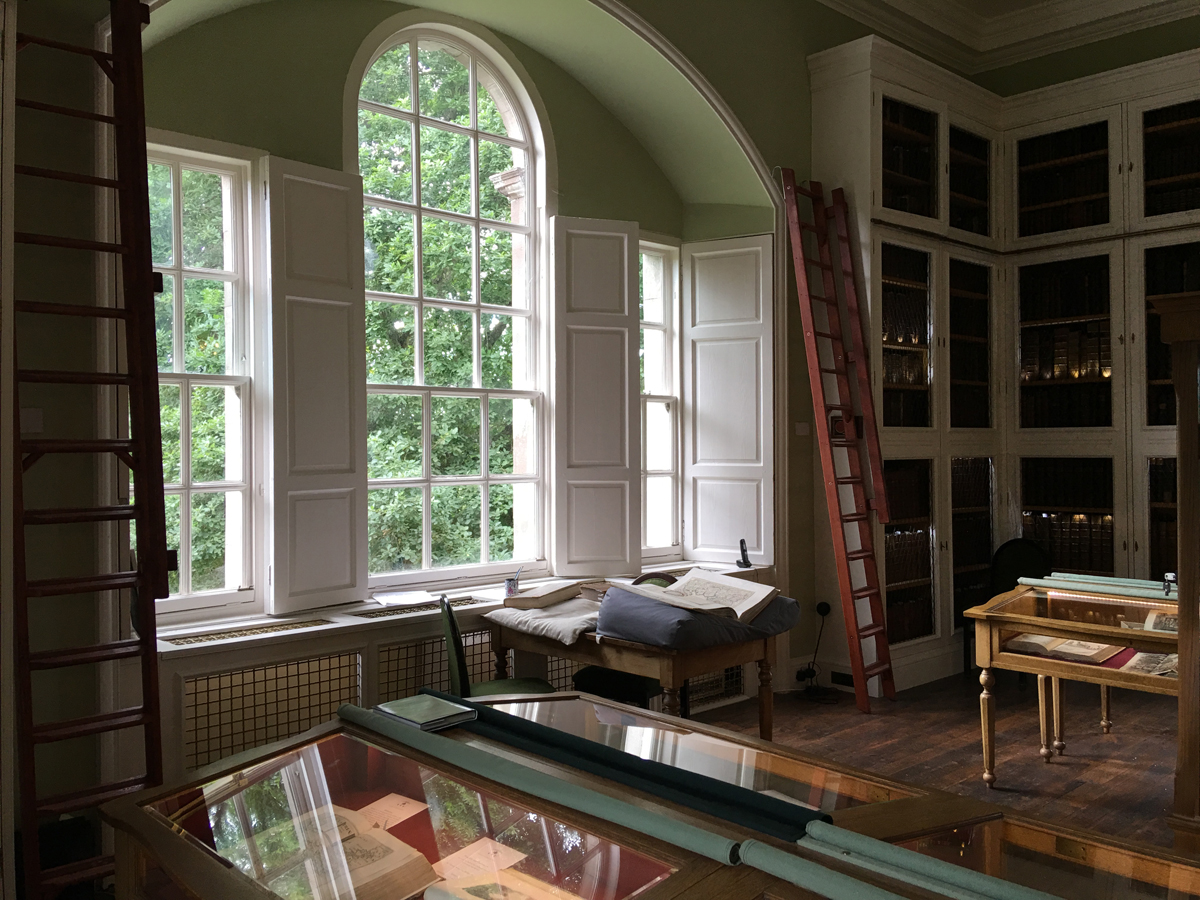
Before long the brown sign for Innerpeffray Library sent me down a potholed track. A turf path though trees, a red squirrel bouncing ahead of me, led me past ancient yews surrounding a tiny chapel where a rash of goose-bumps swept me from head to toe. Around another corner stood the Library.

‘Hello! You took your time!’ said my precocious afflatus.

Beautiful books and friendly faces greeted me. A lovely volunteer explained the Roman origins of the site and the library’s history. I took a sharp intake of breath: 1680, a date central to my next novel. I had been looking for somewhere to ‘place’ the female protagonist. Even if Mrs Muse hadn’t been elbowing me in the ribs, I’d have known – this was it!

The weird coincidences continued: the gentleman giving me a tour of the reading room originally came from the Roseland. That might account for his choice of pages in Camden’s ‘Britannica’. But his finger, pointing straight at Pendennis, the castle at the core of my books? No. THAT was extraordinary. There was more.

The exhibition in the display cases was on ‘Emigration’. A member of the Library had researched and highlighted a name amongst the many hundreds in the borrowers’ registers.  Haxton. Ours is not a common surname anywhere so, of all the names in Perthshire, the odds of that had to be pretty long.

I was still shaking my head in disbelief when a charming couple came in. We were introduced. Roman re-enactors, they live about 500 yards from our new address. When they shared an experience that Mrs Muse began applauding with gusto, I beat a retreat on ‘overload’!

Deliberately taking a different road back to the A9, I found myself approaching the junction that I’d taken so warily almost exactly two hours earlier, but from the opposite direction.

There, sweeping across the carriageway ahead and disappearing into the trees, were four police motorcyclists. The same ones? I’ve no idea.

All I could hear was Mrs Muse yelling, ‘They aren’t police riders! They’re the ghosts of Romans, horsemen, and they continually ride the same route on one day every hundred years. They’ve just updated their steeds …’

I don’t care where she’s been, but Mrs Muse is definitely back!


SISTER SCRIBES: KITTY WILSON ON HOW ROMANCE IS HOPE

Back in November I wrote a post here about Why I Love Romance as a genre. I explained that I had inadvertently written an essay on this subject and that first post covered how I believe romance is universal and utterly relatable, especially romantic comedy, my own specific sub-genre.

Today I wanted to return to that theme and talk about romance novels giving us hope in an often bleak and daunting world. I truly believe this – that romance novels help us have hope in life, the absolute certainty of a happy ending is sometimes exactly what you need to escape real life, whether it be dreadful news or just the day to day monotony.

Whilst trawling the internet a while ago I came across a tweet from a writer, Angela James, asking people to share their romance positive moments. The response was overwhelming, hope was right up at the top of that list and I have picked a couple as illustrations as they say it so much better than I could.

‘I found Romance after my brother commited suicide. It was a very dark and hopeless time, but Romance taught me that hope can rise again even after the darkest of moments and love, in all its forms, can be found if you just open yourself up to it.’

‘I began reading romance novels after my first miscarriage. I believe they re-wired my brain and helped me remember what optimism felt like.’

‘I started reading romance novels while was undergoing cancer treatment. I needed positive, escapist stories that promised a HEA.’

Now I’m not saying that romance is a cure-all, of course it isn’t. But romance novels are often easy and quick to read thus providing escape for an hour or two. They can’t rid you of the burdens that life brings, but being lost in the pages of a novel can give you a brief pause from them. I fell in love with romance when I became poorly at the age of thirteen. My friends were ringing me and asking if I was dying (I wasn’t but they were a dramatic bunch) and all I knew was that my body wasn’t behaving as it should. If I hadn’t had romance novels to read, to lose myself in, I think I would have struggled to cope.

We all know that life is not a romance but these books do give us the thrill of living vicariously, of confronting challenges and winning, of reading about someone’s longing turning into reality. To be fair, that’s true of reading in general but with romance you get the added ahhh factor, the satisfaction of a romance played out, of willing the hero and heroine on without any of the risk or leaving the comfort of your own home. I can be sunbathing on a tropical island or dancing the cha-cha whilst in reality I’m wrapped in a blanket and drinking a cup of tea, ignoring the stuff that I don’t want to have to deal with at that minute.

Happy-Ever-Afters are a reminder that not everything in life is bleak, that there’s the possibility of dreams coming true, that life contains so much positivity. Building a future with someone you love – the pinnacle of Romance – is forward-facing, optimistic, both the essence of hope and an act of hope. Romance Novels are the reassuring and toasty comfort blanket of the fiction world and I love them.

Edit – I wrote this well before Covid-19 was dominating the globe and considered pulling it, but I stand by the fact that in an ever-turbulent world the predictability of a happy-ever-after is reassuring so I’m off to hibernate with my kindle. Keep safe everyone,

Much love, Kitty x