Tell us about In Safe Hands.
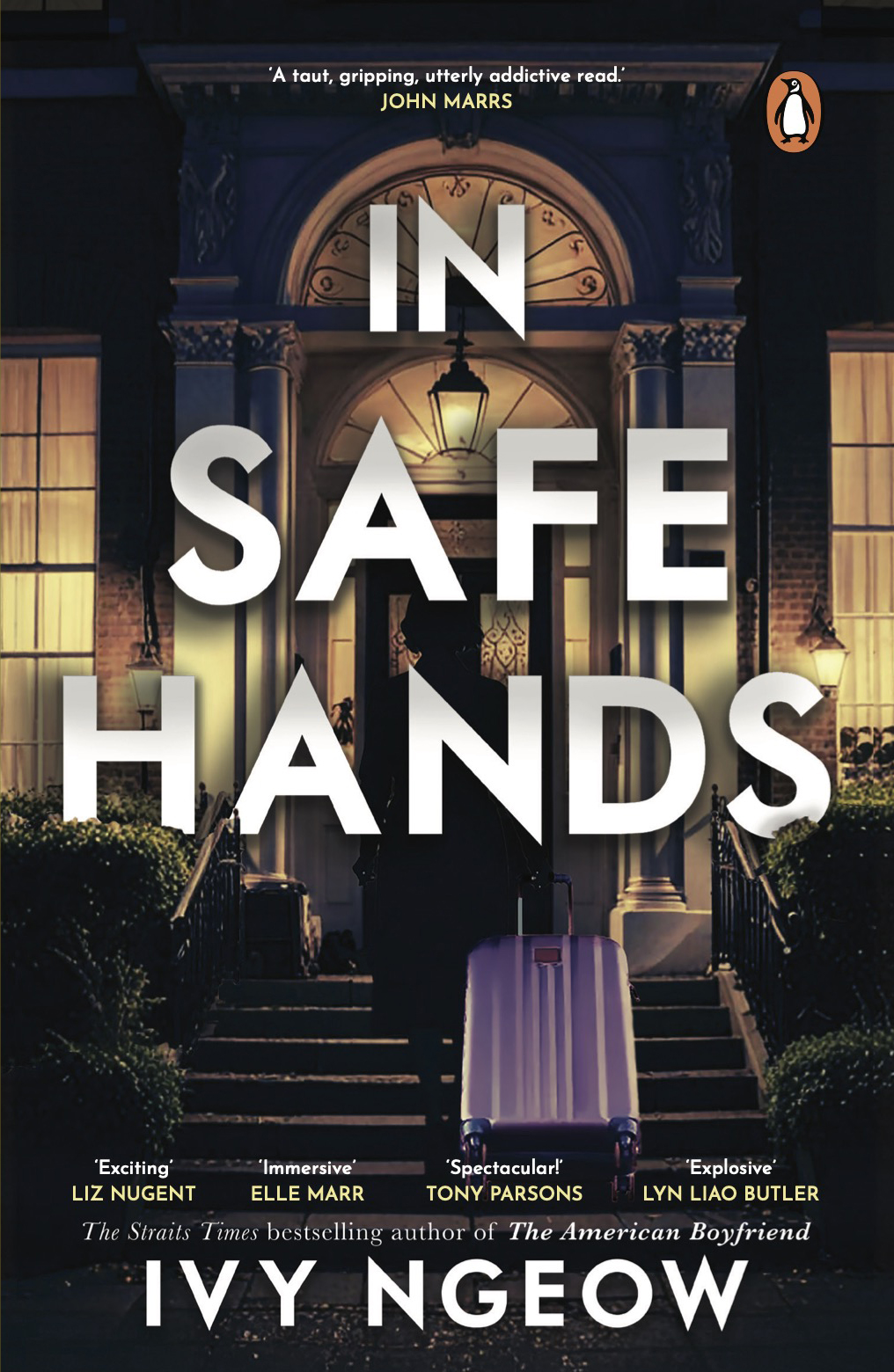
In Safe Hands is a psychological thriller set in London and Singapore, about a once successful but now penniless woman who seeks help from her elderly, wealthy father but finds that her role has been replaced by an attractive and efficient caregiver.
Where does your inspiration come from?
For me, inspiration comes from reading, theatre, sightseeing and walking, travel, TV and movies. I very rarely take inspiration from real people as I want to create settings and characters that are larger than life. Fiction is about stretching the boundaries of our imagination. For In Safe Hands, I was inspired by the class struggle and status consciousness in both Singapore and London, two parallel cities absorbed with economic and commercial growth which made me want to write about the have and have-not characters.
What does it feel like to be published by Penguin Random House?
Like most authors, I grew up on Penguin classics. I used to admire the plain orange spines, and wonder how I would ever write a book that appears on the shelf with the Penguin logo. When I received an offer 9 months after submission for The American Boyfriend, I thought it had to be a scam. I didn’t even reply for a week. After investigating the email, I was grateful that I was going to be not just an author, but a Penguin author.
Can you describe the moment you signed your book deal?
The moment I signed my book deal, I felt excited and light-headed, Prosecco-filled and buzzing. This was swiftly followed by a heavy responsibility, and also that I was an amateur and not good enough. Although in theory every author feels a debilitating sense of anxiety and inferiority, I felt the pressure of no longer someone who was just messing about, experimenting with writing, with sporadic success. Now I was a “real” writer and there were consequences, which were a sense of professional duty to perform, the urge to gain readers from all over the world, while developing my author brand, and finally the responsibility in delivering a top quality product to the world.
Tell us about your writing journey.
My writing journey actually began quite early, even though I only published my debut novel in my late 40s. I was writing short stories throughout my childhood for fun. Some received national commendation. I had always been interested in competitions, in case I won something. A real breakthrough came when one of my short stories was broadcast on the BBC World Service. I was actually even paid for it. It was the first time I had been paid for my writing. Gradually I entered more competitions and eventually won two big first prize competitions.
Encouraged by my initial success, I signed up for an MA in Writing. I began writing my first novel then, which won a literary prize in Hong Kong. After I started writing novels, I was less interested in writing short stories, which I saw as something you do in between novels, like a side dish or a snack. I really enjoy investing time and energy into novel writing, which I feel is all-consuming and more like a satisfying, seriously rich meal.
In Safe Hands is your sixth book. Does it get easier?
Yes and no. They’re like children. The problems change and get bigger. Before, they just come out, exist and you make sure they don’t die. Then, when you have more books, you have to look after the whole family, your brand identity, your own development, the commercialisation of your writing, your publishing strategy and plan. There is no more hodgepodge or random scribblings, unless they are just for fun. The marketing and promo is the least fun bit of being an author, yet a significantly and disproportionately large part of publishing today, to the detriment of the fun bit: just writing. Everytime I make a reel, I know I’m not writing.
Which book is your favourite?
In Safe Hands is my favourite book. I say this not just because it is my latest book. I have made meteoric improvements since my debut 8 years ago. I exceed my own expectations with each book. I wrote better and better books. With each book, I tackle a little weakness or strength learned from previous books. Had I given up, which of course, I have considered doing many times, I would never have realised my potential to grow as a creative thinker and writer.
What is your writing routine?
I don’t have a writing routine. Being a full-time architect and mum of two, I just write whenever I can. If I have one hour while waiting for my daughter at ballet, then I’ll write for one hour. If I have 15 minutes in between appointments, then I will write for 15 minutes. I don’t schedule any of it or get stressed if the words don’t come, because I feel that eventually when you get those minutes or an hour, the words will come. If it’s a story, then the story will be told sooner or later.
Are you a plotter or a panster?
I’m definitely a plotter, as I had made the mistake of spending 12 years writing my first novel due to not having any plot. I would just make things up as I felt like, until I got to the end. This only cost me many more years of rewrites. Now I can fill an A3 page with a diagram of my plot, and a google sheet with my chapter plan. It gives me a sense of peace just staring at these diagrams or Google sheets. I don’t mind if I have to spend a bit more time on the plotting. I see them as just as valid as plans for a building, or instructions to construct an object.
What writers and books do you love?
I enjoy character-driven plots. I read Liz Nugent, Elle Marr, Tony Parsons, Emily Barr, Shari Lapena, Lisa Jewell and Andrea Mara. I also enjoy literary fiction. Books which have influenced me include Penguin Classics. For contemporary book club fiction, I enjoy JM Coetzee, John Lanchester and Rebecca Kuang. An automatic read for me would be David Szalay. I have already ordered his Booker winner, Flesh. I love anything he’s written.