Pride and Prejudice at Jermyn Street Theatre pre-view by Milly Adams


21 characters, 2 actors and 1 of the most romantic stories of all time…

This looks pretty good, and I’m trying to carve out time to see it, and thought our Frost readers should be made aware that hot on the heels of a highly successful 2016 tour, this richly praised retelling of the nation’s favourite novel comes to London in the run-up to Christmas. Pride and Prejudice is a must for all Austen fans and those looking for a fresh and surprising new piece of theatre.

Over 200 years after it was first published, Joannah Tincey’s adaptation brings Pride and Prejudice to life with just two actors. Using nothing but Austen’s text and their own ingenuity the actors illuminate Austen’s words in a fresh and relevant way for the modern viewer.

Joannah Tincey says, I wanted to create an adaptation where the characters talk to the audience in the same way that Austen talks to her readers. By addressing the audience directly and allowing the characters to speak for themselves, we are bringing Jane Austen’s unique and witty writing style to life in a truly theatrical context.

The full gamut of Austen’s 21 characters and locations, from the Meryton Assembly to the grounds of Pemberley, from Mrs Bennet’s nerves to Mr Wickham’s misdeeds all come to life in this inventive production. And, of course, there are Darcy and Lizzy, who move from instant dislike to something altogether more affectionate.

Fun, fast and, most importantly, romantic, this production sparkles with Austen’s wit and style. Pride and Prejudice offers a brand new interpretation of one of literature’s greatest love stories and is the perfect alternative to the traditional Christmas pantomime.

Sounds good, methinks.

Pride and Prejudice, a Richard Darbourne Ltd, in association with Jermyn Street Theatre, presents The Two Bit Classics production

Wednesday 30th November – Wednesday 21st December 2016 Tuesday-Friday, 7.30pm
Saturday-Sunday, 3.30pm and 7.30pm
Additional performances 8th and 15th December, 3.30pm

2 and a half hours (including an interval) @TwoBitClassics, @jstheatre, #PrideAndPrejudice


Jacques by Tanya Ravenswater Reviewed by Jan Speedie


pic-1-jacquesTanya Ravenswater has produced a simple but unique story of Jacques Lafitte’s life and the relationships he forms along the way.

Jacques Lafitte is only 11 when his life changes forever. Following the death of his parents Jacques’ guardian, Oliver Clark moves him to Chester to live with his family. Life with the Clark family is very different from his life in Paris with his loving parents. Jacques forms a close relationship with Rebecca Clark who helps him to accept his new surroundings. As the years pass Jacques realises he has fallen in love with Rebecca and he must decide if she feels the same – the outcome could affect the whole family.

Tanya’s story centres round young Jacques Lafitte as he copes with his new life, the suicide of his closest friend while he tries to find his own stable and loving world.

Tanya Ravenswater was born in County Down, Northern Ireland. After graduating from St Andrews University with a degree in Modern Languages she followed a career in nursing, bereavement support and counselling education. Tanya writes for children and adults and has published a collection of short stories for women and has been short listed and published in the Cheshire Prize anthologies. She won the Cheshire Prize for Literature in 2014-15 for her children’s poem ‘Badger’.


Published by Twenty7 2016 pb £7.99


A Crime Round Up by Margaret Graham


I haven’t been out hunting down criminals but something rather more restful – choosing a few crime books I have enjoyed, and I feel might help you through the autumnal evenings.


pic-1-murder pic-2-are-you-watching-me


A Good Month for Murder by Del Quentin Wilber


This is a real life cop book, praised as writers like Lee Child, and he should know. Peter James also joined the gang, and called it a stunner. Well, is it? Yep, I thought so. It’s a moment in time in a homicide unit, full of detail, some – well a lot of darkness as the team of detectives carry out their almost impossible job, one that demands not only their expertise, but their duty to the dead. Thought provoking. I don’t know how they do it and remain humane.


A Good Month for Murder. Pub. Pan Macmillan hb. £16.99


Are You Watching Me   by Sinead Crowley


This is a creepy, but cracking novel which was short listed for Crime novel of the year at the 2015 Irish Book Awards. Liz Cafferty has been rescued from her past by the owner of a drop-in centre for older men and she soon finds herself as the face of the charity, and the less than willing darling of the Dublin media. A murder occurs, Liz receives notes… Sergeant Claire Boyle is stumped. With no leads how can she protect Liz?


Read and find out.


Are You Watching Me pub. Quercus pb £7.99


Keep you Close by Lucie Whitehouse – author of Richard and Judy Summer Bookclub pick Before We Meet


Marianne Glass falls to her death, accidentally, or so everyone thinks. But not her closest friend, Rowan, who has connections with the family, or once had. This is another creepie, and cleverly plotted psychological thriller.


I liked this. It kept me turning the pages. Clever, with a great ending.


Keep you Close by Lucie Whitehouse. Pub Bloomsbury HB £12.99 ebook £10.99


Tall Oaks by Chris Whitaker. Reviewed by Margaret Graham


pic-1-tall-oaks

As an author I am so used to starting a book and recognising the signals almost immediately of who dun it, or at least a sense of who, why what.


Not with Tall Oaks. The first chapter drew me straight in, without me having a clue what was going on, not really. Yes, it was a recording of an event, and the man listening was reluctant to continue listening at times. But who was he, what, why?


Was it a ghost story? Was he a psychiatrist? Was he a copper? The tension built, and I totally colluded with the author, trusting in him and his writing, and the world he was creating.


Tall Oaks is a blast. For a debut novel it is extraordinarily self-confident, almost swaggeringly so as it strides across the pages, a scarf drifting in the wind behind it, gathering characters, events, emotions, action, and storming to a resolution.


It is by turns funny, dark, and ultimately comes close to ripping your heart out as Whitaker exposes the secrets of Tall Oaks, California. Of course the media descends once it sniffs out the story of a three year old who has gone missing, but without an end game, they leave. Together the young lonely distraught mother and Jim the local police chief are left to try to find the boy. There are other living breathing characters, some missing, some not, some suspicious, some…


Nope, read it. Clever, original and not really fair because this is a new writer, and it all seems so effortless. But then we all know it isn’t. This has been thought through, and then again, and the idea pushed further until originality came to the fore. The writing is tight, the plotting supreme.   Bravo young Chris Whitaker. Get going on the next one please.


Tall Oaks pub Twenty7. £7.99 ebook £4.99

Gransthread: Roots, and how many of us revisit them? By Margaret Graham

It’s strange to return to our ‘roots’. This weekend we took a train to Newcastle, which is where my mum, a Geordie, had one of the few pleasurable experiences in her young life. Her dad took her to see Peter Pan in between the wars, and a short while later, he died.


Mum was born in 1914 in the pit village of Washington, which was then in County Durham. Her Da wasn’t a pitman but he and his brother ran a couple of shops. Mum’s was in Brady Square, which still exists in Washington Station, though as a house. Her mum died when mum was two. My grandma, Annie, was off her head with sepsis and took poison. Mum’s dad was at war, Mum’s brother, my uncle Stan, was seven.


We think times are hard now, but you ain’t seen nothing, if you weren’t living then. The depression was in high gear, war trauma was rife, jobs were scarce. My grandfather killed himself when mum was eleven, soon after he had taken his children to Peter Pan. Post Traumatic Stress, which is one of the reasons I started the charity Words for the Wounded.


I’m not really sure of sections of my mother’s life, but I do know she ran amuck as an orphan until a cousin came to Washington from Gosforth, looking for her. This cousin took mum, now 14, to live with her, sending her to school. Into a class of 7 year olds little Annie Newsome (as she was called) went, to learn to read and write. In time Mum, also an Annie, trained as a nurse.


She worked at the Royal Victoria Hospital as the 2nd World War broke out, and is mentioned in Brenda McBryde’s book, A Nurse’s War. Mum became a military nurse, travelled to India to look after the troops in the Burma campaign, meeting my dad, an RAF pilot, on the convoy going over.


As children my sisters and I used to go to Uncle Stan’s shop for our school holidays. It was the shop where my grandfather died. It is now a house and we were shown round by the current owner last year. My mother would have been sitting up on a cloud roaring with laughter, because he told us the shop was bought on my uncle’s death by a Madam, who ran a knocking shop, until closed down by the police. She spent a bit of time in clink and featured in a national newspaper. Tall story or the truth? Who knows.


Anyway, now I go up north as often as I can. It has changed beyond measure. The pits are gone, the slag heaps too. It is steadily regenerating. Though it has changed it is still ‘home’ and to arrive is a relief, to leave is not. It is an area that informed my writing. Indeed, my first novel After the Storm was based on events in mum’s life. My writing gave my mum immense pleasure. She liked to paint, my father wrote poetry. Perhaps between them they gave me a talent, but it was the north east which gave me inspiration, and continues to do so.


www.wordsforthewounded.co.uk

www.margaret-graham.com


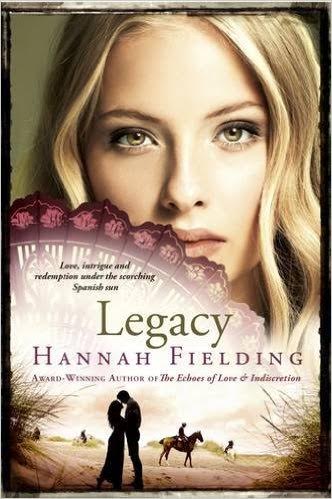
Legacy by Hannah Fielding Review by Contributing Editor & author Margaret Graham

legacy-by-hannah-fielding-reviewAward winning romance novelist, Hannah Fielding, has written the third book in her Andalucian Nights Trilogy and her readers will be relieved and excited to know that this epic, Legacy, is written with all the verve of her previous novels.


I say epic because it has a sweeping plot and setting. The author’s ability to sustain the story line and amalgamate the two main characters is impressive. Her setting is active. By this I mean that her descriptions don’t just sit like a sack of potatoes, but are interwoven into an action so they don’t stop the pace. She doesn’t however ignore the need for a pause to empathise with the setting, or for the reader to process a scene. This is something I try to encourage in those I mentor: pace is important, but so is pause.


She also ‘holds back’. This means that the reader has to wait for facts, secrets, feelings to be revealed, and this is an excellent use of tension. Fielding does this extremely well.


So, the plot in a nutshell: Luna Ward, a beautiful blonde journalist based in New York is commissioned to investigate – undercover –  the head of an  alternative health clinic in Spain. As one might expect she finds the man she has been asked to expose irresistible but  is he good, or bad? And what does her deception make her?


Secrets and lies threaten to destroy their lives, not to mention their love. So…?


Oh no, read it and see.


Hannah Fielding’s novel The Echoes of Love won first place in the Romance category at the Independent Publisher Book Award in New York in 2014, and in 2015 Indiscretion won 2015 USA Best Book Award for Romantic Fiction, and in April 2016  Gold Medal and Masquerade won silver medal for romance at the IPBA Benjamin Franklin Awards.


Frost Magazine is really excited that Hannah will be telling our readers of A Day in her Life very soon. Make sure you keep an eye out.


Legacy by Hannah Fielding  is published by London Wall Publishing.  £7.99


Mustard Gas – a life saver? By Margaret Graham

Out of darkness came hope, or so explained Justin Stebbing, Professor of Oncology, Imperial college, London at the Pink Ribbon conference on 17th September. 


Gerard Dugdill organized the Pink Ribbon’s 3rd breast cancer forum, in association with the Royal Society of Medicine, 1 Wimpole Street, London W1G and Frost Magazine was lucky enough to be there on the morning of the Patients’ Day.


A series of speakers spoke to an audience of patients and their relatives about many things, not quite sea and ships and sailing wax, cabbages and kings, but surgery,  and nursing support. Frost’s own Dr Kathleen Thompson talked about the things she had learned during her journey through cancer, and had excellent ideas for navigating the system.  It is a journey so amusingly but poignantly described in her award winning book From Both Ends of the Stethoscope. A book which is selling strongly internationally.


Then it was the turn of a plastic surgeon, and finally Justin Stebbing who kicked off his talk about what were the beginnings of cancer treatment, and where it appeared to be going now, as research speeds at a gallop into the future. He explained that immunotherapy which is being developed looks as though it could be the way to tackle cancer in the future. As he said, this is a mile ahead, but research is already a few yards into the journey.


But back to mustard gas. Justin told us how Dr Stewart Francis Alexander made the link from mustard gas to cancer treatment. He  noticed that many of those caught in a mustard gas attack had, after several days, a surprisingly low number of immune cells in their blood – cells that, if mutated, can go on to develop into leukaemia and lymphoma.


Alexander hypothesised that if mustard gas could destroy normal white blood cells, it seemed likely that it could also destroy cancerous ones – thence the start of chemotherapy.


This was a hugely valuable day, one ultimately which gave hope that we are on the way in some years hence to non invasive treatment, and perhaps protection.


From Both Ends of the Stethoscope: https://www.amazon.co.uk/Both-Ends-Stethoscope-Getting-cancer-ebook/dp/B01A7DM42Q


Screen Time has Escalated by 42%

Does this bother you? It certainly does me because this is leisure time.

New research reveals our screen-time has increased by a staggering 42 per cent over the past five years, with 6.5 hours of leisure time being spent each day in front of digital screens, excluding work computer usage.

What can be done? Well, if you wear contact lenses, (I don’t) friends say this sounds like a good idea.

screen-time-has-escalated-by-42

Bausch + Lomb are launching the first innovation in reusable contact lenses in almost a decade to help our eyes embraceand keep up with digital technology – plus a new lens for presbyopia too. This means that there hasn’t been an innovation in reusable lenses since the iPhone was launched – and the evidence shows. Whilst three quarters of us do not know how to spot the signs of digital eye strain (also known as Computer Vision Syndrome) which include dry eyes, blurred vision, tired eyes and headaches, 60-90 per cent of office workers using computer screens suffer from some form of ‘computer vision syndrome’. What’s more, up to 20 per cent of Britons admit they are “addicted” to their digital devices.

These lenses retain moisture for up to 16 hours, providing high levels of surface wettability on the lens, and preventing dehydration. I’m told by friends who wear contact lenses that this is a problem for them. They also supply exceptional levels of oxygen transmission, provide consistent comfort throughout the day with a tapered edge design. All of this reduces digital eye strain throughout the day.

For more details: www.digitaleye-d.co.uk