Spandau Baddie: Martin Kemp Meets Vicky Edwards

Martin Kemp tells Vicky Edwards why his musical theatre debut is going with a bang-bang…
'

Photo credit: Alastair Muir

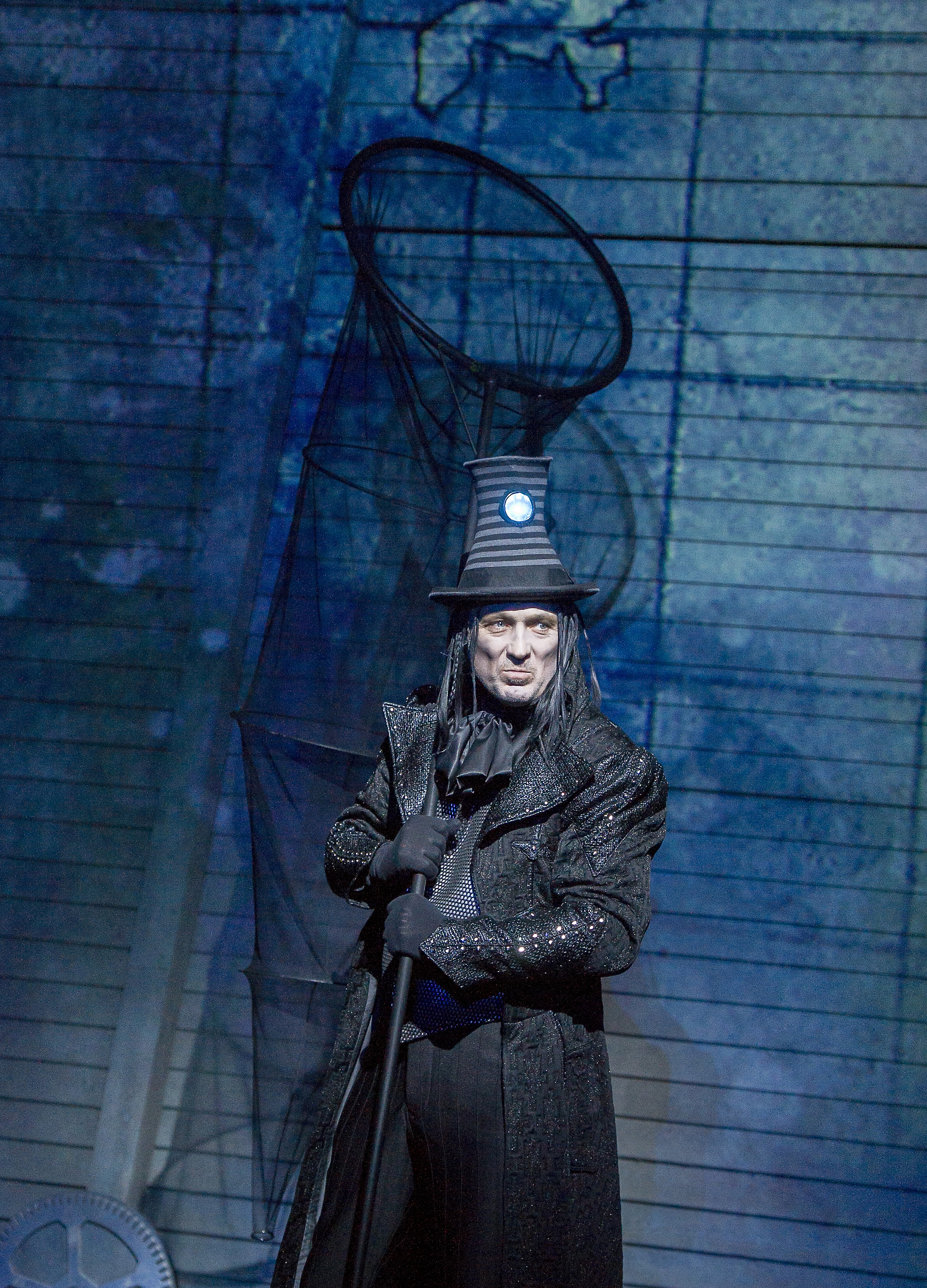
From gangster Reggie Kray to evil control freak Steve Owen in EastEnders, Martin Kemp is extremely good at being bad. Currently on tour in Chitty Chitty Bang Bang playing the Childcatcher, arguably one of the most iconic villains of all time, Martin is drawing on his previous roles for inspiration, but admits that there’s unchartered territory to explore when it comes to the character that regularly tops the polls of movie monsters.
“The Childcatcher is an exaggerated version of everything I have ever done before, but it comes from a completely different angle,” explained Martin. “He’s a step away from reality; all the characters are really, especially in the second half when we go to Vulgaria.
“In the first half I play a character called the Junk Man, but in the second half that kind of Alice in Wonderland thing happens and the Junk Man becomes the Childcatcher. Robert Helpmann did an amazing job [in the film], but my physicality is not the same as his; I don’t have his ballet background, so instead I try to bring a bit more horror to the role.”
Judging from the booing that fills the theatre before he has even set foot on the stage, he’s clearly doing that very effectively.
“Kids are scared of the name: Childcatcher. When the Baron says “Call for the Childcatcher!” I can feel the tension in the theatre and then I hear the boos,” he laughed, adding, “But that’s part of the whole experience. If you haven’t laughed, cried and been scared then you haven’t seen a good show. You need to be taken to all those places.”
And with cheers at the curtain call almost taking the roof off the theatre, it seems that it’s a journey that audiences of all ages are delighted to undertake. A co-production between Music & Lyrics Limited and West Yorkshire Playhouse, this brand spanking new reimagining of the much-loved Sherman Brothers musical is winning critical acclaim as well as standing ovations.
“Ten years ago I saw the show in London and the main thing I remembered about it afterwards was the car,” said Martin. “But now it’s very much about the story. It amazes me, but every night I walk out of stage door and people are there saying how much they loved the whole show. From old people who saw the movie on their first date to kids meeting Chitty for the very first time, the demographic is extraordinary. Yes, it’s changed from the book, and then again from the film and again from the original stage musical, but it really works. We’re sending people home with big smiles on their faces.”
As for his fellow cast members, mention them and it is Martin with a big smile on his face. “It’s a great cast,” he enthused. “I’ve worked with Michelle [Collins] before and it’s lovely to work with her again, but they are all brilliant performers.” And so they are. Funny men Jason Manford as Caractacus Potts and Phill Jupitus as Lord Scrumptious and Baron Bomburst are joined by Martin and Michelle, as well as Andy Hockley of Phantom of the Opera fame as Grandpa Potts, and West End leading lady Amy Griffiths as Truly Scrumptious. Add to that a world class company of singers and dancers and you have a show that is dazzling, star-studded and that absolutely lives up to the ‘fantasmagorical’ praise.
But while the story of Chitty might have been knocking around for a good while, musical theatre is a new challenge for Martin.
“One reason I am here is that I have never done a musical before and I thought this might be a nice way to dip my toe in. I love trying new things and I love working with new people.”
That happy-go-lucky, have-a-go attitude wasn’t always there, however. In fact, as a child he confesses that he struggled with crippling shyness.
“I’ve been doing this a while now but at the age of eight I was incredibly shy, so my mum sent me to Anna Scher’s drama workshops,” said Martin, who knows first-hand what an advantage drama classes can be to children.
“What drama clubs give you is a small amount of this magic dust called charisma. I always say that I owe everything to Anna Scher because she formed my personality as a kid.”
Pointing out that whether you become an actor or join a band or you just use that acquired confidence to get through interviews when you’re 16, Martin is certain that drama clubs are a fantastic way of developing both character and life skills.
As for children watching live theatre, absorbing stories close up rather than on a screen, Martin loves the way they get totally involved.
“Adults watch, but kids believe and become part of the world they see unfolding; they just dive in,” he nodded.
“For Chitty we recently did what is called a ‘Relaxed Performance’ for children with disabilities and conditions like Autism. The show was adapted around the audience’s needs and it was a wonderful thing to be part of.”
A member of one of the most popular bands of all time, star of movies, TV and now a musical, Martin certainly can’t complain of always doing the same old same old.
“I have always changed it up a bit and I like never knowing what’s around the corner,” he laughed, although actually this time he does know what is coming next.
“I have just finished a year on tour with Spandau which was wonderful, but it’s this great big machine that needs five artic trucks and a 100-strong crew. When you play huge arenas the size of Wembley you know that to people at the back you’re just a speck of dust in the distance and that you’ll never get to meet those people. So in May I am doing the sort of antidote to not meeting people with a show that’s going to tour called An Audience with Martin Kemp. I’ll be travelling around England chatting about my life and career and taking questions from the audience. Yeah, it’s going to be different and fun,” he grinned.
With such a busy professional life, relaxation, he says, comes in the form of painting.“That’s my down time. Sometimes it shuts me off from the world and I lose myself completely.” Asked what he paints and the smile that stole my sixteen-year-old heart lights up his face again. “I paint rock ‘n’ roll,” he says with a chuckle.
Super-talented, funny, warm and with rock ‘n’ roll artistic flair to boot, however brilliantly nasty he is as the Childcatcher, in real life Martin Kemp is a total sweetie.
Vicky Edwards


Get Stunning Results with the Revolutionary ‘A-Lift Facial’ by Nouveau Skin Therapy

A Lift 2
A firm, facial favourite with Celebrities and Beauty Therapists alike, Nouveau Skin Therapy focus on bringing the most effective, natural and scientific developments in anti-ageing skin rejuvenation to consumers and salons across the UK. They’re committed to cater for a wide range of skin goals and with their revolutionary £30 A-Lift Facial, you’ll be stunned by the A List results.

What sets the A-Lift Facial a bar above regular facials is that it pretty much gives you the results of a surgical procedure without the need for any needles or scalpels. Yes, it is completely non-evasive and such results are achieved by the use of machines designed for sports injuries to increase ATP production in the cells. In short, this promotes skin regeneration, improves muscle tone and stimulates the skin to act younger by using a series of nano-currents. This also produces an increase of collagen. No wonder why it’s a firm favourite with stars such as Sadie Frost, Ellie Golding and Lisa Snowden.

B&ACheekAL

We were lucky enough to try out the A-Lift facial and even though The Anti-Ageing effect is not personally what I’m after at present, it was still the best facial I have ever had. My skin was instantly brighter, tighter and rejuvenated. Perfect for this brisk winter weather, we would definitely recommend it as the ideal skin therapy. One of the best things was that I didn’t have a single breakout after, nor was there any sign of skin redness. The facial lasts up to 50 minutes and includes lymphatic drainage which effectively rids your skin of toxins. Perfect if you’re in need of an overall boost and some down time. Priced at £30 this facial really is a no brainer and we would recommend it as the perfect lunch-time treat, pre-party pick-me-up or Mother’s Day Gift.

IMG_6529

You can look up salons nearest to you where they offer this treatment here;

To find out more visit www.nouveaubeautygroup.com

A gentleman and a scholar: Vicky Edwards Meets Stephen Boxer

About to play the great author C.S. Lewis, Stephen Boxer takes a break from rehearsals to talk to Vicky Edwards about touring, making an ass of himself and his own connection with Narnia’s creator
Having played everything from soap opera to Shakespeare, as well as appearing in movies such as The Iron Lady, Stephen Boxer is packing his suitcase and hitting the road with a new national tour of Shadowlands. Arguably one of the best plays ever written, Stephen plays Narnia creator C.S. Lewis and, he reckons, the story’s central themes of grief, belief and love will resonate with audiences.
“It’s a beautifully structured play and it’s very poignant, so we can Stephen Boxerall relate to it. But it is also very entertaining; very witty with some real belly laughs,” he said.
Having cleaned up on the awards circuit (the subsequent film version also collected gongs) William Nicholson’s play charts the developing relationship between Lewis, an Oxford don and author of The Chronicles of Narnia and The Screwtape Letters, and feisty American poet Joy Davidman. Finding his peaceful life with his brother Warnie disrupted by the outspoken Davidman, whose uninhibited behaviour is at complete odds with the atmosphere and rigid sensibilities of the male-dominated university, Lewis and Joy show each other new ways of viewing the world. But when Joy is diagnosed with cancer Lewis’s long-held Christian faith becomes perilously fragile.
But, Stephen pointed out, Lewis’s struggle with his faith resulted in the beautiful book A Grief Observed, an extraordinary collection of the author’s reflections about bereavement.
“It is a kind of bible for both religious and non-religious people,” said Stephen. “It rises above religion and belief and talks about how we deal with loss and how a theory of life is tested by reality.”
As for the relationship between Lewis and Davidman, Stephen explained that while there were some fundamental differences between their characters and life experiences, there was also a definite meeting of minds.
“Their intellectual acuity was an absolute meeting place for them both – they could both spar in the same intellectual boxing ring and they enjoyed that; they enjoyed the cut and thrust of intellectual debate. That’s how their relationship started,” said Stephen, adding:
“He was a classically repressed quite conservative thinking Englishman who lived a classic ivory tower life. Part of his emotional repression, I think, was that he was sort of cushioned by the Oxford life you could live as a don. She was an ex-communist Jewish American who told it how it was and shot from the hip. Yes, they were very different, but mentally they were perfectly matched.”
As for his own connection to C.S. Lewis, as a direct result of being an ex Oxford choir scholar and school boy (“I wasn’t an undergraduate but it was my academic home for eight years from 1960 – 1968”) he is in the position of knowing exactly where he was the night that the World lost two great men.
“I was at Magdalen college school, the school that was related to C.S. Lewis’s college. It was the evening of the twenty-second of November 1963 and I was walking back from chapel, in my gown and mortar board, having sung a service. An undergraduate stopped me, which in itself was quite unusual. He told me that President Kennedy had just been killed. It was the same night that less than a mile away C.S. Lewis died, so not only do I know where I was when President Kennedy was shot, but I also know where I was when C.S. Lewis died because I was right on his doorstep.”
Admitting that the insight into Oxford life has proved useful in preparing for the role, what appealed most to Stephen about the play?
“Firstly it’s a whacking great part – I’m never off the stage. In rehearsal I’m finding that a bit daunting,” he laughed.
“At the moment I’m at that stage of running before I can walk and falling over a lot, metaphorically, but that’s a necessary part of the process. Making an ass of yourself and feeling like a fool in rehearsals is a prerequisite.
“Another reason I wanted to do it was that I’ve just done a year of television. I’ve done some lovely stuff which I really enjoyed, but there’s no real rehearsal culture in television and I was dying to get back into the rehearsal room and that organic way of creating on the shop floor.”
Thoughtfully, he added: “And getting to know people, too. You develop very warm relationships in theatre and after a year I missed that.”
With the tour of Shadowlands he is certainly going to have plenty of time to bond with his fellow cast members. Not that life on the road bothers Stephen one jot.
“It’s a great way to catch up with friends, but touring is also a great way to see the country. I visit the galleries and museums and do the walks and whatever else there is to do or see. It’s part of the fun and I’ve seen the world that way. I love working and travelling at the same time.”
Playing opposite him is Amanda Ryan (The Forsyte Saga, Shameless) as Joy. “She was made to play the part,” said Stephen, who doesn’t look too far into the future when it comes to his own career.
“I don’t really plan and the things that come along always surprise me. I wasn’t expecting to play Titus Andronicus at the RSC for instance. It was a play I didn’t know but I loved doing it; it was intriguing, absorbing, and demanding. I think I’d like to play Lear when I’m about seventy,” he mused, before laughing and saying: “Not that long to go then!”
But for now this charming gentleman and scholar is delighting in Shadowlands. Go to see it and you will too.
Official website: www.shadowlandstour.com
Twitter: @shadowlandstour
Facebook: shadowlandsthetour


Jolly good show, chaps! Vicky Edwards meets actor Graham Seed

Vicky Edwards meets actor Graham Seed to talk about Rattigan, romance and how wearing a uniform might give his wife ideas…
With the tractors and traumas of Ambridge well and truly behind him (he played Nigel Pargetter in the radio soap The Archers for an incredible 27 years), award-winning actor and broadcaster Graham Seed continues to work extensively. Just starting out on a national tour, Graham plays Squadron Leader Swanson in Terence Rattigan’s Flare Path, directed by Justin Audibert.
“It’s going very well and we have a terrificGraham Seed as Squadron Leader Swanson and Daniel Fraser as Teddy Graham in the 2016 National tour of Flare Path credit Jack Ladenburg cast,” beamed Graham, a self-confessed Rattigan fan.
“As an actor I am really enjoying it because Rattigan writes such good characters; he just didn’t write bad parts. One of his best plays is The Deep Blue Sea and this has early elements of that. It’s rather delightful and I like the play enormously.”
Based on Rattigan’s own experiences as a tail gunner during World War II, the play is rooted in wartime Britain, where the life-and-death existence of the RAF bomber crews, and their wives and sweethearts who were on tenterhooks awaiting their return, created a permanent state of high anxiety. The story tells of former actress Patricia, the wife of RAF pilot Teddy. When Patricia’s ex‐lover and Hollywood idol Peter arrives out of the blue her emotions are thrown into turmoil and the survival of her marriage to Teddy becomes uncertain. As the conflict rages in the skies above, on terra firma feelings simmer, threatening to become every bit as explosive.
A romance with shades of Brief Encounter then? Graham nodded. “She has to decide what she’s going to do, but it does have humour, too. It’s a very evocative and powerful play.
“My character is quite funny and rather charming. He’s a frightfully good chap; full of that stiff upper lip phlegm.”
But in pitching his performance Graham has had to take care not to stray into parody. “If you did it wrong you’d be into Black Adder or Monty Python territory, which you don’t want at all.”
But it’s not just the good of the play that Graham is mindful about; he clearly has great respect for the real life pilots who carried out such dangerous missions.
“These boys were incredibly brave and they understated the danger always. The play is set against the backdrop of planes taking off and not coming back and at one point my character says: ‘we do owe these boys something.’ You can see why Churchill loved it. The Great War was so ghastly that it became romantic, but in the Second World War far more civilians were bombed.”
Mixing history with an intriguing story gives it broad appeal and the cast are delighted that Flare Path is attracting audiences of all ages.
“It’s definitely a play that is suitable for all the family and I do hope that lots of young people will come to see it,” said Graham, who admitted that these days he isn’t feeling as sprightly as he once was.
“I am suddenly feeling my age,” he confided. For years you’re the youngest in the company and now I’m suddenly the oldest – I’m about twenty years older than everyone else!”
But there’s something about this particular production that has had a rejuvenating effect on Graham. Botox? A bit of a nip-and-tuck? As it transpires nothing so drastic.
“I know it sounds slightly immature for a sixty-five-year-old man to say it, but it’s quite nice to put on an air force uniform. I look pretty chipper,” he teased, agreeing that any fella in a military uniform looks instantly dapper, even if they look like a bag of spanners. Not that Graham does, I hastily reassured him. Laughing off the unintended insult he said:
“It’s like evening dress – if you’re a woman and you suddenly look at your old man in evening dress you say ‘goodness he polishes up well!’ When my wife sees me in my RAF uniform I hope she thinks that there’s life in the old dog yet!”
Certainly on the work front he continues to have offers lined up and, although he is best remembered for The Archers, his CV is crammed with credible theatre, film and TV credits. “That’s because I’m so old,” he twinkled. “I’ve ducked and dived; I’m what they call a jobbing actor.”
As for life on tour, Graham doesn’t mind living out of a suitcase in the least.
“It’s rather romantic and like being with a family. For me, as an older member of the company, there’s a responsibility to make sure that everyone’s happy. But it’s a lovely way to see friends in other parts of the country and to visit wonderful theatres.”
With all the schlepping about he does for work, how does Graham relax?
“I find it very hard to relax,” he confessed. “I do What the Papers Say every other Sunday, so don’t get many Sunday’s off. You always worry about your next job and even at sixty-five I’m always worried that I’ll be found out. But I’m actually pretty content. Getting older makes you less ambitious; there are more important things, like your health. So now I am absolutely thrilled to play good supporting roles and to really enjoy them.”
Anxious that he doesn’t come across as “worthy” (he doesn’t), Graham believes that there is a duty to tour good plays around the country, especially to unsubsidised theatres.
Speaking of which, it was time for him to head off to transform himself into a fine young man in uniform for the evening performance.
“I’m revving up for chocks away,” he grinned, before adding: “It’s not a bad life.”
Indeed. And he’s a jolly good egg. A jolly good egg in a jolly good show. Go and see for yourself.
Official website: www.flarepaththetour.com
Twitter: @flarepathtour
Facebook: flarepaththetour

中国新的一年快乐 ( I hope this wishes everyone a happy Chinese New Year )

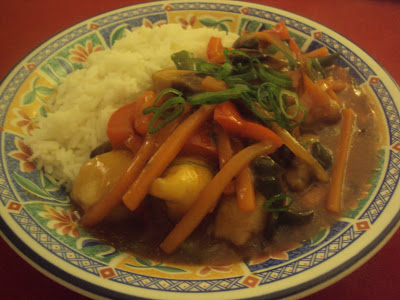
The next couple of weeks is a busy time in my kitchen, Pancake Day, Valentines, I have to cook soul food for Mardis Gras, a rocking Jambalaya, Buffalo Wings for when I watch the Super Bowl and most definitely celebrate the Chinese New Year. I hasten to add I am not American but they would kind of have this month’s events sewn in the bag if not for Chinese New Year. Now everyone has most likely had at one time in their life a Sweet and Sour or Cantonese Pork or Chicken from the local take away. You know the big deep fried doughy balls of slightly tough meat in a sharp Day-Glo orange sauce. It is about as close to being authentic Chinese as my mother is.

I can only hope to cap Sweet and Sour by giving you a version of a totally bastardised American Chinese dish. Again sweet, a little spicy and altogether created for the palates of mid-twentieth century America a dish called General Tso’s Chicken. The dish is named after General Tso Tsung-tang, a Qing dynasty general and statesman, however, any connection is very tenuous. The origins of the dishes invention are in the 1950’s influx of Chinese to the United States.

General Tso ChickenThe dish is reported to have been introduced to New York City in the early 1970s as an example of Hunan cooking though it is not typical of Hunanese cuisine, which is traditionally very spicy and rarely sweet. Fuchsia Dunlop, in the New York Times, identified the claim of a Taiwan-based chef Peng Chang-Kuei. Peng was the Nationalist government banquets’ chef and fled to Taiwan during the Chinese Civil War. In 1973, he moved to New York to open a restaurant and experimented and developed Hunanese-style cuisine adopting it for western tastes.

Other chefs claim that they created the dish or variations which include vegetables, meat other than chicken in a sweetened sauce. Later the chicken was deep fried before being added to the sauce, now almost every American Chinese restaurant has General Tso’s Chicken on the menu. Where the dish is cooked outside of the United States the dish is less sweet with more vinegar or rice wine vinegar and soy sauce in the ingredients. This is more to my taste and I have an admission I’m really rather partial to it, so here is my version.

General Tso’s Chicken      serves 4
As always a general note of caution
BE VERY CAREFUL WHEN FRYING IN HOT OIL.


1 Carrot, peeled and cut into fine strips

100 gr Button Mushrooms, wiped and quartered
1 Red Pepper, diced
A small bunch of Spring Onions, washed and sliced into 2 cm pieces
1 small Red Chilli, finely sliced
3 Cloves of Garlic, peeled and crushed
3 cm piece of Ginger, peeled and finely chopped
100 ml quality Chicken Stock
2 tablespoons of Oil
2 tablespoons Soft Brown Sugar
1 tablespoon Tomato Paste
2 tablespoon Sherry Vinegar
2 tablespoons Rice Wine or Dry Sherry
1 tablespoon Corn Flour
2 Cloves
A good pinch of Chinese Five Spice

for the fried chicken
2 skinned chicken breasts, washed and diced
2 egg whites
Juice of 1 lemon
50 gr Corn Flour
Sea Salt and Cayenne Pepper
2 pints Vegetable Oil

For the sauce heat the vegetable oil in a wok and stir-fry the carrots, mushrooms, garlic and ginger for two to three minutes then add the peppers. In a small pan, heat the chicken stock, vinegar, rice wine, sugar, cloves and Chinese five spice and bring to the boil. Simmer for twenty minutes then thicken with the corn flour mixed with a little water and the tomato puree. After another five minutes simmering, strain into the wok and set on a very low heat.

For the chicken, sieve the corn flour into a large bowl and add a generous amount of salt and cayenne pepper. In a separate bowl whisk the egg whites and lemon juice. Then dip the chicken pieces into the corn flour, the egg whites and back into the corn flour. In your wok or a large heavy bottom, pan heat the oil to 160°C / 320 F using a thermometer to check. If you do not have a thermometer have a few cubes of stale white bread to hand. Place a bread cube in the oil if it rises to the surface and cooks to a golden brown in a couple of minutes the oil is hot enough.

Fry the chicken in batches carefully lowering into the hot oil, for around six to eight minutes or until the batter is crisp and golden, turning from time to time with a large slotted spoon. When the chicken is cooked using the slotted spoon remove from the hot oil, drain on kitchen paper and place into the hot sauce. Add the Spring onions and simmer for a couple more minutes and then serve with steamed rice and garnish with a few extra, finely sliced spring onion tops.

Charles Dickens and The Star Chip Enterprise

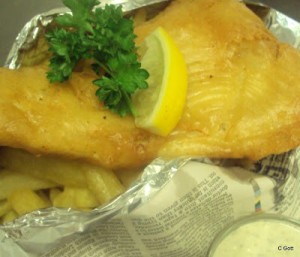
A few years ago was the two-hundredth anniversary of the birth of Charles Dickens, the Star Chip Enterprise is not, and here you may draw a breath of relief, his missing masterpiece and this is not an essay in literary history. However in 1859 Dickens published ‘ A Tale of Two Cities ‘ and included a typical rich description of ‘Husky chips of potatoes, fried with some reluctant drops of oil ’. This is the first acknowledged recorded use of the word chip used in reference to fried potatoes. In ‘ Oliver Twist ‘ he went on to mention fried fish warehouses. You can imagine the likes of Fagin and Dodger fighting over hot freshly fried fish and how tasty it would be.

Fish and ChipsFried fish quickly became a staple part of the lower class diet during the Industrial Revolution when the new steam trawlers could fish out in the Atlantic and bring back fresh fish from Iceland and Greenland. The increasing ease of travel with the vast railway network being developed would enable the efficient, fast delivery of fish across the country from the great coastal ports. The fish was fried in deep pots usually in rendered animal fat, such as lard, which has a high smoking point and is able to reach very hot temperatures.

The humble potato chip did not begin with Walter Raleigh bringing Queen Elizabeth the first potatoes from the new world.* They probably, dare we admit it, originated in France or more hopefully Belgium, clever people the Belgians, think Hercule Poirot he was Belgian. In the United Kingdom, chip shops became popular in the north of England and across the border in Scotland. Dundee City Council claims that “…in the 1870s, that glory of British gastronomy – the chip – was first sold by Belgian immigrant Edward De Gernier in the city’s Greenmarket.” The first chippy or chip shop stood on the present site of Oldham’s Tommyfield Market and is commemorated with a blue plaque. So who was it who first sold fish and chips together and created the nation’s favourite dish.

There is as often the case some rivalry as to who first offered the combination, some confusion and more than a little north verses south pride involved. What is certain is in 1863, a John Lees began selling them in Mossley market in Lancashire while Joseph Malin opened the first recorded fish and chip shop in East End London in either 1860 or 1865. The concept of the fish restaurant was introduced by Samuel Isaacs a successful wholesale fishmonger. His first restaurant opened in 1896 serving what is now a fish and chip shop standard, fish, chips, bread and butter and a hot tea for nine pence.

His restaurants were carpeted, had waited for service, tablecloths, flowers, china and cutlery and for the first time what was seen to be the luxurious standards that went only with fine dining for the very wealth was available to the working classes. The chain expanded throughout London and across the popular south coast holiday resorts to eventually number thirty restaurants. His Brighton restaurant at the then prestigious location, number one Marine Parade eventually became a Harry Ramsden’s fish and chip shop, arguably now the country’s most famous fish and chip restaurant chain and operator of the world’s biggest fish and chip shop in Guiseley, West Yorkshire.

Samuel Isaac, god rest his soul, also started what is now almost an art form with his trademark logo of a fish and a pun with the words ‘ This is the Plaice ‘ . Many of today’s fish and chip shops have great names like The Cod Father, Doctor Chipargo’s and Cod by Mr. Chips ( all book and movie themes, what a well-educated bunch of fryers ). An enterprising English couple Nicky Perry and Sean Kavanagh-Dowsett took on the might of New York’s finest deli’s and eateries with A Salt and Battery but my own personal favourite excluding today’s title is the snappy;

SuperCodaFriedulisticChipspeAlliRoeshop. 

Simply stunning.


The Technical bit

So fish and chips became a staple of the nation’s diet and our number one favourite dish. Indeed, it was so popular and such that during World War II fish and chips remained one of the few foods in the United Kingdom not subject to rationing. Today the fish used is commonly Cod or Haddock but other fish such as Pollack, Whiting, Coley and even Rock Salmon can be substituted. Because of concerns about over fishing, it is best to source from a reputable supplier or consult the Fish Online guide. More traditional chippies and some restaurants still use beef fat to fry their fish and chips because of the flavour it imparts. Obviously, this makes the chips unsuitable for vegetarians and so many fry in blended vegetable oils,

Chips are traditionally thicker than French fries. How much cooking fat soaks into a chip depends on the surface area to volume of potato ratio, the frying temperature and how long they are cooked. Chips generally absorb less oil then fries due to their structure they do however take longer to cook than fries. Chips are often blanched or cooked through at a low temperature then flash fried to reheat and crisp the outside at a temperature between 175 and 190 °C (345–375 °F). The best potatoes to use are floury potatoes with a soft, dry texture look for King Edwards, Maris Piper, Romano or Desirée potatoes.

Many fish and chip shops traditionally use a simple water and flour batter, adding a little sodium bicarbonate or baking soda and a little vinegar to create lightness, as they create bubbles of carbon dioxide in the batter. Many restaurants now use a beer batter as the naturally present carbon dioxide in the beer lends a lighter texture to the batter. The sugars present in the beer also help produce a wonderful golden brown colour on frying. A simple beer batter might consist of a 2:3 ratio of flour to beer by volume. The type of beer makes the batter taste different, the alcohol itself is cooked off, so little or none remains in the finished fried fish.


My Perfect Beer Battered Fish

I cannot state how simple my recipe is just beer, flour and seasoning. No eggs, baking powder, turmeric for the colour it could not be easier or tastier. Experiment with some local ales and lagers until you find your own favourite. Lagers are fine and produce very light fine results almost like tempura. I find a nice session bitter or IPA will create a nutty, tasty batter. Your batter is always better made slightly in advance to allow the flour to absorb a little of the liquid and let the gluten relax. Do not make it to early however as the raising agents will effervesce and disappear with time leaving a flat batter mix.

4 thick White Fish fillets ( around 200 – 225 gr per portion )

100 gr Self Raising Flour plus a little for dredging the fish

A Bottle of Beer

Sea Salt and freshly ground Black pPepper

for the frying

3 pints Lard or Dripping to cook

Sieve the flour into a large bowl and add a generous amount of salt and pepper. With a whisk, mixing continuously, add the beer to the flour until you have a thick, smooth batter about the consistency of thick cream. Place the batter in the fridge to rest for between 30 minutes. In a large heavy bottom, pan heat the oil to 160°C / 320 F using a thermometer to check. If you do not have a thermometer have a few cubes of stale white bread to hand. Place a bread cube in the oil if it rises to the surface and cooks to a golden brown in a couple of minutes the oil is hot enough.

Take two tablespoons of flour and place in a shallow tray, season well. Dredge each fish fillet in the seasoned flour until covered. Shake off excess flour and dip into the batter mix before carefully lowering into the hot oil. Fry the fillets for around eight minutes or until the batter is crisp and golden, turning the fillets from time to time with a large slotted spoon.

When the fish is cooked using the slotted spoon remove the fish from the hot oil, drain on kitchen paper, cover with greaseproof paper and keep hot to serve with home-made chips, plenty of lemon and chunky tartare sauce.

* I have to include a link to one of my favourite comedians ever Bob Newhart

( Fish and Chips are not as unhealthy as you would first think, fish and chips have 9.42 grams of fat per 100 grams – the average pizza has 11, a Big Mac meal with medium fries has 12.1. Fish and chips have 595 calories in the average portion with an average pizza around 871. For a healthier method of frying use vegetable oil instead of the beef dripping ).

Ain’t Soup Super – A Brief History of Soups

The word restaurant ( or restoratif ) was first used in sixteenth century France to describe a cheap, concentrated soup or broth served by street vendors. It was marketed with almost miraculous properties, said to be able to cure exhaustion, the word means ‘something restoring’, and from the very earliest times, a soup or potage was often the staple diet of invalids due to it being able to be easily digested. Most cultures have an example of this tradition in some form, the cure all kosher chicken soup or the squaddie sipping beef bullion from a cube or paste.

These early soups probably bore little resemblance to what we eat today made from a few carefully chosen fresh ingredients. The word restaurant as we use it today, took on the modern association in the 1760’s when a Parisian shopkeeper started serving pots of soup on his premises. As French gastronomy developed so did the soup from the traditional hearty Pot-au-feu becoming elegant, refined Consommé, luxurious cream-based velouté and velvety puréed vegetable classics.

The word soup is most certainly derived from the Latin suppa meaning ‘ bread soaked in broth ‘. There is probably little to distinguish early soups from stews, made with whatever ingredients were available, meat scraps, bones, vegetables, maybe grains and lots of herbs. The pot would hang over the fire and cook for several hours. The French Petite Marmite is perhaps the closest we have to these early soup dishes, the aromatic meat and vegetable broth served in the pot in which it is cooked.

From a culinary perspective, soups can be broken down into four groups, broths and Consommé such as Cock-a-leekie. Vegetable purées such as tomato, curried parsnip or carrot and coriander. Thickened soups such as Mulligatawny, using rice or a traditional chicken velouté made with stock and a roux. The last group is the soup / stews like the Petite Marmite and rustic Minestrone.

Soup

Preprepared Soups

The first concentrated, portable soups were devised, mostly likely by trial and error in the eighteenth century by reducing stocks down to form a very thick syrup that could then be dried out and stored. Today the Japanese make their favourite miso soup is from concentrated pastes. Commercially made soups really came of age with the development of canning, Americans consume approximately two and a half billion bowls of the Campbell’s Soup Company condensed soups three most popular flavours Tomato, Cream of Mushroom, and Chicken Noodle Soup alone. Microwaveable bowls have further expanded the ready-to-eat soup market, even more, offering an almost instant, convenience food.

The concept of dried food is not particularly new but it was not until the twentieth century and vacuum technology allowed scientists to perfect freeze-drying or dehydrating food stuffs. Maxwell House developed a technique to produce coffee granules in 1963. The rest of the food industry soon saw the potential and powdered soups grew to account for just under twenty-five percent of the UK market by 2000.Food manufacturers continue to innovate and changes in packaging saw the growth of fresh soups and today Heinz are introducing soup pastes to replace powder bases.


* Fresh chilled soups, however, still only accounted for 14.4% of retail soup sales in 2000, compared to 61.5% for ambient wet (mostly canned soups) and dry soups, 23.6%. The relatively small size of the sector was reflected by only 13% of adults interviewed agreeing that chilled soups in cartons were actually better quality than canned soups.

The Soup Market Market Assessment Key Note Publications Ltd, January 2001


The Recipe

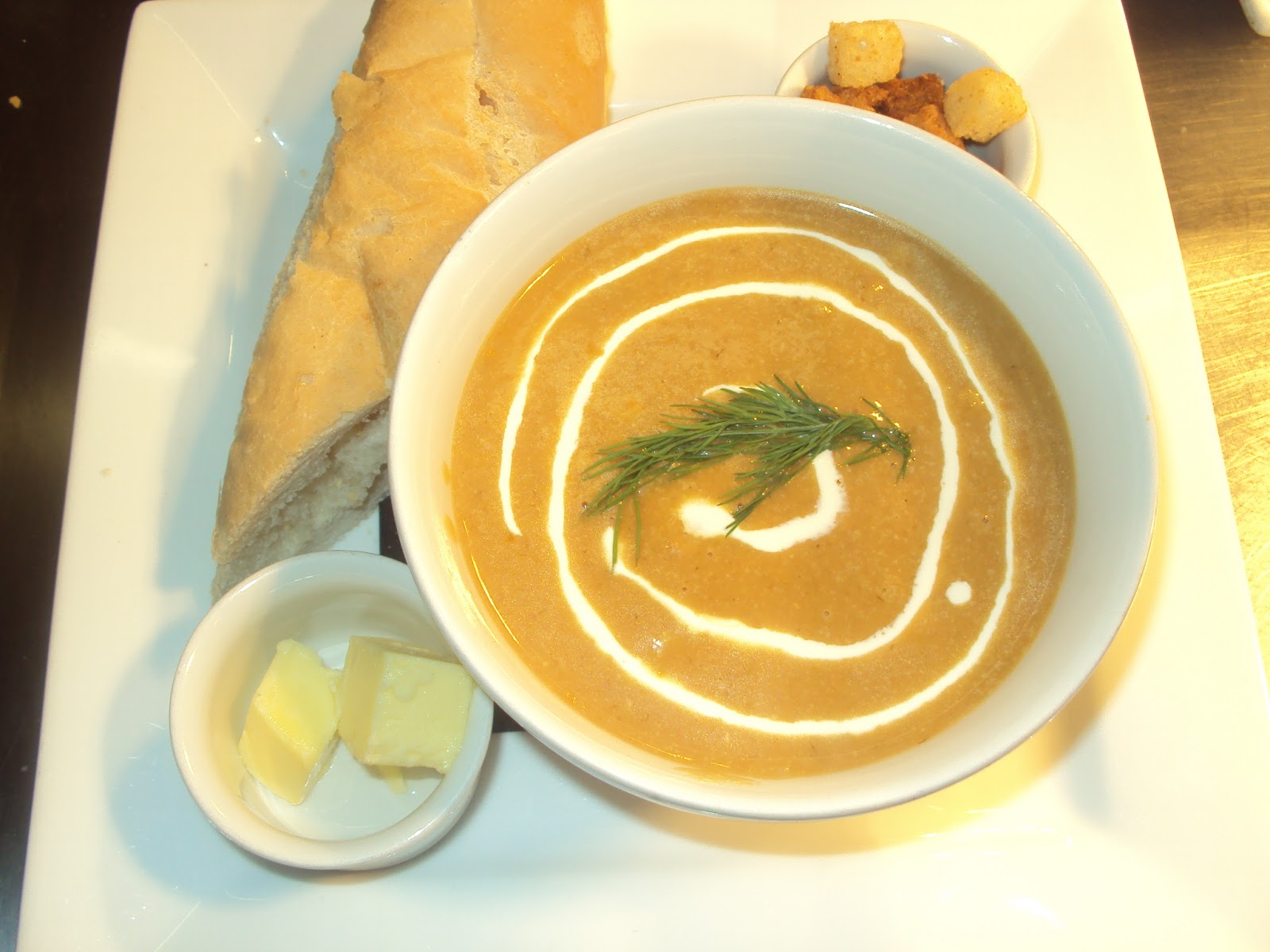
I make soup regularly and always have onions, garlic, leeks and celery to hand to add some base flavours to whatever soup I am making. A stick blender or food processor quickly makes light work of pureeing the cooked vegetables into a smooth soup. The rest of the ingredients are pretty common and essential in a well-stocked kitchen. The secret to this classic is a spoonful of marmalade to add a little extra sweetness and an orange undertone to the finished soup.


Carrot and Coriander Soup                                                                                       serves 4

1 kg carrots, peeled and roughly chopped

2 large Onions, peeled and roughly chopped

3 sticks of Celery, washed and roughly chopped

2 cloves of Garlic, peeled and chopped

50 ml quality Olive Oil

1 litre of Water or light Chicken or Vegetable Stock if available

2 tablespoons thick cut Orange Marmalade

1 tablespoon Coriander Seeds

Sea Salt and freshly ground Black Pepper


Heat the oil in a large, heavy bottomed pan and sauté the vegetables and garlic for ten minutes until soft without colouring. Toast the coriander seeds in a small pan or under the grill for a couple of minutes to release the essential oils then blitz in a food processor. Add to the vegetables along with the water and marmalade. Bring to the boil, cover with a tight-fitting lid and simmer for twenty minutes. Take off the heat and allow to cool for a while before blending in a food processor or with a stick blender. Correct the seasoning and return to the heat to warm thoroughly before serving. You can finish with a little cream if you are feeling decadent and some chopped fresh coriander leaves.


Tactus iPhone Cases for Christmas

Tactus iPhone cases for Christmas 1

My lovely son-in-law has just broken his phone. I doubt he would have it he’d had  the Omniwallet. So guess what he’s getting for Christmas?

Tactus iphone cases are really interesting. FrostMagazine likes the Omniwallet folio case in particular, because we like things that ‘earn their keep’. This not only protects your iPhone 6s, and iPhone 6 but   brings together all your daily essentials and puts them in one secure place. Cash, cards and the phone are all in one package so no more wasted time while you search for one or the other.

Tactus iPhone cases for Christmas 2
The case has a protective detachable inner shell which is secured magnetically making the case usable without the wallet attached. Made of genuine leather, it has a front flap to protect the screen with stud clasp. There are card slots and cash pocket. There is a detachable inner protective phone case that can be used without the wallet feature.

So, what a great present for someone, and it’s under £20 too.

Tactus has a variety of iPhone cases, all interesting and innovative.

What about the jazzy and innovative LumiNova which glows in the dark and is available in 6 snazzy colours.

Tactus iPhone cases for Christmas 3 Tactus iPhone cases for Christmas 4
Or the extra protective, bright bumper case NeoGuard which uses clever technology to dual protect your phone, while looking funky in bright colourways.

Tactus iPhone cases for Christmas 6 Tactus iPhone cases for Christmas 5
For further information:   www.tactus.com