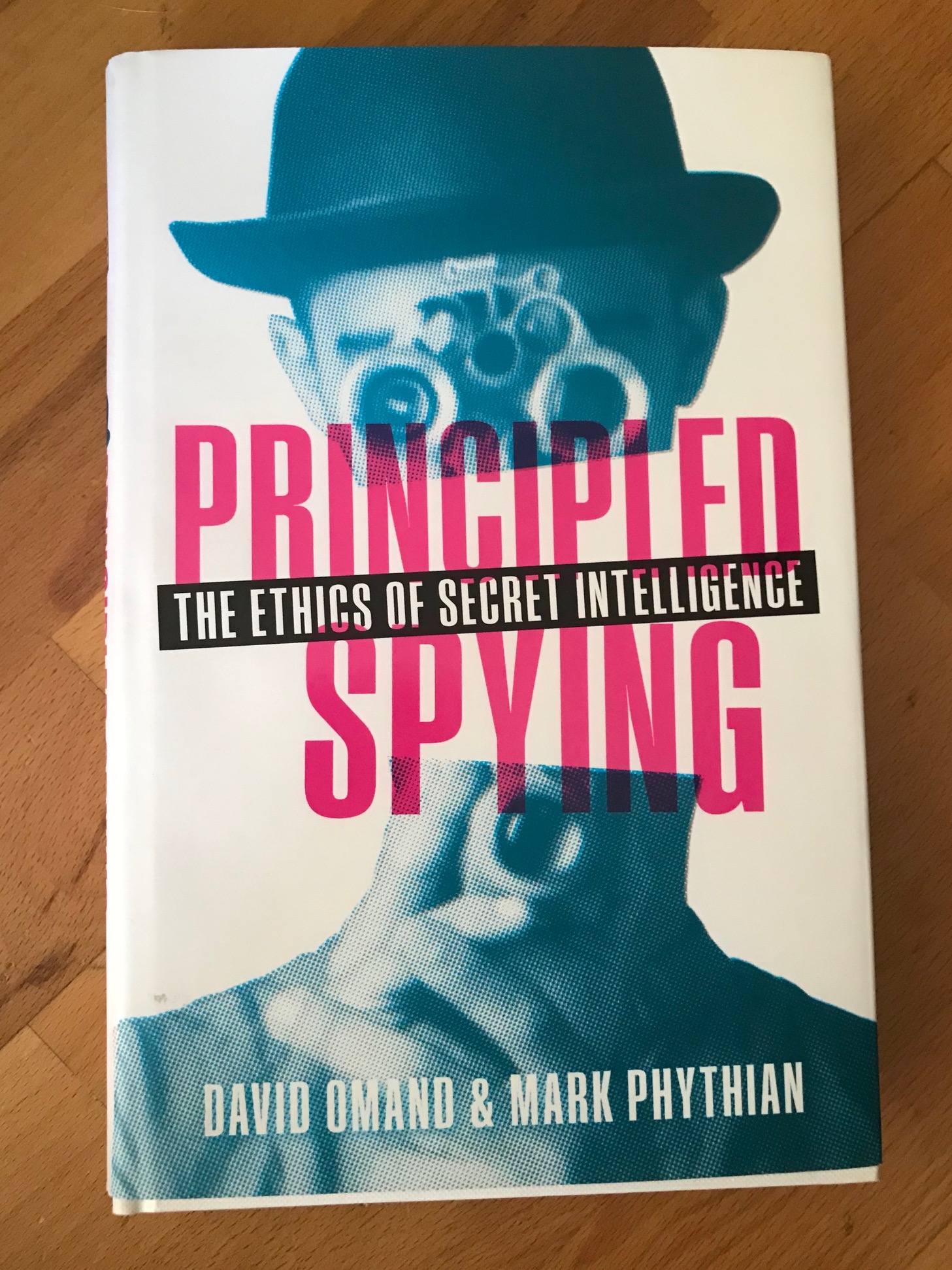
Principled Spying: The Ethics of Secret Intelligence | Book of The Week

principled spying

This book is both timely and much needed. How far should a state go to protect its people? Does the ‘greater good’ argument ever give just cause? This book has lots of fascinating history on spycraft and sound arguments on ethics. A riveting read and a well deserved Book of the Week. 

The question of how far a state should authorise its agents to go in seeking and using secret intelligence is one of the big unresolved issues of public policy for democracies today. The tension between security and privacy sits at the heart of broader debates concerning the relationship between the citizen and the state. The public needs-and wants-protection from the very serious threats posed by domestic and international terrorism, from serious criminality, to be safe in using cyberspace, and to have active foreign and aid policies to help resolve outstanding international problems. Secret intelligence is widely accepted to be essential to these tasks, and to be a legitimate function of the nation state, yet the historical record is that it also can pose significant ethical risks.

Principled Spying lays out a framework for thinking about public policy in this area by clarifying the relationship between ethics and intelligence, both human and technical. In this book, intelligence expert Mark Phythian teams up with the former head of Britain’s GCHQ signals and intelligence agency to try to resolve the knotty question of secret intelligence-and how far it should be allowed to go in a democratic society.
Available here.

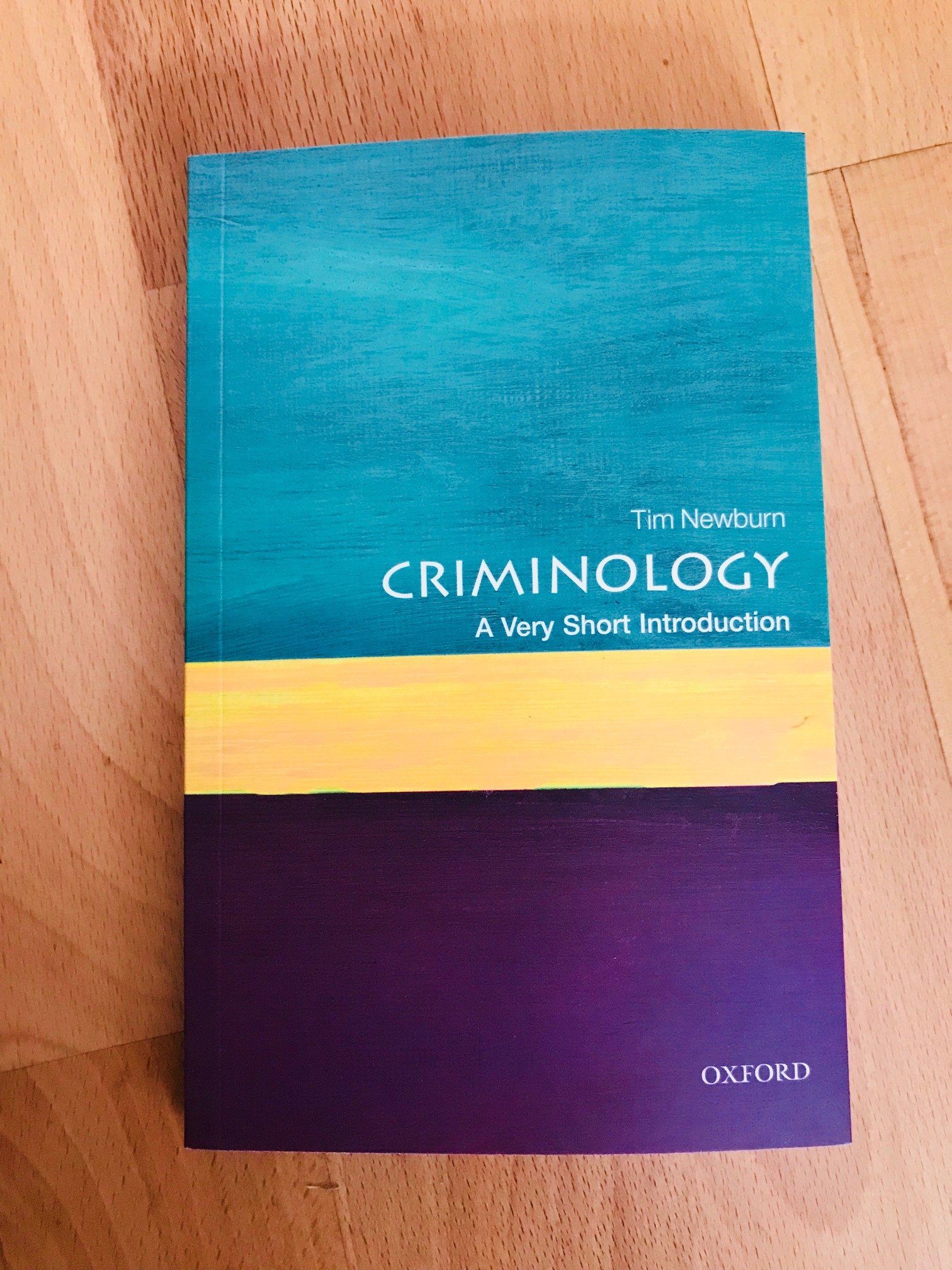
Criminology: A Very Short Introduction

criminology

These Very Short Introduction books are a great way to learn about hundreds of different subjects in an in-depth way. This one on criminology is fascinating stuff. Perfectly written and endlessly fascinating. Essential reading for anyone interested in crime.

Crime is big news. From murder to theft to drug gangs, crime and criminal justice affect the lives of millions of people worldwide. Hardly surprisingly, crime has been pushed high up the public policy agenda across the world. But how can we measure crime, or evaluate the effectiveness of preventative measures? Does the threat of prison reduce someone’s likelihood of reoffending, or would rehabilitation be more constructive?

In this Very Short Introduction Tim Newburn considers how we can study trends in crime, and use them to inform preventative policy and criminal justice. Analysing the history of the subject, he reflects on our understanding of crime and responses to crime in earlier historical periods. Considering trends in crime in the developed world, Newburn discusses its causes, exploring the relationship between drugs and crime, analysing what we know about why people stop offending, and looking
at both formal and informal responses to crime. Newburn concludes by discussing what role criminology can plausibly be anticipated to have in crime control and politics, and what its limits are.

ABOUT THE SERIES: The Very Short Introductions series from Oxford University Press contains hundreds of titles in almost every subject area. These pocket-sized books are the perfect way to get ahead in a new subject quickly. Our expert authors combine facts, analysis, perspective, new ideas, and enthusiasm to make interesting and challenging topics highly readable.

Available here.

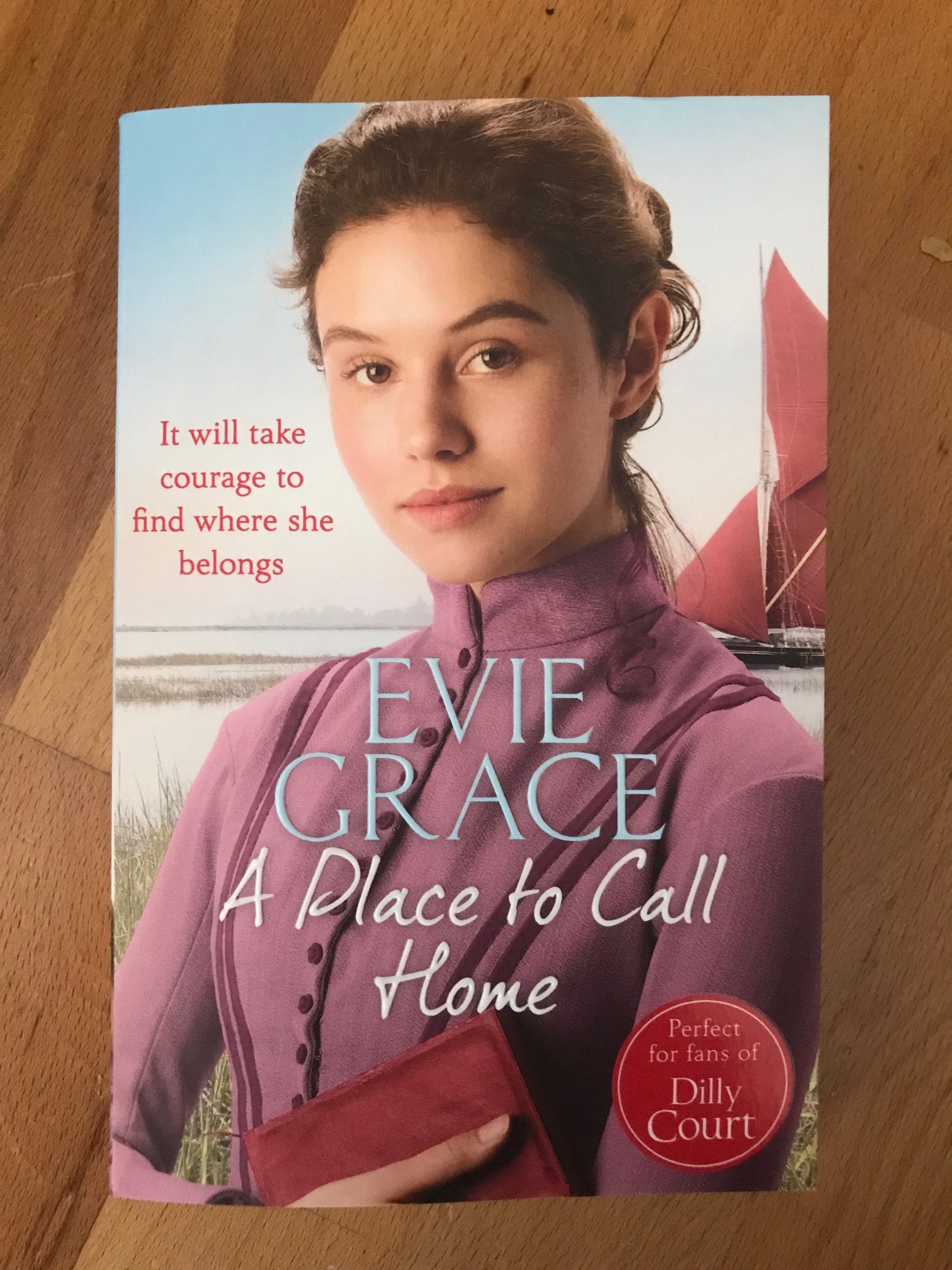
A Place To Call Home By Evie Grace | Recommended Reads

a place to call homeA perfect conclusion to this riveting saga. Get a cup of tea and dig in. The book equivalent to a great Sunday night drama.

THE THIRD AND FINAL SAGA IN EVIE GRACE’S MAIDS OF KENT TRILOGY.

East Kent, 1876

With doting parents and siblings she adores, sixteen-year-old Rose Cheevers leads a contented life at Willow Place in Canterbury. A bright future ahead of her, she dreams of following in her mother’s footsteps and becoming a teacher.

Then one traumatic day turns the Cheevers’ household upside-down. What was once a safe haven has become a place of peril, and Rose is forced to flee with the younger children. Desperate, she seeks refuge in a remote village with a long lost grandmother who did not know she existed.

But safety comes at a price, and the arrival of a young stranger with connections to her past raises uncomfortable questions about what the future holds. Somehow, Rose must find the strength to keep her family together. Above all else, though, she needs a place to call home.

Available here.

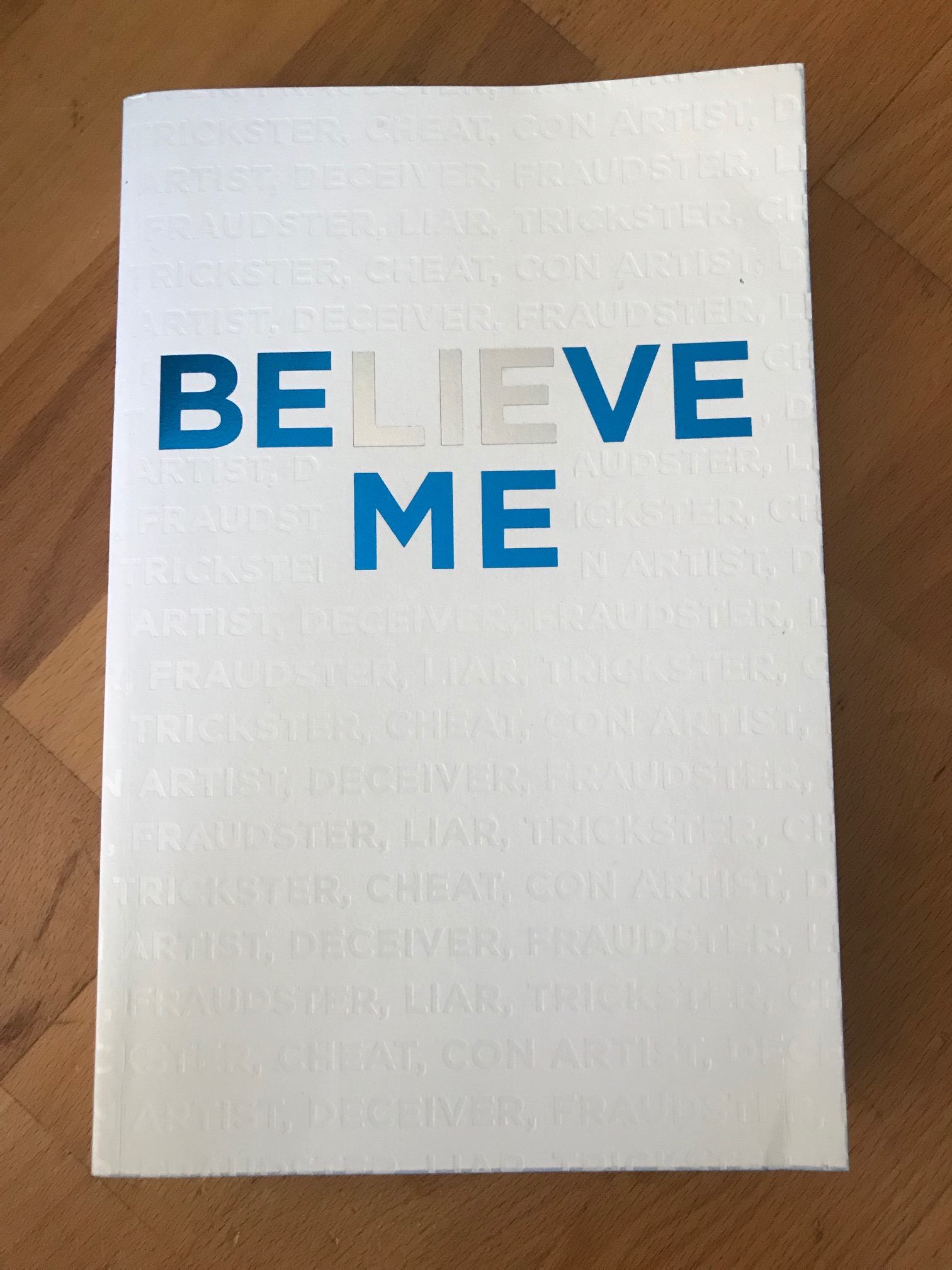
Believe Me By J P Delaney | Book of The Week

believe me JP Delaney

I found it impossible to book this book down. I do not even read much crime thrillers as I get upset about the high female body count, but this book is so well done and does not feel gratuitous. Despite the horror of the crimes. If your love Gillian Flynn and Paula Hawkins you will love this. A pitch perfect psychological thriller.

A British drama student, in New York without a green card, Claire takes the only job she can get: working for a firm of divorce lawyers, posing as an easy pick-up in hotel bars to entrap straying husbands.

When one of her targets becomes the subject of a murder investigation, the police ask Claire to use her acting skills to help lure their suspect into a confession. But right from the start, she has doubts about the part she’s being asked to play. Is Patrick Fogler really a killer . . . Or the only decent husband she’s ever met? And is there more to this set-up than she’s being told?

And that’s when Claire realises she’s playing the deadliest role of her life . . .

Available here.

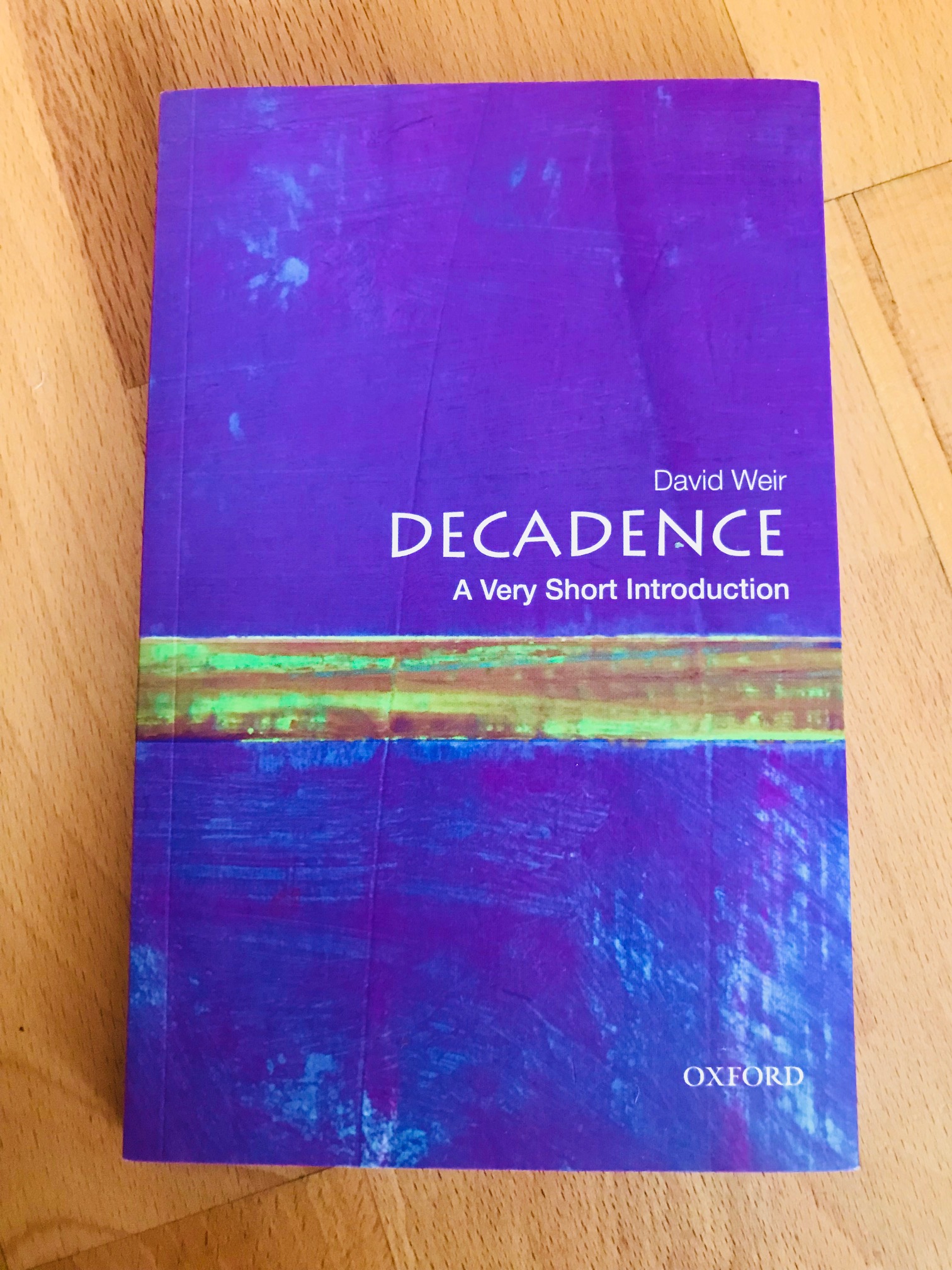
Decadence: A Very Short Introduction By David Weir

A great short read on decadence. A real eye opener which makes you think. We loved it.

The history of decadent culture runs from ancient Rome to nineteenth-century Paris, Victorian London, fin de siècle Vienna, Weimar Berlin, and beyond. The decline of Rome provides the pattern for both aesthetic and social decadence, a pattern that artists and writers in the nineteenth century imitated, emulated, parodied, and otherwise manipulated for aesthetic gain. What begins as the moral condemnation of modernity in mid-nineteenth century France on the part of decadent authors such as Charles Baudelaire ends up as the perverse celebration of the pessimism that accompanies imperial decline. This delight in decline informs the rich canon of decadence that runs from Joris-Karl Huysmans’s À Rebours to Oscar Wilde’s The Picture of Dorian Gray, Aubrey Beardsley’s drawings, Gustav Klimt’s paintings, and numerous other works.

In this Very Short Introduction, David Weir explores the conflicting attitudes towards modernity present in decadent culture by examining the difference between aesthetic decadence–the excess of artifice–and social decadence, which involves excess in a variety of forms, whether perversely pleasurable or gratuitously cruel. Such contrariness between aesthetic and social decadence led some of its practitioners to substitute art for life and to stress the importance of taste over morality, a maneuver with far-reaching consequences, especially as decadence enters the realm of popular culture today.

ABOUT THE SERIES: The Very Short Introductions series from Oxford University Press contains hundreds of titles in almost every subject area. These pocket-sized books are the perfect way to get ahead in a new subject quickly. Our expert authors combine facts, analysis, perspective, new ideas, and enthusiasm to make interesting and challenging topics highly readable.

Decadence: A Very Short Introduction is available here.


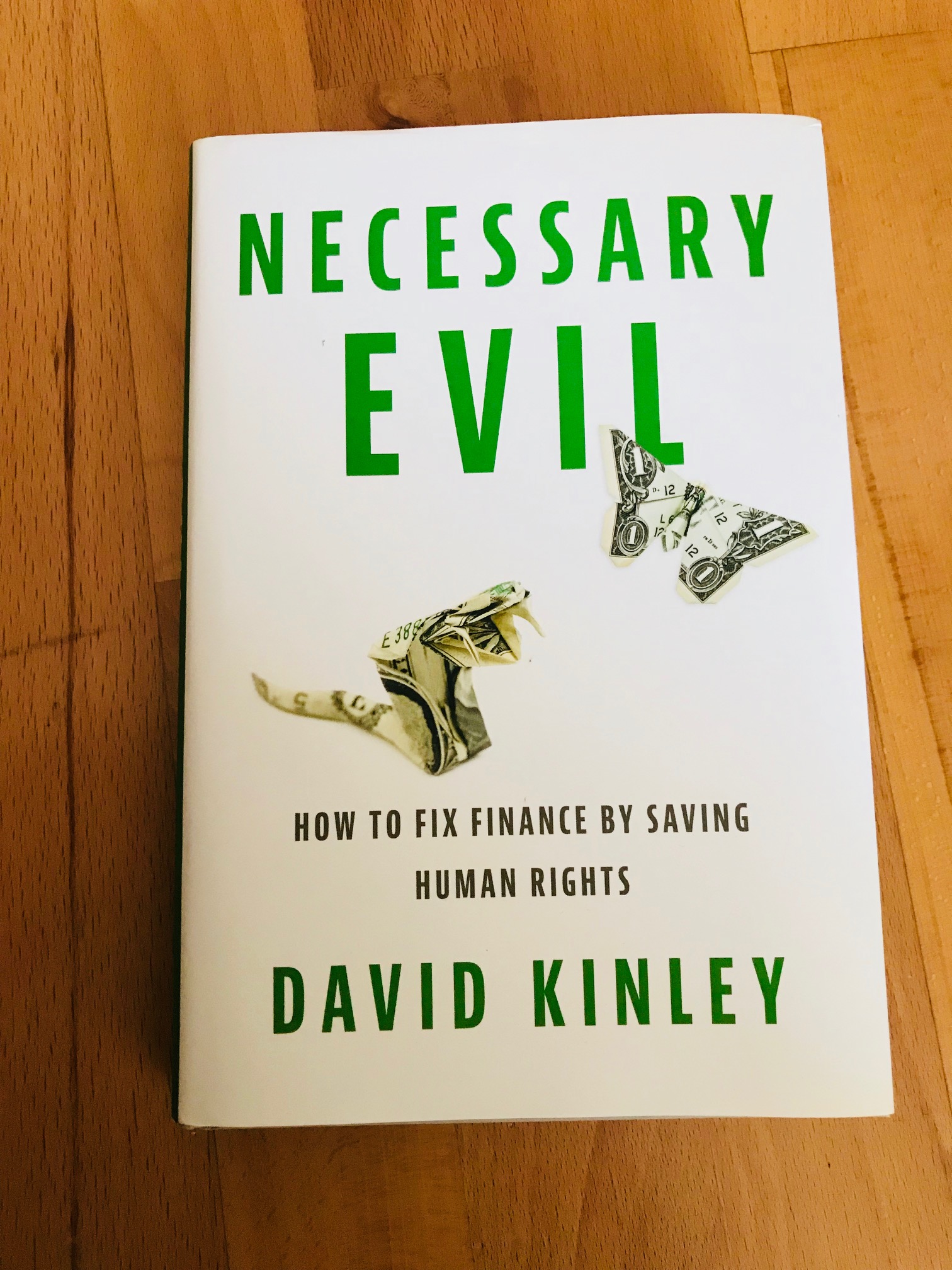
Necessary Evil: How to Fix Finance by Saving Human Rights | Book of The Week

necessary evil finance

When I first received this book I worried it might be bias. There was no need. It is well researched and balanced. Full of fascinating facts and persuasive argument. A compelling and thoughtful read.

Finance is the evil we cannot live without. It governs almost every aspect of our lives and has the power to liberate as well as enslave. With the world’s total financial assets–valued at a staggering $300 trillion–being four times larger than the combined output of all the world’s economies, there is, apparently, plenty to go around. Yet, while proponents of finance-driven capitalism point to the trickle-down effect as its contribution to wealth redistribution, there are still nearly a billion people across the globe existing on less than $2 a day; 14 percent of Americans are living below the official poverty line; and disparities in wealth equality everywhere have reached unprecedented levels. Evidently a trickle is not enough.

How can this be when so much wealth abounds, and when finance is supposedly chastened and reformed after its latest global crisis? How, especially, can it be in an age when human rights are more loudly proclaimed than ever before? Can the financial sector be made to shoulder more of the burden of spreading wealth, reducing poverty, and protecting rights? And if so, what role can human rights play in making it happen?

In answering these questions, David Kinley draws on a vast array of material from bankers, economists, lawyers, and politicians, as well as human rights activists, philosophers, historians and anthropologists, alongside his own experiences working in the field. Necessary Evil shows how finance can shed its conceit, return to its role as the economy’s servant not its master, and regain the public trust and credibility it has so spectacularly lost over the past decade–all by helping human rights, not harming them.

Available here.

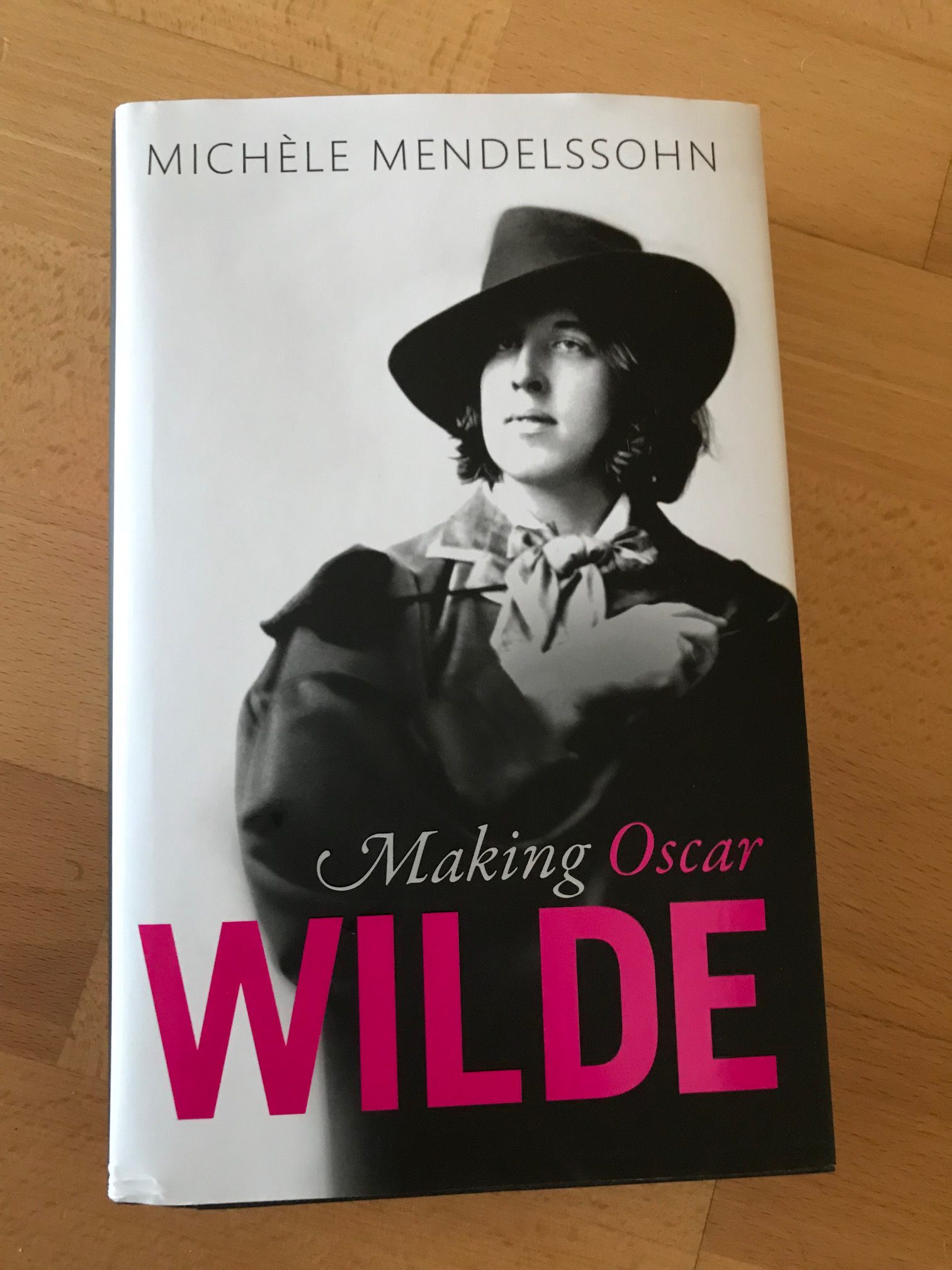
Making Oscar Wilde Book Review

making oscar wildeA wonderful and unique insight into Oscar Wilde. A must buy for any aficionado.

Witty, inspiring, and charismatic, Oscar Wilde is one of the Greats of English literature. Today, his plays and stories are beloved around the world. But it was not always so. His afterlife has given him the legitimacy that life denied him. Making Oscar Wilde reveals the untold story of young Oscar’s career in Victorian England and post-Civil War America. Set on two continents, it tracks a larger-than-life hero on an unforgettable adventure to make his name and gain international acclaim. ‘Success is a science,’ Wilde believed, ‘if you have the conditions, you get the result.’

Combining new evidence and gripping cultural history, Michèle Mendelssohn dramatizes Wilde’s rise, fall, and resurrection as part of a spectacular transatlantic pageant. With superb style and an instinct for story-telling, she brings to life the charming young Irishman who set out to captivate the United States and Britain with his words and ended up conquering the world. Following the twists and turns of Wilde’s journey, Mendelssohn vividly depicts sensation-hungry Victorian journalism and popular entertainment alongside racial controversies, sex scandals, and the growth of Irish nationalism. This ground-breaking revisionist history shows how Wilde’s tumultuous early life embodies the story of the Victorian era as it tottered towards modernity. Riveting and original, Making Oscar Wilde is a masterful account of a life like no other.

Available here.

Strictly Briks Big Briks Review

Kids loving building bricks. I think this is one of the truest sentences in life. So this big set of bricks from Strictly Briks went down well with the toddler. It is an 84 piece set with 4 different colours. They work with all large bricks so you can mix and match brands. This is a great starter set and really lets your childs imagination go wild. Recommended.

Strictly Briks 84 piece set available here.