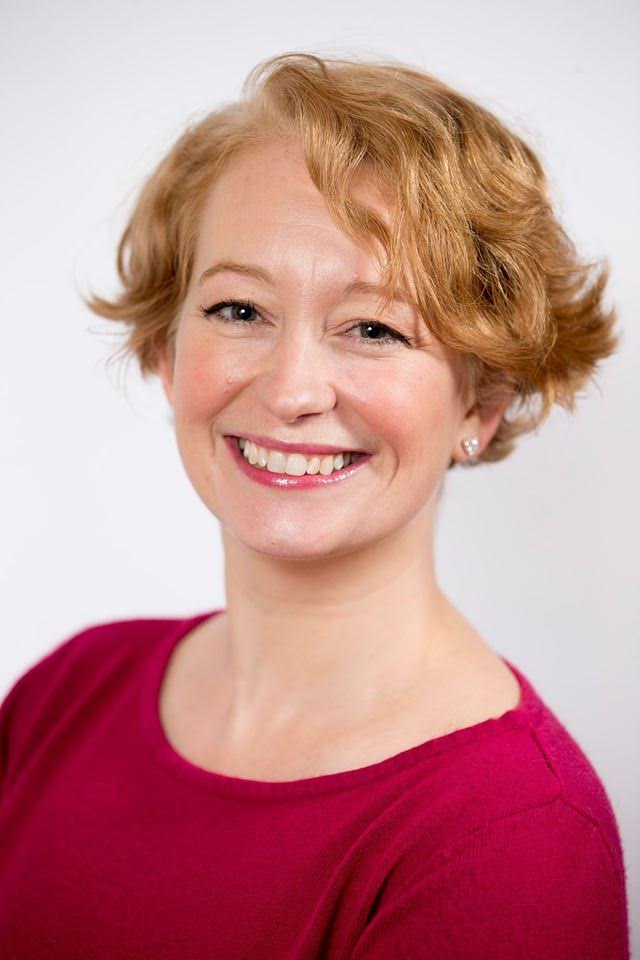
Business Of Books: Jane Cable talks to publishing polymath, Liz Barnsley


BUSINESS OF BOOKS: LOVING BOOKS, LIVING BOOKS

Jane Cable talks to publishing polymath, Liz Barnsley
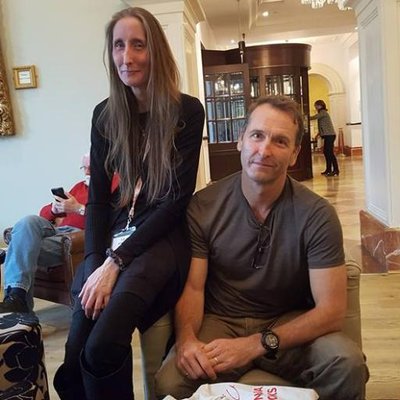
What is your book related job or business?

First of all I’m a reader and reviewer with my own website, Liz Loves Books  – all done for the love of it. On the professional side I work freelance as a submission reader for Orenda books and now as an Editor and Publicity Manager for Lisa Hall at Manatee, our new digital publishing venture. I also take on individual editing, first draft critique and proof reading amongst other things. I also have a “day job” which I’m loathe to give up as I love that too – so all in all it is a busy bookish life and a busy life life! Going into this venture with Lisa was a no brainer for me however – she is an incredible writer and a voracious reader and she knows what a good book looks like and how to get it out there. Who wouldn’t want to be part of that?


What is the most rewarding part of it?

Definitely the most rewarding part is seeing the book complete and published and finding a readership – every little that I do to help that happen gives me a huge buzz. I also like the collaborative side of editing when I’m excited about a story and the author is excited about their story – it is all hugely satisfying seeing that spark of an idea become a brilliant novel. I have to say I love reading the raw material before it goes through all the stages, seeing the talent and story emerge from underneath that first sprawl of creativity. I never tire of reading the same narrative during the tweaks because you get a whole different sense of it every time. Ultimately (hopefully!) the white noise disappears and you are left with a beautiful, readable, emotionally resonant or edge of the seat story that you can send out into the world.


What do you consider to be your major successes?

Manatee is in the very early stages at the moment so I don’t think we can claim any major successes just yet – although I’m very excited by the authors we have signed so far, all of whom are bringing something different to the table and are putting their trust in us. We focus on crime and women’s fiction – I look after the crime and Lisa looks after the women’s fiction and all our authors so far have written, in my opinion, absolutely excellent, engaging and addictive stories. Also it was somewhat of a confidence boost that bestselling crime writer Neil White had enough faith in Manatee to entrust to us his non crime novel Lost In Nashville. We have persuaded him he might want to write some more fiction for us – he is an incredible writer both within the crime genre and out of it. Watch this space. He will probably tell me off now as he’s busy with his next amazing crime novel for Bonnier Zaffre – but it had to be said that he is certainly not a one trick pony. Now he’ll tell me off some more…


Have you always loved books and what are you reading at the moment?

I have ALWAYS loved books. I’ve read many books a week every week since I was very young and I can’t see that stopping anytime soon even though I’m now rather older. Right now I’m reading a brilliant and highly atmospheric novel called “The Monsters Daughter” by Michelle Pretorius – look out for that one – but also several others as I multi read, they include The Innocent Wife by Amy Lloyd, Need to Know by Karen Cleveland, The Fate of the Tearling by Erica Johansen and Strange Practice by Vivian Shaw. Great books all.


Manatee Books focuses on quality, ethical, author focused digital publishing. Their aim is to bring a wide range of exemplary fiction to a broad readership, time and time again.

Find out more at www.manateebooks.co.uk.
 

A Break From Business: Holiday Reading: Jane Cable on fiction from Cornwall, her adopted county

The question I’m asked most frequently since moving to Cornwall is ‘so are you going to write a Cornish book now?’ The answer is that I’m in no hurry to, but in that I seem to be alone and with so much fiction set in the county I thought I’d pick out a few which would make great holiday reading.

Old favourites

I would have to start with Daphne du Maurier’s Rebecca, in many ways the ultimate in romantic fiction with a seriously heavy twist of suspense. The beautiful house by the sea, the spooky aged retainer and the dear departed wife in the background, it has it all – especially as it didn’t resolve in the way I expected.

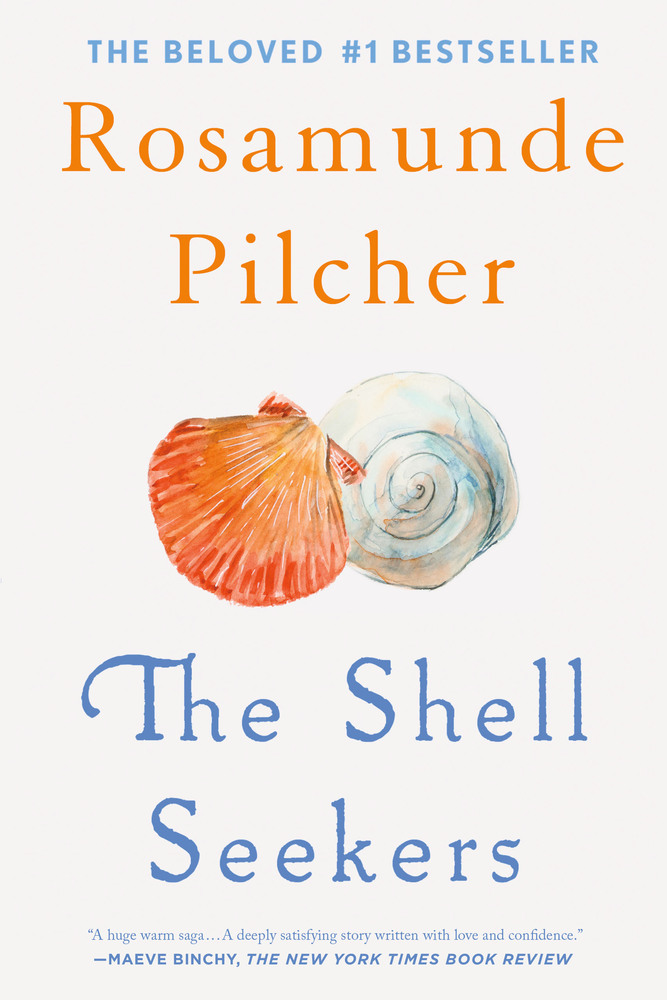
Also a classic is Rosamunde Pilcher’s The Shell Seekers which is in part set in Cornwall and known to readers of this column as my favourite book. The characters are so superbly drawn they could break – or make – your heart every time. But almost as good and often forgotten is Pilcher’s Coming Home, a saga which starts in Cornwall in the late 1930s and follows the heroine and her adopted family through the Second World War.

Another writer from my youth associated with the county is Mary Wesley. Camomile Lawn is her most famous Cornish novel and always a popular choice but I enjoyed Harnessing Peacocks far more. I like her heroine Hebe’s unconventional take on life – it seems especially suited to a backdrop in Cornwall.

In a totally different vein is Patrick Gale’s Notes From an Exhibition which perfectly captures (for me, anyway) the artist community at St Ives. The book tells the story of a family coming to terms with the dazzling genius of their late mother. At times a harrowing tale of depression, the wonderful language Gale uses lifts us and takes us to a completely different place.

New friends

Cornwall is now famous for chicklit and romcoms, a trend surely started by Judy Astley with her Just for the Summer, a sharp, witty read about Londoners who decamp to their Cornish second homes for the holidays.

Among those new out this summer, which means I haven’t actually read them but they may well appeal, are these:

Confetti at The Cornish Café by Phillipa Ashley – the third book in this hugely successful series sees the café become a celebrity wedding venue. Described as warm, funny and feel good by doyenne of romantic fiction Katie Fforde.

The Returning Tide by Liz Fenwick – the latest from a writer who has a built a career based on Cornish novels, this time with a saga of sisters and a wartime betrayal that spans the generations.

The Cornish Hotel by the Sea by Karen King – a heart-warming novel from my April Business of Books guest. Ellie returns to help her widowed mother keep the family hotel afloat, but will she succeed or will love intervene?

Dying to Take The Tour by Chrissie Loveday – a murder mystery set against the backdrop of a Poldark sightseeing tour. Cosy crime from a writer who I have to admit is a Cornish neighbour and is also published by Endeavour Press.


Business of Books: Going Up! Jane Cable on the importance of the elevator pitch

Jane Cable on the importance of the elevator pitch

It is indeed true that the word is getting shorter. Everything reduced to bitesize for folks in too much of a hurry to stop and listen, hungry to gulp down as many tweet-sized pieces of information as possible.

This is not entirely a bad thing. The book business knows that with so much competition for leisure time and money the potential consumer’s attention needs to be grabbed in a flash. A reader may spend hours savouring a good book, but their buying decision is often made in an instant.

Enter the elevator pitch – the ability to describe your latest work in two sentences at most. Catherine Miller’s excellent talk at the Romantic Novelist’s Association conference drew quite a crowd, encouraged no doubt by the lure of a competition for the winning pitch’s manuscript to be read in full by her agent, Hattie Grunewald of Blake Friedmann.

I learnt a great deal while preparing my entry. On a large piece of paper I set out the major themes and keywords for the book, turning them in my mind and distilling them into two neat sentences. I fiddled with the words, one at a time. I was happy with the first sentence: ‘When archaeologist Rachel Ward visits a remote Lincolnshire field she realises it’s where the voice in her head has been leading her for years.’ For ages I couldn’t get the second to gel, then the next morning I woke up with the perfect solution in my head: ‘But as she starts to dig an unseen danger circles ever closer and Rachel is forced to confront her own past in order to survive.’

The process of preparing what turned out to be the winning pitch had actually shown me that the ending of the book wasn’t sufficiently strong – to be fair, the edit notes I’d received said the same – but crystallising the very essence of the story into a couple of sentences made me focus on the issue – and solve it – in a way that nothing else had.

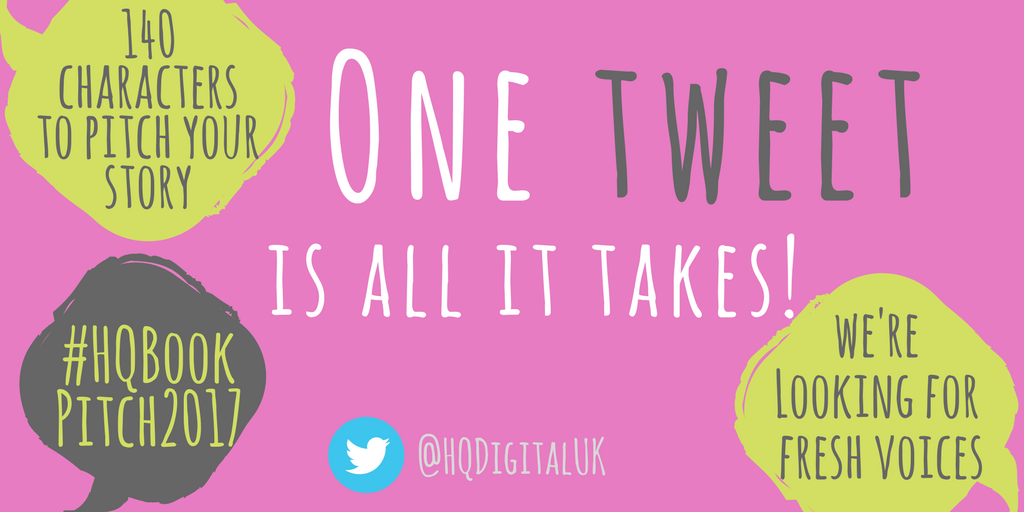
This week has shown me that two sentences is too long. Try pitching in 140 characters – actually 124 when you need to leave space for #HQBookPitch2017 – when Harper Collins’ HQ Digital division opened its virtual doors for tweeted pitches. I tried but failed to pack enough excitement into so few characters but again it was a great learning experience.

At no deadline was given so rather than research the type of books they were looking for I plunged straight in. At any one time I have a number of concepts on the block so I picked one I thought would do and tried to make it sound succinct and sexy. Not sexy enough, clearly, but I have learnt to target publishers I’m interested in better (a number of them do use this technique) and hone relevant pitches so they’re ready.

So what does a successful Twitter pitch look like? I am lucky enough to know two authors who have been asked to submit further and this is what they came up with and how they describe themselves in a tweet:

‘Lucy swaps her husband for a motorbike and has the best ride of her life’ from Sue McDonagh: “I love building my characters, then letting them loose. Should I admit that they do things I hadn’t planned for them and make me laugh?”

‘Millie should have known an archaeological dig is no place to escape the past. But can she uncover her future there too?’ from Kirsten Hesketh: “Pantser, people watcher, procrastinator extraordinaire. Twitter counts as writing, right?”

It goes without saying that everyone at Frost is rooting for them. We’ll let you know how they get on.


The Business of Books: Jane Cable meets Sunday Times bestseller, Elaine Everest

THE BUSINESS OF BOOKS: SPREADSHEETS & SAGAS

Jane Cable meets Sunday Times bestseller, Elaine Everest

How much of your working life does the business of books take up?


I can honestly say that books take up all my life. When I’m not writing I’m teaching novel writing to my talented students at The Mick Jagger Centre in Dartford, Kent. I’m also a committee member of the Romantic Novelists’ Association so you’ll find me organising social media and blogging for the Association. I would say that over 50% of my working day I’d be working on writing although I’m not creating words. Authors also need to be aware of Public Lending Rights, ALCS and other organisations where we need to keep our book details up to date as this will generate much needed funds,


What’s your business model to earn a living from writing?


I’ve been a freelance writer for the past twenty years so from the days when I was selling short stories, pitching features to magazines and organizing workshops for writers I’ve been conscious that I have to earn a certain number of pounds each month. Working in accountancy since leaving college, until moving into the writing world, I am addicted to number crunching so spreadsheets and cash flow predictions were part of my daily life. I could always tell at the push of a button if there were lean months ahead and would know to pitch more – and to write more fiction! This has changed slightly since moving onto writing novels as these days I’m aware when royalties and other payments are due and can plan accordingly. Those spreadsheets still come in handy!


What do you write and what do you consider to be your major successes?


These days I write historical fiction set in the 1930s and 1940s. It is a fascinating period to cover and when not writing I will have my nose in a non-fiction book researching social history, looking for fresh plot settings and generally fleshing out the world where my characters live.


My major successes are my novels with Pan Macmillan. Readers have taken my Woolworths Girls to their hearts making the first book a Sunday Times bestseller.


Tell me about your latest project.


The Butlins Girls was published in May so I’m still busy promoting and blogging about my girls at the end of World War Two. As I write this I’m looking at the final book edits for Christmas At Woolworths, which will be published in November, and these have to be completed by – tomorrow! I know there’s an email notifying me that first edits will be with me in two days for Carols at Christmas, a novella that will be published a few weeks before CAW. Writing wise I’m working on Wartime at Woolworths, which will take my girls through to the end of 1944. This will be published in May 2018. I’ve found the trick is to stay focused on the current work in progress while trying to fit all other aspects of my writing around it – and remembering to stop and eat occasionally. I can recommend writing retreats where I find working whilst gazing out to sea from my desk can be a welcome rest from my desk at home!


Elaine Everest has written widely for women’s magazines, with both short stories and features. When she isn’t writing, Elaine runs The Write Place creative writing school in Dartford, Kent, and runs social media for the Romantic Novelists’ Association. Follow Elaine on Twitter @ElaineEverest.


Business of Books: Jane Cable writes from the Romantic Novelists’ Association Conference

Business of Books: State of the Nation
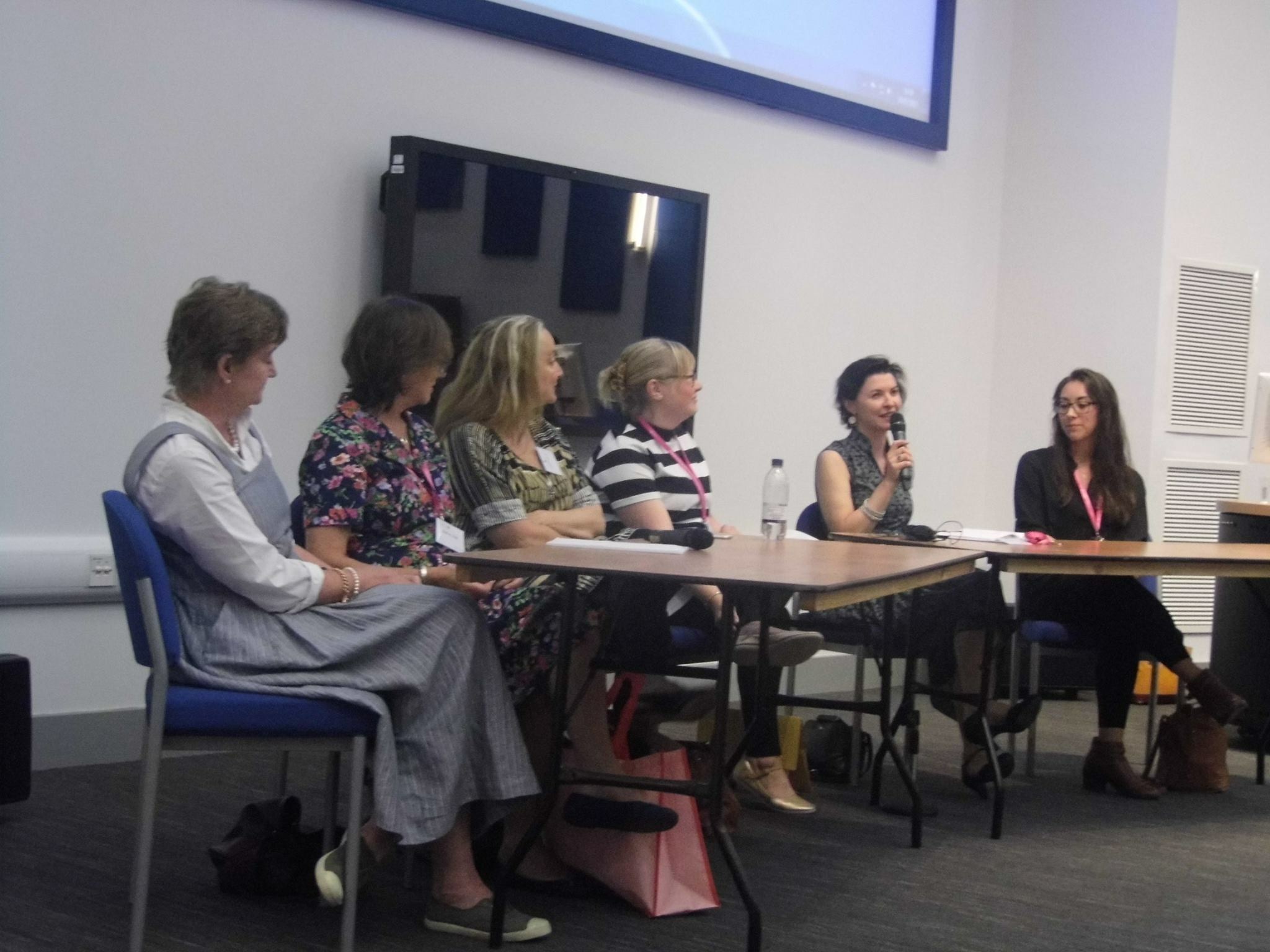
Jane Cable writes from the Romantic Novelists’ Association ConferenceI’m conferenced out. There, I’ve said it now. Suffering from serious information overload but in a very good way. So many fascinating sessions, so many interesting new people to meet. And so much wine to drink – the organisers ordered a mere 600 bottles for the weekend. Not to mention the stocks in the fridges in our own kitchens. Yes, it was a little like rolling back the years and being a student again.The first session after the official conference opening was a state of the industry address and the key messages have interest for writers in every genre, not just romance. Major trends seem to be for shorter books – gone are the doorstops of yesteryear, despite the increase in audio and ebook meaning we don’t have to carry them around anymore. And genres are blurring too – thanks to the rise and rise of indie publishing, even the major houses are beginning to understand that readers are becoming more adventurous.But of particular interest to me was the advice each panellist gave to the assembled authors. Here’s who they were and what they said.

Isobel Dixon (Head of Books and Director of the Blake Friedmann Literary Agency):
Persevere – there is much more flexibility in the market in every way. And once your book is out there, be generous with your readers.

Sam Missingham (former digital project manager at Harper Collins who has just founded @lounge_books, which she describes as a home for book lovers)
Build your own audience platforms, whatever the stage of your career. You can’t waste your time on social media.

Broo Doherty (literary agent at DHH)
Don’t take rejection personally. Believe in yourself.

Rosie de Courcy (fiction publisher at Head of Zeus)
Try to create your own world, somewhere you can write the same but different year after year.

Emily Yau (commissioning editor on fiction lists at Ebury Publishing)
Read as much as you can – in and out of your genre. Understand where your book sits in the market and why it’s special.

Well that’s the words of wisdom – and my thanks goes to John Jackson, the RNA’s unofficial photographer, for the picture.

Now I’m off to plough through pages and pages of notes for more interesting blog content – and some wonderful new people to interview about the business of books.

The Business of Books or Not: Jane Cable talks to Abby Endler about book blogging for love

Jane Cable talks to Abby Endler about book blogging for love


1) What is your book-related job or business?

I run Crime by the Book, a crime fiction review website and its associated social media accounts. My largest platform is on Instagram (@crimebythebook), where I take photos of the books I’m reading and provide my audience with updates as I read them. I also use Instagram to link to my website, where readers can find reviews, author interviews, and more. Crime by the Book can also be found on Twitter, Facebook, and Goodreads, and has a weekly newsletter as well. Crime by the Book is a passion project – while I would never write off the possibility of turning it into a business down the road, the goal is purely to share a love of books, and as of this moment I don’t make money from it.

2) What is the most rewarding part of it?

I would be hard-pressed to find an element of CBTB that is not rewarding, but if I had to narrow it down, the most rewarding part is the knowledge that I’ve connected readers with books they love. Whether that feedback comes from readers who have bought a book on my recommendation and loved it, or from authors who have seen the enthusiasm of my audience for their book, nothing could be more exciting to me than knowing I’m helping those books find great homes! There’s such an appetite for crime fiction out there, even on a platform like Instagram which is dominated by a younger audience, and I am thrilled and humbled every time I hear from my audience that I’ve helped spark their interest in crime fiction. Likewise, it’s extremely rewarding to hear from authors who are excited by the ways I’ve helped connect their book to those readers!


3) What do you consider to be your major successes?

The growth of my platform on Instagram has been a huge success. Crime by the Book just turned two years old, and also just passed 40,000 Instagram followers. As previously mentioned, Instagram does have the reputation of being dominated by a younger audience, so I consider it a huge success that I’ve found footing with a younger demographic! It’s very exciting to me, as a younger crime reader myself, to see my peers connecting with crime books. I also consider every single chance I have to interview an author a major success, whether that author is a big name (authors like Jo Nesbo, Sara Blaedel, and Clare Mackintosh have all appeared on Crime by the Book), or a debut author. No matter the author’s name-recognition, I’m honored to speak with and learn from every single author I interview. It’s a huge privilege!


4) Have you always loved books, and what are you reading at the moment?

I’ve loved reading for as long as I can remember. I started reading mysteries when I was very young – I started with Nancy Drew! And then as I grew up, I transitioned into Agatha Christie, James Patterson, Patricia Cornwell… and my love of reading crime books has just evolved and grown from there. At the moment, I’m reading ORDEAL by Jorn Lier Horst. This Norwegian crime book is part of his William Wisting series, and is the newest installment to be released in the US. I love this series for its detailed portrayal of police work, and its endearing characters.


Bio: Abby Endler is the creator and reviewer behind Crime by the Book, a crime fiction review website and its associated social media accounts. www.crimebythebook.com


The Business of Books: Jane Cable Gets Distracted But Finds She is Not Alone

Jane Cable gets distracted but finds she is not alone

It’s a small miracle you are reading this article at all, to be honest – and great credit to writer friends who have rallied around to provide me with some content. The thing is, last week I moved house. Long distance and for the first time in over twenty years. Not only did time become an issue, but the mental effort turned my brain into a huge mass of Cornish clotted cream.

I am not the only author suffering from a life event at the moment. Frost’s own Margaret Graham has been in the wars but in typical fashion is seeing the positive: “Falling into a wall recently and breaking my shoulder not only put one hand out of use but a whole brain, it seems to me. I feel that actually giving it a rest is probably not a bad thing. You will find that creativity is better for a bit of a holiday.”

Writer of historical fiction, Rosemary Noble, is also good at seeing the upside of potentially distracting events. “Sometimes you can avoid the stress by burying yourself in writing. I’m thinking of trying to sell my mother’s flat to pay for her care home. The only way I got through that 12 months was writing,” she told me.

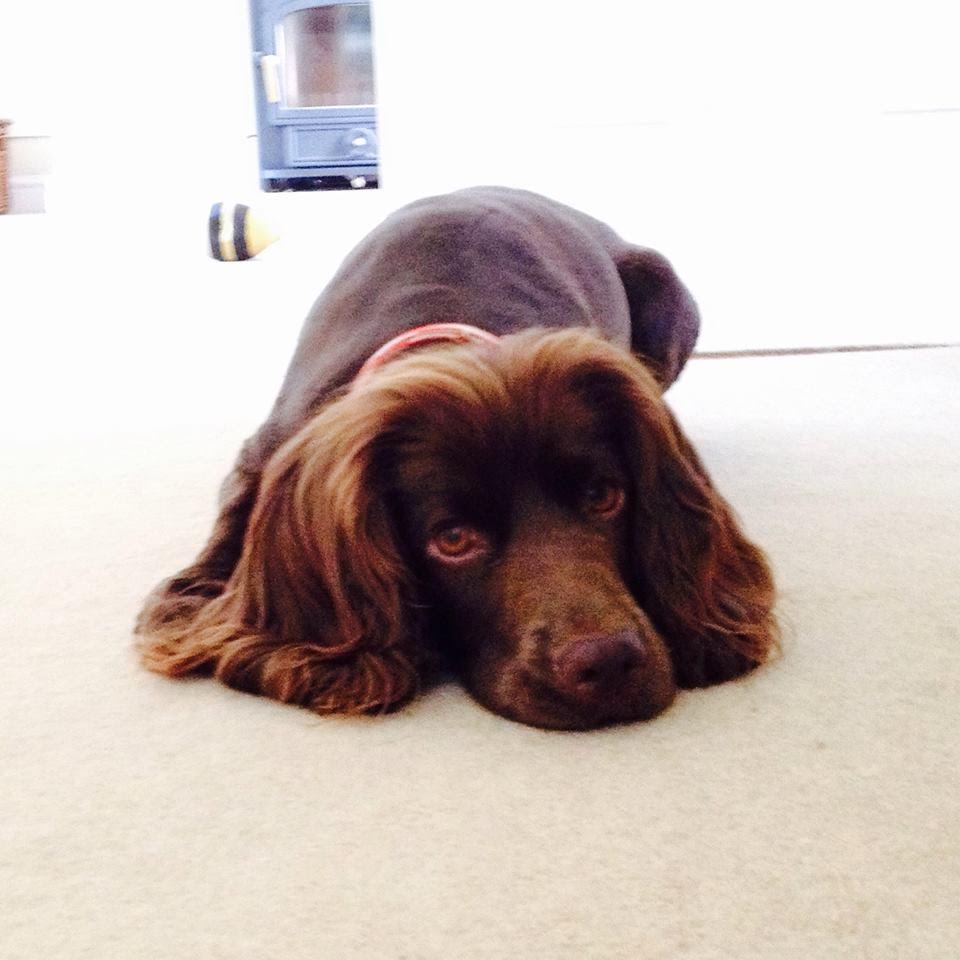
There are some everyday distractions which make the list too. Day jobs (most writers have them), family commitments, lack of sleep, paying the bills – even social media – all sap creative energy. Sometimes the good things do as well. Ghost writer and freelance wordsmith Sue Kelso Ryan cited her dog as the biggest culprit – and it was a great excuse to use her lovely picture as well.

Which just goes to show that good things interrupt our writing too. “Having twins,” says media medic and women’s fiction author Carol Cooper. “That knocked writing on the head for a few months. And illness/surgery. You resent having to rest or slow down because it stops you writing.” Although she did manage to create a top-selling practical parenting guide about her experiences once she was able to find the time.

Crises involving other family members which hit without warning seem to have the biggest effect, as fantasy & romance writer and brand strategist Amy Tipper-Hale has just found out: “My boyfriend breaking his leg in Milan after being run over by a motorcyclist, and me having to fly over to be with him so he wasn’t entirely stranded…I thought I’d have plenty of time to write, but it ended up being stressful and exhausting – my mind all over the place, and not a single word written…except this.” Luckily the patient is now at home – and hopefully Amy will get back to writing again soon too.

As for me, now I have unpacked my desk and settled it into its new location, I need to have a plan. I’ve been sitting on the edit notes for my current manuscript for a month or so and my brain is just starting to tick over them. And one thing this house move is meant to achieve is more time to write. Fingers crossed I can make it happen.

As well as those mentioned above, my thanks also go to Barbara Copperthwaite, Victoria Cornwall, Morton S Gray, Wersha Bharadwa, Carol Thomas and Clare Ruel for their contributions.


Business of Books: Jane Cable talks to Barbara Copperthwaite, Bookouture’s latest best-selling author

Business of Books: Planning for successJane Cable talks to Barbara Copperthwaite, Bookouture’s latest best-selling author

How much of your working life does the business of books take up?

It’s almost a 50/50 split. A huge part of the business of books is social media activity. Networking with fellow authors and bloggers, and interacting with readers is so important. It builds relationships, and ultimately I believe that the business of books is about people. Marketing takes up a huge chunk of time, be it generating original content for your own website and blog (I have both, as I find they service slightly different purposes and appeal to different people) or writing guest posts for others to use. Of course, the rest of the time is spend actually writing the books!


What’s your business model to earn a living from writing?

I always remember my dad telling me that a new business takes an average of two years to make a profit. I went into self-publishing my books with that in the back of my mind, and very much thinking of it as an entrepreneurial venture. I ensured I had enough money behind me to survive for two years without making any profit at all. It’s been tough, but I had a three-year plan in mind – self-publish for two years, make a name for myself, make contacts, then get a publishing deal.

I was stupidly naïve though. I’d never had a Twitter or Facebook account, and no clue that book reviewers even existed online, let alone had such huge influence. Despite that, my first book, Invisible, became a genre bestseller on Amazon. Flowers For The Dead, my second novel, built on that success, becoming not just a genre bestseller but a bestseller, proper – largely because I had by then built up a small but genuine following on social media. Incidentally, for those who dismiss social media as unimportant, you are missing its point. It is not about shouting continually about how great your book is and why people must buy it. It’s about genuinely engaging with people.

All of this begs the question: if I was doing so well, why did I want a publishing deal? Because I know enough about business to realise I am not a natural business person. I have the knowledge and drive to get me so far, but I’m not capable of pushing myself to the next level. The most successful self-published authors I know are not just brilliant writers, but brilliant business people, too. They are great with numbers, marketing, and all manner of other things. I’m not – I’m a writer. Of all the publishers, the one that appealed most to me was Bookouture, a digital only publisher that is growing quickly, has a reputation for picking winners, and is really making waves in the industry (so much so that they were recently acquired by Hachette). I was lucky enough to be taken on by them after submitting my third novel, The Darkest Lies.

I have to add that the fact everything in my three-year plan has actually happened has taken me hugely by surprise, as I honestly thought it was probably a pipe dream.


What do you write and what do you consider to be your major successes?


I write psychological thrillers with a dark edge. I like to explore how ordinary people cope when they find themselves in extraordinary circumstances, what can push someone to kill, how a person can be manipulated without them realizing it. I always say that I write ‘whydunits’ rather than ‘whodunits’.


My major successes don’t necessarily have anything to do with selling a lot of books. It might sound cheesy, but every single time someone tells me they’ve enjoyed one of my books, is a success. Becoming a bestseller for the first time was absolutely incredible, as was being signed by my agent, and being offered my book deal (there was a lot of shouting and jumping up and down in excitement when I got that email!). Beating Lee Child to be chosen as the Sunday Mirror’s Choice Read was definitely a feather in my cap – little old indie author me, beating a multi-million selling, global author. Being contacted by a number of women who have told me how realistic my portrayal of an emotionally abusive relationship is in Invisible. All those things mean the world to me. They are the sort of thing I used to day dream about, and hoped might happen, but never dared believe they would. In which case, fact that my dreams are coming true has to be my biggest success.

Tell me about your latest project.

The Darkest Lies has just been published. When teenager Beth Oak is found beaten almost to the point of death, her mother, Melanie is determined to find the attacker. Someone in the village must have seen something. Why won’t they talk?

I’ve just finished writing a psychological thriller set within a seemingly normal family in the run up to Christmas. As the festive day draws closer, tension grows towards an explosive ending where nothing is as it seems. That will be out in September.

And, because I like to keep busy, I’ve just started a novel featuring a journalist who finds herself drawn reluctantly into investigating a serial killer who seems to be linked to her.


Barbara Copperthwaite is the best-selling author of psychological thrillers Invisible, Flowers For The Dead, and The Darkest Lies. Her first two novels were self-published, and she has now signed with Bookouture, an imprint of Hachette. When not writing, she likes to hide behind a camera and photograph wildlife.