The Privileged Are Always One-Step Ahead, Right? By Josh Edwards

We have been reminded in the press recently, that the privately educated and the rich seem to get a better deal than the rest of us – but why is this?  Perhaps it is to do with the social network they are able to build. The cliché, ‘it’s not what you know but who you know’ certainly has some truth to it.

Let me give you an example. Pretend for a moment that Beatrice’s father Edward has just floated his new tech company on the NASDAQ, and made a fortune. Beatrice bumps up from a comprehensive to a private school in Windsor, where she is surrounded by oil magnate heirs and the like. Overnight she has entered a network of potential contacts. Opportunities will arise, and it is probable that Beatrice will be in a better position than the rest of us.

We cannot blame the elite and the privileged for accessing the doors that are open to them for surely we all would, in a similar position. For the majority of us, however, who are on the other side of that white picket fence, how can we compete?

For me it was about using the opportunities that arose around me. For the people who know me, the past three years of my life has been a mixture of both University and Starbucks.


 While working for Starbucks I soon realised that customers from a multitude of backgrounds come into the store, in search of their caffeine fix. It became apparent to me that I could kill two birds with one stone, I could both work and network at the same time.

While some customers would rather order their coffee with a minimal amount of personal interaction, others would engage in conversation.
2

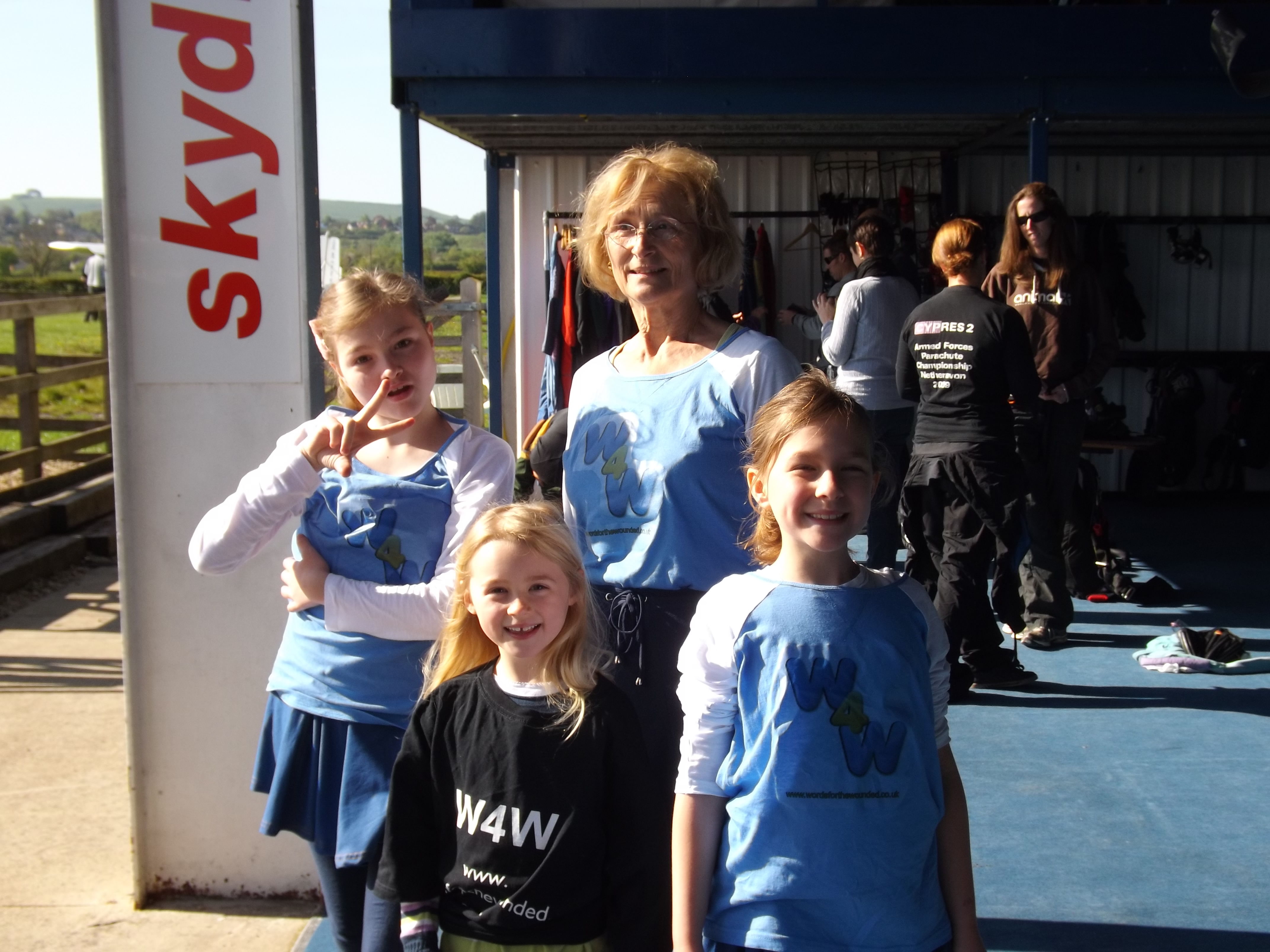
I made an effort to remember names and in time found some to be genuinely interested in my plans, even offering me opportunities to enhance my C.V and further my career. Through networking with customers, I have been offered a number of open doors, including the opportunity to write for Frost, – the online magazine you are reading now – and I have become involved with the charity Words for the Wounded (W4W), and now help look after publicity and all social media.


 I have been able to talk about my work with Frost and W4W during a recent interview and it has definitely enhanced my application – and given me something different to talk about, not to mention improving my skill base and my understanding of how different organisations work.

So if you are in a similar position and work in an environment where you meet a variety of people,  have an open mind. I have found generosity from customers in spades. Are the rich and privileged one step ahead? Probably, but it doesn’t mean the rest of us are too far behind.


Kate Kelly: A Day In The Life of An Author: The Edinburgh International Book Fair

A sunny morning in August and I was heading into Edinburgh on one of the city’s shiny new trams. The reason – I had been invited to appear as an author at the Edinburgh International Book Festival and this was the morning of my event.

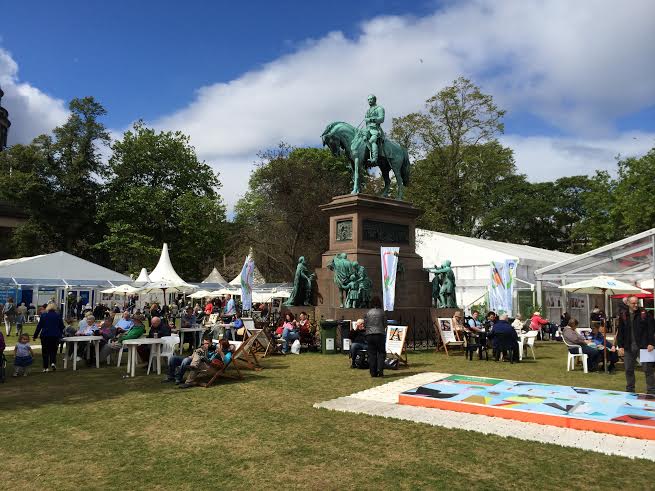
The Edinburgh International Book Festival 2014 was held in the beautiful Charlotte Gardens in the centre of the city. As I approached I could see the tents and marquees clustered beneath the trees and neat crocodiles of school children in pristine uniforms being herded by their teachers towards the venue.

A Day in the life of an author- The Edinburgh International Book Fair 1
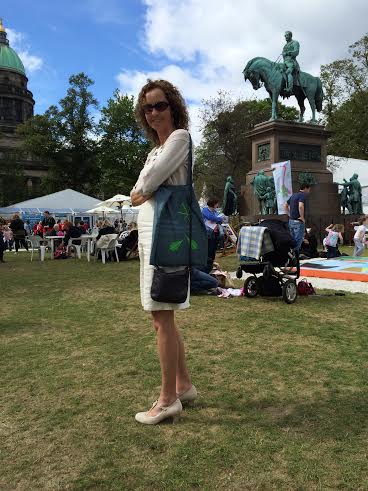
The author arrives at Charlotte Gardens.

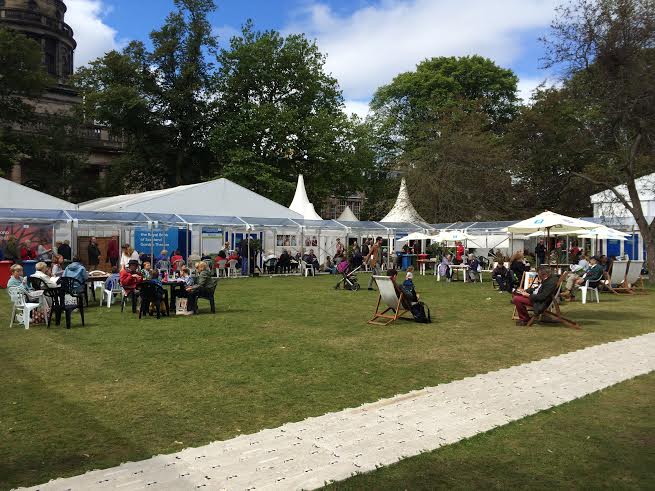
Inside covered walkways connected the event venues and bookshops which had been set up around the edge. In the middle was an area of lawns and seating where people gathered to drink coffee or eat their lunch

A Day in the life of an author- The Edinburgh International Book Fair 4
The Edinburgh International Book Festival in Charlotte Gardens

Mine was to be a joint event with Sarah Crossan, author of dystopian duology Breathe and Resist. Our event was called The End is Nigh and formed part of the Baillie Gifford Schools programme of events.

A Day in the life of an author- The Edinburgh International Book Fair 3
Another view of the venue, Charlotte Gardens.

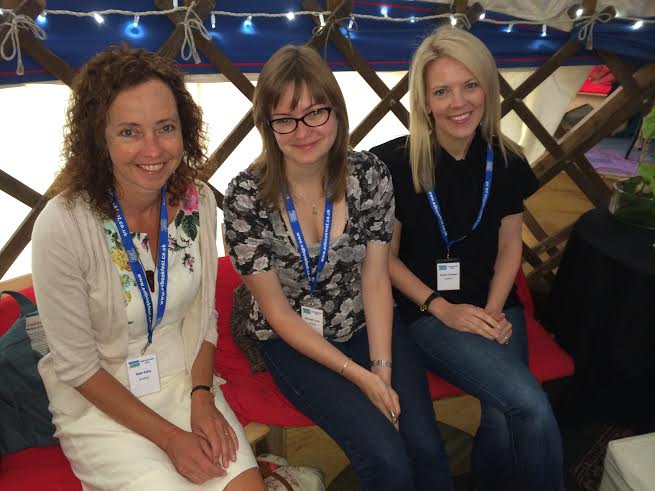
The authors had a separate area, the Author’s Yurt, where we could chat and relax both before and after our events and this was where I headed to meet up with Sarah, Hannah Love of Faber who was chairing our event and my publisher’s marketing director. Here we were fitted with our microphones and then we were escorted to our venue and 150 eagerly waiting schoolchildren.

A Day in the life of an author- The Edinburgh International Book Fair 7
Myself, Hannah Love and Sarah Crossan in the Authors Yurt

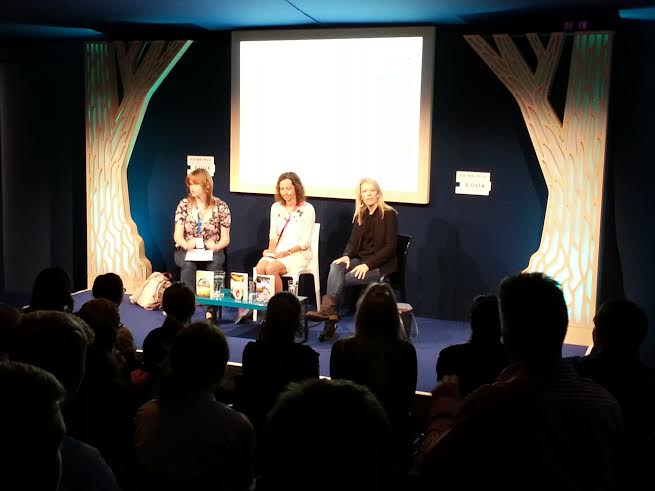
Sarah and I read extracts and answered questions about our books, both about the writing process and our inspirations as well as the environmental issues our books address and the emerging genre of Cli-Fi (Climate Fiction). It was an hour long event but it felt like minutes.

A Day in the life of an author- The Edinburgh International Book Fair
Answering questions about our books.

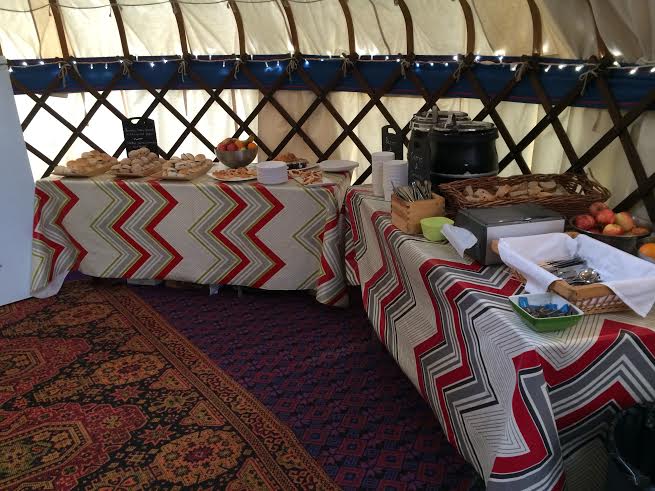
Afterwards we were taken into the festival bookshop where we had the opportunity to meet some of the children and sign books for them. A couple of groups had come across from Glasgow and were doing a school project on Climate Fiction of which our books formed part. It was lovely to meet them and see their enthusiasm. Then back to the author’s yurt for lunch.

A Day in the life of an author- The Edinburgh International Book Fair 5
Lunch laid out in the Author’s Yurt

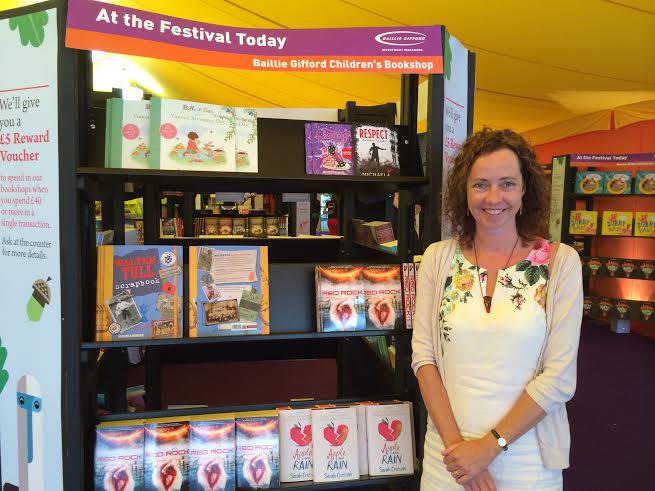
I was then able to explore the festival site a bit more and most importantly to check out the festival book shops. There was a special stand where that day’s events books were displayed.

A Day in the life of an author- The Edinburgh International Book Fair 6
Lots of copies of Red Rock for sale.

Of course no visit to Edinburgh during festival time would be complete without visiting out The Fringe and that was how I spent the rest of the day. Some of the street acts we saw were quite superb and the whole city was vibrant and alive.

My day at the Edinburgh International Book Festival was a superb experience and one I shall never forget.

Biography

Kate Kelly is a marine scientist by day but by night she writes SF thrillers for kids. Her debut novel Red Rock, a Cli-Fi thriller for teens, is published by Curious Fox. She lives in Dorset with her husband, two daughters and assorted pets and blogs at http://scribblingseaserpent.blogspot.co.uk/


Curious Fox link: http://www.curious-fox.com/


Amazon UK link: http://www.amazon.co.uk/Red-Rock-Kate-Kelly/dp/1782020616/ref=sr_1_1_bnp_1_pap?ie=UTF8&qid=1409831765&sr=8-1&keywords=red+rock


Postman’s Park by Margaret Graham

There I was, slouching about in London with ‘he who must be disobeyed’ in search of the Postman’s Park. Have you been? If not, nip along. It’s almost next door to the Museum of London. It’ll pull at your heartstrings.

Postman’s Park is on the site of the former HQ of the General Post Office, and is one of the largest parks in the City of London. It is tucked away almost next to the Museum of London, at St Martin’s le Grand, EC1A.Tube: St Paul’s.
Buses: 4, 8, 25, 56, 100, 172, 242

When you see the blue old police box, just turn into the gates. The Postman’s Park opened in 1880 on the site of the former churchyard and burial ground of St. Botolph’s Aldersgate.

As you enter you will see ahead of you, and beyond the circular flowerbed, a loggia and long wall.  It is this you must head for, past the headstones, past office workers eating their lunch, past the circular bed, lovely though it is.

Your goal is Victorian painter and sculptor George Frederick Watt’s wall of ceramic memorial tables honouring the self sacrifice of ordinary people.

In 1900 Watt’s felt driven to create this memorial, determined that acts of bravery performed by ordinary people should be commemorated.

Only four of the memorial tablets were in place at the time of its opening, with a further nine tablets added during Watts’s lifetime.

Watts’s wife, Mary, took over the project after Watts’s death in 1904, and oversaw the installation of a further 35 memorial tablets as well as a sculpture of her husband.

Later, increasingly pre-occupied with the Watts Gallery, which still features her husband’s work at Compton, near Guildford, she ceased involvement, and only five further tablets were added during her lifetime.

In 1972, key elements of the park were designated Grade 11 listed. Following the 2004 film Closer, which set some key scenes within Postman’s Park, interest was stirred again. Recently, a free mobile app, The Everyday Heroes of Postman’s Park was launched which documents those commemorated on the memorial. New tablets are still being added. Mary and George would have been delighted.

I remember the plaque I came across in the West Australian bush, when researching a novel for Heinemann. The plaque commemorated a young girl who lay across her siblings when a bush fire raged over them on their way home from school. She died, they survived.

Ordinary people do extraordinary things, not the least being our young troops out on patrol day after day in war zones. It is right and good that we remember every one of these ordinary people. Are you supporting the Invectus Games? I do hope so.

A Day in the Life of Tracy Baines

traceybaines


My life is full of distractions, it always has been. It’s one of the hazards of working from home. These days the distractions are mostly delightful and indulgent. First of all we have a new puppy, Harry, a springer spaniel and for the time being his needs come first. At the moment he’s snoozing in his bed at my feet but mostly he’s biting at my files and books and I am constantly telling him NO. He’ll learn.

harry

Once I’ve fed him and myself I’ll get to work on something easy like a blog post, just to get the writing flowing. If I start with emails it’s all too easy to get distracted so I leave that for later when I need a brain break.


I’m working on a book about my experience with my daughter’s eating disorder and the effect it had on the family. It was the kind of book I needed when we discovered how ill she was. It’s hard work as it brings back the awfulness of the situation so after about an hour I’m looking for something lighter to play with.  I might edit a couple of chapters of my novel or work on the second Nelly’s Jellies picture book for children, or an article or short story. I write for magazines such as You, (South Africa), That’s Life Fast Fiction, (Australia) and most of the UK women’s magazines.


After lunch my daughter usually appears with my grandchildren, Elsie and Hadley. The kettle goes on and we sit and chat and generally let the grandkids call the tune. So it might be CBeebies with Mr Bloom and Show Me, Show Me, or an hour in the garden. Sometimes my son comes over with his wife and my grandson, Huxley, and then the house becomes full and noisy and before long I want to escape to the quiet of my office and get back to work.

grandchildren I tend to use the afternoons for admin or going out for lunch with my husband. I can’t say long suffering husband as it’s been the other way around for years and now it’s my turn to pursue my writing career. When he goes out to the golf club  I might work for an hour or two in the office, editing a short story unless I’m teaching in which case I might arrive early to class and work on something or catch up on reading and research. I try to use as many ‘bits’ of time as productively as I can to work on my writing as for years that was all that was available to me. I think that’s why short stories are perfect if you don’t have a lot of time to write. You don’t have to hold so much in your head all and yet you have the satisfaction of seeing your work in print. A quick fix if you like.


Sarah Ball: Damaged Humans By Margaret Graham

Sarah Ball, Welsh Artist of the Year in 2013, and an encouraged artist at the Royal Academy’s Summer Show, has her first solo show in London at the Coningsby Gallery, which is just round the corner from Goodge Street tube station. And what an exhibition!


Small is definitely beautiful. Sarah’s portraits measure no more that 18 x 24cm, the tone of each is muted, the pose motionless and the eyes so compelling that each portrait seems to speak of their past, to our present.

 
I remember talking to Paul Vates, the actor, who was explaining the difference between stage and television. Television is all in the face and eyes. So too are Sarah’s portraits, painted with a flawless technique, and the universal blank stare of those locked in a place of suspended life and time.

 
We look at them and remember when, perhaps to a different degree, we were lost. I founded and run Words for the Wounded and have seen this look in the eyes of the wounded many many times.

 
Sarah uses mainly oil on board for her signature portraiture. She moves from prostitutes to soldiers with an artist’s objective eye, but with intimacy and empathy, revealing her emotional depth, a depth that connects with us.

 
The artist sourced these disadvantaged characters from photographs, many held in the Stanley Burns archive in the US, Denmark’s state archives, and from civil war photographs from the Library of Congress in DC, their personal histories unknown.
Her work provokes questions. What crimes, what woes, what damage was wrought on each individual? She acknowledges that all humankind experiences damage of some kind and it is for this reason that there is an implicit understanding between the subject and the observer. We say, ‘Ah yes, I remember…’
This is a glimpse into the subjects’ reality and at last they receive a sense of compassion, from Sarah and from us.


It will be interesting to see where Sarah Ball, represented by www.bo-lee.co.uk (bo.lee Gallery),  goes from here. Don’t miss this exhibition which closes on 7th June. It’s at Coningsby Gallery, 30 Tottenham St. London W1T 4RJ