Animal Tales At The British Library


image

(Doty & Waterson’s aquatint etching & letterpress edition of A Swarm, A Flock, A Host on display in Animal Tales.

Courtesy of the artist & DC Moore Gallery, New York)

FRIDAY, AUGUST 7TH – SUNDAY, NOVEMBER 1ST

Richly illustrated editions of traditional tales that will appeal to adults and children alike…
From the earliest marks made by humans in caves to our social media obsession with cats, animals have been enduring media stars throughout the ages.

Encompassing symbols of the sacred and the profane, the wild and the domesticated, they both feed our imagination and help us to make sense of the world around us.

No surprise, then, that they have been inspiring writers, poets, scientists and artists through the ages.

Perfectly timed for the school holidays, both adults and children alike will enjoy this new exhibition in the foyer of the British Library.

The show explores why animals have come to play such an important role in literature.

Visitors will be entranced at the richly illustrated editions of traditional tales from Anansi to Little Red Riding Hood.

There’s even an accompanying soundscape with poems by Mark Doty and Darren Waterston.

THE BRITISH LIBRARY
96 Euston Road
London
NW1 2DB
+44 (0)1937 546060

A Day In The Life By Fiona Rule

A DAY IN THE LIFE  By Fiona Rule 1

“Woke up, got out of bed,

Dragged a comb across my head.

Found my way downstairs and drank a cup….”

That is where the similarities end between my Day In The Life and Paul McCartney’s. While he sped off in search of a bus, I fire up my computer and peruse the latest crop of emails before getting down to the work that takes up most of my time – research.

A DAY IN THE LIFE  By Fiona Rule hertfordarchive

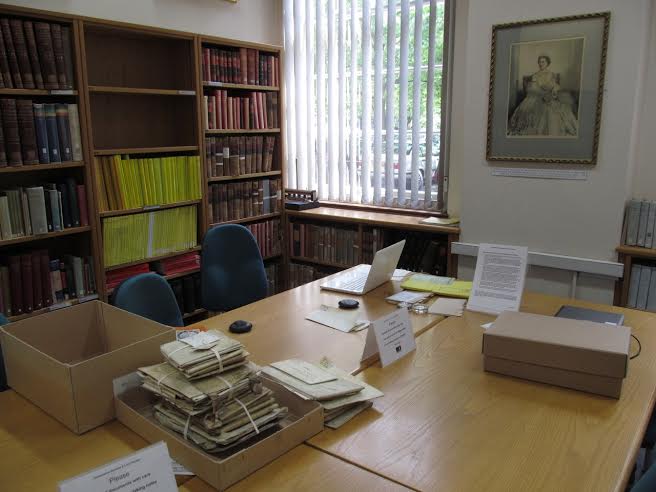
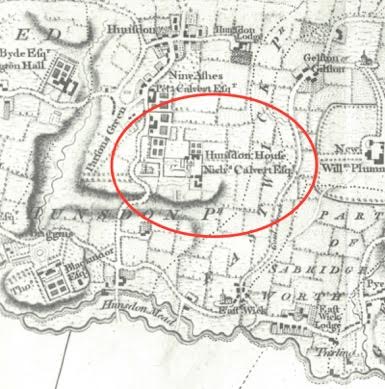
Today, I am looking into the history of Hunsdon House – a spectacularly ancient property in rural Hertfordshire for a private client. My work takes me all over the place and this morning’s destination is the archives at County Hall in Hertford. County and Borough archives are wonderful treasure troves and are open to anyone, free of charge – all you need is proof of ID. However, many are seriously underfunded and some archives I’ve visited are little more than filing rooms. Its a shame that Council finance officers seem so disinterested in their area’s heritage. Nevertheless, Hertford Archives is better equipped than most and I soon find a wealth of deeds and articles on Hunsdon House along with my favourite kind of document – maps.

A DAY IN THE LIFE  By Fiona Rule 3

Since the Babylonians carved a map of the world on a piece of stone back in the 6th century BCE, maps have told us far more than a book ever could because they put everything in visual context. For instance, Andrew Dury’s map of Hertfordshire, drawn up in the 1760’s tells me at a glance that at the time, Hunsdon House was the seat of Nicolson Calvert and it was set in elegantly landscaped grounds, with a patchwork of rural fields beyond. Now I have a name, I can find out more about the family.

By cross referencing the maps with deeds and other documents, I manage to piece together a timeline for Hunsdon House and its various occupants over the centuries. This forms the framework onto which I can build a more complete story through online research once I return to the office. I’ve found that this modus operandi works for any size of project, be it the history of one house or an entire area.

A DAY IN THE LIFE  By Fiona Rule 4

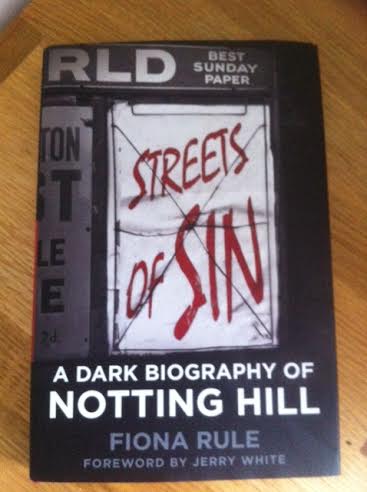
However, before I return to London, I have one final stop to make. I’ve arranged to meet a friend at a local pub to show her a copy of my new, “big” book – Streets of Sin, which is just about to be published. My books are a bit like children – I’m proud of them despite their flaws and I like to talk about them! Thus, I’m excited to show her this “hot off the press” copy. Thankfully, the reaction is positive and I wend my way home to face the biggest challenge of the day – to stop thinking about research and turn my attentions to more mundane, domestic matters. This can be terrifically hard, especially if I have uncovered something particularly tantalising. I wonder if Paul McCartney has the same problem when he’s writing songs?


Streets of Sin – A Dark Biography of Notting Hill by Fiona Rule Book Review

A DAY IN THE LIFE  By Fiona Rule 4

Think Notting Hill, the film, then wonder about Notting Hill, the place. Historian Fiona Rule has all the answers in her latest book, Streets of Sin. Rule has researched her subject meticulously, and presents it in a way that is accessible, and fascinating.

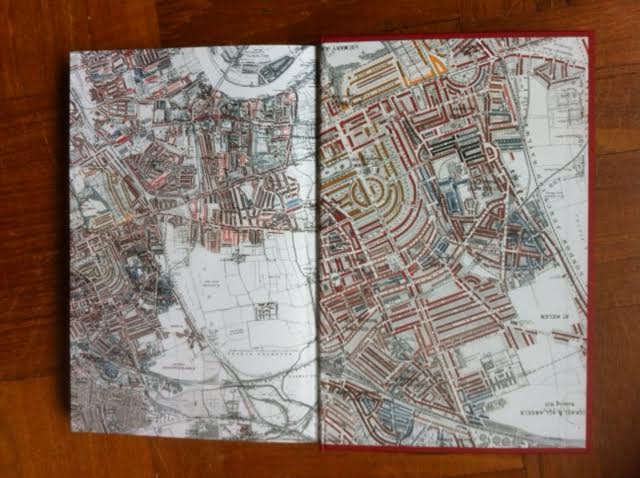
She takes us through the area, much as she does in one of her walks, tracing Notting Hill from its beginnings in the mid 1700s to the present. It began as a small rural community, some half an hour’s walk from the edge of the metropolis, and that half an hour was to be crucial in the initial failure of Notting Hill as a money spinning residential area for its developer. It was just too far from the centre to work as well as Marylebone or any of the closer developments.

Rule lifts the layers of Notting Hill’s history, revealing dreams gone wrong, broken people, piggeries, Rachman, the Profumo affair, and London’s first race riots. Add a dollop of characters such as the murderer Christie, and the musician, Hendrix, give it a good stir, and here you have, ladies and gentlemen – Notting Hill.

Streets of Sin – A Dark Biography of Notting Hill  by Fional Rule

I found Streets of Sin unputdownable. OK, my own research as an author leads me to devour anything historical, but walk these streets, put places to names, see what’s under the surface and you’ll be hooked. It is an easy read, an informative read. I loved it.

About the author: London-based historian, researcher and bestselling author Fiona Rule is widely respected as a specialist in the history of the capital and the Victorian era. She has appeared as an expert on several radio and television programmes including BBC London’s Breakfast Show and The Robert Elms Show, Find My Past and The Great British Story with Peter Snow. Her previous critically acclaimed historical titles include The Worst Street In London (Ian Allan 2008, reprinted 2009, 2010, 2012) London’s Docklands (Ian Allan 2009) and London’s Labyrinth (Ian Allan 2012).

Streets of Sin: A Dark Biography of Notting Hill by Fiona Rule (published by History Press 8th August RRP £17.99 hardback) is available to purchase online and at all good book retailers. For more information please visit www.fionarule.com or follow her @Fiona_Rule
 

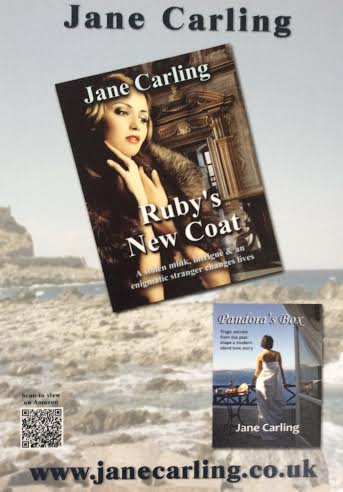
Flash Fiction: A Cuckoo in the Nest by Author Jane Carling

Flash Fiction- A cuckoo in the Nest by author Jane Carling.

Sitting at the back of the Crematorium, the handcuffs that bound her to two prison guards chaffed Josie’s wrists. She watched her husband’s coffin being carried to its final resting place to ‘I did it my Way’. Only one wreath adorned the casket, red roses, like his blood.

Rachel Hunt, dressed in a black, sat alone in the front pew, where Josie should have been.

How had it happened? They tell me I killed him, but I can’t remember.

It was last May, when spring hailed the first call of the cuckoo, that Rachel had returned from the Costa del Crime in the guise of a deadly blonde, now calling herself Samantha. That’s when the friend requests on Facebook began, and it took a while for Josie to realize from the profile that Samantha was actually Rachel, or rats’ tails as she was known in school.

Out of curiosity Josie clicked the accept button, a click she would live to regret.

“Why the new name?”  Josie replied.  A few minutes later messenger popped up.  “I’m a widow and want a new way of life in the countryside, a whole new beginning.  Don’t you ever want to reinvent yourself?”

Josie pondered,  “Why would I? I must go, Roger’s favourite risotto is ready, will talk soon.  Stay in touch.”

As the service continued Josie clenched her fists. The handcuffs rattled. I should have known better, she thought, and so should Roger. He was a successful businessman, for goodness sake, so how could he have been taken in by this woman? Had he always wanted a blonde in his life, was that it?

She winced as she remembered the simpering. “Oh Roger you are so clever, oh Roger, you are so witty. Oh Roger…”

Then the texts.  Good night my love, good morning darling, and laters babe…”  Laters babe?  Oh perlease. The lights reflected off her handcuffs. She should have checked his mobile sooner. Josie bit her lip. She recalled Roger’s denials and accusations when she’d confronted him. He’d argued that it was all in Rachel’s head, totally one-sided and that he loved her, Josie. Oh Roger what a big dick you were.

There was a draught as the door opened and the detective in charge sat down behind her.  Now what?  Can’t I just have today?  He whispered to one of the guards and as the vicar signaled for the curtains to begin be closed. Her cuffs were released and Stairway to Heaven began playing. Confused, Josie rubbed her wrists. ‘You’re free,’ whispered the guard. She placed her head in her hands as the curtains began to close and wept.

Rachel was hurrying out before the curtains closed. Too late though. She was arrested and bundled into a police car.  The detective waited until Josie had composed herself, then explained that formerly undiscovered CCTV footage had captured a blonde at scene of the crime, wielding the knife. It was Rachel Pratt, hustler, renowned con-woman and now a murderer.  Josie was free to go.

Later, sitting in her garden watching kites soar into the deep red sky as the sun set over the Chiltern Hills, images of that fateful day finally returned.  Roger had stepped in front of the blade that was not meant for him. Her husband had saved her life.

The distant call of a cuckoo broke the silence.

Flash Fiction- A cuckoo in the Nest by author Jane Carling.rubynewcoat

Jane Carling 2015 ©
www.janecarling.co.uk


Naming The Day: Jane Cable On Organising a Charity Litfest

Author and Frost contributor Jane Cable shares the first in a series of blogs about organising a charity litfestAuthor and Frost contributor Jane Cable shares the first in a series of blogs about organising a charity litfest

“This is fabulous” said my fellow Chindi author Christopher Joyce, reading about the Words for the Wounded grannies’ latest exploit. “Let’s do something to support them.”
I was so pleased. “Perhaps an event?” I suggested.
“Yes – we’ll have a litfest.”
Nothing if not ambitious, is Mr Joyce.

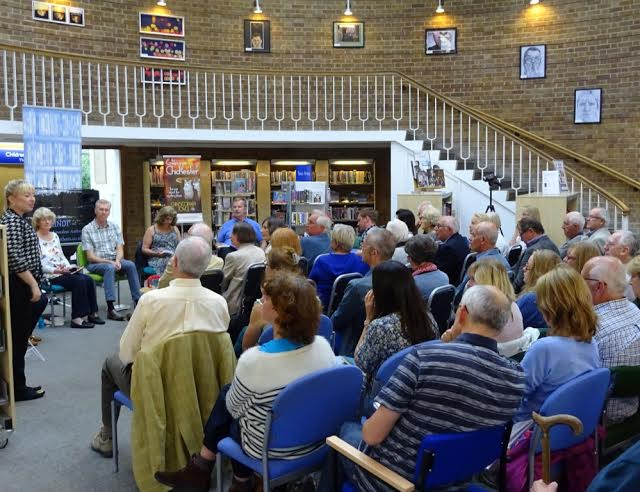
First, let me explain about Chindi; we are group of indie authors from the Chichester area who work together to share information on best practice in publishing and to promote our books. Christopher Joyce, a children’s author, is one of our founders, our chairman and all round powerhouse. And when he sees a great cause like Words for the Wounded, he can’t help himself but get stuck in.

When we put the idea of holding an event to raise funds for the charity to one of our monthly meetings most people supported it so we agreed to go ahead. But our calendar was already crowded with a series of Saturday morning workshops over the spring and summer and two events as part of the Festival of Chichester in June, so it had to be in the autumn. Plenty of time to arrange things then.

gardenAuthor and Frost contributor Jane Cable shares the first in a series of blogs about organising a charity litfest chris

The only person I know with more energy than Chris is Words for the Wounded chief grannie and Frost contributing editor, Margaret Graham. I sometimes worry about what will happen when we get them in the same room. But for the litfest, even Margaret exercised words of caution; Chris was planning a whole weekend – she thought perhaps a day would be fine.

We sketched out ideas of a structure and in the end compromised on a full day on the Saturday and a Sunday breakfast. Margaret would give a morning talk, then lunch with a keynote speaker, a family bookish treasure hunt in the afternoon and an informal fundraiser in a pub in the evening. Rounded off by a book-swap breakfast to nurse our hangovers.

For a while we suffered from chicken and egg syndrome; we had the ‘what’ and the ‘why’ – but should we now focus on the ‘who’, the ‘when’ or the ‘where’? Realistically it had to be when so we narrowed it down to a couple of dates when Margaret and her right hand woman Jan could make it.

Next was who: – we had Margaret, of course, but really wanted another writer as a keynote speaker. Once again we turned to Margaret – having read Words for the Wounded’s impressive list of literary patrons – and she suggested Elizabeth Buchan. I have to admit I was nervous emailing such a superstar of the writing world but I received an almost immediate reply – she would be honoured to help out, but she could only make one of the dates – 17th October.

So there you have it… save the day if you’re anywhere near the Chichester area – 17th & 18th October, Chindi’s Words for the Wounded Litfest.

But have we left ourselves too much to organise in too little time? Find out, dear reader, next month.

Learn more about…
Words for the Wounded: www.wordsforthewounded.co.uk
Chindi Authors: www.chindi-authors.co.uk
Margaret Graham: www.margaret-graham.com
Elizabeth Buchan: www.elizabethbuchan.com
Christopher Joyce: www.creaturesofchichester.com
Jane Cable: www.janecable.com


Ross Mabey Poet And Song-writer By Margaret Graham

Ross Mabey is 72 years old and was diagnosed with Parkinson’s Disease (PD) in November 2005. He was living in London UK for 15 years before returning to Australia in June 2014 accompanied by his wife Linda. Their son Jonathon, 28 years old, returned to Australia in 2012. During his working life Ross was employed in various roles in the Telecommunications industry in Australia and later in the UK. His interests include writing poetry, lyrics for songs and family history. He is also interested in researching to help find a cure for PD.

We published his feature on his work, and life a few days ago, with a promise of his poetry, and song-writing. Here it is. Enjoy.

Ross Mabey's poem and song

Poetry, A Song Of Life.

Poetry is a very personal thing,

That can lift your heart and make it sing.

Its rhythms can have a beat, like a song,

That makes you move your feet.

Or, it can be an intellectual panacea,

For those who seek life’s perfections,

Expressed in words of structured verse.

Which soothe the ripples, of this Universe.

Or, it can be a song of life,

That speaks of truth, love, joy, toil and strife.

Whatever, captures your imagination,

It can be the emotion, that adds to the tapestry of life.

Whatever appeals to your Universe,

Is hidden in words, rhymes and verse.

Their potency is felt by those,

Who feel the need to write, in anything but prose.

Copyright © 2006. Ross James Mabey.

Ross Mabey's poem cowriter

Song lyric – Montana Mountains.

By Ross Mabey and Jeffrey Ullsperger.

Verse #1

Montana Mountains, your son has come home,

Through majestic forests and valleys I now roam.

I look upon your mighty peak’s, towering above,

Their grandeur is what I can’t help but love.

montanamountains

Chorus

Montana Mountains, reaching for the sky,

Take me to a special place,

To nature’s perfect high.

You’re beauty captures my heart,

I will be yours faithfully.

So Montana Mountains won’t you,

Please speak to me.

Verse #2

By the campfire’s glow, at night all alone,

I am comforted knowing you’re part of my soul.

Surrounded by your beauty, every night and day,

The sun, the moon and stars do light my way.

montana

Chorus

Montana Mountains, reaching for the sky,

Take me to a special place,

To nature’s perfect high.

You’re beauty captures my heart,

I will be yours faithfully.

So Montana Mountains won’t you,

Please speak to me.

Bridge

When I die one day,

And home is Heaven above.

I’ll ask for a room with a view,

Of the mountains that I love.

Instrumental

Chorus

Montana Mountains, reaching for the sky,

Take me to a special place,

To nature’s perfect high.

You’re beauty captures my heart,

I will be yours faithfully.

So Montana Mountains won’t you,

Please speak to me.

Montana Mountains won’t you,

Please speak to me.

Copyright © 2009. Ross Mabey / Jeffrey Ullsperger.


Parkinson’s, Poetry And Song. Bring it on by Ross Mabey

(Australian pictures  by Brent Miller)

pic a Ross MabyIMGRoss Mabey is a poet and lyricist and was living in London when he was diagnosed with Parkinson’s Disease (PD) in November 2005. He returned to Australia in June 2014 with his wife Linda. Their son Jonathon 28 years old, had returned to Australia in 2012.

pic 1.Devils Marbles. NT Australia.

Ross told Frost Magazine:

My love of poetry dates back to my school days in Australia. In the late 1940’s and early 1950’s, the names of Australian poets were familiar in nearly every Australian household. Poets such as, Mary Gilmore, Adam Lindsay Gordon, Henry Kendall, Henry Lawson. These poets helped capture and shape the unique character of Australians of that time. Never underestimate the deep love of poetry in the Australian psyche.

!Job:   111180, Layout:        1!

In particular, poets were inspired by this light filled spacious country, and the unique characters that lived here. The wonderful Dorethea Mackellar expressed such a sentiment in “My Country”: “I love a sunburnt country, a land of sweeping plains. Of ragged mountain ranges, of droughts and flooding rains.” Andrew Barton (Banjo) Paterson in his poem “The Man From Snowy River”, speaks of a fearless character and his horse who without hesitation pursued wild horses down a steep mountainside, to finally round them up.

ic 3 BARRIER REEF

My love of poetry was rekindled in 1970’s when I joined a religious teaching, with a focus on creative/imaginative techniques to help individuals to understand life. However, it wasn’t until a few months after I had been diagnosed with Parkinson’s Disease (PD) in November 2005 at the age of 63 that I had a strong desire to write poetry and lyrics for songs.

!Job:   163006, Layout:        1!

Was it the shock of diagnosis, or the medication? Whatever it was, it wasn’t the moment to sit back and feel sorry for myself. I knew that if I wanted the rest of my life to be an interesting and productive experience, I must start creating the life that I wanted. I knew that part of the answer for me was to write lyrics for country songs, but how would I do that? And why country songs ? They were my favourite song genre, but I felt they needed a fresh approach.

Not being a musician and having little idea of how to write or structure these lyrics, I started to search the Internet looking for the answers. Eventually I emailed Jeffrey Ullsperger from Wisconsin in the US. He had experience in editing and co-writing country song lyrics. He also had a couple of songs published. Jeffrey agreed to mentor me in how to “craft” the lyrics for these songs.

pic 5. ARNHEMLAND

So 2006 brought a co-writing partnership. To date we have over 40 song “demos” produced and co-written the lyrics to other songs as well. The genre’s we write in now include Contemporary Country, Folk, Pop and the Blues. Several of our songs were entered in the UK Songwriting Contest over several years, and were rated  in the “Semi-finalist” category.

So how did this experience benefit me with regards to life in general and the PD symptoms that I have?

Without a creative interest of some kind, words like isolation, frustration and loneliness come to mind. Words like interaction, satisfaction, confidence and fulfilment were outcomes that were more appealing to me.

I am very grateful to Australia, for its beauty, co-writer Jeffrey Ullsperger for his patience, tolerance, kindness and help in this endeavour while suffering from his own health problems. Also, my gratitude goes to my wife, son, other family members, friends and many others for their love, understanding and support.

We will be featuring two poems by Ross Mabey soon. 


Words for the Wounded Independent Author Book Award Part 3

Over the last two weeks we’ve highlighted First and Second Place in the recent WforW Independent Author Book Award. Today we have the final winner, Eric Sinclair who achieved Third Place. Words for the Wounded Independent Author Book Award By WforW founder Margaret Grahamwordsforthewounded

As I keep saying to people, The Independent Author Book Award has been a revelation. There are just so many good writers out there, which made our task hugely enjoyable, if difficult. At last we decided on those who were to be commended, highly commended, and then – the winners. In the end, our decision was unanimous. Great books all of them. Thank you all so much for entering – rest assured that 100% of the entry fees go to the wounded.

Words for the Wounded Independent Author Book Award By WforW founder Margaret Grahampalamedes

Thank you, Palamedes PR for sponsoring a professional press release for the winner, and the opportunity of a discounted press release for 2nd and 3rd. Thank you Frost Magazine for publishing a review of the top three

The great good news is that Felicity Trew, of the highly respected Caroline Sheldon Literary Agency, is now representing the winner, Jane Cable.

Felicity Trew will also be our final judge for the 2015 Independent Author Book Award. The excitement is immense.

3rd place

Words for the Wounded Independent Author Book Award Part 3mandogstroke

Man, Dog, Stroke by Eric Sinclair

Man, Dog, Stroke by Eric Sinclair

This is the story of one man’s experience of the devastating effects of a major stroke, and his attempts to recover from it. It is also the story of a dog’s experience of life with unpredictable, irrational human beings.

Judges’ comments: Man, Dog, Stroke is a beautifully written and moving memoir of a stroke victim, with a chapter from time to time from his whippet’s point of view. This is a whippet who sees life, and events, from his side ‘of the pond’ and is a fantastic idea.

We laughed out loud, held our breath, and longed for Eric Sinclair to survive, and to thrive. Man, Dog, Stroke brought out the isolation experienced by stroke victims, the powerlessness when their lives are changed in just a few seconds, in of all things, a strange hotel room. The fear, the long fight back. ‘…The trouble was I didn’t seem able to move my legs or arms at all. With growing fright and disbelief I tried to roll over.’

It made us understand what a patient needs, and how absolutely crucial is good post stroke therapy.

It could happen to any of us. Read this. Laugh, and learn. It’s beautifully written.

Proceeds from the book will be donated to The Stroke Association.

Words for the Wounded Independent Author Book Award Part 3ericsinclair

Biog.

Eric Sinclair is a writer and education consultant living in Aberdeenshire who has worked in schools and colleges in West Africa, Turkey and Germany, as well as the UK. For ten years he was Head Teacher of Kirkwall Grammar School in Orkney, and subsequently was Head of Aboyne Academy, Aberdeenshire, before setting up his own education consultancy and training business in 2000. He was a part-time selector with the Voluntary Service Overseas (VSO) Assessment Team in London from 1989 – 2004.

Since suffering a major stroke in 2004, he has undertaken voluntary work for the Stroke Association, and is vice-chair of their Scotland Committee. In December 2011, he published – Man, Dog, Stroke – describing his experience of recovering from stroke in Oslo and Aberdeen. The sequel to this book is a blog of the same name. He has also published a number of articles in The Scottish Review.

Eric has been a public partner with NHS Healthcare Improvement Scotland and has extensive experience of managing change in a variety of settings, as well as the lived experience of dealing with a chronic health condition. In January 2015, he was appointed by the Scottish Government to the Board of NHS Grampian, which provides health and social care for Aberdeen and the north-east of Scotland.

Eric relaxes by walking and communing with his whippet, Archie, and by singing in a local choir.