Wine for Winter Nights 

It’s officially Winter and almost the countdown to Christmas (eeeek) so here at Frost we decided to toast away what has been a glorious Summer and a mild Autumn with some beaut wine offerings.

For our White Wine lovers we have gone for;

Villa Maria Sauvignon Blanc Private Bin

Villa Maria has long been a hit with consumers and New Zealand Sauvignon Blanc has continued to dazzle customers for a number of years now. As the most widely planted grape variety in NZ, Villa Maria have a few distinct Sauvignon Blanc styles dependent on regions of the country owing to the maritime climate. Here we try the Malborough Private Bin which features grapes picked from a combination of vineyards across two different valleys in Malborough. The result is an intense and herbaceous flavour noticeably distinguishable from Villa Maria Reserve Malborough wine which has grapes specifically from Wairau valley. Private Bin has a strong and fresh flavour alive with citrus and tropical fruits owing to the long sunny days and cooler nights. 

This is a flavoursome wine and can be enjoyed without food but with owing to its strong flavour, a glass with dinner will go down well. We paired it with Chicken and Mushroom risotto. 

Available from most good grocery stores. A full list can be found on their website:

www.villamaria.co.nz 

RRP: £9.69 (Waitrose price)

For a hearty RED recommendation we chose; 

Errazuriz Estate Series Carmenere 2017

This Chilean number is robust and pleasing owing to it being 90% Carmenere. The aromas are evocative of a classic wintery red with hints of black pepper, oak and nutmeg. A perfect fireplace wine. The balance of smoke and spice is the stand out essence which distinguishes this Carmenere variety, and ever so subtly sets it apart from the Merlot. The dash of Petit Syrah which makes up the other 10% adds to the aromatics of the wine.

Smooth tannins make this highly desirable on the palette with and without food and I would certainly recommend with rich dishes sweet and savoury due to the chocolatey nature of this wine. 

RRP: £10.50 

www.majestic.co.uk

Celebrate National Curry Week with The Spice Tailor 

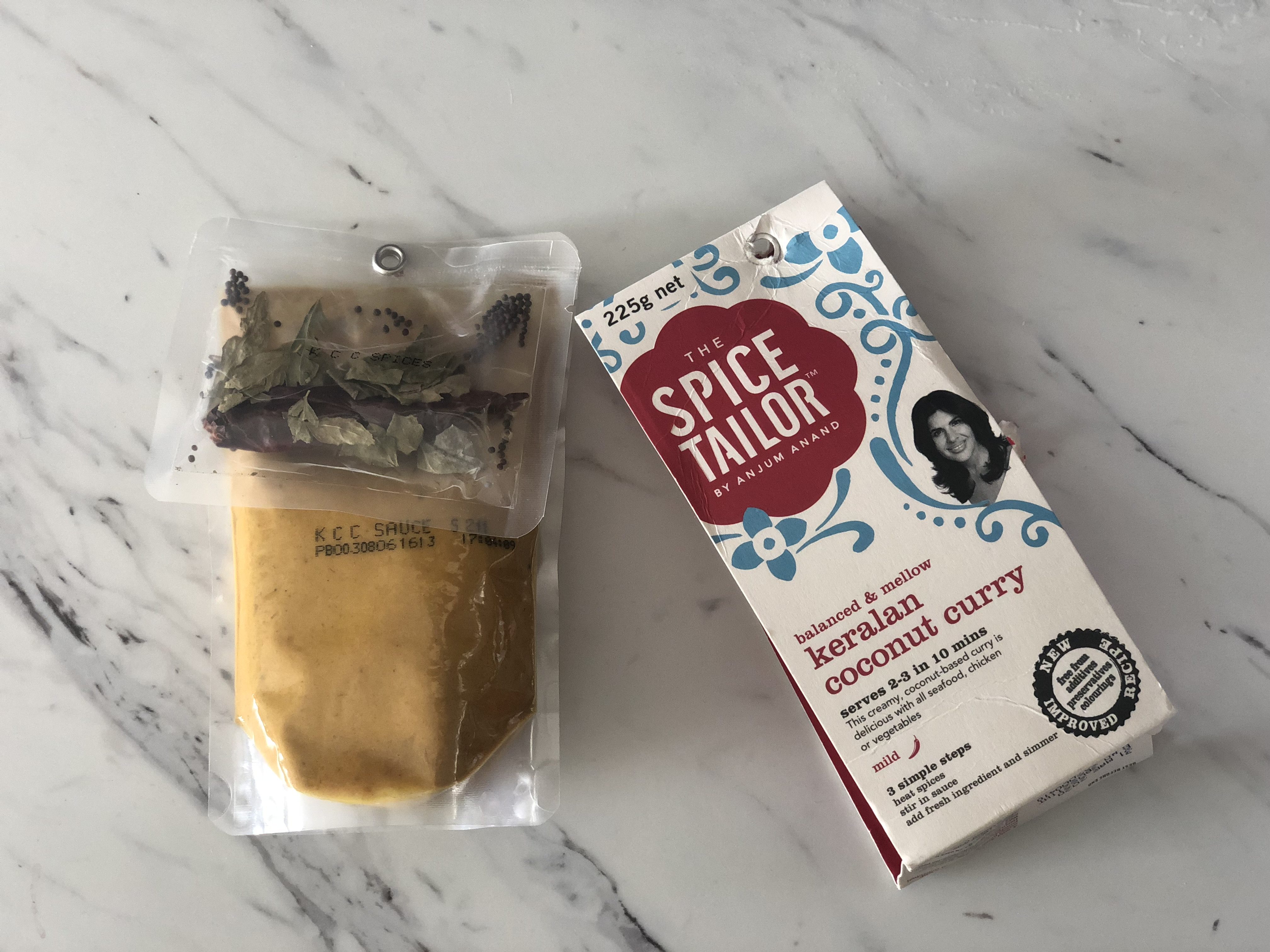
This week is officially National Curry Week and with the colder nights drawing in, we think there’s no better way to warm yourself up then with  Britain’s favourite spicy dish. Of course there are many fantastic Indian restaurants to try around the UK but why not try your hand at making something yourself. But fear not readers, The Spice Tailor have come up with a super range of ‘cheat’ sauces which are packed full of all the authentic spices and flavours to recreate your own authentic curry at home. Perfect for the most discerning cook, modern lifestyles and if you’re wanting to whip up a quick family meal which will impress your diners in less than 15 minutes. 

Developed by Anjum Anand in 2011 she set herself a mission to re-create the authentic flavours of India in a simpler, healthier and more accessible way. There are over 8 sauces to try in the range with something for each taste from Delicate Korma to Fiery Goan Curry. We tried our hand out at the Keralan Coconut Curry and not only were the directions incredibly easy to navigate, the flavours were out of this world and miles apart from any pre-made sauce we’ve tried before. The main difference is that the packet comes with not only a sauce but you are also provided with a sachet of the all important spices for toasting, the thing that really provides the depth of Indian flavour.

You might even fool yourself into thinking for a minute that you are a top chef with the flavours and aromas which emanate from this while you are cooking and the refined and complex flavours. The Spice Tailor sauce kits are priced from RRP £2.90 and available from most large retailers. Whats more, if you wanted to create an Indian feast, The Spice Tailor also has a range of Chutni’s, Naans, Daal and Street Food Kits. 

We paired our Keralan Coconut Curry with the Villa Maria Private Bin Gewürztraminer which was simply a marriage made in heaven. If you’re a fan of the Gewürztraminer you already know that the subtle hints of lychee and rose flavours are perfect with spice and the combo of the sweetness of the wine is just the antidote to the heat kick of the curry. This particular offering from New Zealand Winery Villa Maria was excellently balanced with a unique and rounded flavour due to the fact that the grapes are crushed and soaked for a time with the skins on to extract every bit of flavour. The only trouble I had with this wine was that it was over a little too quickly. Priced at only RRP £11.75 per bottle and available from Majestic wine we’re just off to buy ourselves some more. 

For more information on The Spice Tailor visit thespicetailor.com 

Villa Maria visit villamaria.co.nz 

The Grid: An Immersive Black Mirror/Dystopia Inspired Escape Experience

Image:  Courtesy of brand

The Grid is an immersive, multi-room alcoholic escape experience where patrons get to go undercover an Artificial Intelligence firm in an attempt to learn and defeat the “system”

The tech-driven escape experience challenges guests to puzzles across a series of rooms, with the bar as a backdrop.

Participants are invited to join The Grid, a secret society of individuals working to safeguard humanity’s future against machines.

On the day of the experience, they arrive undercover at the AI corp’s (neosight.org) HQ, where they must move between different rooms, interacting with the Artificial Intelligence and Neosight specialist technology as they try to stop the corp from crunching human data for the “greater good”. The 1.5 hour experience is full of surprises, bespoke tech and futurists tonics (sci-fi cocktails).

“I believe the future of hospitality is all about having fun. Fun now lies in experiences and not only food and drink. This is our first multi-room experience and I am very excited for it,” said Sebastian Lyall, Founder of Lollipop, the immersive experience group behind The Grid.

Lollipop is an immersive lifestyle group known for its experiential creations both here and abroad, including ABQ (abqlondon.com), The Bletchley (thebletchley.co.uk) and The Bunyadi (thebunyadi.com). The mission of the group is to design experiences that cater to the more demanding consumer of today. The group has also recently launched a drink at home wine experience, Vinny (wearevinny.com)

The Grid is set to open its door to public in July/Aug. The waiting list is now open and reservations will be released on a first come first served basis.

Tickets will be priced between £30-£40 per head for a 1h 30m experience and 2 cocktails.

Website: thegrid.london (use code 456712)

Multiseed Sourdough Recipe

Makes 1 loaf

Equipment round proving basket

DF, V+

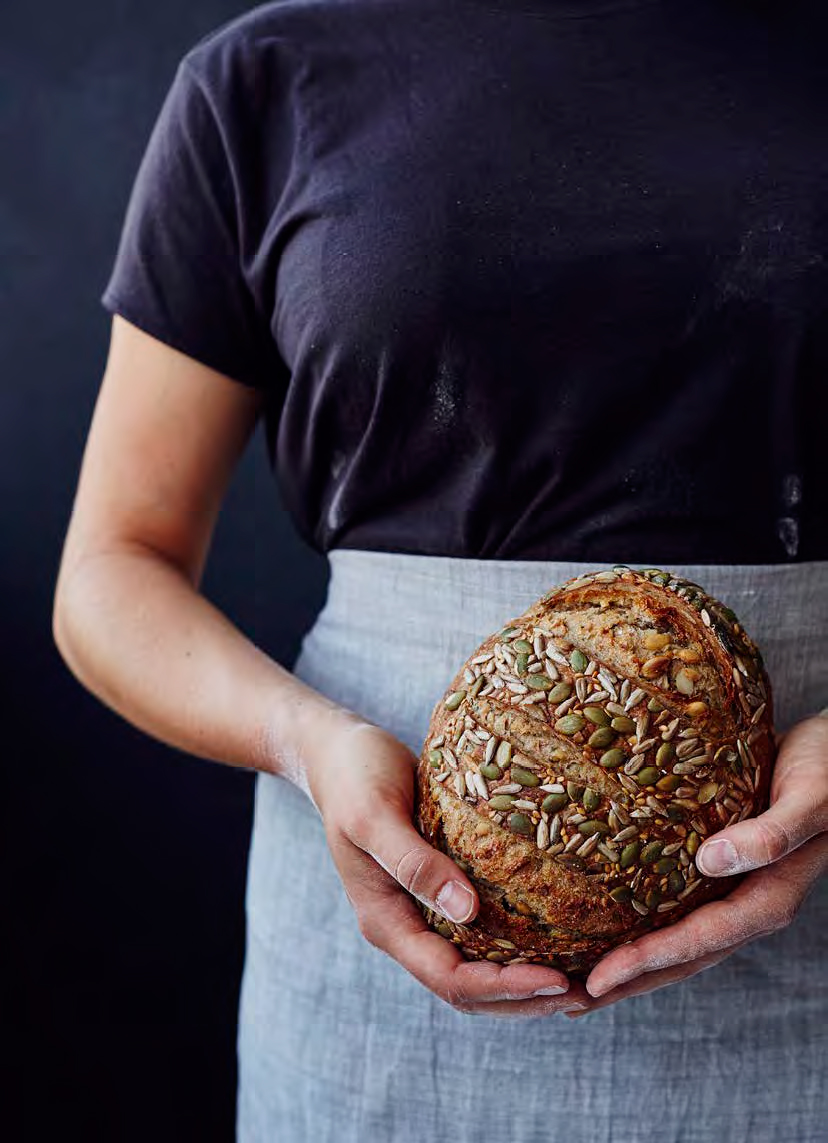
This is the most popular loaf at the bakery. It has a devoted following among regular customers – one family buys ten at a time for their freezer! – and the most frequent first loaf for new customers. It’s also popular with the restaurants we sell through. It is earthy and honest with primal qualities, no doubt the second leavened bread made by man. Under any analysis, made with well sourced ingredients this loaf is as healthy as it gets, with the seeds providing a protein

hit as well as extra fibre and layers of extra flavours. Yet despite all this goodness and history, it’s still an everyday loaf that every member of your family will enjoy. We make this in both a tin and a round shape. These instructions are for the round loaf, but you can use any of the alternative shaping instructions from other recipes.

Day 1

50g strong white flour

50g water, at hand warm temp (32–37°C)

Active wheat starter (see below)

Mix the flour and water with the whole

quantity of the starter and leave loosely

covered at room temperature overnight.

35g sunflower seeds

35g pumpkin seeds

35g golden flaxseeds

15g sesame seeds

335g water

Soak the seeds in the water and leave at room

temperature overnight.

Nutrition Note:

We soak the seeds for a couple of reasons. The first is to do with the bread-making process. If you don’t soak the seeds they will absorb water from the dough, resulting in a drier dough and a heavier texture in the bread. So soaking the seeds guarantees a much more consistent loaf. The other benefit is that you activate them, which makes them release additional nutrients so that they are easier for your body to absorb.

Day 2

100g recipe starter made on Day 1

Water and seed mix from Day 1 (above)

335g strong white flour

40g rye flour

8g salt

Extra seeds for topping

1 In a large bowl combine the recipe starter with

the water and seeds and mix gently.

2 In another bowl combine the two flours and

the salt.

3 Add the flour mix to the first bowl and mix

using one hand until a dough forms. This takes

only a couple of minutes. It’s a good idea to

use only one hand, leaving the other one clean

for using utensils, etc. Use a plastic dough

scraper around the bowl to make sure all the

flour is mixed in. Cover the bowl with a shower

cap or damp tea towel and leave it to rest

at room temperature.

4 After 5–10 minutes, give the dough a fold in

the bowl. Use slightly wet hands to prevent

the dough sticking to them. Pull a section

of the dough out to the side and fold it into

the middle of the ball. Repeat this going

around the ball of dough until you get back

to the beginning (four or five folds). Use the

scraper to turn the dough upside down, cover

the bowl and leave for another 5–10 minutes.

Repeat this three times. After the final fold,

cover the bowl again and leave to rest for

1 hour at room temperature.

5 Turn the dough out of the bowl onto a lightly

floured surface. Stretch out one side of the

dough and fold it into the middle. Repeat

this with each of the four ‘sides’ of the dough.

Put the dough back in the bowl upside

down and leave to rest for another hour

at room temperature.

6 Shaping a round loaf: Once the dough

has rested, turn it out onto a lightly floured

surface. Stretch one side of the dough out

and fold it into the middle. Repeat this all

around the outside of the dough until you

get back to your starting point. Flip it so the

seam side is facing down. Use your left hand

to hold the dough in place and use your right

hand to rotate the dough, tucking it under

and tightening it as you go around (if you are

left-handed you might want to use your right

hand to stabilise and your left hand to rotate).

The idea here is to increase the strength of

the dough without tearing it. The final surface

of the dough should be taut to the touch.

7 Put the remaining seeds in a bowl. Brush the

top of the dough with water and dunk it in the

seeds so that they are evenly spread over the

top. Place the dough so that the seam is facing

up and the seeds face down in a round proving

basket. There is no need to flour the basket

as the layer of seeds will prevent the dough

from sticking.

8 In the bakery at this point we put the dough in

our cool retarder cabinet for it to prove slowly

overnight. This helps it to develop more flavour

and become even healthier as it ‘pre-digests’

more of the gluten and ferments even more

probiotic qualities. Your version of our retarder

is your fridge – and you can leave the proving

basket in it overnight, covered with the tea

towel or shower cap. Take it out as you are

heating the oven. It’s fine for it to go in cold.

However, if you would prefer to speed things

up a little, at this stage you can simply leave

the dough in a warm place (ideally 24°C) until

it has more or less doubled in size. This should

take 2–4 hours. To test when the dough has

proved enough, press your finger about 2–3 cm

into it, then remove. If the dough pushes back

out slowly it is ready. If it springs back quickly

it is under proved; if it doesn’t spring back at

all, it is over proved. There isn’t much you can

do about that. The bread will be edible, but

more liable to collapse.

9 Preheat the oven to 250°C/fan 240°C/

Gas mark 10 or the highest temperature on

your oven. Place a roasting dish in the bottom

of the oven to heat up. Fill a cup with water

and place to one side ready to use. Also put

a flat baking tray in the oven to heat up.

10 When the oven is up to temperature, take the

hot baking tray out, lightly dust it with flour

and then turn the dough from the proving

basket out onto the tray. Slash the dough with

a sharp knife. Make sure that when you slash

you use one quick, smooth action, do not saw

at the dough. This will give you a much cleaner

line. In the bakery we use a single diagonal

slash down the loaf, but there are endless

variations you could use – be creative, define

your own distinctive pattern.

11 Place the baking tray in the oven and pour

the glass of water into the preheated roasting

dish at the bottom of the oven. The moisture

from this makes the dough lighter, helps

to set the crust and gives it a lovely sheen.

12 Turn the temperature down to 240°C/

fan 220°C/Gas mark 9 and bake for

approximately 30 minutes. To check if the

bread is baked through, tap the bottom –

it should sound hollow.

13 Leave the bread to cool for at least an hour

before eating. If you eat it when it’s still hot,

it will not have settled and so will be more

difficult to digest.

Making Your Sourdough Starter

A sourdough starter is how we cultivate wild yeast in a form that can be used for baking and has been done for thousands of years. The easiest way to make one is simply to combine flour and warm water and let the mixture sit for several days. In theory, you will only need to do this once in your life and it is unique to you.

The start is the magic, the genius, at the heart of everything we do and everything in this book. It’s an ancient technology, discovered by accident and passed from generation to generation. It forms the basis of transformation foods with unbelievable powers of preservations and flavour.

A lot of people are intimidated by the idea of making and keeping a starter, but it really doesn’t need to be daunting and is in fact something a child could do, getting a starter going takes 2 minutes a day, over 5 days. It’s really not that much effort at all. If you use it on a regular basis, maintaining it just becomes part of your bread and baking routine, and if you do not use it as regularly, or you’re going on holiday and are worried about leaving it for a while, don’t be. It can cope!

Keep your starter in the fridge unless you are using it every day. Bring it out to top it up, then return it when you have finished using it in your recipes. It will be fine there even for a few months without being used. It may separate in the meantime, but don’t panic, just mix it back together. To get it going again you want to really overwhelm it with food. So throw half of it away and add 100g flour and 100g warm water. Leave it overnight at room temperature and the next day it should be active again, i.e. bubbling away. It really is that straightforward.

At this stage you could use it, but we would actually recommend throwing half of it away again and topping it up with however much you need for your recipe. We find that by taking that one extra day with a rejuvenated starter you get a much more active starter, resulting in a better flavour and rise in your bread.

A sourdough start is also known as a ‘levain’, and sometimes a ‘mother’ (because it keeps producing babies).

In the bakery, we have three bread starters: wheat, rye and brown rice for gluten-free baking. For our basic sourdough, we use the wheat starter. This has an almost cheesy smell to it and a slightly more mellow flavour than the rye starter.

Wheat Starter

Equipment A container with a lid or a clean jam jar

Day 1

  • 1 tsp strong white flour
  • 1 tsp water, at hand warm temp (32-37oc)

Mix together the flour and the water in a container with a lid. We recommend mixing with your hands rather than a spoon. As disgusting as it might sound, we all have naturally occurring yeasts on our hands, so this can give your starter a real boost.

Leave the mixture overnight at room temperature. Cover it with the lid but do not make it airtight. A screw-top jar with the lid partly done up is perfect. You want the yeasts in the air to get in, but you also want to stop the mixture drying out.

Day 2

  • Wheat starter made on Day 1
  • 1 tsp strong white flour
  • 1 tsp water, at hand warm temp (32-37oc)

Throw away half of the mixture from Day 1. This is because you want to almost overwhelm the bacteria/yeast in the starter with food, by adding more flour than the weight of the original mixture. You could do this by adding more flour and warm water and not throwing any away, but you would very quickly end up with an excessively large amount of starter.

Stir the flour and water into the remaining mix and leave again at room temperature overnight.

Days 3 and 4

Repeat Day 2

Day 5

By now you should notice your starter has bubbles in it. This means it is ready! Don’t worry if it smells acidic or cheesy, this is completely normal and each starter will create its ow unique fragrance. Now you have your own living, bubbling jar of healthy microbes that you’ll be using for years to come.

How to use your starter in baking

Now you have your active starter you’re ready to start sourdough baking. The first thing to remember is that to make sourdough recipes you will need to build up your active starter (using all of it) the day before your bake. How to do this is detailed in each recipe under the heading on Day 1.

Having built your starter up, you will need to use most of it for the recipe (in the recipe we refer to it as the Recipe starter). What you don’t use, you retain as your ongoing active starter for your next recipe – you don’t want to have start from scratch each time! This all sounds more confusing that it really is.

Trouble-shooting

If the starter isn’t obviously bubbling, keep repeating Day 2 until it starts to. Quite a few factors can affect how long it takes a starter to activate, temperature being one of the main ones. If you begin your starter in cold conditions it may take longer to get going. Also, the general environment can have an impact. In the bakery, as we are making bread every day, there is so much yeast in the atmosphere that we find starters can take just a few days to get going, whereas if a kitchen is more sterile, it’s likely to take much longer.


Modern Baker: A New Way To Bake by Melissa Sharp with Lindsay Stark (Ebury Press, RRP £26). Photography by Laura Edwards. Available from amazon.co.uk

 

Celebrate Valentine’s Day with Viña Real Wines.

The look of love is in the air and we think Valentines is the perfect reason to wind down with a delicious dinner paired with a superb wine. Whether you’re sharing the day with a loved one, celebrating Galantines or just spending the evening enjoying your own company, Viña Real wine will not disappoint. Now we must admit, we were sent this wonderful package of wine weeks ago but with dry January in full tow we didn’t want to leave out any folk so here’s why Viña Real should be your top choice this week.

The award winning Spanish wine brand CVNE have continued to supply us with a wide range of quality Rioja wines since 1879. With age only comes wisdom and the winery, which is split into four, include Viña Real. The wines we tried were Viña Real Crianza and the Viña Real Barrel Fermented White but the brand also stock four other wines including a Rosado and a Gran Reserva.

First up the Viña Real Crianza, this is a charming red with a flavour of deep dark berries. This is a spicy red perfect for the Winter months and great for sipping with roasted meats. This wine is very easy to drink and can be found in Gordon’s Wine bar in London for £28 per bottle buy you can get this for a fraction of the price from a good wine retailer. This bottle certainly delivers much more than it’s modest price tag. Great value and great all rounder we think this would suit even the most discerning palette.

If it’s a quality white you’re after than the Viña Real Barrel Fermented white comes highly recommended. This wine is made up of 100% Viura or Macabeo grape which has become increasingly popular and is usually used to make up Cava wines. The barrel fermentation means that the wine is fermented in smaller oak barrels as opposed to large stainless steel and helps to highlight the texture which is creamy and light and helps preserve the fruit aromas, in this case gooseberry and honeysuckle. Again a moreish and fantastic value wine with an average price of £10.95

To find out more about CVNE and Viña Real wines visit www.cvne.com

Cocktail Ideas: Missy Flynn’s 2017 Round Up

In our final instalment of Cocktail Ideas before the big day, we’ve got some inspiration from cocktail expert and mixologist Missy Flynn. This week the cocktails featured are a step away from being quintessentially Christmas but a round up of the biggest food and drink trends of 2017 in a glass. Inspired by foraging, veganism and superfoods, we simply love the colours and healthy element of these cocktails. We think they would be the perfect day-after partying tonic for you to refresh yourself and unwind as well as being utterly instagrammable so impress and wow your friends and family and serve up these delicious cocktail creations this week and if mixing up your cocktails is not for you fear not, All Bar One will be serving these very cocktails all the way until New Years Eve.

From Left to Right: Baileys Blush, Turmeric Sour, Beetroot Mule, Tanqueray Forager Smash

Our star cocktail this week is the;

Captain Morgan – Turmeric Sour

Ingredients:

50ml Captain Morgan Spiced Gold
75ml Funkin Sour mix
15ml ginger syrup
1/4 bar spoon turmeric
Lemon twist and mint sprig to garnish

Glass: Rocks
Ice: Crushed

Method:
Add the Captain Morgan Spiced Gold, sour mix, turmeric powder and ginger syrup to a shaker or jam jar.

Seal the shaker or jam jar and holding it closed, carefully ‘dry shake’ so that the sour mix begins to emulsify the drink, building a froth.

Open the shaker, add ice and then shake again.

Strain over ice into a tumbler. Using a zester, take the peel from a lemon and snap it over the drink to expel oil from the skin, resting the peel in the glass.

Clap the mint between your hands to release its aroma and then place inside the drink as garnish.

Bailey’s Blush

Ingredients:

35ml Baileys Irish Cream
50ml Half and Half cream / milk
15ml Cherry Heering
12.5ml cherry syrup
Garnish with raspberry dipped in edible glitter / gold

Glass: Coupe
Ice: None

Method:
Add Baileys, Half and Half cream / milk, Cherry Heering, cherry syrup and ice into a cocktail shaker.
Shake hard!
Double strain into a chilled coupe or martini glass, use a tea strainer to remove any small shards of ice so the drink is nice and smooth.
Roll raspberry in edible glitter or gold until it reaches your desired level of glam, cut a slit in the base of the raspberry and rest it on the edge of the glass.

Tanqueray Forager Smash

Ingredients:

50ml Tanqueray London Dry Gin
25ml lime juice
20ml sugar syrup
Mint leaves
Pea shoots
100ml soda
Garnish with pea shoots, viola flower and mint

Glass: Copa
Ice: Crushed

Method:
Fill a tall glass with lots of ice, add the Tanqueray London Dry Gin, lime juice and sugar syrup. Stir to mix, and top with soda water. Add a little more ice if needed. Gather all your herbs and flowers and toss into a rough mix, dress the drink with this mix, scattering a few extra flowers on the top.

All cocktails featured are available in All Bar One bar’s until New Years Eve and liquors and ingredients are available to purchase through ocado.com

Cocktail Ideas : Tanqueray Edition

Every weekend until Christmas we will be offering you up some lovely cocktail ideas which you can use to celebrate the occasion or to create your very own cocktail guide with to use all year round. This week we were sent some exciting Tanqueray cocktails created by presenter Miquita Oliver. We think you will love her daring twists on some Gin cocktail classics.

First up the Tanqueray Martini – This is probably my favourite cocktail ever. Simple, sophisticated and packs a punch. Miquita has created;

Tanqueray Martini with Ginger Chilli and Coriander.

45ml Tanqueray London Dry Gin
10ml Chilli infused Cocchi Americano
10ml Chilli infused Dolin Dry
5ml Ancho Reyes Chili Liqueur
1 dash orange bitters
Atomised with coriander & ginger spray
Garnish: Coriander leaf

Stir all ingredients over ice and strain into a chilled martini or nick & nora glass
garnish with spray and float a coriander leaf in the drink

For the Chilli vermouth infusions
Take 2-3 dried whole chillies and break their skin and put straight into the bottle and allow to infuse for 1.5 hours – taste after this time to check that the chilli has infused – depending on the strength of the chilli it may need a little longer but this should add a gentle heat to the vermouths – after this time strain and rebottle

For the coriander & ginger spay
Infuse coriander and ginger for 1.5 hours. Strain. Transfer liquid to any plastic atomiser

The Green Tanqueray Tonic –

A refreshing and zesty green take on the G&T


For the Syrup:
500g Sugar
1.5 Litre Water
350g Cucumber
1.5 Granny smith apples (cored)
20ml Lime juice

Heat sugar & water up together and leave to cool to make sugar syrup
Blitz cucumber, apples and lime in a blender and strain. Add to the sugar syrup.

To serve:
40ml Cucumber and Apple syrup
25ml Tanqueray
topped with Fever tree tonic

Garnish:
Pleated cucumber peel (full length of cucumber) pierced by a cocktail stick and rested on top

The Red Tanqueray & Tonic

The Red Tanqueray Tonic – perfect for Christmas, we love the spicy notes and cranberry twist.

For the Syrup:
500ml water
150g Sugar
100g Cranberrys
10g Cinnamon
10g Black Cardamon

All except sugar in a pan and  bring to the boil and simmer for 20 mins
Reduce to about half as much water and add the sugar. Simmer for another 4 mins on a low heat, remove the spice cinnamon & cardamon and blitz the rest. Strain.

Serve:
35ml red syrup
10ml Lemon juice
2 dash angostura bitters
top with fever tree tonic

Garnish:
3 cranberries on a cocktail stick

Tanqueray is available to buy from multiple major retailers. For more details visit www.tanqueray.com

Feeney’s Irish Liqueur – An Essential For The Christmas Drinks Cabinet

Frost loves Feeney’s Irish Cream Liqueur. The gold standard in Irish cream liqueur. Smooth, delicious and festive. It would not be Christmas without it.

A Christmas drinks cabinet wouldn’t be complete without an Irish cream liqueur. Feeney’s Irish Cream Liqueur is a luxurious Irish Cream Liqueur, masterfully distilled and matured for at least three years in Abbeyleix, County Laios, Ireland. Made with barrel-aged, single malt Irish whiskey blended with milk chocolate and the finest quality Irish dairy cream, farmed fresh from cattle grazing in local pastures, Feeney’s Irish Cream Liqueur is rich, smooth and deliciously creamy.

An excellent Christmas cocktail would be Feeney’s Espresso Martini:

Using a cocktail shaker, shake 30ml Feeney’s, 25ml Expresso Coffee and 25ml Premium Vodka with ice and strain into a cocktail glass. Garnish with three coffee beans.


1 litre bottles are available from: Tesco, Asda and 31Dover.com from £12.00 per bottle. ABV: 17%

https://www.tesco.com


70cl bottles are available from: 31Dover.com, Master of Malt and Amazon. RRP: £12.50 ABV 17%

https://www.amazon.co.uk