I Want You To Know We’re Still Here by Esther Safran Foer. Review by Annie Clarke

How do you remember someone who has left no trace?
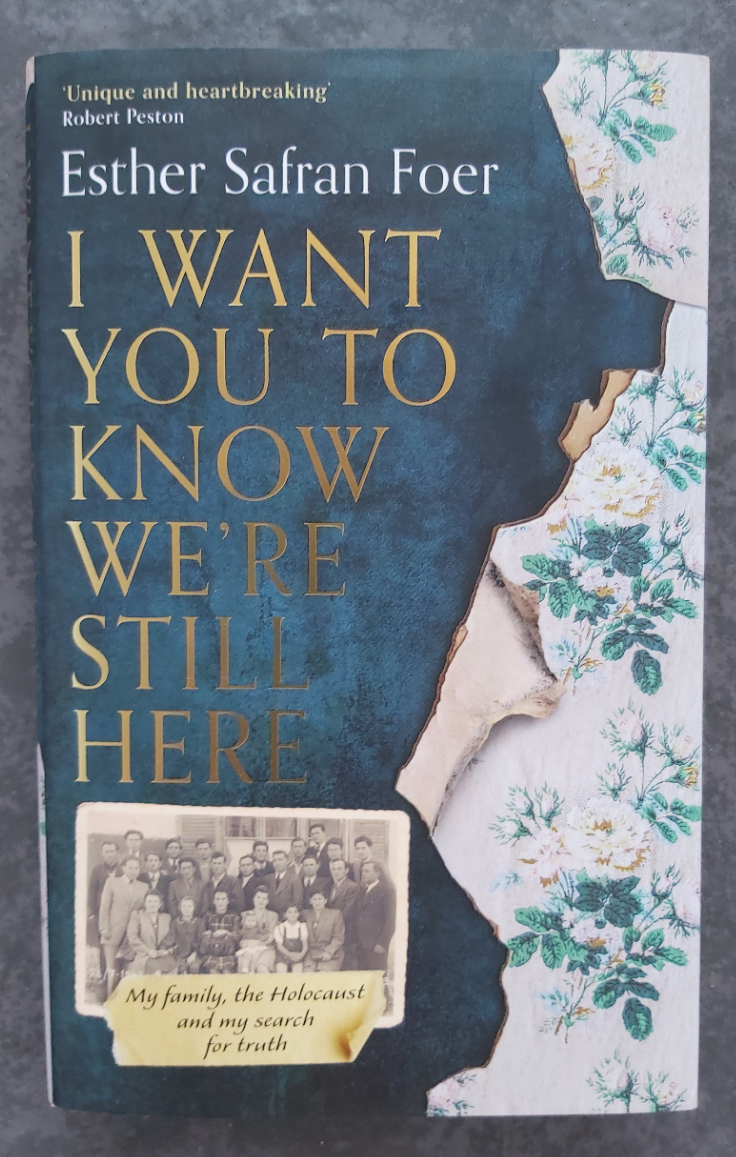
 

Esther Safran Foer grew up in a family where the past was too terrible to speak of. Her parents, the only members of their families to survive the Holocaust, never shared the horrors they had suffered.

There was silence where the past should have been.

So when Esther’s mother makes an astonishing revelation about her father, Esther resolves to follow the trail, wherever it may lead.

This is a powerful memoir of one woman’s extraordinary journey to find answers to the burning question about her past, her ancestors, what they endured and how they survived – that could never be asked until now…

So, let me gather my thoughts, for this is Esther’s story that she has shared with us, revealing her determination to remember those she’s lost, and find kinship after tragedy.   This is a memoir that draws a distinction between memory and history, and then attempts to make a cohesive whole of the two.

Like all of us, Esther’s mother remembers in fragments. As we revisit and revisit the fragments more details might emerge, are they imagined, or factual? Where does it leave the search for a personal history, perhaps though, more than personal, but the history of a region, a town, a tribe. It entails paperwork, travel, searching, always searching, matching memory to history.

And how well this is conveyed in this memoir. The search – was memory true, was it factual?

I have experienced this to some extent. My maternal grandma died when mum was two. There are no photos. Mum remembered her in fragments, but spoke of it only when asked, and that as we were adult. Was it because it hurt, made the loss, the aching vacuum,  real?  But those fragments she began reveal were the memories of others.. Were they accurately remembered by the teller? Had mum remembered accurately  what she had been told? Who knows, after much investigation we were none the wiser. So we are left with fragments, and these have begun to fade.

In this zigzag of a book, with memories, and history intermingling, double backing, rushing forward, we learn about life in Kolki, Ukraine, home to Esther’s family, a shtetl, where so close are the kinship bonds that your best school friend, is likely to be the child of your second cousin, for this is where  your tribe has lived for generation, after generation. It is more than a town, it is your world, your friends, your family.

You hear that the Nazis are coming. You believe the horror stories you have heard perhaps because you are a young adult. Others don’t leave. It’s nonsense, or, this will pass. You leave the safety of the shtetl , you leave your mother without saying a proper goodbye. Your sister gives you a spare pair of shoes. You drop one as you flee. These two incidents haunt on. You didn’t say goodbye, you dropped a shoe, a gift from a sister.

You are just  in time, because soon armed Nazis anti-semites enter your shtetl, your world.  Perhaps they pack  up inhabitants  take them to nearby fields, (march or lorry, babies being carried, children clutching skirts) where they must dig great ditches, into which they tumble when shot; men women children. All Jews. Or perhaps to a camp. Not just one shtetl, but all the shtelts.

There is no-one left to tell the history of your family’s shtetl, or the neighbouring shtetl’s history. Where is your mother who you did not bid farewell, the sister whose shoe you dropped?

What about other survivors. They can remember their own stories, in the turmoil, fear shock, perhaps,but can only surmise about the fate of families.

This book really, though about one family, is about all families.

I Want You To Know We’re Still Here is unique. It is a evocation of a lost world, of an unimaginable sin, of the annihilation of history from the perspective of the victims, so that it is the survivors who pursue the memory to reach the town, to locate the truth. to tell the truth, to show that ‘We’re Still Here.’

Esther Safran Foer goes on that journey.

Heartbreaking, perhaps best read in small doses,a journey into memory and the past in the search for truth.

I met a friend in London  a very few years ago, who had returned to the UK from her ‘now’ home abroad. She wore a necklace, a Star of David. I could see it over her clothing as she walked up the platform towards me, a broad smile on her face. She reached out to me.  ‘Wear it inside your clothes,’ I said. ‘Just to be safe.’

She said, sad despair in her voice, ‘You are the second who has warned me of this, a stranger on the train as we approached London, and you, my friend. My mother would have been packing our cases, leaving them in the hall, ready for flight, again.’

Read this, feel it, applaud the author. You will not forget it. Indeed it must be remembered.

Hardback and e-Book  available now.  Paperback 16th April.   Pub HQ.

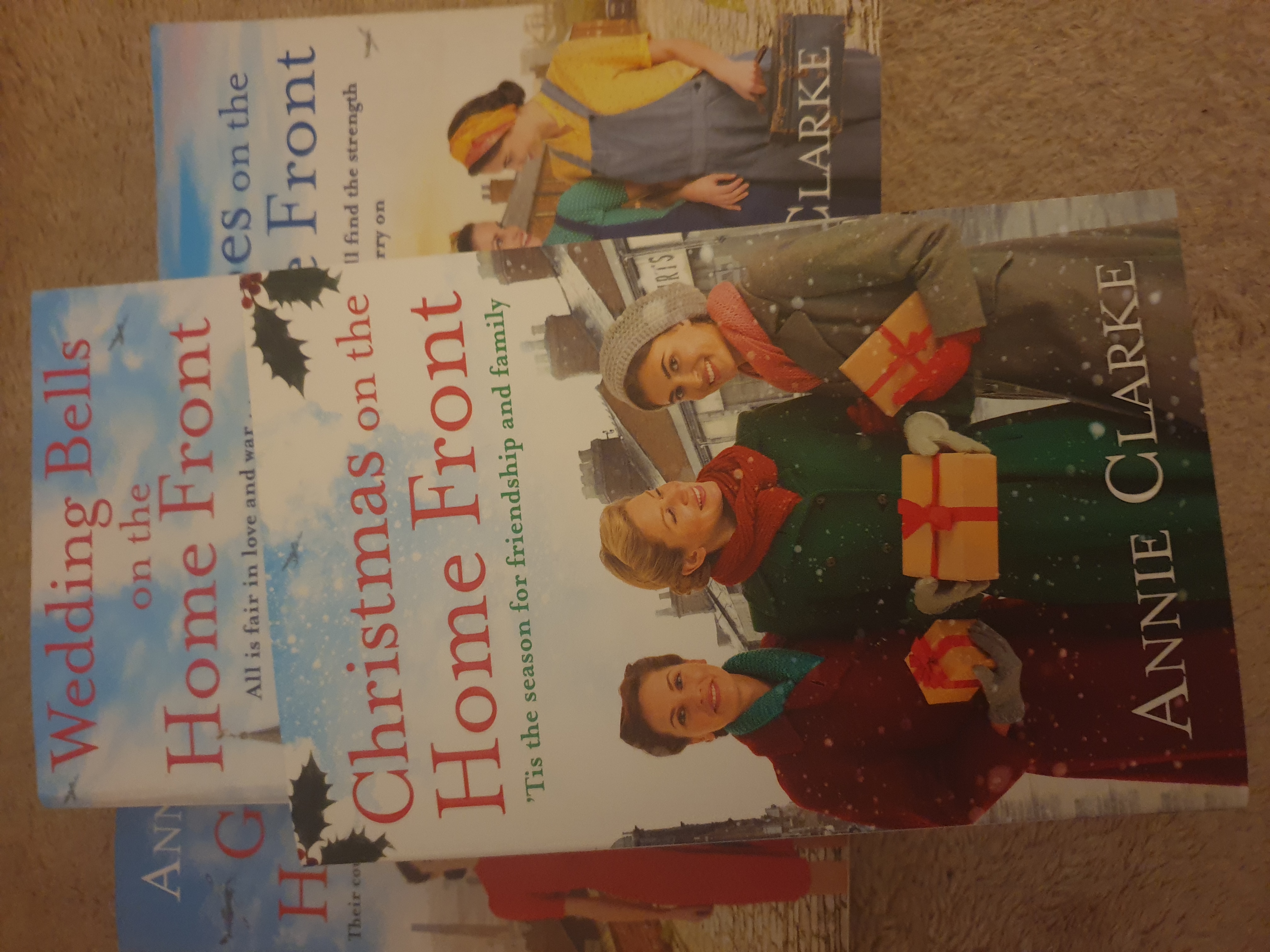
Annie Clarke is the author of the Home Front series.
 

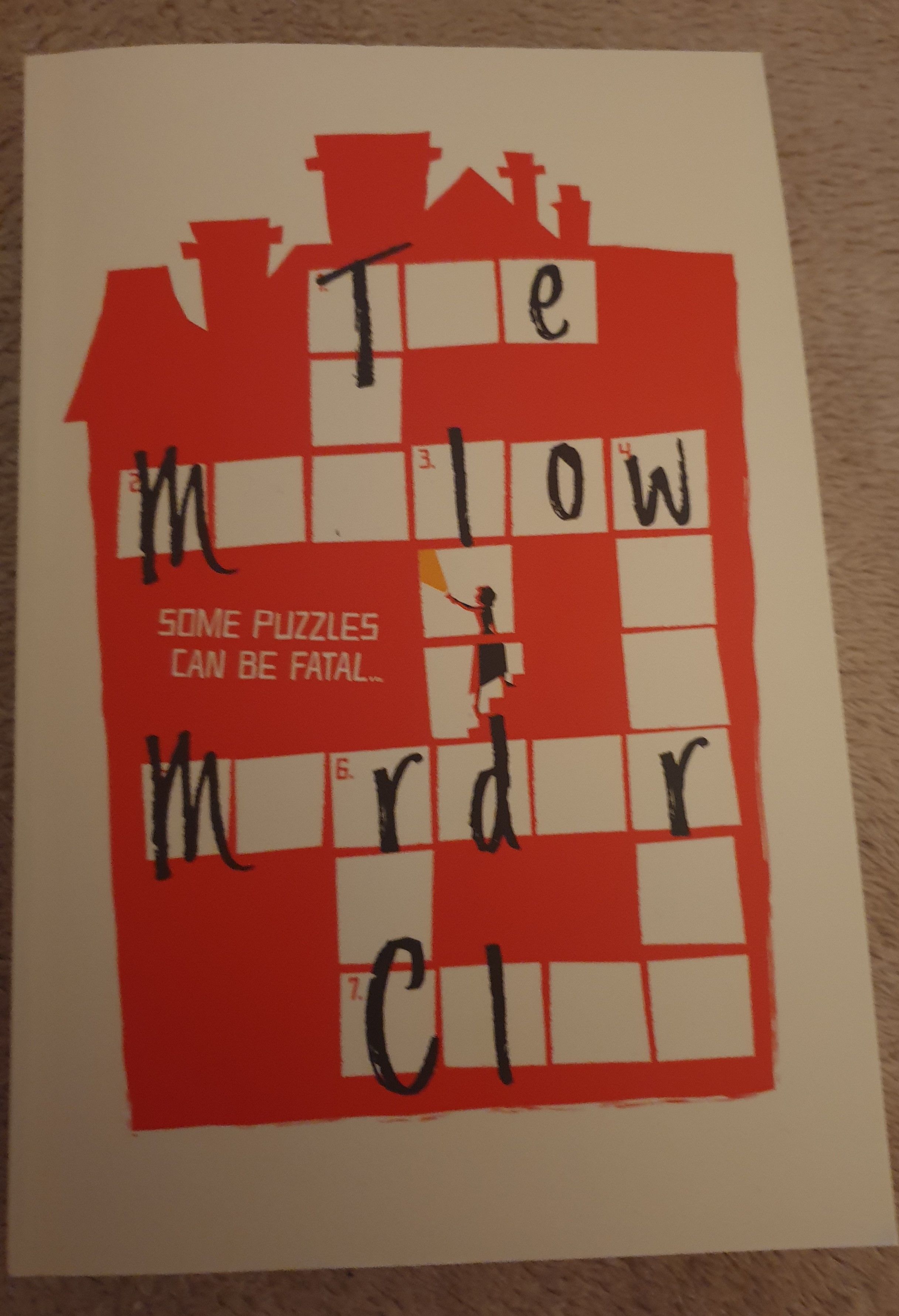
The Marlow Murder Club  by Robert Thorogood, creator of Death in Paradise: Reviewed by Natalie Jayne Peeke, West Country Correspondent.

From the creator of the BBC One hit TV series, Death in Paradise

To solve an impossible murder, you need an impossible hero…

Judith Potts is seventy-seven years old and blissfully happy. She lives on her own in a faded mansion just outside Marlow, there’s no man in her life to tell her what to do or how much whisky to drink, and to keep herself busy she sets crosswords for The Times newspaper. 

One evening, while out swimming in the Thames, Judith witnesses a brutal murder. The local police don’t believe her story, so she decides to investigate for herself, and is soon joined in her quest by Suzie, a salt-of-the-earth dog-walker, and Becks, the prim and proper wife of the local Vicar.

Together, they are the Marlow Murder Club.

When another body turns up, they realise they have a real-life serial killer on their hands. And the puzzle they set out to solve has become a trap from which they might never escape…

I am a huge fan of the hit show Death in Paradise, so you can only imagine my excitement when I heard about The Marlow Murder Club.  I devoured the book in a couple of sittings. Not only is it mysterious and thrilling but  heartfelt and amusing. It truly is like nothing I have ever read before.

Similar to the TV show, nothing is as it seems and you are always guessing about who the killer is.

I adore the lead character, 77 year old Judith Potts who is a key witness. She is unflappable, spritely, amusing, confident, relentless and absolutely amazing, I would love to meet her.

The Marlow Murder Club is a delightful tonic and has brightened these dreary days and I am eager to read the next book in the series.

So if you’re a fan of Death in Paradise, Agatha Christie, especially the Miss Marple series, then I highly recommend you pick up a copy of The Marlow Murder Club.

Available in Hardback, Ebook and audio

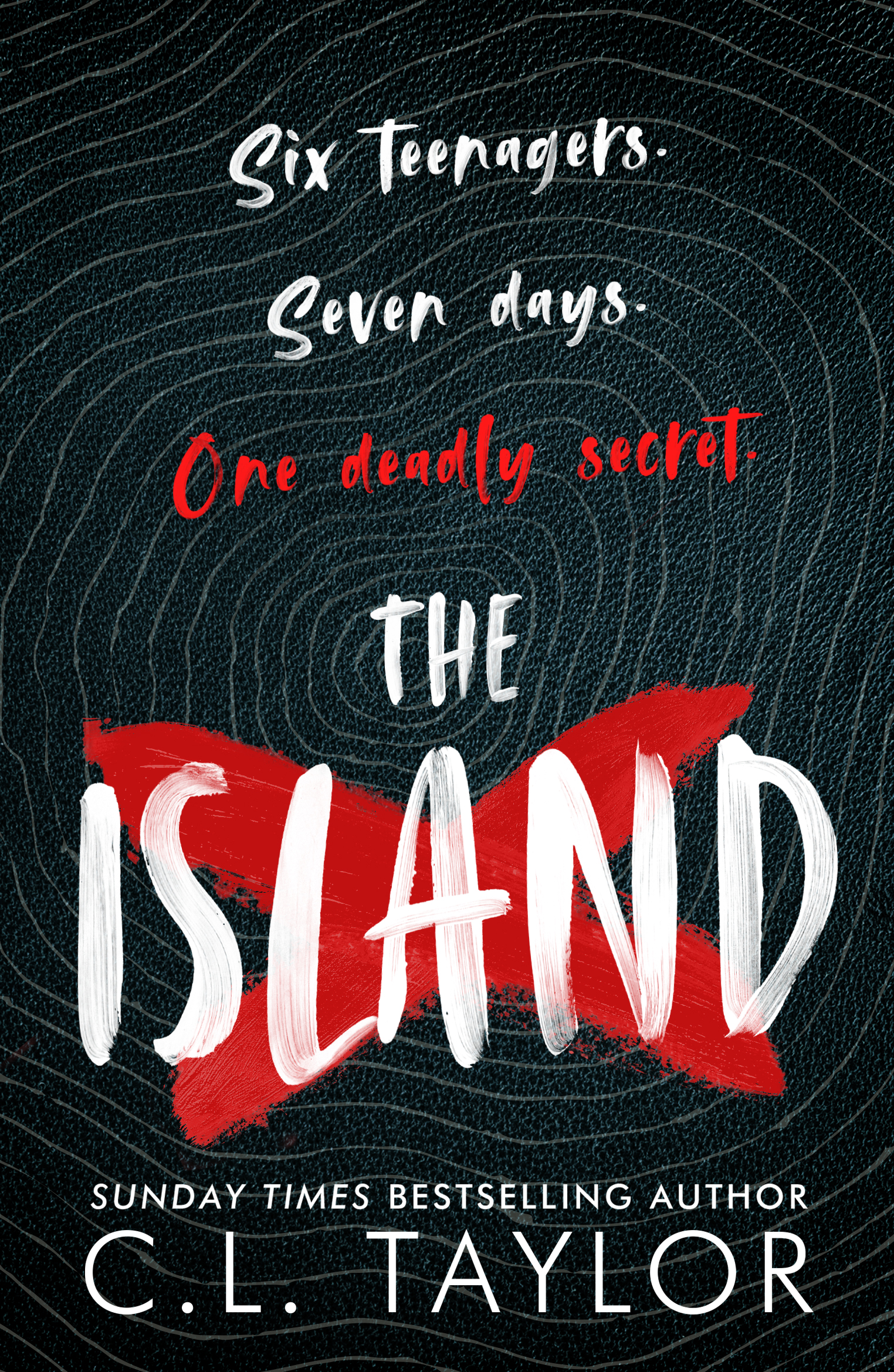
The Island by C L Taylor, reviewed by Natalie Jayne Peeke West Country Correspondent


Welcome to The Island.  Where your worst fears are about to come true…

It was supposed to be the perfect holiday: a week-long trip for six teenage friends on a remote tropical island.  But when their guide dies of a stroke leaving them stranded, the trip of a lifetime turns into a nightmare.

Because someone on the island knows each of the group’s worst fears. And one by one, they’re becoming a reality.

Seven days in paradise. A deadly secret.    Who will make it off the island alive?

I am 28, very soon to be 29 and thought that YA (Young adult) books wouldn’t appeal to me the same way anymore as I am no longer classed as a young adult. So when I was offered the opportunity to read and review The Island I very nearly gave it a pass. And boy, am I so glad that I didn’t.

Could I relate to the characters in the same way as the books intended audience?  Would find it predictable?

Not only could I relate to the group of teenagers, one a survivalist nut, one gloomy and shut off, two who are very much in love with each other and  twins. I was also completely hooked, I know I say this a lot but I genuinely was.

Up until the last moment I could not guess what was going on or why. I had my theories, of course. But…

So if you’re looking for a YA book that is suitable for all ages, that will keeping you guessing until the very end, a read that will make you gasp out loud then I urge you to pick up a copy of The Island.

If you enjoyed, Shutter Island, Lost or The Hunger Games then you will enjoy The Island as much as I did.

C L Taylor i applaud you and your genius, innovative writing

The Island by C.L. Taylor in pb, eBook and audio.

5 reasons to start lifting weights in 2021

Are you considering lifting weights? Maybe you’re worried about looking too bulky, or you’re concerned it won’t fit into your regular training program – whatever your reasons for avoiding weights so far, the truth is, in terms of fitness, you’re missing out.

Lifting weights is beneficial for everyone, regardless of their age or gender. Of course, most of us gravitate towards the cardio machines at the gym, but in terms of overall health and mental wellbeing weight training ticks all the boxes.

Here we’ll explore 5 reasons to start lifting weights in 2021.

You can workout at home

Whether you’re living in a small space, or you’re on a tight budget, not everyone can afford to fill their home with pricey cardio equipment. And not everyone enjoys running in all weathers and in public. Incorporating weightlifting into your daily workout routine means you can have access to gym equipment like quality cast iron kettlebells at home as well as hand weights and dumbbells. All these options allow you to create diverse and challenging weight training programs. Encouraging you to push your limits, focus on your strength and build on your muscle mass. Weight training is convenient and accessible for everyone.

You’ll sleep better

When we push ourselves and take regular exercise, we sleep better. It’s a fact. So, if your exercise routines have taken a bit of a hit since going into lockdown or due to your gym closing, your sleep may not be as refreshing or as deep as you’re used to. Studies have shown that those who focus on weight training sleep much deeper and wake fewer times in the night when compared to those who don’t exercise at all. Sleep is important for the muscle repair process, so the more you get – the better. 

Your clothes will fit you better

Whether you’re trying to lose weight or not, when you start lifting weights, you’re stripping back fat and revealing muscle, which means your clothes will fit and look better on you. It sounds perplexing. But building muscle may help you lose fat more effectively than cardio-focused exercise alone. Just remember to watch your diet and you’ll soon notice your progress.

Lift for your mental health

All forms of exercise are known to release endorphins, a chemical that triggers a feeling of contentment and positivity and weightlifting is no exception. Interestingly, weightlifting has also been connected to strengthening mental health and helping people who suffer from anxiety and depression. You don’t have to be an Olympic weight lifter to feel the benefits. Weightlifting means increased confidence and a stronger mental outlook.

Your bones will also benefit

Weightlifting and strength training can help reduce the risk of bone fractures and other skeletal problems by increasing bone density. Studies have shown that strength training also reduces the risk of osteoporosis, and as it’s an effective form of training to reduce fat, there’ll be less weight and pressure on your joints.

Final thoughts…

As you can see, there are plenty of reasons to pick up those dumbbells and kettlebells and start weight training. What are you waiting for? 


Collaborative post with out brand partner.

Living with Alzheimer’s – The Fight Goes on by Chris Suich

Today I am watching the morning news about a gentleman called John. He had just passed away and was over a hundred years old.  He was on the news now because he had been talking about his loneliness in his care home just before Christmas and people had sent him Christmas cards and lovely messages which helped him overcome this. His wife had died of Covid 19 in March and they had been married 70 years. It was a sad story. It made me think of Bob and how lonely he must feel in his care home.

It is 300 days since I last held his hands or even had any meaningful close contact.  The care home has stopped all visits even looking through the window at him. This is since the second lockdown in November. No Christmas visits.

He  caught Covid. It was 2 weeks after the Lockdown and then he miraculously fought it and got better from it, only mild symptoms. I asked our GP to go in and check him. She confirmed this but said he was very frail. I know this. I have to see this on my weekly Skype for 30 minutes. This is all the contact I am allowed. It is very upsetting for both of us.

Bob does not understand where I am. He looks around the room for me. How cruel is that for his brain? He can hear my voice and thinks I am in the room. He said once, ‘It’s magic,’ because he doesn’t understand the screen and how I can be on it. He reaches for me. At other times he is agitated and tells me ‘She’s dead, dead, dead’ or ‘Shut up.’ I carry on showing him round the house, playing him some records of his favourite tracks, telling him I love him and Joe and Edd send him a kiss. I wave and blow kisses to the screen. Often there is no response. His eyes are not looking. He is staring but not focussing. Sometimes he seems to be trying to dredge up some memory of me but I am not physically there or touching him so he cannot fathom it.

I have not been idle in my quest to see him. I have gone through all the government guidance. It is updated regularly. Window visits can go ahead. Pod visits can go ahead. PPE guidance needs to be followed and personalised risk assessments done. I point it out but that’s all I can do.

The recent third Lockdown has not helped me. The R rate is low where I live in rural Lincolnshire. My headteacher has agreed to me working from home. Keeping safe for Bob just in case I get the phone call. Teaching on Zoom is not easy.

I have alerted my Admiral nurse and my Social worker and the home manager that Bob is ‘end of life’. I have given them a letter from my GP.  New guidance ‘Rules during Lockdown’ p 5 states that exceptional circumstances such as ‘end of life is a compassionate reason for me to have visits and not just at the very end of life. It states that I am allowed to leave home to visit a care home (it is a walk from my home). It directs the reader to the latest guidance which was 19 December 2020 updated from 1 December 2020. There is a section on exceptional circumstances 2.4

The key message states ‘Visits in exceptional circumstances such as ‘end of life’ should always be supported and enabled and not just at the very end of life.’

A December letter from the care home described exceptional circumstances as imminent death – the last 48 hours and not 6-12 months. They said they will let me know when this 48 hours is by phone and a visit will be ‘timed, appointment only and 2m away’

Obviously, this is horrendous. The GP has been great and has spoken to the home  to confirm Bob has months to live in her opinion.  We believe this too because the trajectory of decline has been profound. I believe his illness has declined more quickly because he has not had the stimulation from myself visiting him. She agreed with us that the home would find it difficult to predict Bob’s last 48 hours as she would too. I am terrified I won’t see Bob for a meaningful visit before he dies. Everyone knows this, including the home. I am tired of their empathy or that their ‘hands are tied.’

Today after a discussion with the Social Worker and Admiral nurse – both amazingly supportive,  the manager rang me to say her regional manager will allow me a window visit weekly if  the tests for Bob’s unit comes back negative in the next day or two. They were all negative a few days before.

Surely I could have been having  window visits in any case as the virus does not jump through glass.

When the vaccine gets to his unit it will protect residents and carers. Most have already had the virus; surely they will have some anti-bodies?

So I wait until the unit have had the vaccine and then wait the 3 weeks for the protection – which will be another month – then I want to visit Bob in his room having had a negative test myself and wearing PPE. I think I am more than reasonable. I hope I am not too late.

I was on BBC news in November at 6 pm and 10 pm. It was my last window visit. It is a harrowing film but truthful. Alison Holt, health journalist is following my story. A local councillor got in touch; she had worked with Bob in his local government role for many years and she is beavering away in the background. I have had messages from friends in London that Bob went to university with many moons ago.

The Human Rights law has been broken – right to a family life, the Equality Act never adhered to – and as I am appointed his voice via the Deprivation of Liberty as he has no mental  capacity as well as POA I am trying to fight for what he would want – which is me!

Sadly, there are thousands more like me. Many didn’t win this battle in time.

THE BOOK I NEEDED TO WRITE – MICHAEL PARKER

When I was a Chindi Author (a group of indie writers in Chichester), Michael Parker was our elder statesman, the author who had been traditionally published, and who had time for everyone. It was hard to think I could come to respect him more, but since his beloved wife Pat died last year, he has written an incredible tribute which I hope to review for Frost next month.

I have always been able to write. As a teenager at Grammar school, I used to write hooky notes for my mates and charge them one cigarette for each note. You could say I was earning royalties even then. I was a prolific reader too and often found myself in awe of the authors and how clever they were. But I never aspired to become a writer; that was something only the clever ones did: those with university degrees and a middle-class upbringing. For someone like me: a working-class lad with no qualifications, I never believed I could become a published author.

I started dabbling with storytelling in my mid-twenties and wrote a family saga. It never saw the light of day, but it did become the seed, that feeling that there was something there. I remember contacting the Daily Mirror and asking them how I could get my book published. I had no clue about the publishing world. Their advice was to get an agent. It was when I was in my late thirties that I finally succeeded, when Macmillan agreed to publish my first novel, North Slope, in 1978. The Financial Times called me a “gifted narrator”. As rewarding as that was, it didn’t mean I would become a successful author.

Years later, when I was living in Spain with my wife, Pat, I found myself writing and being published. Eventually I ended up with seven traditionally published novels; six of them with Robert Hale of London. I was published in Norway, Denmark and Canada. Now I have fourteen books to my credit: all of them available on-line. But the book I needed to write: the book I want to talk about now, was a tribute to my lovely Pat who sadly died of cancer last year, 2020.

Pat became ill after a five-week trip to Australia and the Far East. She was diagnosed with cancer on our return after an examination for a spider bite. I looked after Pat for almost two years, here at home, until she finally succumbed to the disease. By this time, I’d already given up writing; there was no longer any inclination or desire. My sole reason for living was to be by Pat’s side and nurse her.

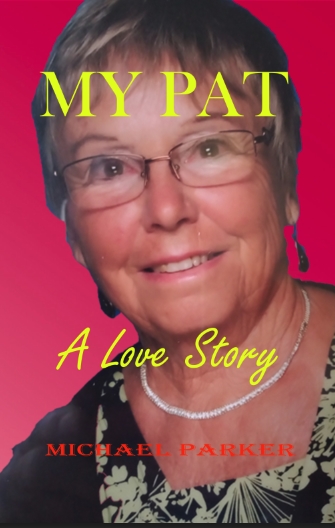
When it was all over, I was asked if I would start writing again. I would shake my head and say probably never. But my granddaughter, Gemma, wanted to know more about her Nan, and it was this that encouraged me to write down my memories after sixty years of marriage, and put them in book form: a tribute to my lovely wife. The book has now been published and is called, My Pat, a love story.

I don’t have enough time here to explain what a lovely woman Pat was, but the following is a short extract from the book:

I first laid eyes on Pat when she was fourteen. I was a “mature fifteen-year-old” who could not possibly have any interest in a girl as young as that. Besides, Pat was my mate’s little sister, and it was beyond parody to think I could have anything to do with her. But I still remember her dark hair, lovely eyes and generous mouth, plus the fact that she was wearing a canary yellow sweater. So, it stands to reason I couldn’t have noticed her. Four years later we were married.

Whether I’ll write again remains to be seen, but I am happy that I have published my best work ever.

You can learn more of me and my books by hopping over to my website: www.michaelparkerbooks.com.


Tips for Starting a Food Delivery Service

coronavirus, is food safe, is coronavirus on food, can I catch coronavirus from food? takeaways.Starting a food delivery service in this climate is quite a savvy move. 

After all, food delivery was always incredibly popular, but the pandemic has sent things surging to brand new heights. The Guardian highlighted that even dry cleaning services have turned to dropping off groceries for a profit due to a lower than usual demand in their own trade. There’s a lot of stiff competition, but there’s plenty of room for success and innovation too. 

Keep reading after the jump to learn some tips for starting your very own food delivery service. 

Understand the Legal Procedures

You can’t get started until your plans to begin or resume a food business are on official record. 

For all your licencing and registration needs, you should consult gov.uk, registering at least 28 days before your opening. 

Food hygiene procedures also need to be followed to the letter. There is no cutting corners here, so proper cooking practices, cleaning methods, and temperature control all need to be properly maintained and regulated. When you tick all these essential boxes and have a plan to action, you can then put your best entrepreneurial foot forward. 

Consider Insurance

Food delivery will obviously require a great deal of time spent transporting goods, so a suitable car or van will be needed to make the trips. 

However, a standard insurance policy won’t cover you for these trips – you’ll need courier van insurance or courier car insurance instead. In fact, if you deliver food and you only have a standard insurance policy in place there’s a good chance that policy could be invalidated because you’d be breaching the terms of that policy, so the right courier insurance really is a must.

Define and Tailor Your Service 

The broader your objectives are, the more you will struggle to keep up with supply and demand at the very start of things. 

Everyone wants food, and that’s a universal truth. However, if you don’t steadily pace the growth of your operations, you will find yourself tripping over your own feet incredibly soon. Customer guarantees fall through, reputations are whittled away, and ultimately you will receive more work than you know what to do with. 

To kick things off, start by more acutely defining the following: 

  • Who you serve: Will you specialise in delivering food to the disabled or elderly, who need your service is a lifeline? 
  • What you serve: Do you provide people with their groceries in the morning, or provide takeaway quality foods in the evening? What markets are oversaturated in your area?
  • Price points: Is the service a cheap and affordable alternative to patrolling the local supermarket, or are you offering the finest quality foods in town? What are your profit margins?
  • Where will you deliver: What is the maximum distance you are willing to travel with the food? Are you serving in an affluent area, or a smaller and humbler town? 

It’s important to be specific with what you are offering from the outset. Humble origins enable you to build things up slowly, well within the confines of your capabilities, finances, and resources. By starting locally, you can also steadily build up a loyal customer base and community, becoming a homegrown business with a loyal following instead of being a faceless, vague entity.  

Flourish Your Appeal

Once the broad strokes of your food delivery service are well-defined, it’s time to flourish the broader appeal of your venture. 

There are many ways to add value to this particular sphere of your operation. You can contemplate lines of enquiry like: 

  • Fair trade: Does your business practice ethical trading methods? Do you source homegrown, local supplies?
  • Public eating habits: Last year, the BBC reported that vegan diets were steadily rising among the masses, which could yield interesting business opportunities. Could the trend towards healthier eating be worth tapping into?
  • Customer service details: Are potential employees friendly and personable? 
  • Marketing signatures: Is your brand sufficiently recognisable? Will you pay for advertising privileges in shop windows, or develop SEO marketing strategies online?

There’s a great deal to cover here, but for many businesses, each one of the points above adds depth to a dynamic service. There are many food delivery services out there, but yours needs to be a cut above the rest to be truly worthwhile. Examine all the areas of your operation where you can add some finer touches to make your offerings more niche and unique, and more customers will gravitate to your services. 


Collaborative Post.


Michael Rowan can now believe in Unicorns, having sampled the impossibly delicious Collective Plant Greek style Vegan Yogurt perfect for Veganuary…


And every other month of the year. www.thecollectiveplant.co.uk

Having been a vegetarian since 1985, things have certainly got much easier for those of us who avoid eating meat and fish.

Today, a new generation, with a more enlightened view of the environment are declaring themselves Flexitarian, which simply means that they will replace some meals with plant- based foods.

And yet, I must confess that when a box of Collective Plant Greek style vegan yogurts turned up in my kitchen, I was resigned to eating something watery and bland. How could even the cleverest alchemist turn this epitome of dairy, into something so tasty, and yet still completely vegan?

I admit I was wrong, these live Greek-style yoghurts, made from a unique blend of oats, coconuts, and rice, will give anyone looking for a dairy-free yoghurt, food for thought, and they are available in four delicious flavours – Natural, Raspberry, Passion Fruit and Fudge.

Alchemy indeed, each of these Yogurts provides a melt-in-the-mouth experience with a thick and creamy base, layered with delicious low sugar compotes. Soy-free, nut-free, and vegan thick and creamy, awesome tasting plant-based yoghurt.

The Collective Plant Plain Yogurt in 400g is smooth and silky with a fresh and tangy flavour, perfect unadorned, or covered in fresh fruit.

The Collective Plant raspberry in 400g and 135g has a deliciously jammy, fresh raspberry layer of compote that pairs perfectly with the creamy plant-based yoghurt.

The Collective Plant passion fruit in 400g and 135g offers a layered the melt-in-the-mouth plant-based yoghurt, replete with a layer of sharp, heavenly scented nectar of passion fruit, including the crunchy seeds.

The Collective Plant fudge in 400g and 135g, is for me, the game changer. This butter-less fudge is a blend of sticky, sweet date, coconut sugar and a pinch of salt creates an authentic, malted fudge flavour and if that is not enough to impress you, there’s not a drop of butter and it is still low in sugar. Alchemy!

Just when you think that Plant could not get any better you discover that it is packaged in recyclable PET pots, made from 100% recycled material.

The Collective Plant 400g and 135g range is available nationwide £2.20 RRP per 400g tub and £1.25 RRP per 135g tub.


www.thecollectiveplant.co.uk