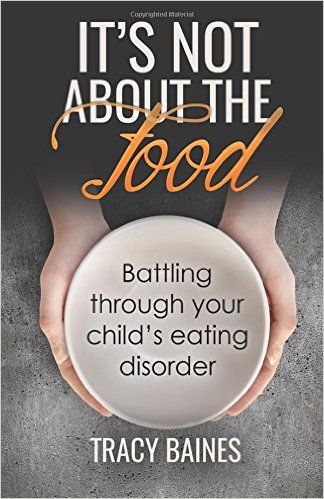
It’s Not About The Food by Tracy Baines reviewed by Milly Adams

pic 1 food


This is the most extraordinary book. It is one for every parent, and perhaps every child, even if they are over 18. Its sub-title is ‘Battling through your child’s eating disorder.’

Tracy Baines writes succinctly and movingly about her daughter, Neile’s, battle with The Bitch as they came to call the internal bully who was ruining Neile’s sense of self-worth. It was a battle they fought – the family and Neile – in a wilderness of fear and panic. Eventually, by hacking at the undergrowth they forged a way through to the light. It wasn’t a quick fix, it was slow, painful with many steps backward, but they found help: from therapists, from support groups, from the right people to be with, but most of all from the new puppy that joined the family.

Eventually Tracy’s family was lucky, they didn’t lose her daughter who is now well, a mother, happily married to a strong sound man. But they did lose that remarkable puppy, Millie, who inexplicably died suddenly and quietly as Neile found herself, as though the puppy knew her job was done.

Walking beside her daughter thoughout these years of despair and worry, Tracy realised that the biggest enemy is fear, the greatest strength is objectivity, (not to mention the family, and also, knowledge) It also revealed to her, her own frailties, her own battle with self-worth, the need to create boundaries herself in order to leave space for her own needs.

This was a road she and her daughter travelled together, but it was also one which drew the family; husband Neil, brother Nick, closer. They all found strength, and found themselves but not until Tracy finally crashed as life imploded around her.


Ultimately it was not just Neile who emerged from this chrysalis state, but Tracy, fully formed, different, ready for the world. It was a state that an alternative therapist used to describe Neile’s condition to Tracy. I feel it described Tracy’s just as much.

So, words of wisdom from Tracy? ‘Take comfort in the fact that you are not alone, that you cannot solve all of the problems all of the time, that you can support your child but you cannot fix them – they have to do that for themselves – and you have to learn to let them, hard as it is. Letting go will revitalise you and give you the energy to cope with whatever comes your way.’

Half this book is about the journey, and then it continues with the practicalities of survival, and hopefully a return to health, with a renewed stronger core.

As Tracy says: sometimes when it looks like things are falling apart they are really falling into place.

It will be the most valuable book you can read this year. Perhaps ever.

Tracy’s articles and short stories have been published all over the world in magazines like Woman’s Weekly, My Weekly, Take A Break, Best and The People’s Friend. A regular speaker at writing festivals, she also judges short story competitions and organises creative writing workshops.

She lives in Dorset with her husband and another, different, but much loved springer spaniel, both of whom are hyperactive and hard work.

For more information about Tracy go to:

www.tracybaines.co.uk


It’s Not About The Food by Tracy Baines: pb £8.99 available on Amazon. Also as an ebook


Eating Disorders – Are you asking the right questions

Eating Disorders

Speaking up

My daughter was 19, almost 20 when I found out she had an eating disorder. A friend had told her that if she didn’t speak to me about it then he would. I will be forever grateful to that young man. How long would it have gone undiscovered otherwise?

She agreed to get help but didn’t feel able to make the call. So I called and got through to the doctor – who couldn’t speak to me because she was over 18. I handed over the phone.

I made other calls and appointments and drove her there and sat outside. And waited, and waited. I wasn’t invited over the threshold. She was an adult, wasn’t she – but she was a vulnerable adult.

She was referred to the eating disorders clinic quite quickly – thank goodness. I went with her to every appointment for weeks; months. I would ring the doorbell because she couldn’t summon up the courage to do that. A simple task, to ask for access. I didn’t know that I should have made her do it herself. I daren’t. I didn’t want to give her any opportunity not to get help.

That was her controlling me, and the eating disorder was controlling her. Fear takes hold and that’s when you lack clarity.

If only someone had told me earlier. If only I had asked.

I didn’t even ask.

I didn’t ask because I knew that NHS resources are overstretched. I didn’t want any professional wasting their time on me. I wanted them to spend their expertise on getting my daughter well because I had no idea what to do.

I should have asked.

I may very well have got the information I needed to help her get stronger. She came out of her appointments and came home with me and I had to deal with the fallout. I had no idea if what I was doing was right or wrong. Pure guess work. I didn’t know anyone else in the same situation and was too embarrassed to ask. I was her mother I should have spotted the signs.

I should have known my child.

Talking about it helps.

Parents need support too. It may very well help the child recover faster. It will certainly help you to speak to others in the same situation. I can’t tell you what a relief it was for me.


You can look on the B-eat website for how and what to do if you are concerned that someone you know or love has an eating disorder.

Tracy Baines has written a book about how her daughter’s eating disorder impacted on her family. The book It’s Not about the Food is part memoir part self-help guide. It contains resources she found helpful and quotes from many other parents she either interviewed or who responded to her questionnaire.

www.b-eat.co.uk

www.tracybaines.co.uk


Authentic Peking Duck Pancakes Recipe

authentic peking duck pancake recipe Pancake Day (28 February 2017) often makes you think of a sweet treat, but why not mix it up this Shrove Tuesday by making savoury pancakes.

Below, the chefs at Royal China reveal their exclusive recipe for the most authentic and delicious Peking Duck Pancakes.

Serves 4

Ingredients:

  1. Duck Breasts

3    Shallots – sliced

3    Spring Onion

1 Clove Garlic

1Tsp Maltose Sugar

2 Tbsp Vinegar

3 Tbsp Oil

Salt to taste

Method:

  1. Fry the shallots, spring onion and garlic in a pan and heavily salt
  2. Marinate the duck breasts with the fried ingredients
  3. Mix the maltose sugar with vinegar and hot water, and pour on the skin
  4. Place the duck into a barbeque cooker until cooked
  5. Baste the skin of the duck with hot oil until it is golden brown and crispy

For the Pancakes:  

Slice the duck breast into slender strips, and place meat in a pancake with sliced spring onion, cucumbers and a dollop of plum sauce.  Wrap and enjoy!

The Royal China Group consists of six of London’s most authentic and prestigious Chinese restaurants, including the luxurious and critically-acclaimed Royal China Club.  Based in prime areas of London, the restaurants are centrally located on Baker Street, as well as in Bayswater, Fulham, Harrow-on-the-Hill and Canary Wharf.

www.royalchinagroup.co.uk


2017 Rental Affordability Index

  • To rent the recommended space for one person, Londoners must pay an average of £963.76 per month.

  • On average, Londoners must earn a gross salary of at least £3,323.07 per month to afford to live alone and meet additional living costs. That equates to a gross salary of £39,876.84 per year.

  • A family living in London must earn an average of £6,305.31 per month to cover rent plus living costs. That equates to a gross salary of £75,663.72 per year.

affordabilityrenting

Nested.com, the London based online estate agent, produced the Rental Affordability Index. The study illustrates the price of renting per square metre in 33 London boroughs, 15 UK cities and 72 cities worldwide. Based on this, the research could further convey the minimum gross salary required to support an individual and a family of four in rented property, based on the minimum space recommended for one person, and for a family.

The comprehensive study was undertaken in order to understand the costs associated with renting as an individual and as a family, and to determine whether cities are becoming increasingly unaffordable. The inclusion of specific results for each of the 33 London boroughs allows easy comparison between regional and global cities to the UK capital, with its much-publicised unaffordability. 

The price per square metre of property was calculated based upon current market listings for all locations researched, whilst the minimum space recommended for one person and four people is laid out in guidelines from the Greater London Authority.1 The gross salary guideline was included to help illustrate relative affordability.2 

London

  • To rent a property of the minimum space recommended for one person, Londoners must on average pay £963.76 per month.

  • Taking into account the recommended maximum 29% of income which should be spent on rent,2 on average a Londoner needs to earn a gross salary of £3,323.07 per month to live alone. This equates to £39,876.84 per year.

  • In London, the minimum space recommended for a  family of four requires a monthly income of £6,305.31. This equates to an annual salary of £75,663.72.

  • The least affordable borough to rent in London is Kensington and Chelsea, where rent per square metre is £72.40 per month. 

  • To afford to rent alone and cover additional living costs in Kensington and Chelsea, an individual needs an income of £9,736.55 per month, or £116,838.60 per year.

  • To afford the rent for the minimum space recommended for a family of four in Kensington and Chelsea, a monthly income of £18,474.48 is needed. This is equal to an annual income of £221,693.76.

  • The most affordable borough to rent in London is Bexley, where rent per square metre is £13.30 per month. 

  • To afford to rent alone and cover additional living costs in Bexley, an individual must earn an income of £1,788.62 per month, or £21,463.44 per year.

  • To afford the rent for the minimum space recommended for a family of four in Bexley, a monthly income of £3,393.79 would be required, equal to an annual income of £40,725.48.


The results for London, ranked by the cost of rental per square per metre, are as follows:

Borough

Cost Per Sq. Metre

Monthly Rental for a Single Person 

Yearly Income Needed to Afford Single Person Rental 

Monthly Rental for a Family 

Yearly Income Needed for to Afford Family Rental

1

Kensington & Chelsea

£72.40

£2,823.60

£116,838.60

£5,357.60

£221,693.76

2

City of Westminster

£54.82

£2,137.98

£88,468.08

£4,056.68

£167,862.60

3

City of London

£44.42

£1,732.38

£71,684.64

£3,287.08

£136,017.12

4

Camden

£39.50

£1,540.50

£63,744.84

£2,923.00

£120,951.72

5

Hammersmith & Fulham

£32.86

£1,281.54

£53,029.20

£2,431.64

£100,619.64

6

Islington

£32.34

£1,261.26

£52,190.04

£2,393.16

£99,027.36

7

Wandsworth

£31.69

£1,235.91

£51,141.12

£2,345.06

£97,036.92

8

Southwark

£31.29

£1,220.31

£50,495.64

£2,315.46

£95,812.08

9

Lambeth

£30.53

£1,190.67

£49,269.12

£2,259.22

£93,484.92

10

Haringey

£26.65

£1,039.35

£43,007.64

£1,972.10

£81,604.08

11

Hackney

£25.72

£1,003.08

£41,506.80

£1,903.28

£78,756.36

12

Richmond upon Thames

£23.49

£916.11

£37,908.00

£1,738.26

£71,928.00

13

Merton

£22.42

£874.38

£36,181.20

£1,659.08

£68,651.64

14

Tower Hamlets

£21.70

£846.30

£35,019.36

£1,605.80

£66,446.88

15

Barnet

£21.67

£845.13

£34,970.88

£1,603.58

£66,355.08

16

Brent

£20.89

£814.71

£33,712.08

£1,545.86

£63,966.60

17

Kingston upon Thames

£20.50

£799.50

£33,082.80

£1,517.00

£62,772.36

18

Ealing

£20.47

£798.33

£33,034.32

£1,514.78

£62,680.56

19

Enfield

£19.00

£741.00

£30,662.04

£1,406.00

£58,179.36

20

Waltham Forest

£17.70

£690.30

£28,564.08

£1,309.80

£54,198.60

21

Hounslow

£17.47

£681.33

£28,192.92

£1,292.78

£53,494.32

22

Harrow

£17.17

£669.63

£27,708.84

£1,270.58

£52,575.72

23

Lewisham

£16.82

£655.98

£27,144.00

£1,244.68

£51,504.00

24

Greenwich

£16.52

£644.28

£26,659.92

£1,222.48

£50,585.40

25

Newham

£16.50

£643.50

£26,627.64

£1,221.00

£50,524.08

26

Sutton

£16.08

£627.12

£25,949.76

£1,189.92

£49,238.04

27

Redbridge

£15.92

£620.88

£25,691.64

£1,178.08

£48,748.08

28

Hillingdon

£15.83

£617.37

£25,546.32

£1,171.42

£48,472.56

29

Bromley

£15.70

£612.30

£25,336.56

£1,161.80

£48,074.52

30

Croydon

£15.30

£596.70

£24,691.08

£1,132.20

£46,849.68

31

Barking & Dagenham

£14.94

£582.66

£24,110.04

£1,105.56

£45,747.36

32

Havering

£13.88

£541.32

£22,399.44

£1,027.12

£42,501.48

33

Bexley

£13.30

£518.70

£21,463.44

£984.20

£40,725.48

Average across 33 boroughs

£24.71

£963.69

£39,876.84

£1,828.54

£75,663.72


UK cities: 

  • The second most expensive UK city for rent prices is Edinburgh at a cost of £12.85 per square metre. 

  • The most affordable city to rent property is Belfast at £6.29 per square metre.  

  • An income of £1,728.10 per month is needed for single habitation in Edinburgh. That equates to an annual salary of £20,737.20 per year 

  • To afford family rental in Edinburgh, a monthly income of £3,278.97 is needed. That equates to an annual income of £39,347.64.

  • An income of just £845.90 per month is needed for single habitation in Belfast. That equates to an annual salary of £10,150.80 per year.

  • To afford family rental in Belfast, a monthly income of just £1,605.03 is needed. That equates to an annual income of  £19,260.36.

  • Single rental in London is more expensive than family rental in any other UK city.  

  • Three of the UK cities made the top 50 global cities list (London, Edinburgh and Bristol)


The top 15 results for the UK cities list, ranked by the cost of rental per square per metre, are as follows:

City

Cost Per Sq. Metre

Monthly Rental for a Single Person 

Yearly Income Needed to Afford Single Person Rental 

Monthly Rental for a Family  

Yearly Income Needed for to Afford Family Rental

1

London3 

£24.71

£963.69

£39,876.84

£1,828.54

£75,663.72

2

Edinburgh

£12.85

£501.15

£20,737.20

£950.90

£39,347.64

3

Bristol

£11.22

£437.58

£18,106.80

£830.28

£34,356.36

4

Southampton

£10.68

£416.52

£17,235.36

£790.32

£32,702.88

5

Manchester

£9.79

£381.81

£15,799.08

£724.46

£29,977.68

6

Aberdeen

£9.61

£374.79

£15,508.56

£711.14

£29,426.52

7

Cardiff

£9.24

£360.36

£14,911.44

£683.76

£28,293.48

8

Leeds

£8.92

£347.88

£14,395.08

£660.08

£27,313.68

9

Nottingham

£8.83

£344.37

£14,249.76

£653.42

£27,038.04

10

Sheffield

£8.54

£333.06

£13,781.76

£631.96

£26,150.04

11

Birmingham

£8.51

£331.89

£13,733.40

£629.74

£26,058.24

12

Newcastle

£8.47

£330.33

£13,668.84

£626.78

£25,935.72

13

Glasgow

£8.31

£324.09

£13,410.60

£614.94

£25,445.76

14

Liverpool

£7.19

£280.41

£11,603.16

£532.06

£22,016.28

15

Belfast

£6.29

£245.31

£10,150.80

£465.46

£19,260.36

Global cities:

  • Of the 120 locations included in the ranking, San Francisco is the most expensive city to rent property outside of London, at £42.81 per square metre. 

  • To afford to rent alone and cover additional living costs in San Francisco, an individual must earn £5,757.21 per month. This equates to £69,086.52 per year.

  • To afford rent for the minimum space recommended for a family of four in San Francisco, an income of £10,923.93 per month is needed. This equates to £131,087.16 per year.

  • Of the 120 locations included, Cairo is the cheapest city to rent property, at just £3.05 per square metre. 

  • To afford to rent alone and cover additional living costs in Cairo, an individual must earn £410.17 per month. This equates to £4,922.04 per year.

  • To afford the rent for the minimum space recommended for a family of four in Cairo, a monthly income of £778.28 is needed. This equates to £9,339.36 per year. 


The top 50 results for the global cities list, ranked by the cost of rental per square per metre, are as follows:

City

Cost Per Sq. Metre

Monthly Rental for a Single Person 

Yearly Income Needed to Afford Single Person Rental

Monthly Rental for a Family 

Yearly Income Needed for to Afford Family Rental

1

San Francisco, USA

£42.81

£1,669.59

£69,086.52

£3,167.94

£131,087.16

2

New York City, USA

£41.03

£1,600.17

£66,213.96

£3,036.22

£125,636.64

3

Hong Kong, Hong Kong

£33.14

£1,292.46

£53,481.12

£2,452.36

£101,476.92

4

Dubai, UAE

£30.49

£1,189.11

£49,204.56

£2,256.26

£93,362.52

5

Singapore, Singapore

£28.84

£1,124.76

£46,541.76

£2,134.16

£88,310.04

6

Washington D.C., USA

£28.73

£1,120.47

£46,364.28

£2,126.02

£87,973.20

7

Geneva, Switzerland

£26.66

£1,039.74

£43,023.72

£1,972.84

£81,634.80

8

Sydney, Australia

£25.30

£986.70

£40,828.92

£1,872.20

£77,470.32

9

Zurich, Switzerland

£25.19

£982.41

£40,651.44

£1,864.06

£77,133.48

10

Los Angeles, USA

£24.75

£965.25

£39,941.40

£1,831.50

£75,786.24

11

London, UK3 

£24.71

£963.69

£39,876.84

£1,828.54

£75,663.72

12

Miami, USA

£24.53

£956.67

£39,586.32

£1,815.22

£75,112.56

13

Chicago, USA

£21.52

£839.28

£34,728.84

£1,592.48

£65,895.72

14

Copenhagen, Denmark

£20.40

£795.60

£32,921.40

£1,509.60

£62,466.24

15

Tokyo, Japan

£20.20

£787.80

£32,598.60

£1,494.80

£61,853.76

16

Vancouver, Canada

£20.00

£780.00

£32,275.92

£1,480.00

£61,241.40

17

Amsterdam, Netherlands

£19.54

£762.06

£31,533.48

£1,445.96

£59,832.84

18

Paris, France

£18.93

£738.27

£30,549.12

£1,400.82

£57,964.92

19

Melbourne, Australia

£18.18

£709.02

£29,338.80

£1,345.32

£55,668.36

20

Oslo, Norway

£17.39

£678.21

£28,063.92

£1,286.86

£53,249.40

21

Reykjavik, Iceland

£17.34

£676.26

£27,983.16

£1,283.16

£53,096.28

22

Stockholm, Sweden

£17.28

£673.92

£27,886.32

£1,278.72

£52,912.56

23

Dublin, Ireland

£16.81

£655.59

£27,127.92

£1,243.94

£51,473.40

24

Seoul, South Korea

£16.36

£638.04

£26,401.68

£1,210.64

£50,095.44

25

Toronto, Canada

£16.32

£636.48

£26,337.12

£1,207.68

£49,972.92

26

Auckland, New Zealand

£16.24

£633.36

£26,208.00

£1,201.76

£49,728.00

27

Brisbane, Australia

£16.12

£628.68

£26,014.32

£1,192.88

£49,360.56

28

Helsinki, Finland

£15.92

£620.88

£25,691.64

£1,178.08

£48,748.08

29

Beijing, China

£15.80

£616.20

£25,497.96

£1,169.20

£48,380.64

30

Perth, Australia

£15.48

£603.72

£24,981.48

£1,145.52

£47,400.84

31

Munich, Germany

£15.26

£595.14

£24,626.52

£1,129.24

£46,727.16

32

Shanghai, China

£15.17

£591.63

£24,481.20

£1,122.58

£46,451.64

33

Milan, Italy

£15.00

£585.00

£24,206.88

£1,110.00

£45,931.08

34

Rome, Italy

£14.54

£567.06

£23,464.56

£1,075.96

£44,522.52

35

Tel Aviv, Israel

£14.51

£565.89

£23,416.08

£1,073.74

£44,430.60

36

Frankfurt am Main, Germany

£13.71

£534.69

£22,125.12

£1,014.54

£41,980.92

37

Edinburgh, UK

£12.85

£501.15

£20,737.20

£950.90

£39,347.64

38

Dusseldorf, Germany

£12.68

£494.52

£20,462.88

£938.32

£38,827.08

39

Madrid, Spain

£12.04

£469.56

£19,430.04

£890.96

£36,867.36

40

Hamburg, Germany

£11.99

£467.61

£19,349.40

£887.26

£36,714.24

41

Vienna, Austria

£11.88

£463.32

£19,171.92

£879.12

£36,377.40

42

Taipei, Taiwan

£11.88

£463.32

£19,171.92

£879.12

£36,377.40

43

Brussels, Belgium

£11.85

£462.15

£19,123.44

£876.90

£36,285.48

44

Moscow, Russia

£11.60

£452.40

£18,720.00

£858.40

£35,520.00

45

Bristol, UK

£11.22

£437.58

£18,106.80

£830.28

£34,356.36

46

Berlin, Germany

£10.81

£421.59

£17,445.12

£799.94

£33,100.92

47

Southampton, UK

£10.68

£416.52

£17,235.36

£790.32

£32,702.88

48

Osaka, Japan

£10.29

£401.31

£16,605.96

£761.46

£31,508.64

49

Jakarta, Indonesia

£10.28

£400.92

£16,589.76

£760.72

£31,478.04

50

Barcelona, Spain

£10.27

£400.53

£16,573.68

£759.98

£31,447.44

Let’s Talk About Eating Disorders

Lets-talk-about-eating-disorders

Please, let’s talk about eating disorders.

The more we talk about it the easier we make it for both those who suffer from one and the wider family who are also affected.

Let’s talk and dispel some of the myths that surround eating disorders – that it’s all about the food. It’s not.

February 27th to March 5th is Eating Disorders Awareness Week and the national charity B-eat will be campaigning to not only shed light on eating disorders but also provide information for parents and carers: how to spot the signs, how to help someone if you think they may have a problem. Early intervention leads to faster recovery.

The majority of people will think that eating disorders are all about food. I thought the same until I discovered my daughter’s eating disorder. I had an inkling that it was also to do with control issues but that was the sum of my knowledge. I was soon to learn otherwise.

Eating Disorders are a mental health issue, and it’s as well to bear that in mind at all times. As soon as I accepted that it wasn’t about getting my daughter to eat but to get her to feel good about herself I was more able to help her. Getting her to eat well came later.

Don’t think that only girls get eating disorders.

Boys get eating disorders too – and men and women of all ages. It can happen to anyone. The powerful image of an emaciated teenage girl sticks with us but you could miss the signs if you become blinkered because of stereotypes.

Don’t think that only extreme thinness denotes the presence of an eating disorder

Plenty of people with eating disorders (or disordered eating ) are a relatively normal body weight. Mental health problems are not so easy to detect. No one talks about it, they are more inclined to go to extreme lengths to keep it a secret. You don’t wear a cast, or a sling; no one wears a badge saying Help, I’m having trouble coping here. Sufferers can binge eat and stay relatively the same weight but still have a problem. As I said, it’s not about the food.

Getting help fast is crucial to recovery.

Our GPs were fantastically helpful, taking my daughter seriously and getting her into the system so that she received the very best of help – all through the NHS. I can never thank the doctors and medical staff enough who got her on the road to recovery. Not everyone is so fortunate.

You can look on the B-eat website for how and what to do if you are concerned that someone you know or love has an eating disorder.

Tracy Baines has written a book about how her daughter’s eating disorder impacted on her family. The book It’s Not about the Food is part memoir part self-help guide. It contains resources she found helpful and quotes from many other parents she either interviewed or who responded to her questionnaire.

www.b-eat.co.uk

www.tracybaines.co.uk


Interview with Sharon Horgan and Rob Delaney for Catastrophe series 3

Interview with Sharon Horgan and Rob Delaney for Catastrophe series 3We left series two on something of a cliffhanger, with Rob about to speak following his discovery of Sharon’s receipt. Where do we pick it up from?

Rob: Right then. Exactly then.

Sharon: Yeah, it’s from exactly that moment.

Did you know what Rob was about to say, when you shot the end of series one, or did you still have to work that out?

Rob: We didn’t know. We love to leave the series with a big question mark, and figure out the answer afterwards. It’s more fun for us that way, and hopefully there is real and palpable mystery for the viewer as they reach that question mark. If we know what’s going to happen, then they might too, and then why bother?

S: There were a few different routes we could’ve gone, so we kind of had vague ideas, but nothing concrete.

Series three and four were commissioned together. You’ve now shot series three. Do you know where it’s going to go in series four? How far ahead have you planned?

R: No. We did one and two back-to-back, and we really benefitted from taking a little break between two and three, so I think we’re happy to not know what’s going to happen for a little while.

S: We had ideas of stuff that could go in series three when we were writing series two, things like that, but we never knew what the big arc was going to be, or narratively where it was going to take us. We just had a bunch of little ideas, and it worked out okay. So hopefully that’ll happen this time.

Did you write season 3 differently because you knew there would be a season 4? Does that help you creatively, because you know you have more space to tell the story?

R: It’s a stunning act of generosity and a vote of confidence from the network to have them do that, so yes, it does give you a feeling of peace.

S: There were definitely moments where we would say “I think that’s more of a series four idea.”

R: Yeah, so we can figure out what’s going to fit in each episode. You can say “I am curious about that, but no way are we going to be able to squeeze that in,” whereas if we didn’t know there were an additional season commissioned, we might try to shoehorn it in, to everyone’s detriment.

S: I guess the smart thing to do would have been to plan out both series so we knew exactly where it was going over twelve episodes, but we just didn’t have the time to do that. We had to concentrate on getting series three made in the four or five months we had.

Catastrophe is unapologetically crude. Do you enjoy coming up with some of the more creative and colourful bits of dialogue? Do you ever worry about elderly family members watching?

R: Well, I mean elderly people, I have found, when they’re being honest, are also scumbags, and enjoy a little prurient humour as well. So no, I don’t really worry.

S: I used to worry about that sort of thing. But I watched Pulling with my auntie, who’s a nun. I gave my dad the pilot of Catastrophe, because we had it for about a year before it got picked up, and he showed it to so many people. There was some pretty crass stuff in there, there was plenty of sex in it and rude goings on. If he’s happy to show his 70-year-old mates, then I think there’s nothing to worry about really. Although, I’m a little bit worried about episode one of this series.

R: Oh, I know what you’re talking about!

The show is far from sentimental, but it still manages to be strangely romantic. Is that a tough trick to pull off? Do you have to go through it making it less saccharine?

S: We just keep an eye on it.

R: We’re pretty good about it. I remember in season two having to saccharine it up a bit. Our natural inclination is not usually to be too saccharine. If anything like that comes out of our mouth, the other will stop them pretty quickly. You’d rather have your audience come away saying “I think I just noticed that they’re in love” rather than hitting them over the head with it.

Catastrophe very definitely deals with flawed people making the best of a flawed relationship. Is that intentional – to show people that it’s possible to have problems and still be relatively happy?

S: I kind of don’t think their relationship is that flawed. I mean, I guess it is in that they fuck up sometimes, or might let themselves or each other down. But I think they were made for each other. They were born to be together. That’s the most fairy tale and romantic aspect of the whole thing. We’ve burst the bubble pretty quickly with all the bad things that happen. But it feels like a steady, sturdy relationship that shit happens to, and they deal with it. I don’t think they have to try and stay in love. They are in love, they just have to try and stop real life from tipping shit on that.

One of the cornerstones of their relationship seems to be that they make each other laugh. Do you see that as being key to them?

R: I think so, yeah. People say that the largest sexual organ is the brain, and I think the fact that they definitely amuse each other is probably the strongest glue in that relationship.

S: Yeah, definitely. Because I think it’s incredibly important in real life as well. You get on with the people who make you laugh. I love having conversations with smart people, but I don’t necessarily leave it going “I fucking love you!” whereas if I’ve spent an hour laughing with them…

Obviously this series was one of the last things that Carrie Fisher filmed. What was it like getting to know her and working with her?

S: It was a dream come true getting to work with her.

R: A giant privilege.

S: For both of us.

R: She didn’t get to where she is by mistake. She delivers. She’s just hilarious and brilliant. You get what you think you’re going to get, and more. She was just a wonderful, wonderful person.

S: Yeah, she was great to hang around with and great to work with. While you’re completely aware of her legacy and everything she’s done, and it’s completely overwhelming a first, then she’s just this woman who says rude things and cracks you up. And she was really kind as well, just a really kind, wonderful lady.

The show won a BAFTA in 2016. Who has custody of it?

S: We got one each! It was the most exciting bit of the night, realising that we got one each.

R: Some awards we’ve had to divvy up. But BAFTA make one for each named recipient, so thanks BAFTA!

What is it like working with the children on the show? Do you have to get to know them really well so they don’t recoil when you pick them up?

S: They like us!

R: Yeah they like us, and we like them. They’re lovely. Babies are an absolute pleasure. Sonny and Dexter, who are the twins who play Frankie, are a bit older. They’re wonderful, but they’re a little harder to work with, because it’s a super-unnatural situation to be in. Working on set is very artificial and bizarre, and for kids it’s like “Why would we do it again? That’s crazy!” And then you have to be like “Yes, it is crazy, but not only are we going to do it one more time, we’re going to do it 22 more times. “And they’re like “That’s INSANE!” So they’re having a tough time with it, but that’s only because they’re healthy, wonderful children.

S: But we both like the company of kids, we like hanging out with kids, so it makes it easier. When the cameras stop rolling, you can have a laugh with them. But you can’t get them too geed up, because then they’re all hyper. You find yourself going “Shit, why did I tickle him?” You have to know how to play it. But when they bring in a baby or one of the twins, we really enjoy it.

R: On a set filled with smelly adults it’s pretty nice to have a kid come in now and again.

You briefly reference Trump and Brexit in ep 1 of the new series. Will there be any more nods to the way the world is going?

R: Not too much.

S: A tiny bit more Brexit stuff.

R: We’re not trying to make any big comments about that stuff. If you’re alive right now, it’s affecting your life, so we couldn’t not mention it, but as ever, we’re just trying to do it in a way that will create more stress for Rob and Sharon. We’re not trying to fix it!

S: It just came up in that episode because I’m trying to find reasons to get away with behaving the way I did. In the original script it was Brexit and ISIS, and then suddenly that arsehole-buffoon got voted in and we thought “We can’t not mention him!” So we added that in our final read-through.

Rob, you’ve been pretty active of late on Twitter, even by your standards. Is it a relief to be over here and away from the whole shitstorm, or is it frustrating being so distanced and powerless to act?

R: It is weird being over here. And I can’t move back there right now. Not that I want to – we’re happy here, my children go to school here – but it’s weird to not have the option. But he’s got healthcare laws in his sights, and I’m part of a family of five people. And when you have five people, there will be some among them who have what are known as pre-existing conditions, so I can’t responsibly bring my children to a country where healthcare is in such upheaval. So that feels weird. And yeah, I’d like to be outside senators’ offices right now protesting, but I can’t right now. So I’m doing what I can from here.

I read somewhere that you two are planning to do a movie together. Is that a possibility?

S: It’s not in the pipeline. We talk about it A LOT!

R: We talk about it, and then somebody will be like “Hey, get back to set,” or “Where’s that script?”

S: We’d absolutely love to. It’s just a time thing.

Would it be a Catastrophe movie?

S: Not at this point. I think we’d like to try something else. It’d be interesting just to see if something else worked.

When you’re writing, do you guys have more ownership of your own character?

R: No, definitely not. Nothing makes me happier than writing dialogue for the character of Sharon, and have her write it for my character.

S: I think that’s why there’s no stereotypical element to either of them.

When do you start on series 4? Do you need time away from the characters first?

R: It’s a good idea to have a break, to let your mind rest and so you can start to cultivate ideas. So we don’t have a start date, but we’re percolating ideas, I guess.

S: Bit of a break.

Can you ever have a bit of a break, or are you always thinking “Ooh, I might put that into the next series?”

S: You do do that a little bit, yeah.

R: You definitely file things away, I’ve got a ton of stuff in the notes section of my phone. Most of it is fucking insane, though. “Here’s a good idea. What if… Rob walked into a spider’s web!!!”


With thanks to Channel 4.

 

One Last Thing (For Now)


 Old Red Lion Theatre, 418 St John Street, London EC1V 4NJ

Tuesday 7th – Saturday 25th March 2017


This is one for me. I have a charity Words for the Wounded that supports wounded troops and this sounds most interesting.


Althea Theatre (There’s No Place Like) present the world premiere of One Last Thing (For Now), inspired by love letters from times of conflict in different cultures and languages. The production, written and developed over the last two years by Lilac Yosiphon with the ensemble, is a universal look at the language of love, the wounds of war and everything in between.


An officer in Russia cannot bear to tell a woman, far away in Wales, that her husband died. Instead, he writes her love letters pretending to be him. A woman in London awaits a letter that will never come while another skypes love messages to her boyfriend in Afghanistan. A soldier addresses his last letter to a former teacher who refused to join the army. And, at the heart of the play, is a story of a woman giving up her own limbs to make contact with her husband, a recent amputee, in the trenches a hundred years ago.


The play interweaves narratives from WWI in Northern England, WW2 in France and Germany, the civil war in Colombia and stories from contemporary Britain and Israel. The internationally diverse cast play British and non-British characters (regardless of their own nationality) and perform in their native tongue as well as other languages. This international collaboration aims to empower a compassionate and honest cultural exchange.


As a part of the show, and the idea that we can better relate to foreign situations through familiar ones, there will be call out for love letters from the Borough of Islington and one scene in the show will be inspired and devised using one of these local letters.


The play connects different aspects of war (the difficulty to describe the violence involved, the need to maintain an illusion, conscientious objection), reflecting on the different injuries which occur on the front line together with the emotional impact these have to the community at home.


…. War wounds never quite heal, war letters are never quite forgotten; both just get hidden away by old memories and dusty pieces of cloth, waiting to be found…

Performance Dates               Tuesday 7th – Saturday 25th March 2017

Tuesday to Saturday, 7.30pm

Saturday and Sunday matinees, 3pm

Twitter                                   @AltheaTheatre, @ORLTheatre, #OLT4Now

Location                                 Old Red Lion Theatre, 418 St John Street, London EC1V 4NJ, www.oldredliontheatre.co.uk. https://theatre503.com/

Box Office                              Tickets are available priced £16 (£12 concessions)

All matinees priced £10

Available from Old Red Lion Theatre Box Office and www.oldredliontheatre.co.uk or 0844 412 4307

**Notes                                      If you have a love letter connected to the borough of Islington   waiting to be found, please contact info@altheatheatre.com as one scene will be inspired by the local community.


Make ‘em laugh, make ‘em cry   by Maya Pieris


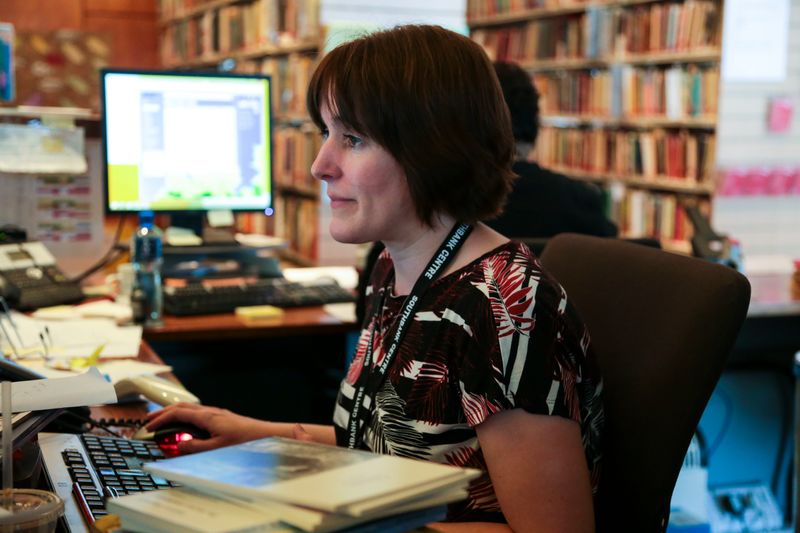
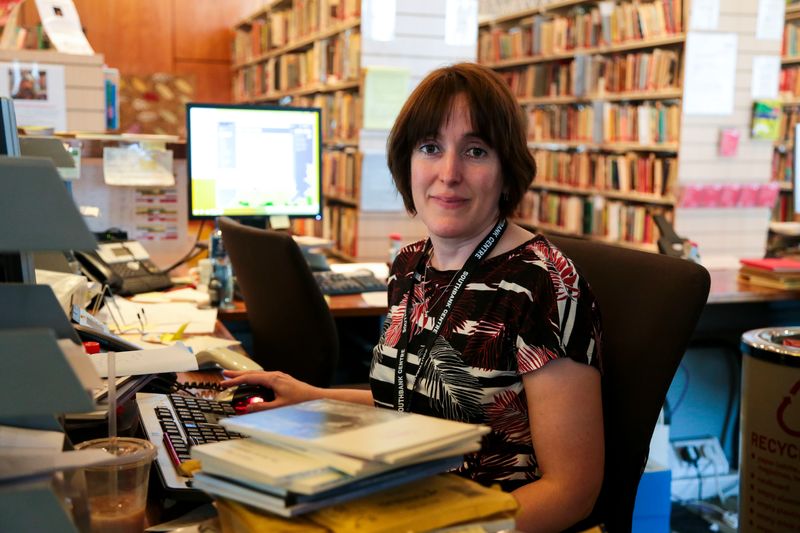
And Lorraine Marriner’s poems do just that. Her words have been inspired by the music she grew up with, from Dylan to Costello, by the London Underground’s “Poems on the Underground” and now through her current day job as a librarian in the South Bank’s Saisons Poetry Library where she is surrounded by the words of the world’s poets.

pic 1 lor


Lorraine did, however, confess to getting “poemed- out on occasions” and going on “poetry retreat in that I make myself have some poetry free days”. Her poems combine comedy and tragedy, the two sides of the human condition, with an everyday normality that is both refreshing and stimulating dealing with the ordinary concerns and situations of life and finding inspiration in family and friends and in the landscape of London. Her answer to whether she is an urban or landscape poet was “Urban, absolutely … the ways of the countryside feel very alien” though living next door to Greenwich Park probably gives her the best of modern city life!


I read her collection Furniture after hearing her read from it and was immediately captivated by an ability to merge complex thoughts, feelings and situations in an accessible framework, almost as though she is telling a story. She is the sort of poet who invites you into to her word world and wants to share the experiences. In Furniture, her first collection, there is a poem called Thursday which is of particular importance to her as it deals with her experiences of the 2005 London bombings. It manages to hold together the everyday and the horrendous as they collide the poem, arranged on the page as a block of text “to look like monument”, is her memorial to the day.

pic 2. Lor

The poem reminded me of the Auden poem, Musee des Beaux Arts, which describes the fall of Icarus as an event that happened on an ordinary day where ordinary lives were being lived. In her latest anthology, There Will Be No More Nonsense, she includes the poem When My Brother Broke which blends a domestic event, the breaking of a favourite doll, with the bigger issues of female image and expectations iced with a gentle layer of wicked humour as one realises the sister has the upper hand.


Recently Interestingly Lorraine has been “dabbling” in screenplays something I can empathise with- poetry, screenplay and play writing both require, I think, an ability to deliver a large picture in a contained space and need to appeal to a visual element.


I am sure, however, that whatever directions her words travel she will continue to pursue her themes with a wry sense of humour and a natural empathy. So if you got a Christmas book token spend it on one or both of her collections.