
7 in 10 women would do same as Angelina Jolie

Angelina Jolie has breasts removed. Almost seven out of every ten women say they would undergo a preventive double mastectomy if tests indicated they were at a high risk of breast cancer 

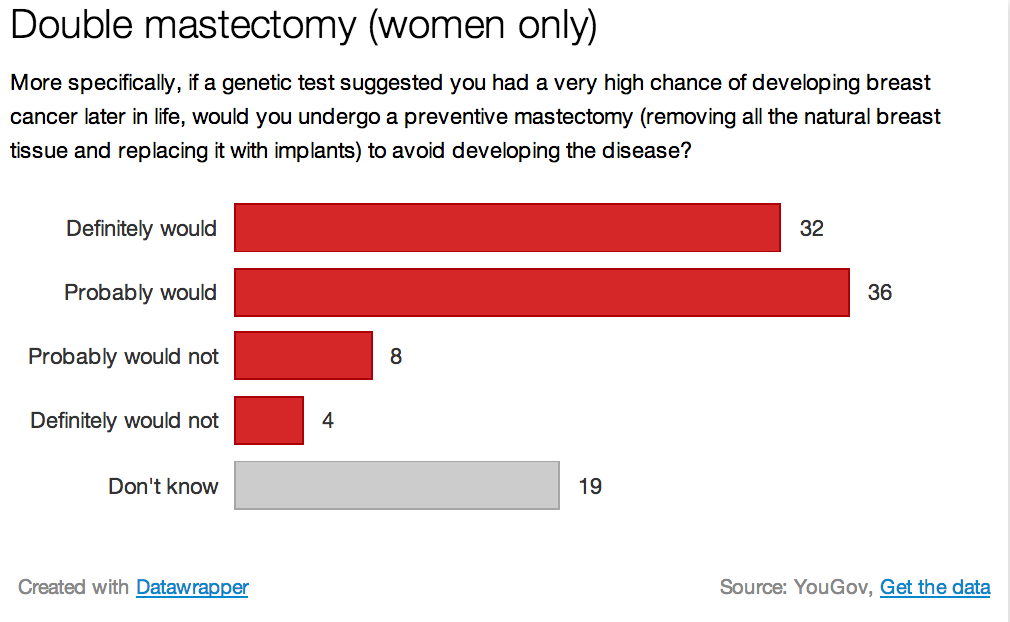
A new YouGov poll finds that nearly seven in 10 women in Britain would have a double mastectomy if genetic tests suggested they had a very high chance of developing breast cancer.

On Tuesday, Hollywood actress Angelina Jolie announced in a widely reported editorial for the New York Times titled “My Medical Choice” that she had undergone a double mastectomy as a preventive measure against breast cancer. Jolie said that doctors estimated that she “had an 87 percent risk of breast cancer and a 50 percent risk of ovarian cancer” due to a “faulty” gene, BRCA1, which increases cancer risk.

68% of women say they would have all natural breast tissue removed and replaced with implants if genetic tests suggested a very high probability of developing breast cancer.
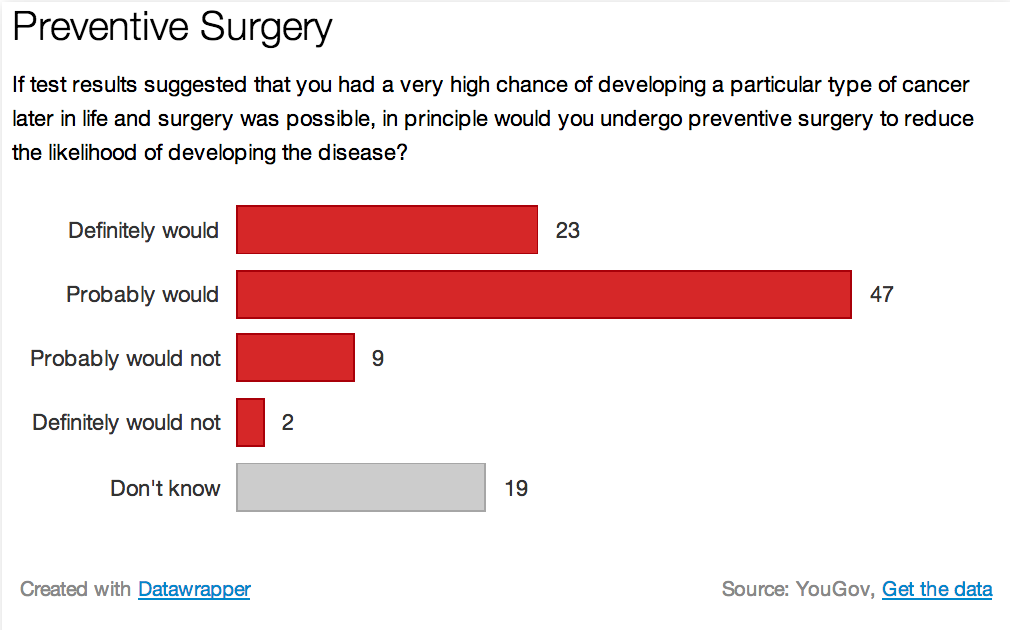
The YouGov survey also found that in identical proportions British women and men would undergo preventive surgery if tests suggested they were at a very high risk of a particular cancer. 70% of Britons say they would in principle undergo surgery to prevent the development of a cancer if tests suggested there was a very high chance of it developing, including 70% of men and 70% of women.
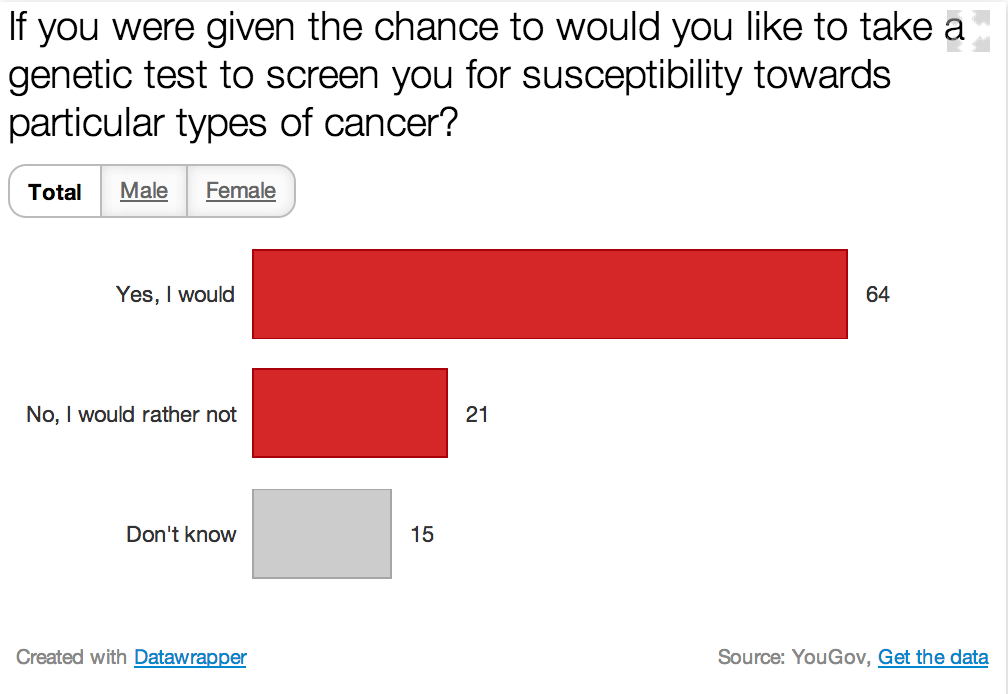
Asked if they would have genetic tests to screen for susceptibility towards particular types of cancer, and 64% of British adults say they would, including 62% of women and 66% of men.
One in five (21%) worry that there is a type of cancer they are particularly susceptible to because of family medical history.

Your Ultimate Festival Survival Guide

festivalstyleFrom a field in the West Country to the Nevada desert, festivals are sexy! Mud, hot pants, sun, hot pants, alcohol, hot pants.  The pressure to appeal to the opposite sex is on.  Here’s our hedonistic health kit with everything you need to make you cleaner, safer, pain-free and altogether hotter this festival season!

Talking dirty

When you are jumping up and down to your favourite band in the middle of a muddy field, oral hygiene will be the last thing on your mind. If you know that the excitement of live music will be enough for you to forget the toothbrush then why not try Oraldiet. Oraldiet is an innovative oral probiotic lozenge that contains the probiotic lactobacillus reuteri. The formulation binds to your saliva and therefore stays in the mouth – allowing you to feel fresh for longer. The presence of aloe vera gel ensures that your mouth flora kept healthy at all times, leaving you to concentrate on more important things – like which stage to visit. Oraldiet is available from www.revital.co.uk. £6.35 for 30 lozenges.

Best foot forward

Plastic wellies may be great for trudging through muddy fields, but they can cause your tootsies to sweat and smell.  If your wellies are causing a stink, try using a good foot deodorant such as Carnation Footcare’s Cool Foot spray to keep feet dry, clean and sweat-free; the perfect remedy after a day’s hard welly-wearing. Carnation Footcare’s Cool Foot spray is available from www.firstaidfast.co.uk £3.83.


Keep it clean

A combination of dancing, lack of showers and mud means one thing: sweat! Make sure you are the last one dancing with Thursday Plantation’s Tea Tree Deodorant. The 100% Tea Tree formulation will keep you feeling fresh and clean throughout the whole day whilst the aloe vera extract will sooth your skin during the sweatiest of musical moments. It’s also organic and aluminum free, meaning you’ll be feeling at one with nature whilst shaking your body to the beat. Thursday Plantation’s Tea Tree Deodorant is available from www.revital.co.uk £4.95 for 60ml.

Get water savvy

Shona Wilkinson, Head Nutritionist at The Nutri Centre, www.nutrticentre.com, recommends drinking plenty of water throughout the day ‘to help maintain energy levels, a clear head, and because dehydration will only worsen the effects of any alcohol you drink later on.  If the weather’s hot and sunny and you’re sweating a lot, you’ll also be losing vital salts and minerals.  Try adding an electrolyte solution to your water to maintain the correct levels. Elete Electrolyte water, £5.52 from www.nutricentresports.com makes 10 litres of hydration liquid, is 100% natural and is taste and calorie-free.’’


Angelina Jolie: “I have had a double mastectomy”.

Angelina Jolie bravely had both of her healthy breasts removed in February, and had reconstructive surgery in April, after finding out she had an 87% risk of contracting breast cancer. Jolie found out she carried the BRCA1 cancer gene. Jolie lost her mother, Marcheline Bertrand to ovarian cancer when Marcheline was only 56. She also revealed she has a 50% chance of contracting ovarian cancer. She said:

‘Only a fraction of breast cancers result from an inherited gene mutation. Those with a defect in BRCA1 have a 65% risk of getting it, on average. Once I knew that this was my reality, I decided to be proactive and to minimize the risk as much I could, I made a decision to have a preventive double mastectomy.’

Angelina Jolie has breasts removed. I started with the breasts, as my risk of breast cancer is higher than my risk of ovarian cancer, and the surgery is more complex.’

‘I choose not to keep my story private because there are many women who do not know that they might be living under the shadow of cancer,’ she continued. ‘It is my hope that they, too, will be will able to get gene tested, and that if they have a high risk they, too, will know that they have strong options.

‘Life comes with many challenges. The ones that should not scare us are the ones we can take on and take control of.’

Jolie worked during her treatment, speaking out about violence against women and children at the G8 summit in London last month.

In the article entitled My Medical Choice for the New York Times she praised the support of her fiance, Brad Pitt, and their children Maddox, 11, Pax, nine, Zahara, eight, Shiloh, six, and four-year-old twins Knox and Vivienne, saying: ‘We knew this was the right thing to do for our family and that it would bring us closer. And it has.’

Living Gluten-Free | Book Review

livingglutenfreeGluten-Free is the new food trend. And while living gluten-free used to be extremely difficult it has gradually gotten better. The need has met the demand. Gluten-free is now widely available and common in the mainstream media. Living Gluten-free is getting easier but it still has it’s challenges. Can these book help? Let’s find out.

Living gluten-free for dummies is a comprehensive guide to eating gluten-free. It talks you through the medical benefits of eating gluten-free, has almost 100 great recipes, and give you guidance on reading food labels.

The book also has great advice on coeliac disease, tells you about tests and lets you know what misdiagnoses you should look out for. Chapter 3 even has an entire chapter on coeliac disease. I don’t have coeliac disease but it would be a great resource for those who do. In fact 10p from every sale of the book goes to Coeliac UK.

The lists of food with and without gluten is also handy. As is the chapter on making sure food is gluten-free. There is also a table on shopping on a budget. This book is a really good resource on buying, eating and cooking gluten-free food. It certainly makes a daunting task much easier and tastier. The recipes are good. There is something there for everyone and not a horrible, cardboard-tasting meal in sight. For those who miss pasta or bread, there are even recipes to make your own. There is also a good amount of dessert recipes. Yum.

If you love eating out or are away from home a lot there is also a chapter to make sure you don’t fall off the wagon. For those with kids, there is a chapter on raising children gluten-free too.

Living Gluten-Free For Dummies

One Month Supply of Krill Oil to Giveaway

Krill-Oil-3D-EverestNutrition-400x400For those of you who haven’t heard yet, Krill Oil is the new obsession of health and beauty writers. According to some it is even better than Omega 3 and deals with inflammation. We have one month supply to give to one lucky reader thanks to Everest Nutrition. Read on for the health benefits and how to enter.

Krill Oil Benefits

Clinical data has shown Krill Oil seems to possess numerous benefits and has the ability to: protect your heart, lower your cholesterol, fight PMS symptoms, combat inflammation, optimize your brain’s capabilities, fight aging AND boost your overall health and wellbeing!

These days we’re all well aware of the importance of including Omega 3 fatty acids into our diets. Everest Nutrition Krill Oil is a fantastic source of Omega 3s, especially EPA and DHA benefits, the two essential fatty acids the body needs to maintain excellent health.

Everest Nutrition Krill Oil goes above and beyond what you would find in any Omega 3 supplement — even when put up against the highest grade fish oil supplement!

Our Krill Oil contains a rich supply of astaxanthin, a red pigment found in aquatic livestock such as krill, shrimp, lobster, mussel, crab and other seafood sources. Astaxanthin is known as a very powerful anti oxidant which can help rid the body of free radicals that contribute to various diseases and illnesses. Astaxanthin is also known for its anti-aging capabilities.

Even better. krill oil’s Omega 3 structure is linked together in a different form compared to fish oil. The essential fatty acids in fish oil are made up in triglyceride form, whereas krill oil is linked together in form – the same structure as the fat cells in the human body! This makes absorption of Omega 3s faster and easier.

To win follow @Frostmag on Twitter and Tweet, ‘I want to win with @Frostmag’ or like us on Facebook.  Alternatively, sign up to our newsletter. Competition will end May 31st 2013.


Understanding IBS

flickr-3705507804-hdWhat is it?

Dr. Wendy Denning, GP and one of Tatler’s top 150 private doctors for the last three years, explains: “Irritable Bowel Syndrome (IBS) is a sporadic and unpredictable disruption of the digestive system. Everyone suffers the odd upset, but if you regularly experience painful abdominal spasms, bloating, or attacks of constipation or diarrhoea, then you could be suffering from IBS.”


Causes

Dr. Denning, says: “Doctors are not exactly sure what causes IBS, and symptoms can vary in type, frequency and severity from person to person. However the condition can be painful, embarrassing and inconvenient to deal with. IBS occurs when the nerves and muscles of the bowel are not working properly. The bowel can become extra sensitive to pain and easily or frequently upset, and, unfortunately, IBS is a chronic condition – often recurring after long periods of calm.”


Symptoms

  • Abdominal pain and cramping – often relieved by emptying your bowels
  • A change in your bowel habits – such a diarrhoea, constipation, or both
  • Bloating and swelling of your abdomen
  • Excessive wind
  • An urgent need to go to the toilet
  • A feeling that you need to open your bowels even if you have just been to the toilet
  • A feeling you have not fully emptied your bowels
  • Passing mucus from your bottom


Stats

  • IBS affects 15-20% of the population, particularly women aged 20-4
  • 25-50% of all hospital gastroenterology appointments are for IBS
  • Studies have shown that approximately 2/3 of IBS patients have at least one food intolerance and some have multiple intolerances
  • Over 50% of those surveyed* had missed work with almost one quarter of 24-34 year olds taking over a month off
  • 43% reported their IBS impacted their confidence, with 24-34 year olds most severely affected (46%), and well over 1/3 (38%) reported low mood
  • 1 in 10 said that their condition had significantly impacted their love life


Treatments

  • The YorkTest IBS Diet Programme includes analysis reaction to more than 158 different food and drink ingredients. The new programme is specifically designed for IBS sufferers because it provides a personalised list of suitable low FODMAP foods which take into account your food and drink intolerances, the low FODMAP diet has been shown to be effective in reducing IBS symptoms.
  • Eliminate foods that patients are intolerant to
  • Probiotics
  • Eight glasses of water per day
  • Advice on eating + / – digestive enzymes
  • Stress reduction
  • Exercise
  • Glutamine
  • Fish oils
  • Cut down on FODMAP foods


*OnePoll survey of 1,000 IBS sufferers

Seb Morgan’s Fitness Column, I’M BACK


Hey All

Well here I go.

Sorry I’d gone, but I’m back.

Well hello faithful Frost magazine readers.

Most of you won’t know me, thats my fault. Last year Catherine accepted me as Frost’s very own health and fitness columnist.

I did write some articles, that I am proud of too as I’m not really great at writing, but then I sort of…vanished.


Well I want to explain where I have been and why.

I joined the army, the reserves in fact and in truth the Parachute Regiment Reserves.

It was 6 hard, disgusting, painful, agonising months that made me open my eyes and realise more about myself than anything ever has done before, and I’ve seen a lot.


The training was the hardest things I have physically done. The mental learning curve was a giant mountain and the limits I had to go to were endless.

I was in more than physical and mental agony, my insides felt like they where dying.

That is the only way i can put it, I died, I went to hell and out the back door to a place they don’t tell you about.


I thought I could explain it but no matter how many graphical words I use it’s just impossible.

You won’t understand what it feels like to tab, to be on your 4th stag in the pitch black night in the dam cold, freezing cold and you will not understand the emotions you go through on the log race.

But what you may understand is quitting. I mean it’s so easy. So simple to do.

When you have had enough or it hurts too much you just say “no more, I am down and out of here”, get up walk away and grab a cuppa.


The hard work isn’t “to keep going” it is to keep going when it can so easily be ended.

I mean, have you ever started something, a hobby, a run, or fat loss project and

stick with it? Or did you quit, walk away because it was too hard and then think months later, “damn, it would be over by now and I’d be better for it.”


What I am trying to say is, if it is worth doing, of course its going to be hard, even painful but it is worth doing because at the end the feeling you will get is something you will have never felt if you didn’t stay with it.

I promise, when I got that maroon machine I shed some tears and of all the things I have done nothing has made me feel like that.


So stick with it, endure and if you want to quit just think, why did you start.


So I will keep going and writing articles about health, fitness and nutrition and you can read them here and also….Tuh-dah! My website, Facebook and Twitter and YouTube account.


Yep I have created an exciting training company called Kettlebell Strength and you can catch up with us at www.kettlebellstrength.co.uk where you can find links to our Facebook, Twitter and YouTube pages so please go, have a look, follow, like, subscribe and get in touch.


I would be great to get to know you.


P.S. I have made a healthy and lush banana cake and will put a video up soon for you guys.

578979_496178797086299_160704025_n


Katy Perry teams up with UNICEF and visits children in Madagascar

Beautiful and talented singer/songwriter Katy Perry has visited Madagascar to bring attention to the situation of children in the tropical island country, one of the poorest in the world and still recovering from a political crisis that began in 2009.


“In less than one week here in Madagascar, I went from crowded city slums to the most remote villages and my eyes were widely opened by the incredible need for a healthy life – nutrition, sanitation, and protection against rape and abuse – which UNICEF are stepping in to help provide,” Perry said.

NYHQ2013-0166 NYHQ2013-0174


“I am grateful to UNICEF for giving me the opportunity to see first-hand how their programmes make a real difference in children’s lives. Support for UNICEF is saving children, I am a witness to it.”

On her first visit in support of UNICEF, Perry saw a full range of programmes, from education, nutrition, health and child protection to water, sanitation and hygiene.

Beginning her trip in a slum area of the capital Antananarivo, she visited a child protection centre and met abused and abandoned children and young mothers receiving support and counseling. More than three out of four children in Madagascar live in extreme poverty, making them vulnerable to exploitation.

Most international donors have frozen development aid following the 2009 crisis, forcing the government to make drastic cuts in public spending and resulting in large parts of the population not having access to basic health care and primary education. Perry visited a UNICEF supported pre-school and a primary school built to enable children to go back to school.

At the Sahavola pre-school, 117 boys and girls between the ages of 3 and 6 receive a quality early education and learn the importance of thinking creatively and working collaboratively. They are also encouraged to participate in health and hygiene practices at an early age. To promote proper hygiene and sanitation, UNICEF constructed latrines and sinks at the pre-school, where Perry took in hand washing with the children.

The old village primary school, made from sticks and with a thatched roof, was destroyed by one of the tropical cyclones that hit the island every year. It was replaced by UNICEF with a solid, cyclone-resistant building.


Schooling rates in Madagascar are alarmingly low. Only three children out of every 10 who start primary school complete the cycle. Two-thirds of teachers have not received any formal training.


UNICEF and national school authorities are working to improve the situation through school construction and providing learning materials, training for teachers and supporting community action plans for education.

“An education is an incredible opportunity here. I visited a very remote community, where children and teachers walk for 45 minutes just to get to school. This is a testament to how appreciative they are about their education,” said Perry in the UNICEF- supported primary school in the village of Ampihaonana.

In the nutrition centre in Androranga village, Perry learned about UNICEF’s efforts to tackle another serious problem of the country – chronic malnutrition. Half the children in Madagascar are chronically malnourished, putting the country among the six worst in the world for chronic malnutrition.


Poor maternal nutrition, poor feeding practices and poor food quality contribute to the failure of these children to reach their full potential mentally and physically. The centre, run by a community health worker, identifies cases and works with village mothers to improve children’s nutrition, including focusing on the importance of exclusive breastfeeding during the first six months of a child’s life.