SISTER SCRIBES: SUSANNA BAVIN ON THE APPEAL OF THE SHORT STORY

Hands up everyone who remembers the First, Second, Third etc Pan Book of Horror Stories, Edited by Herbert Van Thal. I loved those scary stories when I was in my early teens. Looking back, some of them weren’t entirely suitable for a young reader, though that didn’t stop me lapping them up. My favourite was a ghost story by E F Benson (who wrote the Mapp and Lucia books), called The Confession of Charles Linkworth. I had a phase of reading it every Sunday afternoon before tea and, even though I ended up practically knowing it by heart, it frightened me silly every time. The hero of my newest book, The Surplus Girls, is named Gabriel Linkworth, as a nod to that story.
That was the second E F Benson short story I had come across. The first was The Room in the Tower, which featured in a book called Ghosts! An Anthology, which I received as a Christmas present. Unfortunately, the story was rather wasted on me because I didn’t altogether understand it. It is, in fact, a vampire story and I sort of knew that when I read it, but I was a very literal-minded child and this was in a book of ghost stories and therefore Julia Stone had to be a ghost… didn’t she?

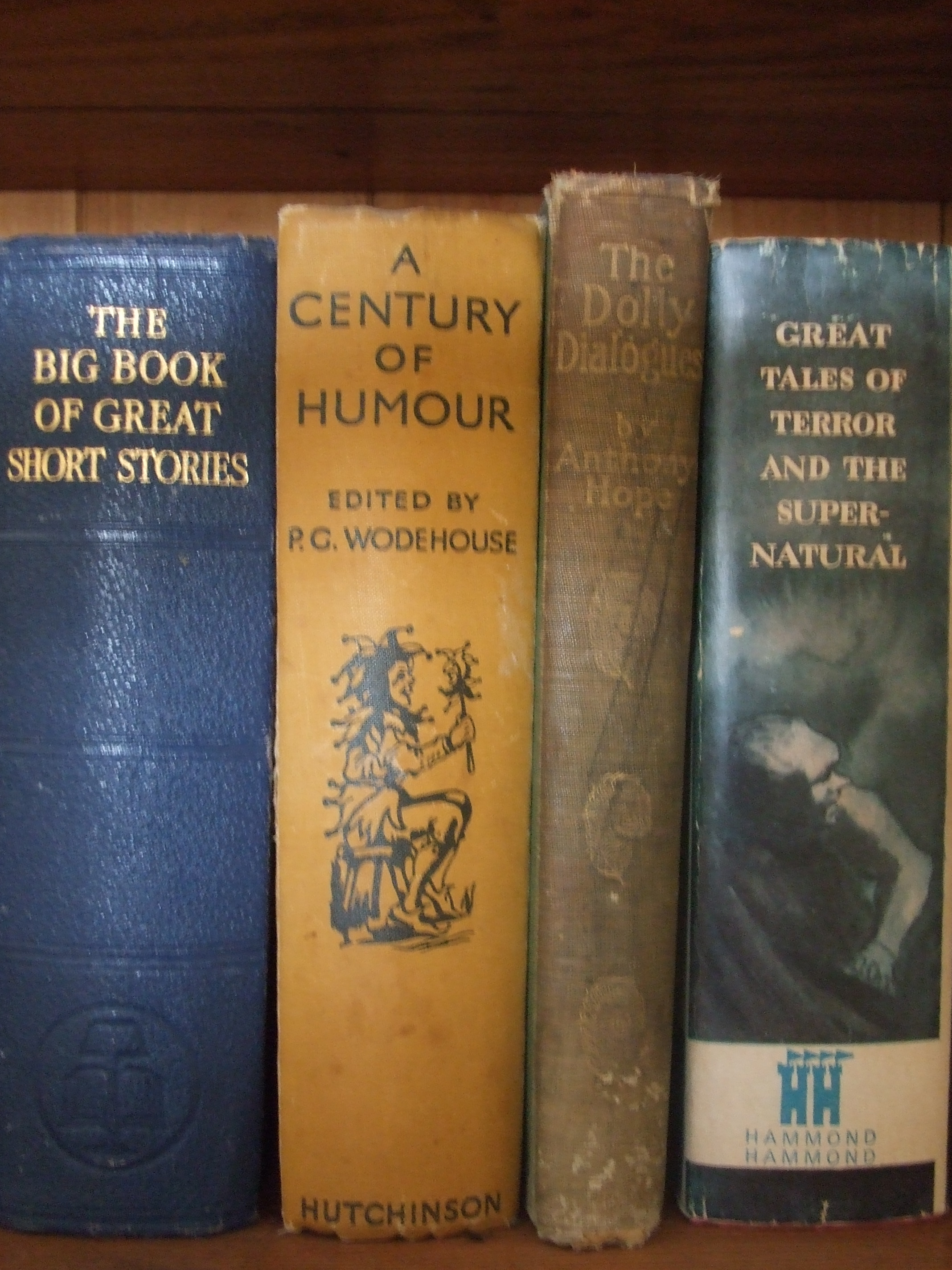
I have always been a reader of short stories. In particular I love the collections that were put together in 1930s, with titles such as The Mammoth Book of Thrillers, Ghosts and Mysteries and A Century of Humour, which was one of a series of A Century of… books. What better way to be introduced to writers such as Wilkie Collins, Guy de Maupassant, O Henry and W W Jacobs? My first taste of G K Chesterton was the wonderfully funny The Tremendous Adventures of Major Brown, which I re-read regularly. The Mammoth Book mentioned above even contained a ‘sealed section’ at the end, with stories to make you ‘glance over your shoulder and perhaps even start when there is a creak on the stair.’

A writer whom I came to love was A J Alan, whose wit and humour could find mystery in the most ordinary situations. It was often the style in these 1930s anthologies to top each story with a few sentences of author biography, beside which was a pencil sketch of the man (it was almost always a man) himself; but there was only ever a fancy question mark in the place where A J Alan’s portrait should be. He was famous for reading his stories on the wireless and his identity was a closely guarded secret, as befitted the mysterious nature of his tales.
And I adored Anthony Hope’s The Dolly Dialogues. I bought myself a first edition after enjoying the two chapters that featured in A Century of Humour. They are clever and teasingly romantic observations of life and love.

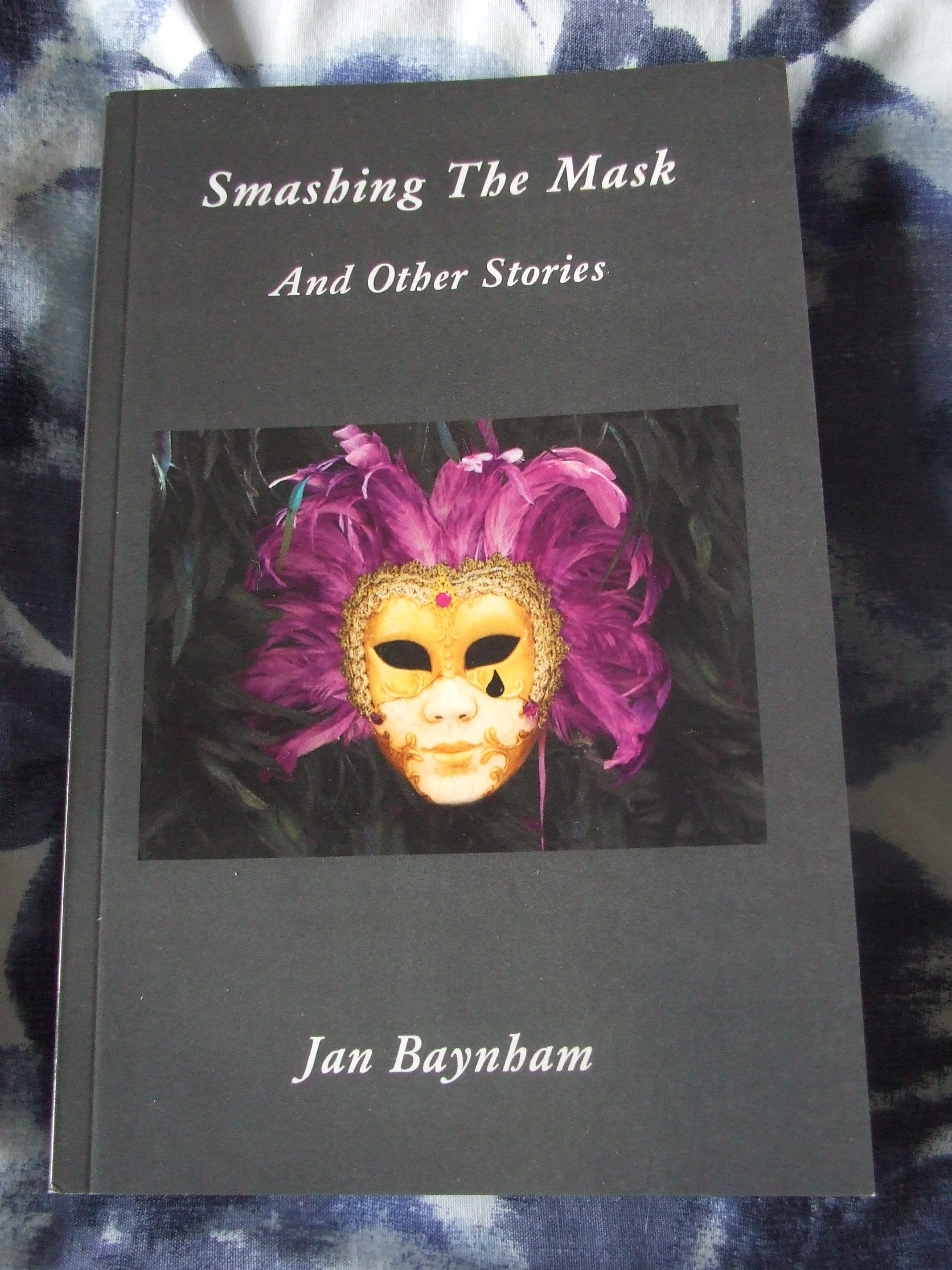
The most recent collection of short stories I’ve read is Jan Baynham’s Smashing the Mask and Other Stories. Although there isn’t an official theme to the book, a thread of the supernatural runs through several of the tales and in each one Jan creates a different sort of atmosphere, from the deep sorrow of a ghostly mother to the chilly horror of a long-ago murdered girl to the traditional creepiness of helping a stranger. She also uses painful directness to tackle the all too recognisable dilemmas of hoping against hope to meet a long-lost child and struggling to be brave in a situation of coercive control. Jan has produced an intriguing collection filled with insight, a variety of moods from the uplifting to the poignant, and more than one clever twist in the tale.


SISTER SCRIBES: CASS GRAFTON ON WHY WRITING IS A NEVER-ENDING ADVENTURE

For me, pursuing a career as a writer is not just a journey; it’s an expedition into a world I’m still discovering. It’s ‘the world inside my head’ meets ‘the world out there’, and they are only on their third date. It seems fair to say, therefore, that I’m not only a writer but also an explorer.

I’ve been published since 2013, a combination of solo and co-writing across seven novels, some indie published and some with a publisher, Canelo Escape. Everything I’ve written so far has had, at its core, a love story —I love romantic storylines.

So, how is my writing career now on its third ‘date’? It’s to do with the genre of romance and the many categories that further define it. I’ve published in two of these ‘sub’ categories: historical romance (Regency era) and time-travel romance. These were the first two ‘dates’, and they went quite well—I’m certainly going to be seeing them again—but for now I’m rather excited about my upcoming third. This date is with contemporary romance.

When I was young, I dreamed of writing love stories, but always in the present day. No breeches and fluttering fans; no flitting to and fro through the centuries courtesy of a charmed necklace. My dream was of writing modern romances—relatable, believable and with characters doing everyday things, but always, ultimately, falling in love.

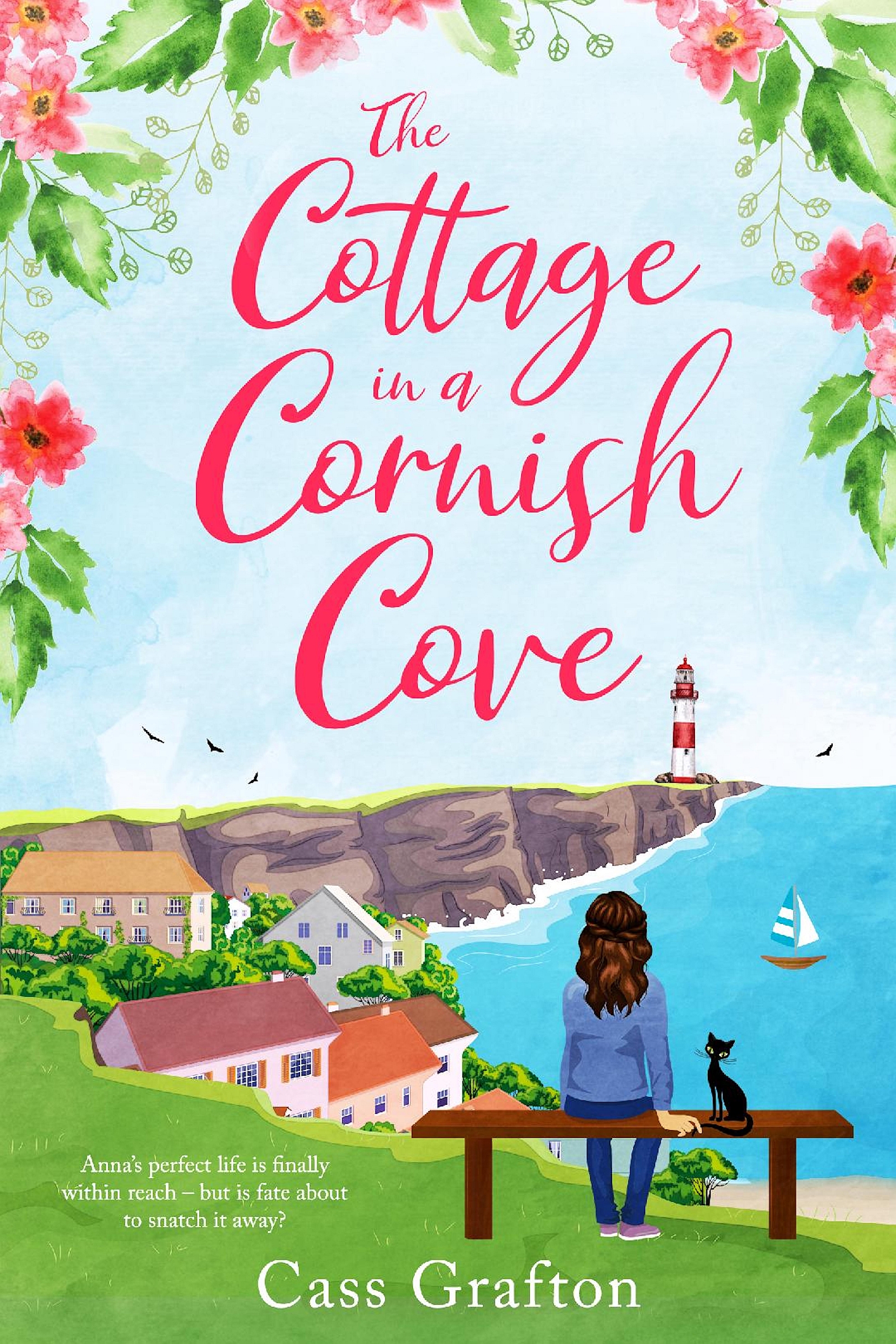
I’ve been toying with the idea behind The Cottage in a Cornish Cove since the days when my hair was a box-shaped perm, my shoulder pads needed scaffolding to support them and keeping in touch with non-local friends was done by a landline phone or with good old pen and paper.

Although the story I’ve now written bears little resemblance to those initial ideas other than the inciting incident that sets the plot in motion, I view it with the affection of an old friend, one of those worlds inside my head that simply took a long time to emerge and meet the world outside.

So what’s it about, I pretend to hear you cry?

It’s a heart-warming tale of discovering all you never wanted is exactly what you need.

Much of Anna Redding’s happiness as a child came from the long summer holidays spent with an elderly family friend, Aunt Meg, in the charming village of Polkerran.

With Aunt Meg’s passing, Anna is drawn back to the West Country, relocating to the Cornish cove where she was once so happy. Settling into her new life, and enjoying her work for the older, reclusive and—to be honest—often exasperating Oliver Seymour, Anna is delighted when Alex Tremayne, an old crush of hers, reappears in Polkerran and sweeps her off her feet.

The stars finally seem to be aligned, but just as Anna thinks all she’s ever wished for is within reach, a shock discovery reveals she’s living a dream that isn’t hers…


As for those other dates, is the adventure over? Definitely not! They are part of my on-going expedition, my journey as a writer, so I won’t be deserting them. Ada Bright (my co-writing partner) and I still have a third time-travel romance up our sleeves, and I have two Regency romances in the works, which I hope to finish soon.

In the meantime, though, if you’re up for a bit of eavesdropping on my third date, come and join us in gorgeous Cornwall, wallow in the quaintness of Polkerran, get to know the locals and fall in love with romance all over again.

The Cottage in a Cornish Cove will be released on 11th February 2020.


SISTER SCRIBES: JANE CABLE ON PLANNING FOR CREATIVITY

It’s the first morning of the decade and I’m making plans. Or rather I’m ordering dreams and prioritising my wish list, licking them into some sort of order. But shouldn’t the magic of creativity just be allowed to flow?

To my mind that’s a ridiculously self indulgent approach when you have chosen writing as a career. Having some sort of plan is so much better than sitting at a crossroads scratching your head. I have so many ideas for books I’ll probably never write them all – but which should I be following up? And what else needs to be done to make them successful?

Over the last few years I’ve developed a plan for planning – an easy ‘to do’ list for January 1st (or thereabouts), which keeps me on track.

  • Scrawl a quick review of the previous year in two sections – what went well, and what didn’t. Coming straight off the top of your head helps focus on what’s been important to you; what you need to do more of and what needs putting right.
  • Consider how you’d like to develop your writing life this year in each and every direction. For me the most important things are to understand more about (and hopefully write!) books with stronger hooks, and to find out more about winning at Amazon. Once you’ve worked out what your priorities are, allow yourself to dream a little – where would you like to be in five years’ time? How will this year’s plans help you to get there?
  • Now you have the basics you can set out your goals for the year. In my business life I had many clients who used the SMART system (specific, measurable, attainable, relevant and timely) and they’re a pretty good rule of thumb for writing too. Except I quibble a little with ‘attainable’ here, because I like to think in writing we continue to grow beyond our current skill sets – and what’s wrong with stretching ourselves anyway?
  • Next write down what you’re not going to do this year. It may sound a bit negative, but most people are prone to a bit (or a lot) of time wasting so cutting the draining tasks from your life is actually one of the most productive things you can do. One of my weaknesses is volunteering for too much so I’ve promised myself nothing new this year.
  • Then write down what you are going to do – the things that will make the biggest difference to your reaching your goals. What works in your writing life? What makes you feel good about it? What do you have to do more of to succeed?
  • The last part of my plan is to break down my goals and put them on a timeline. I do a rough quarterly guide, then an action plan for the first few months of the year. This will develop as projects move on. I also use quite small boxes for each month so I’m not tempted to overfill them and tackle too much too soon. I have a tendency to want everything to happen now, so this is very useful in spreading the workload. And, of course, it leaves room for some all important flexibility. Because even in the most ordered of worlds, real life happens.

So all this comes with a caveat: you can only plan everything when you are in control of everything. And in writing, as with most careers, you’re not. I was expecting my next book to be out by now, but it isn’t. Nobody’s fault – just one of those things. And I suspect when I look back this time next year there will be other things that haven’t happened too. But without any plan at all, I wouldn’t even know where to start.


SISTER SCRIBES’ WOMEN’S WRITING WISDOM 2019

During 2019 Sister Scribes were lucky enough to welcome women writers we admire and have some connection with to Frost and in the process we learnt a great deal. With a new year approaching, here as some of the choicest nuggets to mull over.


Alexa Adams: My network of women who I can depend on, confide in, and trust has exploded, and I have a hard time recalling how I ever got by without them. These friendships are the most unexpected gift that writing has bestowed on me, and for them I am immeasurably grateful.

Carol Thomas: Three top tips for working collaboratively:
1) Take a little time to find your way, but also be prepared to step up. Somewhat obvious but … the key to collaboration is collaborating.
2) Be prepared to compromise. Working as part of a group will require it at some point.
3) Be actively supportive of others; you’ll get more from it than you might think. Rightfully so, when it comes to working in a group, you tend to get out, what you put in.

Catherine Boardman: Telling stories is what I love to do.  The solitary nature of sitting down to write suits me perfectly.  Yet it is the support and friendship of fellow female writers makes the procrastination so much more fun.

Daisy Tate: THERE ARE NO FOES in the world of women’s fiction. Along this windy path I’ve walked, I have only met people who are there to help others.

Dr Gaby Malcolm: Ignore anything other than constructive criticism and admire your own work.

Jessica Redland: So far, our joint venture [The Yorkshire Rose Writers] has worked well and we love working together. We’re both excited to see where it could go in the future. My advice to anyone thinking about such a venture, though, is be really clear on your aims and your time commitment right at the start so you’re on the same page.

Maddie Please:  I try to keep the boxes of stationery under control but boxes of pencils, Sharpies and Post-it notes are like cat-nip to me!

Merryn Allingham: When several members of my book group announced recently they didn’t like historical fiction, I was disappointed. But stunned when one went on to say she couldn’t see the point of history. For me, discovering the past doesn’t just illuminate quirky corners of a bygone age but helps understand the world of today….. Researching history complicates that first simple ‘take’ on a culture and a period, changes our perspective, makes connections. And, crucially,  illuminates our own troubled present. Worth paying attention then!

Rachel Brimble: I could not write without women from the past, the present and undoubtedly, the future. Here’s to the strong women who have gone before us and who continue to walk with us today!

RL Fearnley: I realise that I don’t have to write ‘women’ in my stories, I just have to write ‘people’. It should not be a revelation to see that these two things are not mutually exclusive. After all, in worlds where anything is possible, why can’t the quiet, plain girl at the back of the class be the one who takes up the sword and slays the troll?

Tracy Rees: Exploring our dreams as far as possible makes us happier, fuller people, which in turn allows us to help and support others.


SISTER SCRIBES’ BOOKS OF THE YEAR 2019


Kitty: I knew when I was reading it that Circe would be a book that stayed with me for a long time and I’m happy to call it my book of the year. I’m already itching to re-read it, an absolutely wonderful read. 

I finished Circe by Madeline Miller this month and I cannot do justice to how much I loved it. The story of Circe, a woman locked in by her divinity whilst also dealing with the very female roles of mother, daughter, sister and lover. This retelling made Circe much more accessible and empathetic than the male-centric version that I grew up with. Full of self-discovery, courage and empowerment it turns the myth of vicious witch into a story of a true heroine. I loved it so much that having read it once I am going to store it, like a secret treasure, for a re-read in a few months so I can wallow in it slowly and feel the magic again.

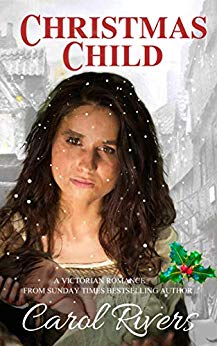
Susanna:  I love Carol’s 20th century sagas, but this year she wrote her first Victorian story, which happens to be my favourite historical setting. Carol Rivers + Victorian = one very happy reader!

One of the things I love and admire about books by Carol Rivers is that, while some authors get a bit stale and produce books that feel samey, Carol always writes something fresh, using new ideas, at the same time as remaining true to the drama and strong sense of personal relationships that characterise her books. Christmas Child is a story for any time of year, not just for the festive season. An emotional and enthralling tale, it follows Ettie as she faces up to life’s dangers and challenges and learns the hard way that not everyone deserves to be trusted. I love stories set in Victorian times and I’m delighted that Carol Rivers has, for this book, left behind her customary 20th century setting and moved into the 19th century. I hope there will be more Victorian stories to come from this wonderful writer.

Cass: A hilarious yet poignant story of self discovery, where you are laughing out loud one moment and holding back tears the next.

“Everyone should be adopted, that way you can meet your birth parents when you’re old enough to cope with them.” So says Pippa Dunn, the eponymous heroine of Alison Larkin’s debut novel, The English American (which has its roots in her autobiographical one-woman comedy show of the same name). Adopted as an infant and raised terribly British (attending a posh boarding school, able to make a proper cup of tea and in the ‘love’ camp for Marmite on toast), Pippa – now 28 – discovers her birth parents are American. Finally, she begins to understand why she’s so different from everyone she knows. Pippa sets off for America, soon meeting her creative birth mother and her charismatic birth father. Moving to New York to be nearer to them, Pippa believes she’s found her ‘self’ and everything she thought she wanted. Or has she? This is a hilarious yet poignant story where you are laughing out loud one moment and holding back tears the next. Pippa’s journey is very funny, yet deeply moving, and I highly recommend The English American to anyone who loves to finish a book with a smile on their face and a warm feeling in their heart.

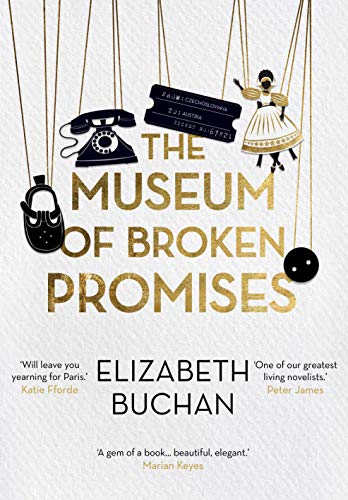
Jane: Elizabeth Buchan’s The Museum of Broken Promises is, like her other books, a slow starter. I have learnt to be patient while she creates a tapestry of detail so rich and wonderful, holding my breath until to story tips into second, third and fourth gears and becomes unputdownable.

The book is set in Paris in the present day and in Prague in the 1980s. The end of the Cold War was in touching distance, yet nobody knew it, and this adds an additional poignancy to the narrative. Laure, a young woman coming to terms with the death of her father is an au pair to a businessman and party insider, and while trying to make some sense of life behind the Iron Curtain, meets a dissident musician who steals her heart and soul. Years later in France, she sets up the Museum of Broken Promises, full of artefacts people donate in attempt to avenge or assuage the pain of betrayal – and some of them belong to her own past. Slowly the book teases out truths from a long ago Czechoslovakian summer. One moment achingly beautiful, the other shocking in its violence, the whole fits together like a handmade glove. It stayed with me, too – and it’s only now I’m writing this review I finally understand the most important promise. And who broke it. A must read. Honestly.

Kirsten: Beautifully written and no matter how grim the present times feel, at least we are not living in a plague village in 17th century Derbyshire!

I love historical fiction and I was late to the party with  Year of Wonders by Geraldine Brooks. It was published in 2002 and was recommended to me several times before I finally grabbed myself a copy. The book is set in 1666 and it’s based on a true event. The Great Plague has reaches the quiet Derbyshire village of Eyam through a contaminated piece of cloth that has been sent to a tailor from London. It’s the only place in the region that’s been affected and the villagers make the extraordinary decision to isolate themselves totally so that the plague cannot spread further – so no one allowed in or out until the plague has run its course or everyone has died. This story is told through the eyes of 18-year-old Anna Frith as she confronts ‘the loss of her family, the disintegration of her community and the lure of a dangerous and illicit love’. I loved it. It’s sad and interesting and touching and fascinating and I had no idea that anything like this had happened. I wonder how we’d have reacted in the same situation.

SISTER SCRIBES GUEST: LORNA COOK ON THE IMPORTANCE OF WRITING BUDDIES

I love this post, it sums up everything I have found to be true of the writing community. After reading and loving The Forgotten Village, I was lucky enough to meet Lorna at the Joan Hessayon Award this year, which she deservedly won. She was an absolute joy – funny, friendly and unassuming – and I cannot wait for her next book. 


When I started writing my debut novel, The Forgotten Village, I had zero writing buddies. Not one. I had just had my second child and we were going through that odd stage together where she slept most of the day (and not at all at night!). It left me slightly frazzled, very jaded and I was left to my own devices while my hubby went out to work and I took maternity leave. I joined lots of little groups with my tiny newborn but I sorely missed colleagues. And that joy of real human interaction that has nothing to do with nappy-chat was hard to find.

Don’t get me wrong – I did not go through the equal amounts of pain and joy of writing a novel so I could make chums. That was the happy by-product of this crazy and often misunderstood realm of fiction writing. And it is misunderstood. When I very quietly, very cagily, tell people I write novels it is only because someone has asked me directly ‘So, Lorna, what do you do for a living?’

And then begin the questions about how much I earn and if I am the next JK Rowling. Every single time. Praise be for The Romantic Novelists’ Association. I’m not sure I’d be quite as sane (manic laugh) as I am now without the RNA and the wonderful friends I’ve found there who just get it.  I joined the RNA’s New Writers’ Scheme in 2017 and no one ever made me feel as if I ‘wasn’t quite one of them’, because I was unpublished. I had found likeminded souls, who knew the pain and pleasure of being a novelist. Most of them were also unpublished like me and we’ve had many an hour of gossiping about industry one-to-ones at the RNA conference, about disastrous critiques from independent editors and the sheer joy of meeting new people.

I joined the RNA’s Chelmsford Chapter and was made to feel instantly welcome. I try to make it to all the lunches, which are once a month so I can share in dramas and pain, excitement and what everyone is working on at the mo. It’s brilliant. I always come away motivated. As a result of the Chelmsford Chapter, a few of us have formed a breakaway writing group called … wait for it, ‘Write Club’. You think we’d be better at puns than this – what with being writers, but there it is.  And once a month we meet and share in the ups and downs, as well as helping each other with our current WIPs.

I owe so much of my sanity to the RNA and the friends I’ve found there. Honestly, I don’t know where I’d be without it.


LORNA COOK lives by the coast with her husband, daughters and a Staffy named Socks.  She is the 2019 winner of the RNA’s Joan Hessayon Award for her debut novel The Forgotten Village, which sold 150,000 copies and reached Number 1 in the Kindle Chart. Her second novel, The Forbidden Promise, is out in spring 2020. A former journalist and publicist, she owns more cookery books than one woman should and barely gets time to cook.

@LornaCookWriter (Facebook) @LornaCookAuthor (Twitter) @LornaCookAuthor (Instagram)  http://www.lornacookauthor.com

SISTER SCRIBES: KIRSTEN HESKETH IN PRAISE OF WRITING GROUPS

Writing can be a lonely business and much has been written about writers seeking out other writers online. I’m a member of several online writing groups. I’m writing this article as one of the Sister Scribes; five writers who met through the RNA and banded together to become – hopefully – more than the sum of our parts. Then there’s the LLs – aka the Literary Lovelies – a group of writers who met through Twitter. Over the past four years, we’ve chatted most days, virtually cheering each other up and spurring each other on in our quest for world domination … er, publication. Geographically we’re scattered from Devon to Scotland via the home counties and Wales, but everyone makes a real effort to get together for lunch in London and the occasional retreat. Then there’s the informal support group that sprang up during Nano, another one that vents about politics, writers that met at the RNA conference, others that met during a virtual editing course … Wow – reading back through that lot, it’s a wonder I have enough time to do any writing at all!

All these groups have several things in common. We are all novelists- mostly writing romance or sagas or women’s commercial fiction. We are all – with a couple of honourable exceptions – woman. Most are seeking a publishing deal. And we are all – or mostly – ‘of a certain age’!

Which is partly why I love being part of my local writing group. I’ve been a member of Reading Writers for the past three years. It meets on the second and fourth Wednesdays of the month and it is gloriously diverse …. in age, gender and writing predilections. People are writing crime and thrillers, fantasy and sci fi and genres I’d barely heard of before. Many are busy with short stories or flash fiction or poetry or memoir. Lots have – or are planning to – self-publish. Some are biding their time while they learn about the craft of writing.

It all makes for a wonderfully vibrant and exciting group, one that pushes you outside your comfort zone and makes you look at your own writing though fresh eyes. I’ve written before about our ad hoc writing sessions in Coppa Club where a small group of us will meet for a morning to put our writing worlds to rights – before cracking on with the wordcount. A workshop on poetry and another on writing using all the senses really encouraged me to reassess my prose. The one on plotting had me stocking up on multi-coloured Post It Notes. Everyone other meeting is a ‘manuscript night’ where you are encouraged to submit 1,000 words of your WIP – the feedback is robust but invaluable – for example, last time, the 20 and 30 year olds in the group told me exactly why and how the online dating world is not how I had described it #imadinosaur #whoknew?. There have been book launches and pub visits and days out and going to the pantomime that one of the members had written.

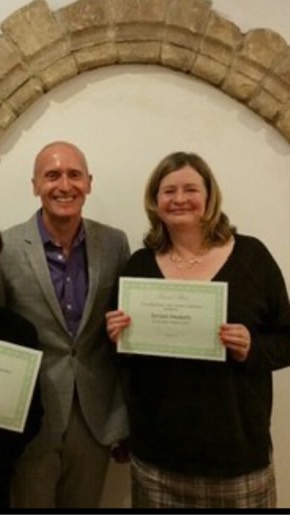
And the competitions! Twice my short stories have come second – anonymously judged by external authors or journalists – and both times it was genuinely thrilling – the first and only times my writing has ever won anything. The certificates still have pride of place on the fridge.

All in all, it’s a fabulous group and I’m very proud to be a member of it.

The current treasurer’s a bit rubbish though 😉


SISTER SCRIBES’ READING ROUND UP: NOVEMBER

Jane:

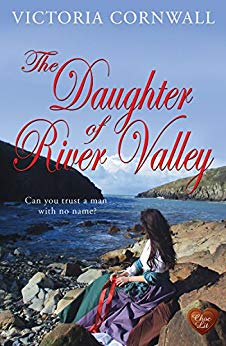
My first read of the month was The Daughter of the River Valley by Victoria Cornwall and I enjoyed this book so much. It drew me in from the beginning – it was so refreshing to read a story set in Victorian times with a fiery female working class character, and which wasn’t unrelenting doom and gloom. Well written and meticulously researched, I absolutely loved it.

I’ve had a real historical month and also adored Tracy Rees’ Darling Blue (now republished as The Love Note). Set in Richmond in the 1920s it charts the stories of three women, during a year when each of their worlds changes beyond recognition. The cast of characters is beautifully drawn, and rather than being a predictable flapper-fest, the novel addresses some of the important issues of the day, including the way the First World War changed both people and society. But for all that it isn’t a heavy read; it’s sensitive and joyful and at times impossible to put down.

Finally, in the name of research, I read Alice Chetwynd Ley’s A Reputation Dies. It’s a detective story set in London in 1815 and her use of period language is so rich it was a joy to read. I felt completely immersed in the period and enjoyed this historical cosy crime very much indeed.


Kirsten:

I love historical fiction and I was late to the party with  Year of Wonders by Geraldine Brooks. It was published in 2002 and was recommended to me several times before I finally grabbed myself a copy. The book is set in 1666 and it’s based on a true event. The Great Plague has reaches the quiet Derbyshire village of Eyam through a contaminated piece of cloth that has been sent to a tailor from London. It’s the only place in the region that’s been affected and the villagers make the extraordinary decision to isolate themselves totally so that the plague cannot spread further – so no one allowed in or out until the plague has run its course or everyone has died. This story is told through the eyes of 18-year-old Anna Frith as she confronts ‘the loss of her family, the disintegration of her community and the lure of a dangerous and illicit love’. I loved it. It’s sad and interesting and touching and fascinating and I had no idea that anything like this had happened. I wonder how we’d have reacted in the same situation.


Susanna:

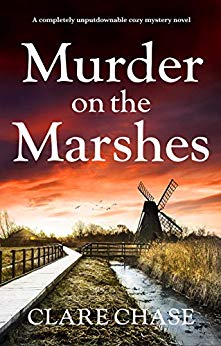
The first two novels in Clare Chase’s Tara Thorpe series, Murder on the Marshes and Death on the River, are set in and around Cambridge and the Fens. In the first book, Tara is an investigative reporter, while in the second, time has moved on and she is now a police officer, which makes an interesting transition that adds depth to the story. The plots are clever, with twists, atmosphere, pace, a range of well-fleshed-out characters and plenty to make you think. The settings in the books are beautifully conveyed and show Clare Chase’s skill as a writer. I enjoyed the chemistry between Tara and Garstin Blake and when I read the second book, I longed all the way through for Tara’s nasty colleague to get his comeuppance. There are two more Tara Thorpe books (Murder Comes to Call and Death in the Fens) and I’m looking forward to reading those.