Crobar by Gathr – Award Winning cricket flour protein bar


crobar-frost_magazine

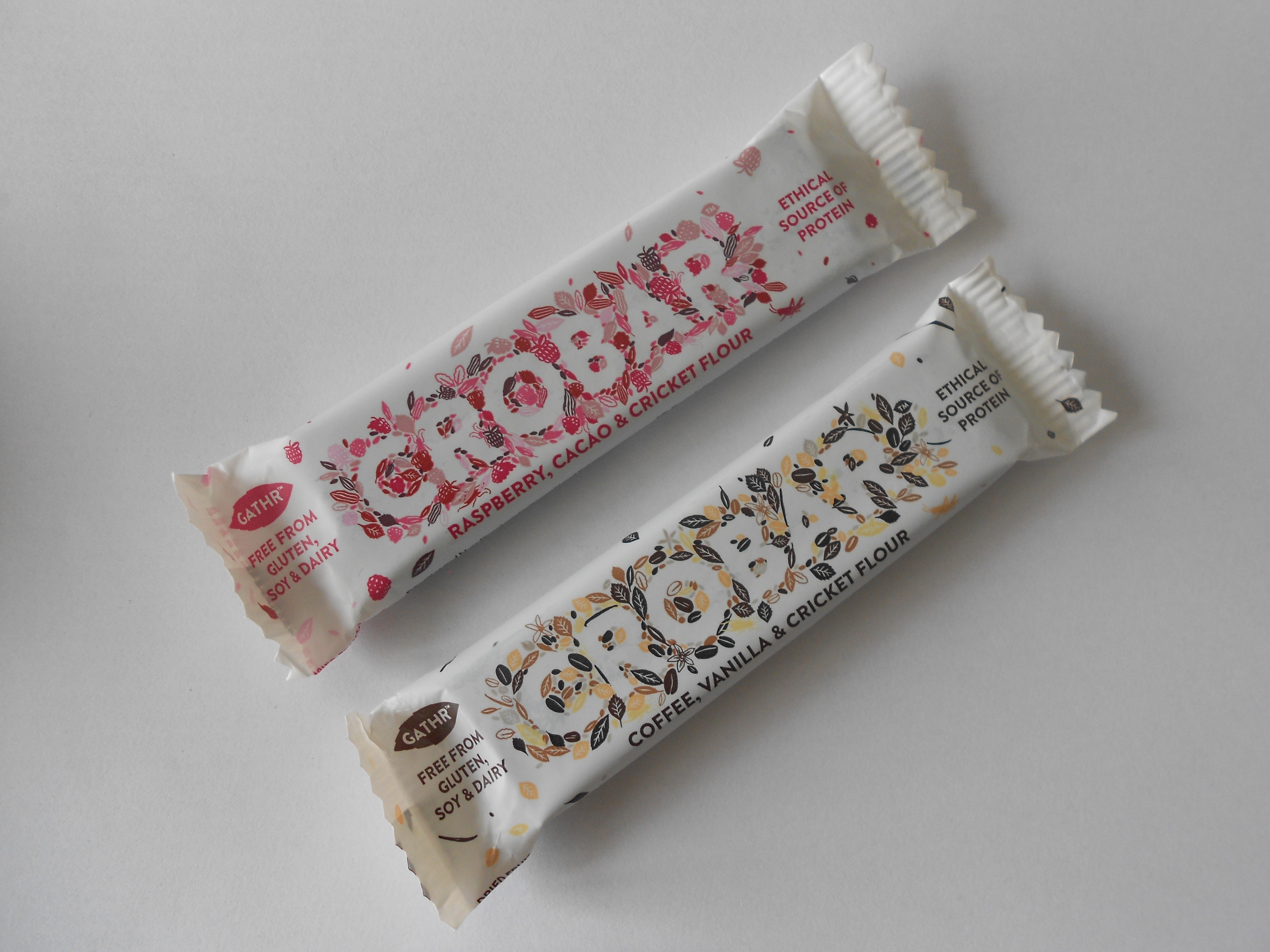
Crobar is the first insect-based food product to retail in the UK and Gathr have now added Coffee & Vanilla and Raspberry & Cacao to the original range of Peanut and Cacao. They are made from fruit, nuts and cricket flour and contain no added sugars or sweeteners.

Gathr is leading the trend of food producers who are looking at alternative sources of protein and vitamins in their products, and have plans on developing insects into a viable and more sustainable source of protein in our diets. Crickets contain more protein and less fat than an equivalent amount of beef, plus are high in iron and vitamin B12. They are not only good for you, they are good for the planet.

Insects are already available to buy as food in the UK, but Gathr has taken things one step further by using them as a key ingredient and incorporating them into everyday food.

Gathr’s products won ‘Best New Food Concept’ at the IFE World Food Innovation Awards.

Don’t be put off by the fact that it contains insects, albeit that they are ground into a flour. I can happily say it tastes delicious. I’m not partial to coffee flavoured sweets or cakes but the flavour was subtle and suitably balanced by the cacao. That said, I preferred the raspberry & cacao flavour.  Free from gluten, soy and dairy it was a tasty snack and easily satisfied my sweet tooth. I’d love to say it made me jump higher as well – but it didn’t.

Available in smaller 30g sizes the new flavours RRP from £1.79 each and are available online on the Gathr website, Amazon Prime and at selected retailers. For further information and multipack orders visit the Gathr website.

They will also be available to buy in-store from South East Asian Cuisine specialists Nusa Kitchen.

As well as energy bars, Gathr also stocks organic cricket flour, which can be used in everyday cooking. Recipes on the website.
 www.gathrfoods.com

www.gathrfoods.com/recipes

www.nusakitchen.co.uk

Don’t trust your scales – why you should be focusing on reducing your visceral fat, not your weight

don'ttrustthescalesBy Andy Kay, Training Manager at British Military Fitness 

If you’ve been watching your scales to see if your exercise regime is paying off, you might be wasting your time. New research has found that doing between two and four months of endurance training can cause either no, or very minimal, reduction in body weight, with participants in a study losing only between zero and 4kg of weight.[1]

Does this mean you should throw in the towel and swap evenings working up a sweat for nights on the couch? No! The same researchers studied the reduction in visceral fat, and found that after two to six months it was markedly reduced, with participants who had lost no weight, having reducing their visceral fat by 6%.

So, what is visceral fat?

Visceral body fat is what is created when the body stores excess calories as fat cells around your organs. You might not always be able to see it on the outside but excess visceral fat is bad news, being known as a risk factor for coronary heart disease and diabetes, as well as being linked to a number of different cancers and even Alzheimer’s disease.

This is because an excess of visceral body fat can interfere with liver function and can disrupt your organs’ normal function. This can lead to an increase in cholesterol, particularly bad cholesterol, as well as increased insulin resistance, which can lead to type 2 diabetes.

How much is too much?

It can be hard to identify if you have too much visceral body fat, but the World Health Organization recommends that a waist to hip ratio higher than 0.9 for men and 0.85 for women is high risk. Divide the circumference of your waist by the circumference of your hips to work this out.

What can you do about it?

As the researchers found, exercise is highly effective in reducing this type of fat, even if it has little effect on weight, with every 1% reduction in body weight associated with a 3% reduction in visceral body fat. Steady state cardio such as running, cycling and swimming, as well as exercise classes based on high intensity interval training such as BMF, are highly effective in reducing fat and helping people to get fitter. Exercise two to four times a week to gain the benefits, and ensure you are leading an active lifestyle the rest of the time, with more time spent walking and less spent sitting down.

What are the first steps to reducing visceral fat?

If you have a high waist to hip ratio and want to reduce your visceral body fat the first step is to get active and start exercising. From there, the focus should be on limiting portion sizes and making sensible choices when it comes to nutrition. Swap sugary and salty snacks in favour of complex carbohydrates, protein and vegetables and try to prepare as much of your own food as possible.

For more information, please visit: www.britishmilitaryfitness.com or to sign up to a free British Military Fitness trial go to: https://www.britmilfit.com/try-bmf-for-free/

[1] http://onlinelibrary.wiley.com/doi/10.1111/obr.12406/abstract


Breast Cancer: in the young, the pregnant and with family history

Pink Ribbon logoOn 17th September, the UK’s leading annual event for anyone affected by breast cancer will take place. There will be information from a range of experts, including Frost Magazine’s medical consultant Dr Kathleen Thompson. 

Registration: 10.00 am – coffee.

Morning session:  diagnosis, management and treatment for young women 

DIAGNOSIS : 10.30 Chairs introduction. Chairs: Mark Ho-Asjoe (St Thomas), Laura Johnson (Royal Marsden) 

 10.35 Breast cancer: the extent of the problem for young women: Bernard Rachet, reader in cancer epidemiology, London school of hygiene and tropical medicine 

10.55 From diagnosis onwards: navigating the breast cancer system: Denise Flett, young women’s breast cancer clinical nurse specialist (CNS), Royal Marsden hospital 

11.15 Reactions to diagnosis: getting the treatment you want: Kathleen Thompson, doctor, patient and author of From Both Ends of the Stethoscope 11.35 Panel 11.45   Short break + pastry 

TREATMENT: 12.00 Surgical options for hereditary and non-hereditary breast cancer. Breast conservation in young women Hisham Hamed, consultant oncoplastic breast surgeon, honorary senior lecturer, Guys and St Thomas Trust 

12.35 New options for the management of different breast cancer subtypes: Justin Stebbing, professor of oncology, Imperial college, London  

Following lunch: pregnancy, trials and survivorship 

2.15 Reserved (charity and sponsor, Philips)
2.35 Pregnancy and breast cancer: Alison Jones, breast cancer consultant, including for pregnancy and clinical trials, Leaders in Oncology Care 

3.10 Living with and beyond breast cancer: Susannah Stanway, consultant, medical oncology, breast unit, Royal Marsden hospital; also acute oncology unit, Croydon university hospital 

Venue: Royal Society of Medicine,1 Wimpole Street, London W1G 0AE 

BOOK (Event Brite): http://tinyurl.com/h45xfbf

* 16th September. Separate CPD day for clinicians: rsm.ac.uk/breastcancerforum


New Research Shows The Benefits of Vitamin D Supplementation And Heart Health

As our summer lurches from cloud to cloud, this latest information from HSIs (The Health Supplements Information Service, an independent body) is interesting:


Taking a vitamin D supplement may improve heart function in people with chronic heart failure according to a paper published in the Journal of the American College of Cardiology and presented at the American College of Cardiology in Chicago on April 4.

Commenting on the trial, Dr Emma Derbyshire a public health nutritionist for the Health Supplements Information Service (HSIS) noted: “This was a randomised double blind controlled trial in 223 people with chronic heart failure due to secondary left ventricular systolic dysfunction of the heart and also vitamin D deficiency.

“Trial participants were either allocated to one year of high dose vitamin D3 supplementation 4000 IU (100 micrograms daily) or a placebo. Measures made included the change in left ventricular function and the ability to do a test walk.

“Vitamin D supplementation restored normal levels of vitamin D in these people and left ventricular heart function was also better in the vitamin D supplemented group than placebo. There were no changes on the walking test with vitamin D.

“These findings are very encouraging as chronic heart failure is increasing and treatments can be expensive. Many people in the UK have very low levels of vitamin D. In fact average vitamin D intakes in the UK are between 2.3 and 5.1 micrograms daily which is not enough to protect against deficiency.
“A previous modelling exercise found that more than 8 micrograms would be needed daily to ensure a normal vitamin D status in most peopleIn addition, while the best source of vitamin D is sunlight, the Northerly latitude of the UK means that we lack the right form of sunlight for more than half of the year”.
The Health Supplements Information Service (HSIS) (www.hsis.org.uk; Tel: 020 7052 8955) is an independent information body, set up to provide balanced information on vitamins and minerals. It is supported by a restricted educational grant from the Proprietary Association of Great Britain (PAGB).


Is This the Best Treatment for me Doctor? Statistics on a Postage Stamp by Dr Kathleen Thompson

When we read about impressive new drugs, do we really understand what the percentages quoted mean?

You may need to make medicines-related choices—particularly for cancer, but other illnesses too. To make rational decisions you MUST understand the numbers your doctor quotes. He won’t deliberately mislead, but it is easy to misunderstand  statistical data.

So let me give you an inkling—not a maths lesson, just a few tips to help you ask the right questions.

Last week the BBC headlined: ‘Breast cancer: Taking hormone drugs for up to 15 years can reduce risk … cancer recurrence was cut by 34%’

Wow. Impressive. But let’s look closer: In that particular study, 95% of those who took the treatment for 15 years were cancer-free, compared to 91% who stopped at 10 years.

Hang on – 95% isn’t that different from 91%. How is that cutting risk by 34%?

Well (and this is important) improvement percentages quoted in newspapers, and by doctors and scientists, are often described in relation to the original risk.

In these patients, the original risk of cancer recurring was only 9%, so any improvement would appear large relative to 9%. If the original risk had been higher, the same benefit would have appeared less.

OK that’s the bottom line. But for the curious, another example:

Relative Risk Reduction (RRR) is a statistic often used to describe drug benefit. It is what it says—the reduction in risk (eg risk of death, or disease recurrence) relative to the original risk, ie the actual risk improvement divided by the original risk.

cancerriskreduction2

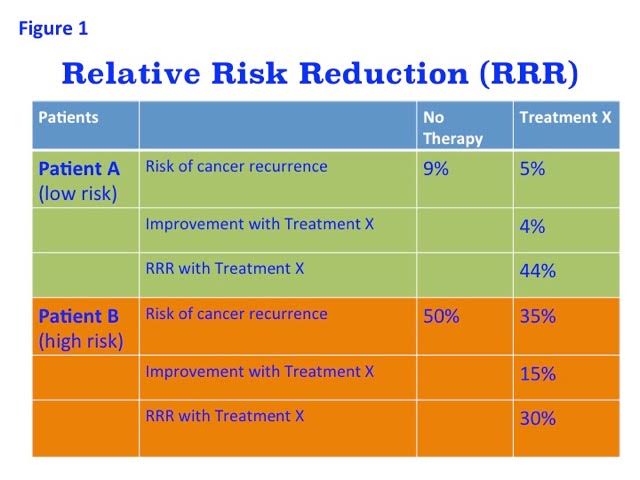
The Table shows an example. Patient A has a low risk of cancer returning (9%); Patient B’s cancer is more likely to recur (50%).

You can see from the Table that Patient A’s risk will only decrease by 4% with Treatment X, whereas Patient B’s will decrease by 15%.

Knowing this, Patient B should be more inclined to take treatment X than Patient A.

However, if Patient A’s doctor describes the benefit as RRR (see Table), then Patient A’s risk appears to decrease by a massive 44%. Consequently Patient A may have wildly inaccurate expectations for the treatment. The doctor isn’t tricking him, RRR is scientifically valid, but you need to know what it means.

This example highlights another point. Sometimes we only know that a treatment works in most people. However sometimes there is more information about how much it works in different patients eg Patient B would respond to Treatment X more than Patient A.

If available, you need specific information on the benefit for YOU. This could influence your decision, particularly for a treatment which has significant side-effects.

So, in summary: 

If your doctor uses percentages to explain a treatment benefit, ask:

1. Exactly what do the numbers mean?

2. By how many percentage points should you improve on treatment?

3. Is there more specific information for your particular situation? 

Don’t be frightened to ask your doctor for more information—he wants you to understand and may not realise when you don’t.

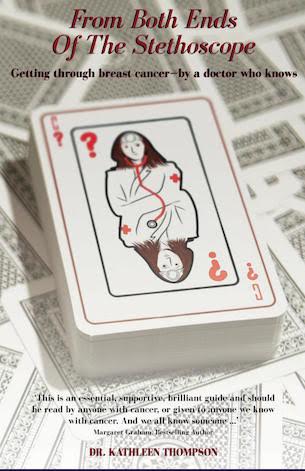
By Dr K Thompson, author of From Both Ends of the Stethoscope: Getting through breast cancer – by a doctor who knows

http://www.amazon.co.uk/dp/B01A7DM42Q http://www.amazon.com/dp/B01A7DM42Q

http://faitobooks.co,uk

Note: These articles express personal views. No warranty is made as to the accuracy or completeness of information given and you should always consult a doctor if you need medical advice

Further information:

http://www.bbc.co.uk/news/uk-36455719

http://www.nejm.org/doi/pdf/10.1056/NEJMoa1604700

http://scienceblog.cancerresearchuk.org/2013/03/15/absolute-versus-relative-risk-making-sense-of-media-stories/

http://www.breastcancer.org/risk/understand/abs_v_rel

http://www.nps.org.au/glossary/absolute-risk-reduction-arr


Enjoy a Coconut Escape with Palmer’s Skincare Coconut range

IMG_6841

Palmer’s, the Skin Gods that brought us the iconic Cocoa Butter which i’m sure takes pride of place on many a bathroom shelf, is on a mission to bring a little summer to our skincare regime. Ok, so it may not be summer quite yet but to help us feel a little more tropical, they have created a skincare range featuring the popular luxurious and favourite trend, Coconut Oil. The range includes a Body Lotion, Hand Cream, Body Cream and Body Oil to make sure you’re totally covered from top to toe. Not only does the Bodycare range provide 24 hour moisture and leaves skin radiant, but the new range uses mainly ethically and sustainable sourced raw, organic Coconut Oil. The range is free from Parabens, Phthalates, Mineral oils and dyes. The delectable scent stems from the infusion of Polynesian sacred Oil Tahitian Monoi Oil and with added benefits such as Antioxidants, Vitamin E and Proteins to help boost skin’s health and radiance need we say more…

Here’s our round-up of the new Coconut Oil Formula range;

Coconut Body Lotion 300dpi

Palmer’s Coconut Oil Formula Body Lotion;
RRP £4

This is perfect for everyday moisturising and after using it for a couple of weeks we noticed a huge improvement in hydration. The scent is unremarkable and the formula is not too thick and easy to soak into the skin.

Coconut Hand Cream 300dpi

Palmer’s Coconut Oil Formula Hand Cream;
RRP £2.40

For someone who’s not usually a fan of hand cream, this is my new go to product. Since the weather has been switching from Winter to Summer in one fell swoop, it has really taken a toll on my hands and the best thing about this product is that the formula is luscious, creamy and not greasy at all making it lock into the skin and provide a constant protection against the elements.

COF Body Cream New

Palmer’s Coconut Oil Formula Body Cream;
RRP £5

A little more luxurious than the lotion this Body Cream is rich and decadent. Again, perfect for providing deep conditioning and leaving the skin radiant. This is a perfect after sun antidote.

Coconut Spray 300dpi

Palmer’s Coconut Oil Formula Body Oil; **TOP PICK**
RRP £7

I love body oils, my skin is outrageously dry and this tropical oil not only provides an unbeatable silky moisture but transforms your skin to give it the perfect summer glow. So even though it may not be summer outside, close your eyes, inhale the scents of Palmer’s Coconut Oil range and let it transport you to a coconut escape!

IMG_6843

Products are available from Boots.com, Sainsburys.co.uk, Superdrug.com, Feel Unique and Amazon.co.uk

#coconutescape

From Both Ends of the Stethoscope By Dr Kathleen Thompson Book Review

From Both Ends Of The Stethoscope by Dr. Kathleen Thompson book review, health, breast cancer,I have to admit that I thought From Both Ends of the Stethoscope would be good. I also knew that it would educate me, but what I didn’t realise was that Dr Kathleen Thompson would make her book so entertaining and readable. The book is outstanding, an essential for anyone with breast cancer and their family. Dr Kathleen Thompson writes about her own experience in a graceful and poignant way while also giving you the inside track. You would only get this type of information from an insider and Dr Kathleen Thompson is an insider twice over; as a doctor and cancer survivor. I was incredibly impressed by her book. Her writing is so good she could write a novel.

Far from a fuddy medical book this guide takes you by the hand and tells you everything you need to know. It takes the process step-by-step, giving invaluable information at every point, all intertwined with Dr Kathleen Thompson’s fine prose on her own experience. I loved this book. Well done Dr Kathleen Thompson. Well done indeed.

Dr Kathleen Thompson is Frost’s medical expert but I promise you this has caused no bias for this review. This book is stunning and I am proud to have Dr Kathleen as one of our writers. The woman is an inspiration. You can send us any questions for her about any medical problem to frostmagazine@gmail.com or tweet us @Frostmag

Whilst dealing with her own breast cancer, Dr Kathleen Thompson recognised the desperate need for a ‘going through breast cancer’ guide. Her experiences make a fascinating story in themselves, and Kathleen uses them to guide the reader through diagnostic tests and treatment options, what to do when things go wrong, and when mistakes are made. All the while she explains what is happening and why. 
Recognising that anyone encountering cancer is in a state of shock, she delivers factual information intermingled with her own story, in an easily-digestible, and often amusing format. Each chapter ends with further information sources and a summary. 
Kathleen looks back on her cancer journey with honesty, humour and compassion, and with the benefit of her medical understanding and knowledge of the system.  
Later in the book she also explains medical research and how to assess the credibility of the numerous cancer treatment claims, and what we can all do to protect ourselves from cancer.


Read an excerpt from From Both Ends of the Stethoscope here.

Both Ends of the Stethoscope by Dr Kathleen Thompson

Paperback ISBN: 978-0-9935083-0-1

E book ISBN: 978-0-9935083-1-8

http://www.amazon.co.uk/dp/B01A7DM42Q


How old is too old to have a baby? 44, according to British women

how old is too old to have a baby? post natal depression, PND,How old do you think is too old for a woman to become a mother? Well new research conducted by the Private Pregnancy UK Show reveals that when it comes to having babies, British women believe that 44 is “too old” and should be the cut-off point. This is despite social factors such as focusing on careers and not finding the right partner, as well as advancements in medicine and science, playing crucial roles in the surge in older women having babies.

The research aims to start a debate on how far medical intervention and assisted conception can go in aiding women who wish to preserve their fertility or delay having children, as well as highlighting the need for increased fertility awareness for adult women and calls for sex education to include information on fertility options.

The five most cited reasons as to why women believe 44 should be the cut-off age are:
1.    It is unfair on the child to have old parents
2.    Increased likelihood of health complications like Down’s Syndrome for the child
3.    Women aged 50-plus should not be allowed fertility assistance via vitro fertilisation (IVF)
4.    Parents won’t live long enough to see the child grow up
5.    It is “unnatural” to have babies after that age

The research also reveals that almost three-quarters (74%) of women believe that there isn’t enough fertility education available for women about not “leaving it too late” to start a family, or the options now available to help preserve a woman’s fertility and likewise, to assist with conception. The majority of women (75%) questioned believe that the responsibility to educate women about these time-sensitive issues lies with government health officials.

Dr Amin Gorgy, fertility consultant and IVF specialist at The Fertility & Gynaecology Academy comments:

“The ideal age for women to become pregnant is in their twenties and early thirties. A woman’s fertility potential declines rapidly after the age of 35 and drops even faster after the age of 40. Indeed, successful egg freezing through vitrification has made it possible for women to postpone conception to later in life but as a society, we should be encouraging couples to have children at a younger age, in fact, I recommend that couples should aim to complete their families by the age of 35. There isn’t enough education available to women, many of whom still believe they can go on forever.

Theoretically, through egg donation and using eggs frozen at an earlier age, women can conceive at any age, in fact, the receptivity of the womb for implanting embryos declines only after the age of 54 but usually, we take 50 as the age limit for assisted conception and only under special circumstances will we consider someone beyond the age of 50. IVF must be put into perspective if used after the age of 35 as the chances of having a live birth with an IVF cycle declines dramatically with age, for example, there is a 20% success rate at the age of 40 which falls to just 1% above the age of 45.”

Dr Alex Eskander, consultant gynaecologist at The Gynae Centre comments:

“My feeling is that women in the UK enjoy much more the liberty, freedom and opportunity to further their careers over settling down to have children, the latter of which is now a thoroughly outdated concept of the traditional family.

I find the two key points of pressure for these women to have children come from their parents’ “need” to have grandchildren and a growing understanding of their biological clock. As a clinician, let’s be clear, I am not scare-mongering, it is a fact that ovarian function declines significantly from 30 years of age and even more sharply after 35 years.

I agree that 44 is too old for women to have children. From the ovaries standpoint, the number of eggs decline and the egg quality is poor. As a result, it is difficult to conceive and the conception maybe associated with a high rate of chromosome abnormalities and increased chances of miscarriage. From the mother’s standpoint, there is a high risk of hypertension, pre-eclampsia and caesarean section.

My advice for young women who may want to delay conception for any reason beyond the age of 35 is to seriously consider egg or embryo freezing (with donor sperm) as your “insurance policy””.

The two doctors will be joining a wider panel of experts who will be hosting this debate in a women’s healthcare Question Time seminar on Sunday 22 May at the Private Pregnancy UK Show.

For more information, please visit www.privatepregnancy.co.uk