A SPORTING STORY SELDOM TOLD

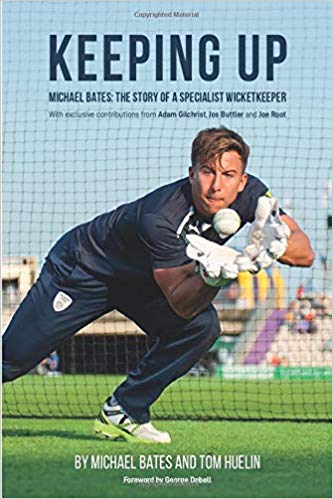
Jane Cable reviews Keeping Up by Michael Bates and Tom Huelin

So why am I reviewing a book about cricket? More than one reason, but mainly because this autobiography tells a story seldom told; that of a brilliant young sportsman who fell by the wayside. Not because of accident or injury, but because he it came to the point he simply couldn’t get a job. As an honest portrayal of what went wrong it should be required reading for any youngster aiming for a career in professional sport – and their parents.

This book is important because it’s the story of a career that didn’t work out. And not because of lack of talent, lack of professionalism, or lack of hard work. These are the stories we don’t hear. Especially in an everything’s perfect candy floss world dominated by social media. We need to know it’s OK if you try your best and it isn’t enough. It’s a lesson for us all.

I first met Michael Bates in late 2008 when he was part of an exceptionally talented group of youngsters in the Hampshire Cricket Academy. At the time I was freelancing as a cricket writer, working for the club’s website and I was keen to write about these youngsters. Michael came across as confident and mature (he’d have just turned eighteen), with a burning ambition to play for England.

Humour me for a few sentences while I wax lyrical about his keeping, because in order to understand this book, you need to understand just how good Michael was. That’s hard if you’re not an out and out cricket badger, but if you watch any sport at all, you’ll know that the best of the best move in a way that sets them apart, and have such confidence in their ability they make the almost impossible look easy. And that was Bates behind the stumps.

The book charts his progress from school cricket, through, and beyond, the professional game. For me it was absolutely fascinating to see the club I knew so well from one angle revealed through another. I totally relate to Michael’s descriptions of the macho environment where admitting weakness was practically impossible, but at the same time, in one day cricket at least, it was a period when Hampshire were very successful.

So what went wrong for Michael? In simple terms, these days wicket keepers need to be good batsmen as well. Now while he could undoubtedly bat, it was never in the same class as his keeping. But I was of the school of thought that maybe he didn’t score so many runs himself, but add the runs he stopped the opposition from scoring and the equation more than evened itself out.

But the powers at Hampshire didn’t agree and after Michael being a key part of the team that won Hampshire two trophies in 2012, they brought in a keeper with a better batting reputation over his head. Hampshire members were outraged. And although no-one knew it at the time, Michael Bates’ career was effectively over at twenty-two.

The one thing this book doesn’t do very well is draw comparisons with the wider world, perhaps because it’s fundamentally a book about cricket. But the authors have missed a trick here. Not just the angle that it’s OK to talk about failure, but also the inherent lessons for modern teams in the world of work in general.

The book does, however, have a happy ending. Michael Bates is now coaching at a high level in the cricket world, being part of the backroom staff behind the England Women’s World Cup win in 2017. He’s been able to take the harsh lessons he learnt and apply them to help others to succeed. At twenty-eight years old, that’s quite something.


Keeping Up is independently published. https://www.amazon.co.uk/Keeping-Up-Surviving-specialist-multi-dimensional/dp/1090420161/

My Writing Process – Caryl Hart

I’m a children’s author and, over the past ten years, have published over 45 picture books and young fiction titles with seven major publishers. Several have been shortlisted for awards and I’ve won a few too. I run creative literacy workshops for schools, libraries and festivals and run teacher training and mentoring services.

Find out more here: www.carylhart.com

What have you written?

I have 45 published titles to date and around 15 books in production.

Next year celebrates the tenth anniversary of my Albie series, illustrated by Ed Eaves (Simon & Schuster), which includes the best-selling How to Grow a Dinosaur and Supermarket Zoo. We are currently working on book 11!

I also have a series of five feisty princess books, the most recent is The Princess and the Shoe – a book about following your dreams and believing in yourself, illustrated by Sarah Warburton and published by Nosy Crow.

Then there’s the Knock Knock series of crazy counting book capers, illustrated by Nick East and published by Hodder. The fourth book, Knock Knock Superhero is out in August. 

And Let’s Go.. a preschool series of first experiences, illustrated by Laruen Tobia and published by Walker books.  

My book Big Box Little Box, illustrated by Edward Underwood was shortlisted for the Klaus Flugge design award and is the first in a new series with Bloomsbury.

These are just a few of my titles. You can see them all here: www.carylhart.com/books
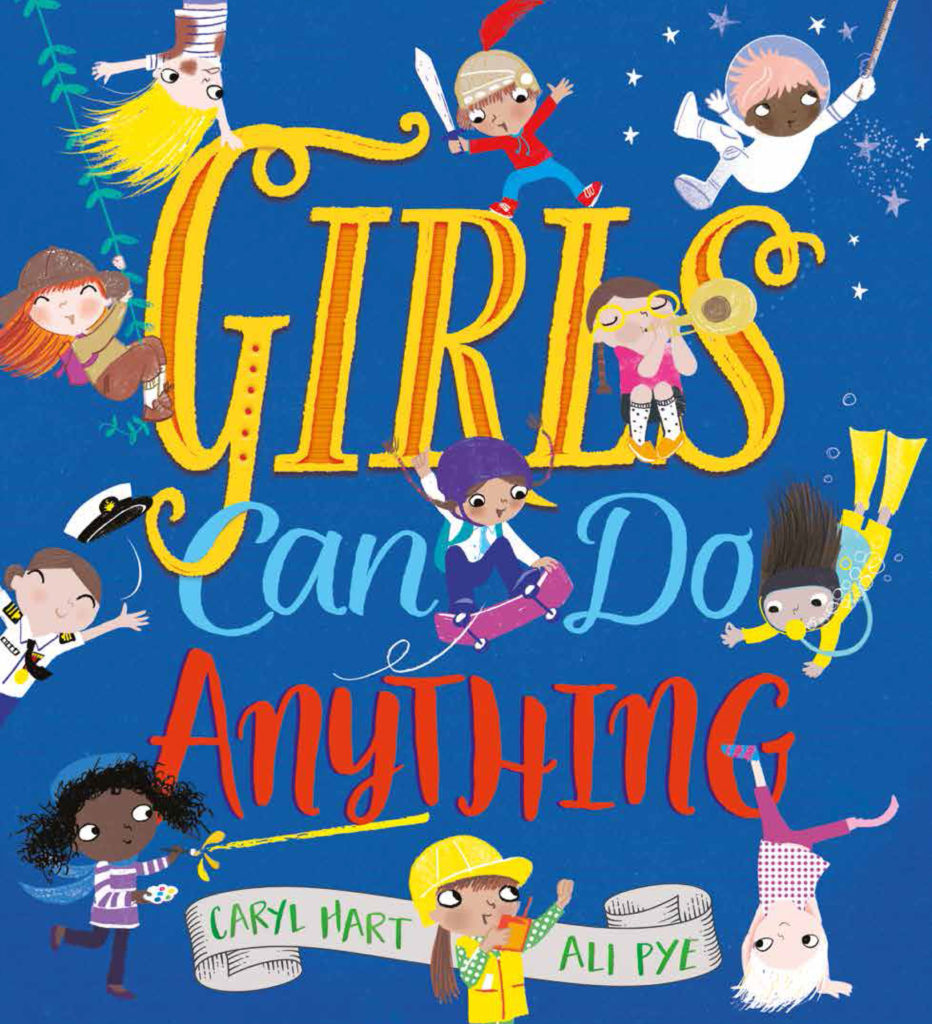
I’m very excited about the publication of Together We Can, a book about friendship, illustrated by Ali Pye and published by Scholastic. It’s a rhyming picture book that talks about what a friend is, how to make friends and, most importantly, how to be a friend. It is also a book about diversity as it features over 150 characters including children with different skin tones, hair styles, clothing, interests, mobility and other aids, prosthetics and cognitive and other physical difference.

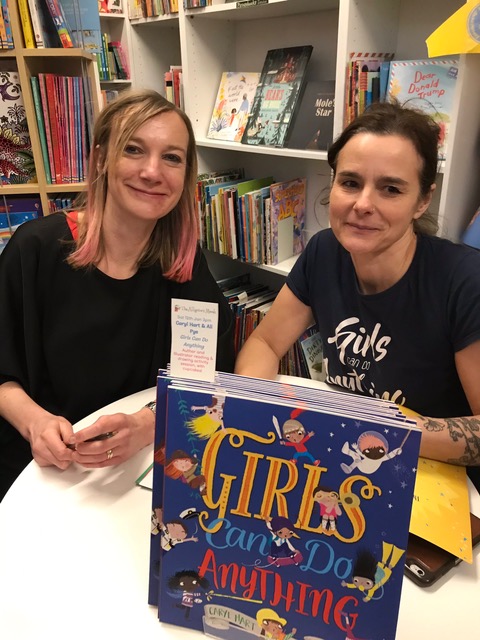
It follows on from the success of Girls Can Do Anything and has already received a lot of interest on social media.
A bit about your process of writing. 

Do you plan or just write?

Every book is different. Sometimes I create a proposal in which I outline my idea and write sample spreads, which I then submit to publishers.

Other times, I just start to write.  Sometimes I sketch out ideas too, it just depends on how my brain is working on a particular day!

What about word count?

This also depends on the book. The shortest book I have written is 50 words and the longest around 60,000. On the whole, picture books are around 600 -1000 words and titles aimed at preschoolers or babies are shorter.  I guess, as I’ve gained experience, I have developed a feel for how many words work on a double page spread.  

There’s always a lot of editing, both for the first draft and at various other stages during production.  For example, once the illustrator has created rough drawings, my editor and myself will work together to cut out unnecessary words, or re-write lines, so a text will often get sparer with each iteration until the final book is produced.

What about structure?

Once I’m ready to being writing, I lay my text out in spreads. A typical picture book has 12 -14 spreads so I just put the spread number as a subheading on my page and write the text to fit.  I find this helps me to evaluate word count and also to make sure that every page turn gives the reader something new and exciting to experience. 

What do you find hard about writing?

Getting the time to actually sit down and put words on a page can be hard. Working from home and being a mother and wife have their own distractions, but I also do a lot of school visits and workshops, so spend quite a lot of time planning timetables and creating activities to go with my books.  You can see some of these here: www.carylhart.com/about/book-activities

As a freelancer, I’m happiest when I’m busy and have several new projects on the horizon. There are times when I do worry that the next contract might never come, but have learned to push those worries to the back of my mind and trust that either I’ll come up with something, or a publisher will commission a new project. In reality I’ve never had a period when I’ve been without work, perhaps because I’m quite well disciplined and very self-motivated.

What do you love about writing? 

I love losing myself in a story and the discipline of writing, especially writing in rhyme. It’s very challenging creating a multi-layered story with appealing characters, a satisfying arc and clear meaning and also making the rhythm consistent and the rhyme solid.  It can take a day or more to write a four line verse so it can be very slow-going, but I get great satisfaction when I finally crack it. 

I also love getting the rough illustrations through as this is the point at which my stories really start coming to life. I’m so lucky to be working with lots of super-talented super-lovely illustrators who really do an amazing job, so it’s great seeing the books going from lines of text in a word document to bright, colourful, engaging  books that are just gorgeous to look at and handle.   You can meet all the illustrators I work with here: www.carylhart.com/about/illustrators

Advice for other writers. 

Writing for pleasure is a wonderful thing to do. It helps you, and others, work out how you feel and what your views and opinions, hopes and dreams are.  Writing can help you manage stress and take you to places you never thought you could go. Sharing your writing with friends, family or people online is a great way to feel validated, loved and appreciated.  There are now so many platforms out there where writers can share their work – social media, performance, blogs to name but a few. So if you love to write, WRITE!

If you’re hoping to get your work formally published as a printed book, set your bar high.  Remember that your work is competing for contracts with authors who already have a track record and relationship with their publisher, so your work really does need to shine.  

Publishers have to make money to survive and the industry is very competitive so your work needs to be commercial. That means that you have to take on board what editors and designers ask in terms of developing your texts. Publishing books is a team effort and if you are unable to stomach criticism then consider other platforms where you have total control over what gets published.

If you are writing in rhyme, make sure your rhythm is tight and your rhymes feel natural. Half rhymes work okay in song lyrics but aren’t ideal for children’s books.

If you are hoping to publish a picture book, go it alone. If you illustrate too, then by all means send some sample illustrations but don’t do the whole book unless you’re very experienced. Publishers will have their own ideas on how they want your text to be illustrated by, and rarely sign books that are submitted by a ready-made duo.

The more you write, the better you will become, especially if you are able to take on feedback from professionals in the industry.  Just because your mum or your children like your book idea, it doesn’t mean its commercially viable.  So if you get the chance to speak to someone with experience in publishing, do try to act on their advice – it’ll save you a lot of time and effort in the long run.

Above all else, write. Just write. And then write some more. You never know where it might take you!

CBD Oil (Cannabidiol) – News From Green Stem by Dr Kathleen Thompson


Since writing about CBD oil in Frost last month, Green Stem CBD wellness products wanted us to let you know that TV presenter Jenny Powell is their new ambassador.

They told us that Jenny discovered CBD oil when she was searching for a safe and natural remedy for crippling migraines, which affected her each month. In the past these had caused her to use various medications, and she had needed to lie in a dark room for 3 or 4 days. Jenny says of CBD oil, ‘I tried it and now eight months later, I haven’t had a migraine,’ and ‘For me, that’s life-changing.’

She’s spoken widely in the media about the benefits of CBD in recent months, and, as a guest on TV show Lorraine, apparently she commented, ‘Just a couple of drops underneath the tongue twice a day works for me.’ It seems that she was so impressed, she shared her CBD oil oral drops with her father, who is in his nineties and suffering from cancer. She felt that his pain, anxiety, and sleep were improved after using the drops.

Just to remind you, readers, anecdotal reports are interesting but not scientific proof of benefit. Currently, only a few hundred people have been studied in clinical trials, and more trials are urgently needed to investigate the pros and cons of CBD, and, importantly, the most-effective and safe doses. Nevertheless, Jenny clearly feels it works for her and her father and we are pleased that her migraines are so much better, whatever the reason.

CBD is short for cannabidiol – extracted from the hemp plant, a cousin of the marijuana plant. Although marijuana contains THC, which makes one ‘high’, CBD doesn’t have this ability. CBD is thought to have anti-inflammatory and anti-oxidant properties.

Until more evidence is available I can’t tell you whether it works in the myriad of illnesses suggested, or even what dose you should take. However, if you do decide to try it, it’s important to find a quality product and Green Stem makes CBD to stringent guidelines and quality and potency checks. It is available in Boots.  Their products are also free of THC (the chemical causing marijuana ‘highs’). CBD can affect the blood levels of various medicines, so if you do take it in addition to other medicines, you should check with your doctor.


By Dr K Thompson, author of From Both Ends of the Stethoscope: Getting through breast cancer – by a doctor who knows

http://www.amazon.co.uk/dp/B01A7DM42Q http://www.amazon.com/dp/B01A7DM42Q

http://faitobooks.co.uk


Note: These articles express personal views. No warranty is made as to the accuracy or completeness of information given and you should always consult a doctor if you need medical advice


SISTER SCRIBES: KITTY WILSON IN PRAISE OF CRITIQUES

I’ve recently returned from the Romantic Novelists Association (RNA) conference where I briefly had to speak to the NWS members. It was terrifying (terrifying!) but did make me think it was worth sharing details of the scheme that helped me, alongside many others, become published.

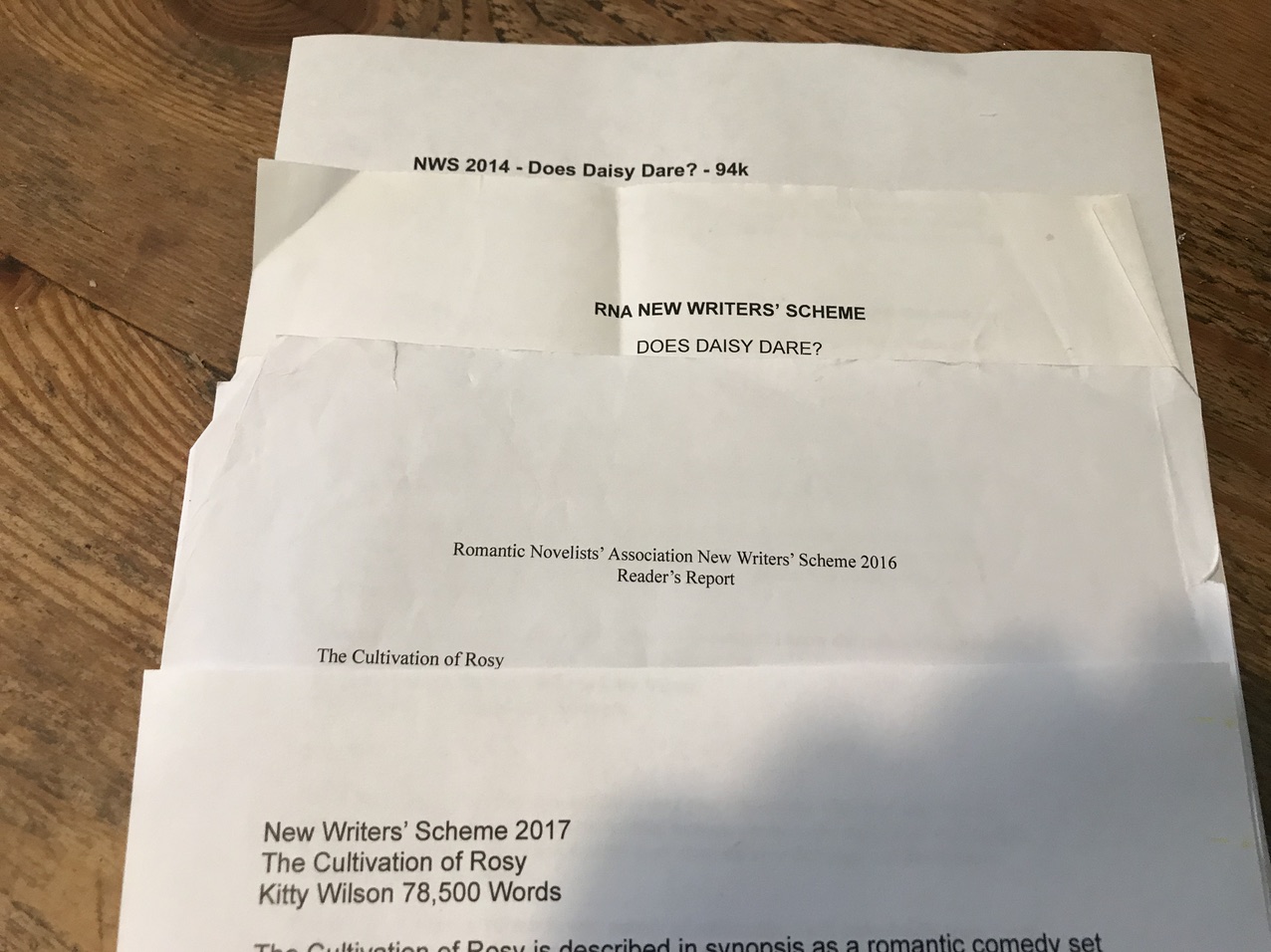
The NWS is a New Writers Scheme run by the RNA and encourages unpublished writers to join local meetings and make friends with the more experienced. It’s how I began to meet other authors, including the Sister Scribes, and as we are always saying writers need writer friends – I should tattoo this on my forehead and be done, I say it so often – and joining the RNA is a great way to meet them.

More than that, and why I initially joined, is its critique scheme. For the price of membership (considerably less than you’d pay for an assessment anywhere else) you are entitled to a critique of your full manuscript (partials are accepted if you haven’t got as far as writing The End yet).

It was the first opportunity I had to have my writing read by someone who knew the industry inside out (i.e. not my mother and close friends) and who could be completely honest about what they thought – the reader remains anonymous so they can be truthful without worrying that you’re going to launch at them at the Winter Party and either cover them in kisses or rip their eyes out whilst spitting ‘so, you didn’t like my heroine?’

The critique is usually divided into areas like plot, pace, voice, dialogue so you can see immediately which are your areas of strength and which ones need work. It doesn’t matter if you’ve written a zillion books, every writer needs a little help and an objective eye (otherwise we wouldn’t need editors), so if you expect a critique that says ‘oh my goodness, this is the best thing ever written in the history of the world’ then you may be bound for disappointment. If you want someone to gently point out what needs work to make your book even better then you’re in luck.

Being me, I found it really hard initially to hear the positive, whereas the things I needed to work on seared into my soul, fluttering under my eyelids as I’d try to sleep. It was at this point I decided to colour code my critique – if you have read my other posts you know I need no excuse to break out the felt-tips – and then I could see there was easily as much green (yay, this was great) as there was orange (this needs work).

What I didn’t know was how this technique would feed into my edits when I was eventually published and I use the orange and green method for these. So not only did joining the RNA get me friends and recommend friendly publishers and agents, it taught me how to react to suggestions about my work in a positive way, which meant that when my structural edits arrive, my meltdowns don’t last too long…or at least only as long as it takes me to unzip my pencil case. Thus not only did it improve my writing pre-publication, it also gave me tools which I have used habitually since becoming published.

So, if you are writing and as yet unpublished and if your manuscript has a romantic element then I cannot recommend the RNA’s New Writers Scheme enough. I’m going to pop a link below and hope to see you at a meeting soon. Good luck on your path to publication.

All love, Kitty x


https://romanticnovelistsassociation.org/membership/#link_tab-1517250016637-2-10


My Writing Process – Damaris Young

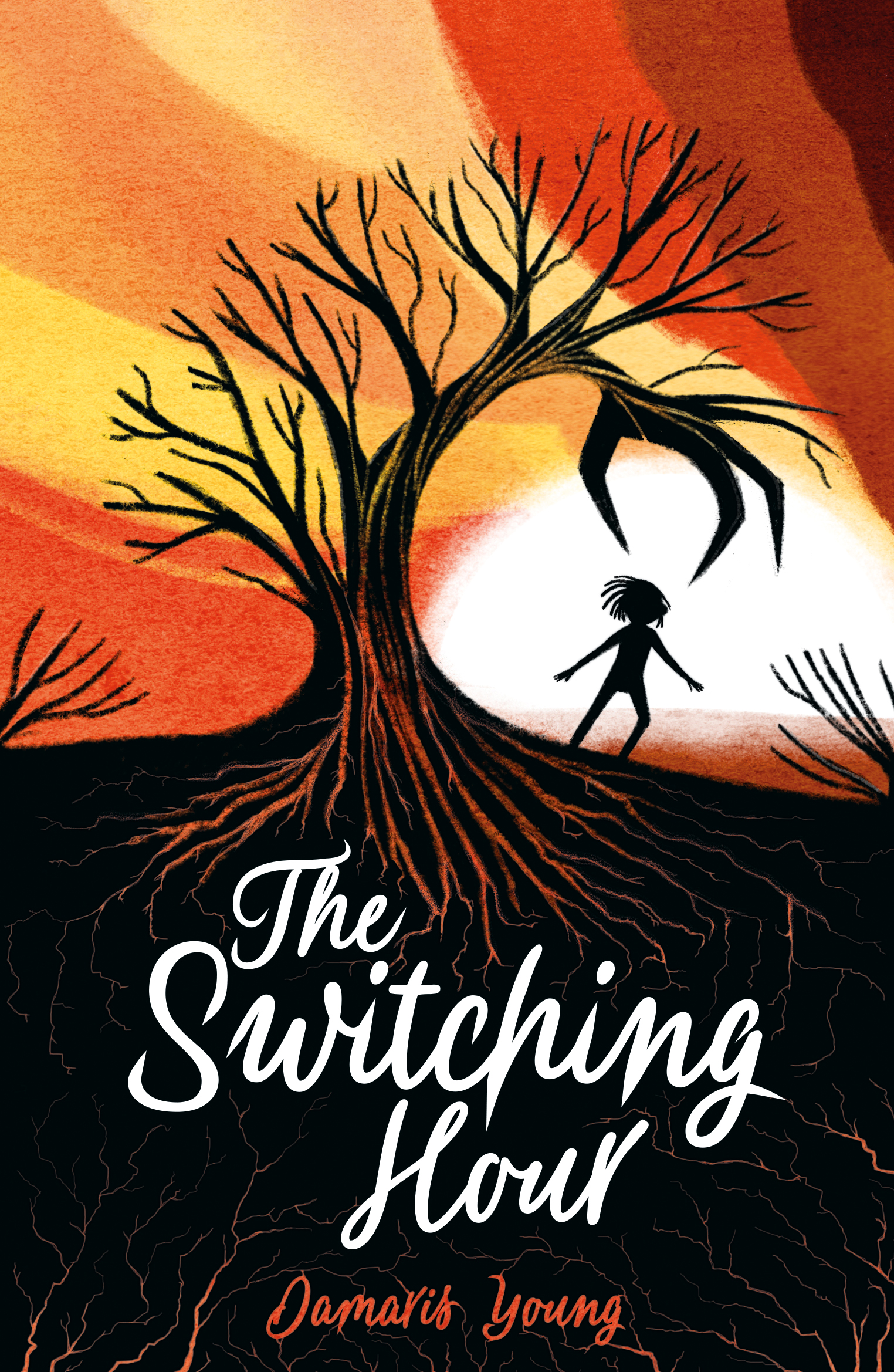
damaris young, author, the switching hourI was an avid reader growing up. I would try and copy my favourite stories, filling notebooks with fantastical worlds much like Alice’s wonderland. As my confidence grew, I started writing stories of my own, often to entertain my four younger brothers and sisters. When I moved to Bristol as an adult, I continued writing stories, eventually studying on the Bath Spa Writing for Young People MA, where I wrote my debut children’s novel, The Switching Hour. 

The Switching Hour is my first published book, but I have been writing stories ever since I can remember. I have so many half-written novels hidden away in my desk draw and on long-lost USB sticks!

What you are promoting now?

My debut The Switching Hour, a fantasy story aimed at young readers, is being published by Scholastic on the 1st August. It is about a girl called Amaya who lives with her grandmother, her small brother Kaleb and her pet goat in a land suffering a terrible drought. Every night, the doors must be locked after twilight, the Switching Hour, because the drought has awoken Badeko, a creature that snatches people away to eat their dreams. Three days later, the memory that they existed is gone from those that knew them, and those that are left are afflicted with The Sorrow Sickness – a grief which consumes a person without them knowing why. When Kaleb is taken by Badeko, Amaya must journey into the terrifying forest to find her brother before she forgets him.

The Bookseller has reviewed it as being ‘Highly atmospheric and genuinely spine-tingling, the power of family and female friendships shine in this assured debut’ which was wonderfully encouraging as The Switching Hour makes it’s way into the world for the first time.

A bit about your process of writing. 

I allow the seed of the story to grow by indulging in all the different ways the plot could go, no matter how ridiculous! I spend time thinking about the characters, how they talk and think and what they want most in the world. Once I have an outline for the story, I do lots of research. For The Switching Hour, I looked into what life would be like living through an extreme weather phenomenon, as well as being inspired by my experience growing up in central and southern Africa. I also had to do a lot of research into goat behaviour as my main character has a pet goat who is very much a part of the story!
Do you plan or just write?

I get the first draft down by furiously writing, without looking back on what’s been written. Once I have the first draft written down, I put it to one side and start from scratch all over again. This may sound quite discouraging, but for me the first draft is for getting a sense of the characters, testing out the plot and immersing myself into the story. The subsequent drafts are where the planning really starts and the manuscript begins to take shape. 

What about word count?

The Switching Hour is aimed at 8-12-year-old readers, so the general word count is expected to be around 50,000 words. I’m a ferocious editor of my own work so I do find it a struggle to keep my word count up!

What about structure?

I structure my story around the key narrative points, the exposition, the inciting incident, the peak and the resolution. When you’re writing for children it is especially important that you get to the inciting incident as soon as possible, to really capture the readers attention. In The Switching Hour, the inciting incident is when Amaya’s younger brother is taken by the Badeko and she must journey into the forest to find him. If you can create intrigue from the very first page all the better! I will always rewrite my opening chapters last, which may seem strange, but it helps to understand how the story ends in order to know where the best place is for it to begin. 
What do you find hard about writing?

Self-discipline. I write from home, sitting on my sofa with my two dogs snoring next to me and I’m easily distracted by social media, emails and even the washing up when I’m in the middle of a tricky chapter! It’s important to take time away from your laptop and just allow your mind to mull over the story, letting the character take up space in your head (and heart) but there’s no getting out of the fact that you have to just sit down and WRITE! 
What do you love about writing? 

I love getting swept away by writing, when I’m immersed in the story and I’m creating something that I really care about. I also love the way that my characters can surprise me by acting in ways that I hadn’t anticipated. Amaya in The Switching Hour was initially boisterous and outgoing (something I thought I wanted her to be) but I soon found out Amaya was actually a younger version of me, someone who felt unsure of herself and sometimes alone, yet fiercely protective of those she loved.

Advice for other writers. 

Believe in yourself and your writing. It’s all very well taking courses, reading books about writing and going on writing retreats (all things that will help you improve!) but if you don’t believe in your ability it will show on the page, so be your own biggest supporter! Another piece of advice would be; don’t follow trends. The publishing process can be slow and so by the time you have written the story about the latest trend, the publishing world will have most likely moved on. Write what you enjoy and aim to write it as best you can. And most importantly, just keep writing!

The Switching Hour is available here. 

@ScholasticUK  | youtube.com/ScholasticFilmsUK  | facebook.com/ScholasticUK  | instagram.com/scholastic_UK

The Olay Whip SPF30 Collection

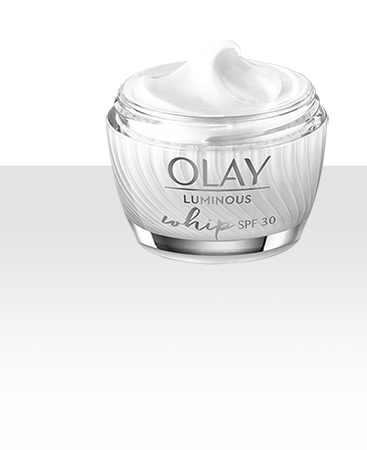
Olay whip SPF30

I never leave the house without an SPF. Even in winter. I think it has made a difference to my skin. So much of ageing comes from sun damage. I like Olay and tend to use it a lot. Finding a moisturiser with SPF30 can be hard, and a good one harder. I was sent the Olay Luminous Whip to review. I like the packaging but it is what is in the inside that counts. What I find is a product that moisturisers like a heavy moisturiser but has the light and airy feeling of a lighter counterpart. It feels soothing and calming as it goes on. My skin feels like it has had a good, long drink. My skin looks well moisturised too. I will definitely keep using the Olay Whips SPF30 range. It gives an excellent light finish with high SPF protection. It also absorbs instantly. My skin does not feel like it is suffocating. Brilliant stuff. 


More than half of women (61%) claim they don’t use an SPF when UV levels aren’t strong

The UVA/UVB rays from the sun are a leading cause of premature ageing

The Olay Whips SPF30 range has a ‘light as air’ finish and instant absorption with high SPF protection

Whether she’s up and out of the door for the daily commute or taking herself on an early morning jog – one thing her skin needs day in, day out is SPF protection.

However, it seems that although women know the importance of incorporating a moisturiser with SPF into their daily routines, they don’t seem to be acting on it.

Olay consumer research reveals that despite women knowing the sun is damaging their facial skin and making it age faster, they still aren’t protecting it with a daily SPF. More than half (61%) claim they don’t use SPF when they think UV levels aren’t strong, even though UV rays damage the skins all-important moisture barrier and act as a trigger for other skin aging effects year-round. Could it be the thick, sticky nature of SPF moisturisers that’s holding them back?

The good news is, the days of heavy, hard-to-handle facial moisturisers are no more. Olay’s game-changing Whips moisturiser has launched an SPF30 collection – so you can enjoy the light as air texture and potent anti-aging skincare ingredients of Olay Whips, with the powerful protection of SPF30.

OIay Whip SPF collection offers a broad-spectrum UVA/UVB SPF30.

Olay Whips SPF30 promises its exclusive ‘light as air’ formula that is perfectly whipped for instant absorption to the skin, leaving a flawless finish either on its own or under makeup. The product range includes Active Rush Technology™ which can hold and quickly release 1000x its weight in hydration and active ingredients. Olay Whips transforms from cream to liquid on contact, flash absorbing into skin to deliver potent anti-aging skincare with a light as air touch. So, women on the go can reap the benefits from a lightweight moisturiser and their much-needed SPF30 in one step!

Olay Whips SPF30, available in the Regenerist, Luminous and Total Effects ranges, offers powerful skincare with a light as air feeling, and year-round protection from the sun’s harmful rays.

For more information on Olay products, visit www.Olay.co.uk

Stockists: Boots.com, Superdrug.co.uk, amazon.co.uk and all leading retailers
RRP: £34.99

SISTER SCRIBES: CASS GRAFTON ON HOW 200 YEAR OLD SISTER SCRIBES HELPED FIND A CHARACTER

Writers have various ways of defining the characters in their books. When one of your characters is, or was, a real person, however, surely it’s so much easier?

Well, that depends on whether you’re sensible and choose someone about whom there is a wealth of fact available, along with authenticated portraits or photographs. If you’re not sensible, and I’m sure you can tell where this is going, it’s not quite so easy.

I co-write with my friend, Ada Bright, and because we have to ensure we’re imagining our characters with the same face and figure, we usually turn to the great Oracle that is Google Images for their appearance. This works brilliantly, unless your character is Jane Austen.

There are a few portraits that claim to be of Jane, but only one showing her face is authenticated. It’s a small pencil and watercolour drawing by her sister, Cassandra, and said by one of Jane’s nieces to be ‘hideously unlike’, whilst others claimed ‘perhaps it gave some idea of the truth’. Faint praise indeed.

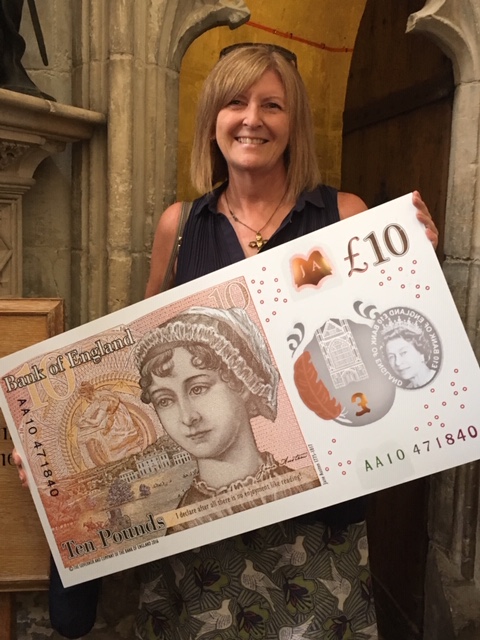
Needless to say, as the only authenticated image, it has been widely used, mainly in an increasingly prettified form over the years, most recently on the new ten-pound note.

We were left, therefore, with written accounts of Jane Austen’s appearance. These vary in the eyes of the source, but there are some common similarities: she was tall and slender, her brunette hair was long but cut short around the face to form curls, as was the fashion at the time, and she had hazel eyes, full cheeks and a clear complexion.

This helps our imagined physical manifestation of Jane. But what about her personality?

One of her brothers, Frank, then Admiral Francis Austen, wrote of her in 1852:

‘She was cheerful, not easily irritated, a little shy with strangers. Her natural reserve was sometimes misinterpreted as haughtiness. She was kind and funny, never failing to excite “the mirth and hilarity of the party”.’

Letters, therefore, became our best source. Jane and her beloved elder sister, Cassandra were incredibly close. Even as a child, their mother claimed that ‘if Cassandra were going to have her head cut off, Jane would insist on sharing her fate’.

Jane and Cassandra enjoyed a healthy correspondence when apart. Although we can ‘hear’ Jane’s voice through the characters of her novels, in her correspondence she is very much herself: open and honest, her wit to the fore, and clearly set upon entertaining her sister even as she wrote about mundane things such as the weather, the neighbours and the price of bread, including:

‘Next week I shall begin operations on my hat, on which you know my principal hopes of happiness depend.’ (1798)

‘I do not want people to be very agreeable, as it saves me the trouble of liking them a great deal.’ (1798)

‘I will not say that your mulberry trees are dead but I am afraid they are not alive.’ (1811)

‘He has but one fault, which time will, I trust, entirely remove – it is that his morning coat is a great deal too light.’ (1796)

‘She looks remarkably well (legacies are very wholesome diet)…’ (1808)

Although Cassandra destroyed many of Jane’s letters shortly before her own death, we are grateful to her for passing so many on to family members. It is thanks to her that we were able to develop Jane’s character, and we hope we did her wit and zest for life justice in our books.


Sources: Jane Austen’s Letters (4th Edition – 2011), collected and edited by Deirdre le Faye; A Memoir of Jane Austen, by James Edward Austen-Leigh (1870)


54 Celsius have brought theatricality to Candles … Bear the Pyropet in mind for Halloween …


For so long now candles have just been a low flickering light, perhaps with a scent and in a nice jar which can be used for something else when it achieves ‘burn out’. But… But… Icelandic designer Thorunn Arnadottir, founder of 54 Celsius has added a whole new dimension.

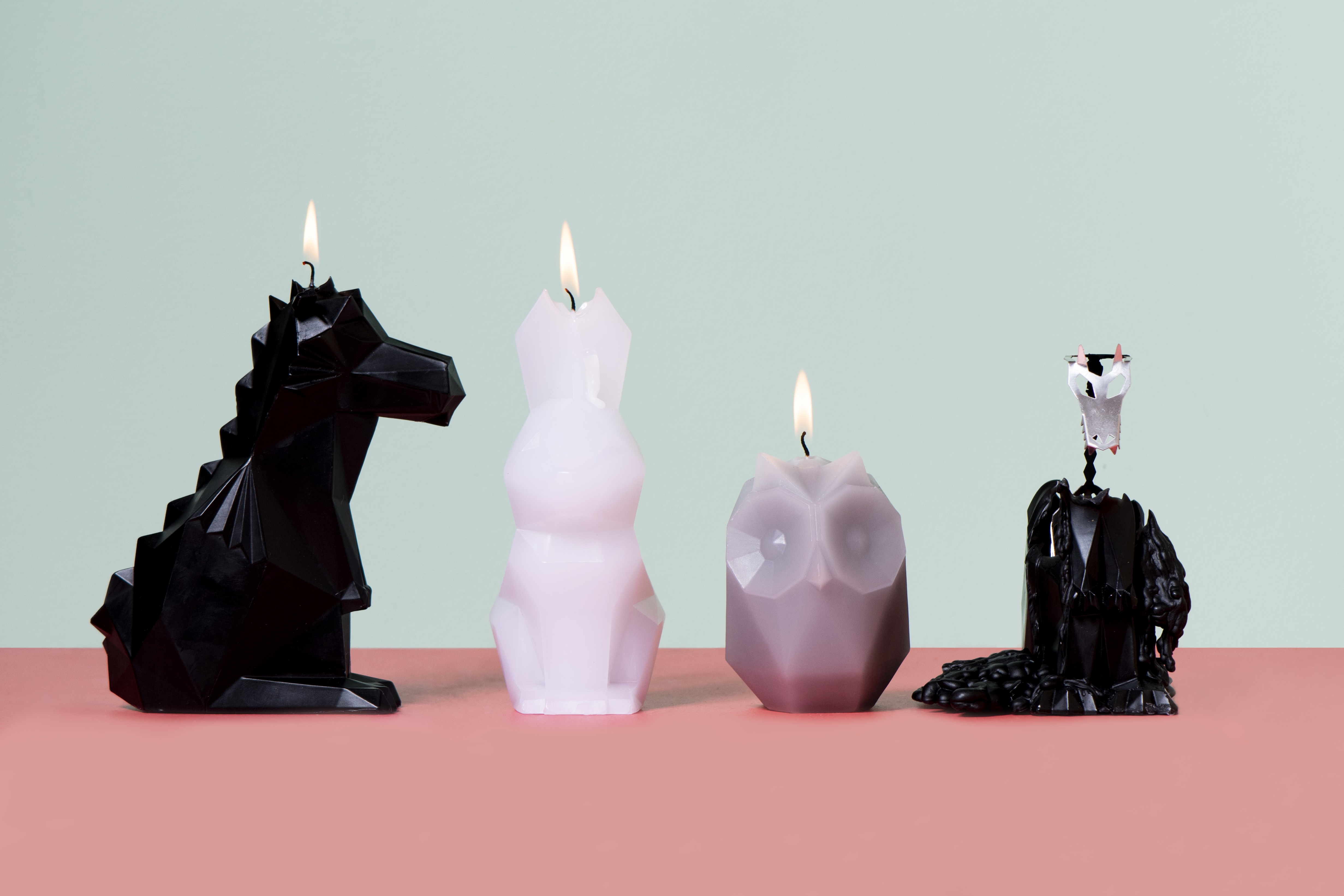
Recognised for their abstract, geometric cute animal exterior,  the Pyropet Candle  is not quite what it seems at first glance. Oh no, indeed not –  strike a match, light the wick and enjoy the performance. As it burns and melts it reveals  an aluminium skeleton with fire glowing eyes. As we at Frost Magazine thought: ideal for Halloween, but not just that.


Whether it’s a dinner party amongst friends or just to distract from a hard day at the office, there it is, on the mantel piece – waiting.  Out with the matches, light it, and  let all your stresses and strains wash away as the candle transforms from an innocent, adorable creature into a – well, predator perhaps.


Each Ugla PyroPet Candle comes beautifully packaged in a geometric printed gift box. A wonderful housewarming or birthday gift idea for he or she who takes great pride in their surroundings, I mean let’s face it, it will  create an interesting embellishment to their  living space.

Measuring 4 x 4 x 4.3 inches in size, Ugla is available in two varying colors; Dusky Blue, a hue of timeless, elegance, for versatile usage round the home and Grey which offers a classic, sleek and refined aesthetic that molds to your surroundings effortlessly. Made from the highest quality each Ugla PyroPet Candle is made from Paraffin wax, with a cotton wick and aluminum skeleton.

Ugla (the Owl) is available to buy online for £22.00 from 54 Celsius.

 PyroPet Candles, come in other shapes.  including; Kisa (the Cat), Bíbí (the Bird), Hoppa (the Rabbit), Einar (the Unicorn), Dýri (the Deer), Dreki (the Dragon) and Voffi (the Dog). 

I’d keep a few in for Halloween. What could be better on that spookie evening.

Find out more about the whole PyroPets range:  54 Celsius.