A LIFE IN THE DAY OF A RESEARCHER: Denise Beddows


Denise Beddows took joint second place in the WforW Georgina Hawtrey-Woore Award for Independent Authors: Non-Fiction Category with the brilliant and engrossing Odd Man Out. And here she tells us of a typical day in her life.

 

Many of us recall with warm nostalgia the bedtime stories our mothers used to read to us. My late mother, a former wartime bus conductress in Lancashire, was an avid reader of lurid press accounts of murder. She could recount every detail of every murder of the twentieth century, and recount them she did – every time I begged a bedtime story. Not for me the gentle tales of Noddy or Peter Rabbit. No, tragic Ruth Ellis, last woman hanged in Britain, and Haigh, the acid bath murderer, were my bedtime companions. So, it came as a surprise to me when, only recently, I learned that one of my mother’s fellow ‘clippies’ was executed for murder; a murder Mum never once mentioned.

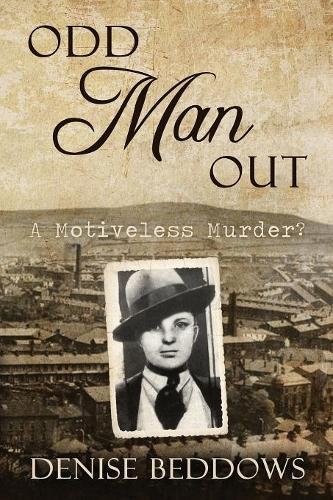
My curiosity piqued, I set about researching the case. Contemporaneous press reports were brief, perhaps because, although the accused confessed to the crime, she never said why she did it. She did not give evidence in court and nor did she appeal her death sentence. So, had middle-aged Margaret Allen brutally beaten to death Nancy Chadwick, an elderly woman whom she barely knew, and if so, why?

The victim, an eccentric and parsimonious scrounger, was described by her own nephew as ‘abnormal’. The killer, too, was unconventional to say the least. Allen, the twentieth of twenty-two children, born in extreme poverty, believed she was really a man and insisted on being addressed as ‘Bill’. The only explanation Allen offered for the killing was ‘I must have been in one of my funny moods’. The police presented the case as a murder in furtherance of a robbery, albeit that Allen was penniless when arrested. Clearly, the case warranted further investigation.
Close scrutiny of the records showed that much crucial evidence was suppressed by police at the time. Numerous witnesses claimed they had seen the victim hours after the alleged time of death. Statements by Allen’s family, putting her three miles away at the time of the murder, were neither tested nor put before the court. Scurrilous allegations made in court about Allen’s character and behaviour were demonstrably untrue, and public opinion was prejudiced by allegations of a lesbian relationship between Allen and her close friend Annie Cook. Seemingly, like Ruth Ellis, Allen was hanged as much for what she was as for what she was alleged to have done.

Drawing on historic interviews, I also contacted people who had met Allen. Their recollections were of a kind and generous person, not at all the violent, brutish character portrayed in press reports. Although, after one of the shortest murder trials on record, the judge deemed this a ‘motiveless, senseless’ killing, I uncovered a very obvious potential motive.

There comes a point, however, when most researchers experience qualms about delving intrusively into a stranger’s background. Indeed, I questioned my own motives in exploring the intimate detail of Allen’s life. Was I seeking to establish Allen’s motive, to find reason to mitigate this awful crime, and, perhaps, even to prove her innocence, or was this simply morbid curiosity? After much soul-searching, I persuaded myself that, whilst curiosity was my motivation, my aim was to give a voice to a troubled and disadvantaged transgendered individual, a troubled soul who chose to say very little about herself or her crime but went quietly and with dignity to the scaffold. As Margaret’s executioner, Albert Pierrepoint, famously said: ‘murderers are so often ordinary people caught on the wrong foot’.

A volunteer researcher for several history and heritage groups, Denise regularly gives talks to a variety of community groups. She is married with one grown-up daughter.

Denise, who also writes under the name of D J Kelly, has also written the well received Buckinghamshire Spies & Subversives, The Famous and Infamous of The Chalfonts and Gerrards Cross, Chalfont St Peter and Gerrards Cross at War, A Wistful Eye – The Tragedy of a Titanic Shipwright, Running with Crows – The Life and Death of a Black and Tan, Homes for Heroes – Life in a 1940s Prefab (ghost written with Joan Brant).

Odd Man Out – A Motiveless Murder? by Denise Beddows. pub by Misbourne Press in paperback
Available from: https://www.amazon.co.uk/ODD-MAN-OUT-Motiveless-Murder/dp/178697973X/ref=sr_1_sc_1?ie=UTF8&qid=1528376817&sr=8-1-spell&keywords=odd+man+out+Denise+beddowes
www.wordsforthewounded.co.uk

BYE-BYE BORING BLOW DRY!

Let’s be honest here, the main reason washing your hair is such a drag isn’t the refreshing time in the shower. It’s the lengthy blow dry process. Blow drying in the summer? Far too hot to handle. Blow drying in the winter? Nuh-uh, we’re cold and want to snuggle down in bed. Blow drying in the morning? Too much effort for our sleepy heads. You get the gist.

Enter, PowerDry.ME! PowerDry.ME is the brainchild of a Canadian brand, Design.ME, which is selling out of this beaut blow dry essential across the pond. The spray decreases your drying time by up to 50% (really!) so technically you can have a brilliant blow and style in half the time– WIN.

It’s a specially formed micro emulsion which coats hair fibres, while controlling frizz, offering heat and UV protection and smoothing and conditioning your hair. It also has a really soft, sweet scent too – a bit like a traditional bubble bath!

Ready for the super complicated usage instructions? Here we go…

  • Mist onto damp hair from roots to ends
  • Dry
  • Style

See, miracles do happen!

How much? £14.95 for 230ml

I need it! Visit Sally Beauty (online or in store) to purchase.

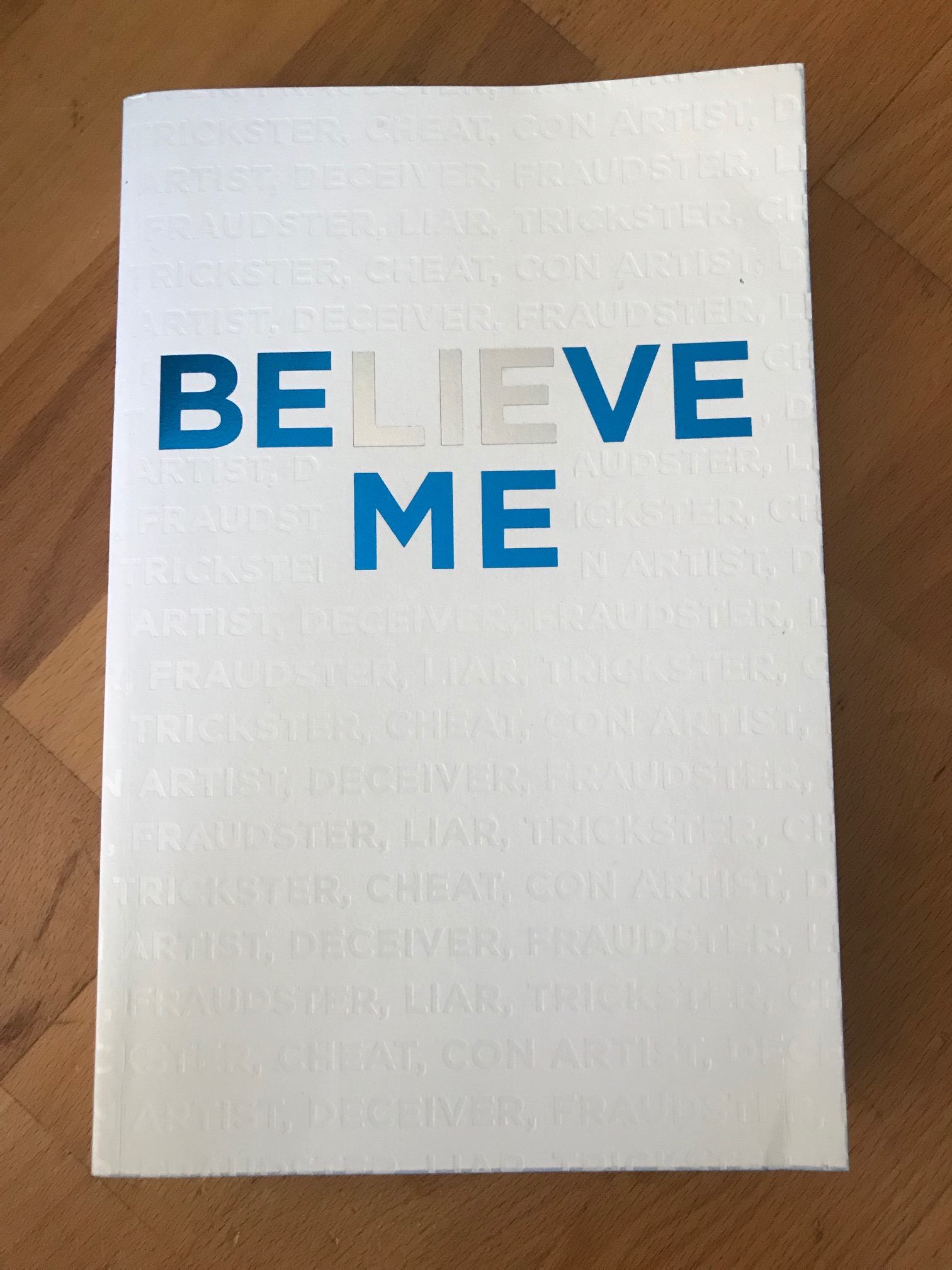
Believe Me By J P Delaney | Book of The Week

believe me JP Delaney

I found it impossible to book this book down. I do not even read much crime thrillers as I get upset about the high female body count, but this book is so well done and does not feel gratuitous. Despite the horror of the crimes. If your love Gillian Flynn and Paula Hawkins you will love this. A pitch perfect psychological thriller.

A British drama student, in New York without a green card, Claire takes the only job she can get: working for a firm of divorce lawyers, posing as an easy pick-up in hotel bars to entrap straying husbands.

When one of her targets becomes the subject of a murder investigation, the police ask Claire to use her acting skills to help lure their suspect into a confession. But right from the start, she has doubts about the part she’s being asked to play. Is Patrick Fogler really a killer . . . Or the only decent husband she’s ever met? And is there more to this set-up than she’s being told?

And that’s when Claire realises she’s playing the deadliest role of her life . . .

Available here.

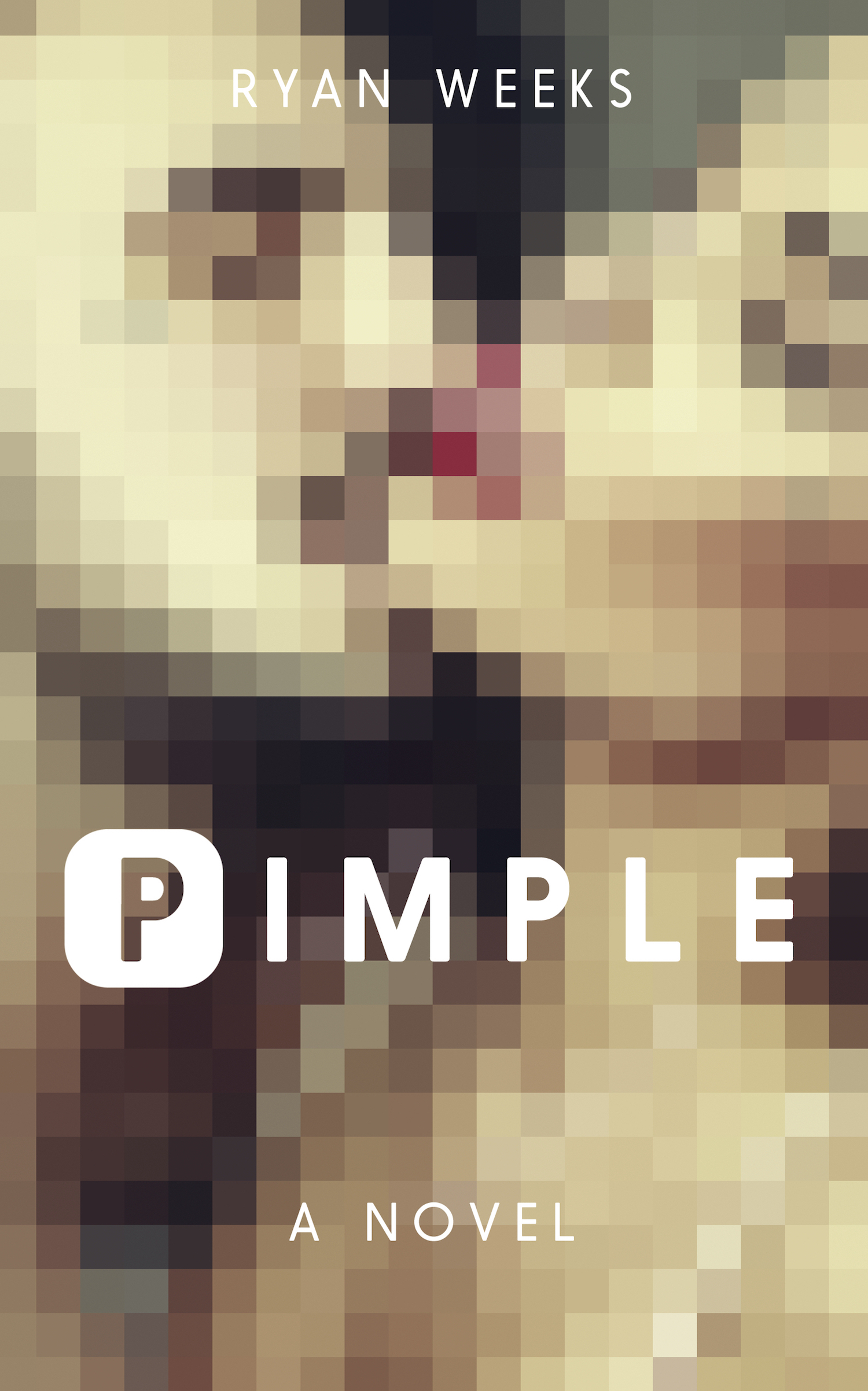
Book Review: Pimple, by Ryan Weeks

Ryan Weeks’ debut novel paints a disturbing picture of the sex industry fuelled not by drugs and organised crime but by download speed.
By Lucy Bryson for Frost Magazine
With shades of Black Mirror, the hit Netflix series, Pimple is a brave debut novel by the tech journalist, Ryan Weeks. In it, he transports us – hopefully for the first time – to London’s underworld where pimps, prostitutes and criminals abound. It explores what would happen if this shady cast of characters were thrust in the neon glare of the internet and the impact of ‘disruptive technology on society.

Pimple sees tech insiders take on the sex industry by creating an app that puts sex workers and clients directly in touch with one another, Uber-style.
With an insider knowledge drawn from his years as a mover and shaker within the world of ‘FinTech’ (or financial technology), Weeks casts a sideways glance at the buzz terms and behaviour of those involved in game-changing tech but isn’t afraid to confront tough questions about accountability.

The sex industry is a controversial subject to cover, and it’s very much to the author’s credit that Pimple doesn’t descend into tawdry imaginings of sexual encounters. Rather, it’s a thoughtful and stylishly-written novel that looks at the lives of four very different people – Annie, the tech-savvy young woman who creates the app; Elena the sex worker that signs up for what she hopes will be a safer and more profitable way of doing; Emerson, a disgusting pimp who violently object to the loss of income; and the police officers enforcing the laws that ban prostitutes and pimps from plying their trade.

Annie, the book’s main character, is a techy-savvy millennial looking for a new challenge after her financial start-up is bought out by a High Street bank. Looking for something morally rewarding, she begins to imagine ways in which she could use technology to stem a rise in violent crime against female sex workers in the city. With the help of close friend Veronica, she develops a revolutionary new app that is to throw an already dangerous situation into chaos.


The first chapters of the book outline the women’s attempts to launch the app on the street worker scene, and before long prostitutes begin to sign up in their droves – accustomed as they are to the abusive pimps, these vulnerable women find themselves suddenly in a more powerful position. Able to pick and choose her clients (rated on a 1-5 scale, as are the prostitutes) and her rates, Annie feels a cautious sense of liberation and independence. But neither the pimps nor the police are happy, and events spiral dangerously out of control, as several fraught chapters lead to a violent conclusion.

This is not a book that will appeal to all tastes. The stylised language sounds a little forced at times – particularly in the dialogue between Annie and Veronica – and some readers will baulk at the idea of a book about Millennials and their ‘tech-talk’. But Weeks is unafraid to poke fun at his own generation and its presumed pretentiousness, making this a more humorous read than the subject matter may suggest.

Weeks succeeds in conveying a sense of impending doom, and fans of the thriller genre will find a lot to enjoy here; the book crams a lot of tension, twists and turns into little over 200 pages.

But Weeks also poses some challenging questions about sexual exploitation and the impact of technology on society – questions which readers are likely to be pondering long after they’ve put the book down.

Ryan Weeks is the editor of AltFi.com, one of the leading news and intelligence resources for ‘fintech’ (financial technology) in the UK. Pimple, explores the dramatic consequences of technological disruption. It is out now through Amazon UK priced £10.99 in paperback and 99p in ebook.

Sherlock Holmes: The Sign of Four By Sir Arthur Conan Doyle UK Tour:

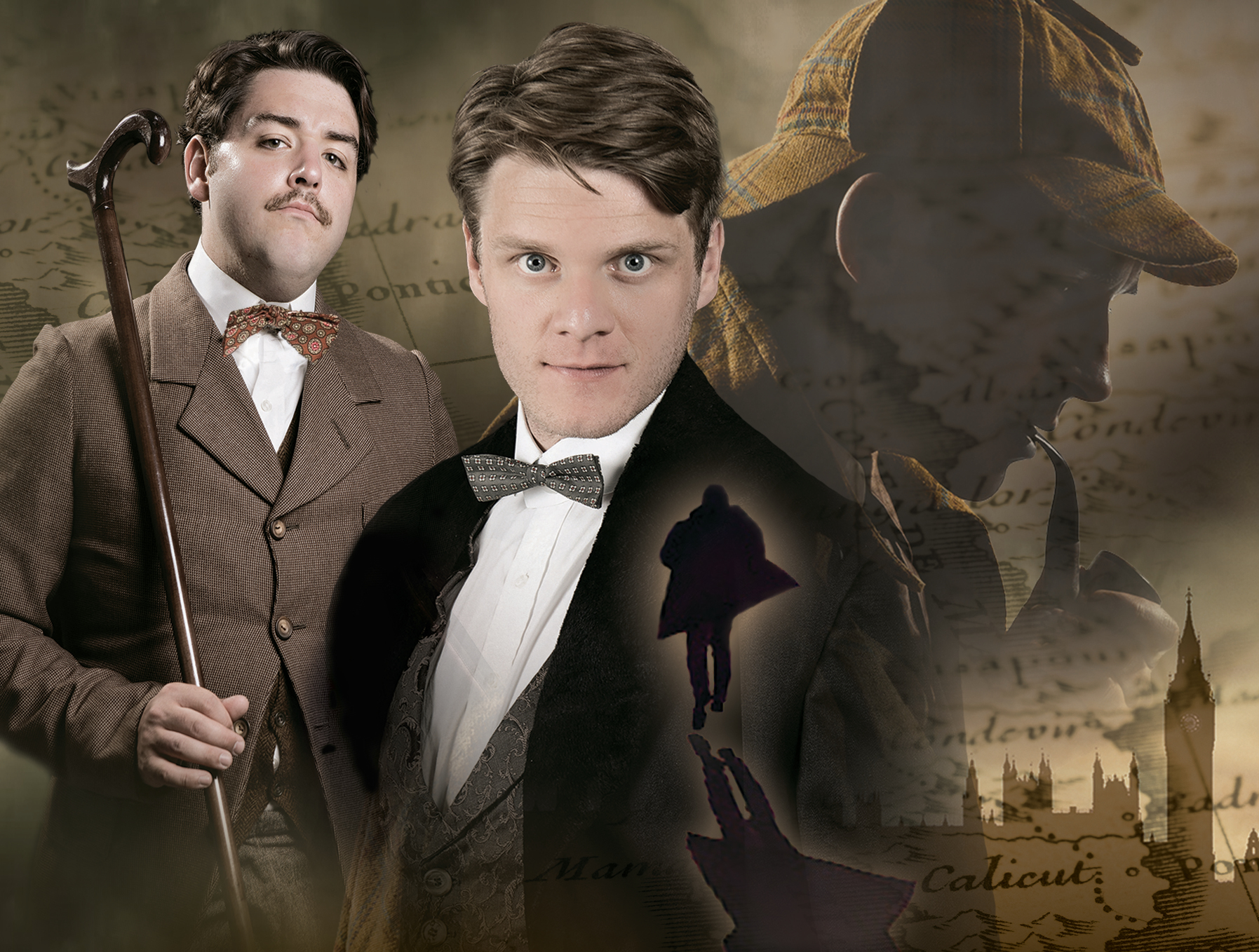
This autumn, Blackeyed Theatre are back with a thrilling new adaptation of The Sign of Four – Sir Arthur Conan Doyle’s epic second Sherlock Holmes novel.

In association with New Theatre Royal Portsmouth and South Hill Park Arts Centre it will be touring the UK until spring next year.  September 2018 – April 2019.

Crammed full of adventure, romance, comedy and, of course, one or two rather brilliant deductions, this faithful adaptation sees Sherlock Holmes and his companion Dr Watson use their powers of deception to solve the mysterious disappearance to Mary Morstan’s father.

This fabulous play will appeal to devoted fans, adults, children and budding detectives alike, and will combine live music, composed by Tristan Parkes, and ensemble storytelling.

When Mary Morstan arrives at Baker Street to request help following the mysterious disappearance of her father, Sherlock Holmes and his companion Dr Watson are plunged into a murky world of deception and a complex plot involving murder, corruption and stolen jewels.

The cast features Luke Barton as Sherlock Holmes (The Unexpected Guest, Mill at Sonning; Misterman, Liverpool Everyman and Playhouse), Joseph Derrington as Dr John Watson (The Importance of Being Earnest, MAC Belfast; The Canterville Ghost, Erasmus Theatre), Zach Lee as Jonathan Small (Bouncers, Glass Menagerie, Hull Truck; The Derby McQueen Affair, York Theatre Royal), Stephanie Rutherford as Mary Morstan (Kubla Khan, Mirror Mirror, Oily Cart; Cinderella, Derby Theatre), Christopher Glover as Dost Akbar (Peckham The Soap Opera, Royal Court; Eastenders, BBC) and Ru Hamilton as Thaddeus Sholto (Tipping the Velvet, Lyric Hammersmith; Peter Pan, Derby Theatre).

Director Nick Lane comments, I don’t think I know anyone over the age of ten who doesn’t know at least the name Sherlock Holmes. He is part of the literary fabric of this country – hugely popular and hugely adaptable – and his cases with Watson are a blueprint for so many crime novels, films, TV shows and theatre. We have approached this adaptation in a stylised way which will appeal to avid fans of the novel as well as those who simply want to come to the theatre and enjoy a rattling good crime story!

Sherlock Holmes: The Sign of Four is produced by Blackeyed Theatre in association with New Theatre Royal Portsmouth and South Hill Park Arts Centre in Bracknell and supported by Arts Council England.

Sherlock Holmes: The Sign of Four

Running time 120 minutes (including interval)

Twitter @Blackeyedtheatr, #SignofFour

Tour details: Blackeyed Theatre

Age Guidance 11+

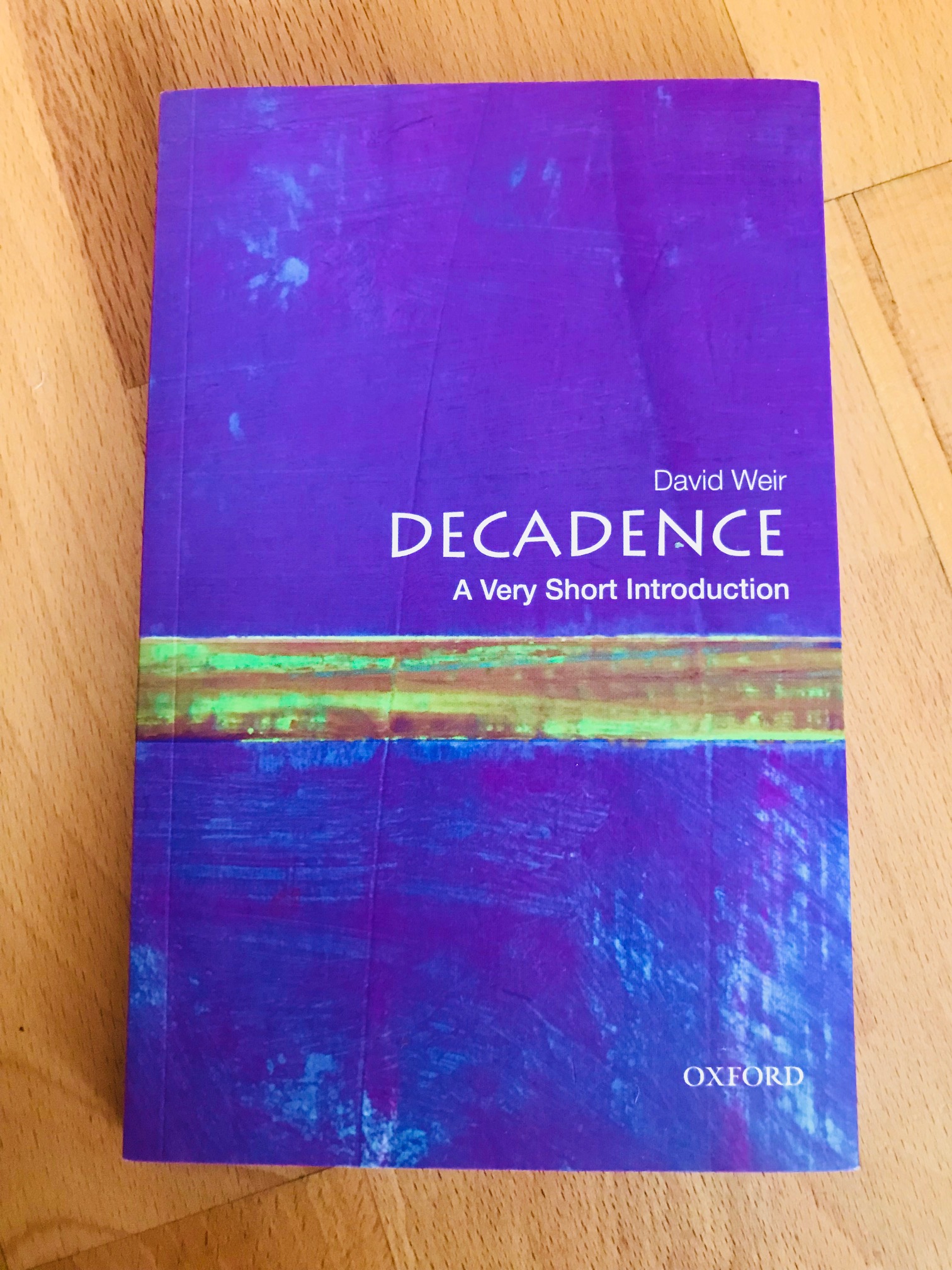
Decadence: A Very Short Introduction By David Weir

A great short read on decadence. A real eye opener which makes you think. We loved it.

The history of decadent culture runs from ancient Rome to nineteenth-century Paris, Victorian London, fin de siècle Vienna, Weimar Berlin, and beyond. The decline of Rome provides the pattern for both aesthetic and social decadence, a pattern that artists and writers in the nineteenth century imitated, emulated, parodied, and otherwise manipulated for aesthetic gain. What begins as the moral condemnation of modernity in mid-nineteenth century France on the part of decadent authors such as Charles Baudelaire ends up as the perverse celebration of the pessimism that accompanies imperial decline. This delight in decline informs the rich canon of decadence that runs from Joris-Karl Huysmans’s À Rebours to Oscar Wilde’s The Picture of Dorian Gray, Aubrey Beardsley’s drawings, Gustav Klimt’s paintings, and numerous other works.

In this Very Short Introduction, David Weir explores the conflicting attitudes towards modernity present in decadent culture by examining the difference between aesthetic decadence–the excess of artifice–and social decadence, which involves excess in a variety of forms, whether perversely pleasurable or gratuitously cruel. Such contrariness between aesthetic and social decadence led some of its practitioners to substitute art for life and to stress the importance of taste over morality, a maneuver with far-reaching consequences, especially as decadence enters the realm of popular culture today.

ABOUT THE SERIES: The Very Short Introductions series from Oxford University Press contains hundreds of titles in almost every subject area. These pocket-sized books are the perfect way to get ahead in a new subject quickly. Our expert authors combine facts, analysis, perspective, new ideas, and enthusiasm to make interesting and challenging topics highly readable.

Decadence: A Very Short Introduction is available here.


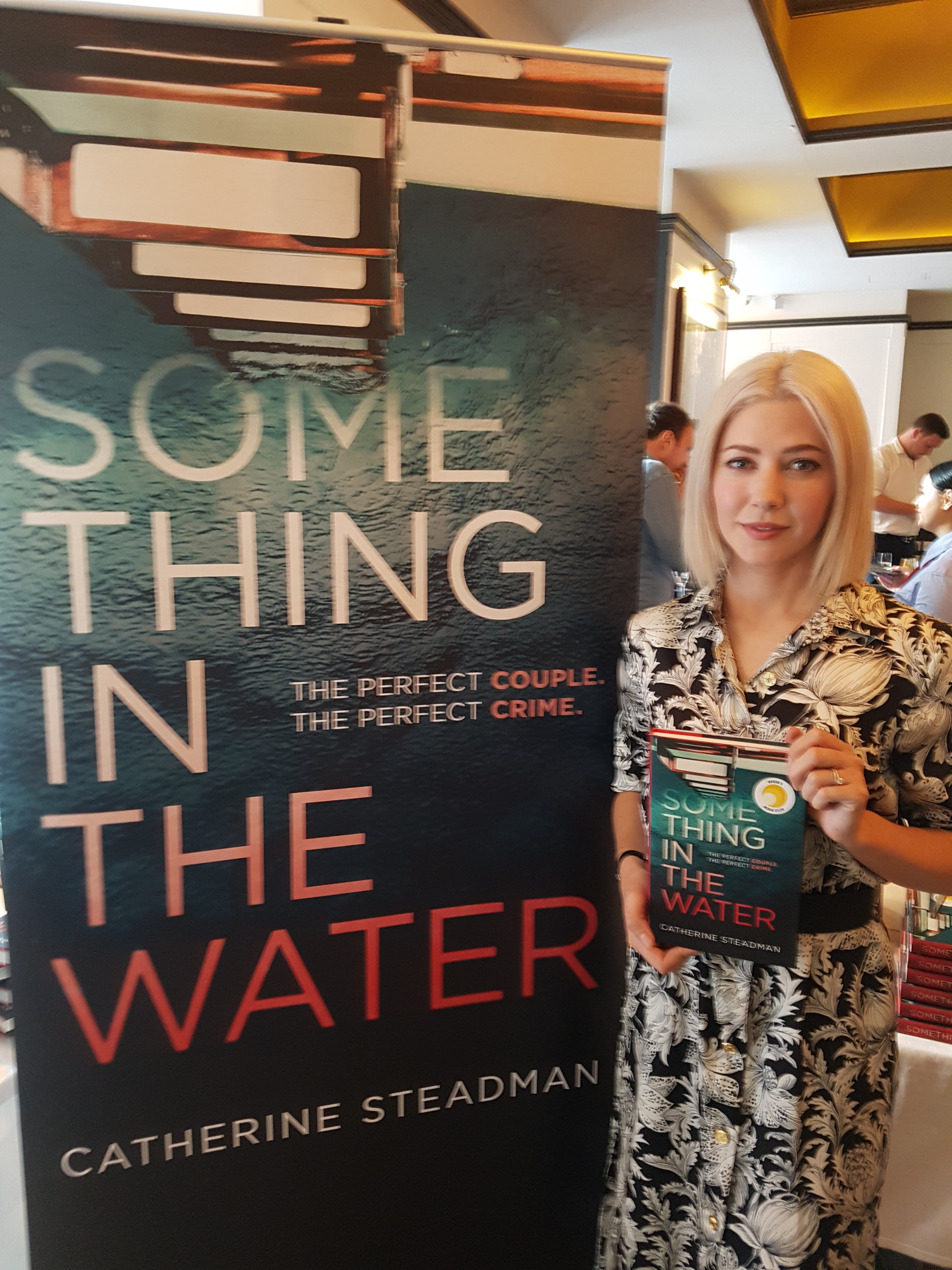
Does ‘Something in the Water’ fit the bill for that perfect holiday read? Michael Rowan lets us know.

It most certainly does, unless of course you are going on a diving holiday or honeymoon but for all other occasions

Something in the Water by Catherine Steadman grips and won’t let go.

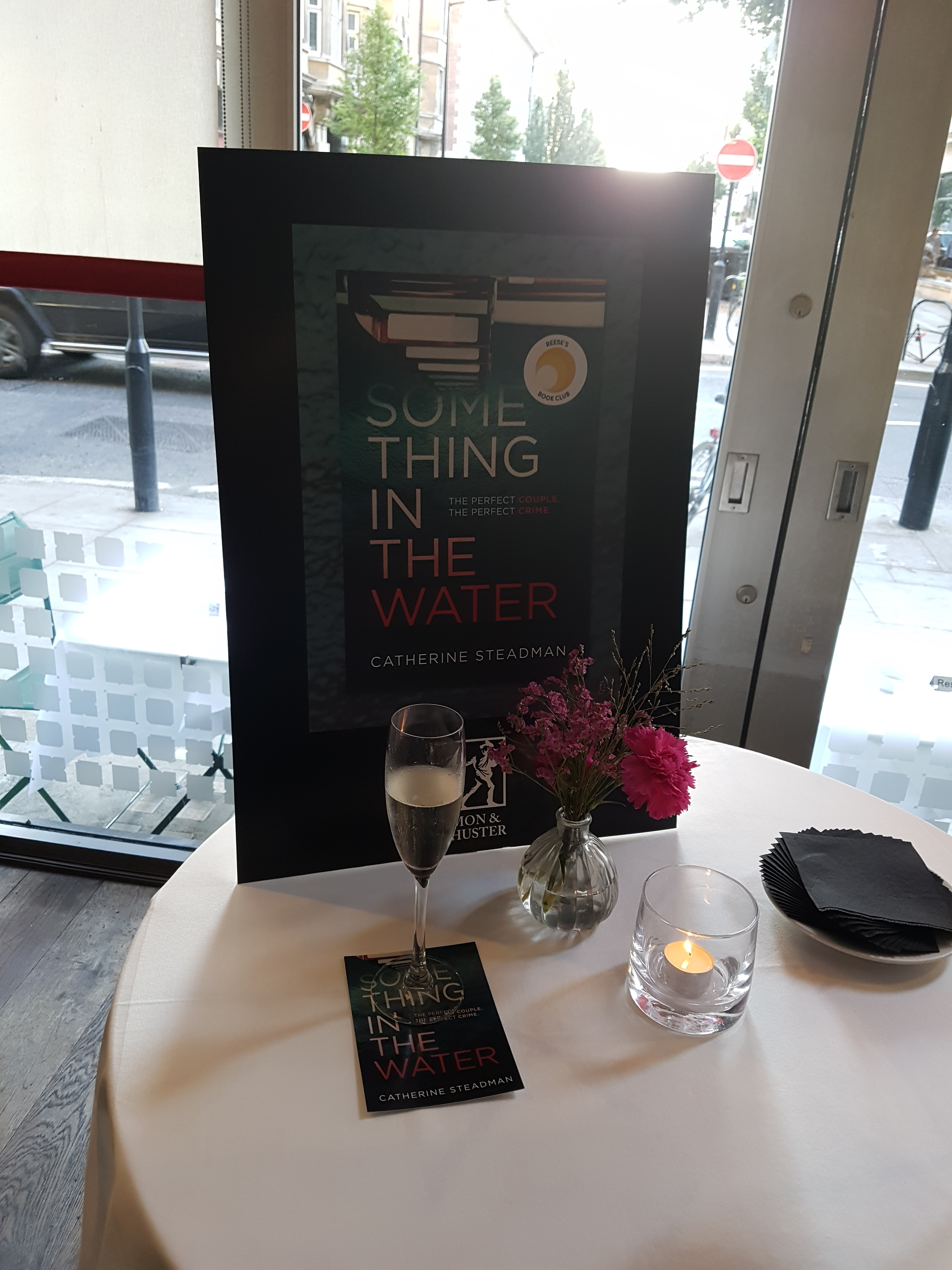
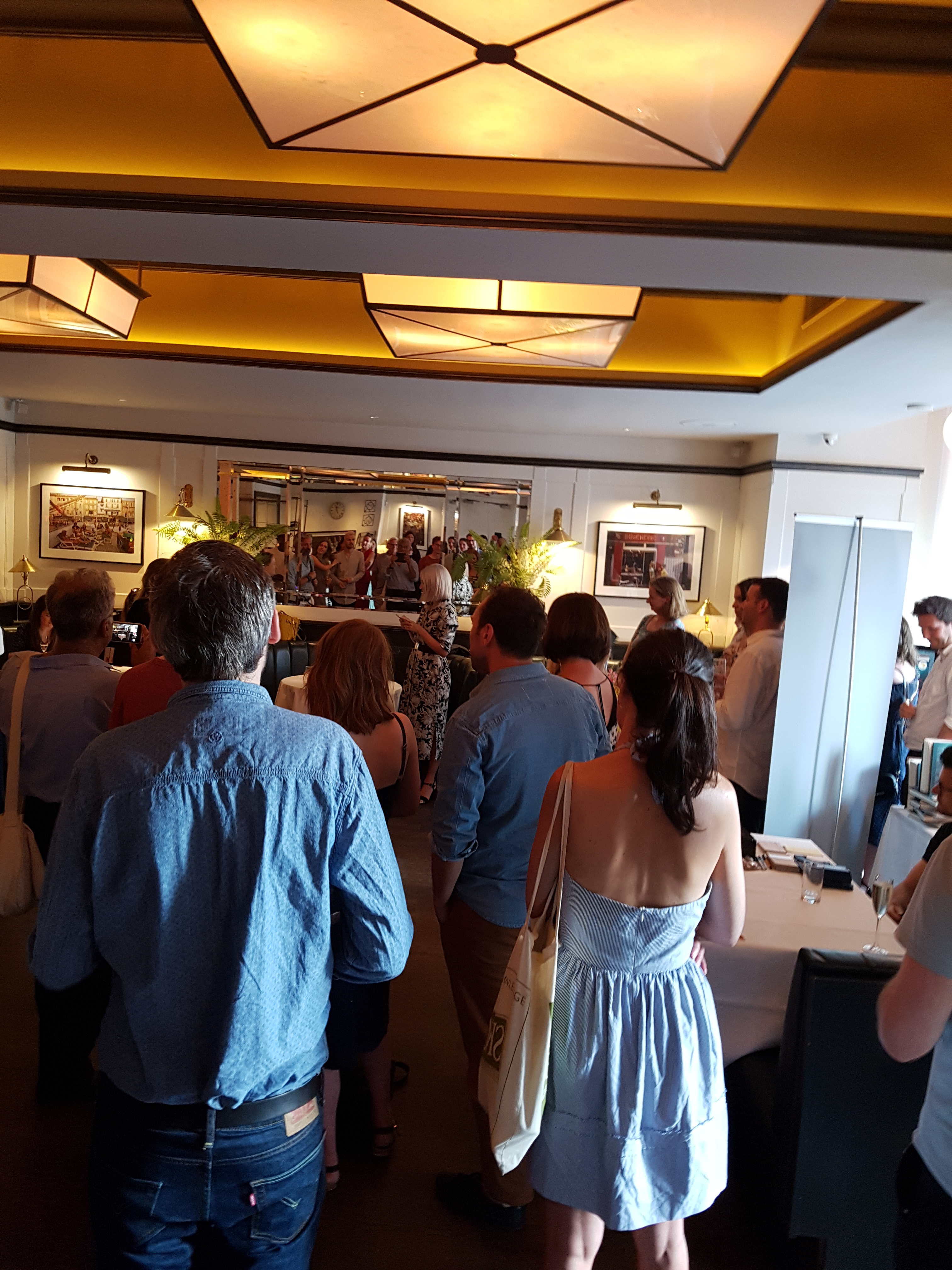
The Villandry Restaurant in Great Portland Street proved to be the perfect venue for the book launch of this brilliant new thriller, ‘Something in the Water’ by Catherine Steadman.

It seems that some people have more than their fair share of talent, and yes, I am talking about Catherine Steadman. Not content with carving out a successful television and film career, she has now turned her hand to writing and to continue the metaphor, she has made a pretty good fist of it.

It comes as no surprise therefore, that Steadman has had her first book, ‘Something in the Water’ optioned as a film, or that she has been commissioned to write a second book.

Erin, the protagonist of ‘Something in the Water,’ occasionally breaks the fourth wall, which somehow makes the reader complicit in some of the decisions that she makes. We can understand her thinking and feel her fear as the tension rises.

Moral dilemmas with increasingly severe consequences are presented in such a way that it is impossible not to agree with some of her choices.

So, where is Erin and what is she doing?

Mark and Erin are on the tropical island of Bora Bora, and Erin is convinced that  Mark will keep her safe. And he does, until …  they find something in the water. Something they decide to keep a secret — after all, if they do,  no-one will  be hurt.

Or will they? Their decision triggers a catastrophic chain of events…  and endangers everything precious to them.

Catherine Steadman ramps up the tension page by page, until it is impossible to put the book down. The various threads are drawn together as Erin and her new husband sink deeper into a world of crime they had never known, other than as a casual observer.

‘Something in The Water’ shows that when the going gets tough good people can justify almost anything.

At the very beginning of the book Erin asks if we have ever wondered how long it takes to dig a grave and before I read this I can happily admit that I hadn’t but now…..

If this was her debut novel I for one cannot wait for book two

Something in The Water by Catherine Steadman  in HB, PB, ebook and audio download and CD


Theatre Review by Paul Vates: The Scarecrows’ Wedding.

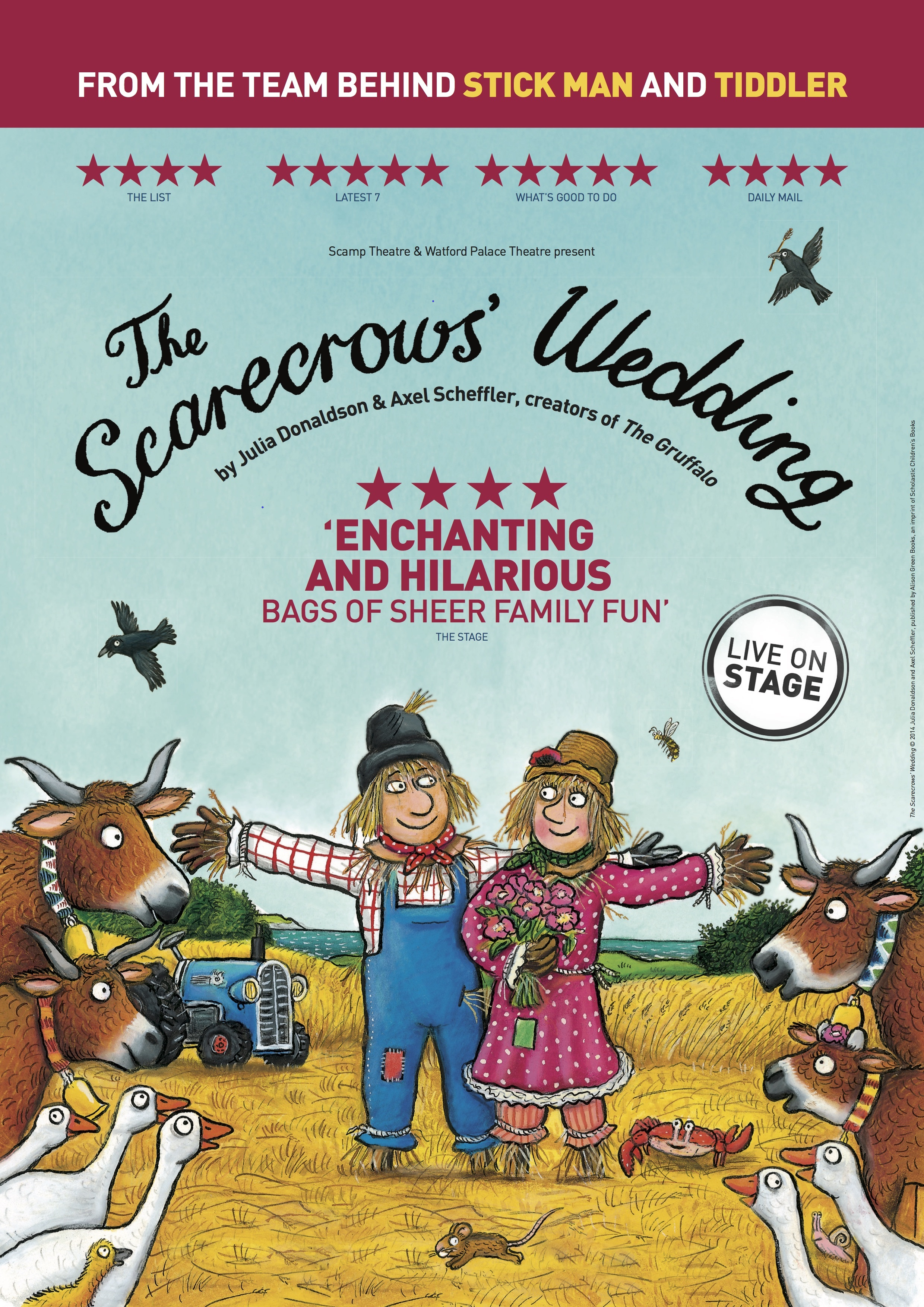
The Scarecrows’ Wedding at Leicester Square Theatre, London


“Fun, cute and friendly with a happy ending (spoiler!)”


For those who don’t know the enchanting worlds of Julia Davidson and Axel Scheffler – this play, in itself, is a wonderful introduction. I deeply suspect, though, that the children in the audience were very much aware. The authors came to light with The Gruffalo and since, with Scamp Theatre, have toured the UK with adaptations of the others books Stick Man and Tiddler.


It all starts quite smoothly – the actors entering the auditorium quietly. A few greetings and plenty of smiles. They meet and start to sing a song, working their way towards the stage, gently taking us into the action. As is so common these days, the performers not only play all the characters, but act, sing and play instruments with ease and grace. This performance had the trio of Philippa Hogg, Matthew Burns and Mark Kane.

Utilising props in unusual and imaginative ways, they create the illusion of animals. A toad, a snail [pictured], a cow, a crab – yes, and he’s Spanish! – and those honking geese.


The story is a simple romance between two scarecrows. In order to fulfil their wishes for the wedding that no one will ever forget, both Betty O’Barley and Harry O’Hay seek specific objects (rings, bells, pink flowers, a shell necklace and white feathers). They meet  a variety of animals who help, including the farmer – Mark Kane, who also plays all of the animals!


There is plenty here for the adults, too. The children are mesmerised and the whole piece rattles along at a cracking pace. The songs lend themselves to traditional country in style, suitably fitting the countryside theme. (Although, I still don’t know how the crab fits in!)


It’s fun, cute and friendly with a happy ending (spoiler!). What’s not to like?


Photography:     Helen Maybanks

Producers:         Scamp Theatre

Director:             Eva Sampson

Designer:           James Button

Music:                Elanor Higgins


Length:                            55 minutes

Ages:                 3+

Venue:               Leicester Square Theatre, 6 Leicester Place, London WC2H 7BX

Running until:    Sunday 2nd September 2018

(Check website for performance dates and times)

Tickets:              www.leicestersquaretheatre.com – 020 7734 2222

Pricing:               £19.50 adults, £15.50 children. Family tickets available.

Babes in arms go free!