MumsThread On The Motherhood Penalty: Can Only Men Have it All?

how old is too old to have a baby? post natal depression, PND,There has been a lot in the media about the Motherhood Penalty so I felt I had to give my opinion on it. The truth is, it exists. As for the next question in the title: can only men have it all? Mostly. Yes, I know. It isn’t fair and it certainly is sexist, but having a child affects a women’s career much more than a man’s. Now there are exceptions to the rule, and the number of stay-at-home dads is growing, but childcare is still widely seen as a women’s issue. And that’s wrong. Women get the motherhood penalty but men get the daddy bonus.

It is not that women can’t have it all. You can, but it’s really hard. Mostly it is just that they can’t have it all at the same time. Parenthood requires sacrifice. The sacrifice comes from both genders, but weighs heavier on the female. Since my husband and I had our son his career has gone from strength-to-strength, he gets to go out occasionally and even gets invited to award ceremonies because he has a permanent unpaid babysitter at home. In contrast, my life now resembles almost nothing of its predecessor because I don’t. I have given up numerous opportunities because I could not juggle them with my child.  Somedays I get no work done at all. Other days I just stare at my son while he plays thinking about how the hell I can be a good mother to him, run a business and be an author and freelance writer. Because, and it pains me to say this, sometimes I can’t. Something has got to give, and usually it is my hobbies, social life, and career. My husband still has the bones of his old life. Only his evenings and weekends are different, my old life on the other hand was obliterated. My son is worth it of course, but that doesn’t mean I don’t sometimes miss the person I used to be and the life I used to have. I wrote about this subject before I had my son and while I still think women can do whatever they want with their lives, it is harder for them.

I could put my child into a nursery of course. But let’s not kid ourselves, that is not having it all either. There is nothing wrong with it. I have female friends who ended their maternity leave early because they said they could not take being at home with a baby all day. Being at home with a baby all day is hard and I don’t judge. Good for her, not for me. There is also the cost of childcare, which is extortionate. The nursery next to us cost £93 a day. A DAY! Who can afford that?

I read in the Metro that 2 out of every 3 women with pre-school children are locked out of work. I was fired twice when I was pregnant, and many other promises amounted to nothing when my pregnancy became public knowledge. It upset me then and it upsets me now. There are generations of women who had so much to offer the world, but maternity discrimination put paid to that. It is no surprise that the “mumpreneur” industry is so huge. And you only have to look at what mumpreneurs are doing to know that there are not the ones missing out, the people who forced them out of work are. I recently saw the amazing Diane Keaton film Baby Boom. It was made in 1987 but is just as relevant today. It is on netflix.com so do watch it. In the beginning Diane Keaton’s boss tells her that only men get to have it all, but in the end she starts her own business and becomes a mother. She really does get to have it all.

I know many of friends who aren’t even thinking of having children but are married and “of an age” so are discriminated against. I think maternity leave should apply to both sexes. Then women cannot be the only ones discriminated against. It is a thought. I might not work, but something has to be done. Whether by women who start their own business, by making sure that men are not discriminated against for wanting to stay at home, or by a change in the law, we need to keep doing whatever we can. Not just for ourselves, but for our daughters and sons too.

WforW Short Story Workshop

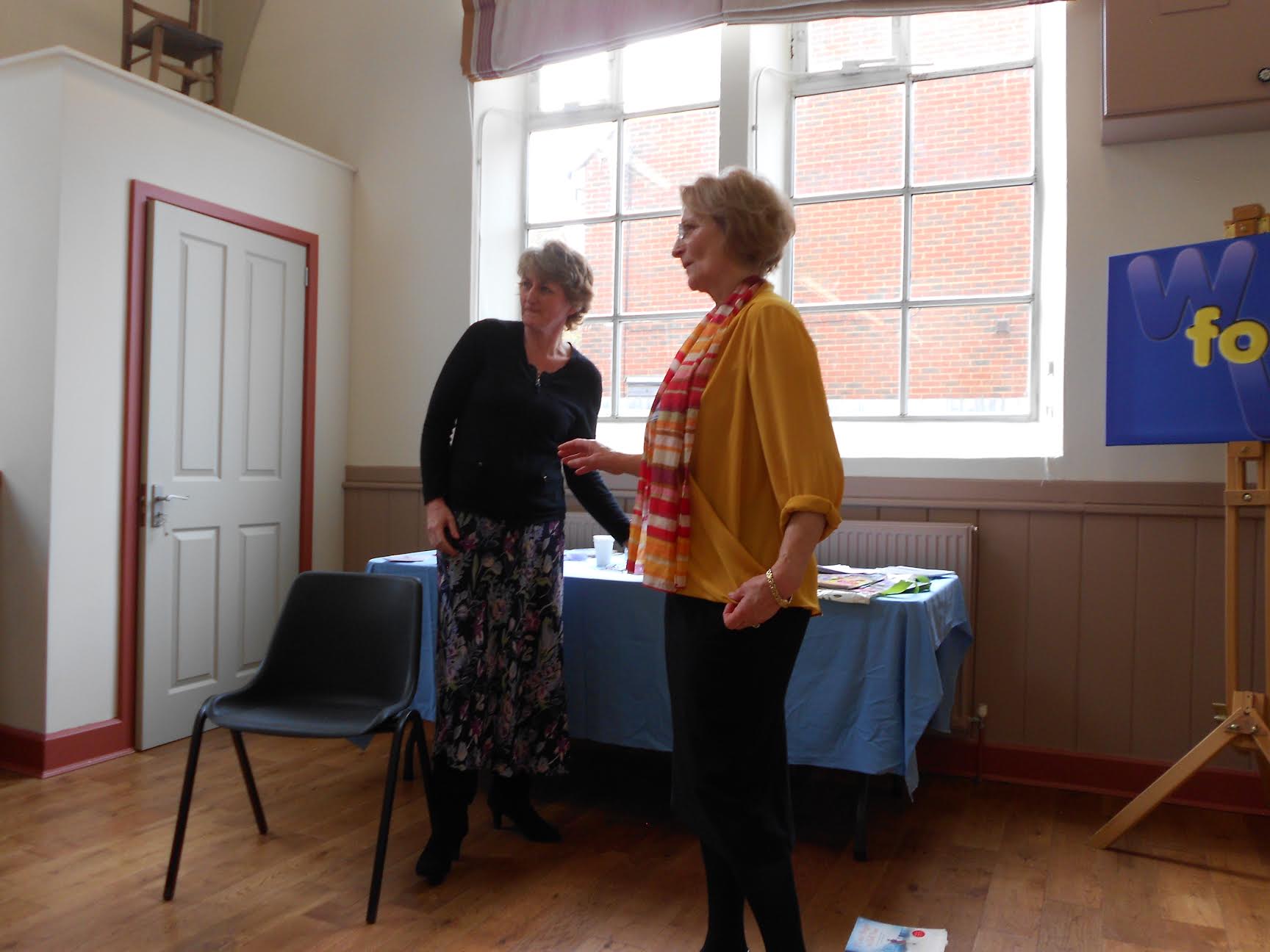
short story workshop, short story, writing Words for the Wounded is a charity founded by Margaret Graham, author and contributing editor for Frost Magazine. WforW raises funds through writing events   to help wounded ex-service personnel, with 100% of everything raised going to the wounded. To this end, WforW is holding an inaugural writing workshop on 24th September. There are just a few places left on the:

Short Story Workshop.

Short stories can earn you cash as well as being your calling card. Learn how to turn those rejections into sales.

We will ground you in the basics of short story structure, and provide you with the ability to target your work towards a market of your choice. It will be fun; Margaret and Tracy’s workshops always are.

Tracy Baines has been selling her short stories for almost twenty years. Her stories have appeared in Woman’s Weekly, Take a break, My Weekly and The People’s friend and many others in the UK as well as overseas markets.     www.tracybaines.co.uk

Margaret Graham is a best selling author with Arrow. She also writes short stories and features. She is a creative writing tutor,mentor, editor, and also contributing editor for Frost Magazine. She is founder and administrator of WforW.  www.margaret-graham.com

Saturday 24th September:  10:00 – 16:30   ( Registration 09:30 )

Venue: Downley Community Centre, Old School Close, Downley, High Wycombe, HP13 5TR.  (trains run regularly from London to High Wycombe, Downley is about 2 miles and there’s a taxi rank  at the station )  There is parking at the venue.
Cost: £45

Book online www.wordsforthewounded.co.uk


Hunting The Eagles By Ben Kane Review by Jan Speedie

HUNTING THE EAGLES BY BEN KANE Review by Jan Speedie book reviews, books, reading

This is Ben Kane’s second book in his trilogy about the Roman invasion of Germania.  Following his first book covering the invasion of AD9 in which the Roman’s were ambushed and defeated in the Teutoburg Forest. Carefully researched military history, passionate and violent perhaps not for the squeamish or weak hearted.

The first part of ‘Hunting the Eagles’ is planning the revenge for the ambush and the loss of the legions gold Standards. Centurion Tullus, a veteran of many battles, is determined to avenge the loss of 15,000 soldiers and regain his Eagle.

Part 2: Germanicus is now in charge of the Roman forces and planning an invasion of Germania in the autumn of AD14.  In Germania, Arminius and the local warriors are determined to repulse the Romans once again.  Legions and tribes clash in bloody battle, who will survive, who will conqueror……….

Immerse yourself in this story of Roman legions; it’s cruel, relentless and compelling reading.

Ben Kane was born in Kenya. The family moved to Ireland where Ben completed his education and then studied veterinary medicine at University College, Dublin.  Ben always had a passion for ancient history and travelled the world visiting and collecting facts and incredible stores about Roman history. Ben lives in North Somerset with his wife and children.

Published by Arrow in Paperback £6.99


Pizzolato Showcase their Honest Organic Produce

PIZZOLATO WINERY AND VINEYARDS 2015 (1)

Our favourite West London Italian, Pizzicotto famous for their wholesome, organic and sustainable produce and of course their activated charcoal pizzas invited us back once more for an afternoon of cheese and wine. With such a focus on the quality of their products, it made sense to introduce us to the company behind their beautiful organic wine, Pizzolato. Served alongside some traditional Italian Fayre and in good company, we were able to get an insight into how special Pizzolato’s wines really are. With a combination of a wholesome, family run business and exceptional quality produce we were taught about how the organic wines served here are a cut above the rest.

IMG_7192

Contrary to popular belief, the ambassadors from Pizzolato explain to us that the art of winemaking was by and large an organic process as chemicals did not arrive until after the 70’s. The Family however decided to keep the wines organic which then further developed into sulphite free wines in 2007. In the case of their prosecco, this produces a much riper fruit and has much of a similar quality to it’s French counterpart Champagne. The outcome is much more complex than your average supermarket prosecco with a shelf life of just around 2 years, the prosecco is enjoyed young, fresh and a pure test of the grape is in a sulphite free wine. If we want to get into the nitty-gritty of why this wine is especially spectacular, we must look at the fact that grapes are picked by hand and the fact that a sulphite free wine has much more clarity than a natural wine which is not filtered. Another reason for the unbelievable drinkable and pure prosecco is that the minerals from the prosecco comes from stones from the Dolomites, the mountain range near to where Pizzolato produce their liquid gold. If that wasn’t enough reason to switch to Pizzolato’s selection of fantastic organic wines, we then learn that they all have a vegan certification meaning that absolutely none of their products come from animal origin as in the case of many wines, the addition of bentonite which produces clarity does carry this source.

IMG_7194

With a host of wines to try from the winery, it is not only their prosecco which is outstanding, they also produce a selection of red wines, white wines and dessert wines which ooze an incredibly mineral, fresh and what can almost be described as without the alcoholic taste. Special mention goes to The Barbarossa, the rich intense flavour of this wine comes from the fact that it is produced like the Amarone, one of the finest, richest red wines to come out of Italy. This of course is dry and chocolate and perfect with a big bowl of Pizzicotto’s mouth-watering meat dishes. Now, if this hasn’t made you run for the door to grab some cheese to go with your Pizzolato wine, consider this; Did you know the reason strong cheeses are a good accompaniment to wine is that it brings out the body of the wine due to it containing natural glutamate, which are the natural salts.

Pizzicotto is open Tue-Sun

www.pizzicotto.co.uk 

For more info on Pizzolato and to purchase visit

www.lacantinapizzolato.com

In Search of the Past: A visit to the Somme Part 6 by Penny Gerrard

Lieutenant Colonel Harry Vivian Robert Hodson

Our two day trip was drawing to a close and so, lunchtime baguettes eaten and the loo in a local café visited, our thoughts turned back to Richard’s grandfather Harry Hodson.

After the battle of Mametz Wood, Harry assumed command of the 14 Royal Welsh Fusiliers on 18 July 1916 and redeployed with the 38 Welsh Division to the Ypres salient on the Yser Canal until June 1917 when he was appointed Officer Commanding the Brigade School.  Harry took command of the 1st Battalion the North Staffordshire Regiment on 9 April 1918 to reform and retrain the battalion after it had been virtually wiped out in the area of St Quentin when the Germans first launched the Ludendorff offensive.  The battalion was deployed in the Lens area from May to late September until relieved. The regiment was then redeployed to the Cambrai area to take part in the final stages of the war and the battle of the Selle.

In Search of the Past. A visit to the Somme. Part 6 by Penny Gerrard16
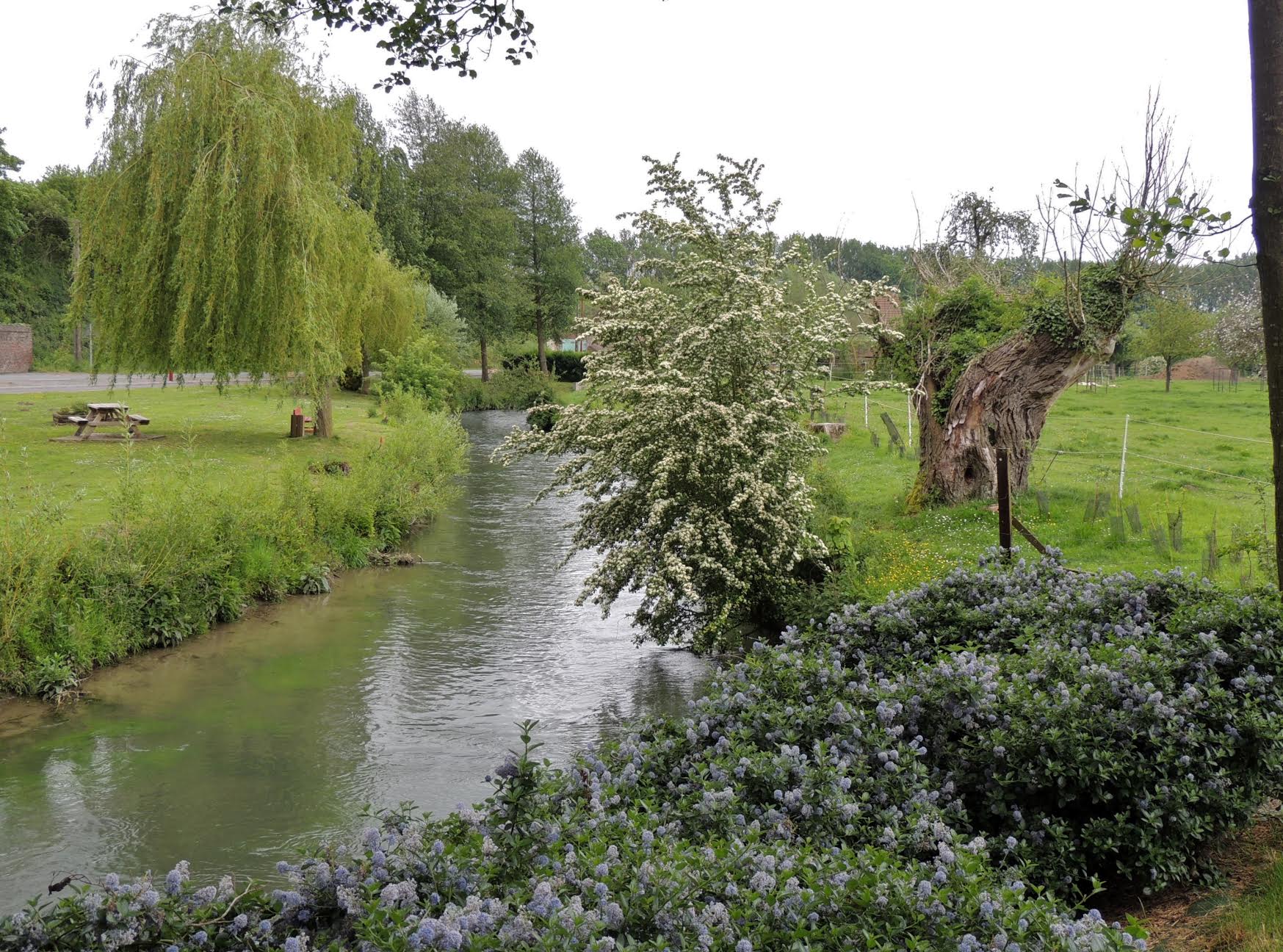
“The peaceful River Selle as it is today”

We drove down a steep hill to find the River Selle which formed the setting of this battle and were rather nonplussed to find a small, tranquil and reed-edged river winding its way in a rather chocolate box way through a pretty village.   Not at all Richard’s vision of what the River Selle would be.    It was clearly a very different place when Harry’s regiment fought for control of what was a key bridge.

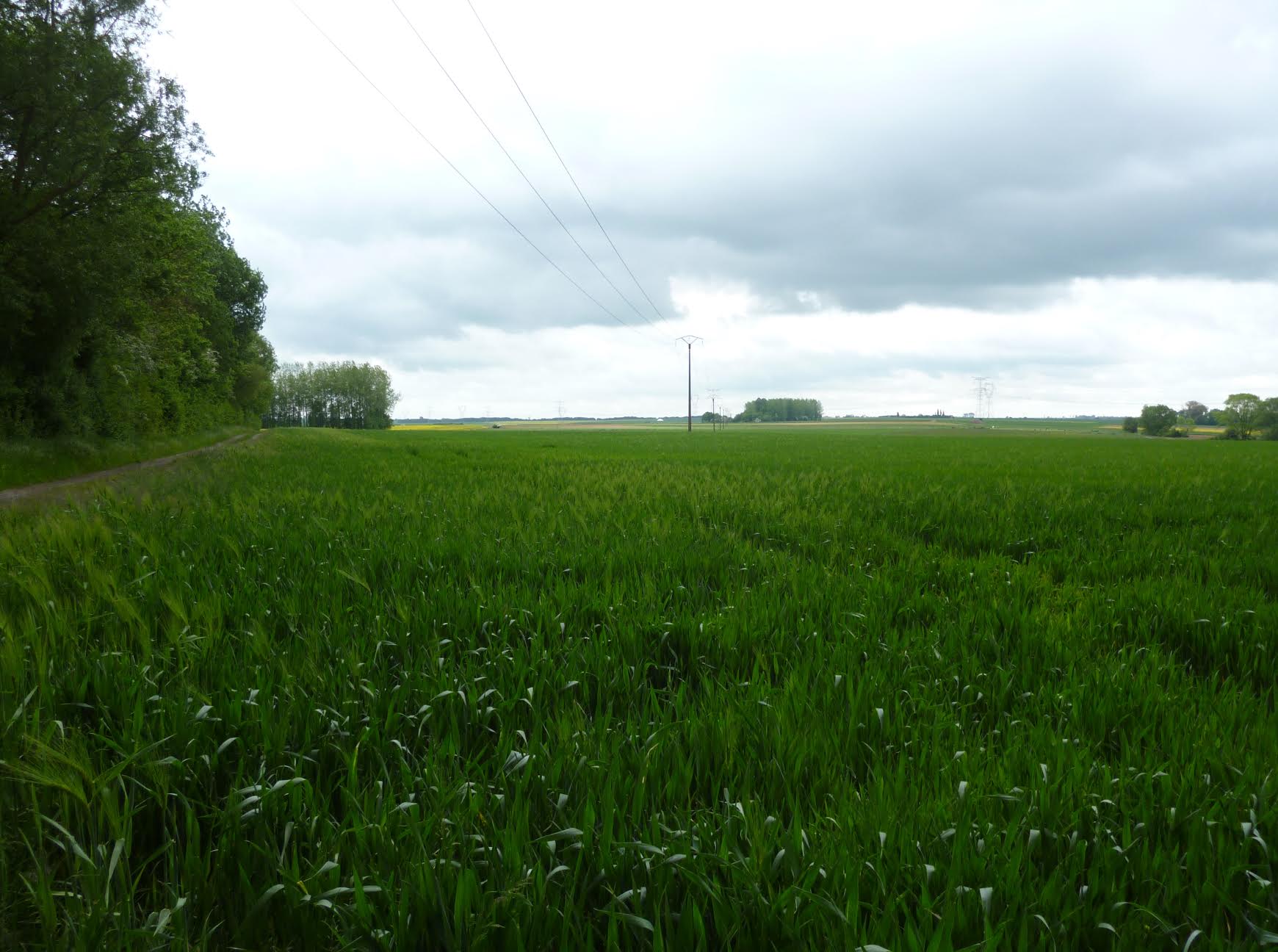
In Search of the Past. A visit to the Somme. Part 6 by Penny Gerrard26 “The landscape above the River Selle where Harry’s battalion fought”

Back up the hill Richard was able to bring the area of the fighting above the village to life for us, having an instinctive grasp for the lie of the land and the direction of the fighting which the rest of us lacked.

In Search of the Past. A visit to the Somme. Part 6 by Penny Gerrard3
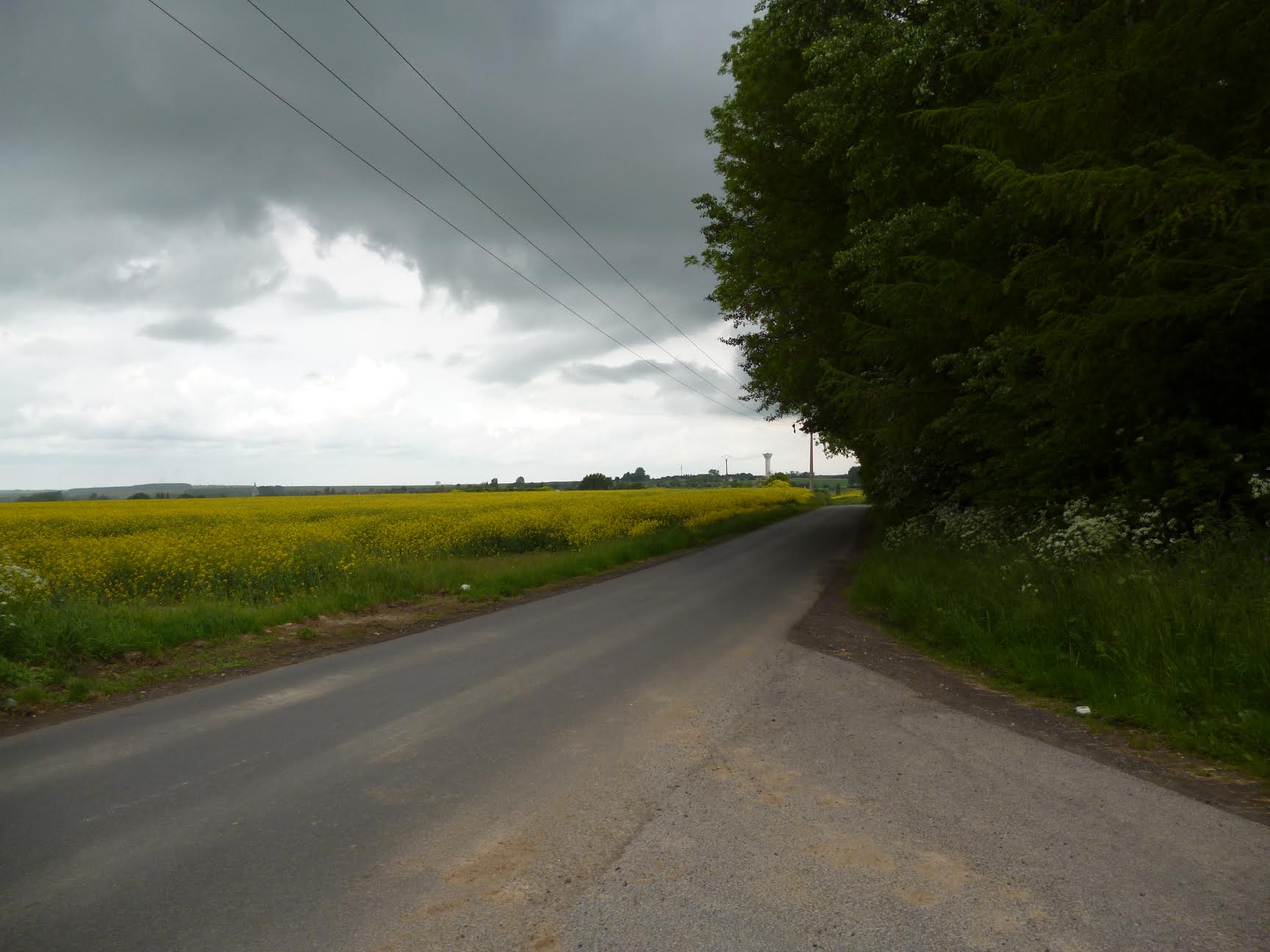
“Dark clouds over the fields above the River Selle”

Harry commanded his battalion in operations from 7 October to clear the enemy from the villages of Awoingt, Cauroir, Cagnoncles, Rieux, Avesnes, St Aubert until he was wounded at 11am on 13 October 2018, very near the end of hostilities.  He was twice “Mentioned in Despatches” for gallantry.  The war ended before he was again fit for duty and so he survived and returned to his wife and three children, one of them being Robin, Richard’s father.  He commanded his regiment again in 1925 and was stationed in Calcutta until 1929.  In 1930 he was compulsorily retired due to defence cuts, living to the age of 85.

As we stood on the road trying to visualise the battle raging across the landscape, we thought about how different things could have been if the bullet which hit Harry in the hip had actually killed him.  A long life could easily have been cut short as it was for so many thousands who went off to the Somme with such high hopes of serving their country a century ago.

Our time exploring the Somme battlefields was over and we left with just a little more understanding of the experiences of Robert, Walter, Gilbert, Harry and Frederick – only two of whom lived to tell the tale.

They shall grow not old, as we that are left grow old:

Age shall not weary them, nor the years condemn.

At the going down of the sun and in the morning

We will remember them.*

In Search of the Past. A visit to the Somme. Part 6 by Penny Gerrard4 “St Aubert British Military Cemetery – just one more example of the dedication of those looking after these very special memorials all across France and Belgium”

*From “For the Fallen” by Lawrence Binyon


Penny Gerrard

with information & text from Richard Hodson


The sun continues: So what about wine al fresco?

Vina Real Barrel Fermented Blanco 2014

The sun continues- So what about wine al fresco?

Picnics are booming with this late summer sunshine, so why not take this Vina Real in the picnic box with you. I have a firm liking for oak aged wines. I discovered them in the Margaret River area of Western Australia years ago now. This Vina Real Blanco has, or should I say, had (it’s all gone) a hint of a toasty and biscuity flavour from the oak and the lees, with pure floral and citrus aromas. There’s such a smooth rich palate that it slips down rather too easily. Fantastic with poultry.

Made from 100% Viura this wine really should be tried. But much like the Monople (below) it must be served at a cool temperature.

RRP £11.10

Stockists: Grayshott Wines, D.Byrne and Co, Famous Wines, The Clifton Cellars, The Seriously Good Wine Company

Monopole Rioja Blanco 2015

winereview

Another for the picnic, or for anytime actually. I enjoy Rioja, and this Monopole Blanco didn’t disappoint. The moment the cap came off the scent leapt out of the bottle. Rather a subdued bottle, I have to say, for a rather lovely wine.

It is fine and elegant and  is the perfect summer drink with its white flower and tropical fruit aromas. Mango and ripe citrus flavours dominate t and a balanced refreshing acidity makes this a great wine to enjoy in the sun. It must go into the fridge, and be taken on the picnic in a cool bag, please.Essential it is  served at the right temperature.

RRP £10.00

Stockists: Wine Rack, Vino Wines, The Whalley Wine Shop, Noble Green Wines, Hoults Wine Merchants, Hailsham Cellars, Partridges of Sloane Street, Islington Wine


Gransthread: Retirement by Penny Gerrard

The trouble with writing about your retirement is that it could easily come out like one of those circular Christmas letters where people vie with each other to list their family achievements – little Emily’s amazing performance at as the youngest Olympic gymnast ever, young Peter’s prowess on the Jew’s Harp and forthcoming debut at the Royal Festival Hall and smug parents’ getaways at their little place on the French Riviera.

Gransthread- Retirement by Penny Gerrard1

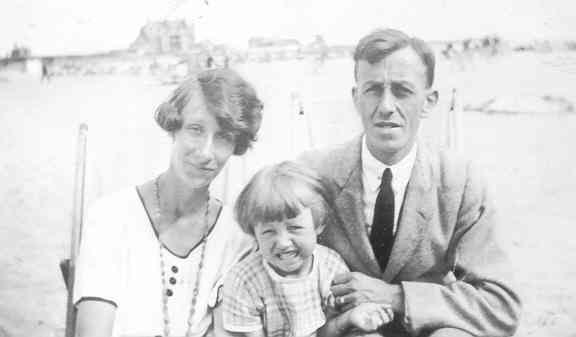
Nanny and Grampie with their daughter, Penny’s mother 1925
As far as my own retirement is concerned, I keep wondering when it‘s going to start.    When I visualise a proper old fashioned retirement, what comes to mind is my grandparents who,  after a lifetime of house moves, finally settled in a respectable terraced house one street back from the sea front at Westbrook in Kent.   Retirement for them was a predictable affair with their days kicked off promptly at 5 am by my grandfather who believed in early to bed and early to rise, not just for him but for anyone in his household.   Nanny, who might very well have welcomed a more leisurely start to the day, was woken by his thumping footsteps down the stairs, accompanied by loud whistling, followed shortly afterwards by his arrival in her bedroom with a cup of tea.   Just in case she wasn’t fully awake he would bang vigorously on the cup with a teaspoon and announced loudly that the day was nearly over.

Nanny’s day followed a predictable pattern of housework – my weekly run around with hoover and feather duster was not enough for her.    The house had to be cleaned daily with every ornament in the floral wallpapered rooms conscientiously dusted every day.    My grandfather’s full English breakfast had to be on the table by 7am and washing was done using an old fashioned copper once a week.    Shopping was a daily matter – done with the aid of a sturdy wicker basket on wheels which she towed along to the parade of individual shops with a careful shopping list.   The day’s meat – two lamb chops perhaps –  was bought from a butcher who knew every customer’s preferences and relished the demise of the wartime rationing which had made life so difficult for him.  Fruit and veg meant a queue and a chat with other regular customers at the greengrocers and often her list would call for visits to the fishmonger, the chemist  and maybe the haberdashers where she would replenish her supply of knitting wool for the jumpers and cardigans she regularly knitted for me and my brother.   (These had to be sewn up a second time by my mother as Nanny’s knitting was fine but the sewing up was sketchy to say the least).

Gransthread- Retirement by Penny Gerrard4

Nanny with Penny’s mother 1942

Back home from the shopping, there was dinner to prepare – always meat and two veg, and often involving suet pastry.   A pudding and custard was considered essential and so it would often be well into the afternoon by the time she had cleared everything up and my grandfather had returned to the garden which was his pride and joy.    Then perhaps there would be time for a sit down, Woman’s Hour on the radio and perhaps a visit from two friends known to all the family as “the girls” even until they were well into their seventies.     There was a time when Nanny would use this precious free time to play her piano.   She had the enviable gift of being able to play by ear – and on visits I would watch her hands effortlessly skimming over the piano keys from which poured forth wonderful music.   Less enviable was her possession of a husband who, on a whim, sold her piano without her knowledge so that her gift was left to wither.   She did not complain.

Her afternoon free time over, it was time to get the tea – a proper tea with bread and butter, home-made jam and cake – perhaps a Victoria Sponge or a lightly fruited madeira – all very decorous and eaten with wedding present cake forks from bone china plates.

Evenings meant my grandfather’s choice of radio programmes and more knitting for Nanny, but only till 9pm naturally because after all there was an early start tomorrow wasn’t there?

Finally Nanny could climb into her high Queen Anne bed, but not until she had entirely stripped it to remove the electric blanket and remade it – it not being safe to sleep on one!

Gransthread- Retirement by Penny Gerrard5

Nanny enjoying retirement at Westbrook with Penny’s mother in 1963


She was 75 when she died and I sometimes wonder what she would make of a modern retirement which often seems considerably busier than the working life I left behind ten years ago!   She did share my enjoyment of the knitting which keeps me occupied in spare moments, but more importantly she enjoyed the time spent with friends and family which are the most important part of my own retirement.    So perhaps we are not so different after all.


Top 20 most Stressful Things about Parenthood

baby, shared parental leave, feminism, equality, childcare, leave, maternal, work, working mothers, lean inThe answer to this could be everything. No, we jest. A recent poll of 2,000 parents has revealed the Top 20 most stressful things about parenting. The nightly teeth-cleaning battle, the bedtime routine and the dreaded school run are among the most stressful things about parenthood, a study has found.

The average mum and dad spend almost two hours a day feeling stressed, with trying to keep the house tidy the most common cause.

Others feel the strain at bath time, while trying to get children to behave in public and shopping for new clothes with the youngsters in tow.

Mornings – complete with getting the children out of the door for the school run, persuading them to finish their breakfast and clean their teeth – are the most stressful time of the day, claiming five of the 10 top stresses.

Dr Linda Papadopoulos, who has been working with belVita Breakfast to help relieve parents, particularly in the mornings, said: “The stress and challenges of parenting can feel overwhelming – especially when we feel under pressure to get a lot done in a short space of time.

“Morning can be especially challenging and it’s key to develop a positive, convenient routine in the morning as it sets the rhythm for the day.

“When it’s ‘back to school time’, trying to get everything done and leaving the house on time is at its most pressurised so developing strategies that you give you and your family a sense of control is really important.”

The study by belVita Breakfast of 2,000 parents of school-age children, found that staying on top of the house chores is the biggest cause of stress for mums and dads, while getting the children to do their homework and the bedtime routine are also big triggers.

Researchers also found the average parent spends one hour and 48 minutes of each day feeling stressed, with 63 per cent going as far as to say the majority of their stress is parenting related.

Mornings are the worst time of day for parents with the average mum and dad having at least one day a week where they struggle to get out of the front door on time for school and work.

The children taking too long to do things is usually to blame for the family’s lateness, followed by youngsters not doing as they are asked and not getting out of bed.

But as a result of the frantic mornings, one in five parents has dropped the kids off at school after the bell and the same percentage have ended up late for work as a result.

Others have given the children lunch money instead of a lunch box, sent them to school in dirty or un-ironed uniform or with wet hair.

As families prepare for the dreaded ‘back to school’ week, it’s not just kids who bear the brunt of the ‘morning madness’, with over a third of parents forgetting breakfast and 38 per cent having a fight with their partner over who takes on the most in the morning.

Eighty-seven per cent even said they look forward to the weekends when they don’t have to worry about the school run and leaving the house on time.

It also emerged that 66 per cent of parents believe mums bear the brunt of the morning and back to school stress, with half admitting they often argue with their partner about who gets the raw deal.


Top 20 most stressful things about parenthood

1. Keeping the house tidy and the chores up to date

2. Getting the children ready and out of the door in time for school

3. Getting back into a school/morning routine after the school holidays

4. Getting children to do their homework/reading

5. The bedtime routine

6. Getting children to eat certain foods

7. Getting children to clean their teeth

8. Making sure my children are well behaved in public

9. Getting back into a school/morning routine after the school holidays

10. Getting children out of bed in the mornings

11. Meal times

12. The school run

13. Entertaining children on a rainy day

14. Remembering everything they need for school

15. Shopping for new clothes

16. The back to school period

17. Getting children to sleep through the night

18. Getting children to eat their breakfast

19. Juggling your children’s different after school/weekend clubs schedule

20. Getting children dressed in the mornings