One of the best things about being editor-in-chief of Frost Magazine is all of the people I get to meet. Having a chat with a writer I admire is also exciting for my other life as an author. Greg Mosse is a great interviewee. Candid, kind, and bursting with interesting information. I read The Coming Darkness in 2022 and loved how unique it was. It is a great thriller. Now, the third in the trilogy, The Coming Fire, is out. I interviewed him over Zoom to talk all things writing, A.I., and Kate.
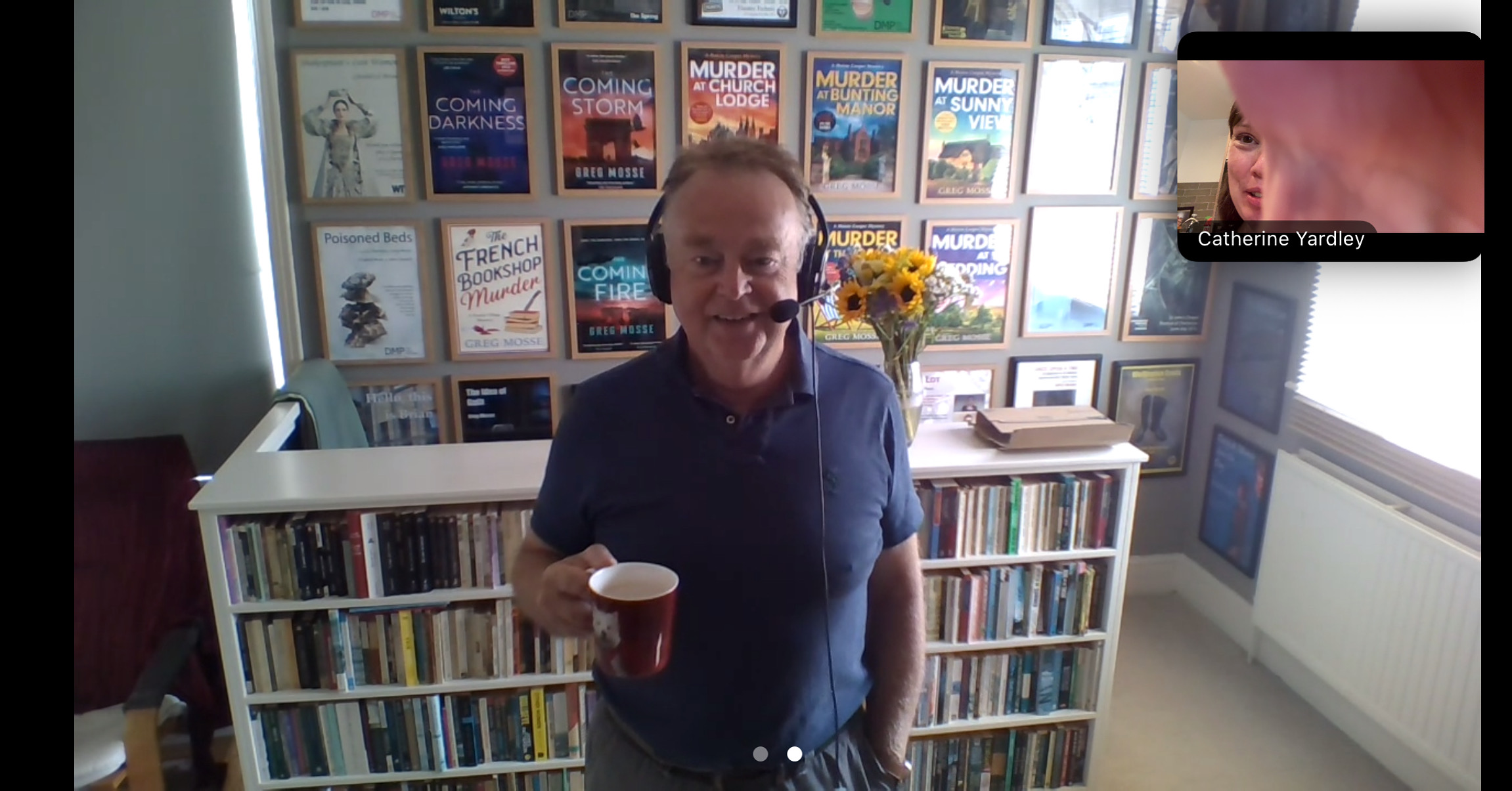
Greg complimented my children’s artwork on the fridge, and I complimented his impressive book posters.
On the impermanence of theatre and writing during lockdown: ‘The posters on the wall, most of them are mementos of my theatre work, because theatre is a wonderful fugitive experience. It’s that brilliant moment shared by the audience live in the room together that can never be repeated, but at the end of a run of theatre, for most shows it’s gone forever. And unless you’re in Les Mis or something like that, and it doesn’t stop, it’s great to have the poster on the wall as a reminder of, ‘Oh yes, I did that.’
The rhythm of my life under coronavirus lockdowns changed completely. In one way, because theatre had become illegal, and so there was really no point in writing new plays for I didn’t know how long, but in another way, it didn’t change at all. It just meant that I sat in the corner of my study, there with my red blanket, because it was March, wasn’t it? It was cold at first, and then it got really hot. It just changed from writing dialogue to writing prose and that’s why, in the centre of the wall of posters behind me, are all the novels I’ve published.’
That was a smart thing to do. Yes, but remember, we were utterly unemployed, weren’t we? We had to fill our days and I did find it very easy to be productive, because I was utterly without distractions.
As the lockdown started, I actually went and I picked up both of our children. My wife, Kate Mosse, and I. Felix was working in Norwich. He was on stage in a show that shut, and Martha was living in North London in a flat in a block, and we thought both of those circumstances would be a less pleasant way of being locked down than in our house in Sussex with fields that you could walk out to and all of those lucky things that we had, but that said, you know, they’re grown-ups, so it’s not like I brought them home and had to look after them. So I had not limitless time, but I had a lack of distractions, which really taught me how valuable that can be in terms of working quickly, but not necessarily efficiently.
On writing a trilogy: For The Coming Darkness, the first book in the Alex Lamarque trilogy, I wrote 170,000 words from which ultimately I cut 70,000 words because the thriller that MoonfFlower, my brilliant publisher wanted, was just under 100,000 words. However, when The Coming Darkness went very well, I got excellent reviews for which I’m very grateful. It meant that I had these subplots I cut from the first draft that were the heart of the second book, The Coming Storm. That also accelerated the process. So it wasn’t like I had to sort of start again. My hero, who’s like an action hero, a member of the French secret services. He wins at the end of The Coming Darkness, but he only wins a fragment of the battle that he’s engaged in. But I already had the heart of The Coming Storm already on the page. It had to be massaged into a different shape, a different timeline, but it already existed. The future, historical background to the book that I researched by reading lots of scientific papers and government papers and NGOs and everybody who’s predicting the future, trying to plan for what’s coming next. Five years, 10 years, 15 years, a generation. All of those notes were super valuable over the whole of the trilogy, and the things that we’re worried about today in 2037 are more urgent, more dramatic, more desperate, but they are the same things, but more so.
The Coming Fire is the culmination of a trilogy about a time when everything that we’re worried about today is more intensely felt and more intruding, more fully on people’s lives. So that meant I’ve already got a crescendo that can play out over three books, and then the other way of describing it. The further Alex goes towards the heart of this terrorist mystery, the closer he gets to the biggest, hardest enemy to defeat. There’s an overall shape that you know you’re writing into. I sometimes describe it as pouring creativity into a pre-existing shape, yet not just writing to find the shape, but the shapes already there in the back of my mind.
On authors being pigeonholed: As a writer for theatre, nobody says to you, “You know, last year, you wrote a play about smugglers, set in 1749. Why are you now writing a play about the First World War?” Whereas, as a novel writer, people say that to you all the time. Being able to write in these different voices, to tune into a different quality of creativity, is really normal for a playwright and to write dialogue in different voices. One day a king, another day a minor living 300 years later, another day a 12-year-old child living today, is totally normal. Now, the other part of your question, which one do I like best, writing plays or books? The great thing is that they refresh one another. You know what I was just saying about playwriting? That’s one of the best things about writing plays. So a full-length, two-hour play is about 20,000 words, whereas The Coming Fire is 98,000, I think. So a full-length, two-hour play is a fifth of a novel. So it’s more difficult to get that refreshing change in novel writing because the scale of the creative enterprise is so much bigger. If you have sympathetic publishers who understand that you’ve got these different goals, entertaining people in different ways, that’s what it’s about. They really bounce off each other super well.
On his writing routine: It’s 6:30 till 10:30 more or less every day. When I say every day, it’s like six days out of seven. Sometimes I’m travelling for other parts of my life. And so it can’t happen if I’m driving to London in the morning for the work I do in theatre, for example. But about six days out of seven. 6:30 to 10:30. In that time I’d expect to write a couple of 1,000 words. I’d expect it to begin with a two. Doing that for six weeks of six days a week, 2,000 words a day that’s 72,000 words, isn’t it? And once I’ve got to sort of that, I’ve actually got an unpublished novel in my computer over there that I’ve written about 65,000 words of, and I’m currently editing it because I’ve got an idea of how it will end, like a framework for how it will end, but in order to write the last quarter of the book, I need to make sure everything in the first three quarters ties up and is completely coherent, and that I’ve probably been writing for about six weeks and now it’s going to go really slowly for a week or 10 days, maybe because I’m reviewing everything, and I have to keep going backwards and forwards, you know, to tie things together. And I’ll find a thing on page 102 and God, where was that, although I referenced that. And then there it is on page 17. And all of that over and over and over again. And only once I’ve got all of that done, probably through the whole of those 65,000 words twice. Only then will I write the last quarter of the book. And then, of course, I’ll have to check it from line one to the last line again to make sure I’ve got it all right. So that means about 10 weeks in total for a draft that I am willing to show one person alone, and that person is my wife, Kate Mosse, [Most people would be scared to give Kate Mosse the first draft of their novel] yeah, probably. But, you know, there she is. She’s having a cup of tea in the morning, eating her Marmite on toast, and she’s trapped. You know, there’s nothing she can do.
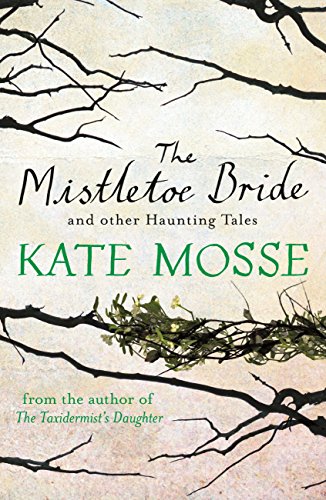
I was asked this weekend, as I usually am at some point at festivals, ‘Greg’, was it helpful at all to be married to the international best-selling novelist Kate Mosse?’ And I always say she is the wave that I surf.
On supporting other writers: When Twitter was invented, before it became a cesspool of bots and hatred, it is I chose as my Twitter description, ‘writer and encourager of writers.’ Back then, almost all of my writing was theatre, of course, and that’s changed, but the encourager of writers hasn’t. It’s the reason why, with my son Felix Mosse, we run a theatre script development programme at the Criterion Theatre, Piccadilly Circus, which is free to the mid-career playwrights who take part. And then when I’m at a festival, like Harrogate, or in the new year, Kate and I will be in Jaipur, and then Dubai, at the Emirates Festival, the majority of my time there will actually be spent with readers and writers, aspirant writers, trying to help them develop their plots, understand the business. You know, all of that stuff. And that’s super rewarding.
His thoughts on A.I: My thoughts on A.I., what I wanted to put on stage in The Coming Fire was the fact that the terrorists, the big, bad, evil presence behind the whole of the trilogy, has a view on A.I. that you and I and many people probably share, which is that it’s an enormous danger, and there are two parts to this danger. There is a relinquishing of humanity, and thinking that A.I. is probably as good as the ways in which humans have evolved, in doing things over a gazillion years over evolution, and then recorded history.
And then the other part of it is that relates to the creative arts. There’s a brilliant, I think it’s in an Arthur C. Clarke science fiction story from many years ago, where he compares a flawless reproduction of a piano to a real piano. And he says it’s like the difference between being told that you’re loved and being held in your parents’ embrace. It’s great. It may not be a quotation, but it’s something like that, right? You know what I mean there, there is a difference that feels elusive, but it’s also really substantial.
Yes. So then the other part of it is the fact that, and we’ve seen this all through the technological age, technologies respond in ways that we don’t predict. There’s always a law of unintended consequences. There’s always unfortunate outcomes, even with the best of intentions. My brother, who has a sardonic cast of mind, sometimes says to me, no good deed ever goes unpunished, and you want, but people who are, I would argue, unthinkingly embracing technology, assume the best, whereas I’m a much more precautionary cast of mind. You never know where this will end up. So coming back to the big baddie in The Coming Fire.
He wants to set back Earth’s technological development by a few generations. He wants to destroy the hyper-connected world, the global village, and fragment and atomise human populations. Now, of course, that also means that he’s a completely inhumane barbarian,
utterly insensible to human tragedy and loss of life. Those things are meaningless to him because he has this conceptual idea of turning back the technological human clock,
and a thing that he can’t see is the inhumanity of the A.I. that he wants to exploit in order to achieve those terrible goals is actually super similar to his own cast of mind, and that’s why Alex must stop him.
Well, it’s the third part of a trilogy. There is a hero. Usually, the hero wins, but of course, it would be a spoiler to say if he does. I have a friend who’s a neuroscientist who works at the University of Sussex, with whom I was talking quite recently about the fact that he gets infuriated when he’s told that artificial intelligence has discovered or devised something. And he says there is no artificial intelligence. What there is is an algorithm that analyses statistical probabilities and comes up with likely scenarios from which it can choose one. But it’s not intelligence. It’s a sifting of data to find the most likely average outcome.
Thank you Greg.
The Coming Fire is out now and published by Moonflower.