
Spandau Baddie: Martin Kemp Meets Vicky Edwards

Martin Kemp tells Vicky Edwards why his musical theatre debut is going with a bang-bang…
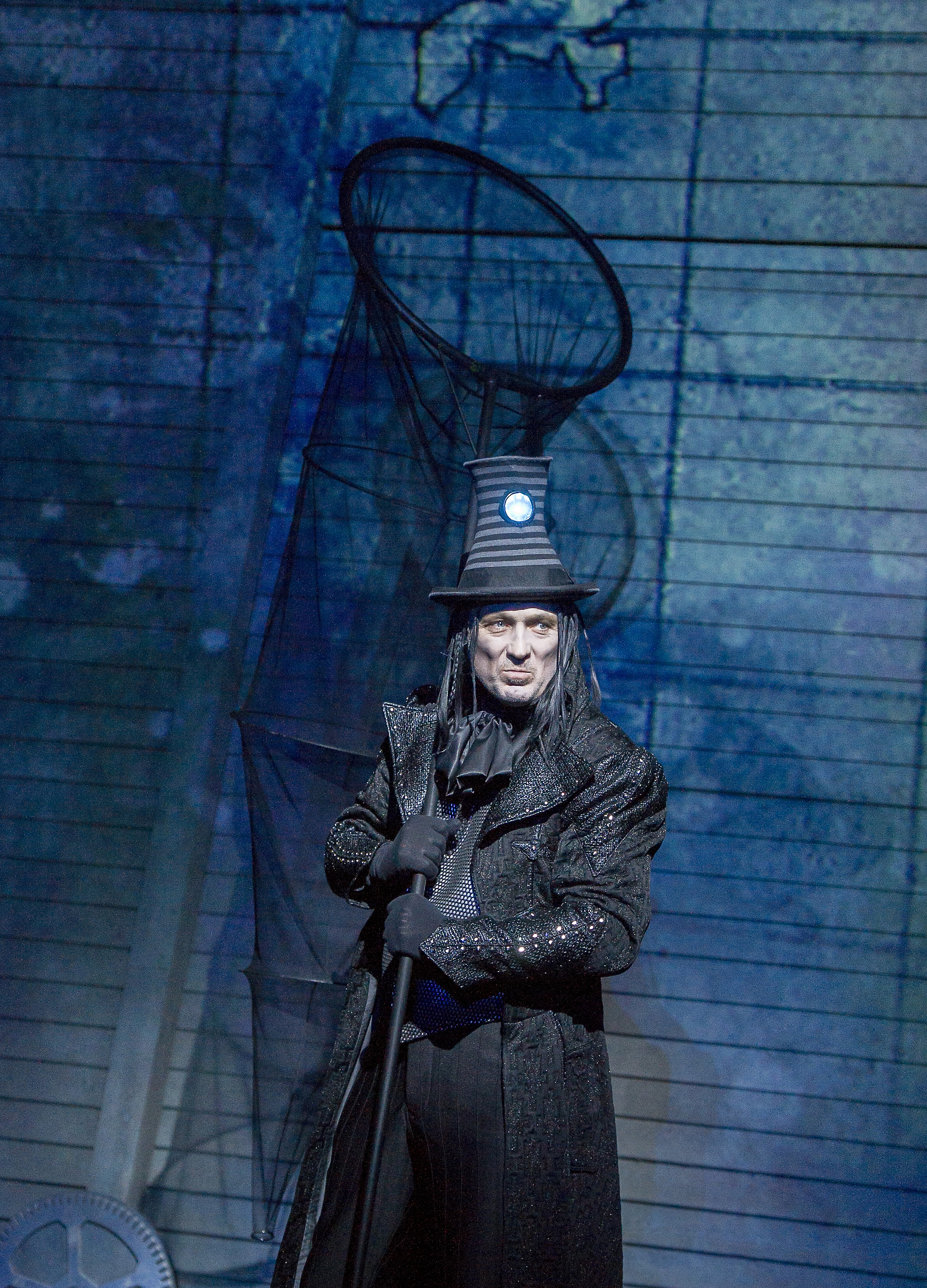
'

Photo credit: Alastair Muir

From gangster Reggie Kray to evil control freak Steve Owen in EastEnders, Martin Kemp is extremely good at being bad. Currently on tour in Chitty Chitty Bang Bang playing the Childcatcher, arguably one of the most iconic villains of all time, Martin is drawing on his previous roles for inspiration, but admits that there’s unchartered territory to explore when it comes to the character that regularly tops the polls of movie monsters.
“The Childcatcher is an exaggerated version of everything I have ever done before, but it comes from a completely different angle,” explained Martin. “He’s a step away from reality; all the characters are really, especially in the second half when we go to Vulgaria.
“In the first half I play a character called the Junk Man, but in the second half that kind of Alice in Wonderland thing happens and the Junk Man becomes the Childcatcher. Robert Helpmann did an amazing job [in the film], but my physicality is not the same as his; I don’t have his ballet background, so instead I try to bring a bit more horror to the role.”
Judging from the booing that fills the theatre before he has even set foot on the stage, he’s clearly doing that very effectively.
“Kids are scared of the name: Childcatcher. When the Baron says “Call for the Childcatcher!” I can feel the tension in the theatre and then I hear the boos,” he laughed, adding, “But that’s part of the whole experience. If you haven’t laughed, cried and been scared then you haven’t seen a good show. You need to be taken to all those places.”
And with cheers at the curtain call almost taking the roof off the theatre, it seems that it’s a journey that audiences of all ages are delighted to undertake. A co-production between Music & Lyrics Limited and West Yorkshire Playhouse, this brand spanking new reimagining of the much-loved Sherman Brothers musical is winning critical acclaim as well as standing ovations.
“Ten years ago I saw the show in London and the main thing I remembered about it afterwards was the car,” said Martin. “But now it’s very much about the story. It amazes me, but every night I walk out of stage door and people are there saying how much they loved the whole show. From old people who saw the movie on their first date to kids meeting Chitty for the very first time, the demographic is extraordinary. Yes, it’s changed from the book, and then again from the film and again from the original stage musical, but it really works. We’re sending people home with big smiles on their faces.”
As for his fellow cast members, mention them and it is Martin with a big smile on his face. “It’s a great cast,” he enthused. “I’ve worked with Michelle [Collins] before and it’s lovely to work with her again, but they are all brilliant performers.” And so they are. Funny men Jason Manford as Caractacus Potts and Phill Jupitus as Lord Scrumptious and Baron Bomburst are joined by Martin and Michelle, as well as Andy Hockley of Phantom of the Opera fame as Grandpa Potts, and West End leading lady Amy Griffiths as Truly Scrumptious. Add to that a world class company of singers and dancers and you have a show that is dazzling, star-studded and that absolutely lives up to the ‘fantasmagorical’ praise.
But while the story of Chitty might have been knocking around for a good while, musical theatre is a new challenge for Martin.
“One reason I am here is that I have never done a musical before and I thought this might be a nice way to dip my toe in. I love trying new things and I love working with new people.”
That happy-go-lucky, have-a-go attitude wasn’t always there, however. In fact, as a child he confesses that he struggled with crippling shyness.
“I’ve been doing this a while now but at the age of eight I was incredibly shy, so my mum sent me to Anna Scher’s drama workshops,” said Martin, who knows first-hand what an advantage drama classes can be to children.
“What drama clubs give you is a small amount of this magic dust called charisma. I always say that I owe everything to Anna Scher because she formed my personality as a kid.”
Pointing out that whether you become an actor or join a band or you just use that acquired confidence to get through interviews when you’re 16, Martin is certain that drama clubs are a fantastic way of developing both character and life skills.
As for children watching live theatre, absorbing stories close up rather than on a screen, Martin loves the way they get totally involved.
“Adults watch, but kids believe and become part of the world they see unfolding; they just dive in,” he nodded.
“For Chitty we recently did what is called a ‘Relaxed Performance’ for children with disabilities and conditions like Autism. The show was adapted around the audience’s needs and it was a wonderful thing to be part of.”
A member of one of the most popular bands of all time, star of movies, TV and now a musical, Martin certainly can’t complain of always doing the same old same old.
“I have always changed it up a bit and I like never knowing what’s around the corner,” he laughed, although actually this time he does know what is coming next.
“I have just finished a year on tour with Spandau which was wonderful, but it’s this great big machine that needs five artic trucks and a 100-strong crew. When you play huge arenas the size of Wembley you know that to people at the back you’re just a speck of dust in the distance and that you’ll never get to meet those people. So in May I am doing the sort of antidote to not meeting people with a show that’s going to tour called An Audience with Martin Kemp. I’ll be travelling around England chatting about my life and career and taking questions from the audience. Yeah, it’s going to be different and fun,” he grinned.
With such a busy professional life, relaxation, he says, comes in the form of painting.“That’s my down time. Sometimes it shuts me off from the world and I lose myself completely.” Asked what he paints and the smile that stole my sixteen-year-old heart lights up his face again. “I paint rock ‘n’ roll,” he says with a chuckle.
Super-talented, funny, warm and with rock ‘n’ roll artistic flair to boot, however brilliantly nasty he is as the Childcatcher, in real life Martin Kemp is a total sweetie.
Vicky Edwards

 

A gentleman and a scholar: Vicky Edwards Meets Stephen Boxer

About to play the great author C.S. Lewis, Stephen Boxer takes a break from rehearsals to talk to Vicky Edwards about touring, making an ass of himself and his own connection with Narnia’s creator
Having played everything from soap opera to Shakespeare, as well as appearing in movies such as The Iron Lady, Stephen Boxer is packing his suitcase and hitting the road with a new national tour of Shadowlands. Arguably one of the best plays ever written, Stephen plays Narnia creator C.S. Lewis and, he reckons, the story’s central themes of grief, belief and love will resonate with audiences.
“It’s a beautifully structured play and it’s very poignant, so we can Stephen Boxerall relate to it. But it is also very entertaining; very witty with some real belly laughs,” he said.
Having cleaned up on the awards circuit (the subsequent film version also collected gongs) William Nicholson’s play charts the developing relationship between Lewis, an Oxford don and author of The Chronicles of Narnia and The Screwtape Letters, and feisty American poet Joy Davidman. Finding his peaceful life with his brother Warnie disrupted by the outspoken Davidman, whose uninhibited behaviour is at complete odds with the atmosphere and rigid sensibilities of the male-dominated university, Lewis and Joy show each other new ways of viewing the world. But when Joy is diagnosed with cancer Lewis’s long-held Christian faith becomes perilously fragile.
But, Stephen pointed out, Lewis’s struggle with his faith resulted in the beautiful book A Grief Observed, an extraordinary collection of the author’s reflections about bereavement.
“It is a kind of bible for both religious and non-religious people,” said Stephen. “It rises above religion and belief and talks about how we deal with loss and how a theory of life is tested by reality.”
As for the relationship between Lewis and Davidman, Stephen explained that while there were some fundamental differences between their characters and life experiences, there was also a definite meeting of minds.
“Their intellectual acuity was an absolute meeting place for them both – they could both spar in the same intellectual boxing ring and they enjoyed that; they enjoyed the cut and thrust of intellectual debate. That’s how their relationship started,” said Stephen, adding:
“He was a classically repressed quite conservative thinking Englishman who lived a classic ivory tower life. Part of his emotional repression, I think, was that he was sort of cushioned by the Oxford life you could live as a don. She was an ex-communist Jewish American who told it how it was and shot from the hip. Yes, they were very different, but mentally they were perfectly matched.”
As for his own connection to C.S. Lewis, as a direct result of being an ex Oxford choir scholar and school boy (“I wasn’t an undergraduate but it was my academic home for eight years from 1960 – 1968”) he is in the position of knowing exactly where he was the night that the World lost two great men.
“I was at Magdalen college school, the school that was related to C.S. Lewis’s college. It was the evening of the twenty-second of November 1963 and I was walking back from chapel, in my gown and mortar board, having sung a service. An undergraduate stopped me, which in itself was quite unusual. He told me that President Kennedy had just been killed. It was the same night that less than a mile away C.S. Lewis died, so not only do I know where I was when President Kennedy was shot, but I also know where I was when C.S. Lewis died because I was right on his doorstep.”
Admitting that the insight into Oxford life has proved useful in preparing for the role, what appealed most to Stephen about the play?
“Firstly it’s a whacking great part – I’m never off the stage. In rehearsal I’m finding that a bit daunting,” he laughed.
“At the moment I’m at that stage of running before I can walk and falling over a lot, metaphorically, but that’s a necessary part of the process. Making an ass of yourself and feeling like a fool in rehearsals is a prerequisite.
“Another reason I wanted to do it was that I’ve just done a year of television. I’ve done some lovely stuff which I really enjoyed, but there’s no real rehearsal culture in television and I was dying to get back into the rehearsal room and that organic way of creating on the shop floor.”
Thoughtfully, he added: “And getting to know people, too. You develop very warm relationships in theatre and after a year I missed that.”
With the tour of Shadowlands he is certainly going to have plenty of time to bond with his fellow cast members. Not that life on the road bothers Stephen one jot.
“It’s a great way to catch up with friends, but touring is also a great way to see the country. I visit the galleries and museums and do the walks and whatever else there is to do or see. It’s part of the fun and I’ve seen the world that way. I love working and travelling at the same time.”
Playing opposite him is Amanda Ryan (The Forsyte Saga, Shameless) as Joy. “She was made to play the part,” said Stephen, who doesn’t look too far into the future when it comes to his own career.
“I don’t really plan and the things that come along always surprise me. I wasn’t expecting to play Titus Andronicus at the RSC for instance. It was a play I didn’t know but I loved doing it; it was intriguing, absorbing, and demanding. I think I’d like to play Lear when I’m about seventy,” he mused, before laughing and saying: “Not that long to go then!”
But for now this charming gentleman and scholar is delighting in Shadowlands. Go to see it and you will too.
Official website: www.shadowlandstour.com
Twitter: @shadowlandstour
Facebook: shadowlandsthetour


Jolly good show, chaps! Vicky Edwards meets actor Graham Seed

Vicky Edwards meets actor Graham Seed to talk about Rattigan, romance and how wearing a uniform might give his wife ideas…
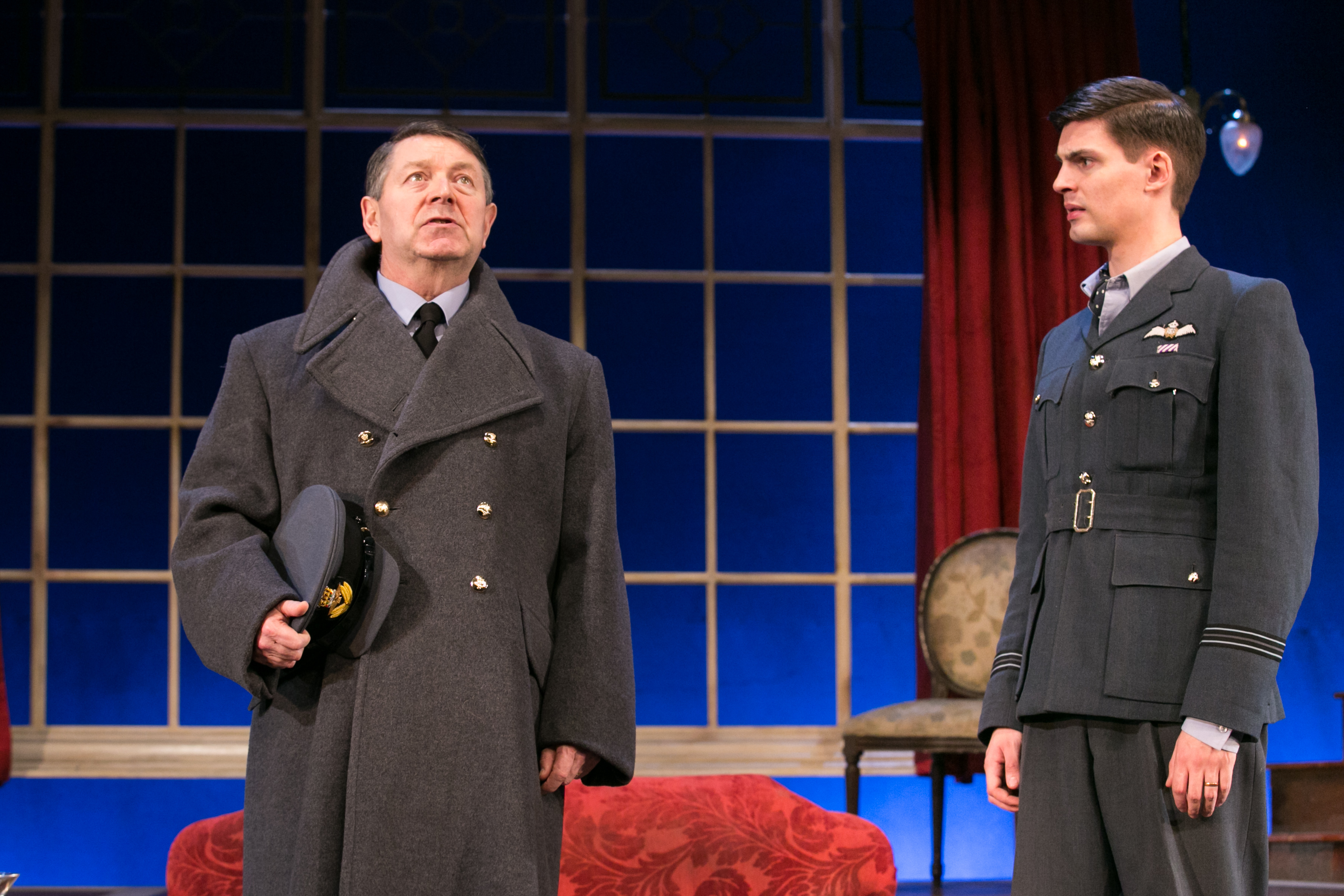
With the tractors and traumas of Ambridge well and truly behind him (he played Nigel Pargetter in the radio soap The Archers for an incredible 27 years), award-winning actor and broadcaster Graham Seed continues to work extensively. Just starting out on a national tour, Graham plays Squadron Leader Swanson in Terence Rattigan’s Flare Path, directed by Justin Audibert.
“It’s going very well and we have a terrificGraham Seed as Squadron Leader Swanson and Daniel Fraser as Teddy Graham in the 2016 National tour of Flare Path credit Jack Ladenburg cast,” beamed Graham, a self-confessed Rattigan fan.
“As an actor I am really enjoying it because Rattigan writes such good characters; he just didn’t write bad parts. One of his best plays is The Deep Blue Sea and this has early elements of that. It’s rather delightful and I like the play enormously.”
Based on Rattigan’s own experiences as a tail gunner during World War II, the play is rooted in wartime Britain, where the life-and-death existence of the RAF bomber crews, and their wives and sweethearts who were on tenterhooks awaiting their return, created a permanent state of high anxiety. The story tells of former actress Patricia, the wife of RAF pilot Teddy. When Patricia’s ex‐lover and Hollywood idol Peter arrives out of the blue her emotions are thrown into turmoil and the survival of her marriage to Teddy becomes uncertain. As the conflict rages in the skies above, on terra firma feelings simmer, threatening to become every bit as explosive.
A romance with shades of Brief Encounter then? Graham nodded. “She has to decide what she’s going to do, but it does have humour, too. It’s a very evocative and powerful play.
“My character is quite funny and rather charming. He’s a frightfully good chap; full of that stiff upper lip phlegm.”
But in pitching his performance Graham has had to take care not to stray into parody. “If you did it wrong you’d be into Black Adder or Monty Python territory, which you don’t want at all.”
But it’s not just the good of the play that Graham is mindful about; he clearly has great respect for the real life pilots who carried out such dangerous missions.
“These boys were incredibly brave and they understated the danger always. The play is set against the backdrop of planes taking off and not coming back and at one point my character says: ‘we do owe these boys something.’ You can see why Churchill loved it. The Great War was so ghastly that it became romantic, but in the Second World War far more civilians were bombed.”
Mixing history with an intriguing story gives it broad appeal and the cast are delighted that Flare Path is attracting audiences of all ages.
“It’s definitely a play that is suitable for all the family and I do hope that lots of young people will come to see it,” said Graham, who admitted that these days he isn’t feeling as sprightly as he once was.
“I am suddenly feeling my age,” he confided. For years you’re the youngest in the company and now I’m suddenly the oldest – I’m about twenty years older than everyone else!”
But there’s something about this particular production that has had a rejuvenating effect on Graham. Botox? A bit of a nip-and-tuck? As it transpires nothing so drastic.
“I know it sounds slightly immature for a sixty-five-year-old man to say it, but it’s quite nice to put on an air force uniform. I look pretty chipper,” he teased, agreeing that any fella in a military uniform looks instantly dapper, even if they look like a bag of spanners. Not that Graham does, I hastily reassured him. Laughing off the unintended insult he said:
“It’s like evening dress – if you’re a woman and you suddenly look at your old man in evening dress you say ‘goodness he polishes up well!’ When my wife sees me in my RAF uniform I hope she thinks that there’s life in the old dog yet!”
Certainly on the work front he continues to have offers lined up and, although he is best remembered for The Archers, his CV is crammed with credible theatre, film and TV credits. “That’s because I’m so old,” he twinkled. “I’ve ducked and dived; I’m what they call a jobbing actor.”
As for life on tour, Graham doesn’t mind living out of a suitcase in the least.
“It’s rather romantic and like being with a family. For me, as an older member of the company, there’s a responsibility to make sure that everyone’s happy. But it’s a lovely way to see friends in other parts of the country and to visit wonderful theatres.”
With all the schlepping about he does for work, how does Graham relax?
“I find it very hard to relax,” he confessed. “I do What the Papers Say every other Sunday, so don’t get many Sunday’s off. You always worry about your next job and even at sixty-five I’m always worried that I’ll be found out. But I’m actually pretty content. Getting older makes you less ambitious; there are more important things, like your health. So now I am absolutely thrilled to play good supporting roles and to really enjoy them.”
Anxious that he doesn’t come across as “worthy” (he doesn’t), Graham believes that there is a duty to tour good plays around the country, especially to unsubsidised theatres.
Speaking of which, it was time for him to head off to transform himself into a fine young man in uniform for the evening performance.
“I’m revving up for chocks away,” he grinned, before adding: “It’s not a bad life.”
Indeed. And he’s a jolly good egg. A jolly good egg in a jolly good show. Go and see for yourself.
Official website: www.flarepaththetour.com
Twitter: @flarepathtour
Facebook: flarepaththetour

Das Spiel: Are You Part of the Game?

Das Spiel- Are You Part of the Game?Mind-reader, illusionist or trickster – no matter what you think of Philipp Oberlohr, he’ll certainly leave you mystified with his ability to master fate and delve into the depths of your soul.

Das Spiel: Are You Part of the Game? At The Vaults, Waterloo, doesn’t use the conventional theatrical props and it certainly appears as if there’s no script or set-direction.

It seems to flow naturally around the all-important members of the audience.

But then we question whether we’re all just pawns in Oberlohr’s game as the seemingly random participants are actually written into the stage-show as he reads a letter written earlier to name and thank those who played along.

We forget this is actually a theatrical experience as unassuming Austrian Oberlohr carries us, and we in turn carry him on this journey which blurs reality, the past and the present.

The players are different each night so the game you’ll be involved in will vary from mine, but I wanted to share some of the awe-inspiring and mind-boggling events that took place.

To kick off the show, Oberlohr drew a circle attached to the two sides of a triangle, followed by the words red, black, black.

He then took out a pack of cards with the numbers 1-100 and an audience member chose one. At that point we felt it would be a very long night as Oberlohr went round the room asking the audience to guess the number.

After the third attempt, Natalie shocked us all by guessing it was 32. And incidentally, she was wearing a necklace with a round pendant, a red dress and black shoes and tights – perfectly describing the pattern Oberlohr had penned earlier.

Then three blank pieces of paper were handed out and the holders had to draw one of the first things that came into their minds. As this was happening, Oberlohr’s eyes were taped and blindfolded before his hand hovered over the drawings. Incredibly he correctly guessed that two hearts with cupid’s arrow had been drawn, in addition to the rear view of an elephant. Magda was the next player.

He guessed the birth date of one player, the favourite city of another and even guessed the name of the person one audience member had shared her very first kiss with.

Oberlohr said he was inspired to create Das Spiel after reading The Magus by John Fowles. “I related to the protagonist as the reality that was created around him kept changing and transforming. This theme inspired me to create an experience like this for an audience in a live setting”.

In the same way, we’re changed and transformed from that point onwards – this is certainly unlike anything I’ve seen or been involved in before.

And just a note about The Vaults venue – it’s a myriad of darkened rooms and tunnels under the arches supporting the train network above – a funky hideout for the urban classes.


The Mousetrap at Chichester Festival Theatre: Review

The Mousetrap on Tour
Chichester Festival Theatre
Until 28 November
www.cft.org.uk

Photograph by Liza Maria Dawson

TheMousetrap_SPThe cast of The Mousetrap in the 60th Anniversary Tour of Agatha Christie's The Mousetrap. Credit Liza Maria Dawson (27)

It is almost inconceivable that after 63 years there is anyone who hasn’t seen the world’s longest running play, and yet the Festival Theatre was full of wannabe sleuths last night.

Opening with an eerie whistling of the nursery rhyme Three Blind Mice, the killer doesn’t faff about – the first murder of the night takes place almost before the house lights have gone out.

Cut to Monkswell Manor, a guest house being run by a young couple whose enthusiasm is offset by their complete inexperience of running such a business.

As the snow falls and guests arrive at Monkswell, swiftly becoming stranded there by the wintery deluge, it becomes clear that among their number is someone with murder in mind – but who?

The mistress of suspense, Christie’s script certainly cranks up the tension beautifully. Everyone could be linked to the murderer and could therefore be a target. Menace and anticipation transcend the stage and the audience, as a man, quivers with anticipation.

There are a few laughs to relieve the apprehension, mainly born of Christie’s superb observations of character and human nature, but in the main the evening is more inclined to baited breath than belly laughs.

A bit more ham than cheese in places (some of the cast are guilty as charged when it comes to occasional overacting), the intrigue and enticement to find out who the killer is makes forgiveness of such over-the-top moments easy to grant.

Particularly strong performances come from Anne Kavanagh as the magnificent battle-axe Mrs Boyle, and also Luke Jenkins as a suitably authoritative Sgt. Trotter. Edward Elgood also convinces as the immature and borderline-bonkers Christopher Wren, who could just as easily wield a machete as he could a feather duster.

Is The Mousetrap dated? Truthfully, yes. But it is also a British classic; a splendid piece of ripe Stilton that should be embraced and enjoyed absolutely in its original form.

As to whodunit…

Ah, but that would be telling!

A Triumphant Production of Ibsen’s A Doll’s House

Baron’s Court Theatre

3rd Nov – 22nd Nov, 2015

7:30pm  (Two and half hours)

A Triumphant production of Ibsen’s A Doll’s House groupA Doll’s House, written by Henrick Ibsen, was first performed in 1879, and today the same discussions are still whirling about: the right of individuals to discover themselves, presumably at whatever the cost to others, especially the children.

This complex and multi layered play, and its premise, has always vexed me. Would the New Dreams Theatre Company’s production stir my depths again?

Oh yes, indeed. Dick and I not only had the great pleasure of seeing this controversial but popular play passionately performed at Baron’s Court Theatre, but argued all the way home about just these ‘rights’.

Paul Vates (Torvald Helmer) has been writing in Frost Magazine over the last few months, highlighting the processes involved in putting on a stage play. It was good, therefore, to join the audience in the intimate theatre below The Curtains Up pub on 10th November. Good, but slightly nerve wracking – would it work, would it move me, make me laugh, make me cross, make me re-join the argument?

A Triumphant production of Ibsen’s A Doll’s House paul

Kevin Russell’s production of Bryony Lavery’s pared adaptation is confident and  modern, but nonetheless steeped in the essence of the period. Ibsen writes of lives lived behind closed doors, and I believe he hints at the accommodations needed in order to hold everything together, though others see only the ‘rights’ within the play.

A Doll’s House touches on many things, fraud, debt, loneliness, unrequited love, death, the roles people play, the responsibility borne by bread winners, the sense of patronising male ownership of wife and children, and ultimately, the choice made by Nora to pursue her happiness and personal development whatever the cost. This attitude has never sat well with me, and never will.

The pace was crisp, the set utilized, Nora (Alexa Matthews) is compelling, beautiful and frenetic, Torvald (Paul Vates) a cypher of the age, and is as emotionally repressed as Nora, conforming to the norms of society and business as he does.

A Triumphant production of Ibsen’s A Doll’s House noraJust as circumstances strip Nora of her ability to role-play as a doll within a doll’s house, so too, they strip Torvald of his role as perceived by society. Vates’ confusion and desperation reveals a humanity that moved me,  brought me to tears, in fact, and more than balanced Nora’s implacable decision to strive to find herself, to grasp her ‘rights’ heedless of the contextual responsibilities.

The whole production is thoughtful, subtle, and all the players more than fulfilled their roles: Julia Florimo as Mrs Linde is a good foil to Nora, as she exposes  her controlling personality to bring about all that she wants. Ramzi Dehani’s Krogstad is ready to wreak his revenge, and is taken by surprise at the happy harbour into which he is being led by Ms Linde, by the nose one thinks. Brian Merry’s Dr Rank is painful and lost in love for Nora, but determined to wrest control back and terminate his illness at a time of his choosing.

adollshouseI thought Nora’s interior monologue worked well, and the brief by-play with  the maid Helene, was supposed to reassure us that as she’d brought up Nora, she would bring up the three children and all would be well. Tosh.

I loved it. A bravura production. It is with me still. And let me tell you, Dick was engrossed throughout and he so often isn’t.

Don’t miss it, grab the chance while you can.

A Doll’s House (Bryony Lavery)

Baron’s Court Theatre, (below The Curtains Up pub)

3rd Nov – 22nd Nov, 2015

7:30pm

PRODUCTION TEAM

Set designer: Katie Unsworth Murrey. Lighting design: Harry Amatage, Sound Design: Ben Cowen.

New Dreams Theatre


Elf the Musical – Review

Elf the Musical
The Dominion Theatre, until 2 January
Box office: 0845 200 7982
www.elfthemusical.co.uk

'

Photo credit: Alastair Muir

Even strolling beneath the over-sized illuminated baubles of Oxford Street, on a mild November evening it still felt far too soon to embrace Christmas. Fast-forward three hours and I was positively exuding seasonal cheer – this is a show that would transform even Scrooge from selfish to elfish.

Based on the 2003 film starring Will Ferrell, the plot is fairy tale daft. A baby crawls into Santa’s sack one Christmas Eve and is raised by Elves in the North Pole. Being a fairy tale nobody mentions the fact that Buddy can place the star on top of the Christmas tree without the aid of a cherry picker, but eventually Santa ‘fesses up: Buddy is actually human and has a father in New York. As it turns out, a father who isn’t too keen on welcoming an oversized elf to the family.

At the risk of spoiling the story for those who haven’t seen the movie, suffice to say that chaos, comedy, romance and high drama follow, each element taking the narrative towards Happily Ever After as smoothly as champion skier heading down a nursery slope.

Ben Forster as Buddy is a joy. Bouncing around like a particularly nimble and enthusiastic Labrador, he has a terrific rapport with the audience and manages to be both charming and sweetly innocent. He also sings like a dream (Forster was the winner of the TV search for Jesus Christ Superstar), and makes an exceptionally good fist of songs that, while entertaining in the moment, aren’t especially memorable.

Kimberley Walsh as Jovie, the object of Buddy’s affections, is also in fabulous voice, while Joe McGann as Buddy’s dad Walter convinces as the tetchy publisher of children’s books who has been putting work ahead of family for too long.

Offering up plenty of warm and fuzzy feelings from the off, excellent teamwork sees a supporting cast singing, dancing and acting their Christmas socks off, while the design team’s clever set (‘wow’ factors come thick and fast) deserves a curtain call of its own.

Directed and choreographed by Morgan Young, if panto isn’t your cup of eggnog then there are plenty of seasonal sensations to be had here, without all the ‘behind you’ capers. And if you don’t leave the theatre wanting to spread tidings of comfort and joy, frankly you’re a lost cause.

A Lesson from Auschwitz Theatre Review

A lesson from Auschwitz review‘Vermin’, ‘parasite’, a ‘flea’ that needs to be exterminated. Those are the vile words that are shouted at the Jew who weeps and repents his actions on the stage.

For we the audience of A Lesson from Auschwitz at Churchill Theatre in Bromley are the next generation of Nazi SS soldiers being brainwashed to treat the victims of the holocaust as worthless sub-beings.

An intimate production by Brother Wolf, the play consists of just two actors: the intimidating Rudolf Höss, played by Eric Colvin as the Nazi soldier, and Abraham Könisberg, portrayed by James Hyland, who barely manages to stand on his feet.

He wears a chalkboard around his neck, etched with ‘Ich Bin Zurük’, meaning he’s an escapee.

Unfortunately, he is now to be punished and made an example of in-front of the roomful of trainee Hitlerites.

It makes for uncomfortable viewing, as the lesson from Auschwitz is actually 25 lashings against the prisoner’s blistering back.

And with each rise and fall of the whip, we’re told that showing sympathy towards the prisoners is a sign of weakness, how no Jew is spared – women and children won’t leave the camp alive and how a ‘genius’ has developed a deadly gas substance which can kill more than 2,000 people per day.

Even better, the healthy Jews will build the contraptions ie the showers, which will ultimately kill their own kind – it’s ‘political hygiene’ at its finest.

The rest, as they say, is history.

It’s hard to find anything enjoyable about this play given the bleak subject matter, and in all honesty, I was relieved it was over after just an hour.

But Hyland, the SS soldier, was convincing as the dominatrix and Colvin pulled on all the right emotions.

We’ve all heard the tales of horror and survival from the camps, but what was different about A Lesson from Auschwitz was how it flipped the norm so it was told from the side of the Germans.

However the tales of death and destruction in Nazi-occupied Poland are retold, the lessons from Auschwitz must live on today so that history never repeats itself.

In commemoration of the 70th anniversary since the liberation of Auschwitz, the play’s dedicated to all the victims – those who were murdered and those who survived.