Business of Books: So Much to Give – Part 1

Jane Cable on how authors get together to support charities
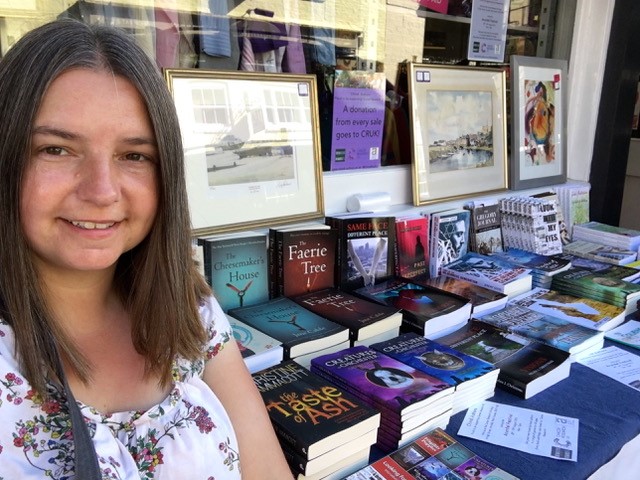
It’s that time of year again. The time when Chindi Authors stand outside the Cancer Research UK shop in Arundel for ten whole days during the town’s festival trying to sell books. Not an easy task when the second hand offerings inside are so much cheaper, but we stick at it because we can add to the coffers of this excellent cause, promote our own books and meet readers.

We know we’ll be well supported by our members and local people, but organiser romantic novelist and kidlit writer Carol Thomas was asked by author contacts up and down the country if they could donate too. While she did the charitable thing and set up a donation page – http://www.carol-thomas.co.uk/Chindi-cruk/ – her generosity simply got me thinking about how much writers achieve when they band together for good causes.
The most high profile recent example of this was the Authors for Grenfell online auction which attracted pledges of more than £150,000, over £30,000 of which was for Philip Pullman to name a character after one of the young victims of the fire. Quirky lots did well too, with conductor and writer Lev Parikian putting together a package which bridged both his worlds: “I offered signed books and (more importantly on this occasion, I think) conducting lessons. A bidding war between three people meant we raised £1,700.”


CLIC Sargent runs an annual ‘Get in Character’ eBay auction where authors such as crime writer E V Seymour and novelist and poet Claire Dyer have offered bidders a range of lots including – you guessed it – having a character in a book named after them. Critiques prove equally popular and previous Business of Books guest Karen King (https://www.frostmagazine.com/2017/04/how-to-have-more-than-100-titles-published/) offered one in the Authors for Refugees auction last year, an initiative which raised £22,000.


Another way of writers getting together to raise money is by giving their time to contribute to and to edit anthologies for causes as diverse as cancer and heart charities, earthquake appeals, women’s rescues and hospices. Some have very personal links to the cause, including saga writer Elaine Everest (also a previous Business of Books guest): “I organised and edited the anthology ‘Diamonds and Pearls’ (Accent Press) to celebrate my 30th anniversary of surviving breast cancer (7 years ago) with funds going to Against Breast Cancer.”


Crime & thriller writer Jane Risdon is a serial contributor to anthologies, supporting amongst others Women for Women, Breakthrough, Women’s Aid, The Norfolk Hospice, The Princess Alice Hospice and Save The Children. She was slightly upset when there was no thanks from certain charities, but would still do it again. Other authors say that smaller charities are more responsive than the larger ones so they prefer to work with these.


Some writers go the whole nine yards and get together to form charities of their own. A prime example of this is saga writer and Frost contributing editor, Margaret Graham, who together with Jan Speedie and Penny Deacon set up Words for the Wounded which exists to raise funds for injured service personnel through writing prizes and events. It’s a wonderful organisation and every penny goes directly to the people who need it. Authors can help in a variety of ways – Chindi raised almost a thousand pounds by organising a litfest, others give their time to speak at events or in my case I donate £1 for every Amazon review of my book Another You. Find out more about W4W here: http://www.wordsforthewounded.co.uk/.


Business of Books: Going Up! Jane Cable on the importance of the elevator pitch

Jane Cable on the importance of the elevator pitch

It is indeed true that the word is getting shorter. Everything reduced to bitesize for folks in too much of a hurry to stop and listen, hungry to gulp down as many tweet-sized pieces of information as possible.

This is not entirely a bad thing. The book business knows that with so much competition for leisure time and money the potential consumer’s attention needs to be grabbed in a flash. A reader may spend hours savouring a good book, but their buying decision is often made in an instant.

Enter the elevator pitch – the ability to describe your latest work in two sentences at most. Catherine Miller’s excellent talk at the Romantic Novelist’s Association conference drew quite a crowd, encouraged no doubt by the lure of a competition for the winning pitch’s manuscript to be read in full by her agent, Hattie Grunewald of Blake Friedmann.

I learnt a great deal while preparing my entry. On a large piece of paper I set out the major themes and keywords for the book, turning them in my mind and distilling them into two neat sentences. I fiddled with the words, one at a time. I was happy with the first sentence: ‘When archaeologist Rachel Ward visits a remote Lincolnshire field she realises it’s where the voice in her head has been leading her for years.’ For ages I couldn’t get the second to gel, then the next morning I woke up with the perfect solution in my head: ‘But as she starts to dig an unseen danger circles ever closer and Rachel is forced to confront her own past in order to survive.’

The process of preparing what turned out to be the winning pitch had actually shown me that the ending of the book wasn’t sufficiently strong – to be fair, the edit notes I’d received said the same – but crystallising the very essence of the story into a couple of sentences made me focus on the issue – and solve it – in a way that nothing else had.

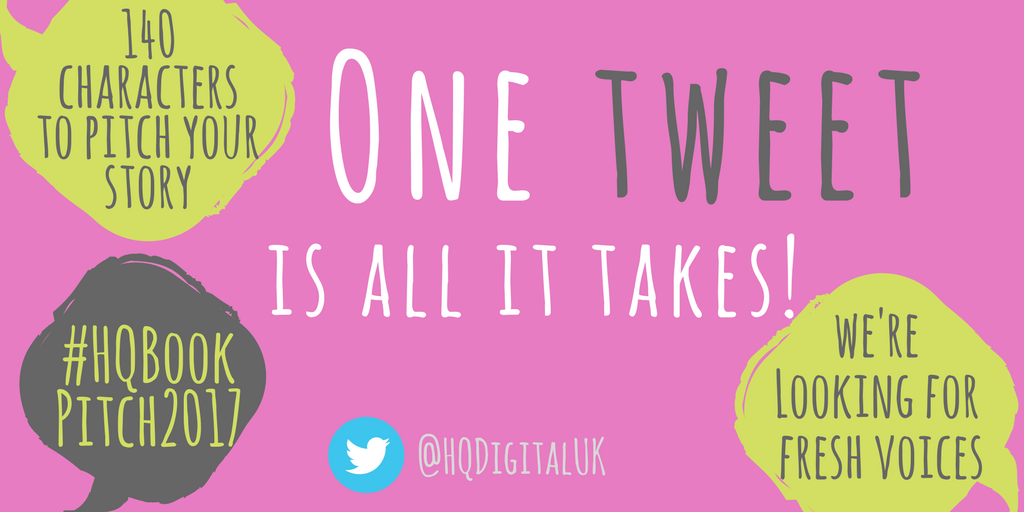
This week has shown me that two sentences is too long. Try pitching in 140 characters – actually 124 when you need to leave space for #HQBookPitch2017 – when Harper Collins’ HQ Digital division opened its virtual doors for tweeted pitches. I tried but failed to pack enough excitement into so few characters but again it was a great learning experience.

At no deadline was given so rather than research the type of books they were looking for I plunged straight in. At any one time I have a number of concepts on the block so I picked one I thought would do and tried to make it sound succinct and sexy. Not sexy enough, clearly, but I have learnt to target publishers I’m interested in better (a number of them do use this technique) and hone relevant pitches so they’re ready.

So what does a successful Twitter pitch look like? I am lucky enough to know two authors who have been asked to submit further and this is what they came up with and how they describe themselves in a tweet:

‘Lucy swaps her husband for a motorbike and has the best ride of her life’ from Sue McDonagh: “I love building my characters, then letting them loose. Should I admit that they do things I hadn’t planned for them and make me laugh?”

‘Millie should have known an archaeological dig is no place to escape the past. But can she uncover her future there too?’ from Kirsten Hesketh: “Pantser, people watcher, procrastinator extraordinaire. Twitter counts as writing, right?”

It goes without saying that everyone at Frost is rooting for them. We’ll let you know how they get on.


The Business of Books: A Taste for Romance | Jane Cable visits a Choc Lit roadshow

Jane Cable visits a Choc Lit roadshow

As regular readers of this column will know, I’ve been keeping my eye on Choc Lit for a while. As a writer of romance, you simply can’t ignore them; they’re up there, they’re out there – and they have a definite brand.

It’s this clear branding which draws me to them as a publisher. They have prettily and cleverly set out their stall as purveyors of delicious (in their words) women’s fiction from historical romance through to contemporary romantic thrillers. The books they publish are accessible and good quality; their readers know exactly what they are going to get.

When I saw that one of Choc Lit’s roadshows was coming to Southampton I knew I had to sign up. I was fascinated to see how they balanced an event aimed at readers and writers – not always the easiest of tasks. And the promise of chocolate was pretty enticing too.

Initially I hadn’t intended to pitch to one of their editors but when the email came through confirming my place I wondered if I should. Careful of their brand, Choc Lit have very precise submission criteria and I wasn’t sure I had a manuscript which would meet them. Or to be honest, one of them in particular: the requirement (for all but their Choc Lit Lite imprint) to show the hero’s point of view.

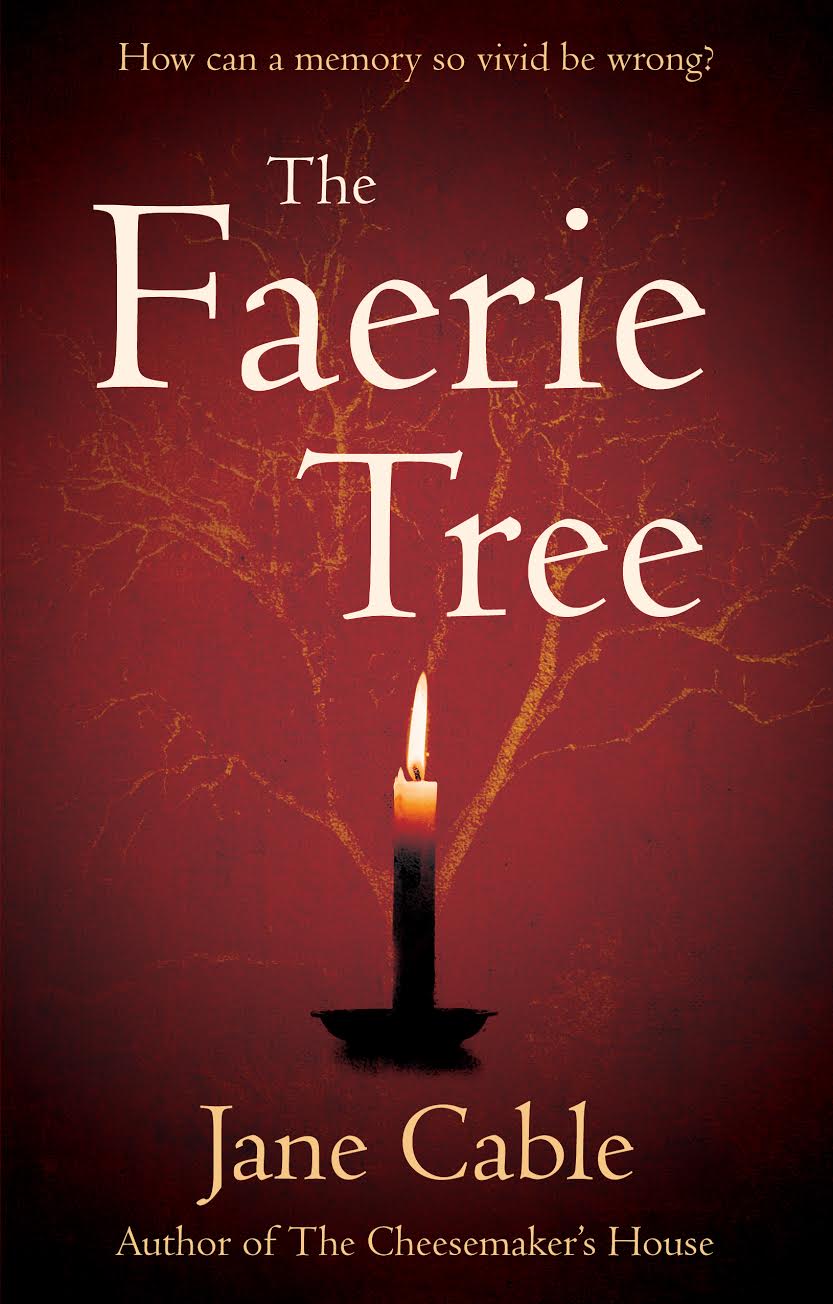
The book I am just starting could certainly be written that way, but Choc Lit only want completed – and professionally assessed – manuscripts. This is a really sensible move as it must make their slush pile less, well, slushy as a certain level of quality is assured. But reading their requirements again it became clear that self-published novels are acceptable and one of mine, The Faerie Tree, fits the bill.

The basic premise of The Faerie Tree is that when a couple meet again twenty years after their brief affair they discover that their memories of it are completely different, and this meant that the best way to tell the story was to alternate the hero’s and heroine’s points of view. It is the right length and certainly has romance at its heart, so I decided to give it a go.

If nothing else, it could be a foot in the door. Choc Lit are looking for authors with whom they can build a long term relationship, and as a writer, that’s what I am looking for too. I would love to be able to work with an editor to plan books ahead, knowing that they had a home when the writing was done. I would love a publisher where I could build my author brand alongside their own.

After listening to the Choc Lit authors’ stories (one of them, Laura E James, will feature in Business of Books later this summer) I was even more excited about setting out my stall to editor Lusana Taylor. In the main she was interested in my social media profile and how I marketed myself as a writer. I wanted to know about the importance of the hero’s point of view and what they looked for in an author. When we finally got around to talking about The Faerie Tree, she delighted me by asking to see the full manuscript.

Except it isn’t Lusana who will be assessing it. Choc Lit have a unique and rather wonderful way of choosing manuscripts for publication – their Tasting Panel of real readers. How refreshing is that? Once Choc Lit consider an author has potential it is up to this panel to decide whether the actual book is good enough. It seems a fairer process and a recipe for commercial success. I’m just hoping that The Faerie Tree delivers on flavour.

The final Choc Lit roadshow of the summer is at Stockton on Tees on 17th June. Find more details here: http://www.choc-lit.com/choc-lit-on-tour/


Business of Books: Behind the Best-seller Jane Cable Meets Rosanna Ley

the-business-of-books-interviewswithjanecableThis week I am especially delighted to welcome one of my favourite writers, best-selling author Rosanna Ley.
BUSINESS OF BOOKS- Behind the Best-seller rosanna ley

1)      How much of your working life does the business of books take up?

Pretty much all of it! I work full time from home: writing, researching, editing, writing publicity material and taking part in events and occasionally doing a manuscript appraisal for an author (I used to do more of these but now although I’d love to, I simply don’t have the time). I also run an annual week’s writing retreat in Andalucia in July for around 12 writers at finca el cerrillo which I adore. It’s a haven of tranquillity and it’s so good to work with other writers. I used to do a lot more tutoring of creative writing and also working with community groups on therapeutic writing but I have had to let this go. Very reluctantly. But writing and editing a book a year (of around 130,000 words) is very time-consuming!

2)      What’s your business model to earn a living from writing?

I’m not sure that I have a business model at all. I’m fortunate in that I do earn a living from writing. It’s hard in these days of low advances and competitive deals from independent publishers, not to mention the number of authors who self-publish who have to work so hard to earn from their books. I would certainly consider running creative writing courses as a good way to supplement income, and there are appraisal agencies who take on experienced readers to give constructive feedback on writing for authors who go down this route. Apart from that, my model would be to keep writing, keep publicising and hope that your work is eventually recognised. Just keep getting it out there…

3)      What do you write and what do you consider to be your major successes?

I write novels often described as ‘commercial women’s fiction’ which are contemporary but also contain elements of the historical. They offer a bit of mystery and some romance and are set in stunning locations such as Sicily and Sardinia (as well as my home turf of West Dorset and also Cornwall). I have also set novels in Cuba, Burma, Morocco and Barcelona. Yes, I like to travel… My books are often called ‘holiday reads’ because of the locations I choose, but I like to think they offer a bit more than that…  I like to include some (hopefully) thought-provoking subject matter and I like to explore human relationships and the ‘tangled webs we weave’. My biggest paperback success has been ‘Bay of Secrets’ which takes on some rather dark and hopefully intriguing subjects centring around the Spanish Civil War when a woman from Dorset in 2012 goes looking for her birth mother. My biggest e-book success was ‘The Villa’ which is about three generations of women and their journeys – one to find her lost love, one to discover the secrets of the past and one to find her own sense of self!

4)      Tell me about your latest project.

The project I am currently working on is entitled ‘Her Mother’s Secret’ and is set in Belle-Ile, a small island off southern Brittany, France. It centres around Colette, who left the island when she was eighteen and who returns when her mother Thea is ill in order to care for her and help run Thea’s flower shop. I have finished the first draft and am doing some editorial work on that now. We are also looking at cover ideas. I am also doing some publicity work for ‘Little Theatre by the Sea’ which is out in hardback with Quercus already and will come out in paperback on June 1st. This book is about restoration and change. Faye travels to Sardinia to take on the project of re-designing the little theatre and finds much more than she ever bargained for…

Rosanna Ley is the best-selling author of The Villa, Bay of Secrets and Little Theatre by the Sea. Her books are published by Quercus.

How To Have More Than 100 Titles Published

the-business-of-books-interviewswithjanecable
This week I talk to multi-published and multi-talented author and writing tutor, Karen King.


How much of your working life does the business of books take up?

The short answer is all of it! Writing – and teaching writing – is how I earn my living.  So every day I’m either writing, visiting schools to talk about writing, running a writing course, marking writing students’ assignments or doing social media about my books.


What’s your business model to earn a living from writing? 


Keep writing. Be flexible. Be aware of the market. Be dedicated. I’ve often worked to commissions so I’ve had to be adaptable, to work to publishers’ briefs and keep track of current trends. As I earn my living from writing it’s a priority for me. Writing comes first, ironing and cleaning is way behind. I had four young children when I first started writing so worked around them, early in the morning, evening and late at night. Writing for magazines meant I had deadlines to work to and, at first, this was the days before email so I had to write up my story/article or whatever, and get it in the post often within a few hours.

karenking How To Have More Than 100 Titles Published

What do you write and what do you consider to be your major successes?
I’ve been a published writer for over thirty years now and for the first twenty years I wrote solely for children. I started off my writing career writing for teen magazines like Jackie, Patches and Loving then moved on young children’s magazines such as Thomas the Tank Engine, My Little Pony, Barbie and Sindy. I wrote photo stories, comic strips, short stories, articles, puzzles, the lot. I even wrote a horoscope page and a problem page. Alongside this, I wrote children’s books. Now I tend to write mainly YA and chicklit. I was really delighted when Accent Press contracted me for three chicklit novels, and offered to republish my backlist too. They have such a great reputation and are a delight to work for. That’s my major success so far.

Tell me about your latest project.

I’ve just finished my third chicklit for Accent Press. The second one comes out in July, it’s called The Cornish Hotel by the Sea, and the cover is so lovely I keep looking at it. Accent are also republishing my YA Perfect Summer on 10 May. It’s got a fab new cover and has been completely revised. I’m really excited about it as it deals with two themes close to my heart, the pressure society puts on people to have perfect looks and how people with disabilities are treated. The tagline is ‘In a society obsessed with perfection, being different is a crime’ so that gives you a big clue to the plot.


Author Bio

Karen King is a multi-published author of children’s books, YA and romantic fiction. She has had 120 children’s books published, three romantic novels and several short stories for women’s magazines. She is also a writing tutor. Her YA Perfect Summer is released on 10 May and her second chicklit, The Cornish Hotel by the Sea will be released in July.

Contact links

www.karenking.net

Amazon Author Page

Karen King Children’s Books Facebook

Karen King Romance Author Facebook


Catherine Balavage’s Poetry Book What Do You Think?: A Collection of Poems Free Until 27th January

poetry, poetry books, poet, female, women, Catherine Balavage, what do you think? writer

Some good news for poetry fans, you can get Catherine Balavage’s poetry book, What do you think?: A collection of poems, for free until the 27th January 2017. It is free on Amazon Kindle across the world. The book has received good reviews and has reached no 1 in the women’s poetry fiction chart on Amazon. Get your copy of What do you think?: A collection of poems here.

A Day in the Life of Victoria Fox

I wake up, wondering why I’m not on a beach in the Seychelles. Where is the sound of the ocean, the gentle sway of my hammock? This is the life a bonkbuster author ought to have: glamour, cocktails, lazy mornings spent penning a chapter in my satin bathrobe, all elegant turban and painted nails… Or maybe a gilded office in an LA mansion, surrounded by glossy ornamental panthers, à la the late, great Jackie Collins.

A Day in the Life of Victoria Fox1The reality is neither of these things. Instead, it’s downstairs in my Bristol cottage to warm a bottle of milk for my one-year-old. She’s already singing to herself, talking to her toys Michael, Jean and Trudi (I have to give proper names to every toy she owns, I don’t know why: she has a Duncan, for heaven’s sake). It takes us a long time to get dressed, interspersed as this is with removing every book I own from the bookshelves and having a good rummage in my underwear drawer), and all the while I’m imagining what happens next in my book. This was a trick an author friend told me a while back: when time is tight and opportunities are few, write the story in your head. That way, when you do get a chance to sit down and get to grips with the word count, it’s all there waiting for you. (This is advice I’d give any aspiring writer, by the way. Whether you’re on the bus, doing the washing up or queueing at the supermarket, write it in your head. It makes that blinking cursor much less scary.)


We go for a walk in the morning, up the hill to look at the lake. It’s beautiful, sunny, and there are a few sailboats on the water. I’m hoping she’ll drop off to sleep so I can sneak back and do an hour’s writing, but invariably she’s still babbling about something or other by the time we get home. Perhaps we’ll see a friend before lunch, or build that tower of colourful blocks for the six hundred and sixteenth time.

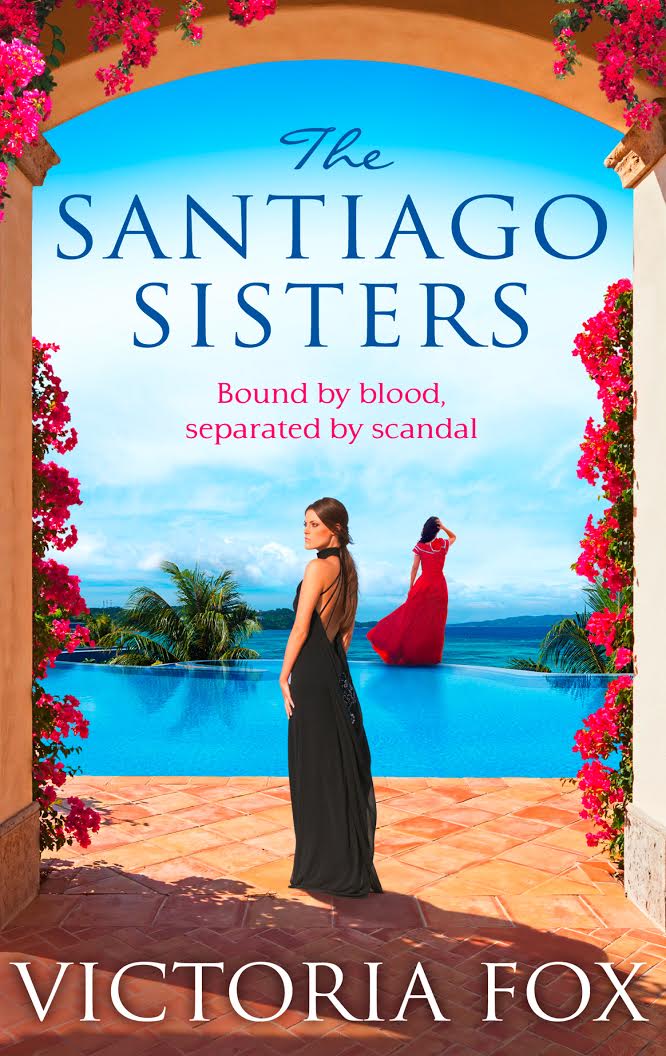
A Day in the Life of Victoria Fox2Ah, a nap! Early afternoon and I sit down to write. It pours out – and, oh, it’s nice to think about something that has nothing at all to do with babies. For a precious forty-five minutes, I’m whisked away to Italy (where my next book is set), drifting through the grounds of a fragrant Tuscan villa and getting lost in the lemon groves. Maybe I’ll answer some interview questions on my latest novel The Santiago Sisters, and immediately I’m transported back to Argentina, where the story begins and where I went on honeymoon. It seems a world away, before I even knew my daughter. In Patagonia, we rode horses and camped beneath the stars. I was always destined to know her, I realise: she was always in my stars.


Speaking of which, there she is, a squeak from upstairs. I’ve missed her a little and scoop her up for a hug. We decide to go to the zoo. She enjoys pointing at a gorilla, who is not impressed, and then she talks all the way home in the car: there are important messages to communicate but I have no idea what they are. I make the most of playing my music, because before long I’ll start getting requests from the crowd.


My husband comes home early evening. He asks me about my day. Judging by the washing up in the sink and the remnants of supper on the high chair, it looks like any other day. But I did get a mini-break to Italy, and to South America…and maybe tomorrow will be the same.


Victoria Fox’s The Santiago Sisters is out now.


Best Endeavours Business Best Practice: Jane Cable On what happens once that publishing deal is in the bag continues

writing, #amwritingBEST ENDEAVOURS

Jane Cable’s blog about what happens once that digital publishing deal is in the bag continues.

BUSINESS BEST PRACTICE

So there we have it: from a deal signed in August to the perhaps untimely escape of the book just before Christmas – the first part of Another You’s story is complete. But in many ways the hard graft is just beginning.

Having come through the ranks of savvy indie authors it amazes me when I meet writers with publishing deals who think that marketing isn’t their job. Yes, when you have a deal you aren’t the only one trying to sell as many copies as possible, but I don’t believe you can delegate responsibility. As a writer I have three books to market – as a publisher Endeavour has thousands.

My motivation for writing is to share my stories. Perhaps it’s different for other authors; maybe the craft itself is enough, and finding a publisher is sufficient reward for a job well done. Perhaps for them it is the end of the journey.

How other authors approach the business of writing fascinates me and next year I’ll be using this blog to talk to some of them about how they make a living from their words. This will come as later in 2017 I’ll be making the transition from more-or-less full time accountant to more-or-less full time writer. It’s going to be quite some year.
Jane Cable, publishing, writing

But for now I am back to the anxious business of nursing a new baby through its first fragile steps into the world. I can’t stop myself from checking Amazon rankings daily and I am waiting with equal parts of terror and excitement to read the first review. Quite frankly I need to get a grip because no one is going to get around to reading the book over Christmas.

As for me, I’ll keep on gently marketing during the break. I need to approve a press release for issue early in the new year. I need to send seasonal/promotional emails to friends. I need to perfect the art of creating publicity material with Canva (my new favourite website). Perhaps I need a Facebook advert. And I have blog tour material to prepare and at least four guest blogs to write.

Thank goodness my husband has Christmas sorted…

Jane Cable is the author of two independently published romantic suspense novels, The Cheesemaker’s House and The Faerie Tree, and a sporadic contributor to Frost. Another You tells the tale of how chance meetings on the 60th anniversary of D-Day help forty-something Marie Johnson to rebuild her shattered confidence and find new love. Discover more at www.janecable.com.