SISTER SCRIBES GUEST: MERRYN ALLINGHAM ON HISTORY REPEATING ITSELF

“Researching history… changes our perspective, makes connections.” Historical novelist Merryn Allingham tells Susanna Bavin what she found by delving into the story of the Ottoman Empire.


When several members of my book group announced recently they didn’t like historical fiction, I was disappointed. But stunned when one went on to say she couldn’t see the point of history. For me, discovering the past doesn’t just illuminate quirky corners of a bygone age but helps understand the world of today. When I set out to research the background for A Tale of Two Sisters, a novel set in Constantinople 1905 – 1907, it was the nationalism of President Erdogan that I heard in my head, declaiming that Turkey had once been a great power and would be again.

So began my burrowing into the Ottoman Empire, a regime that lasted over five hundred years. The Ottoman Turks were indeed a great power, wielding influence over territories stretching from the Balkan States to the Horn of Africa. A multinational, multilingual empire, that  ended only after the Great War, when it was partitioned and its Arab region divided between Britain and France – helping to explain something of the Middle East today.

My research wasn’t all political. I had my characters travel on the Orient Express – I’d been fortunate to journey on the train myself, to Venice rather than Constantinople. Cocooned in gleaming blue and gold carriages, art deco compartments and mosaic-tiled bathrooms, I stepped back a century. Today the long journey to Istanbul is a once a year event, but in the early twentieth century it was part of the regular timetable and I gave my heroine the chance of travelling alone for the first time time in her life and to an unfamiliar, exotic destination.
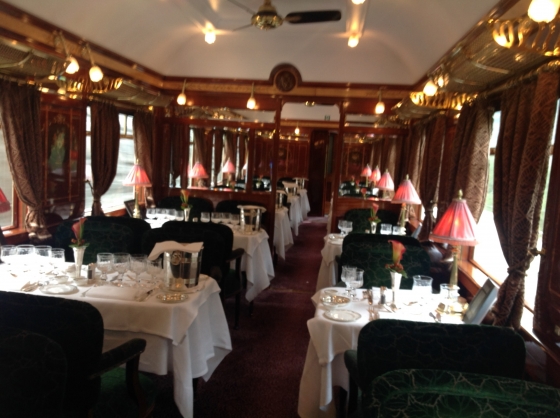
I enjoyed researching old timetables, calculating how many days, how many hours, between one beautiful capital and the next – Paris, Munich, Vienna, Budapest, Bucharest – locomotives changing at every frontier, as one national railway system handed over to another. In all, the train covered a route of more than 1,700 miles before reaching Sirkeci station in Constantinople.

Topkapi Palace was my heroine’s destination and I still retain a vivid memory of my visit there. It was one of many Ottoman palaces in the city, sultans moving their court from palace to palace, often in response to external threat. Even though I saw only a small portion of Topkapi, I was overwhelmed by its opulence and beauty.

For this book, I wanted to dig deeper, wanted to know what life was like for the women who lived there around the  turn of the century. I’d read accounts by a number of intrepid female travellers to the Orient – Lady Mary Wortley Montague, Mabel Sharman Crawford, Mary Lee Settle – and been struck that, almost to the woman, their experience ran counter to the prevailing European stereotype of Turkish women as either decadent concubines or slaves.

Women spent most of their lives within the home, it was true, but within those four walls, they had absolute sovereignty. The harem was a sacrosanct space, not just a place where women were guarded, but a place of retreat to be respected. And if they ventured outside, always with a female companion, they were treated with courtesy. It was considered a sin to stare at women in public, for instance, and if a man behaved badly towards a woman, regardless of his position or religion, he would not escape punishment.

The truth, as always, is mixed. The Ottoman Empire was both civilising and brutal. Slavery continued until the last days of the empire, yet it was time limited for the individual and could be a means of social mobility. The children of the court were much loved, but in the early days of the empire, fratricide was frequent – the Ottomans did not practice primogeniture and male relatives seen as a threat to the potential sultan could be executed or imprisoned.

Researching history complicates that first simple ‘take’ on a culture and a period, changes our perspective, makes connections. And, crucially,  illuminates our own troubled present. Worth paying attention then!
SISTER SCRIBES: KIRSTEN HESKETH ON LOCAL RADIO STARDOM

I’ve been on TV and radio a number of times.

I’ve appeared on Flog It (in a filthy temper after the runner referred to my children as my grandchildren!). I’ve had a blink-and-you-miss-it appearance in a documentary about the Docklands. I’ve even been an extra in a comedy filmed at my children’s primary school starring Keeley Hawes no less (no, we haven’t stayed in touch!)

But I’ve never been in a real studio and I’ve never done anything linked to my writing.

Until today.

The lovely Claire Dyer asked if I would like to take her place as a guest panellist on Bill Buckley’s Reading Reads on Radio Berkshire.  I was enormously flattered and said yes before I had a chance to say no because it’s miles out of my comfort zone and Claire has very big shoes to fill.

The book we were reviewing this month was Life Death and Cellos by local author Isabel Rogers. I was sent a copy and duly read it, making notes as I went and feeling ridiculously important.  The book is a treat, BTW – a real laugh-out-loud ensemble piece with a big heart.

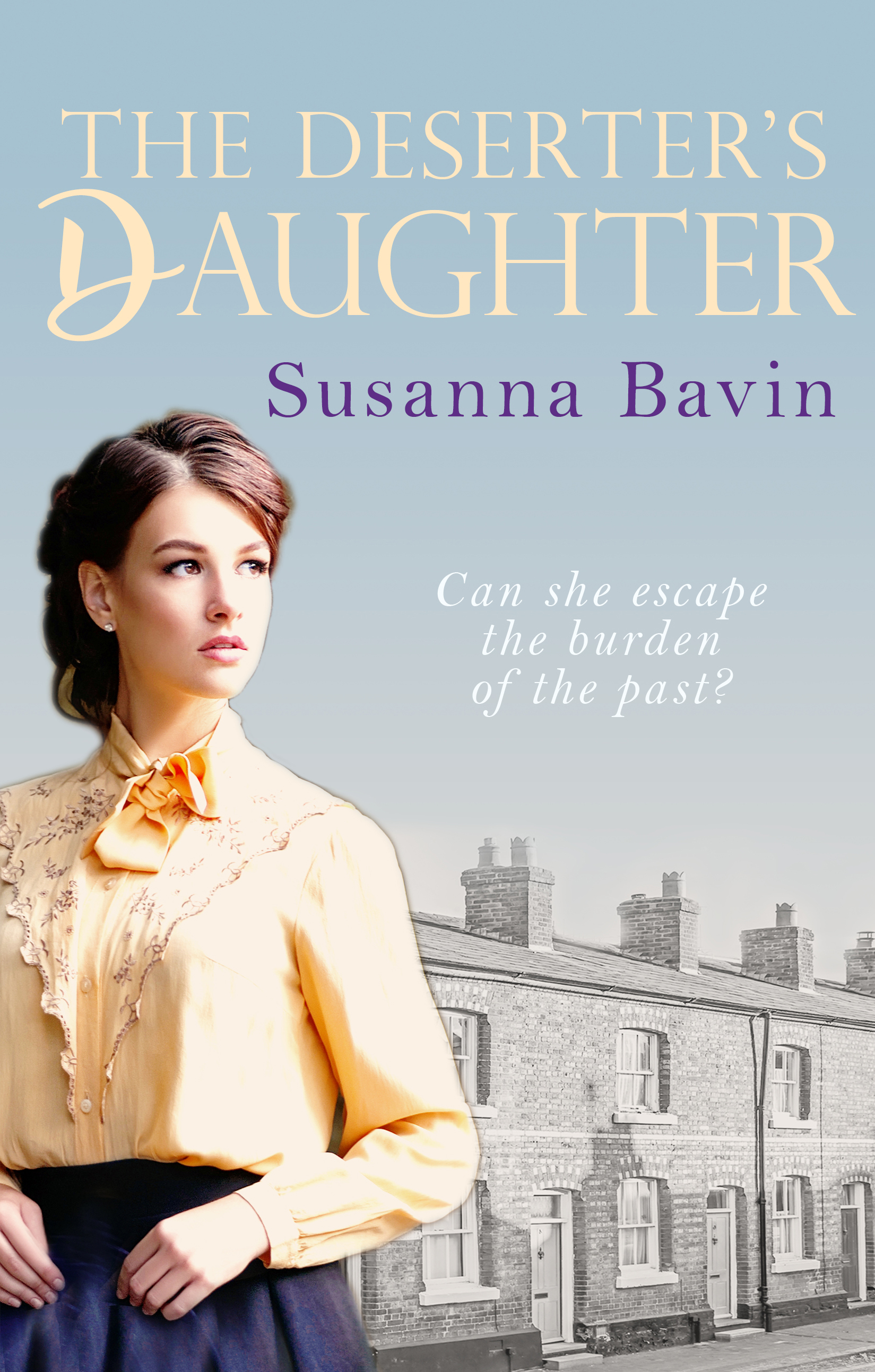
Panellists also recommend two others books and I plumped for The Girl Next Door, a taut and twisty psychological thriller by Phoebe Morgan and The Deserter’s Daughter, a saga set in 1920s Manchester by my fellow Sister Scribe Susanna Bavin.

The day itself was such an experience. To my husband’s despair and amusement, I started my day with a highly indulgent blow-dry; ‘it’s the radio, darling’.  Of course, no one took a single photo of me all day, but still; it’s how you feel about yourself that counts, isn’t it?

Radio Berkshire is set in an industrial park just outside Reading – the sort of place where your sat nav leads you to somewhere half way along a dual carriageway with no discernible building in sight. I arrived a trifle later and much more stressed than I would have like.

The regular panellist, David Barker, was already in reception and he was very kind and welcoming. He also explained exactly what to expect which was just as well because there is very little briefing or preamble; Radio Reads takes place half way through Bill Buckley’s afternoon show so you’re wheeled into the studio during a song, a few introductions and you’re off. At first I was very aware of the microphones and the production people behind the windows – they reminded me of the one-way mirrors when I am moderating focus groups, but Bill was so warm and friendly that pretty soon it just felt like a chat. There was even time, when songs were playing or the news was on, for Bill to explain his job and all the things he’s constantly juggling – like what to do when the traffic presenter went temporarily AWOL – whilst making it look oh-so-easy and effortless. It was all terrific fun and I was thrilled when Bill and David chose Susanna’s book as the book of the month.

All too soon it was over. I walked though reception on cloud nine, half expecting everyone to stand up and give David and I a rousing round of applause. Nothing. No one batted an eyelid. I switched on my phone. Daughter was feeling sick, could I pick her up from school? A reminder that I have a dentist appointment tomorrow. Husband had found a ring on the archaeological dig.

Life goes on … but what a blast!

Thank you, Claire Dyer, for the opportunity.


THE TRUTH ABOUT BULLYING – ALEXANDER WALLIS

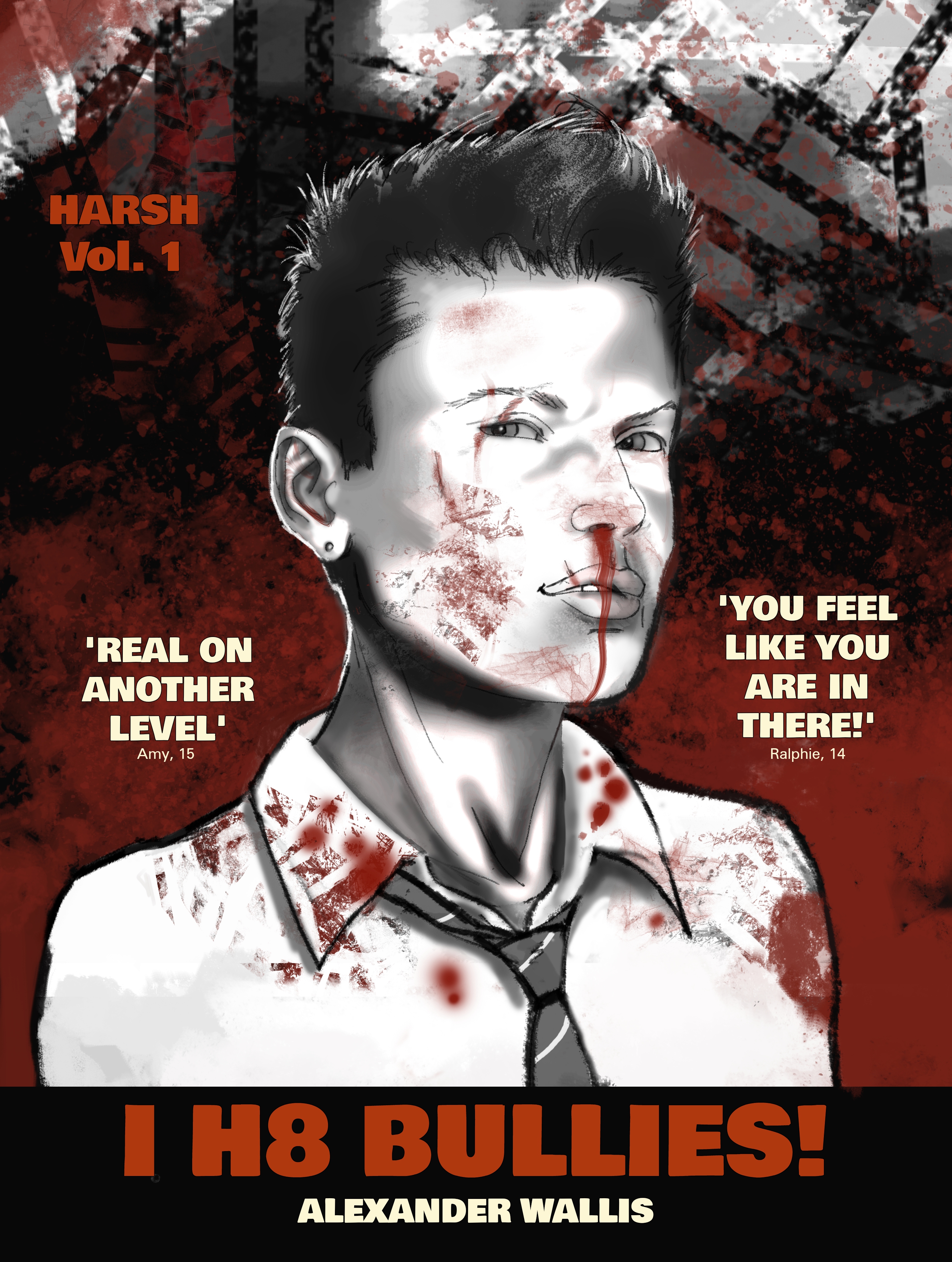
Jane Cable: Last week I received an email from an author I used to know when I lived in Chichester. I remembered him as a warm and principled man, a youth worker who’d written a fantasy book with a moral message. He’d contacted me to let me know he’d written a novel about bullying, aimed at teenagers and children. Not my normal read, but I clicked the link to I H8 Bullies anyway. Then I clicked on ‘look inside’. I read two pages and I was compelled, yes, compelled, to buy it.

It’s written from the point of view of a teenage lad in rich yet accessible language. The voice rings true. Alex’s blurb says it’s written for kids who don’t like books, and at only 66 pages short I can believe it. I also think it should be compulsory reading. Which is why I asked Alex to write this article for Frost.


The truth about bullying is that it can rarely be stopped.

The act of undermining others is a survival strategy – however maladaptive – which feeds vampiric ego at the target’s cost. Its excesses are applauded by those who don’t want to be next in the firing line and whose silence (or laughter) serve to timidly collude. Organisations enable rather than contain its flourishing, hierarchical lines supporting those who narcissistically abuse their power.

Nowhere can bullying be better studied than in a school, where adolescence stirs thicker the drama and thinner the consequences. A fully-stocked armoury is available to the teenager who bullies, from opportunity to physically aggress (within the relatively less punitive micro-society of the school discipline system), to ample places to regularly do it and the chance to capture and further torment on social media.

School anti-bullying programmes lean towards ‘awareness raising’, as if this phenomena is not already deeply understood. Since Goliath took up against David, humans have recognised that superior size, privilege or opportunity presents the risk of some throwing their weight around more than they should.

Interviewing students helped me to better understand the experience from the target’s view. Bullying somehow forces an intense self-examination, our own inner critic immediately jumping ship to add to the gang of detractors. Targeted students were not just conscious of the way they looked, but made to think deliberately of how they walked or talked. Thrown into a deep self-critique which often stemmed from an already sensitive and self-conscious life position.

When I began writing I H8 Bullies, my thoughts were initially on my own school experience, decades earlier. Old school bullying more often took the form of a thump to the ear, a pounding by some bigger boys (which we had sometimes provoked) and, at worst, the wave of a penknife.

Bullying feels more enduring and emotionally damaging now. Social media provides means to shame a person that is only limited by the imagination and which can endure long beyond the school bell. It can follow a person from place to place, preserving images better forgotten.

Sometimes the only factor under a target’s control is how they themselves react (or don’t). The quiet dignity of preserving your own values, even if you are still discovering for yourself what you think and feel. Bullying can rarely be stopped but it can be survived. It is about winning the battle within, and that is what the story of I H8 Bullies is all about.

Alexander Wallis is a youth worker for Sussex Against Bullying and the author of I H8 Bullies.


SISTER SCRIBES: KITTY WILSON ON PLANNING… OR NOT

Hello, it’s my turn again on the Sister Scribes and I thought seeing as I wrote about the structural editing last time, today I would go backwards and talk about how I begin a brand-new book.

The writing world is often divided into pantsters and planners, with a whole sliding scale in between. Pantsters are those writers that pick up a pen, or open the keyboard, and then just write into the void. I love doing this. It’s so exciting and you start the day never knowing exactly where the characters will take you. Whilst the start can be immediate and the writing often flows, the editing process is a lot longer as you tighten up the plot, ensure character continuity and fill any gaping holes that you didn’t notice whilst sprinting along.

Planning involves a lot more work before you start putting words on the page, you flesh out your characters, decide their strengths and weaknesses and become familiar with them and their back stories, plan the plot within an inch of its life so you don’t have massive rewrites to do later and know exactly what is happening where.

The very first book I ever wrote (unpublished), I did by pantstering. At that point I didn’t know if I could write anything other than academic essays and job applications, so was unsure as to whether a whole book was even possible. It didn’t cross my mind to plan, I started with an anecdote and went from there. It was so much fun! I also hit writers block, more so than any time since. I would write my characters into a corner and then have no idea how to get them out. I would sit at the laptop and try and write anything at all and see if it worked. I would then decide it was all rubbish and binge watch crime shows instead.

I now know this is actually standard operating procedure, and I spend the entire length of a book, from the first fifteen thousand words until the reviews come in, absolutely hating it, declaring it’s the worst book in the world and should never be allowed to see the light of day. My family are struggling to remain sympathetic, although have learnt the phrase ‘but you thought that about the last one’ is likely to initiate threats about eye-gouging (my favourite threat and absolute stand by).

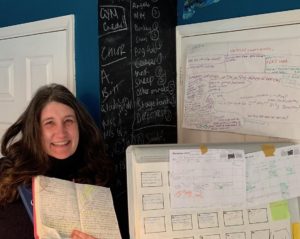
These days, with tight deadlines and a determination to do as little structural editing as necessary, I am a converted planner. I start with an inkling of who the characters are going to be, their dominant personality traits and their flaws. Writing a series means that I tend to have mentioned them in previous books so take my cue from that. Then comes the stationary. I have a chalk wall, a great big whiteboard, notebooks galore and every colour post-it note pad imaginable. I draw diagrams, story maps and make swirly messes on huge sheets of paper with coloured felt-tips. I print out calendars and plan a timeline. I work out my beginning, my end and think about exciting middle bits and then take a deep breath before drawing out chapter plans, because I know if I have detailed chapter plans then writing will be an absolute breeze.

But then my butterfly mind kicks in, I look at all the bits and pieces surrounding me and think sod it and start to type.

I am a committed planner with a pantster heart. I write romantic comedy where we all know, heart wins every time.

SISTER SCRIBES: CASS GRAFTON ON WHY IT’S GOOD TO TALK

Recently, I was on a writing retreat – one that lived up to its name, being only accessible by boat at high tide (or after a hike through the woods from the nearest village). Hosted by Kath Morgan and Jane Moss of The Writing Retreat, the theme was simply ‘Time to Write’, which we had in abundance.

There were only 6 of us, and we soon developed our favourite spots for contemplation and scribing: at the wooden table by the creek, in the large window seat in the sitting room or even on the pontoon jutting out into the river.

I wrote in my room during the day, either in my own window seat with its fabulous water views or at the desk I’d tugged into place between the window and the extremely large bed (known as Robert Plant’s bed – long story, but there’s also a recording studio under the main house)!

Despite the obvious benefits of a retreat – that longed-for chance to focus on nothing but writing, allowing your mind to wander, your characters to fully take hold of you and the story in a way they often can’t when you’re surrounded by the minutiae of daily life – I was able to indulge in something else: time to talk, not only with fellow writers (usually over the yummy lunches and dinners) but also during one-to-one sessions with Kath or Jane.

These sessions brought answers to dilemmas I’d spent months battling with: what’s my hook; how do I finish this book that’s been almost done for months; what do I write next? Talking it through, being heard, was all it took for solutions to come, often prompted by the tutors’ insights. I left every one-to-one on a high, inspired and raring to get back to the writing.

This hasn’t been my only chance to talk face-to-face with other writers, of course. Aside from get-togethers with my fellow Sister Scribes, I’ve been co-writing with Ada Bright (for her guest post on being an author, see link below) for years, and despite the thousands of miles and 9-hour time difference separating us, we talk when writing 3 or 4 times a week. We discuss plot, why a character is behaving in such a way, battle out the things we’re struggling with, and we laugh. There’s a lot of laughter!

Do you begin to see the benefit of the talking? Writing can be such a solitary profession. Things go round and round in your head, we hit stumbling blocks, trip over our own words, lose faith, regain it, sometimes question whether we love what we’re doing, whether we should even continue.

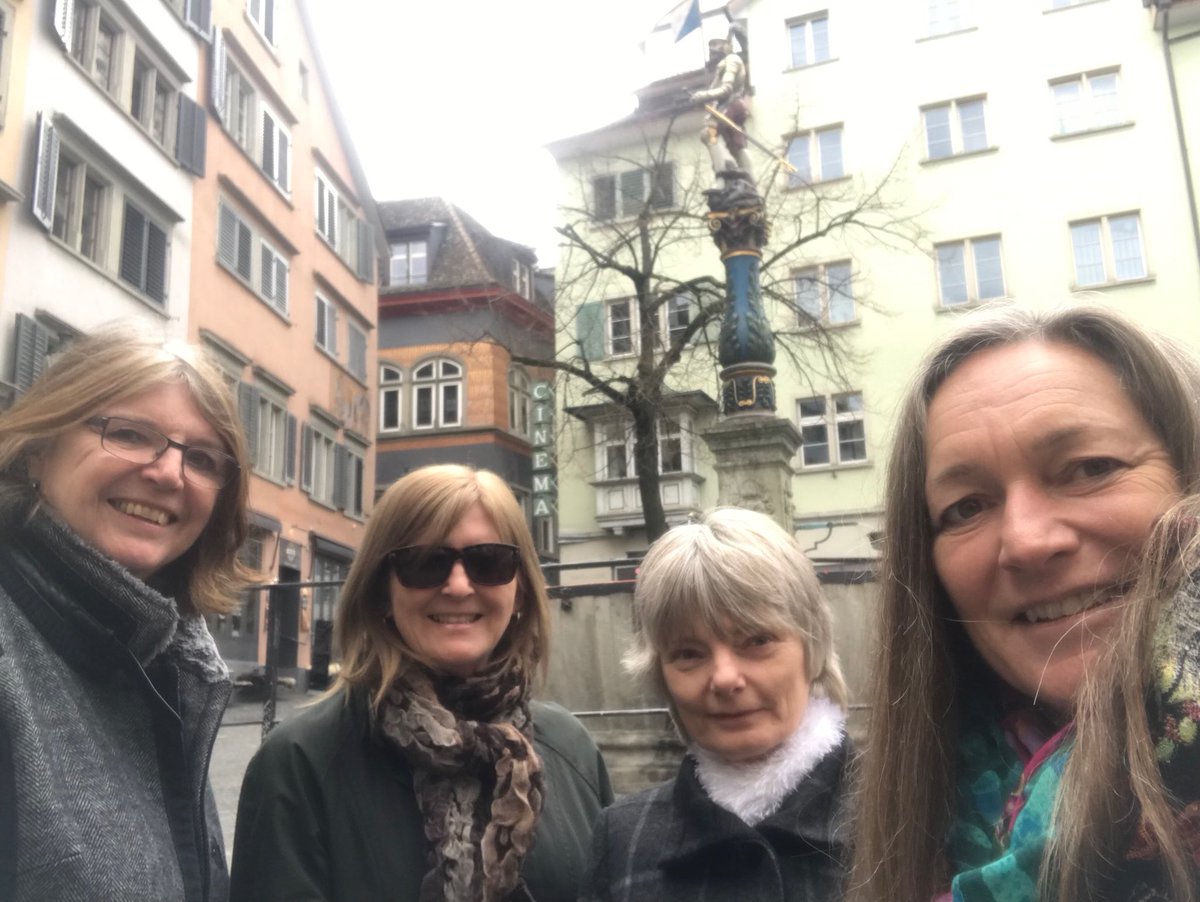
Living in Switzerland, as I do, can also be isolating – I can’t meet up with my Sister Scribes as often as I’d like – so imagine my delight when I connected with 3 other British writers who regularly meet up for ‘writerly lunches’! They all pen fabulous psychological suspense novels, with Louise Mangos (@LouiseMangos) published by HQ Digital, Alison Baillie (@alisonbailliex) by Bloodhound Books and Linda Huber (@LindaHuber19), who has a wide portfolio, by Bloodhound Books and their imprint, Bombshell Books. She also writes light romance novels under the name of Melinda Huber.

Aside from lunch and laughter, we share our thoughts and feelings on the sort of things writers value talking about: practical experiences, both in writing and publishing, our ups and downs, our current challenges and our plans for ‘what next’. Oh yes, and there’s the odd glass of Prosecco too!

So write and enjoy it. Embrace it, but if you get the chance, talk to other writers, preferably face to face. You won’t regret it!


Find out more about my retreat venue at https://thewritingretreat.co.uk.


A PUBLISHER’S YEAR: APRIL – AWARDS, AGENTS, SERIES

We have been very busy at Sapere Books in March and April. At the beginning of March, Catherine Isaacs was announced as the winner of the Romantic Novelists’ Association Popular Fiction Award, which we sponsored, for her absolutely brilliant novel, YOU ME EVERYTHING. We were thrilled to be involved with the award and we have agreed to sponsor it for at least two more years.

A week later we were at London Book Fair, catching up with all of the literary agents we currently work with and meeting with plenty of new ones to discuss what we are looking for. I can’t reveal the outcomes just yet, but we mentioned that we were looking for nautical fiction to one agent and she told us she has an author who has planned a 20-book series of naval thrillers! She is currently discussing the offer with the author, so fingers crossed we will be announcing our first nautical fiction writer very soon!

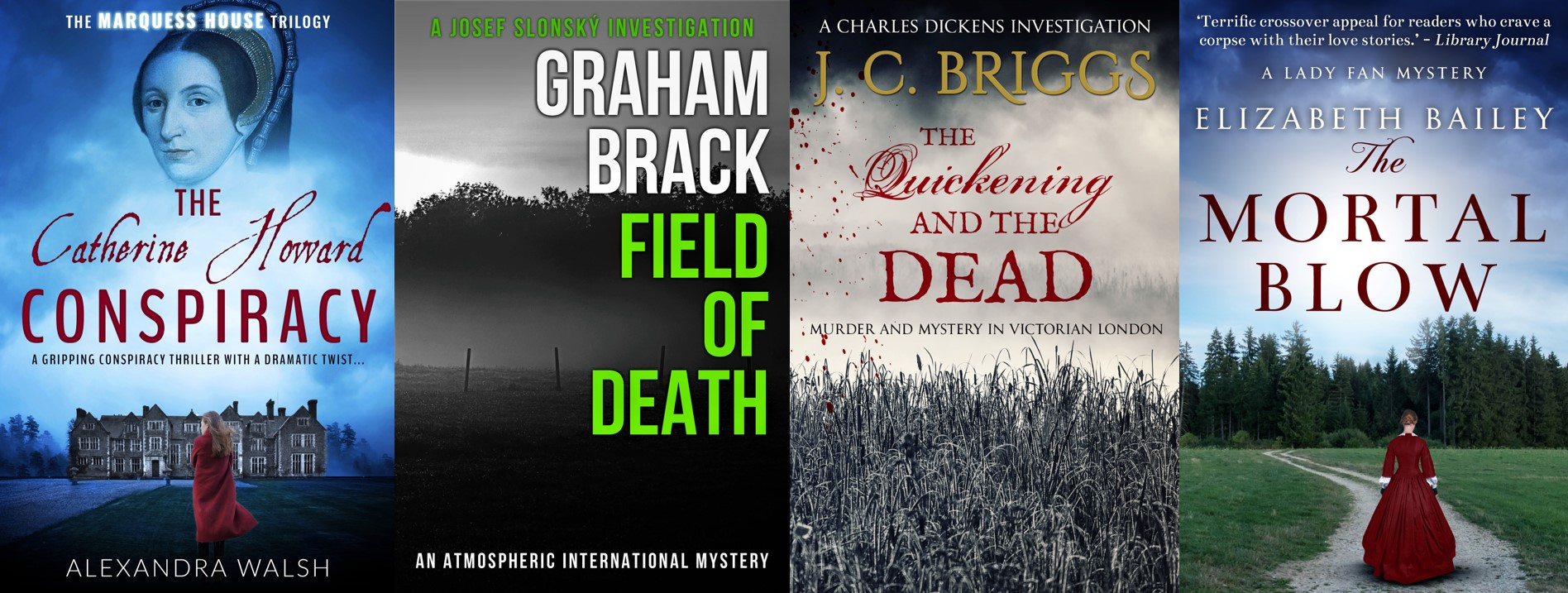
March saw the release of Alexandra Walsh’s debut thriller, THE CATHERINE HOWARD CONSPIRACY, which has been racing up the charts, as well as the fourth book in Graham Brack’s Josef Slonsky series – FIELD OF DEATH – which readers have completely fallen in love with. April also saw the release of new titles in two more of our most popular series: The Lady Fan Mysteries by Elizabeth Bailey and The Charles Dickens Investigations Series by J C Briggs.

We are preparing lots of fantastic titles for release over the summer, and we have realised that we do not have as many contemporary romantic fiction titles as we do crime and thriller, so we are about to start scouting for romance authors who are writing heart-warming British-set romances, which have the potential to become three or more book series – in the style of Debbie Johnson’s ‘Comfort Food Café’ series and Hannah Ellis’s ‘Hope Cove’ series.

Our most exciting news for April is that we have just officially offered someone our Editorial Assistant job and she accepted! I can’t give any more details just yet, but in next month’s blog post I will be able to introduce her properly!

Amy Durant

SISTER SCRIBES: APRIL READING ROUND UP

Susanna:

Have you ever read a book that was so good that, while you looked forward to reading more by the same author, at the same time you couldn’t help feeling a bit wary of doing so – you know, in case the next book didn’t live up to expectations..? For me, psychological thriller writer Linda Huber is one of these writers. Since reading The Cold Cold Sea, I’ve never been able to open another of her books without that little iffy moment of wariness.

Linda Huber’s strength lies in her ability to build a creepy atmosphere that creates a thread that runs throughout each book, growing stronger the further you get into the plot. Her latest book, Stolen Sister, is billed as a ‘gripping family drama,’ but it is much more than this. It is a well-crafted, psychologically complex story that is fueled by strong characterisation. It is a chilling tale of ordinary people in what they gradually realise is an extraordinary situation and I wanted to reach inside the story and tell them what was really going on. A thoroughly gripping read.


Jane:

The first of my holiday reads followed me around for a while after I’d finished it – always a sign of a great book as far I as was concerned.

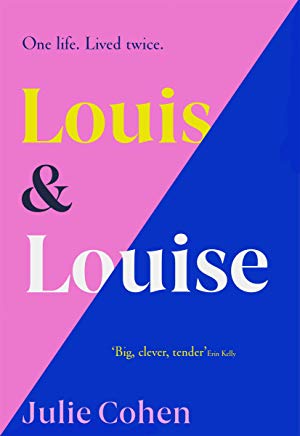
I was absolutely fascinated by the premise of Julie Cohen’s Louis and Louise; one life lived twice in a different gender. As well as being a satisfying story it made me think long and hard about gender identity and how it is shaped from childhood and the choices we make – often unwittingly – because of it.

Julie Cohen is a great storyteller and the small town in Maine where most of the book is set came to life in her skilled hands. It takes Louis and Louise from birth until their early thirties, flashing between the present and the defining moments of their childhoods. I found their relationship with their twin friends (a boy and a girl) echoed their own gender identities beautifully.

One thing that jarred a little was the few paragraphs – one quite early on – where the author ‘stepped in’ and explained to the reader what was happening and this really wasn’t necessary.  To me it smacked of over zealous editing on the part of the publisher and was quite annoying being treated like an idiot. Otherwise a great book I’d thoroughly recommend.

Also on holiday I struggled through Jane Austen’s Sense and Sensibility (sorry Cass!), mainly for research purposes, and read Angela Barton’s Magnolia House. This romance has received a ton of five star reviews and tells the story of Rowan, whose life spins apart just after she moves to London and how her new housemates and old friends help her to pull it back together.

But my most amazing holiday read of all was Madeleine Bunting’s Island Song. I’m a fussy reader at the best of times, but this marvellous novel drew me in right at the beginning and held me there until the end. The writing is so natural, so clever, I don’t even really know why it is so effective, but it carried me into a world of wartime Guernsey and 1990s London I was reluctant to leave.

The premise is not an original one; mysterious mother dies leaving daughter to uncover the truth about her life, but the richness of the storytelling and the layers of complexity made it an absolute joy to read. Easily my book of the year so far and I recommend it without reservation.


SISTER SCRIBES GUEST: R L FEARNLEY ON ELVES, ENCHANTMENTS AND EMANCIPATION

Becci is a sister scribe from Reading Writers  – as well as being on the committee together and going to  the regular meetings, we like to write together in local cafés. She writes under the name R.L. Fearnley and is a fantasy poet and novelist, performing her poetry all across the country and delivering creative writing workshops in a variety of settings. Her poetry collection, ‘Octopus Medicine’ was published under ‘Becci Louise’ by Two Rivers Press in 2017. She is working on her first novel.

Lonely children love other worlds. I know this because I was a lonely child. I found solace in alternative landscapes filled with dragons, wizards and magic. The idea of riding on the back of a fire-breathing monster was one of the few things that made me feel powerful. I loved the stories of dragon-riding heroes and farm-boys-turned-champions. It made me feel that anyone, no matter how humble and invisible, could have the potential for more. I devoured these stories with gusto; Christopher Paolini’s ‘Eragon’ was a favourite, as was J.R.R. Tolkein’s ‘The Hobbit’ and C.S. Lewis’ ‘Chronicles of Narnia’. Of course, I wrote my own stories too. Looking back on them now, I see a fatal flaw that I was, perhaps, too young or too socially conditioned to see.

Where are all the women in fantasy stories?

To be fair, they are there. You see them in the flowing golden locks of Tolkein’s Galadriel, the serious and distant personality of Paolini’s Aryen and Lewis’ stuck-up, lipstick-loving Susan, where liking make-up is apparently reason enough to get you thrown out of Narnia. Women in fantasy when I was growing up all seemed to look the same. You knew you were reading a ‘strong, fantastical female’ if she:

  • Was an elf of some description
  • Had almond-shaped eyes (whatever that means)
  • Had high cheek bones
  • Had full lips
  • Had ‘ivory skin’ (looked dead or never saw sunlight)
  • Had long flowing hair, usually black or blonde.

Normally, she was tall, aloof and had no sense of humour. She was ferocious with a sword but devoid of personality. She was almost always the motive for action or the trophy at the end of it. She was, actually, quite boring.

I notice, from my early teenage attempts to write fantasy stories, that all the ones with female protagonists were unfinished. I just couldn’t seem to write them. I thought, in my youth, that it was because I liked doing ‘boy stuff’, like climbing trees and hunting insects, so of course I empathised with male characters more. Now, I think I just read very few fantasy narratives in which women were written as if they were real people.

Fortunately, a recent flurry of phenomenal female fantasy writers is challenging this trend. Jen Williams’ brilliant ‘Copper Cat’ trilogy has a fierce, humorous central female character who knows what she wants and goes out to get it. N.K. Jemisin’s stunning ‘Broken Earth’ Trilogy is populated with female characters displaying the range of human strength and vice, and her female characters are almost exclusively of colour (another thing you rarely see in fantasy!) Naomi Novik’s brilliant protagonist in ‘Uprooted’, who’s growth is joyous to witness, also pushes female-centred fantasy to new heights. And I find, suddenly, that I have plenty of inspiration. I no longer read books where I, a woman, am irrelevant. I realise that I don’t have to write ‘women’ in my stories, I just have to write ‘people’. It should not be a revelation to see that these two things are not mutually exclusive. After all, in worlds where anything is possible, why can’t the quiet, plain girl at the back of the class be the one who takes up the sword and slays the troll?