All is not Forgotten by Wendy Walker Book Review

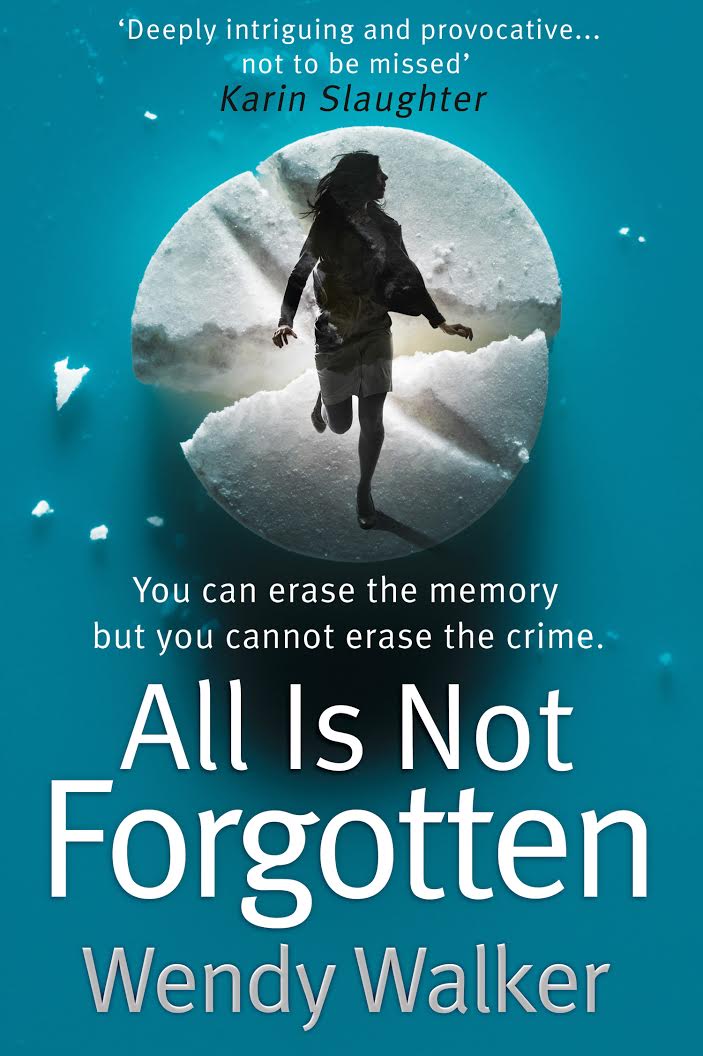
All is not Forgotten by Wendy Walker.
All is not Forgotten landed on my desk along with others. Flipping through the pile this debut psychological thriller intrigued me. It’s not usually a book I would read. I can’t bear violence towards children, for Jenny is one, though I suppose in fact she is a youth. She is 15, so a youth, but really as are they all, a vulnerable child.

I couldn’t put it down.

Wendy Walker has created a fascinating concept that explores memory and what you would be willing to do to protect your child.

Jenny is attacked, raped, horribly. Her parents agree to an experimental treatment that wipes the mind, enabling her to move on with her life. But does she? Can this really work?

She has a scar on her back, and instead of being haunted by the memory of an event, she is instead tormented by an unknown fear.

This is perhaps why it intrigued me. One of my own children had to undergo massive painful surgery at the age of one. The consultant said that because of his age my son had no understanding of the pain and distress of the event, and would forget the actual incident. But for many years, his dominant emotion to any situation would be an intense fear. And so it was. It breaks my heart even now to think of it.

The unknown for Jenny is worsened by the knowledge of a violation. But what?

And where is justice? Her father is obsessed with finding her attacker and her mother is in denial.

The decision is made to take Jenny back into her memories. But even if it can be done, will pulling at the threads of her suppressed experience reveal more than intended. Where is the healing then?

Well written, thought provoking at a profound level. A triumph, but it won’t be a novel that you can forget, so be prepared. And to try and decide what decision you would make.

The only problem for Wendy Walker is what to write now.

Let me know your thoughts on the book at frost@margaret-graham.com

Film rights have been pre-empted by Warner Bros, with Reese Witherspoon set to produce.

Published by Harlequin on 14th July. £12.99

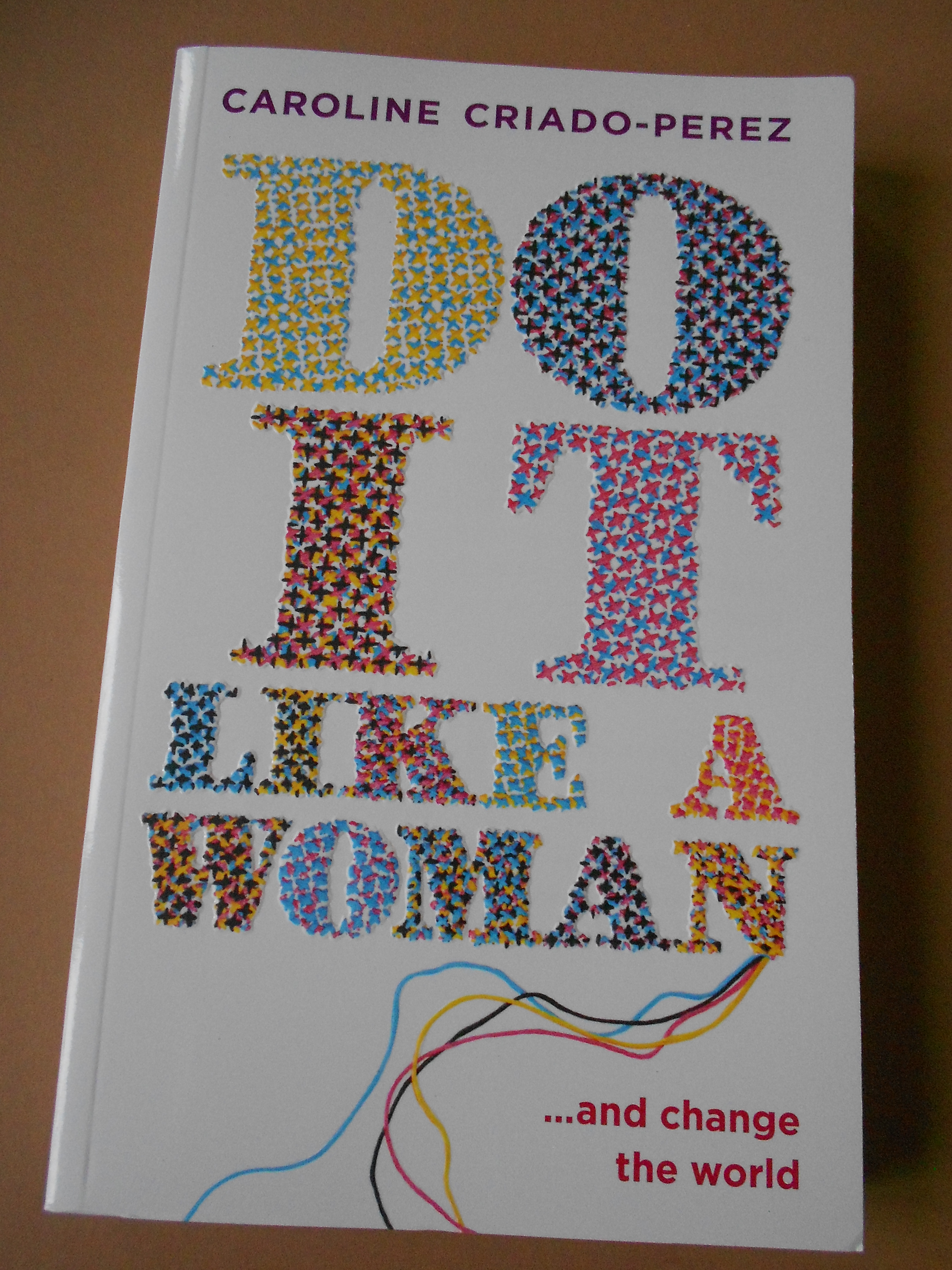
Do It Like A Woman by Caroline Criado-Perez

Do-it-like-a-woman-Caroline_Criado-Perez

Do It Like A Woman …and change the world by Caroline Criado-Perez

Doing anything like a woman used to mean being a bit rubbish.

No longer. Now, as the women in this book prove, it means being brave, thinking differently, speaking out, standing up, taking a risk, fighting back, dreaming big, and being more than a bit amazing.

Every day, all around the world, women are reinventing what it means to be female in cultures where power, privilege or basic freedoms are all too often acquainted with being male.

From physical strength to having a voice and being heard, women are still being overlooked and even dismissed. I still find it hard to believe that women not only have to fight to be heard but that the fight is not over. Many of the older generation will remember when things were much worse in the UK and USA and we have come a long way over the years but women in others countries are not so fortunate. FGM is one topic covered and the graphic description and potential side effects suffered by young girls made me grit my teeth as I was reading it – and sadly, women continue to be the perpetrators which I find baffling.

The book contains examples of women challenging various boundaries on a day to day basis which differs from country to country. Speaking out, not keeping silent, putting your head above the parapet can be traumatising and draining but it has to be done. Criado-Perez tells of the consequences.

We could, in the next few weeks, see leaders of both Conservative and Labour parties,  and we already have female first ministers of Scotland and Northern  Ireland. It will be interesting to notice how the general reaction differs as to when Margaret Thatcher came to power in 1979. I remember many males objecting to being told what to do by a woman. I think there will be fewer protestations now, it is much more common to have women leading companies and businesses.

One quote that stood out for me, as women continue to work harder for equal recognition was the following:

‘I am reminded of the aphorism that we will have equality when there are as many mediocre women at the top as there are mediocre men. ‘

Quite.

www.portobellobooks.com

www.carolinecriadoperez.com

Short Story Author embarks on “World’s Most Insane” Writing Marathon


In March author Tim Austin began a “Brilliantly Insane” project: to write a brand new 100 word short story every single day for 365 days.  It has since been viewed thousands of times by readers from across the globe – from Sri Lanka to Canada, India and Australia.

With just under 300 more days to go, we talk to Tim about the project, celebrity contributors and what writing fiction means to him.

What is One Word, One Story?

It’s a project where members of the public suggest single words and I use those words as titles for flash fiction short stories.  I read each word, an image forms in my mind and I take that image as inspiration for what I write.  I never, ever know what’s going to come next!  And I’m writing a new story every day for a year over at onewordonestory.org.

It sounds crazy.  What made you do it?

A friend of mine suggested the notion of word association as a way of exploring my imagination and practicing my writing.  I started doing that as a hobby.  At first it was single paragraphs but I enjoyed it so much that I turned it into entire short stories.  Taking it public and doing it every day for a year seemed like a fun next step.

You have a strange idea of fun,….

Haha!  I enjoy taking things too far and I like a challenge.  I think this counts for both.

Why just a hundred words?

I wanted to create something that people could read on the go.  People have little time if they’re on a lunch break or travelling to work and I wanted to write something bite-sized that they could enjoy.  Maybe read two or three in a go.  The other reason was the challenge of condensing a whole narrative into so few words – it really makes every word count.  It’s very pure and I like that very much.

Where did the idea of approaching other authors and celebrities come in?

Yeech, I hate the word “celebrities”!  It sounds so contrived and pat.  I want everyone to be able to suggest words and titles but I thought it’d be fun to approach a few writers and actors I admire.  I’ve been honoured that many of them have been kind enough to donate words.

Such as?

Danny John-Jules (“Cat” in the Sci-Fi classic “Red Dwarf”) suggested “SmegForBrains”.  I’ve also had suggestions from screen writers and authors including Mike Wells, Jonathan Maberry, Eddie Robson (Doctor Who) and Robert Shearman (also Doctor Who – writer of the acclaimed Season One story “Dalek”).  I’m keeping quiet about future contributors.  But I’m always asking.  And I’m always looking for new words – anyone can suggest their own.  Hint.

Did you expect it to become this popular?

To be honest, I thought it’d get a couple of hits a day.  I started the site as a hobby, after all.  But within two weeks I was getting hundreds of visitors a day and thousands of hits a month.  It’s been wonderful to connect with people and hear that they’ve enjoyed each story.  That’s been the greatest pleasure.

You can read, contribute to and support Tim’s One Word, One Story project over at onewordonestory.org now.


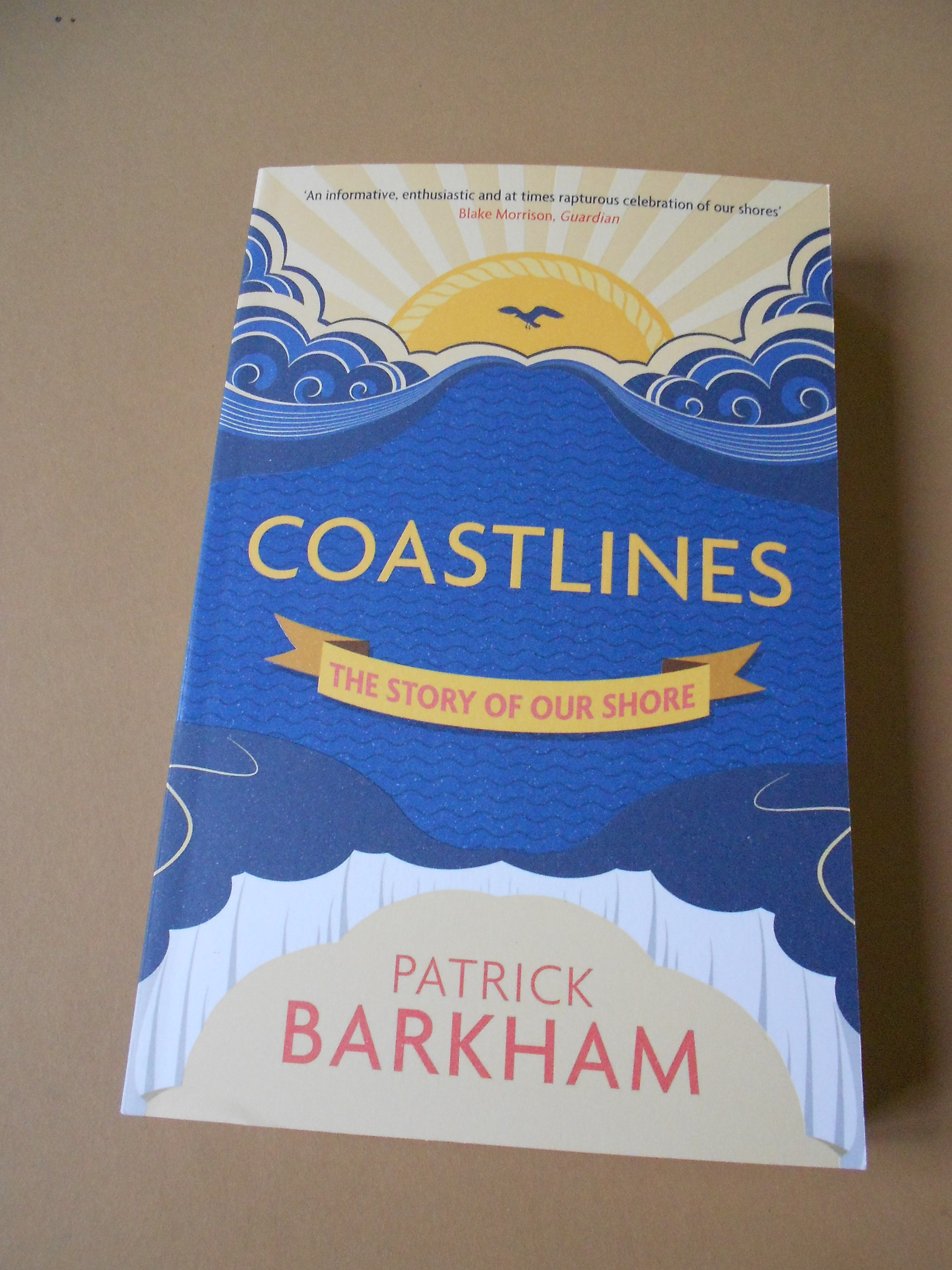
Coastlines:The Story of Our Shore by Patrick Barkham

Coastlines_Patrick-Barkham

Coastlines: The story of our shore is a portrait of the British coastline from the Giant’s Causeway to Land’s End.

Told through a series of walks beside the sea, this is the story of the most beautiful 742 miles of coastline in England, Wales and Northern Ireland – its rocks, plants and animal, its views, walks and history – and of us, the people of this island nation, shaped by our shore.

Barkham  explores land that is protected by Enterprise Neptune, the National Trust’s maritime section which was launched in 1965 to protect our national coastlines. Scotland does not feature as it has its own National Trust but it would be great to know that a second volume will follow.

This is the perfect read if you are planning a break or a day out in the UK. However,  if you are sofa bound you will still enjoy the vivid description and various anecdotes that Barkham recounts on his journey.  I laughed at tales of the formidable Mrs Christie of Brownsea Island in Dorset  and smiled at Norrie Dougan walking down the street with Elvis in Strangford Lough. His beautiful, tightly observed descriptions made me want to seek out new areas of coastline and revisit those of my childhood.

Each page is packed with tales of curious places, and curious characters.  It’s not simply a book of walks but contains stories of the people and past that shaped our country, those times of war and peace that have left their marks upon this beautiful land. The chapters cover Art, Faith, Work and Childhood among many others; looking back to the past and forward to the future, and the steps that are being taken to preserve our shores.

I enjoyed discovering the history and heritage of each location as well as the author’s own experience of it and made many notes of places to check out  and explore. There is plenty of information on relevant websites, nearest railway stations and OS map coordinates if you should care to visit yourself.

A book to dip in and out of  whenever the fancy takes you.


Breaking news – Granny Power reigns By Margaret Graham


Today we begin our Gransthread, a column which will be a regular feature on Frost from now on.  So let’s start with what comprises the stupid selfish old biddies as someone recently labeled grannies.


We might have been born during the 2nd World War in which our parents fought, or during austerity – with rationing lasting until the mid 50s. As children we were always hungry as the country determined to get back on its feet and begin recovery after our efforts to defend our essential sovereignty and democracy.


At school we were often taught by spinsters who had lost their men in the first or second world war. At home and at school we were taught to put ‘self’ to the rear and make sure that others were alright.


We lived beneath the cloud of the cold war and Armageddon, and some husbands were there, deep in the sea or up in the sky, defending us all over again.
We screamed at Beatles concerts. The pill arrived, along with the hippy revolution. We wore flowers in our hair, and kaftans, and loved wisely we thought, but probably not. We debated politics, and were always aware of world affairs.


We endured the IRA bombing campaign. We saved for things we needed because credit cards – ‘take the waiting out of wanting’ had not yet arrived. We wives couldn’t access our joint bank accounts into which our salaries went, without a letter from our husbands, even as late as the end of the 60s.


In a referendum in 1975 the UK electorate voted to stay in the EEC under renegotiated terms of entry. We trotted through Heath’s 3 day week,


We set up house. We sewed and knitted, because it was cheaper to make our children’s clothes. Some of us worked, or helped out with the childcare of our friends. We began to understand our parents as people, because we were tackling a changing world as indeed they had and were. We listened to their advice.


We became grandparents, and wondered about social media, its benefits and anonymous bullying. We resumed childcare, this time for our grandchildren, and parent care, for our own parents.  We downsized to help with children’s house   deposits, we handed over interest free loans.


We kept fit, ran marathons, set up and ran charities. Many of us continue to work, but as well we volunteer: charity shops, drop in centres. We keep helping, even when our 87 year old colleague is punched in the face by an irate shoplifter. We mop up the changing rooms which have, yet again,  been used as latrines.


We realize we have become invisible through age, as people in streets expect us to move to accommodate their passage. We are learning to stand our ground.


We used to stand on crowded trains while younger people sat but we increasingly force our way past spread legs to claim a seat.


We continue to follow politics. We respect the opinions of others, and expect that ours will be respected in turn.


And, most importantly, we laugh, and eat cake, or have a glass with our friends even when we our waists tell us we shouldn’t. We have dogs we walk, and make full use of our bus passes while we have them. We live every day to the full.


Grannies of all ages, and some are very young, are people. We are as difficult, as pleasant, and as inspiring as everyone else, plus we have with a distillation of experience which could be termed wisdom.


What’s more, we’ve reached the age where we feel we’ve earned our place in the world, so we’re not moving over just so others can diminish or walk through us.


Flower power? Forget it. Granny power reigns.


* We will be featuring Gransthread lives and thoughts and memories as the months go by. If you have any that you would like to share, Frost Magazine would love to hear from you:   frost@margaret-graham.com



My Local Temple Time by Alex Bannard Bangkok Correspondent

A bicycle ride to a local temple provides the perfect respite from modern day annoyances for Alex.

My local temple time by Alex Bannard Bangkok Correspondent 1

I have a friend who is a practicing Buddhist. It has helped her through some traumatic times and she shares the benefits, techniques and insights of shamatha with me and a few others in a weekly meditation class. I love it. I find the style of meditation too prescriptive sometimes, but to spend 2 hours every week consciously coming back to oneself, focusing on the breathe, the senses or emotions before allowing the mind some freedom to just be is simply liberating. I have yet to encounter one of those life changing insights and feel a long way from enlightenment but I really believe in the therapeutic benefits of meditation and mindfulness. 


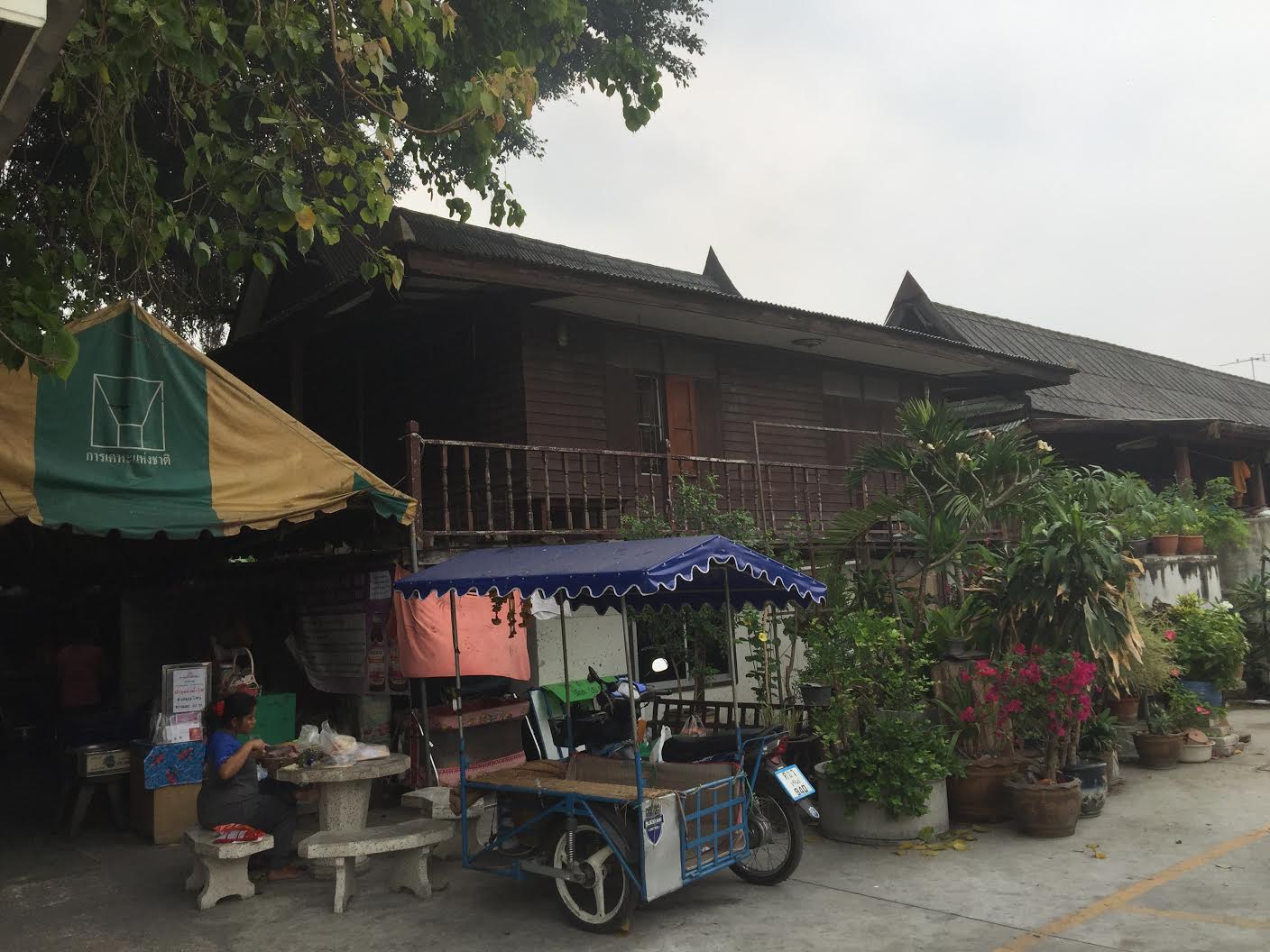
When we first met we agreed we would head off on our bikes to explore a local temple. Of course life takes over and the months went by and then suddenly opportunity presented itself and off we headed. We came out of our Moobaan and snuck through a little entrance, carrying our bikes along a mud path scattered with litter alongside an algae and no doubt mosquito-infested swamp with wooden and corrugated iron roofed shacks perched on its banks. I knew this was going to be fun.


 You see living as we do in a gated community alongside other Farang and the more affluent of Thai society with housekeeper and driver assisting to our daily needs it is easy to forget the real side of Thailand. As we cycled along the path alongside the stinking Klong (canal) you cannot escape it. And I love that. It makes life here so much more real. Because for the vast majority in Thailand life is dirty, gritty and hard. Many people even in Bangkok live in small wooden huts some on stilts others alongside main roads, under over-passes, alongside the waterways. You cannot escape their lives as you pass: 3 generations hunched over noodle soup on wooden stools having their lunch with the TV blaring. 

My local temple time by Alex Bannard Bangkok Correspondent 2

In other homes, women swing in their hammocks and nod or cheerfully say ‘Sawadee’ with bare-footed children scampering at their feet. Because that’s the other thing, the Thais are extremely friendly and very non judgemental. They are fascinated, especially the kids, to see 2 Farang on their bikes, teetering along the narrow path alongside the Klong. Seeing the waterway underneath swimming with plastic bottles and other rubbish it crossed my mind that we are only months away from what is being forecast as the wettest rainy season in decades. How many of these homes resting so precariously close to the water’s edge would be washed away in the floods? It is ironic, that the country is in the depths of drought and on the back of the hottest summer for years, and this monsoon season people’s livesare likely to be destroyed by the water they so badly desire.


As we came off the path and cycled along the back streets, the houses became more substantial, some were concrete rather than wood. There were even cars parked outside some and gardens. And it is obvious the pride people have in their homes keeping despite the poverty. We cycled through a Muslim area and passed the school which was based in the mosque. We cycled further along the Klong, carrying our bikes up the steps and over the bridges until we came to the temple complex.


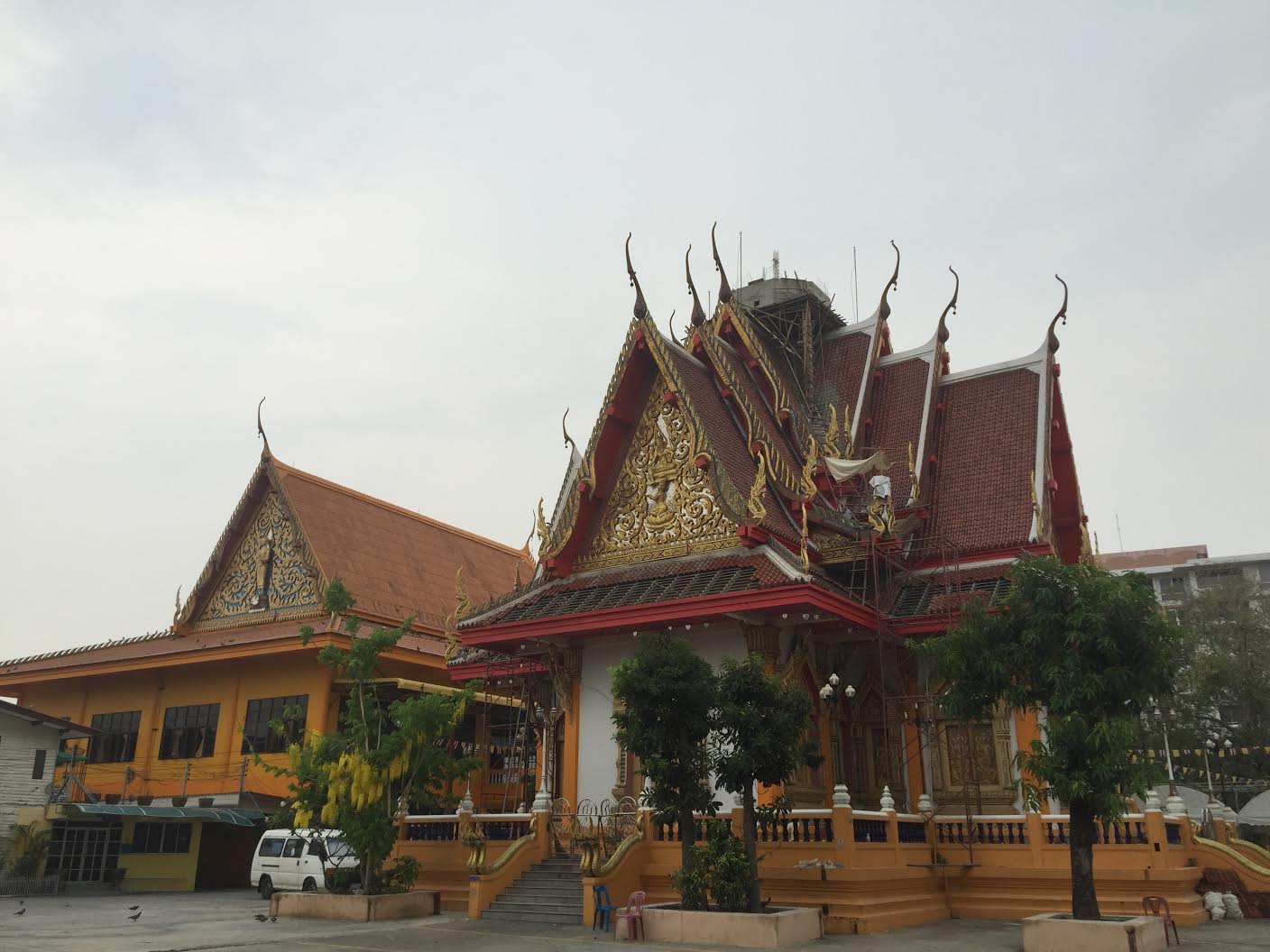
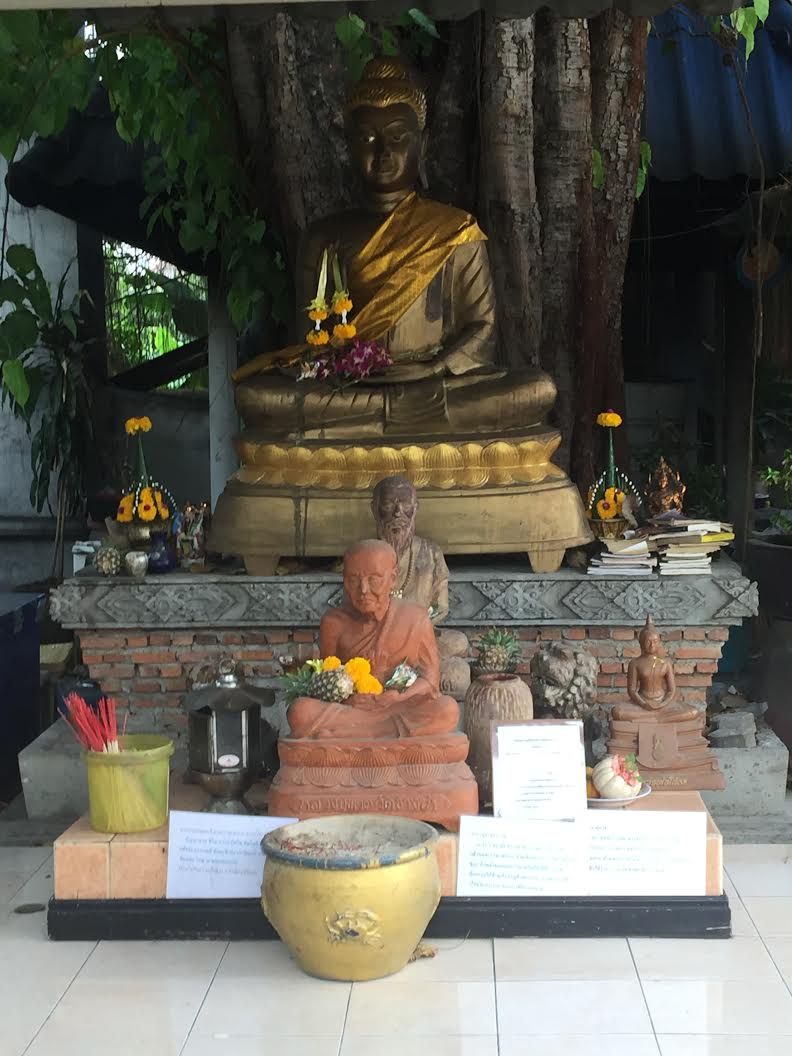
Thai temples are ornate and spectacular and this was no exception. We walked clockwise around the complex – three times – bringing good luck. We ventured into the Ordination Hall where seven monks were leading some kind of devotion whilst worshippers ate their lunch, sitting on the floor feet tucked away from the saffron robed monks.

My local temple time by Alex Bannard Bangkok Correspondent 3

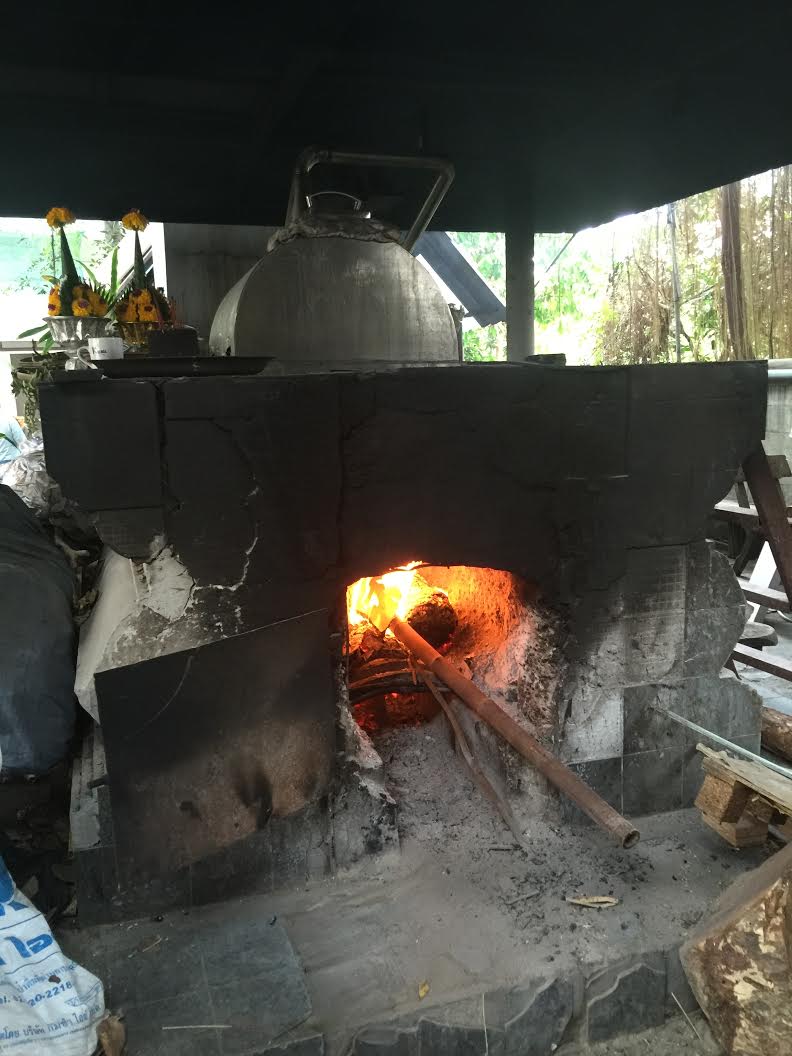
One of the monks approached us to say hello and tell us about a 3 day festival celebrating the re-gilding of the Buddha. He escorted us outside to see the actually Buddha which would be restored to its golden glory and then took us to the back corner of the complex where women were preparing food, eating and also loading wood into the kiln to keep a sauna going which the monks and nuns use daily.

My local temple time by Alex Bannard Bangkok Correspondent 4

It was fascinating: the monk’s openness and willingness to share insights into their daily lives and rituals; seeing the nuns in their white robes and shaved heads which previously I hadn’t seen; and being privy to the real sense of community within the temple’s complex. It was such a serene and calm place that my previous slightly frustrated mood evaporated eased. It was the kind of serenity and soul the popular tourist temples somehow fail to deliver. But then without a sea of selfie sticks and hoards of noisy tourists it is no wonder really. 


We cycled home mostly through the back streets hoping the threatened downpour would evade us at least until we were close by. We emerged on a different approach to our moonbaan perhaps reflective of the different approach we would be embracing during the afternoon: one of gratitude, serenity and inner calm as so often a journey off the beaten track induces.

The Salt Marsh by Clare Marsh

The Salt Marsh           by Clare Marsh

As a bestselling author I am increasingly impressed by the standard of novels being published by Head of Zeus. I have not read one I have disliked or thought lacking in expertise or originality.


The Salt Marsh is another of this ilk . It is a ‘haunting thriller’, so says the blurb, set in the windswept marshes of Kent and Norfolk.


I can assure you that it is indeed haunting, it is also well written and evocative with a great sense tension and of place. Clare Carson has bags of empathy, and the characters live. There is pace and rhythm. So what more can I say?


The Salt Marsh tells of Sam, who can’t lay her father’s ghost to rest. Jim was an undercover agent living a double life, and Sam has left university to find out the truth about his work.


The story moves from the nightclubs of 80s Soho to the salt marshes and shingle spits of Norfolk and Kent. I remember both – the cigarette heavy gloom of the nightclubs, and the salt laden winds of the east coast. I can also remember the smugglers’ huts but never found any buried bones. It is here, in these two arenas that Jim’s secret past beckons her. So, will Sam walk away and pick up her own life? Or become an undercover operative herself and continue her father’s work in the shadows?


Read it and find out. Let me know your thoughts. frost@margaret-graham.com


The Salt Marsh, Head of Zeus, HB £18.99


Lucky Us by Amy Bloom

Lucky-Us-Amy -Bloom

When Eva’s mother abandons her on Iris’s front porch, the girls don’t seem to have much in common – except, they soon discover, a father. Thrown together with no mothers to care for them and a father who could not be considered a parent, Iris and Eva become one another’s family. Iris wants to be a movie star; Eva is her sidekick. Together, they journey across 1940s America from scandal in Hollywood to the jazz clubs and golden mansions of Long Island, stumbling, cheating and loving their way through a landscape of war, betrayals and big dreams.

Set in 1940s America, this is a thrilling and resonant novel about loyalty, ambition and the pleasures and perils of family.  Iris has grit and the determination to escape her surroundings;  she wants a different life and Eva soon becomes a part of, and important to, those new horizons. Bloom artfully covers such detail in so few words that it read like a huge sweeping novel rather than the slim volume it was. Clever and deft writing, sharp and witty by turns, the characters and their circumstances are finely observed and I cared about each one of them, willing them to overcome the obstacles that littered their paths.

Iris and Eva are full of guts and the determination to not only  survive, but thrive. The book explores what is possible when we refuse to give up and are willing to be flexible and adapt to conquer life’s twists and turns. Something that resonates with the challenges we face at the moment.

A totally satisfying and superb read. I look forward to reading more of Amy Bloom’s writing now that I’ve found her.

www.grantabooks.com