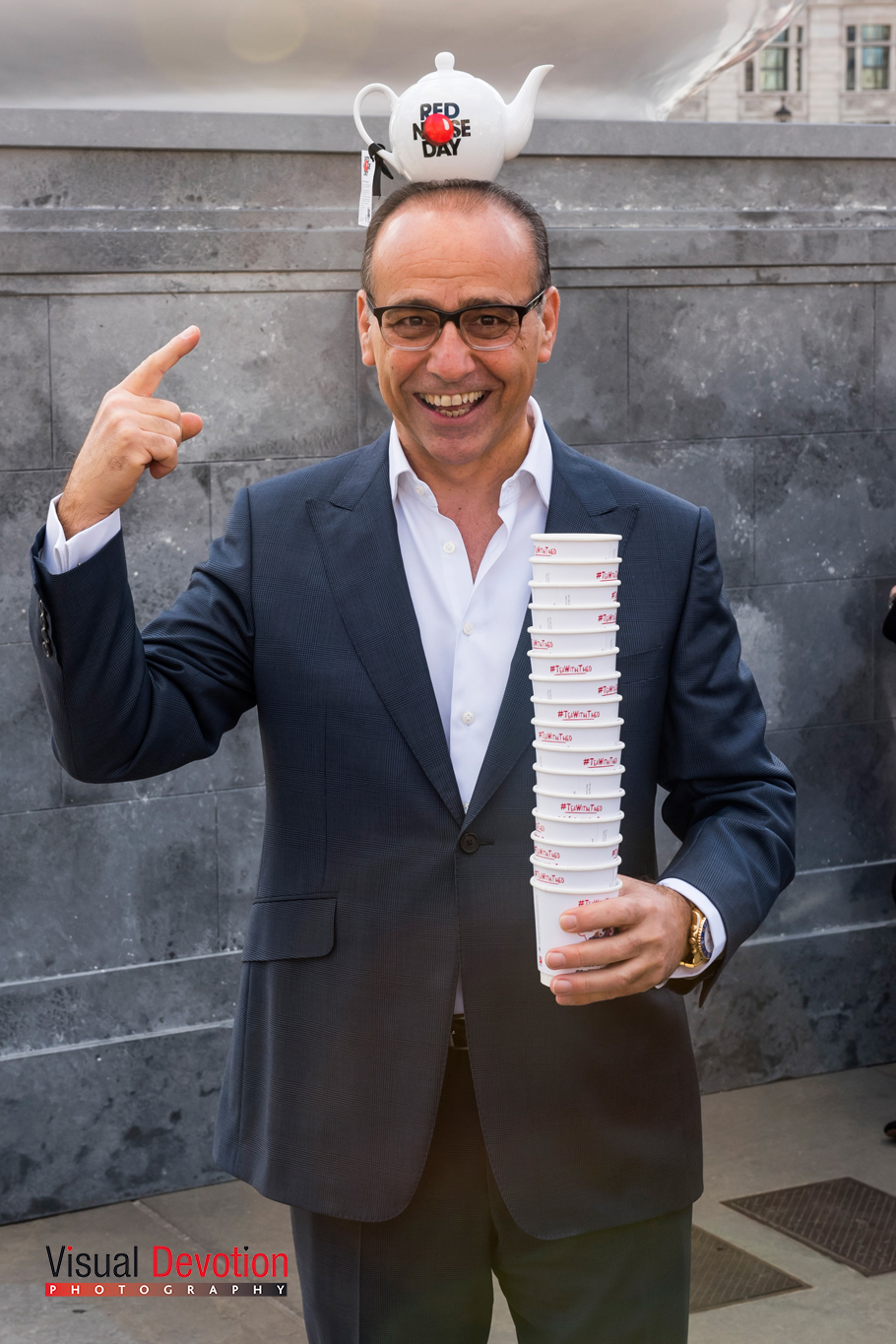
The brief was to get myself to Trafalgar Square at 11:45 on Friday 27th February, find the 8’ high teapot and share a cup of Rosie Lee with former Dragon’s Den star, Theo Paphitis and some of his celebrity friends, all in the name of Comic Relief’s bi-annual Red Nose Day being held on Friday 13th March 2015.

On what was possibly the warmest day of the year so far, a crowd gathered, donning red noses, handed out by a pair of bananas… well, two bubbly members of Ryman staff dressed as bananas, mingling and giggling in the bright sunshine – I lost count of the number of selfies that were being taken around me, celebrities and the public posing together, all in the name of the Comic Relief charity. Matt Cardle, Lauren Goodger, Jake Wood, Helen Lederer, Nick Moran and Paul Bradley graciously took time out to raise awareness for Comic Relief and Red Nose Day 2015. Theo brought along the Boux Avenue Range Rover, all blinged-up, surrounded by a bevvy of TOWIE fans just itching to lick the bonnet.
Born-organiser and self-confessed shopkeeper,Theo Paphitis, shepherded his celebrity friends and warmly invited the public to grab a cup of tea (courtesy of PG Tips, served by www.coopersbeansandleaves.com from their quirky little three wheeled mobile coffee van) and chat … and chat we did.


Jake Wood (aka Max Branning – EastEnders) told me about his time on Strictly Come Dancing – a sharp learning curve when you’ve never danced before, but under the wing of professional dancer, Janette Manrara, Jake proved that he has a natural talent for Ballroom and Latin dancing – borne out through many spectacular hip-gyrating Salsas and Rumbas, taking him through to the nail-biting #SCD semi-finals. Jake explained to me that he is now mentoring Anna Kennedy, a mother from Uxbridge who set up schools and support for people with Autistic Spectrum Disorders and will be a contestant on a very special edition of the hit BBC series Strictly Come Dancing.
![961603_10152818805533031_2134276961_n[1]](https://www.frostmagazine.com/wp-content/uploads/2015/02/961603_10152818805533031_2134276961_n1.jpg)
Mrs Kennedy, 54, set up Hillingdon Manor School in Harlington Road in 1999 after struggling to find suitable education for her two autistic sons and will partner Robin Windsor on the BBC 1 show, mentored by Jake and Janette. Anna, who has received an OBE for services to special needs education, will be one of six ‘everyday heroes’ taking part in The People’s Strictly for Comic Relief. The five-part series will see all the regular Strictly faces, including judges Anton du Beke, Darcey Bussell, Bruno Tonioli and Len Goodman, and hosts Tess Daly and Claudia Winkleman.
Jake paid tribute to the BBC, explaining the behind-the-scenes activities that go into putting a series together, along with intense training and the rush of adrenaline when performing, the format is unlike any other. I asked if he is going to continue dancing and he answered “My children loved seeing me dance in Strictly and I think they’d have something to say if I stopped now!”
When the kettle came off the boil and the teapot ran dry, we moved inside to the Trafalgar Hotel where I sat down with Theo Paphitis, Chairman of Ryman, Chairman and Owner of Robert Dyas and Boux Avenue, also sitting on the Commercial and Technology board for Comic Relief.


CDTT: Thank you for the interview, Theo! So, tell me, how did #TeaWithTheo come about?
TP: Well, I’m a director of Comic Relief, for a start, I’ve been involved with them for many years, I’ve been to many of the projects around the world that we fund to see where the money is spent that the great British public donate to and that it’s spent properly and well. I’ve been involved with it with my businesses for a number of years, both Ryman and Robert Dyas, both convenience shops involved with our communities so there’s real great enthusiasm in those six weeks leading up to Comic Relief where it gives our colleagues the opportunity to interact with our customers, have a bit of fun, be a bit silly, come off the tracks a little bit and come away from the mundane part of life and raise millions and millions of pounds, which we do every year for the charity, and help others, so it really is win-win all round.
CDTT: A great collaboration Theo, as you say, win-win. You mentioned Boux Avenue, this is a brand that’s relatively new to me.
TP: Where do you live?
CDTT: Norwich.
TP: Ah, we have a shop in Norwich, in Chapelfield. Really, Boux Avenue was probably the biggest single reason I stopped Dragon’s Den… that, and Robert Dyas, because I started Boux Avenue. And when we started Boux Avenue, we took a clean piece of paper and I said if I wanted to create an international lingerie company and I’ve got nothing at the moment, how would it be? So we designed a shop, opened a few shops to test it, created and designed the product, and we’ve been going for three years now. We’ve got 25 stores in the UK, 10 overseas already, we’re now turning over a lot of money as a business, it’s become an international brand and it’s taken a lot of my time with a lot of people involved, an international team and we’re very excited about it. In the middle of a recession, we started a retail business aimed at an international market…
CDTT: …and it worked.
TP: And it worked.
CDTT: You did an interview back in 2011 and quoted that you were going on the search for ‘Boux’, did you find her?
TP: Boux… a little French woman we met on a family holiday in Monaco, she was cute and lovely and epitomised what we had in mind for the brand.
CDTT: Well, Shane and I are going to Monaco this year, so we’ll look out for her! With my fashion editor hat on now, your style and dress sense is very elegant… do you have a stylist or does Mrs P choose your clothes?
TP: I have had a stylist for a programme I appeared on, but I dress myself – Man at Dunhill!
CDTT: (Both laugh) And do you have any acquisitions or business opportunities in the pipeline that you can tell me about?
TP: Well, Boux Avenue is growing internationally, any day now I’m going to sign a contract on another large international deal which we’ll probably announce within the next ten days, Robert Dyas is growing, Ryman is growing, we’re always on the look out for other things. We’ve had a great Christmas, a great retail year, and we’re all passionate about what we do, we all love shop-keeping, if you look on my Twitter, I’m the ‘shopkeeper’, that’s what I do. I’d give up television and everything else, but I couldn’t give up shop-keeping.
CDTT: So the reason you left Dragons Den was because the new businesses were in their infancy and you needed to give more time to ‘shop-keeping’.
TP: Yes, and Boux had launched, I risked a lot of money in that, I had to get that right and also it wasn’t fair to everybody else, my diary was becoming rubbish and the filming weeks made things very tight. I had such a marvellous time (on Dragons Den) and the BBC get knocked and knocked and knocked but actually, as I learnt about television and learnt how brilliant the BBC are, I became more appreciative of what they do… people don’t realise how good they are. So I had a wonderful time in my eight years on Dragon’s Den and it was a wrench to leave, it really was a wrench.
CDTT: I think the public miss you not being there sitting next to Peter.
TP: Well, Deborah (Meaden) has my seat now but the BBC were very generous giving me a year off television to get my businesses established and they kindly backed me, and a year to the day, they called and offered me a slot on The One Show, which is great fun. I’m back into the swing of things now that Boux is established, and Robert Dyas has gone from a difficult loss-making business to a very profitable business. So what’s new? I’ll tell you what’s new, I’m back on TV, that’s what’s new.
CDTT: So, to round things off, the person that really makes me laugh is Lee Evans, he hits my comedy button, who hits yours?
TP: Morecambe and Wise always made me laugh, David Jason, but now… and Mrs P is really going to slap me for saying this, Lemon, Keith Lemon! He cracks me up!
CDTT: And who is Mrs P’s favourite?
TP: Miranda! Miranda actually said “Theo Paphitis is my fantasy man” in one episode… my Twitter feed went mad (laughing).
CDTT: Thank you so much Theo, a fabulous interview!
TP: Lovely to meet you, enjoy your cruise and Monaco… and if you see Boux, say hello!
After the interview, I came to the conclusion this successful entrepreneur really does have a USP … a ‘Unique Spirited Person’ with a nose for business and an eye for the opportunity – plus he makes a jolly good cup of builders slosh!







Watch the Snotty Professor teapot being eased into place!

Time for tea with Theo and his celebrity friends:
![11026542_10152818829638031_935081013_n[1]](https://www.frostmagazine.com/wp-content/uploads/2015/02/11026542_10152818829638031_935081013_n1.jpg)
Matt Cardle
Appearing at Wrexposure Music Festival on 4th April 2015 – www.wrexposure.com/
Lowry Theatre, Salford on 20th May 2015 – www.thelowry.com/event/matt-cardle1
Lauren Goodger
@LaurenGoodger – www.laurensway.com – promoting her range of tan, lip, hair and eyelash products, wearing a camel–coloured coat from Cherry Drop Clothing:
Paul Bradley
Best known playing Nigel Bates EastEnders, now Elliot Hope in Holby City
Helen Lederer
Losing It is the hilarious debut from Helen Lederer, one of the UK’s favourite comediennes, a ‘mid-lit’ book (apparently somewhere between chick-lit and grey-lit!)
Nick Moran
Appearing in ‘Twelve Angry Men’ at the Garrick Theatre, London, until March 15; nimaxtheatres.com/Garrick
![rnd15_newsarticle_teapot_01[1]](https://www.frostmagazine.com/wp-content/uploads/2015/02/rnd15_newsarticle_teapot_011.jpg)
OWN YOUR OWN RED NOSE DAY TEAPOT!
The porcelain Red Nose Day teapot featuring the Snotty Professor costs £4.99 from Robert Dyas or from the online shop, with at least £2.25 from each sale going to Comic Relief.
How to donate: www.rednoseday.com
Find out more: #TeaWithTheo #RND15 @rednoseday
Theo Paphitis – www.theopaphitis.com @TheoPaphitis
Through his appearances on Dragons’ Den, Theo has advised many young entrepreneurs and invested in several innovative businesses and brands. The Paphitis Charitable Trust distributes all of his fees from TV appearances, speeches and his book to causes close to his heart and charities associated with children. In early 2009 Theo was appointed patron for Skillsmart Retail, the Sector Skills Council for Retail, which is committed to driving up skills levels in the industry. His special areas of responsibility are as the Retail Apprentices’ Champion and for the new National Skills Academy for Retail. In summer 2009 he was awarded an Honorary Doctorate from the University of Middlesex. Theo lives in Surrey with his wife Debbie. They have five children and three grandchildren.
Ryman – www.ryman.co.uk
Ryman is a UK stationery retail company with over 230 outlets nationwide in the UK. The website and stores provide a wide range of stationery and office supplies for homes and businesses. Theo acquired Ryman in 1995. He introduced the Ryman Direct mail order catalogue in 1996, the Ryman website in 1998 and has turned Ryman into a successful and profitable business comprising 232 stores with a turnover of more than £120m.
Robert Dyas – www.robertdyas.co.uk
Robert Dyas is a UK retailer founded in London in 1872. The website and stores provide ranges of housewares, small electrical appliances, gardening products, kitchenwares, DIY, and consumer electronics throughout 96 stores, mainly in Greater London and South East England.
Boux Avenue – www.bouxavenue.com
Boux Avenue Ltd. is a chain of lingerie stores based in the United Kingdom. Boux Avenue launched in the spring of 2011 initially opening six stores across the United Kingdom. All the stores are located in shopping centres across the region, including Bluewater (Kent), Lakeside (Essex), St. Davids (Cardiff), Trafford Centre (Manchester), Meadowhall Centre (Sheffield) and Buchanan Galleries (Glasgow). In March 2012, a seventh store in Birmingham’s Bullring opened. In September 2014, an eighth store opened in Brighton’s Churchill Square shopping centre. The store boasts an original selling layout for the UK shopper by displaying the majority of its products in drawers as opposed to hanging rails and stands.
www.coopersbeansandleaves.com
With their quirky little three wheeled mobile coffee van, Coopers Beans and Leaves brings you high quality gourmet coffees including Lattes, Cappuccinos, Americanos, to name but a few, also offering a large range of Organic Fairtrade Clipper Teas, (always adding to the range), the “best” hot chocolate, Chai, Lynch’s Hot Apple & Schmoo Milkshakes, along with a delicious selection of home-made cakes and goodies.
#TeaWithTheo event images courtesy Shane Finn www.visual-devotion.co.uk @VisualDevotion
www.corinne-modelling.co.uk @ladycdtt