ERIC CARLE, 1929 – 2021

Eric Clarke, author, hungry caterpillar.
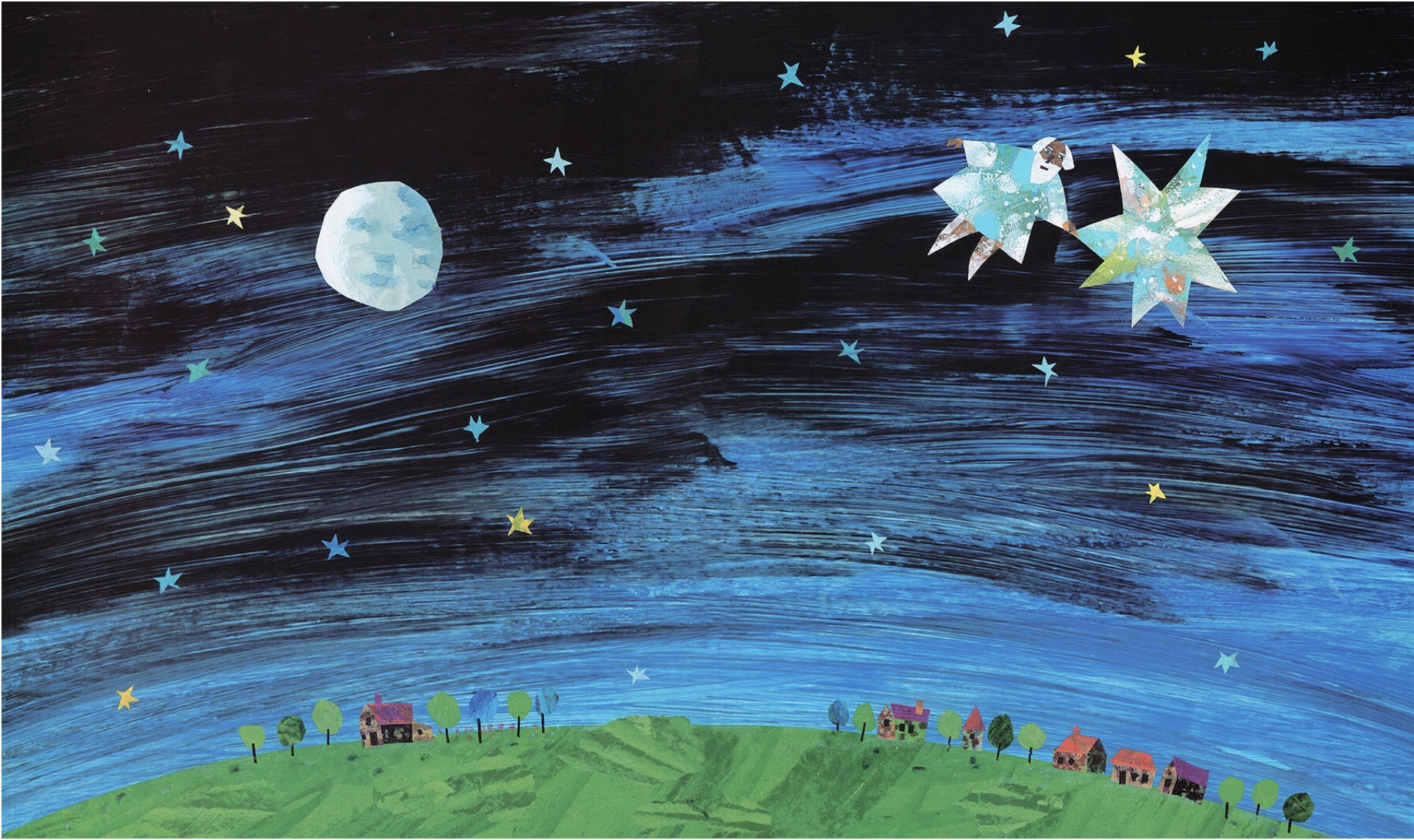
‘In the light of the moon,
holding on to a good star,
a painter of rainbows
is now traveling across the night sky’
The Carle family announces with great sadness that Eric Carle, beloved artist, illustrator, and writer, passed away peacefully and surrounded by family members on May 23, 2021  at his summer studio in Northampton, Massachusetts. Eric was 91.

A true creator, Eric Carle is renowned for his multi-dimensional practice, spanning a large body of fine art works in collage, painting, works on paper and fabric, and sculpture; theater and furniture design; and the stories he envisioned in over 70 brilliantly illustrated and designed children’s picture books. The books Eric created across more than 60 decades have sold over 170 million copies and include timeless classics such as Do You Want to Be My Friend? (1971), The Grouchy Ladybug (1977), Papa, Please Get the Moon for Me(1986), “Slowly, Slowly, Slowly,” said the Sloth (2002), The Very Clumsy Cricket (2017), and so many more. His best-known work, The Very Hungry Caterpillar, has been translated into over 70 languages (including Mongolian) and shared around the world since its publication in 1969.

Drawing on his formal training and ongoing practice as an artist (which Eric fondly referred to as his “art art”), Eric quickly developed a distinctive, personal style that he continued to explore and refine in his books, illustrations, and fine art. Numerous artistic influences came together in Eric’s creative output. His art took root in the long tradition of collage, an artistic technique tracing back to the 1900s Dadaist movement, combined with his hand-painted, colorful, and textured tissue papers, which recall the work of abstract artists associated with the Academy of Fine Art Stuttgart (the so-called Stuttgart avantgardists), from where he earned his fine art degree.


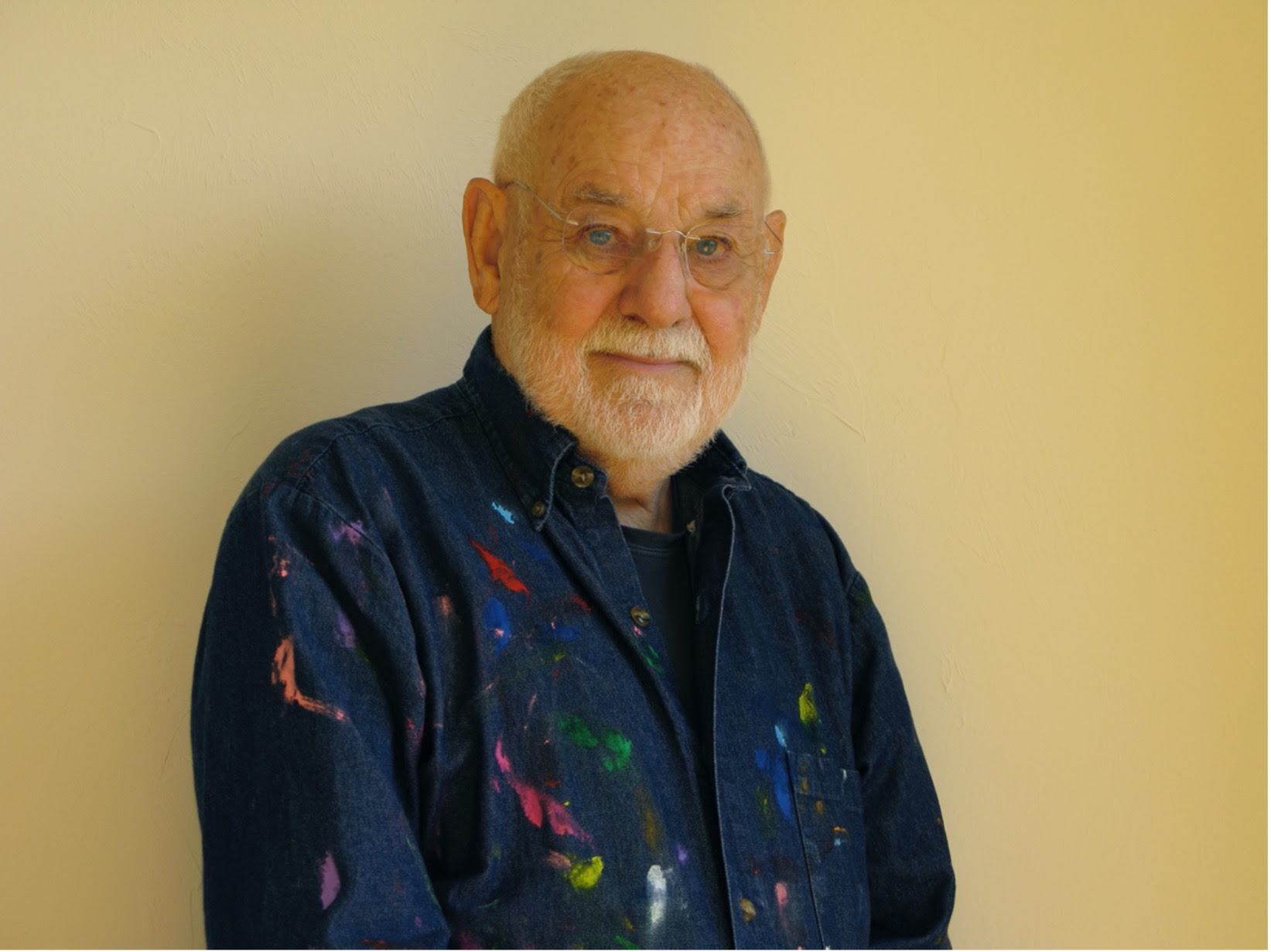
Eric Carle. Photo: Motoko Inoue
Eric’s prolific career as a picture book illustrator began by chance in 1967 when author Bill Martin Jr, while in a doctor’s office waiting room, saw a medical advertisement in a medical journal for antihistamines with an illustration Eric had done of a big red lobster. Soon after, Martin invited him to illustrate Brown Bear, Brown Bear, What Do You See? and the experience sparked his interest in creating his own stories, combining his artistic abilities with his experience in the field of printing.

His first original, 1,2,3 to the Zoo, was published the very same year. The book was published by Philomel Books, an imprint of Penguin Young Readers, and edited by the late Ann Beneduce, who Eric has always credited the success of his early works. They would go on to work together for the next fifty years.

Bright collage images, imaginative stories, and little details – die cut pages, a firefly’s twinkling lights, a quiet cricket’s song – made Eric’s illustrations uniquely playful. Eric was the recipient of the 2003 Laura Ingalls Wilder Award (now called Children’s Literature Legacy Award) and held eight honorary degrees, including from Williams College and Amherst College. He remains an important influence on artists and illustrators at work today.

In 2018, Penguin Young Readers established The World of Eric Carle, an imprint dedicated to Eric’s work. Eric is also published by Simon & Schuster, HarperCollins Children’s Books, and Macmillan. In 2020, the World of Eric Carle was the #1 bestselling literary preschool brand, led by The Very Hungry Caterpillar,which was 2020’s 16th bestselling book of the year, and the #1 best-selling board book. Penguin Young Readers continues to publish new books featuring Eric’s iconic and beloved characters and artwork under The World of Eric Carle imprint.

Eric’s career as a creator extended far beyond his beloved children’s books—his independent artwork (or “art art”) is the root of his deeply individual style, reflecting a sense of whimsy, unfettered creativity, and calculated spontaneity. Utilizing materials such as aluminum, silk, glass, including scraps, and objects found in his studio, Eric amassed an extensive body of visual artworks throughout his lifetime including abstract collages, glass sculptures, and works on paper. Part of Eric’s early training as an artist was to treat all the arts, commercial or otherwise, with the same dedication, the same passion, and the same respect.

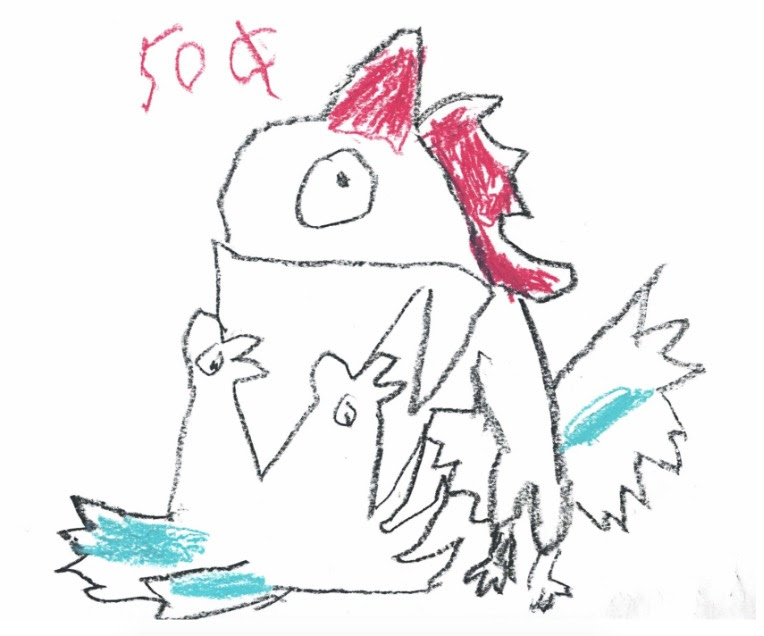
Eric was a true artist until the end—creating drawings as recently as this spring. Eric’s last drawing series, created in his final years, include several with “50 cents” written onto the image. When asked about this choice, he said that “children should know they too can sell their artwork.” A child at heart, the secret to Eric’s incredible legacy as a creator of picture books lay in his intuitive understanding of young minds—their feelings and their inquisitiveness, their creativity, and their intellectual growth. Besides being beautiful and entertaining, his books always offer children the opportunity to learn something about the world around them and encourage them to engage as artists themselves.

It was in this spirit that Eric and his wife Bobbie Carle (1938­-2015) co-founded The Eric Carle Museum of Picture Book Art in Amherst, Massachusetts in 2002. The Carles envisioned the museum as “a place for young visitors’ very first visit to a museum”, preparing them to develop the habits of museum going and discovery. The first major museum in the country dedicated to picture book art, it is a champion for illustrated children’s literature, collecting and exhibiting original illustration, and encouraging guests of all ages to read and create art. In summer 2020, The Eric Carle Museum of Picture Book Art presented Eric Carle’s Angels: An Homage to Paul Klee, an exhibition of 20 abstract assemblages dedicated to artist Paul Klee (1879-1940), who created over 70 drawings and paintings of angels during his lifetime. Eric’s singular, bold, three-dimensional “Angels”, created from painted cardboard and found objects, are a testament to the expressive power of collage in the hands of a master. His wishes for this series were that they never be conserved. Instead, he asked they be allowed to naturally disintegrate. The series represents a small but notable period of Eric’s extensive work in visual art.

Eric was born is Syracuse, New York on June 25th, 1929, and at the age of six moved with his parents Johanna and Erich Carle, both German immigrants, back to their hometown of Stuttgart, Germany. After graduating in 1950 from the prestigious Academy of Fine Arts Stuttgart (Akademie der bildenden Künste), he fulfilled his dream to return to America—the place of his happiest childhood memories. In 1952, with a portfolio in hand and $40 in his pocket, he arrived in New York City. With the help of the illustrator and art director Leo Lionni, who would go on to become a mentor, Eric landed a job as a graphic designer at The New York Times. He was drafted into the U.S. Army during the Korean War; after discharge he returned to his job with The New York Times and later he became an art director of a medical advertising agency, L.W. Frolich. Eventually, he was promoted to oversee International Hiring, recruiting art directors for the agency’s international offices (London, Mexico City, and Frankfurt), a job that took him away from designing himself. He soon left and began a career as a freelancer designing book jackets, album covers, and eventually children’s books.

Eric is survived by his two children from his first marriage to Dorothea Carle (née Dorothea Wohlenberg), Rolf Carle and Cirsten Carle, and Rolf’s wife Teresa Toro; his sister Christa Bareis, and his sister-in-law Rita Wiseman. Eric was preceded in death by his wife of 42 years Barbara ‘Bobbie’ Carle (1938 – 2015). Eric was a resident of Key Largo, Florida, where he and Bobbie lived since 2004.

An artist till the end, Eric continued to create art until early May 2021. Some of his latest works on paper can be seen here.

Online condolences, memories, and photos may be shared with the Carle family at:

Website: www.ericcarle.art/
Facebook: @ericcarleartist
Instagram: @ericcarleartist
#RememberingEricCarle

The Pact by Sharon Bolton | Book Review

I love getting my teeth into a good thriller and The Pact by Sharon Bolton is like a big, juicy steak. The characters are so vivid and the writing is so insightful that I loved every page. This clever book about six talented friends and the consequences of a very stupid thing they do. The daredevil game goes wrong and a woman and her two children die. It is heart-rendering stuff and someone must pay the price.
One of the friends, Meghan, takes the blame and pays a huge price. When she is released from prison the real fun begins. This is a clever and entertaining book that leaves you gripped all the way to the end.

A golden summer, and six talented friends are looking forward to the brightest of futures – until a daredevil game goes horribly wrong, and a woman and two children are killed.

18-year-old Megan takes the blame, leaving the others free to get on with their lives. In return, they each agree to a ‘favour’, payable on her release from prison.

Twenty years later Megan is free.
Let the games begin . . .

The Pact is available here.

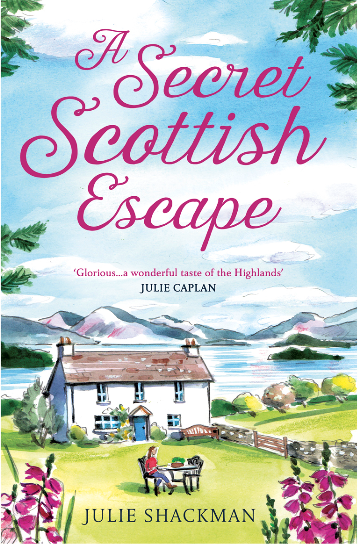
My Writing Process Julie Shackman.

I am a writer of feel-good romance and live to the North of Glasgow with my husband and two sons. I trained as a journalist and studied Communication & Media, but I always wanted to be an author. We  adopted a Romanian rescue puppy, who we named Cooper, just before Christmas and he is often my writing companion!

What you have written, past and present. 

A Secret Scottish Escape is my fifth published book. My first two novels, Rock My World and Hero or Zero, were published digitally by the London based publisher Not So Noble Books and my next novel after that, A Room at the Manor, was released by Allen & Unwin. Book number four, The McKerron Castle, was released in audio by Bolinda.

Years ago, I also had two children’s picture books published in Dublin, but I always wanted to write feel-good, escapist romance and that is the genre I love to read.

What you are promoting now. 

I am promoting my latest feel-good romance, A Secret Scottish Escape, which is being released by the wonderful HarperCollins imprint One More Chapter as an ebook on 21 May and in paperback on 19 August. I can’t wait to share the tale of Layla and Rafe!

A bit about your process of writing. 

I find it very difficult to write straight onto the PC, so I tend to write long-hand in one of my many notebooks (!) and then type it up. I usually go to my favourite tea shop to write, but since lockdown, that hasn’t been possible, so I have been learning to write on the sofa, in the kitchen and whilst staring out of the window in the office! I also have to have music playing. Listening to lyrics seems to work for me as well.

Do you plan or just write?

I used to be a real panster, but have got a little bit better since  my last couple of books. I haven’t been planning everything, but write more detailed notes now on character background, settings and where the story is headed.

What about word count?

I just tend to write the first draft, get it all down and then tweak polish and edit after that. if I can write about 1k-1,500 words a day, I’m pleased with that. The most I have ever written in a day was 4,500 words. I wouldn’t like to do that too often!

How do you do your structure?

I make lots of bullet points in my notebook, referring back to themes and characters. It can look rather chaotic, but it seems to turn out ok in the end!

What do you find hard about writing?

I procrastinate alot! I also have a habit of browsing through social media or reading the paper and then have to have a stiff word with myself.

What do you love about writing? 

I love creating worlds and characters that readers can hopefully lose themselves in. I think we all really need to be able to do that – especially now!

Advice for other writers. 

Don’t ever give up. Keep going, keep writing and keep reading. A published writer is an unpublished writer who never quit.

UK Amazon Link –

https://www.amazon.co.uk/Secret-Scottish-Escape-heartwarming-women-ebook/dp/B08T5WWNDR/ref=tmm_kin_swatch_0?_encoding=UTF8&qid=&sr=

US –

https://www.amazon.com/Secret-Scottish-Escape-Julie-Shackman-ebook/dp/B08T5WWNDR/


Animal by Lisa Taddeo Book Review

Lisa Taddeo, Animal, book, book review,

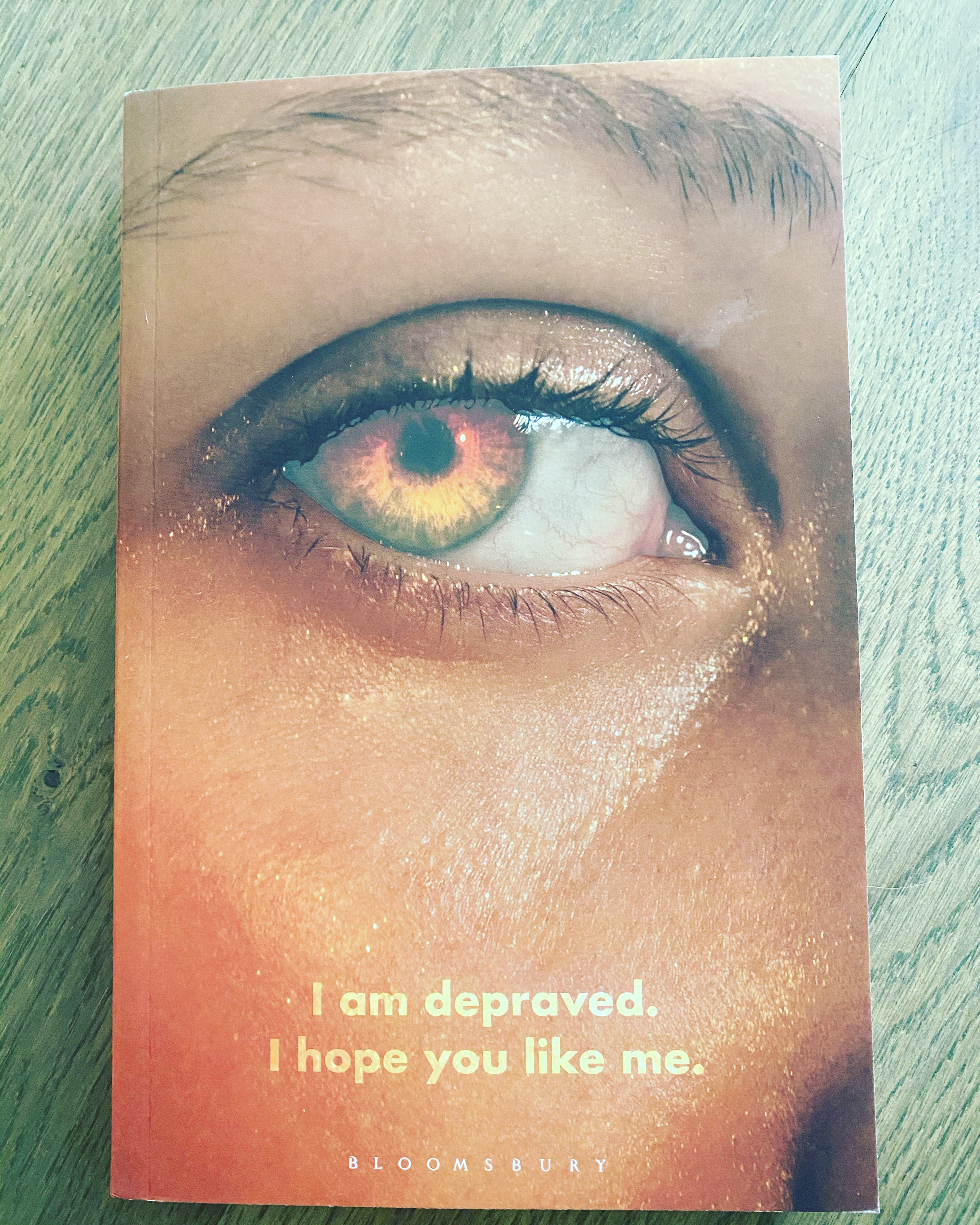
Animal is a searingly dark book. Lisa Taddeo takes you into the dark heart of what trauma does to a woman. All of those ‘tiny little rapes’ and things that happen that build up to the pure rage of a woman. It is so refreshing to have a writer who writes about women to unapologetically, and who writes about their anger and rage. Even if the character is one who makes bad life decisions. Yet Taddeo writes the story so perfectly that she unwraps the psychology of her character and how she came to be who she is with precision. You don’t need to like female characters.

Taddeo is so brave and writes with no filter. It is how all writing should be done, of course. That makes the writer no less brave for putting a story out there. There was never any doubt that Animal was going to be one of the books of 2021. But beware, before you read it: brace yourself. You will not be able to forget it.

This is the first novel from the author of Three Women which was a global phenomenon.

I drove myself out of New York City where a man shot himself in front of me. He was a gluttonous man and when his blood came out it looked like the blood of a pig.

That’s a cruel thing to think, I know. He did it in a restaurant where I was having dinner with another man, another married man.

Do you see how this is going? But I wasn’t always that way.

I am depraved. I hope you like me.

MEET JOAN: 24th June 2021.

Animal is available here.


My Writing Process Kat Dunn

  • What you have written, past and present

DANGEROUS REMEDY was my debut novel, published in 2020. MONSTROUS DESIGN is the second in the series, out June 2021, and I’m in the midst of writing the third and final book in the series, 

Before my debut I wrote a whole host of finished, part-written and completely abandoned novels, none of which I let myself take seriously.

  • What you are promoting now

MONSTROUS DESIGN is the sequel to DANGEROUS REMEDY, and comes out 10 June 2021. The first book in the series saw Camille, her girlfriend Ada, and their band of outcasts rescue a girl with strange powers from the guillotine in revolutionary Paris. In the second book, the gang is split between London and Paris struggling against Royalist forces that are growing ever stronger. Think duels, necromancy, betrayal, and a cast of queer, found family misfits.

  • A bit about your process of writing

I work a 9-5 day job, so I write evenings, weekends, lunch breaks and early mornings. It’s not always been easy to find the time to write, and I’ve had to put aside other aspects of my life to make it work. But I’ve been writing since I was a small child, and there’s nothing else I’ve ever wanted to do with my life.

I usually have anything from 5-10 ideas fermenting in my head at once, but I try to focus on 1-2 projects at a time. I’ll usually write a draft in 3-4 months, go back straight away and fix all the bits I know are wrong, then chunk it over to someone else (whether my editor, agent, or a friend) to get some more direction for the next round of edits. 

  • Do you plan or just write?

I used to think I was a planner, but the more real planners I meet the more I realise I’m somewhere between planner and pantser.  

It feels like someone’s dumped out a jigsaw puzzle into my brain, and I have some pieces that are obviously corners or edges, or here are a whole heap that connect together to make a building or cloud or something, and then there’s the mess of unknown pieces. So I’ll try to write the bits I know out in a very sketch note form. I like scrivener for this, because I can make a document for each puzzle piece and then start grouping them and moving them around, while making notes of all the things I think should happen in that scene. 

Then writing it is like putting the puzzle together. Sometimes it zooms along, sometimes you realise what you thought was a cloud was actually snow and it’s in the wrong place and you have to pull things apart…. You get the idea. 

  • What about word count?

Apart from a few outliers, I end up somewhere between 80-110k for most drafts. Things grow and shrink during edits, but I don’t have an over or under writing problem. I write the right number of words, they’re just the wrong words and have to go in the bin.

  • How do you do your structure?

I really love books about story structure. I don’t think there are really any hard and fast rules (and a lot of those rules are western-centric and automatically dismiss other forms of storytelling). But I like knowing what sort of patterns are out there, and pulling them apart. 

DANGEROUS REMEDY and MONSTROUS DESIGN are fast paced stories that take place over a handful of days each. I didn’t get to play around with structure too much, but I did use the structure to think a lot about what information I share with the reader and what I withhold until the right moment. I love a good twist and to make them work you’ve got to do a lot of work before you can whip back the curtain and reveal the truth. Having a clear idea of my structure helps me work out where I need to lay seeds. 

  • What do you find hard about writing?

I’ve found it tricky know how to structure stories that are driven by emotions and character over big flashy plots. I’ve been working on a side project where this has been my main challenge and I’ve learnt so much. It’s made me think about my writing in a really different way and prove to myself that even though I’m a published author now, there’s still so much more to do and learn.

I find editing harder than drafting. It stops being potential and starts being a real thing, which will always disappoint me a bit for not being exactly the thing in my head.

  • What do you love about writing?

I had to think about this for a while. It’s like someone’s asked me what do I love about air. I like that it means I can breathe? I’ve been through a lot of difficulty in my life, and for a lot of it been on my own, so writing has been as essential as water or sunlight. It means I can exist. It gives me purpose and meaning and joy. 

If I have to say something specific, I think my greatest joy is when character drives plot and plot drives character in a really effective way – a slow burn character arc that takes a hero to a villain. I love writing in moral grey areas, where good people do terrible things and terrible people do good things.


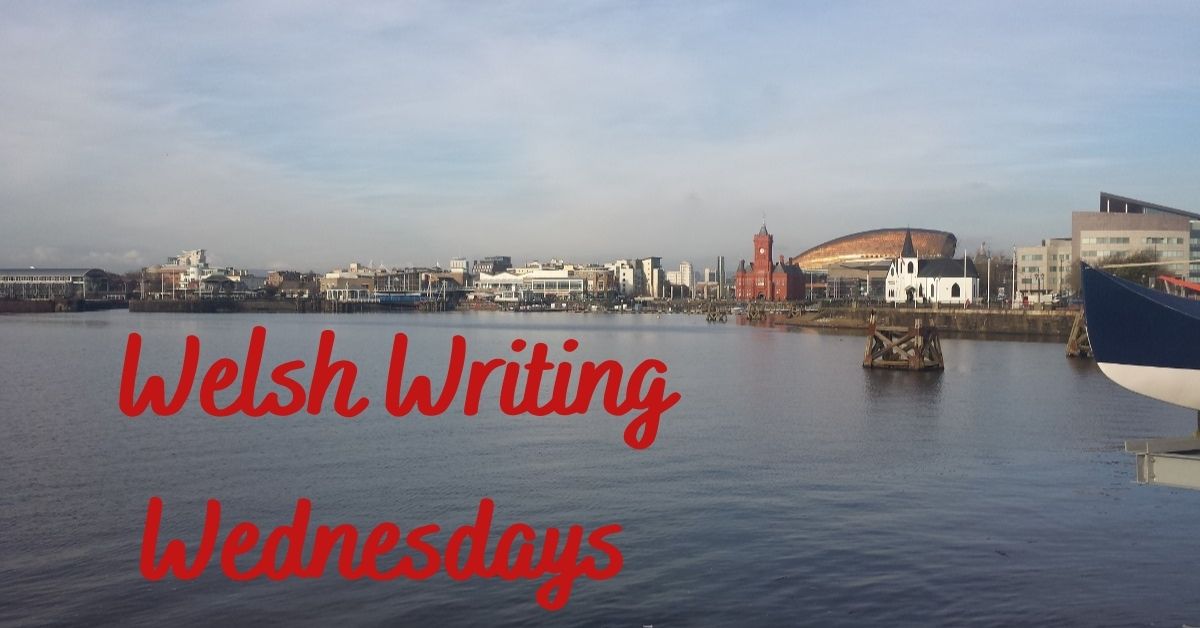
WELSH WRITING WEDNESDAYS: JUDITH BARROW ON HONNO PRESS

“Great Women, Great Writing, Great Stories”

Honno Press was set up in 1986 with four core aims: to provide a feminist perspective, to give Welsh women writers an opportunity to see their work published, to get earlier important, but neglected, writing by Welsh women back into print and to provide employment in publishing for women in Wales.

At the time, none of the publishing houses in Wales were particularly interested in promoting Women’s literature or writers, especially not in English.  There was a practice of publishing Welsh-language material by winners of competitions in the National Eisteddfod by the traditional presses, who would then pursue those particular authors. But the thought of going out to look for new female talent and female voices was not a priority

The establishment of Honno, their active search for women writers in both languages in Wales widened opportunities for women and saw all the Welsh publishers take women’s writing and the subjects women write about more seriously.

When asked why there is such a great variety in the books published by Honno, Janet Thomas, former editor of Honno and now on the committee, says, “I think a key reason for the vitality of Honno’s list that we are run as a group, with a variety of tastes, enthusiasms and expertise.  Honno tries to be open to all the broad range of writing that Welsh women want to write, looking for talent as widely as possible, Welsh and English, in all different kinds of fiction and non-fiction. As long as the skill is there, whatever the genre, style or subject matter, Honno will consider publishing their work.”

The commitment to provide opportunities for women in Wales in the publishing world is still at the heart of Honno. As well as the experienced staff, who appreciate the chance to work in publishing in mid-Wales, over the years there have been many volunteers in the Honno office, allowing them to gain practical experience and an insight into how publishing works. Volunteers generally take part in marketing activities, read manuscripts, help with general office procedure, and work on other projects as required. Gaining experience at Honno has helped many to go on to work in various areas of publishing.  (Of course, at the time of writing, due to the pandemic, this is on hold.)

Throughout the years the Press and its titles have garnered many awards including Wales Book of the Year. Even so, as Caroline Oakley, Editor for Honno says, “For independent presses to survive and compete against the big publishers they need strong customer support and to build a community of enthusiastic readers – a lot of which recent tech advances enable. Social media is vital to creating a groundswell of interest in any new title from a small press with ‘word of mouth’ (or more likely ‘tweet’) becoming an essential viral marketing tool.”

Finally, when asked to sum up what Honno have done, Janet says, “It’s hard not to see all we haven’t done – the writers we want to find, the histories we want to tell. I have a note my late father once wrote out for me, a quote from Ecclesiastes: ‘And of the making of books there is no end.’ I think he gave it to me as a comfort when I was feeling overwhelmed by one project or another, but it’s also optimistic. We keep going. Books matter. They last. The books we haven’t published yet are, with luck, the books we will publish next year. For Honno to have survived thirty-five years is a great achievement and a testimony to all the women who’ve been part of it.  It’s also, hopefully, just the beginning.”

https://www.honno.co.uk/


My Writing Process Joy Ellis

1) What have you written, past and present.

To be honest, quite a lot, and mainly in the last five years. I’m at present writing my 26th book for Joffe Books, but have two more completed novels lurking in a cupboard (and in a completely different genre) that will probably never see the light of day. There are twelve books in the DI Nikki Galena, Fen Series; seven in the DI Jackman and DS Evans series; three Matt Ballards; and one stand-alone novel. Oh, and two more completed and already in the editing process with my publisher. Right now I’m working on book thirteen in the Fen Series. I sometimes wonder just how much mileage you can get from one detective, but from the messages sent to me by the amazingly supportive ‘Nikki Fans’, I’m beginning to think I’ll rival Coronation Street for longevity! 

2)What are you promoting now.

At the moment, because of it being shortlisted for The British Book Awards, Book of the Year, Fiction: Crime and Thriller section, all interest is on The Patient Man, Book 6 in the Jackman series. I loved writing this book as it was one that allowed me to use some wonderfully dysfunctional characters, and a particularly vindictive and vengeful killer who had set his sights on Jackman and Marie. I have to confess to enjoying writing the ‘baddies’ as the scope of what they are capable of is endless. Having said that, I always strive for a satisfactory outcome, which means good triumphing over evil… well, most of the time…

3) A bit about the process of writing.

It always starts with asking myself, ‘What if…?’ Just a thought, a vague idea that almost instantly begins to escalate. At that point I grab a notebook and scribble down these tenuous threads that might lead to a new novel. A whole book can materialise from a couple of lines hurriedly written in a notebook. They sometimes take the form of a cameo; a brief scene played out in my mind, and that becomes the foundation for the novel. A perfect example of this was when I was considering a plotline for one of the earlier books in the Fen Series. I envisaged the collapse of a building, trapping two strangers, a man and a woman. Believing the injured woman trapped with him to be dying, the man confesses that he has just killed someone. But, what if she didn’t die? What if she remembered what he had told her? And what if, he discovered that she was still alive? No more was needed to begin writing Stalker on the Fens.

4) Do you plan or just write.

I’m an organic writer, so once I have written Chapter One, I’m off! No detailed plans, I just work with my basic idea and run with it. I firmly believe that I set the scene, introduce my characters, then hand the whole thing over to them to do as they will. If I don’t, half the time they highjack the story anyway! 

5) What about word count.

It’s a little bit odd, but I seem to write each novel to finish up with a similar word count. It’s not intentional, as far as I’m concerned, the book is as long as it needs to be. It just works out that way. I use Word for my manuscripts, type in Times New Roman, font size 12, and always double space the text. For four books in a row, when I finally typed those wonderful words, The End, it was on page 406, and I have no idea how that happened. As to wordage, it’s generally around 120,000 words. My last book was a little longer and came in at 127,949 words, but of course that’s before my editor gets to work and prunes it heartily! 

6) How do you do your structure

This is quite hard to describe, because although I know how important it is, especially for a new writer, to structure a book well, it isn’t something I do consciously. Perhaps because of having written so many books, I’ve found a mental blue-print, and work to that automatically. And it’s as simple as one, two, three… because that is exactly what it is. A beginning, a middle, and an end. I’ve always thought of it as three acts, the first where you introduce the characters, the location and present the problem; the second where that problem is confronted; and the final act, where the problem is solved. And through all of this I endeavour to keep up the tension, and pay careful attention to the pace of the novel. Pace is incredibly important, and I see that as a wavy line with peaks and troughs. Build the pace and hold it, then slow it down and allow your reader to breath again! Then stick them back on the roller-coaster for a while! If you don’t give them time to gather themselves, they will fall, exhausted and gasping, across the finish line and wonder what on earth that was all about. Even if I’m not totally conscious of it, I know I’m aiming to structure my book to continually connect with my reader and keep them with me, page after page, until we reach a satisfactory ending… together.

7) What do you find hard about writing.

About the actual writing, very little! The hard part is when life gets in the way! If I’m on a roll, I really resent appointments, and doing all the things that still have to be done to exist. And as I’m not exactly in the first flush of youth anymore, sitting for long periods of time does me no favours! I am sometimes forced to stop simply through pain, and that is irritating beyond words, especially if the muse is with me. Yes, for me, the hardest thing about writing is striking a work/life balance, and I can truthfully say, that’s one thing I’m rubbish at!

8) What do you love about writing.

How long have you got? I love everything about writing. Recently however I’ve come to realise things that I never truly appreciated before the pandemic. I’ve always loved books and reading. My favourite present at Christmas as a child would be a book. It provided escapism, company, and adventure. Now, from some of the heart-warming messages that I’ve received in the last year, I’m understanding how much deeper this goes. Books have been an absolute  lifeline to so many people during this worldwide period of isolation and fear, and it’s really come home to me that writing books, is actually helping people to cope in extreme situations. It’s very humbling, and some of the stories I’ve been sent have literally reduced me to tears. So, I have to say the thing I love about writing the most, is finally understanding the positive power that books have to really make a difference.


Three Weddings and a Proposal By Sheila O’Flanagan Book Review

Three Weddings and a Proposal - bestseller Sheila O'FlanaganI have read quite a few of Sheila O’Flanagan’s books now and I am always impressed by the depth of her female characters. They are not your silly carbon-copy women. Delphine is no exception. The main character of Three Weddings and a Proposal will have you cheering her on at every point. She is such a great character and grows so much throughout the novel, it is impossible to not love her.

Three Weddings and a Proposal is a doorstopper of a book and it is such a joy to lose yourself in it. I also loved the fact some of the book is set in Mallorca as it felt like I was on holiday. With all of its twists and turns and fantastic characters, it is impossible not to love Three Weddings and a Proposal. It is an entertaining book full of depth, warmth and happiness. Loved it.

Three Weddings and a Proposal (HB, £20, Headline Review) will become a much-loved staple for readers of Sheila’s books. In her classic style, it’s set between Ireland and Spain, continually transporting the reader straight to the sparkling seas and sun-baked streets of Mallorca. Sheila grapples with the complexities of dilemma and change, gets to the heart of empowerment for women and champions finding your feet. Her books always feature a strong female protagonist, are always fun with characters you really care about and have a big dollop of warmth throughout.

Delphine has worked hard for her success, but her opinionated family aren’t convinced that her lifestyle could truly make her happy. While at a wedding, Delphine hears some shocking news that will make her revaluate all that matters to her – will love, family and compromise come before her career, security and independence?

Out on 20th May.