THE FAERIE TREE: A Book In The Making

SamhainSAMHAIN: The time of year when the harvest has been completed and the earth has become dormant. The time when the veil which separates the living and the dead is at its most delicate. The time to honour those who have passed.

I feel as though I’m chewing on metal. You see I’ve just bitten the largest bullet an author can bite – I’ve sent my completed manuscript to my publisher. I finished writing and editing it months ago, but it was still really hard to let it go.

So what, you may ask, has that got to do with the pagan festival of Samhain? Well everything and nothing really. The timing of my baby leaving the comfort of my laptop was driven by the necessities of publishing schedules but sometimes, when you look higher, wider, around you – there is an underlying connectivity which at once astounds and makes perfect sense.

The Faerie Tree is not a novel about paganism, but simply a story where one of the major characters has chosen this path to make sense of his world. What it is, is a novel about loss. That sad universal truth of life we all have to battle with from time to time; finding a way to understand and move on, without ever forgetting.

Samhain is a time of remembrance. The pagan equivalent of the Christian All Souls, it is one of a number of major festivals which run in parallel across the boundaries of faith. It is so very human to want to reach out beyond the grave that it makes perfect sense to set aside a time to honour our loved ones on the other side.

Those of you who are familiar with my first novel, The Cheesemaker’s House, will naturally be thinking that The Faerie Tree sounds like another ghost story. It isn’t. Here the characters who have died live only through the memories of those who loved them.

Memory – or memories – are central to the book. So much will become clear as I take you through my journey from the manuscript being sent to my chosen publisher Matador, to the book being available in the shops. But first I think we need to go back in time so I can share the book’s story so far. I think you might be interested; where inspiration comes from is the question I am most often asked in interviews or when talking to groups of readers.

Every author is different, but for me a novel becomes worth writing when two ideas coalesce to make a really gripping story. The first concept was the fairy tree itself. A few years ago a friend took me walking in a beautiful piece of woodland next to the river Hamble, with the express purpose of showing me this tree.

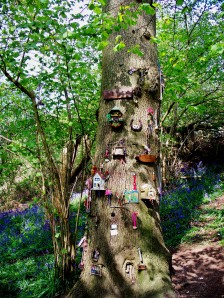
As we approached we began to find tiny teddy bears and plastic toys perched in the bushes, but even their increasing numbers did nothing to prepare me for the tree itself. An oak; not gnarled and twisted, but young, straight and strong – covered with toys, ribbons, beads, strings of shells, and even an old cuckoo clock. But best of all was the box filled with letters from children to the fairies – and the plastic folder on the back of the tree which contained the fairies’ replies.

Never before – or since – have I wanted to hug a tree so much. The feeling was pure instinct – something really basic inside me. As was the covering of the tree with offerings. Pagan? Yes – but in a way few of those who had left their gifts would even recognise as such.

So the fairy tree was the first strand of inspiration, but what of the characters who would discover it for themselves? The previous winter I had visited the beautiful city of Winchester for its Christmas market, and seeing homeless men gather at the Buttercross in the main shopping street, I began to wonder what it would be like to look into the eyes of one of them and realise they were an old flame. And that, dear reader, is where Robin and Izzie’s story starts. The themes of memory and of loss, well, they rather wove themselves, because The Faerie Tree had to be more than just a romance – there had to be mystery, and suspense.

So here I am, with a manuscript winging its way through the ether to my publisher. But the hard work of getting it into readers’ hands isn’t over – it’s only just started. As you will begin to realise when we meet again at Yule.


Jane Cable


The Indie Author Fair – a Pop-up Bookshop at the Chorleywood Lit Fest

Sunday 16th November, 2pm-5pm, British Legion Hall, Chorleywood

indiebanner

Indie authors and indie bookshops ought to be a marriage made in heaven – ideally suited to work together to create something fresh and exciting.

Catriona Troth, from the indie author collective, Triskele Books, is proud to have facilitated one such partnership – the first, she hopes, of many. Chorleywood Bookshop, well known for bringing literary luminaries to ‘the best little lit fest you’ve never heard of’, are working with the Triskele Books author collective and the Alliance of Independent Authors to host the inaugural Indie Author Fair at the Chorleywood Lit Fest.

authorreadings

For the first time, in one place, forty indie authors convene to showcase their work and demonstrate how indie author publishing represents all that is innovative, daring and creative.

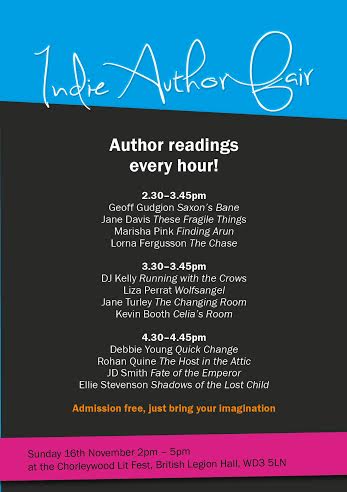
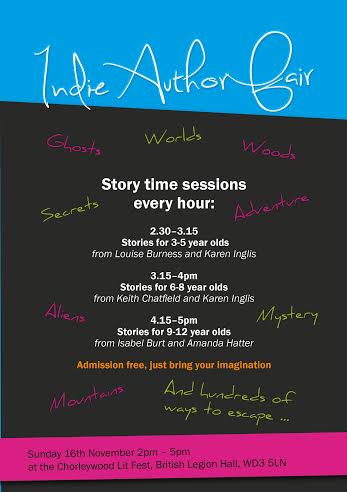
The Fair will feature works of crime, romance, historical fiction, comedy and lit fic, all read by the authors themselves. You can join in with story time sessions for children of all age groups, or browse the books while having afternoon tea and discover a hidden treasure.

indieauthorfairchildrensflyerIndie authors are a supportive, enthusiastic gang of professionals, ready to answer questions and share their experiences – good and bad. You can discuss plot with a crime writer, brainstorm covers with a designer, pick historical fiction brains, kick around marketing ideas. Or meet the people who make indie authorship happen: Sponsors Ingram, Matador and Reedsy are available to answer your questions.

Troth hopes it will turn into an annual event. “The Fair seems to have captured imaginations – authors are coming from as far away as Spain and Switzerland.”

Alliance of Independent Authors founder and co-host of the Fair, Orna Ross, is looking forward to, “the connections and collaborations, and the energising creative spirit that always blows when a crowd of dedicated indie authors get together.”

Richard Mollett, CEO of the Publishers Association says, “The Indie Author Fair is a great way of promoting writing and reading in Britain.”

If you love reading, if you enjoy meeting authors, if you’re curious about independent publishing – then come to the Indie Author Fair!


For more information, please contact Catriona Troth catriona.troth@gmail.com


Event page: https://www.facebook.com/events/727624687310614
Online catalogue: http://issuu.com/janedixon-smith/docs/iaf_catalogue_proof_issuu/0


A Day In My Writing Life: Lynne Hackles

I’m a busy writer, working under several different names. Here’s my typical day. Wake at 5am, do a thirty minutes run, thirty minutes housework and then sit and write until five in the afternoon. Some days I take a ten minute break for lunch.

And, if you believe that, you’ll believe anything.

Lynne Hackles

The truth is I get up when I feel like it. Some mornings I really do exercise. I stretch out my arms from under the duvet and clench and unclench my hands five times, then rotate the wrists five times.

Wearing my dressing gown, I stumble into the next room and switch on the computer, ready to start work. But I don’t. Start, I mean. I check emails, check my online horoscope, check Facebook, check my blog to see how many hits it’s had, then I do an online crossword, or two. I suppose I sort of creep up on work.

On my desk is an open notebook holding my To Do list. I’ll decide which job I am going to tackle, then set my kitchen timer for 25 minutes and while it ticks away I get stuck in and write. Once the alarm goes off I stop, get up and move. A few minutes later I start another 25 minute session. Moving regularly is necessary for me. I have a collection of lumbar discs in a jar so need to take care of my back.

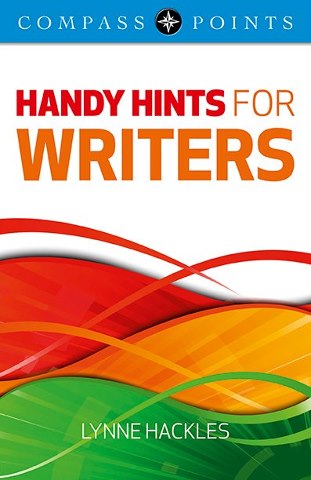
Lately, my writing work seems to be mostly journalism and non-fiction stuff. There was a time when I churned out stories for women’s magazines but I’m having a rather long rest due to being all story-ed out. Some days I have student assignments to mark – I’ve been a tutor for Writers’ News Home Study for 20 years. (They keep ignoring my hints about a golden clock.) Other days I try to ‘push’ my work. Writers are expected to do more than their bit when it comes to publicising their books. Handy Hints for Writers is one of my latest but I’m still telling people about Writing From Life and I give talks about writing down personal experiences as well as going the whole hog and tackling life stories.

Lunch is taken whilst listening to Tim Wonnacott on Bargain Hunt. I reckon, by now, I must have earned a degree in Fine Art and Antiques.

Afternoons are for doing other things. The LSO (Long Suffering One) and I will be in the garden or, if the weather’s not good, we’ll be inside stripping wallpaper, painting cupboards and doing the 1001 things that are needed in order to finish renovating the house we moved into a year ago.

Most evenings I carry my laptop downstairs and, while the television is on in the background, I’ll answer emails and do the admin’ side of my writing job. Other evenings, like tonight, I go out to give a talk.

And then there’s the Sabbath which can be any day of the week but which is work-free. It’s a time to recharge the batteries and do something different. We are working our way through a long list of places to visit, people to see and things to do.

handyhintsforwriters racingstart writingfromlife

Racing Start – a Kindle best-seller. Fast paced cycling fiction for 8-12 yr olds
Kindle/Amazon: http://www.amazon.co.uk/Racing-Start-Lynne-Hackles-ebook/dp/B00HNFOM8G/ref=sr_1_1?ie=UTF8&qid=1389086256&sr=8-1&keywords=lynne+hackles+racing+start
Kobo: http://store.kobobooks.com/en-US/ebook/racing-start
iTunes/iBooks: https://itunes.apple.com/gb/book/racing-start/id785373782?mt=11
www.lynnehackles.com
www.lynnehackles.blogspot.com
Handy Hints for Writers – Compass Books
Writing From Life – How To Books
Ghostwriting – Aber Publishing


Kate Kelly: A Day In The Life of An Author: The Edinburgh International Book Fair

A sunny morning in August and I was heading into Edinburgh on one of the city’s shiny new trams. The reason – I had been invited to appear as an author at the Edinburgh International Book Festival and this was the morning of my event.

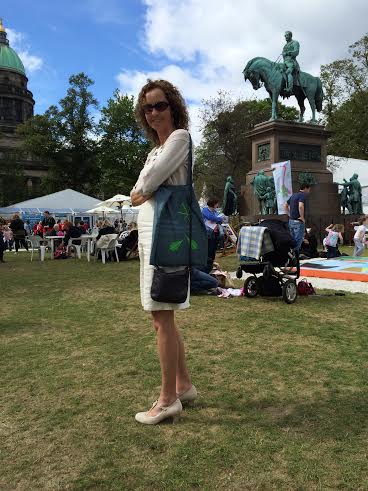
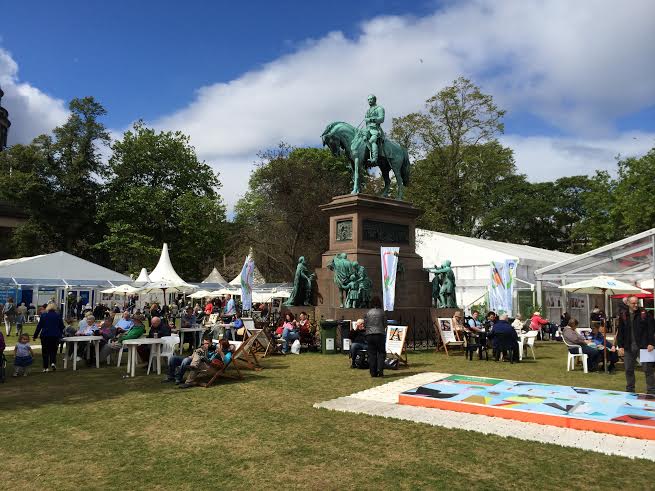
The Edinburgh International Book Festival 2014 was held in the beautiful Charlotte Gardens in the centre of the city. As I approached I could see the tents and marquees clustered beneath the trees and neat crocodiles of school children in pristine uniforms being herded by their teachers towards the venue.

A Day in the life of an author- The Edinburgh International Book Fair 1
The author arrives at Charlotte Gardens.

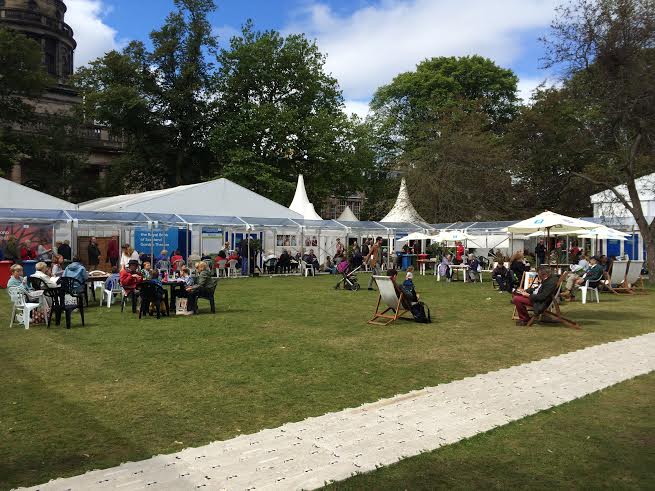
Inside covered walkways connected the event venues and bookshops which had been set up around the edge. In the middle was an area of lawns and seating where people gathered to drink coffee or eat their lunch

A Day in the life of an author- The Edinburgh International Book Fair 4
The Edinburgh International Book Festival in Charlotte Gardens

Mine was to be a joint event with Sarah Crossan, author of dystopian duology Breathe and Resist. Our event was called The End is Nigh and formed part of the Baillie Gifford Schools programme of events.

A Day in the life of an author- The Edinburgh International Book Fair 3
Another view of the venue, Charlotte Gardens.

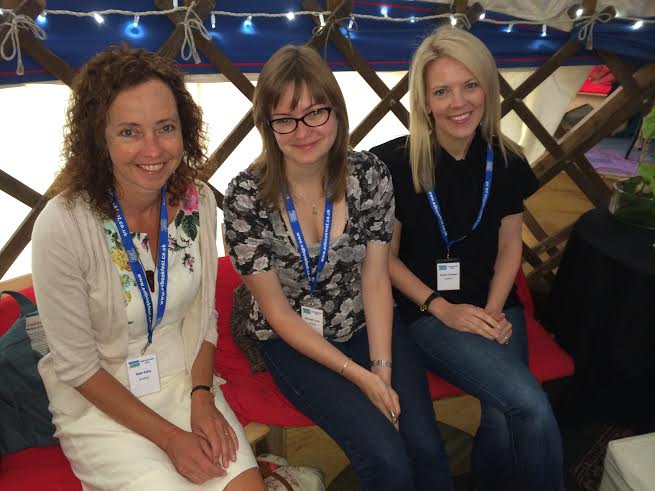
The authors had a separate area, the Author’s Yurt, where we could chat and relax both before and after our events and this was where I headed to meet up with Sarah, Hannah Love of Faber who was chairing our event and my publisher’s marketing director. Here we were fitted with our microphones and then we were escorted to our venue and 150 eagerly waiting schoolchildren.

A Day in the life of an author- The Edinburgh International Book Fair 7
Myself, Hannah Love and Sarah Crossan in the Authors Yurt

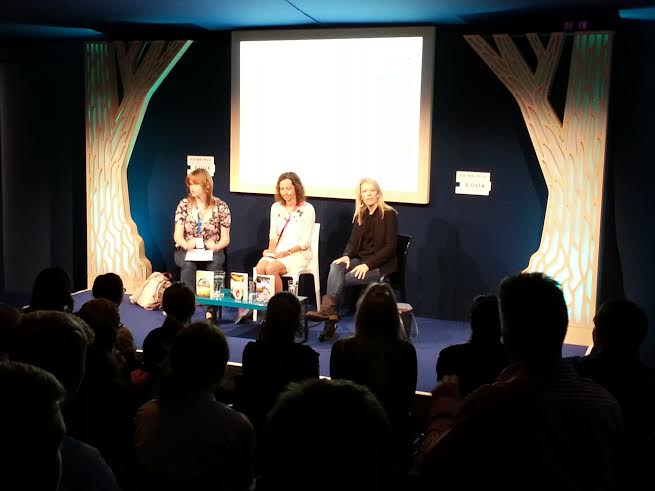
Sarah and I read extracts and answered questions about our books, both about the writing process and our inspirations as well as the environmental issues our books address and the emerging genre of Cli-Fi (Climate Fiction). It was an hour long event but it felt like minutes.

A Day in the life of an author- The Edinburgh International Book Fair
Answering questions about our books.

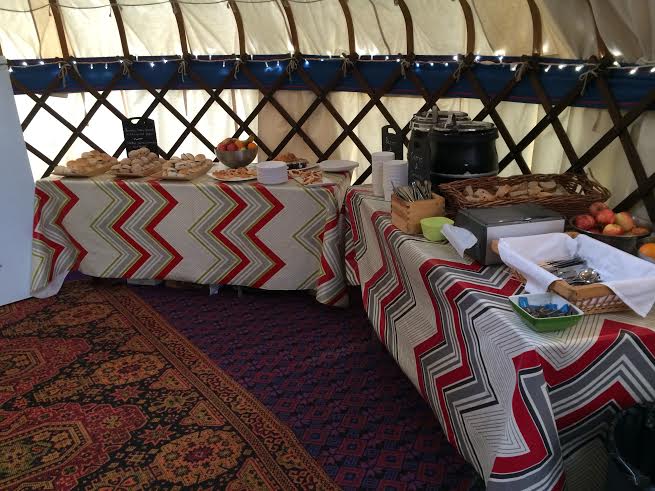
Afterwards we were taken into the festival bookshop where we had the opportunity to meet some of the children and sign books for them. A couple of groups had come across from Glasgow and were doing a school project on Climate Fiction of which our books formed part. It was lovely to meet them and see their enthusiasm. Then back to the author’s yurt for lunch.

A Day in the life of an author- The Edinburgh International Book Fair 5
Lunch laid out in the Author’s Yurt

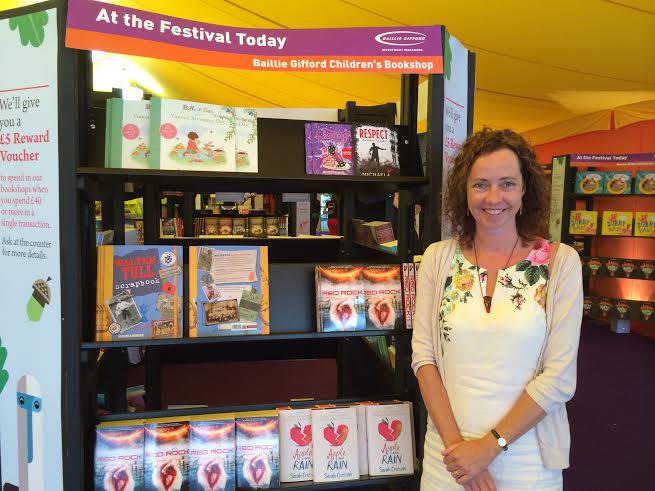
I was then able to explore the festival site a bit more and most importantly to check out the festival book shops. There was a special stand where that day’s events books were displayed.

A Day in the life of an author- The Edinburgh International Book Fair 6
Lots of copies of Red Rock for sale.

Of course no visit to Edinburgh during festival time would be complete without visiting out The Fringe and that was how I spent the rest of the day. Some of the street acts we saw were quite superb and the whole city was vibrant and alive.

My day at the Edinburgh International Book Festival was a superb experience and one I shall never forget.

Biography

Kate Kelly is a marine scientist by day but by night she writes SF thrillers for kids. Her debut novel Red Rock, a Cli-Fi thriller for teens, is published by Curious Fox. She lives in Dorset with her husband, two daughters and assorted pets and blogs at http://scribblingseaserpent.blogspot.co.uk/


Curious Fox link: http://www.curious-fox.com/


Amazon UK link: http://www.amazon.co.uk/Red-Rock-Kate-Kelly/dp/1782020616/ref=sr_1_1_bnp_1_pap?ie=UTF8&qid=1409831765&sr=8-1&keywords=red+rock


A Day in the Life of Tracy Baines

traceybaines


My life is full of distractions, it always has been. It’s one of the hazards of working from home. These days the distractions are mostly delightful and indulgent. First of all we have a new puppy, Harry, a springer spaniel and for the time being his needs come first. At the moment he’s snoozing in his bed at my feet but mostly he’s biting at my files and books and I am constantly telling him NO. He’ll learn.

harry

Once I’ve fed him and myself I’ll get to work on something easy like a blog post, just to get the writing flowing. If I start with emails it’s all too easy to get distracted so I leave that for later when I need a brain break.


I’m working on a book about my experience with my daughter’s eating disorder and the effect it had on the family. It was the kind of book I needed when we discovered how ill she was. It’s hard work as it brings back the awfulness of the situation so after about an hour I’m looking for something lighter to play with.  I might edit a couple of chapters of my novel or work on the second Nelly’s Jellies picture book for children, or an article or short story. I write for magazines such as You, (South Africa), That’s Life Fast Fiction, (Australia) and most of the UK women’s magazines.


After lunch my daughter usually appears with my grandchildren, Elsie and Hadley. The kettle goes on and we sit and chat and generally let the grandkids call the tune. So it might be CBeebies with Mr Bloom and Show Me, Show Me, or an hour in the garden. Sometimes my son comes over with his wife and my grandson, Huxley, and then the house becomes full and noisy and before long I want to escape to the quiet of my office and get back to work.

grandchildren I tend to use the afternoons for admin or going out for lunch with my husband. I can’t say long suffering husband as it’s been the other way around for years and now it’s my turn to pursue my writing career. When he goes out to the golf club  I might work for an hour or two in the office, editing a short story unless I’m teaching in which case I might arrive early to class and work on something or catch up on reading and research. I try to use as many ‘bits’ of time as productively as I can to work on my writing as for years that was all that was available to me. I think that’s why short stories are perfect if you don’t have a lot of time to write. You don’t have to hold so much in your head all and yet you have the satisfaction of seeing your work in print. A quick fix if you like.


New York Times Bestselling Author Elizabeth Buchan | Writer Interviews

Elizabth Buchan I Can't Begin to Tell YouWhat is the key to writing a good romance novel?

Good question and I think the answer is the same as it would be if you asked: what is the key to writing a good novel…? The answer must be absolute commitment to get the material down onto the page in a way which is truthful, resonant and as gripping as you can make it. That includes the love story and the emotional roller coaster of it, the thriller, the war drama and delicious social comedy. I would like to point out that these aims sound very simple and easy to achieve … but, in my experience, they are anything but.

Do you have a favourite book that you have written?

No, they are all my children… having said that some were easier to produce than others. Revenge of the Middle Aged Woman tripped off the pen. So did Daughters and I Can’t Begin to Tell You

What is your writing routine?

Breakfast with newspaper (and cats). I cannot go without any of those. Then, out for power walk around Clapham Common (can’t go without that either). I usually settle into the office about 9.30 where I write until lunch time and then again through the afternoon. If I am on the final stages of a book, I will be work until quite late.


How do you come up with your ideas?

I wish I could tell you. I just pick up something – from a book, the paper, a conversation and, suddenly, I seem to have a subject. But I have to wait for that coup de foudre to happen. It is useless to try and force yourself to write about a subject with which you haven’t fallen in love.


Do you ever get writers block?
Yes. The trick is to do something deeply boring – such as the ironing. Exercise is another way of letting the brain solve a problem without you being aware of it consciously. Also… ahem… I find a little light retail therapy works as well.


How long does it take you to write a book?

Anything from about eighteen months to two years


Advice for wannabe writers?

Do it. Don’t talk about it. Don’t dream about it. Don’t put it off.
Do it. Try and isolate a part of the day in which you function best (are you a night owl or a lark?) and set yourself a realistic target a day. Half a page. A page. It is amazing how it grows and observing it grow encourages you onward.


Best piece of advice you have ever been given?

Was it Bernard Shaw who said: ‘If you fail, pick yourself up and fail again better’. (I am sure someone will know the quotation).

Favourite authors/books?

Charlotte Bronte’s Jane Eyre, Ian McEwan’s Atonement, Anne Tyler’s Breathing Lessons Richard Holmes’ Footsteps, Kingsley Amis’ Lucky Jim, William Boyd’s Any Human Heart and Robert Harris’ Enigma. I have many more.

You are a judge for the Costa awards. Is it hard choosing a winner?

Extremely.

You review for The Sunday Times, how do you write a good book review?

Reviewing is a different animal from judging. It acts as a form of introduction to the reader. In effect you, the reviewer are saying: this is the book, this is what it is, this is how well I think it works and, now, it is up to you. If you can relay over the flavour and substance, offer acute reflection and perceive it fairly you are doing a good job. You are not really there to entertain. Having said that, reviewers who write brilliantly deservedly have a following.


What’s next for you?

I am writing the next novel, Aftermath, which is set in South London just after the Second World War. In it, I will have a fractured family who show how difficult it was to pick up the pieces having experienced violence, disruption and hatred of an enemy. There is also a death. Is it suspicious or not?

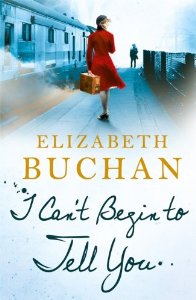
Elizabeth Buchan’s latest novel, I Can’t Begin to Tell You, is published in Penguin.