INTRODUCING SISTER SCRIBES: SUSANNA BAVIN

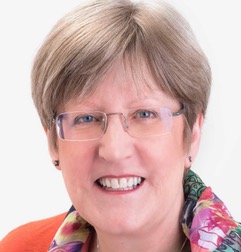
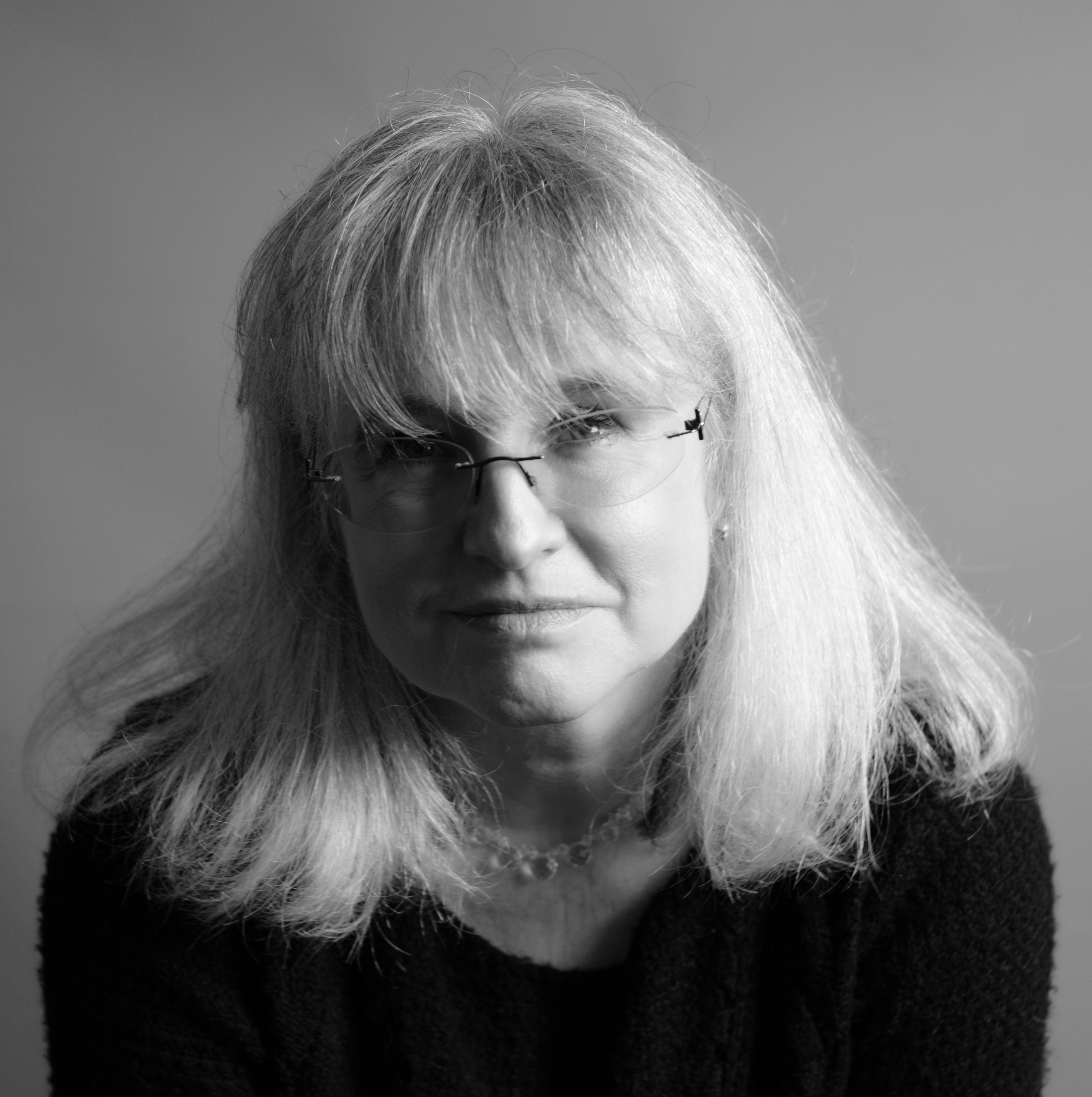
Despite her concerns about sounding showy-offy that’s the last thing Susanna Bavin is. She may be the quietest of the Sister Scribes, the most softly spoken, but that does nothing to hide her keen intellect and enquiring mind. Most definitely her own woman.
There is something scary about being asked to introduce yourself on a magazine page. Will it sound showy-offy? But my fellow Sister Scribes have all introduced themselves, so now it’s my turn. Here goes.

I am living proof that dreams come true. There! How’s that for showy-offy? Not to mention being rather a grand claim. But it’s the simple truth. As a child, I dreamed of one day living in North Wales – Llandudno, to be precise – and six years ago, my husband and I found a beautiful house here, threw caution and jobs to the winds, and moved here. Best thing we ever did. One question we get asked by people who would love to live here (it seems that almost everybody who comes here on holiday dreams of living here) is, “Is it different when you live here? Less special?” and the answer to that is a resounding No. We love it just as much, if not more, and that feeling of “Wow! We really live here” has never gone away.

So that’s one dream. The other, of course, is that I have finally become a published writer. I say ‘finally’ because, although I was a child-writer and have been writing all my life, for most of that time I didn’t submit anything to literary agents. As a matter of fact, I got rather hooked on getting feedback and worked with a writers’ advisory service for some years. Then I decided to aim for publication, so I joined the RNA (Romantic Novelists’ Association) with the intention of writing four books, so as to have a body of work to offer a literary agent.

In the event, after I had written three, I became aware of other new writers getting their books published, which made me feel left behind, so I decided that the size of my body of work was perfectly adequate at three books and started submitting to literary agents. I was lucky enough to be signed up by Laura Longrigg at MBA.

The books I write are sagas. To date, I have had three published – The Deserter’s Daughter, A Respectable Woman and The Sewing Room Girl. The fourth, The Poor Relation, follows in May. The books are set in the part of Manchester where my family has lived for several generations and where I grew up.

I was a saga writer before I knew what sagas were. As a teenager, I lapped up Victoria Holt’s novels and started writing gothic stories, but these naturally grew and became what I later found out were sagas. For me, this was just the natural development of my writing style. I was delighted when, as a reader, I found out that other people wrote this kind of story too!

What do I like about sagas? The historical setting, for starters. I love to see the characters having to tackle their problems within the social and legal context of the time. I also enjoy the glimpse of social history, which is a great interest of mine. Clothes, meals, furniture – I love all those domestic details especially costume. It’s no coincidence that my forthcoming book, The Sewing Room Girl, involves the making of lots of clothes!

Follow Susanna on Twitter @SusannaBavin


A PUBLISHER’S YEAR: JANUARY – HIRING, GENRES, AMAZON

It is an exciting start to the year for Sapere Books. We have decided to hire our first full-time staff member. Up until now Sapere Books had been solely run by its three co-founders – myself as Editorial Director, Caoimhe O’Brien as Marketing Director and Richard Simpson as Operations Director. We were also using freelancers last year to help with cover design and proofreading, but we have decided we are at a stage where we need a full-time extra pair of hands as well! So, in a couple of months I’ll have a new Editorial Assistant to introduce to everybody. It is our first time hiring so we are currently brainstorming what tests to set candidates and exactly what we want to ask them at the interview stage. More news on that in a few weeks!

We have also put a call out for ‘nautical fiction’, as that is a genre which is underrepresented in the market and which we know readers love, and we’ll be looking for other niche genres to sign up throughout the year. We are having a lot of success with our first ‘timeslip’ novel – The Catherine Howard Conspiracy by Alexandra Walsh, which alternates between the Tudor court and the modern day, so that may be an area we’ll expand into more in the coming months. Other than that, my inbox is full to bursting with submissions, which is fantastic, but I always find it slightly heartbreaking when I have to turn authors down. We are getting such a fantastic quality of submissions coming through that I am turning down lots of novels which are certainly good enough to be published, but we can’t say yes to all of them because we don’t want to flood our list, and end up not being able to give our books the attention they deserve.

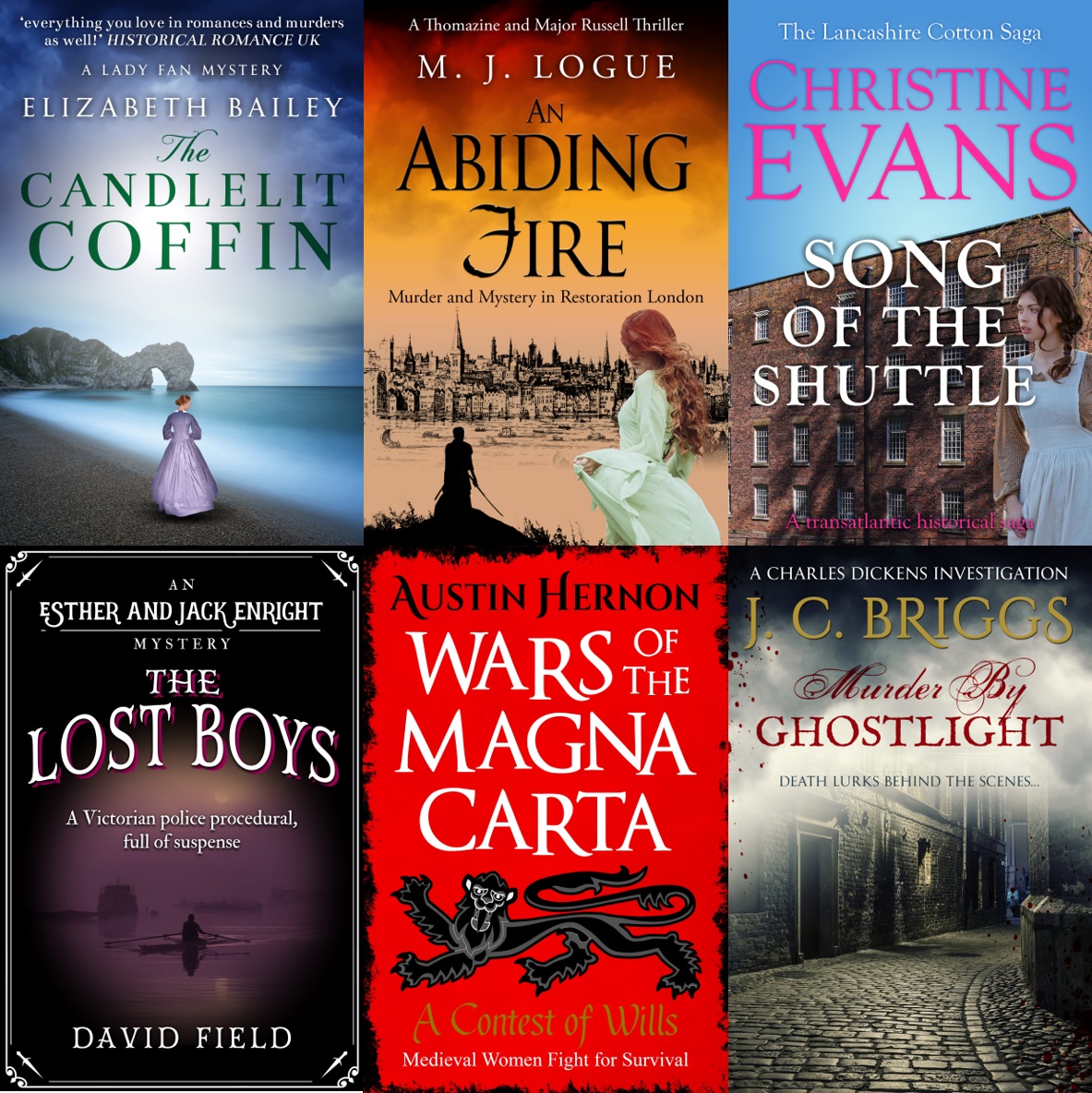
The publication schedule for this month focussed largely on historical fiction. At the start of the year I published the fourth book in Elizabeth Bailey’s brilliant Regency mystery series and M J Logue’s first romantic thriller featuring Major Thankful Russell and his wife Thomazine, set during the Restoration. They were followed by a Medieval novel; the first part of a saga trilogy set at the time of the American Civil War; a crime novel featuring Charles Dickens as the investigator; and the final book in the eight-part Victorian mystery series we launched last year, featuring a husband and wife detective partnership. Next month will be more crime and thriller focussed – with a bit of romance thrown in in time for Valentine’s Day!

We have just had a catch up meeting at Amazon HQ to let them know what we will be publishing this year. The Amazon team have given us lots of ‘Kindle Daily Deal’ and ‘Kindle Monthly Deal’ slots over the past few months in the UK, US, Australia, Canada and even India, which can really give books a boost, so we are keen to keep the team over there up-to-date with our plans and the books we are publishing. I am also sorting out the diary for London Book Fair, which promises to be a crazily intense three days as always, but a brilliant time to catch up with literary agents, meet with authors – and indulge in a drink or two!

Finally, I have some exciting news to share to do with the Romantic Novelists’ Association but I have to wait until the official press release goes out next month so you’ll have to wait until then to hear more!

Amy Durant


WRITING IN THE NEW

Jane Cable sets out her plans for Frost for 2019…

Much as I’ve loved hosting Business of Books over the last couple of years, it’s definitely time for a change. Two changes in fact, but more of the second one later.

Readers with very good memories may recall that in the autumn I went on a mini retreat with four writer friends. It was a comment from Kitty that started it – just as we were leaving – she said we’d become sister scribes. So I began to ponder what that could mean.

The world over women are particularly good at giving other women support. We excel at cooperation, collaboration, sharing the champagne and handing out the tissues (or the gin). We celebrate, we commiserate, we coax, we cajole – in short, we are there for each other.

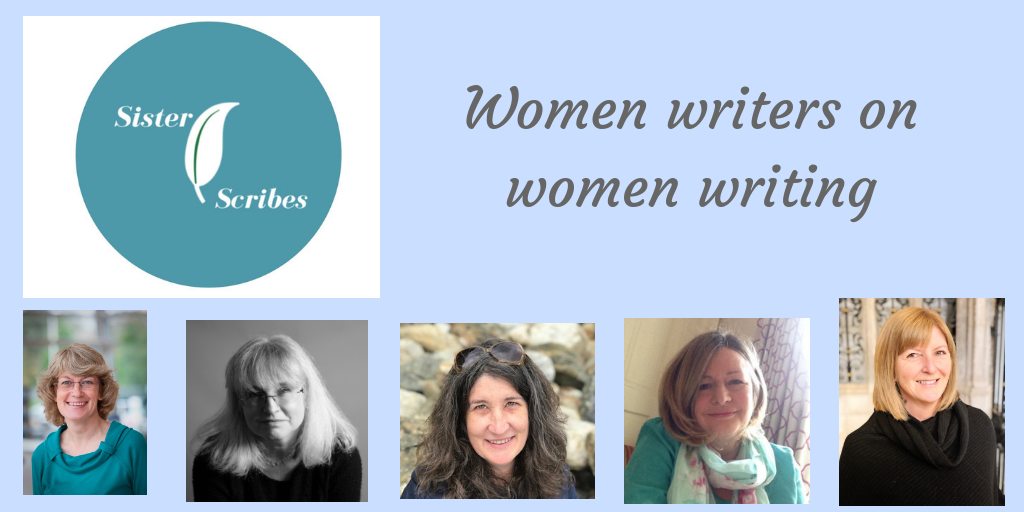
So this year I’m sharing my Frost columns with my Sister Scribes. Over the next few weeks everyone will introduce themselves, and in the coming months we will all introduce other sisters from the world of words; women whose contributions to our writing lives are important to us. Women who want to share their passion for writing for, by, and about women.

So, the Sister Scribes are:
Cassandra Grafton has her roots in Austen-inspired fiction and is a Jane Austen Literacy Foundation ambassador. Published by Canelo from this year.
Jane Cable is a long term contributor to Frost. Indie author published by Sapere from this year.
Kirsten Hesketh’s first novel landed her an agent. Hopefully a deal will follow soon.
Kitty Wilson walked straight out of the RNA New Writers’ Scheme into multiple offers. Writes hilarious romcoms for Canelo.
Susanna Bavin writes elegant, well-researched sagas. Published by Allison & Busby.

We met because we are all members of the Romantic Novelists’ Association, but that doesn’t mean the columns will all be about romance as our network of contacts spreads far and wide. Within the genre we cover a broad church, from sagas to romcoms and a great deal in between. There will be plenty of interest for readers and writers alike, with our first guests including my own long time buddy Carol Thomas on marketing collaboration and Cassandra’s co-author Ada Bright on what it’s really like writing together.

So that’s the first change. The second is an additional column on the last Wednesday of every month to replace the popular Take Four Writers. I will miss Angela, Claire, Jackie and Lucy but it’s time to offer a different perspective and I’m delighted that Sapere Books has offered to provide it.

Every month one of the Sapere team will give an insight into their publishing year. Editorial Director Amy Durant is as delighted about it as I am: “I am very excited to be offered this chance to give readers and writers a unique perspective into what life is like at Sapere Books. We are still a very new publisher and we have lots of exciting projects and developments launching this year – including publishing two of Jane’s books – so there will be plenty of news to share. As a small team we have the flexibility to change strategies at the drop of a hat, if something interesting pops up, so even I don’t know yet what I’ll be writing about in six months’ time, but I hope you will enjoy reading about Sapere Books’ journey in our second year of trading.”

So what will I be doing with all this extra time? I’m hoping I’ll be able to review more books for Frost and even branch out into travel and history related articles. Plus, as Amy has reminded me, I have two books out this year…


BUSINESS OF BOOKS: FIRST, LAST, EVERYTHING – BEST OF THE BEST, PART 2

We’ve been given some wonderful advice from our First, Last & Everything guests this year, so here’s the best of it:

ON WRITING

Don’t get it right – get it written. Susanna Bavin

Sometimes it really is okay to tell not show. Every course I’ve ever attended and blog you read talk about showing not telling. It can become obsessive. At some point, it’s better to just say: ‘it’s midnight’ rather than: ‘Bats passed silently by the ancient metal hands of the church clock as they moved into a vertical position.’ This is particularly true in children’s books where most kids want action. Christopher Joyce


ON EDITING

I went on an editing course recently and was advised to highlight the different points of view in my manuscript using different colours. The idea being that the distribution of the colour throughout the manuscript enables you to see if the balance between each characters’ points of view is even. This is an invaluable tip, as often I get fixated on one character’s view point and this enables me to present a balanced piece of work. Morton Gray

I printed my novel on A4 paper and began to read it. This was a pivotal moment in my writing career. Multiple small errors, which were mysteriously invisible before, began to jump out at me. It was a valuable lesson and now I always edit a paper version at some point during my self-editing phase. Victoria Cornwall


ON PUBLISHING

Phillipa Ashley and Rowan Coleman both advised me without a second’s hesitation to join the Romantic Novelists’ Association’s New Writers’ Scheme. I went on and joined in the January of 2014, and published that début novel the following year. Julie Stock

Put a name to a face quickly and always have a smile. Publishing is still quite a small world and conducting yourself in the right way will really keep your options open. You never know when you may need somebody’s help in the future! James Faktor

If you’re going to self-publish, it’s important to go through the same steps as a mainstream publisher would prior to publication. Think carefully before using free resources unless you’re convinced about the result. It’s usually worth paying professionals for edits, proofing and cover design.  Cathie Hartigan


ON READING

I think everyone should make friends with their local bookshop.  Booksellers have a wealth of knowledge that they love to share, and bookshops are such beautiful places to spend time in. Cressida Downing

If you’re not enjoying a book, don’t struggle through it and make the whole process horrible. There are so many amazing books out there for a variety of tastes, passions and interests – find something that sparks a light in you and devour it! There will be a book out there for you, I can guarantee it! Lara Marshall


ON LIFE

Comparing your own life and career to the life and career of someone else portrayed online is not only pointless but can be damaging. So I’ve had to learn to stop – and I would definitely give this piece of advice to anyone starting out in writing or any other career. Clare Swatman

In the famous words of Antoine de Saint-Exupéry, “All grown-ups were once children… but only few of them remember it.” Yasmin Thornber

You won’t learn about people in a classroom.  Get out there, but take your notebook.

Julia Dean


BUSINESS OF BOOKS: FIRST, LAST, EVERYTHING – BEST OF THE BEST, PART 1

We’ve been given some wonderful advice from our First, Last & Everything guests this year, so here’s the best of it:

ON WRITING

There’s no magic bestseller formula (if there were we’d all be making millions of pounds!) – all you can do is write the best book you can. That’s it. Clare Swatman

Listen to the advice you are given but do not blindly accept it or reject it without consideration. Evaluate it, then adopt or discard it. There is no ultimate template of how you should write, what you should write, the rules you should obey or break. Sandra Danby

I have offered this advice to a few writers and they have all told me it is a good idea, so I am happy to share it with you here: don’t stop writing today unless you know how you are going to start writing tomorrow. For me, following this rule means that, when I hit a problem and the writing becomes difficult, I always keep at it until I have got past the hard bit and things are flowing freely again… so that when I stop, I know how I’ll start again next time. Susanna Bavin


ON EDITING

Once you’ve written and edited your work get in proofread by a professional. This is not your sister, who is an English graduate; not your neighbour, who studied law and is very bright and NEVER yourself. It’s impossible. Christopher Joyce

I follow a lot of writing blogs on Twitter, and many of them have wonderful snippets of advice, one of the most practical of which in recent months was about removing redundant words from your manuscript. I discovered there were plenty of lists out there, once I’d put ‘redundant words in your novel’ into Google, and soon I was working my way through my extremely long manuscript and culling them (thank you, Word, for the Search and Replace function). In the end, nearly 10,000 redundant words sailed off into the blue yonder; not one of them was missed! Cassandra Grafton

Two author friends, at separate times, said they were listening to their manuscripts for errors and suggested it was a good way to edit. It is easy to read what we expect to see rather than what is truly there. Our hearing is very sensitive. A misspelt word, repetition or a sentence that is far too long, is more obvious to our ears. Victoria Cornwall


ON PUBLISHING

Ebook jackets will be seen as thumbnails on retailers’ sites so you need to ensure that the title can still be read. A small, thin font in a colour that doesn’t stand out isn’t the best and don’t clutter your cover – try to keep it simple and avoid too much text. Megan Lockwood-Jones


ON LIFE

The one piece of advice that has helped me in both my personal and professional life is: treat others as you’d want them to treat you. So be polite and considerate and don’t take advantage of other people. Never say something behind someone’s back you wouldn’t say to their face and if you make a mistake, apologise and move on. And never try and attribute blame. Mistakes happen, learn from them. Sue Featherstone

Be kind to yourself. Set reasonable goals (if that’s the type of writer you are) and don’t beat yourself up if you don’t manage to achieve them. Also have breaks from your writing. Writing isn’t something to be forced but to be enjoyed and, if it isn’t, maybe it’s time to ask ourselves why we’re doing it. Wendy Clarke

It is never too late to begin to write. Morton Gray


BUSINESS OF BOOKS: RETREAT OR TREAT?

Retreat or treat? When five writers arrived in Bath last month, we didn’t really know how it would pan out. We intended to work, but it was the first time we’d seen each other since meeting at the Romantic Novelists’ Association conference fifteen months earlier, so would there be too much gossiping going on? Or even a frosty silence as we realised we didn’t actually like each other that much after all.

We certainly started being very polite. Cassandra Grafton (no stranger to Bath with her Austen-esque novels) found an enormous Georgian house we could rent from Bath Boutique Stays and there was quite a bit of ‘after you – no, after you’ as we chose our bedrooms.

It soon became clear that our centre of operations would be the kitchen with its windows either end and huge table. We had no plans to cook, but Kitty Wilson and I had raided M&S on the way (she is one serious snack shopper) and what with our booty and all the wine, the fridge was filled to bursting point. But did we open a bottle straight away? No – we made a nice cup of tea.

So the first myth was busted open – we were not destined to spend our three nights drinking ourselves into a stupor. A drink with dinner (we tried a variety of local restaurants, culminating at the amazing Aqua) then another one or two afterwards was about our limit and while the vodka bottle was hit pretty hard (you know who you are, ladies), the gin went almost untouched and only two half bottles of Prosecco from our stash were consumed.

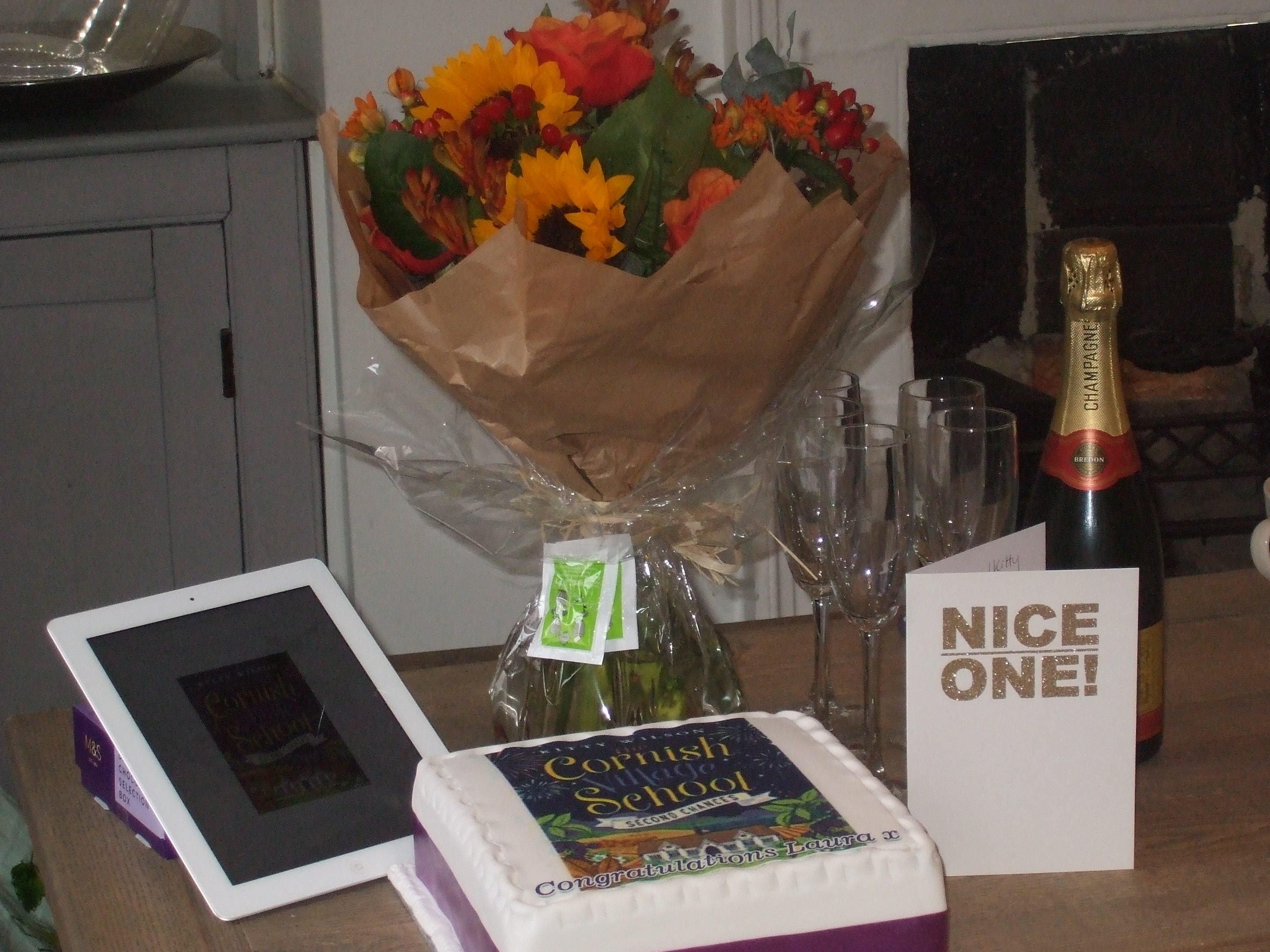
We did drink on the second morning though as we celebrated the launch of Kitty’s second book. Champagne and cake well before the sun was anywhere near the yard arm, flowers smuggled into the house and hidden the previous day, and a gift from us all. Of course, before we could touch any of it we had to stage a photo or two for social media. And then spend a great deal of time sharing them to all our followers.

Second myth – we had no real intention of doing any work. Wrong again. Susanna Bavin wrote more twenty pages in longhand towards the trilogy of sagas she’s working on. I completed the structural edit of the second book of my Sapere deal. Kirsten Hesketh was busy reworking the draft of her second novel while Kitty focussed on guest posts for her blog tour (not to mention keeping up her daily word count) and Cassandra worked her way through her ‘to do’ list following the announcement of her contract with Canelo.

But more than anything we supported each other in ways small and large. I helped Kitty with her guest blogs (I’ve done so many of them) and she and Susanna critiqued the outline I’d prepared for Sapere. Kirsten’s agent had started to send her manuscript to publishers and had received a few initial rejections – and there always are rejections – but that doesn’t mean they hurt any the less. I like to think we were all there for her.

The two days and three nights flew past, mainly because we were in the company of other writers. It’s a profession where you have no colleagues, no daily water cooler moments and just to be around each other and chat authorly things was utter bliss. Noone understands writers like other writers – the highs, and the lows, and the mundane bits in between.

We left Bath on the Friday morning with the firm resolve to do it again. But something else had happened along the way; bonds had been formed and friendships deepened. We’d become, as Kitty put it, sister scribes.

BUSINESS OF BOOKS: FIRST, LAST, EVERYTHING – NOVELIST MORTON GRAY

What was the first piece of writing advice you were ever given?

When I first began to write I attended a weekly writing course run by author Sue Johnson in the lovely town of Pershore in Worcestershire. Sue gave us a variety of writing prompts each week, such as poems, pictures, leaves, random objects, word lists and such like. Then she’d give up a time limit in which to write something. The idea was just to relax and see what appeared on the page from the stimulus of the prompt. I still use this technique to get started with stories, or if I’m stuck in the middle of a book. I am very grateful that this early training enables me to write quickly if I need to.


What was the most recent piece of writing advice you received or gave?

I went on an editing course recently and was advised to highlight the different points of view in my manuscript using different colours. The idea being that the distribution of the colour throughout the manuscript enables you to see if the balance between each characters’ points of view is even. This is an invaluable tip, as often I get fixated on one character’s view point and this enables me to present a balanced piece of work.


What piece of advice (writing or otherwise) would you like to pass on?

Oh dear … it is difficult to stick to one, so I’m going for three!

  1. It is never too late to begin to write.
  2. You should always stay true to your own work and not worry about what others are writing.
  3. Writing is such a solitary occupation that it is important to find fellow writers to speak to and share with, be that online or in real life.


Morton has been reading and writing fiction for as long as she can remember, penning her first attempt at a novel aged fourteen. Her debut novel The Girl on the Beach was published after she won Choc Lit Publishing Search for a Star competition. She is now writing a series of novels based in her fictional seaside town of Borteen. Her second novel The Truth Lies Buried is to be followed by Christmas at Borteen Bay out on 13 November 2018.


You can catch up with Morton on her website www.mortonsgray.com on

Twitter – @MortonSGray, her Facebook page – Morton S. Gray Author – https://www.facebook.com/mortonsgray/ and

Instagram – https://www.instagram.com/morton_s_gray/

BUSINESS OF BOOKS: FELINES, FILMS AND FINESSING

If there’s one creative mountain that’s harder to climb than getting a book accepted by a publisher, it’s selling a screenplay to a film company. But stripped back to its most basic level you’re actually creating, and selling, the same thing – a story.

Of course I’d heard of novelists using screenplay techniques but I’d never given it serious thought until one day last summer when I was lazing in author Liz Fenwick’s gorgeous garden and she told me these were methods she used. Given how much I admire Liz’s work I quite literally sat up and took notice. And given how much of an evangelist for these skills she is, just a few hours later she sent me a reading list.

The first book on it has the unlikely title of Save the Cat and is written by Hollywood screenwriter Blake Snyder. While the title is intriguing the contents are a veritable bible and one or two areas in particular resonated with me. Especially as I’ve always struggled with what authors term ‘the elevator pitch’ and what Snyder calls ‘the log line.’

The log line’s job is to sell your screenplay – or your novel – in one or two sentences. I think we all know that. But Snyder digs down into what a great log line should be and stresses that you shouldn’t get too far into your opus (or indeed start it at all) until the log line has been pinned down, finessed, and tested. Once it has, it isn’t just a selling tool either – it becomes the starting point for developing your story.

The first question it needs to answer is ‘what is the book about?’ Go on, scribble it down. Just reducing it to a couple of sentences will most likely be a challenge. But honing it until you have the right selection of words takes much more skill and again Snyder gives us the tools: Does it hook the reader’s interest? Does it create a compelling mental picture? Is it easy to tell who the intended audience is? There’s a whole chapter on genre and categorising your story in film terms – which gives a very interesting perspective on classifying novels too.

After the ‘what’, comes the ‘who’. Who is the hero? And what is he or she up against? If that’s already clear from your log line, then great – but the chances are it won’t be, so out comes the red pen again. Snyder advises that at the very least you need to have an adjective to describe the hero, an adjective to describe the bad guy (in the widest possible use of the term), and to show the hero’s compelling goal – which has to be one the audience will identify with.

And once you have all that right there’s just one more tiny thing – the killer title. I didn’t say this was going to be easy, did I? Talking of killer titles, what exactly does Save the Cat mean? It refers to that small but important moment early in the story where the hero does something to make the audience love him or her – a very small point in the overall context of the book – but as titles go it certainly does its job.

Of course I’m skating over a great deal of detail here – my aim is to whet your appetite, not give a blow by blow account of the whole technique. There are so many valuable hints and tips between the pages of Save the Cat any writer who wants to perfect the log line would be wise to read it themselves.