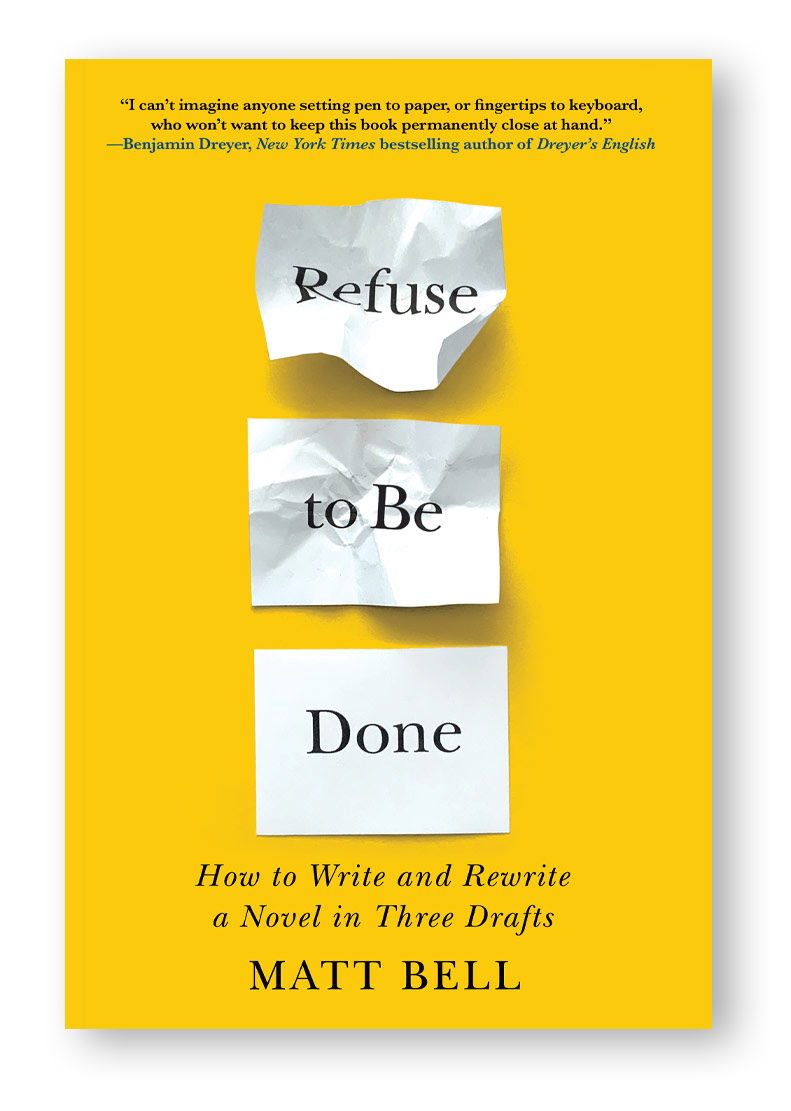
Matt Bell’s March craft book, REFUSE TO BE DONE: an accessible, practical guide to writing and revising a novel—for writers of any genre and level

“I can’t imagine anyone setting pen to paper, or fingertips to keyboard, who won’t want to keep this book permanently close at hand.”
—Benjamin Dreyer, New York Times bestselling author of Dreyer’s English
 We all need help to be the best writer we can be. This brilliant book from Matt Bell not only does that, but it also teaches you have to be efficient, something that is a must as writing becomes a career. I loved this book and I cannot recommend it enough. I will definitely keep it close to hand. — Frost editor, Catherine Balavage.
Acclaimed author Matt Bell draws from years of writing and teaching experience to deliver an accessible, direct, and concise guide to novel-writing full of concrete tips meant to guide writers of any genre, at any stage of their career, from first to final draft.
Matt Bell | Refuse to Be Done: How to Write and Rewrite a Novel in Three Drafts | Trade Paperback Original | $15.95 US/$21.95 CAN |
ISBN: 9781641293419 | ON SALE: March 8, 2022 | Soho Press
Refuse to Be Done is intensely practical, focusing always on specific tasks, techniques, and activities for writing a novel, from the first draft all the way through final revisions. Divided into three main sections—each containing numerous subheadings and detailed items—the book is easy to use at any and every stage of the writing process, whether one is starting from scratch or already has a full draft to revise. Concrete examples from published fiction and media, as well as Matt Bell’s personal experiences, bring further meaning to the tips included, showing how they were developed and how they come to fruition in existing works.

In the first section, Bell shares a bounty of tactics to get through perhaps the most daunting stage of novel-writing: actually writing the book. Intended to push writers through the initial conception and get words on the page, this section includes strategies for process (such as how to regiment one’s writing and track progress), the writing itself (e.g. how to develop characters and determine which scenes to write next), and overcoming writer’s block.

Next, with a complete draft in hand, the second section focuses on reworking the narrative through outlining, modeling, and rewriting. This includes such tasks as fleshing out characters, scrutinizing the plot, and reshaping a manuscript into a more polished form.

The final stage captures Bell’s philosophy to “refuse to be done,” encouraging writers to stay in their novel for as long as they’re able by working through a checklist of revisions. In this layered approach, writers fully work through the text multiple times, focusing on a specific, achievable task through each pass. Whether it’s revising the prose or scrutinizing the structure of each scene, every pass brings the manuscript closer to accomplishing the writer’s ambitions and becoming the greatest it can possibly be.

Written for novices and veteran writers alike, Matt Bell’s accessible, practical guide to novel-writing offers an abundance of strategies to motivate writers and invigorate the revision process, empowering novelists of all genres to approach their work with fresh eyes and sharp new tools to produce their best work yet.

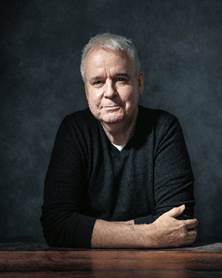
Tim Sullivan My Writing Process

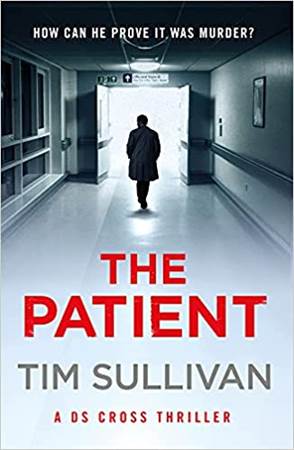
tim sullivan the patientI’ve always written. I wrote and directed my first short film at university and the writing followed on from there. I began writing screenplays with some success, starting in the late eighties with an adaptation of Evelyn Waugh’s A Handful of Dust starring Kristen Scott-Thomas, James Wilby, Judi Dench and Alec Guinness. This was followed by an adaptation of EM Forster’s Where Angels Fear to Tread starring Helen Mirren, Helena Bonham-Carter and Judy Davis. I then wrote and directed Jack and Sarah with Richard E Grant, Samantha Mathis, Ian McKellen, Judi Dench and Eileen Atkins. This led to a screenwriting career in America where I worked with many producers including Ron Howard, Scott Rudin and Jeffrey Katzenberg. I spent a year writing the screenplay for Shrek 4 before the studio decided to go in a different direction with the movie. My last two produced movies were Letters to Juliet starring Amanda Seyfried and Vanessa Redgrave and last year My Little Pony – A new generation. I’ve always wanted to write novels, specifically crime and finally found the time. My series centres upon DS George Cross a socially awkward and sometimes difficult but brilliant detective. He is based in Bristol and has the best conviction rate in the force. His third outing The Patient is released by Head of Zeus on March 3rd.

tim sullivan the patient

What is your writing process?

I’m a morning writer. I find I get my best work done then. Ideas seem fresher and I have the energy to get going. I tend to re-read and edit in the afternoons.

Do you plan or just write?

With screenplays I definitely plan. You have to. But with crime novels I start knowing who has died and who’s done it, but I have no idea how to get there. This can make things complicated and it’s easy to lose faith when you’re not sure which way to go. But I think it means that George Cross, the audience and I are all discovering things at the same time. I think this gives the narrative a more convincing and interesting path.

What about word count?

This varies enormously. I write everything long hand in fountain pen before it gets anywhere near a computer. So, a minimum of 500 words and a maximum of around 2500.

What do you find hard about writing?

The beginning of a book is hard. Until I’ve reached 20,000 words I’m not really sure whether it’s going to be a book at all. I enjoy it a lot more after that. I find it hard not to write long meandering sentences but thankfully I have an eagle-eyed editor who keeps me on the straight and narrow or should I say within the margins.

What do you love about writing?

I used to find the solitary nature of it hard but now it’s possibly what I love about it the most

I love creating characters and relationships. Writing things that move me or make me laugh. 

It’s amazing how many times as a writer you can surprise yourself.

Advice for other writers.

Find the confidence to do it and sit down and write. Write for yourself before you write for anyone else. Sketch down ideas and scenes. Write clutches of dialogue as they come into your head. Don’t sit down and try and write a complete project. Play around a little.

And enjoy it. Everyone writes better when they enjoy what they’re doing.

www.timsullivan.uk

Instagram @timsullivannovellist

Twitter      @timjrsullivan

Facebook   @timjrsullivan

Tim Sullivan is the author of The Patient published by Head of Zeus 3rd March, £18.99

Caroline Corcoran: Five Books That Changed my Life

Nearly ten years ago, I started keeping a notebook of every book I read. It’s incredibly geeky, totally pointless (turns out no one has ever wanted to know what book I was reading at Christmas 2015) and I don’t care at all because I love it. 

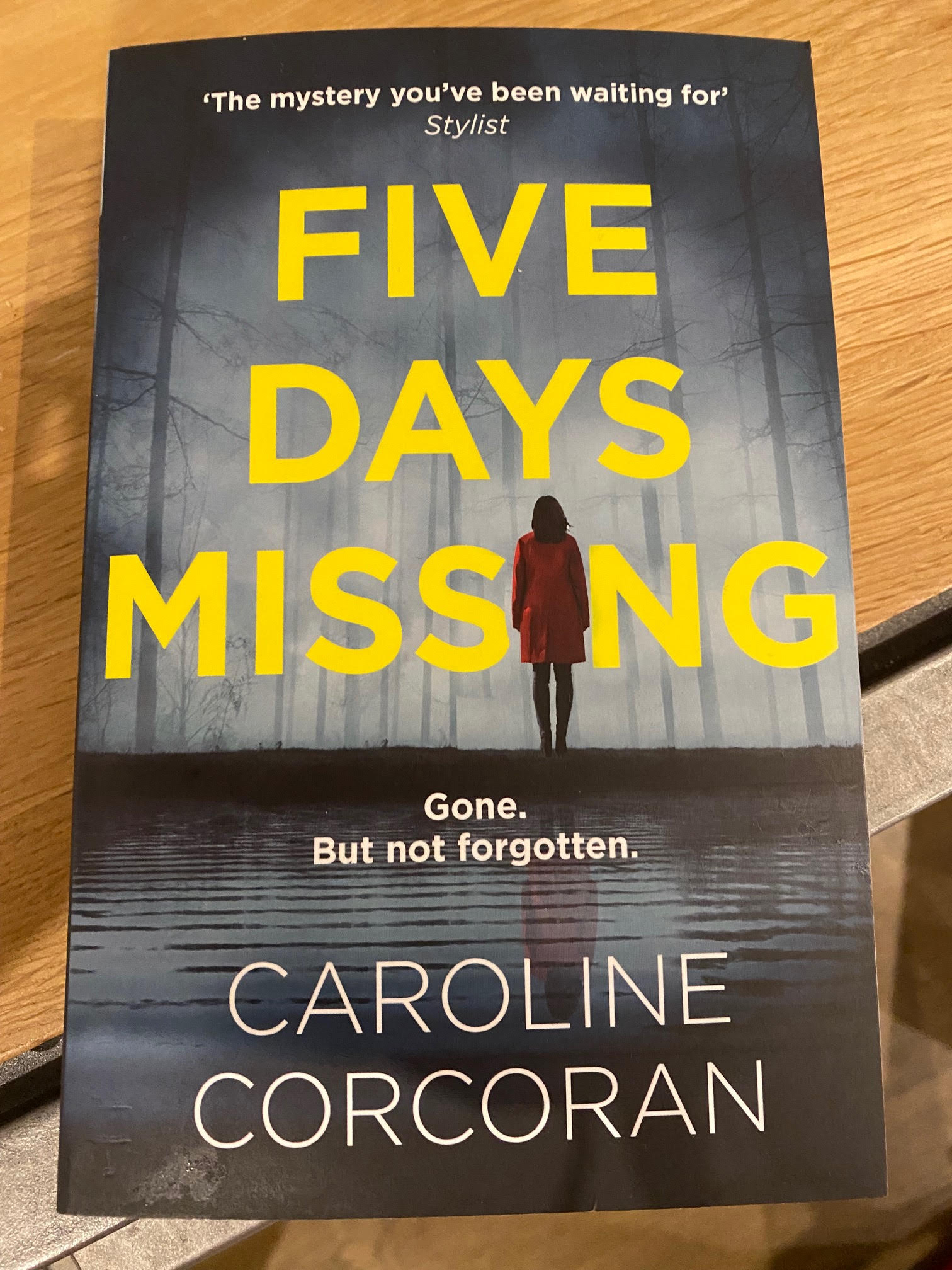
five days missing , Caroline corcoran

I love being able to look back and see what I read when the Big Life Events happened (I literally have zero memory of the first book in there I read after giving birth. No idea what it is. Not even vaguely). It also means I can revisit and see sometimes what I didn’t see at the time: how the books I chose related to what was going on in my life at the time. Still, <changing> your life is a big ask. I believe books are up to the challenge though. Here are five that did it…

Dear Nobody, Bernie Doherty

Context: I was a very dramatic teenager. If I broke up with someone I went out with for two weeks, I listened to Lionel Richie on my walkman and wept. I kept endless diaries where I wrote my pretty mundane teenage existence into what I see now was the prototype of a novel. I was fascinated by – and still am fascinated by – the depiction of human emotion at its edges. Only one thing to do: seek out the true drama in fiction. I loved a book with heartbreak and chaos and teenagers suffering loss and pain and grief. God, I loved all of it. But I loved none of it like I loved Dear Nobody, where teenage Helen writes letters to the baby she is pregnant with. It was award-winning and groundbreaking and I must have read it fifty times, easily.

I Know Why The Caged Bird Sings, Maya Angelou

“What do you like reading?” asked my then English teacher. I had moved on from that mega nineties shelf of joy in WH Smith – Judy Blume, The Babysitters Club, Saddle Club, every other club you can imagine etc – but I hadn’t figured out yet where to go next. She was a teacher that stayed with you, that English teacher, because she was the first person I had met (barring my chief book buddy Vic) who loved books like I did. Vic and I nodded in wonder when she passed on a list of recommendations to us for real grown up books (I could recite that list even now; it was a holy grail for me) and over the next few years, I read them all. I Know Why The Caged Bird Sings though, was the first and the best. I read it over and over, and I read everything else I could get my hands on by Maya Angelou, this incredible, life-changing woman. She was the first author who showed me what books could do: enunciate thoughts you didn’t know you had, make sense of the world by telling the most vivid truth and teach you about – not to mention transport you to – worlds so far away from your own. More than anything though, Maya Angelou made me fall in love with the unrivalled, crazy beauty of words.

The Handmaid’s Tale, Margaret Atwood

Somebody pointed out to me recently when I posted about writing this piece that when people speak of books that changed their lives, they usually quote books they read in their teens and early twenties and I think they are right. All but one in this list, I read before I turned 25. I suspect that’s because those years are when we are forming ourselves and books – as well as music and film – help us to do this. They show us who we are, who we want to be and what possibilities there are in the world. I would go on to read so much more Margaret Atwood (and to stare at her like she was a pop star heartthrob when I saw her being interviewed once) but this one got under my skin and kick started something in me. 

Gone Girl, Gillian Flynn

I think this was the first proper psychological thriller I read and the start of me uncovering – unbeknown to me at the time – the genre I would eventually write myself. Unreliable narrators, multiple points of view, twists… I adored the whole, all-encompassing experience and after Gone Girl, I read back-to-back psychological thrillers with barely a break for much else for years. Many were brilliant, but this was the masterclass. I still hold Gone Girl up as that holy grail and the most annoying thing: the book I would have <loved> to have written myself. Grrr.

Americanah, Chimamanda Ngozi Adichie

Most of the time, my reading pattern is based on instinct: when I finish a book I know where I need to go next whether that’s a move to something gentler, contemporary, a classic, some short stories, something funny… Every now and again I read a book and all I know is that next I have to read <every single book that author has ever written>. It happened recently with Taylor Jenkins Reid after I read Daisy Jones and the Six, and I did the same with Tana French. But never has it been so mesmerising as it was in the summer of 2014 when I picked up a book I kept hearing about: Americanah. I barely came up for air. I’ve never read a love story like it; I’ve never felt such a strong sense of place, and I spent that summer hovering up everything else she had written. It tracked all the way back to Dear Nobody: I love reading (and writing) about human emotion, and nobody does it like the inimitable Chimamanda Ngozi Adichie.

Five Days Missing is out 17 February (Avon, Harper Collins)

WELSH WRITING WEDNESDAYS: CHRIS LLOYD ON WALES AS A STATE OF MIND

Wales has an extraordinary breadth of landscapes and moods. From cities to hamlets, from rural idylls to the legacy of the mines. A beautiful country pockmarked by elements of its past that has learnt to make a virtue out of the ravages it’s experienced. It’s a landscape and a history that invite legend and myth to flourish, a haven for stories and storytellers.

So, if that’s the case, why do I set all my books outside Wales?

In many ways, Wales is a state of mind. A way of viewing the world – both our own and others – that is born of being a small nation. How I view the world, the places I’ve lived, the countries I’ve visited, is determined not just by where I happen to be, but where I happen to be from.

When I was twenty, I went to Spain for six months as part of my degree. I ended up going back there after graduating and staying for twenty-four years, twenty of them in Catalonia. My connection with Catalonia – initially the small city of Girona and then the big guns of Barcelona – was immediate. I felt an affinity with its history of being the smaller partner to a more powerful neighbour, a culture that had been denied and pushed and pulled about at various times, a language that had been banned and belittled, and a culture that continued to thrive despite everything it had faced. And I viewed it all through the prism of my own background.

And that is why, despite the richness of Wales as a setting, there was never any question in my mind that I should write about Catalonia. The problem was that I waited until I was living back in Wales before having the idea to write a book set there, a monument to my planning skills. Except it wasn’t a problem. Just as when I’d first gone to live in Catalonia, I found myself looking at Wales through new eyes and finally understanding how I felt about being Welsh, so writing about Girona from a distance actually helped me pin down my thoughts and feelings about my former adopted home. Oddly, I’ve found that to write about somewhere I love, I need a distance from it, which is probably one of my barriers to writing stories set in Wales – I live here.

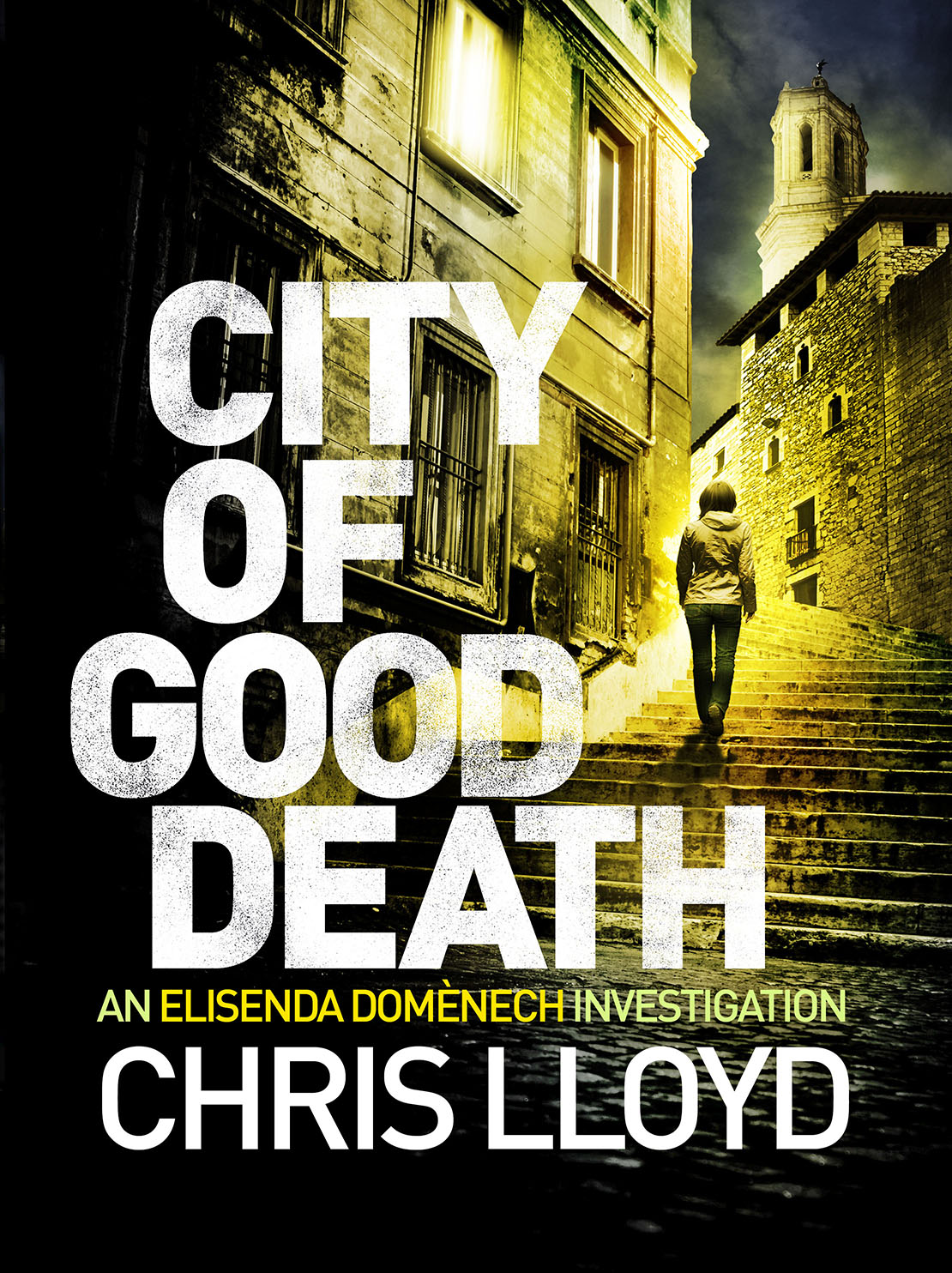
The first in my Catalan trilogy, City of Good Death, featuring Elisenda Domènech, a police officer in the newly-created Catalan police force, draws enormously from Catalan culture and the history and legends of Girona. A killer is using the Virgin of Good Death, a small statue dating from the Middle Ages, when it served to give convicted prisoners a final blessing before they were led out of the city to their execution, to announce the impending death of someone they feel is deserving of execution. Unfortunately, there are those in the city who agree and who applaud the killer’s every move. Until the victims become less deserving.

It was a similar passion that led to my new series, featuring Eddie Giral, a French police detective in Paris under the Nazi Occupation. I’d been fascinated for years by the notions of resistance and collaboration, and the blurred lines between them, but I wanted to write the story from a Parisian’s point of view, not the guns and guts heroism of the movies, but the day-to-day survival of ordinary people trying to get by. As near to the real history as possible. And I think that that is an essentially Welsh vision of life – an interest in society and community, an affinity with the underdog and the need to preserve a sense of self.


Follow Chris on Twitter: https://twitter.com/chrislloydbcn


WELSH WRITING WEDNESDAYS: INTRODUCING CRIME WRITER CHRIS LLOYD

With writing, there’s always a spark that ignites the flame. In my case, it was a small grey plaque almost hidden inside the entrance to a school.

But I’m getting ahead of myself. My name’s Chris Lloyd and I write crime fiction. I’m from Wales, but I studied Spanish and French at university and fell head over heels in love with the Catalan city of Girona when I spent my study year there. So much so that after I graduated, I hopped straight on the first bus back to Catalonia and there I stayed for nearly a quarter of a century.

I taught English in Girona for a few years before moving to Bilbao, in the Basque Country, where I opened the Oxford University Press office. After that, I moved back to Catalonia – specifically to Barcelona – where I lived for the next sixteen years, apart from a three-year stint in Madrid. I also spent a semester in Grenoble, where I researched the French Resistance movement – you’ll discover the reason for that in a moment.

My job in educational publishing meant that I was paid to travel all around Spain giving workshops and book presentations, which was great fun until it stopped being great fun. That’s when I took voluntary redundancy three days before my fortieth birthday and set up as a Catalan and Spanish translator. I also wrote travel books for Rough Guides at the same time, until my wife and I decided it was time to move to Wales, which is where we live now, in the town where I grew up. All good stories should come full circle.

Which brings me back to the spark.

It was a small grey plaque in a nondescript building and it stopped me in my tracks. It was in the Pletzel, a district of Paris that was home to much of the city’s Jewish population in 1940, and it listed the children from the school who had been sent to Auschwitz and never returned.

I was already researching for a novel set in the city under the Occupation – my fascination with the era and the oddly blurred notions of resistance and collaboration had been ignited when I was in Grenoble – but it was that moment when I felt the small hand of history tug at my sleeve and I knew that I had to tell the story of the city under the Nazis as truthfully as possible.

But I had to tell it my way, through crime fiction. About a Paris police detective, Eddie Giral, a veteran of the last war, who struggles to do his job and retain a moral compass under the new rules imposed on the city and the people. On the day the Nazis enter the city, four Polish refugees are found gassed in a railway truck, and only Eddie among the police feels the need to find out the truth of what happened to them. This will lead him into conflict with his fellow police, an American journalist, the Polish Resistance and, most dangerously of all, the Occupiers. It will also lead him to question decisions he made in the past and decide what he must do to atone in the present.

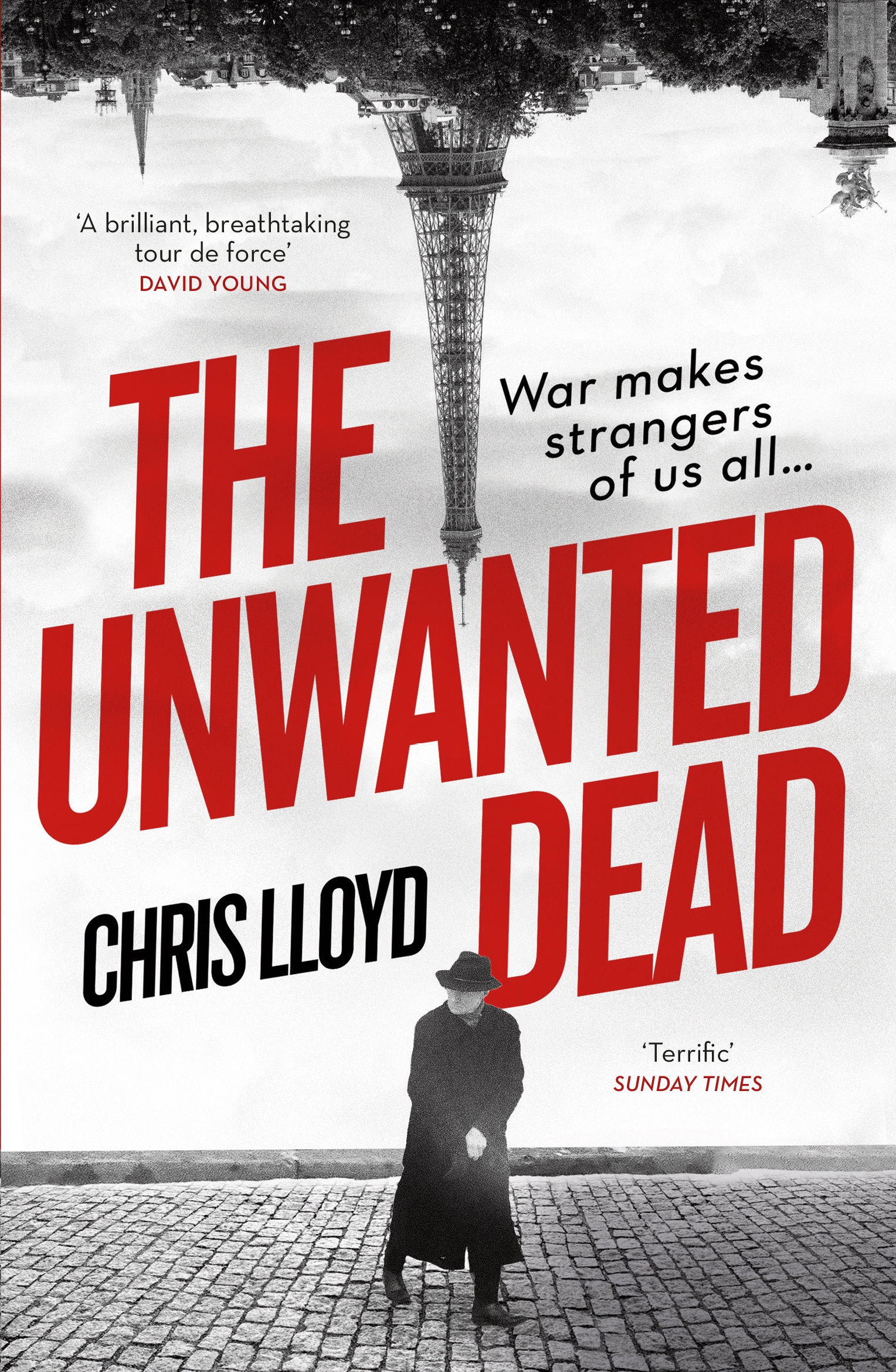
The first book in the series, The Unwanted Dead, recently won the HWA Gold Crown Award and was shortlisted for the CWA Historical Dagger. The second book, Paris Requiem, comes out in 2022, and I’m currently writing the third in the series, set at Christmas 1940, although with little seasonal cheer or goodwill.

On which note, please allow me to wish you all the very best of cheer for Christmas and the year ahead. And lots of good books to enjoy.


Read more about Chris at https://chrislloydauthor.com/


ANNA HOLMES ON THE ENVIRONMENTAL INSPIRATION FOR HER LATEST NOVEL

The back cover blurb for my novel begins like this:

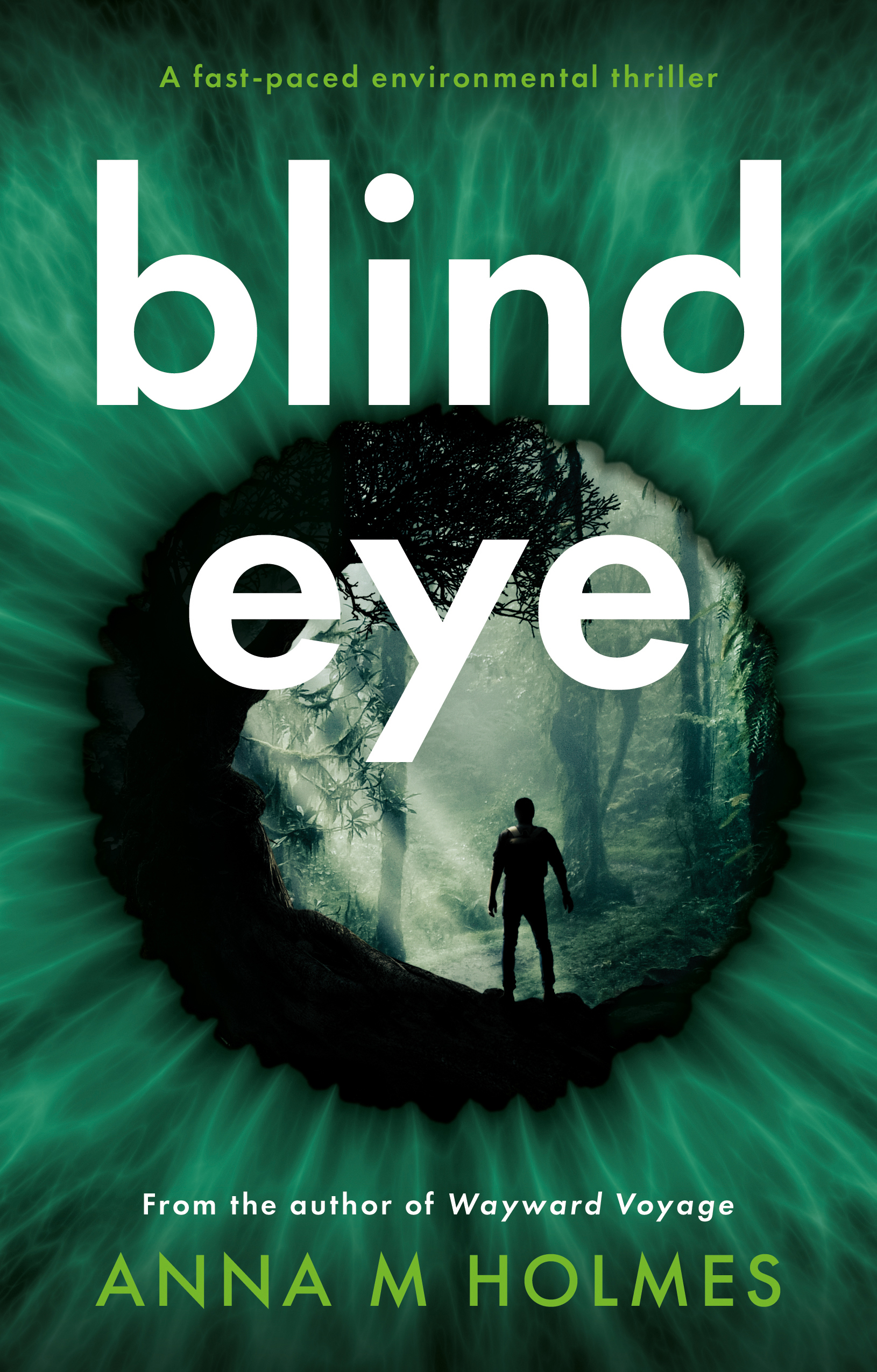
Set in the Indonesian rainforest, Blind Eye is a fast-paced environmental political thriller exploring moral predicaments and personal choices.

In a nutshell Blind Eye is about illegal logging.

Governments’ failures to stop this practice is depleting the worlds rainforest at alarming rates. In the eleven years since I first wrote my story as a screenplay, to when I turned it into a novel, forest cover roughly the area of Mexico has been lost according to figures compiled by Global Forest Watch (GFW) of the World Resources Institute.

My background is in dance, theatre, yoga and writing. I know a lot about these subjects and next to nothing about trees and timber. So what drew me to write about this subject?

My partner was a founder member of Forest Stewardship Council (FSC) which promotes responsible management of the world’s forests. He is still involved. At that time, he had a company supplying FSC timber and he had travelled to different places in the world to support community forestry projects. I felt there was a story waiting to be hatched in my brain.

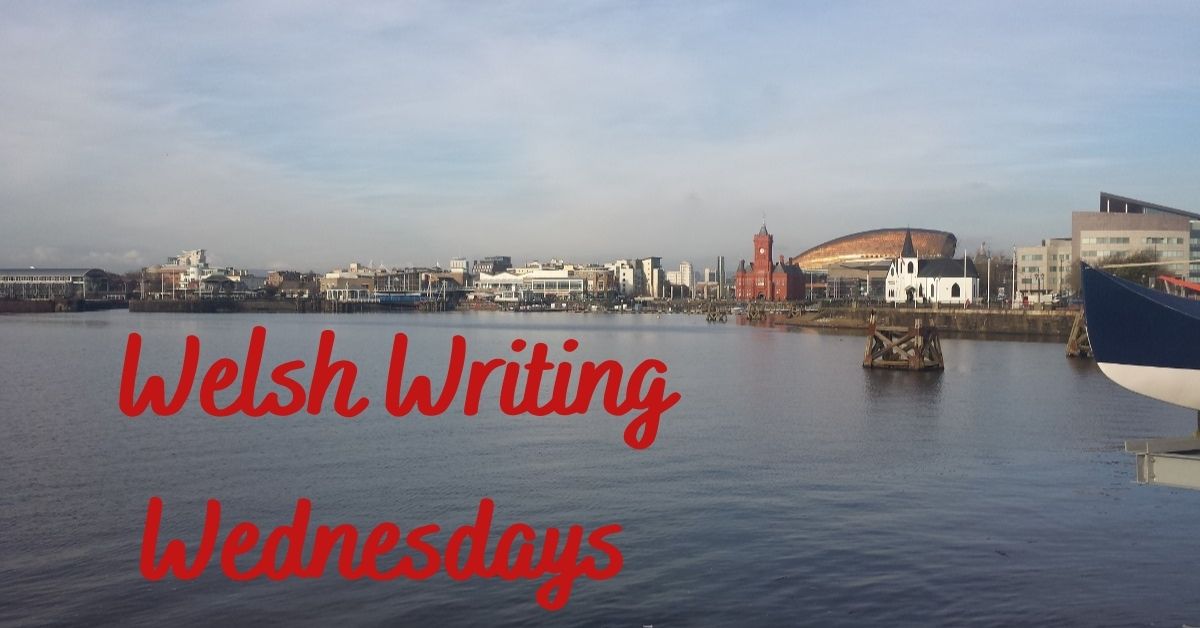
Many of us recognise that distinctive logo incorporating a tree with a tick on it and the initials FSC. It appears on toilet paper packaging, books, wooden kitchen utensils, garden furniture and much more. All these wood and paper products can demonstrate a chain of handlers from a well-managed forest or plantation through the milling process to the finished product. Big projects that signed up to sustainable building include the Senedd building (Welsh Parliament) in Cardiff Bay with its the magnificent curvy wooden interior and the hardwood decking outside leading to the waterfront. That is a project I know about as my partner’s company had a small role in this. Gosh, I even remember the name of the Brazilian hardwood decking: Massaranduba. Not bad!

As I said, the timber trade is not my thing, but I am environmentally conscious.

I love world-building and am a plot and character type of writer. With my debut historical novel, Wayward Voyage, (inspired by a true story) I thrust Anne Bonny into a harsh seafaring pirate life. In Blind Eye my protagonist, Ben Fletcher, is thrust into the murky world of illegal logging in an Indonesian rainforest.

With Blind Eye I am not interested in hammering readers over the head with a preachy, do-goody story. Who needs that? Readers should want to turn the page to find out what happens next. And I don’t want to just highlight the problems – we know what many of these are – so I leave readers with some hope and show that solutions are possible.

One review blogger writes: “Holmes has put together a first-rate thriller, mixed in a little romance, and shown the brutal side of business putting profits ahead of people. If the end result of reading this book is not just an enjoyable ride through some thrilling pages but also beginning to open our eyes a little wider, then we can be grateful for this story on multiple levels”.

Think about it. Don’t turn a blind eye when replacing your garden furniture or purchasing a new coffee table. That wood has a story to tell. What is it?


Links to Blind Eye retailers on Anna’s website

https://www.annamholmes.com


ELAINE SPIRES: TURNING A NOVEL INTO A STAGE PLAY

In her second article Elaine Spires turns a novel into a stage play

In my previous article – Turning a Stage Play into a Novel – I shared my experiences of turning two of my plays into novels and of the relative ease with which this was done. Writing a play from a book (Singles’ Holiday) proved much harder.

Photo credit: Danann Breathnach

Originally I wanted to write a screenplay but knew the probabilities of getting it in front of anyone that mattered were slightly less than winning the Euromillions next Friday. And although I know lots of actors, writers and directors, I unfortunately don’t know anyone with the financial means to make such a film or TV series. Producing Singles’ Holiday for the stage, however, was much more feasible.

The book has a fairly large cast of characters, and I wanted them all to appear in the play.  This was impossible.  As interesting as their backstories were and of importance in explaining how this totally diverse group of people come to holiday together in Antigua, it couldn’t be told in two hours.  So the culling of characters began.  It felt like I was murdering my own children.

To start, I took a red pen to all the minor characters.  Then I concentrated on those remaining to move the story along and produce my first draft. I’ve always preferred writing dialogue, but writing only dialogue proved a challenge resulting in lengthy stage directions.

The draft was four hundred and two pages: totally unrealistic as it would mean a six-hour show.  Actor Nick Campbell who knew the book well, had encouraged me to write the script and wanted to produce the play sat down with me and after much foot-stamping on my part persuaded me to cut two more characters but this meant we lost a huge plot twist.

I feared this would diminish the story but I could see that he was right; it was better to concentrate on writing a play that worked rather than a faithful rehash of the book that didn’t.  There’s nothing worse than theatre that doesn’t entertain.

It turned out to be sound advice.  I realised that Singles’ Holidays is, in fact, almost three books in one and by carefully plotting the story arc and concentrating on a smaller cast it could work well.

Once the second draft was ready I got a group of actors together for a table read.  This is a vital part of the playwriting process as it’s the first time a writer sees her characters come to life and hears them speak, outside her own head, of course.  It also shows what works theatrically and what doesn’t. As this draft was over two hundred pages I already knew further editing would be necessary.  I made copious notes and worked on the script again. Cutting out two further characters and their dialogue brought us to one hundred and sixty pages.

And it was time for another table read.  A fabulous director friend Jane Gull came along and was brutally honest with me, asking,

Whose story is it, Elaine?”

This one question (answer – Eve the tour manager’s) showed me what I needed to do: cut out anything superfluous to developing her story.

Finally, I had a one-hundred-and-thirty-page play script. Another table reading showed it worked!

And in October 2014, Singles’ Holiday had a hugely successful week’s run at the Brentwood Theatre, courtesy of Melabeau Productions.

Singles’ Holiday is now the first in the six-book Singles’ Series. The others are set in worldwide tourism destinations and continue Eve’s story.  I still think they would make great TV.  Does anyone know someone at Netflix?


www.elainespires.co.uk


ELAINE SPIRES: TURNING A STAGE PLAY INTO A NOVEL

In the first of two articles Elaine Spires shares the secrets of turning a stage play into a novel

My first novel, What’s Eating Me, started life as a stage play.  It’s the story of Eileen Holloway, a struggling single parent of two teenage boys who’s holding down a demanding job while dealing with her difficult mother. Food is the drug of choice that gets her through the day until she is tricked into appearing on Barbara’s Beautiful Bodies, a reality TV show. She becomes a celebrity over night, albeit a reluctant one. Compulsive overeating is a grossly misunderstood condition and it was a story I was keen to tell.

Photo credit: Danann Breathnach

The play was a one-woman show, which I took to the Edinburgh Fringe. Although we played in a tiny venue, it had great reviews.  Afterwards, though, I just couldn’t let Eileen go. So I decided to turn her story into my first book.

As the play was a three-act soliloquy – Eileen sharing her thoughts with the audience – it seemed to me logical that the book should be written in the first person (I) as this would tell Eileen’s story in her own voice, giving it an intimacy that would have been missing in the third person (she).

A huge advantage for a writer turning a play into a novel is that the characters have already been brought to life and their voices have been heard. A great tip for writing novels, especially dialogue, is to read your words out loud to hear the characters’ voices and when converting a play this part has already been done for you.  Your characters are already 3-dimensional and alive; you’ve seen and heard them. The audience feedback i.e. where they reacted by laughing, gasping, clapping, stunned silences or – hopefully not – bored indifference is also a great indicator of what’s working and what isn’t, not just re dialogue but also plot twists and story arc.  I would recommend watching your play performed as many times as possible. You’ll be surprised that you see something different every time. Actor input also plays a helpful, vital role.

Regardless of when events and back stories appeared in the play my first step was to put them into chronological order thus giving me a time line of scenes. Then I worked on each scene, developing character/personality traits, adding or expanding on backstory thus giving not only deeper insights to the individual characters but explaining, in this case, Eileen’s reactions to them.  This I call sprinkling the glitter – where the creative process really gets to work. It’s the part where ideas often appear from nowhere that move the plot along or take it in a different direction. This, in turn, helped demonstrate the Why behind Eileen’s self-destructive behaviour. In the end, although the main events of the story occur in diary form in the novel, backstory events are revealed as and when the plot demands it, thus producing twists.  And everyone loves a twist, don’t they? Perhaps this sounds complicated but with detailed A3 sheets on the wall covered in post-it notes, it worked for me.

I thoroughly enjoyed this way of writing and so another play – Sweet Lady – became my second novel.  And this book, too, is written in first person, although quite different from What’s Eating Me.  The rest of my novels haven’t been plays but I always visualise them as such, making notes and envisaging scenes of dialogue, which I perform aloud – fortunately I live alone – before I start the proper writing of the book.

Readers often remark that my books would make great TV series. I think that’s the result of the way I plan.


www.elainespires.co.uk