The Chalfont St Giles and Jordans Literary Festival by Denise Beddows

The Chalfont St Giles and Jordans Literary Festival by Denise Beddows1

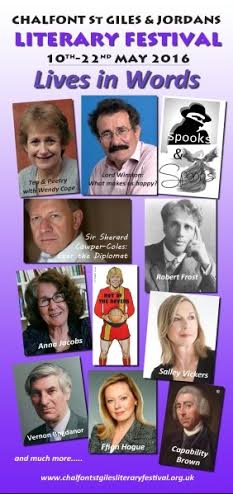
The theme of this year’s exciting Chalfont St Giles & Jordans Literary Festival (10-22 May) is ‘Lives in Words’. Sharing their insights into their own or others’ lives will be a stellar line-up of guest speakers.

Participants will include Professor (Sir) Robert Winston, examining ways in which science may increase our happiness, and diplomat Sir Sherard Cowper-Coles, sharing his experiences as a British Ambassador.

Anna Jacobs outlines the background to her best-selling novels, whilst poetry lovers will be well served by the wit of award-winning poet Wendy Cope.  American poet Robert Frost will be the subject of a discussion led by Gabriel Woolf and Linda Hart, and Claire de Carle and Dr Sarah Rutherford will discuss Capability Brown.

Ffion Hague examines the relationship between Robert Walpole and poet Thomas Gray, and Vernon Bogdanor describes the constitutional crisis of 1936 caused by Edward VIII’s relationship with American divorcee Wallis Simpson.


In a joint presentation entitled Spooks & SpooksDenise Beddows, aka author DJ Kelly,  explores our county’s 600 year history of spooks of the spy variety, as featured in her book Buckinghamshire Spies & SubversivesCatriona Troth describes the inspiration for her book Ghost Town and the way The Specials’ chart-topping song of that name eerily reflected the 1980’s urban decay, unemployment and racial violence, and Margaret Whittock  recounts the spooky circumstances leading to her discovering the Gallipoli graves of her two great uncles and to her novel Ghost of Gallipoli.

With coffees, teas, homemade cakes and books on sale, readers and budding writers are invited to pop in to browse books and seek writing and publishing tips from 8 published authors at the Writers’ Café and Pop-up Book Shop (10-1pm Sat 21stMay in The Reading Room, High Street, Chalfont St Giles – admission free). See:www.chalfontstgilesliteraryfestival.org.uk


Writing Short Stories for Magazines

Short Story Magazines

The Most Important Thing You Need to Know


There isn’t a secret recipe to success so it’s no use looking for the answer here.  If you want to write short stories and sell them there is one thing you need to do before you even begin to write your story. Market Research. You can’t write a story and send it off willy nilly. You may sell one or two that way, if you are extremely lucky, but for continuous success you need to know your reader.

I’d advise selecting one or two magazines that publish short stories. Those accepting them at the moment are, among others, Woman’s Weekly, Take A Break, Fiction Feast, The People’s Friend and Yours. You can find a full list of markets at www.womagwriter.blogspot.co.uk

Read through all of the stories in your chosen magazine and find something that resonates with you, those that might be similar to stories you would choose to write. Most importantly, read them with respect. Don’t sneer and pass judgement. It’s a hard market to crack and if you disrespect your reader your writing will come across as patronising. Guess what? No sale.

Get a pen and paper and make notes. What are the characters names, what ages? Where do they work?  Where are the stories set? What are they about – family, romance, comedy, thriller? Each market has its subtleties and you need to make yourself familiar with them if you are to have any hope of success.

What is the word count? Each magazine has set limits. It’s no good sending a 700 word story  to Woman’s Weekly when they only take 1,000 or 2,000 words. It will come straight back to you.

Now read the entire magazine, the articles, the readers’ letters, the adverts, the problem pages. You can learn so much about the readership by doing this and then you will be able to build a picture of your ideal reader. Do it as an exercise. Imagine a woman buying that magazine – what does she look like? What job does she have? Where does she live? Before you know it you will have a character; you may even have a story – get writing.

Editors are busy people. Make things easy for them. Present your work as per their guidelines, found on their website. If you are unsure how to set things out pop over to writer Sue Moorcroft’s website because she has the best example I’ve seen on how to present a professional manuscript. It will save you so much time and effort  www.suemoorcroft.wordpress.com/manuscript-presentation


I’ll be talking at Words for the Wounded Literary Festival on 16th April and will be happy to chat about writing short stories for the commercial market throughout the day.


Tracy Baines’ stories have appeared in Woman’s Weekly, Best, Take a Break, The People’s Friend, Candis, My Weekly, Yours in the UK – and magazines in Scandinavia, Australia and South Africa. She has completed a book on Eating Disorders and is now working on a novel.

Words for the Wounded Host Their Annual LitFest Literary Festival

Words for the Wounded Host Their Annual LitFest Literary Festivallogo

Great excitement – Words for the Wounded which raises funds for wounded troops and veterans by creating  opportunities for aspiring writers and readers is holding its annual LitFest again on April 16th.

The WforW LitFest Day will be held as always at the lovely Downley Community Centre, School Close, Downley, High Wycombe HP13 5TR
10.00am to 5.00pm.

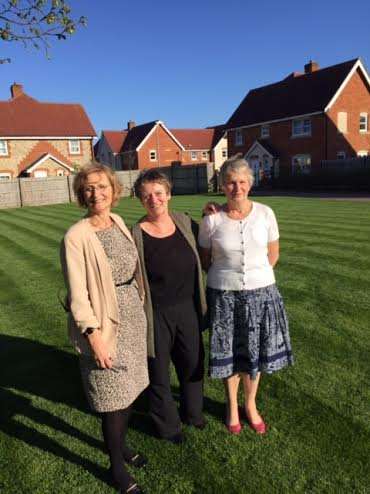
As everyone knows by now, the three grannies, Margaret Graham,  Jan Speedie (both Frost Magazine writers) and Penny Deacon absorb all the costs of the charity and therefore 100% of everything they raise goes to where it should.

Words for the Wounded Host Their Annual LitFest Literary Festival

The speakers this year are:  Sunday Times No 1 bestselling author and a patron of WforW –  Elizabeth Buchan talking about her work.

Words for the Wounded Host Their Annual LitFest Literary Festivalelizabeth buchanan

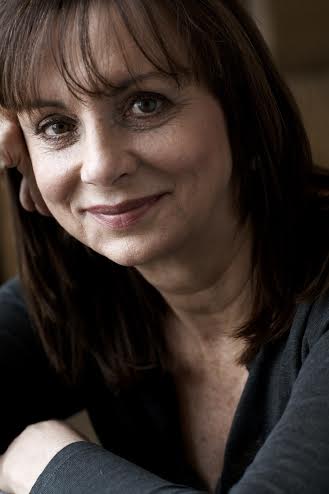
Jemima Hunt, editor and literary agent, and director of The Writers’ Practice with advice on editing your work and attracting an agent.
Tracy Baines, successful women’s magazine  short story writer with tips about getting published.

Catherine_Balavage_023
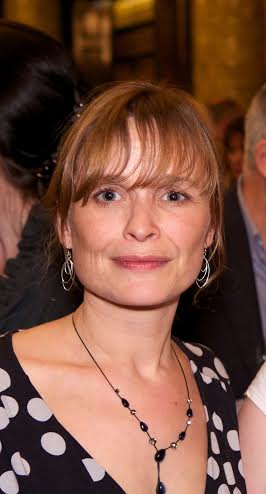
Further excitement as Catherine Balavage, blogger and editor of Frost Magazine will be joining the day to talk about blogging, running a magazine, and her various successful books.

Paul Vates, the brilliant actor, and friend of Words for the Wounded, will be reading from the work of our speakers.

Sharon Bennett will be displaying her art.

Cost £35 (which includes lunch with wine, morning coffee and afternoon tea)

For Tickets, send a cheque or postal order to: (cheques payable to Words for the Wounded)
Words for the Wounded
12 Woodcote Green, Downley, High Wycombe, HP13 5UN
Please include a SAE

Trains from London are frequent, and there are taxis for the 10 minute journey.

www.wordsforthewounded.co.uk

Gillian Holmes, (aka The Editor) Responded to Frost’s Request for Help Writing a Synopsis

Synopsis: A brief summary of the plot of a novel, motion picture, play etc. by Gillian Holmes

Meet Gillian Holmes – literary editor By Margaret Graham1


A very talented friend of mine sent me the synopsis of the novel she was writing for her Creative Writing MA. Her tutor had sent her away with a flea in her ear, and she came to me with no real idea of what she’d done wrong.
As a veteran of synopses of nearly twenty years standing, I saw immediately that she had made a very common error. Namely, she’d forgotten what a synopsis is. She thought she needed to show her thinking behind the book, and give the reader a flavour of what was to come. Consequently, she had managed to give far too much information, while also giving too little.

How is that possible?


  1. She wrote a lot about her main character, while neglecting the plot.
  2. She had included lines from the book, but with no context, they were irrelevant.
  3. She had tried to illustrated the themes in the book, but neglected the plot.
  4. She had tried to illustrate the humour in the book by describing the occasional amusing scene. But she’d neglected the plot…


Do you see where I’m going here? So when you sit down to write your synopsis, always remember that  this is not a creative work, so don’t try to be too clever. Clarity is everything.


So what do agents and editors want from a synopsis?


  1. They want 1500 words or fewer.
  2. They want an elevator pitch – a couple of lines that outlines the concept. The concept is a very strong consideration for all agents and editors, so make it snappy and memorable. For example, let’s take a recent bestseller – The Husband’s Secret. A happily married woman with three children discovers that her husband murdered a young girl when he was a teenager.
  3. A brief summary of the plot, key moments, key events, and main characters so they can see the arc of the story and judge whether the structure seems sound – leave out complicated sub plots, it will only bog you down in unnecessary detail.
  4. The end – and that means the end. Don’t hold anything back, this is not a cover blurb.


And that’s it. Easy peasy.
If you’re wondering about my friend, I sent her back to rewrite her synopsis several times. But it was worth it. She got an A for it in the end.

Gillian has been an editor for mainstream publishers for twenty years. Now she runs her own editorial agency.
To contact Gillian:  gilliansholmes@hotmail.com


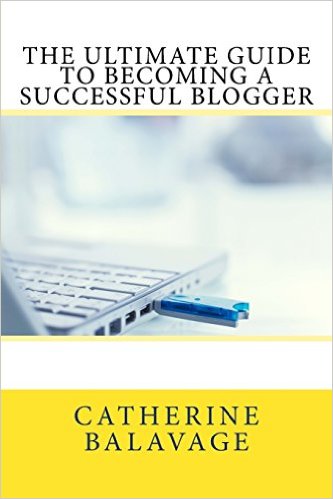
Frost Editor Catherine Balavage Writes Ultimate Guide To Blogging Book

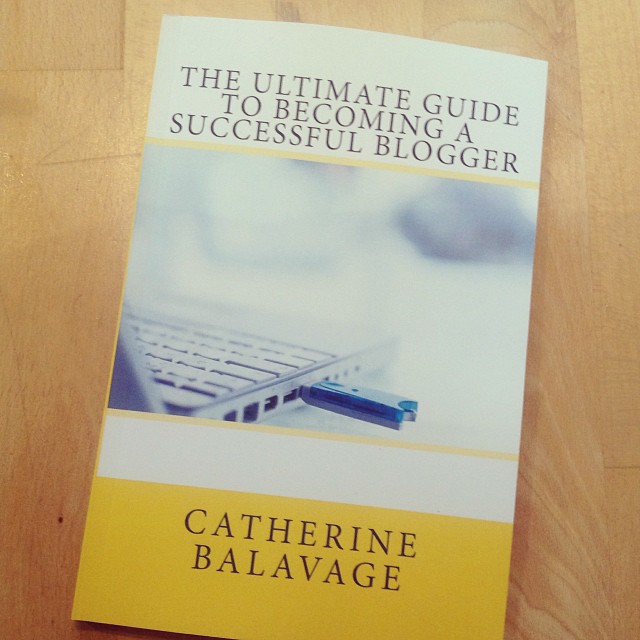
The Ultimate Guide To Becoming a Successful Blogger , blogging, blogs, how to be a successful blogger, blogger, blogging, Catherine BalavageThe Ultimate Guide To Blogging is Launched.

The Ultimate Guide To Becoming a Successful Blogger by Catherine Balavage is now published.

ISBN 978-0-9929639-8-9


It’s all here, just take your time, and let the expert take you by the hand, and save you zillions of hours of stop and start mistakes.

Bravo, a book that needed writing …

Bestselling author Margaret Graham


Catherine Balavage, editor and founder of Frost Magazine, has published a new blogging book based on over ten years worth of blogging experience. Catherine founded Frost Magazine six years ago and in that time has made it into a successful online magazine. She first started blogging eleven years ago when she was a teenager with a LiveJournal blog. She is also one of The Huffington Post’s signature bloggers. Blogging has become huge in recent years and is only becoming more popular. The Ultimate Guide To Becoming a Successful Blogger has everything anyone could want to know about being a successful blogger.


From design to advertising, social media and publicity, the book is everything you need to start your blogging career. The book is packed with hundreds of useful tips and invaluable information which will save you hours of time and give you essential information to develop your blog to its full potential. It also covers vlogging and how to market your blog. The Ultimate Guide To Becoming a Successful Blogger is an in-depth and thorough book which covers every aspect of being a success in digital publishing. It covers various revenue streams, how to write the best content, how to take the best pictures, social media and SEO. Perfect for beginners or those who already have a blog but are unsure of how to take it to the next level, the book has a chapter on interviews with essential advice from other successful blogger, including beauty blogger Really Ree.


This is Catherine Balavage’s third book. She has also written an Amazon bestseller on Acting, How To Be a Successful Actor: Becoming an Actorpreneur, and a wedding planning book, The Wedding Survival Guide: How To Plan Your Big Day Without Losing Your Sanity.


The Ultimate Guide To Becoming a Successful Blogger is available on amazon.co.uk and is included in Amazon’s Kindle Countdown Deal. It is only £1.99 for another six days.


Early Chapters by Gillian Holmes of The Editor | Get Published

Meet Gillian Holmes – literary editor By Margaret Graham1

Frost is delighted to have an editor of Gillian’s calibre to help aspiring authors. It’s particularly apt, because the fundraising Independent Author Book Award, run by www.wordsforthewounded.co.uk is open for entries until 6th March 2016.


Last year’s winner, Jane Cable, is now represented by the Caroline Sheldon Literary Agency as a direct result of the competition. Felicity Trew of the Caroline Sheldon Literary Agency is judging this year’s Award.


So over to Gillian:


Early Chapters


It’s tough being a writer, and we editors appreciate that. I have never written a book – if you don’t count the half-written romance with a Daniel-Craig-as-Bond-type hero, but the least said about that the better. So all writers who have the tenacity and commitment to complete a novel have already earned my full admiration.


However, on the other side of the coin, having worked as an acquiring editor, a reader for literary agents, and a reader for competitions, you can appreciate, I’ve probably read more than my fair share of opening chapters and synopses. And sometimes I stop within half a page. It sounds brutal, but when you have a lot of manuscripts to read, you simply don’t have the time or the inclination to read on to see if it improves.


So here are ten tips to help you catch the eye of the judges.


First the Don’ts:


  1. Please do not, and really I mean this, open with a dream. Ask any editor/agent/reader. There is nothing more irritating than to be pulled into some action, only to find it’s not real. Can I add here, do not ever use dreams as a way to move the plot forward. Please.
  2. Do not open your book with backstory… if we don’t know the characters, how can we be interested in their backstory?
  3. Do not start the book with a minor character. No matter how good the writing, as soon as the reader realises that the character they have been reading about disappears by chapter 2, they will give up.
  4. Do not open with your character doing mundane stuff – getting ready for work, having breakfast, unstacking the dishwasher, going out the door – because although you may think it’s a great contrast with the explosive action that comes later, the reader may never know that. They’ll have given up just as your character is locking their front door.
  5. Do not mince your words. Starting any book with exposition and/or long descriptions of the character or location can be mind-numbing for the reader. Dive in, all will reveal itself as the book unfolds. Speaking of long descriptions: watch out for flowery language and too many adjectives. Having to wade through paragraphs of wordy prose before you even get to the story is frustrating and time-wasting.


Now the Dos


  1. Give the reader a snappy opening line that immediately intrigues.
  2. The submitted chapters should be the very best they can be, so I would suggest you hire an editor/copy editor. It can be an expensive business, but do it for just these three chapters in the first instance. It makes a huge difference to the reader, and could give you some useful advice for the rest of the book.
  3. Keep the pace moving and don’t get bogged down in irrelevant detail.
  4. Introduce us to your characters – the reader needs to be invested in them from the start.
  5. If you’re sending a prologue as part of your first three chapters, make sure it’s relevant and interesting, not just a convenient way to give backstory.

Soon I will be giving you some hints on writing the synopsis.


gilliansholmes@hotmail.com

www.wordsforthewounded.co.uk
http://www.carolinesheldon.co.uk


Using a Copyrighted Picture Cost One Blogger $7,500. Why You Should Never Use Copyrighted Pictures

Using a Copyrighted Picture Cost One Blogger $7500. Why You Should Never Use Copyrighted PicturesDo you take images from Google without checking the copyright and hope for the best? Then stop. Pictures from Google and other search engines are protected by copyright law. It is rare to be sued over an image, or even to get a cease and desist letter, but it only takes one mistake to lose vast amounts of money. If you want proof then here is one example,

Chrystie from Living for Nap Time blogged about green pepper coupons in 2014, she needed an image so did a Google image search for a photo of green peppers, found one she wanted and then uploaded it, months later she received an email from a lawyer stating that the image cost $750. Chrystie pointed out that it was a picture of a green pepper that you can get a lot cheaper, the lawyer responded that the law was on their side and that their client wanted $7,500 in damages.

Chrystie researched the person in question and found out that they owned lots of domains and seemed to be planting clearly-tagged pictures to boost the SEO of the pictures. Chrystie thinks they did this to optimise the pictures so bloggers like her would use the image and would then sue the blogger in question. Chrystie had to hire her own lawyer. Her lawyer advised her to settle the case even though the chances of it going to court were small because if it did go to court she would be liable for the claim and all of the court costs, which could cost $100,000 or more.

The truth is, if you copy a picture from the internet and it is copyrighted it is protected by law and you are liable for the cost of the image or even damages even if you link back to the original source. So don’t do it, it’s not worth it! This case is American and people in the UK may be less likely to sue but it is not worth the risk.

If you need free images you can search Google for copyright-free images by clicking on the options icon in the top right hand corner then going to advanced search. If you then scroll to the bottom you will get to ‘usage’ and can click on ‘free to use or share – even commercially’. There are a few options, including an option to modify images. It helps to take a screenshot of the copyright-free image to further protect yourself. Don’t get caught out. You can also take your own pictures which is the best option as you can then tag them and get hits via Google Image Search. I will do another post on where you can get free images for your blog soon. In the meantime, stay safe.


For more blogging tips like this check out my book The Ultimate Guide To Becoming a Successful Blogger. It tells you everything you will ever need to know about blogging. 

howtobeasuccessfulblogger


Meet Gillian Holmes – Literary Editor

Meet Gillian Holmes – literary editor By Margaret Graham1

Gillian Holmes


Frost is delighted that Gillian Holmes of the editing house, The Editor, will, over the next few weeks, advise Frost’s readers on writing successful first chapters, and that tricky beast the synopsis.


The timing is particularly apt because the charity Words for the Wounded (sponsored by Frost Magazine) has launched its 2016 Independent Author Book Award  for self published books – fiction or non fiction/e-book or physical.  which is due to close on 6th March. Last year’s competition was won by Jane Cable, who as a result is now represented by Felicity Trew of the Caroline Sheldon Literary Agency.

Meet Gillian Holmes – literary editor By Margaret Grahamfelicitydrew2 Felicity Trew


It is Felicity who is judging the Words for the Wounded competition this year, so flex those fingers, sharpen your imaginations and let Frost, and Gillian, help you along the way.


Gillian Holmes  has been working in publishing for nearly twenty years. She started out at Quarto, working on craft books – applique and decoupage was very popular at the time and she’s endeavoured to forget everything she learned about those skills over the years.


She quickly moved on from that nightmare to work at Simon & Schuster where she worked with authors such as Jackie Collins, Ben Elton and Sean Hughes. As well as doing quite a lot of football, the X Files and books about UFOs.


Then on to Carlton, working on illustrated non-fiction and TV tie-in novelisations – the Coronation Street novel is a particularly proud moment. The entire 40 years in a novel.


But with three children, life in-house became difficult, so she worked as a freelance editor, copy editor and proofreader for various clients, before moving back in-house to Arrow Books six years ago, where she edited many bestselling authors, such as Katie Flynn, Dorothy Koomson, Amy Silver (aka Paula Hawkins), Cathy Woodman, Lisa Lynch and Margaret Graham, and many others.
Gillian is really looking forward, over the next few weeks, to helping those of you who are working on a novel, or perhaps to inspire those who are not, to do so.

For more information about the Words for the Wounded Independent Author Book Award, and the charity which raises funds to help in the recovery of wounded service personnel, go to www.wordsforthewounded.co.uk

Gillian has now set up her own concern, The Editor: gilliansholmes@hotmail.com