Why We Have To Get Rid Of The Notion of a Bikini Body Forever

Catherine Balavage, feminism, bikini body, the myth of a bikini body sexism, love your body, Women Either Have To Exercise, Diet and be Subjected to Photoshop, Or Be Told How “Brave” They Are For Having “Real” Bodies. And that has got to stop.

It’s summer and with that comes dieting, exercising, fake tanning, dry body brushing, exfoliating, waxing and moisturising. It includes hundreds of products and doing our hair and make up just perfect. Oh, and shopping for bikinis and sandals. Except THANK GOD it doesn’t. There is only one way to get a bikini body: put on a bikini. There you go. You already had the body.

In the run up to summer, magazines are full of articles on how to detox and lose weight for summer. I have read so many articles on fake tanning on auto-pilot that it actually made me angry that I did not stop reading these “how-to’s” years ago. I don’t even use fake tan. I love my pale skin and I will not let society and the media tell me how to ‘fix’ it to conform to their ideal of beauty. Ditto the dieting, waxing and detoxing articles. In fact, one of my biggest girl crushes, Mindy Kaling, has said the following: “Most people want to ask about my size and how brave I am. I’m like, ‘I’m not brave, I’m just not really skinny”. Because being a successful and beautiful woman is not enough, right? You also have to be skinny and conform to a certain ideal of beauty. Usually a tall, thin white woman.

The truth is, a women’s body is always politicised and objectified. We either have to work out, eat healthily and be photo-shopped into oblivion, or  flaunt our ‘real women’ bodies (how I hate that phrase!) and get told how “brave” we are. We get bullied into insecurity because that is how the beauty industry, how capitalism, makes billions from us.

Making women feel bad about themselves is an industry in itself.

I am not attacking women’s magazines, but I am saying that those ‘bikini body’ articles have to go. Sure, tell us how to be fit and healthy. Tell us about the latest beauty products and give us great articles on health and recipes for good, nourishing food, but stop with the bikini body myth. It is damaging all of us. There is no such thing as perfection. It seems like it is a secret that women’s bodies are not perfect. That they don’t have marks on them. Well they do. Women have cellulite and stretch-marks. But here is the thing: men do too! They just can’t make money out of making men feel bad about it so they don’t bother. Hell, even babies have cellulite! Frankly, can you think of anything more dire than the pursuit of physical perfection? For one, it doesn’t exist. Even for the most narrow of beauty ideals, and because we all have better things to do. Can you imagine what women could achieve if they spent the same amount of time getting ready as the average man? We could take a course, work, even just relax for a while. I would rather carry some extra pounds and enjoy my life than have a ‘perfect’ body (and let’s be honest, those don’t exist).

In my life I have been everything from a UK size 4 to a UK size 12/14. And here is the thing: I always felt fat. I hated it if my stomach was bloated, if my skirts were tight around my hips. Then I freed myself. Because, to borrow a phrase from another wise woman, fat is a feminist issue. My body has made another human being. It has been good to me and I love it. And I love it even though I have been taught not to. Despite the lack of fake tan, waxing and expensive ‘firming’ creams. I love it because loving your body as a woman is a revolutionary act. And I have always been a bit of a rebel.


Breast Cancer: in the young, the pregnant and with family history

Pink Ribbon logoOn 17th September, the UK’s leading annual event for anyone affected by breast cancer will take place. There will be information from a range of experts, including Frost Magazine’s medical consultant Dr Kathleen Thompson. 

Registration: 10.00 am – coffee.

Morning session:  diagnosis, management and treatment for young women 

DIAGNOSIS : 10.30 Chairs introduction. Chairs: Mark Ho-Asjoe (St Thomas), Laura Johnson (Royal Marsden) 

 10.35 Breast cancer: the extent of the problem for young women: Bernard Rachet, reader in cancer epidemiology, London school of hygiene and tropical medicine 

10.55 From diagnosis onwards: navigating the breast cancer system: Denise Flett, young women’s breast cancer clinical nurse specialist (CNS), Royal Marsden hospital 

11.15 Reactions to diagnosis: getting the treatment you want: Kathleen Thompson, doctor, patient and author of From Both Ends of the Stethoscope 11.35 Panel 11.45   Short break + pastry 

TREATMENT: 12.00 Surgical options for hereditary and non-hereditary breast cancer. Breast conservation in young women Hisham Hamed, consultant oncoplastic breast surgeon, honorary senior lecturer, Guys and St Thomas Trust 

12.35 New options for the management of different breast cancer subtypes: Justin Stebbing, professor of oncology, Imperial college, London  

Following lunch: pregnancy, trials and survivorship 

2.15 Reserved (charity and sponsor, Philips)
2.35 Pregnancy and breast cancer: Alison Jones, breast cancer consultant, including for pregnancy and clinical trials, Leaders in Oncology Care 

3.10 Living with and beyond breast cancer: Susannah Stanway, consultant, medical oncology, breast unit, Royal Marsden hospital; also acute oncology unit, Croydon university hospital 

Venue: Royal Society of Medicine,1 Wimpole Street, London W1G 0AE 

BOOK (Event Brite): http://tinyurl.com/h45xfbf

* 16th September. Separate CPD day for clinicians: rsm.ac.uk/breastcancerforum


Vida Glow Review

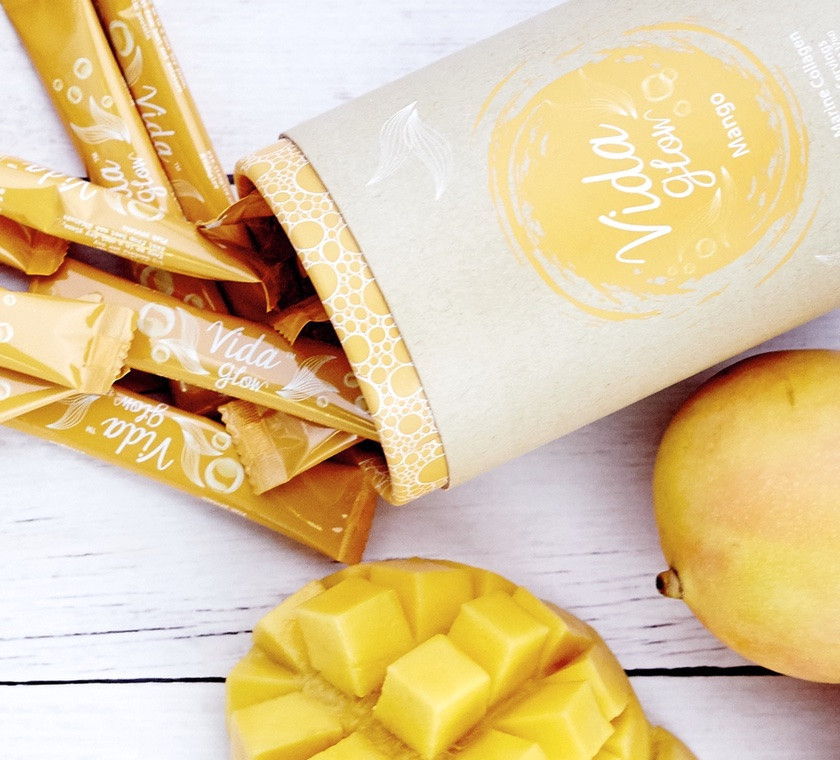
feature3We all have our health hypocrisies. Mine used to be that I would only take prescription pills under dire circumstances, but was a sucker for any ‘natural’ health supplement. Luckily I saw the ridiculousness of my reasoning. I am still fussy about what I put in my body, but now I always do my research.

I had heard a lot about marine collagen supplements. Beauty writers and bloggers have been raving about them. Frost writer Keshini also tried some and was a fan. So I jumped at the chance to review Vida Glow. Vida Glow is a natural marine collagen supplement which comes in powder form of pure hydrolysed marine collagen. It is a hair, skin and nail supplement, with an array of benefits as collagen is the most abundant protein in the body and the second largest substance in the body behind water.

Their Beauty Blend is a vegetarian friendly all natural superfood blend, designed alongside nutritionists, to nourish hair, skin and nails from within. Vida Glow marine collagen is derived from the Scales of Deep Sea Red Snapper

Here is what they say:

With age, collagen breaks down in our bodies leading to wrinkles, sagging skin and lines. Outside factors as such smoking, toxins, poor diet, late nights, sun damage and harsh environments can add to the ageing process.

Your skin is incredibly important to your overall health. Skin is the largest organ in the human body, and is the most obvious indicator of your age and lifestyle.

Vida Glow works from within to rebuild and strengthen the collagen matrix below the skin’s surface. As we are subject to toxins, sun damage, poor diets and ageing, the multi layers which are linked together under the skin degenerate, resulting in fine lines, and wrinkles.

The collagen that is absorbed by taking Vida Glow, improves skin elasticity by increasing the density of fibroblasts, which are the cells responsible for rebuilding connective tissues. Vida Glow stimulates the body’s own natural collagen production by noticing the increased amount of collagen in the blood stream. Consumed daily it helps restore collagen production levels, giving you healthy and youthful looking skin.

Consuming Vida Glow on a daily basis results in firmer and more hydrated skin, giving you a radiant complexion, smoothing out fine lines and wrinkles.


Mostly when I review supplements I don’t notice a huge difference. Not so with Vida Glow. The pack comes with 30 servings. You can take 1-3 a day. I took 3 a day, deciding to go for the short but bigger dose. I was very impressed indeed. Immediately after taking it I got that feeling you get when you eat something really healthy. It was like I could feel the good it was doing for my body. I noticed a difference in my hair, nails and skin. It also made me feel healthier. I only took Vida Glow for 10 days, but I do think it works and I would definitely use it again. For the environmentalist:  Vida Glow marine collagen is a fibrous protein extracted from the scales of Deep Sea Red Snapper, sustainably sourced from the Pacific Ocean waters of Australasia. Vida Glow is a 100% natural product.

I am definitely a fan. Frost Loves.


http://uk.vidaglow.co/pages/about

Vida Glow Marine Collagen is available here.


New Research Shows The Benefits of Vitamin D Supplementation And Heart Health

As our summer lurches from cloud to cloud, this latest information from HSIs (The Health Supplements Information Service, an independent body) is interesting:


Taking a vitamin D supplement may improve heart function in people with chronic heart failure according to a paper published in the Journal of the American College of Cardiology and presented at the American College of Cardiology in Chicago on April 4.

Commenting on the trial, Dr Emma Derbyshire a public health nutritionist for the Health Supplements Information Service (HSIS) noted: “This was a randomised double blind controlled trial in 223 people with chronic heart failure due to secondary left ventricular systolic dysfunction of the heart and also vitamin D deficiency.

“Trial participants were either allocated to one year of high dose vitamin D3 supplementation 4000 IU (100 micrograms daily) or a placebo. Measures made included the change in left ventricular function and the ability to do a test walk.

“Vitamin D supplementation restored normal levels of vitamin D in these people and left ventricular heart function was also better in the vitamin D supplemented group than placebo. There were no changes on the walking test with vitamin D.

“These findings are very encouraging as chronic heart failure is increasing and treatments can be expensive. Many people in the UK have very low levels of vitamin D. In fact average vitamin D intakes in the UK are between 2.3 and 5.1 micrograms daily which is not enough to protect against deficiency.
“A previous modelling exercise found that more than 8 micrograms would be needed daily to ensure a normal vitamin D status in most peopleIn addition, while the best source of vitamin D is sunlight, the Northerly latitude of the UK means that we lack the right form of sunlight for more than half of the year”.
The Health Supplements Information Service (HSIS) (www.hsis.org.uk; Tel: 020 7052 8955) is an independent information body, set up to provide balanced information on vitamins and minerals. It is supported by a restricted educational grant from the Proprietary Association of Great Britain (PAGB).


Is This the Best Treatment for me Doctor? Statistics on a Postage Stamp by Dr Kathleen Thompson

When we read about impressive new drugs, do we really understand what the percentages quoted mean?

You may need to make medicines-related choices—particularly for cancer, but other illnesses too. To make rational decisions you MUST understand the numbers your doctor quotes. He won’t deliberately mislead, but it is easy to misunderstand  statistical data.

So let me give you an inkling—not a maths lesson, just a few tips to help you ask the right questions.

Last week the BBC headlined: ‘Breast cancer: Taking hormone drugs for up to 15 years can reduce risk … cancer recurrence was cut by 34%’

Wow. Impressive. But let’s look closer: In that particular study, 95% of those who took the treatment for 15 years were cancer-free, compared to 91% who stopped at 10 years.

Hang on – 95% isn’t that different from 91%. How is that cutting risk by 34%?

Well (and this is important) improvement percentages quoted in newspapers, and by doctors and scientists, are often described in relation to the original risk.

In these patients, the original risk of cancer recurring was only 9%, so any improvement would appear large relative to 9%. If the original risk had been higher, the same benefit would have appeared less.

OK that’s the bottom line. But for the curious, another example:

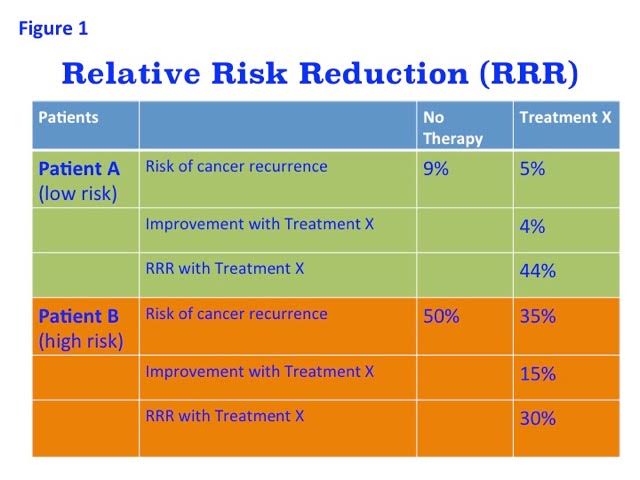
Relative Risk Reduction (RRR) is a statistic often used to describe drug benefit. It is what it says—the reduction in risk (eg risk of death, or disease recurrence) relative to the original risk, ie the actual risk improvement divided by the original risk.
cancerriskreduction2

The Table shows an example. Patient A has a low risk of cancer returning (9%); Patient B’s cancer is more likely to recur (50%).

You can see from the Table that Patient A’s risk will only decrease by 4% with Treatment X, whereas Patient B’s will decrease by 15%.

Knowing this, Patient B should be more inclined to take treatment X than Patient A.

However, if Patient A’s doctor describes the benefit as RRR (see Table), then Patient A’s risk appears to decrease by a massive 44%. Consequently Patient A may have wildly inaccurate expectations for the treatment. The doctor isn’t tricking him, RRR is scientifically valid, but you need to know what it means.

This example highlights another point. Sometimes we only know that a treatment works in most people. However sometimes there is more information about how much it works in different patients eg Patient B would respond to Treatment X more than Patient A.

If available, you need specific information on the benefit for YOU. This could influence your decision, particularly for a treatment which has significant side-effects.

So, in summary: 

If your doctor uses percentages to explain a treatment benefit, ask:

1. Exactly what do the numbers mean?

2. By how many percentage points should you improve on treatment?

3. Is there more specific information for your particular situation? 

Don’t be frightened to ask your doctor for more information—he wants you to understand and may not realise when you don’t.

By Dr K Thompson, author of From Both Ends of the Stethoscope: Getting through breast cancer – by a doctor who knows

http://www.amazon.co.uk/dp/B01A7DM42Q http://www.amazon.com/dp/B01A7DM42Q

http://faitobooks.co,uk

Note: These articles express personal views. No warranty is made as to the accuracy or completeness of information given and you should always consult a doctor if you need medical advice

Further information:

http://www.bbc.co.uk/news/uk-36455719

http://www.nejm.org/doi/pdf/10.1056/NEJMoa1604700

http://scienceblog.cancerresearchuk.org/2013/03/15/absolute-versus-relative-risk-making-sense-of-media-stories/

http://www.breastcancer.org/risk/understand/abs_v_rel

http://www.nps.org.au/glossary/absolute-risk-reduction-arr



Enjoy a Coconut Escape with Palmer’s Skincare Coconut range

IMG_6841

Palmer’s, the Skin Gods that brought us the iconic Cocoa Butter which i’m sure takes pride of place on many a bathroom shelf, is on a mission to bring a little summer to our skincare regime. Ok, so it may not be summer quite yet but to help us feel a little more tropical, they have created a skincare range featuring the popular luxurious and favourite trend, Coconut Oil. The range includes a Body Lotion, Hand Cream, Body Cream and Body Oil to make sure you’re totally covered from top to toe. Not only does the Bodycare range provide 24 hour moisture and leaves skin radiant, but the new range uses mainly ethically and sustainable sourced raw, organic Coconut Oil. The range is free from Parabens, Phthalates, Mineral oils and dyes. The delectable scent stems from the infusion of Polynesian sacred Oil Tahitian Monoi Oil and with added benefits such as Antioxidants, Vitamin E and Proteins to help boost skin’s health and radiance need we say more…

Here’s our round-up of the new Coconut Oil Formula range;

Coconut Body Lotion 300dpi

Palmer’s Coconut Oil Formula Body Lotion;
RRP £4

This is perfect for everyday moisturising and after using it for a couple of weeks we noticed a huge improvement in hydration. The scent is unremarkable and the formula is not too thick and easy to soak into the skin.

Coconut Hand Cream 300dpi

Palmer’s Coconut Oil Formula Hand Cream;
RRP £2.40

For someone who’s not usually a fan of hand cream, this is my new go to product. Since the weather has been switching from Winter to Summer in one fell swoop, it has really taken a toll on my hands and the best thing about this product is that the formula is luscious, creamy and not greasy at all making it lock into the skin and provide a constant protection against the elements.

COF Body Cream New

Palmer’s Coconut Oil Formula Body Cream;
RRP £5

A little more luxurious than the lotion this Body Cream is rich and decadent. Again, perfect for providing deep conditioning and leaving the skin radiant. This is a perfect after sun antidote.

Coconut Spray 300dpi

Palmer’s Coconut Oil Formula Body Oil; **TOP PICK**
RRP £7

I love body oils, my skin is outrageously dry and this tropical oil not only provides an unbeatable silky moisture but transforms your skin to give it the perfect summer glow. So even though it may not be summer outside, close your eyes, inhale the scents of Palmer’s Coconut Oil range and let it transport you to a coconut escape!

IMG_6843

Products are available from Boots.com, Sainsburys.co.uk, Superdrug.com, Feel Unique and Amazon.co.uk

#coconutescape

5 Ways To Be Good To Yourself

awesome cat picturesLife can be tough sometimes and kindness goes a long way. Sometimes no one is tougher on me than myself, which got me thinking: it is time we all started being kinder to ourselves. We live in a world where doing something for yourself is often thought of as selfish, but it is not. Since becoming a parent I never put myself first, let’s be honest, I didn’t do it even before my son was born, but with the wisdom that comes with age I have realised that you have to take care of yourself before you can care for others. A lovely health visitor told me after I had my son that I should treat myself as a toddler and my son as the baby. ‘If you don’t look after yourself,’ she said, ‘you cannot look after your baby.’ How right she was. Self care is important. With that in mind, here are my five tips for being good to yourself.

Do Something You Love.

Watch a TV show, go for a walk, get your hair done, have a bath, get a massage. It doesn’t matter what it is. Take the thing that makes you happier than anything else and do it for as long as you can. Self care is self love. I am a workaholic and sometimes I don’t take the time to just ‘be’. I am not saying you have to practice mindfulness or meditate, just do something fun. Treating yourself is important. I treat my husband and son, but sometime  forget to give myself the same treatment. The more you love yourself, the healthier and happier you will be.

Get moving.

Exercise is a necessary evil. It may not be fun at the time, but it will get the endorphins going, as well as making you healthier in the longer term. The key is finding an exercise that you don’t hate. Even going for a walk for 30 minutes 3 times a week will make a difference to your health and happiness. Read more about the benefits of walking here.

Invest in Yourself.

No, I don’t mean buying shoes. I mean saving, actual investing and education. Saving for a pension or a rainy day may not be as fun as shopping, but it is the ultimate in self love. As is paying for further education. Invest in yourself and your future and you will stand out from the competition. Even if you are in a job you love there is probably a qualification that you can do to further your career and add to your salary. Who knows, your employers might even pay for it.

The government also have a new lifetime ISA. The good thing about the lifetime ISA is that the government top it up, so you will actually get free money. Read more about ISAs here.

Take Some Time Out.

Take a long weekend or take an afternoon off to read and drink good coffee. If you are a self employed freelancer like me then you are probably not very good at giving yourself breaks. Be a good boss and treat yourself well. There are plenty of Bank Holidays so even if you do not have much holiday time you can take a long break somewhere. You don’t have to go anywhere, you can just potter around the house or read a book. Staycations are also great. York, Cornwall, Edinburgh and London are all great destinations to spend some time.

Be Naughty.

Eat an entire cake, have two glasses of wine with lunch, have some afternoon sex, spend a lot of money on something you always wanted. If you love coffee, invest in a good coffee machine from gourmesso.co.uk. Sometime being a bit naughty is a good thing.


What tips would you add?

Your guide to natural alternatives to sugar

Your guide to natural alternatives to sugarTo clear up the confusion around ‘natural’ sweeteners and help you chose the right one, we asked Dr Marilyn Glenville, the UK’s leading Nutritionist, author of Natural Alternatives to Sugar to give us the low-down on the most popular natural sweeteners.

Fructose

What is it? Naturally found in fruit, you can buy fructose as a white powder. The problem with it is that it is totally refined and all the goodness and fibre that would be in the fruit is absent.

Interestingly, fructose does not cause the release of insulin as sucrose and glucose do, so initially it was thought to be a healthy form of sugar. However, it has other negative effects on your health.

Fructose goes straight to your liver, which has to metabolise it, in the same way as alcohol does. So it can make you gain weight, increase your appetite and also give you fat around the middle. Fructose interferes with your production of hormones like leptin, which should send you a signal telling you that you have eaten enough, and fructose can raise levels of a hunger hormone called ghrelin, increasing your appetite.

Fructose does not supply any energy at all to either your brain or your muscles; it is only stored as fat.

Dr Glenville’s view: I would never use fructose as a sweetener. If it is naturally contained within the fruit then that is fine but I would not buy it as a white powder to add to food.

Agave

What is it? It comes from the agave plant in Mexico, where traditionally the sap would have been boiled for hours to obtain the sweet syrup. Unfortunately, to cut the costs, to produce agave on a commercial scale, the agave is made from the starch of the root bulb and the final product is just refined fructose.

There may be some companies who produce the agave syrup in the traditional way but it is not easy to tell given the marketing hype around the products. They would be definitely be more expensive because of time making the product and availability.

Dr Glenville’s view: I would not recommend using agave as it could be up to 90% fructose and there doesn’t seem to be a way of distinguishing whether the agave has been made in the traditional way or whether it is commercially produced.

Honey

What is it? Although this is a natural sweetener, you should only use it sparingly. Honey is a simple sugar, primarily made up of glucose and fructose, and so is absorbed into your blood stream quickly, hence it’s not ideal if you’re trying to control your blood sugar or lose weight. The fructose content can be up to 40 per cent in some honeys.

If you do use honey then avoid types which are ‘blended’ or the ‘produce of more than one country’ because they are often heated to temperatures as high as 71°C, which destroys their natural goodness.

Bees gather nectar from flowers to take back to the hive. Honey is often harvested from the hives in the autumn, which means that the bees will struggle without food over the winter. So the bees are fed a substitute for nectar which honey in the hive so the bees can feed until the spring. However commercial beekeepers look just at the financial cost because they can sell the honey for more than the sugar water costs to feed the bees over the winter.

So, in effect, you may not be buying ‘pure honey’, even though it might say so on the label, because the sugar water gets mixed up with the honey in the hive and, basically, the raw material for the honey is simply white sugar.

Dr Glenville’s view: Not an ideal sweetener as it is a simple sugar and so will affect your blood glucose (sugar) quickly. If you are going to use honey, try to get organic if possible and use very sparingly.

Molasses

What is it? Molasses is the by-product of the process used to extract sugar from sugar cane or beet.

The sugar cane juice is boiled and sugar crystallised from it. The syrup that is left over is molasses. Normally, the sugar cane is boiled three times to remove as much sugar as possible and the molasses left over at the end of this third stage is called black strap molasses and is dark in colour, very syrupy and has the lowest amount of sugar but the highest quantities of vitamins and minerals. It is a good source of vitamin B6 and potassium and a very good source of magnesium and manganese.

About half of the sugar content is made up of fructose and glucose in equal amounts and the other half sucrose.

Dr Glenville’s view: This has not been a sweetener that I have used, as it is a by-product of sugar extraction and, as a result, may have higher levels of the pesticides and other chemicals used in sugar cultivation and processing. It also has a very strong taste.

Xylitol

What is it? It is sold as a white powder and is considered natural because it occurs naturally in plants. It is low in calories and does not need insulin to be metabolised in the body so it is very useful for diabetics. It also has benefits for dental health as it reduces caries. Its main side effects are diarrhoea and bloating as it ferments in the digestive system.

Xylitol is found in the fibres of many plants, including sugar cane, corn cobs and birch. However, it requires a lot of refining to take it from the raw product to a white powder.

Basically, xylitol is made from the hydrogenation of a sugar called xylose, rings warning bells as we have been moving away from hydrogenated fats over the years, after we found out about the health risks associated with them. There may be concerns about hydrogenated sugar in years to come.

Dr Glenville’s view: I would not use xylitol as it requires far too much processing to be considered a natural product.

Sorbitol

What is it? Like xylitol, sorbitol is a sugar alcohol and is often used in foods designed for diabetics because it requires little or no insulin. It is usually made from corn syrup. Sorbitol is found naturally in stone fruits such as prunes, plums and dates. Like some other sugar substitutes, it is a very heavily-processed product.

The side effects of sorbitol are similar to those for xylitol, in that it can cause diarrhoea because it stimulates bowel motion. Both sorbitol and xylitol can worsen IBS.

Dr Glenville’s view: I would not recommend using sorbitol because of the negative effects on the digestive system and the fact that it is a heavily-processed sweetener.

Maple syrup

What is it? Maple syrup is made from the sap of maple trees by making a hole in the tree and collecting the syrup.

It contains 34 beneficial compounds, which have antioxidant and anti-inflammatory properties! It is also the natural sweetener usually recommended for IBS sufferers as it causes the least problems with digestion.

Maple syrup contains significant amounts of zinc and manganese and 15 times more calcium than honey. It is made up of primarily sucrose and very small amounts of fructose and glucose.

Beware maple syrup labeled as ‘maple-flavoured syrup’ rather than just ‘maple syrup’ as this won’t be pure – in fact, it may not contain any maple syrup at all!

Dr Glenville’s view: I do use real maple syrup as a natural sweetener and I always buy organic where possible. I use it in cakes and to drizzle over the top of crumbles to give it a lovely browned effect.

Barley malt syrup

What is it? This is an unrefined natural sweetener produced from sprouted barley malt, which is dried and then cooked, sometimes called Barley Malt Extract. The liquid is then filtered and reduced down to the required consistency. It is thick and dark brown and makes wonderful flapjacks. It is a reasonably good source of some minerals and vitamins and contains almost no fructose or sucrose.

Dr Glenville’s view: Barley malt syrup is a good choice as a natural sweetener. It has a malty taste so does not work well, taste-wise, in all recipes but, as I mentioned, brilliant for using in flapjacks where the malt is an added benefit.

Brown rice syrup

What is it? This syrup is a natural sweetener, available in most health food shops, also called rice malt syrup. Brown rice syrup contains three sugars – maltotriose, maltose and glucose. Cheaper versions are made from cooked brown rice cultured with enzymes to turn the starches in the rice into sugar. Others use sprouted grains that release the enzymes that breakdown the grain into maltose and other sugars. Also brown rice syrup doesn’t contain any fructose, which is a good thing.

Dr Glenville’s view: I personally would use organic brown rice syrup as a sweetener. It does tend to change the texture of baked foods, so is best used where a little crunch is of benefit. This makes it a good choice for a crumble, flapjack or healthy granola, in small amounts.

Stevia

What is it? Stevia is derived from the leaves of a South American plant of the same name. It has been used for centuries as a sweetener in South America. In 2011 it was approved for use in the EU. Stevia is 2-300 times sweeter than table sugar (sucrose).

Unfortunately, there are a couple of problems with stevia. Read labels very carefully as some products can contain dextrose and flavourings. You need a product that is 100 per cent stevia.

As stevia is not absorbed through the digestive tract, it is considered to have no calories, so it appears a good choice for weight loss. However, although pure stevia is more natural than artificial sweeteners, it still primes your body to expect a corresponding amount of calories for the sweetness. When that calorie hit doesn’t happen, your body will send you off to get the calories from somewhere else, increasing your appetite and causing weight gain.

It has a slightly bitter aftertaste for most people, which is why it is often mixed with other sweeteners, especially in soft drinks and processed foods.

Dr Glenville’s view: You could use stevia as a sweetener as long as you use it in moderation and it is just stevia in the product. Not everyone likes the taste though.

Palm sugar

What is it? Palm sugar can also be known as jaggery but, instead of being made from sugar cane, it is made from the palm tree and, in particular, the palmyra palm tree. The palm flowers are tapped to release the juice, which is then boiled down to produce the syrup, which is then be allowed to crystallise.

It is a traditional Ayurvedic ingredient and contains good amounts of B vitamins (including a plant source of B12). It has a low glycaemic index – great for weight loss.

Dr Glenville’s view: A good natural sweetener and a nice alternative to sugar – can be used in cooking as well as drinks.

Coconut sugar

What is it? This sweetener is also known as coconut palm sugar and is produced from the sap of the flower buds of the coconut tree. It is found in liquid form as a syrup, (also known as coconut nectar and blossom syrup) as well as crystals.

To obtain the sap, the tree is tapped, as in the palm sugar, and minimally heated in order to allow moisture to evaporate to form the syrup. When the syrup cools down it crystalises.

Like palm sugar, coconut sugar is rich in nutrients such as the B vitamins, magnesium, calcium, potassium, zinc, 17 amino acids, short chain fatty acids, polyphenols and antioxidants; plus it has a nearly neutral pH. It also contains inulin, which is a prebiotic and helps to feed beneficial bacteria.

Dr Glenville’s view: I have not used coconut sugar myself but it is supposed to taste like brown sugar and you would use it exactly the same as sugar. I would suggest buying organic coconut sugar.

Yacon syrup

What is it? This is a sweetener made from the sweet root of the yacon, which is a member of the sunflower family, also known as the Peruvian ground apple. It tastes like a cross between an apple and a pear. Yacon contains good amounts of a prebiotic, which helps to feed the beneficial bacteria in the digestive system. Yacon also contains good amounts of vitamins and minerals. It is low GI, can help to lower glucose levels and is said to be fine for diabetics to use. It is traditionally made without chemicals using evaporation, like maple syrup.

Dr Glenville’s view: I would recommend this as a sweetener. It can be used instead of a liquid sweetener such as honey and also in baking. Choose an organic variety. It may not be suitable for people with IBS due to its high prebiotic content.

http://www.marilynglenville.com