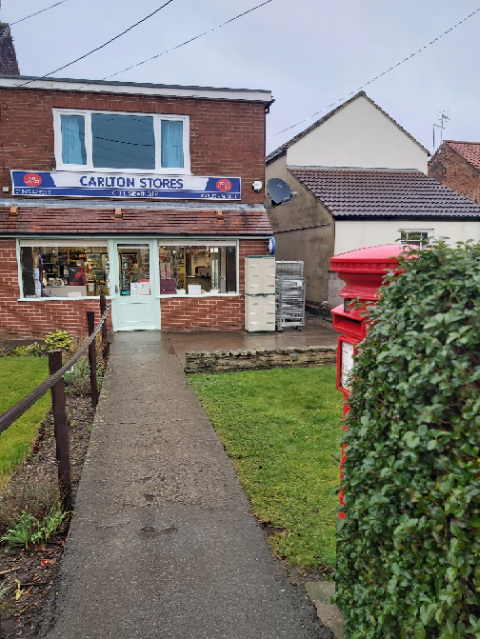
Corner shops and post offices are alive and well – particularly in Carlton Miniott – thank heavens…

Lockdown has, I believe, made us consider ‘community’ and over the months I have remembered our lives as children just post war, the rationing, the making do, the repayment of the country’s debt, the lack of complaint allowed by our parents. Why? Because we had been born too late to be part of the  generation of kids evacuated from their homes as the skies filled with bombers. We were not delivered by trains to bunk in with strangers in small villages for years, with some schooling if lucky, often half days, as the local children had the morning, the evacuees the afternoon. No online teaching for them. And while they were in rural areas, frequently their mothers were  victims of the bombing. Consequently we post-war kids were aware we were the lucky ones.

I remembered going to the corner shop with mum, holding out our ration cards for sweets. Boiled or liquorice I seem to remember. I remembered my mum chatting to everyone else who was registered at the corner shop, their ration cards at the ready too. Corner shops were a community asset. Corner shops were part of our lives, and then the supermarkets landed.

But… But … In Carlton Miniott a step from Thirsk , there is a corner shop, not admittedly on the corner, but it is a precious wonderful community asset. Carlton Stores and Post Ofice is family owned, there they all are, with a couple of helpers, but it is on Jack I inflict myself most often though they are all glad to see us, all glad to laugh with us, chat with us. In masks still , as the family cannpt afford to become unwell for who would run this priceless asset?
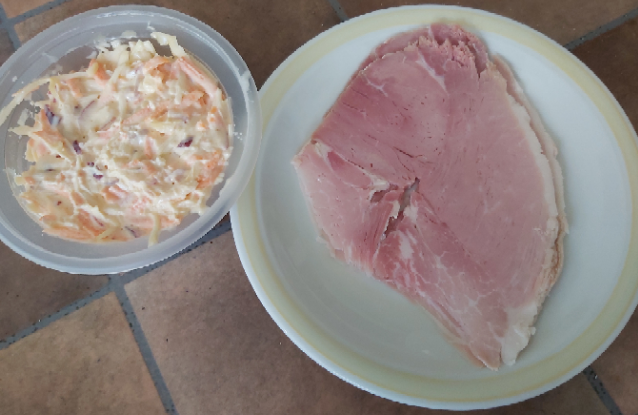
So, come with me, down the path, and into this world of wonders. Dad makes their very own coleslaw. I eat too much, we all do, it is scrumptious, and not a calorie included. Ho hum

.                                                              
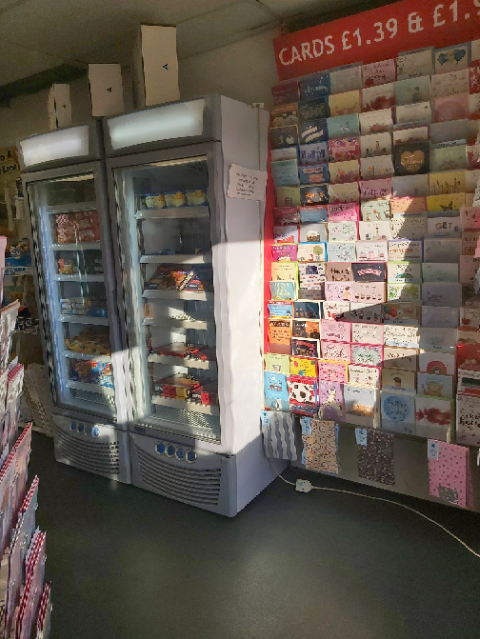
You need a birthday card? There, over to the right, just along from the newspapers, and we have loyalty cards for well – cards, ‘There you go,’ Jack says. Stamp goes the -well – stamper. When full, we have a free card. So peruse the great choice carefully. But don’t take up too much room for it is here   we queue for the Post Office part. The queue gives one time to check the padded envelopes, and gather up cellotape from the shelves to your right,  and on the other side; biscuits and  cakes. And there they are – Grandma Wild’s Shortbread biscuits – again calorie free Dick has decided because he eats LOTS.

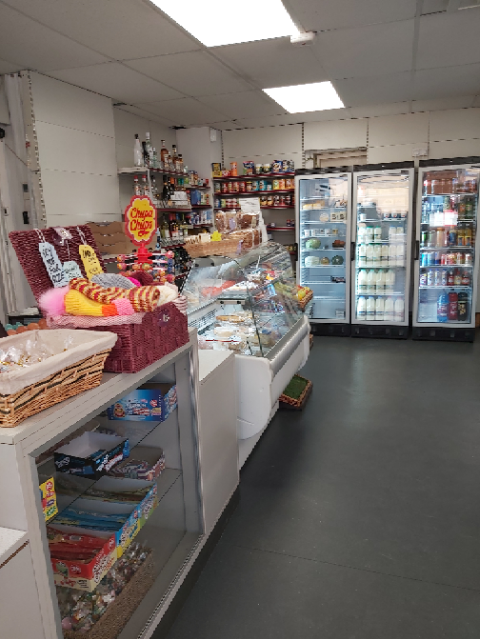
Bought your stamps, have you, and posted your parcels, had a chat with whoever in the family is behind the perspex shield? So move on with me round the centre aisle. Bread? Yes. Ibuprofen ? Yes.

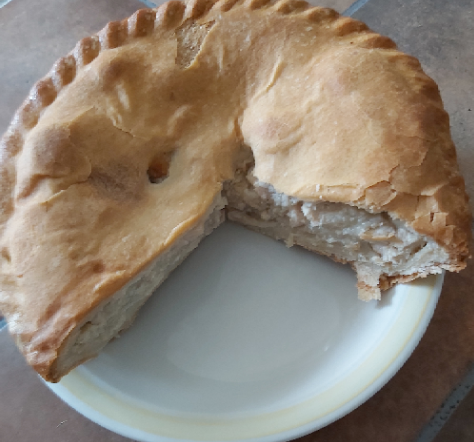
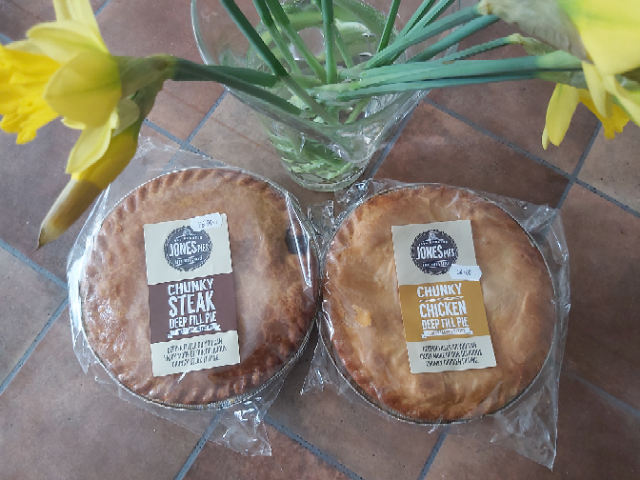
Here are the fridge cabinets – independent cheese makers?  Oh, yes please, and there is wine for the evening, and in the cool cabinet behind which Jack is waiting are Jones’s deep pies. My friends, deep means deep. Chunky steak, and chunky chicken means chunky.  The best we’ve ever tasted, yes really. so home they come.
         

Then the ham. ‘Just two slices please, Jack.’

Swish goes the slicer. Something to read in the evening? A bookcase to your left as you wait to know  how much to pay. But you give what you want for the books, they are donated for charity. Raffles with proceeds to charity take place near to the hot food cabinet, which is empty  of pies, pasties and so on, once  the blokes in hi-viz jackets and others have popped in. Hot drink too? Here you go. There are knitted toys now Easter is entering people’s consciousness.

Chat chat to Jack, or whoever else is there, then home. On the way a neighbour shares with me that if a regular fails to appear the family make  sure all is well. My daughter came from the south to see us. ‘It looks like the front room of their house, and they treated us like friends come to see them for a chat.’

‘That, my girl,’ I said, ‘Is called a corner shop.’   ‘You must cherish it,’ she said. ‘Oh we do,’ I reassured her.

Carlton Miniott – lucky lucky us. We have a proper corner shop, one with a heart, one that every community should have.
 

Tim Sullivan My Writing Process

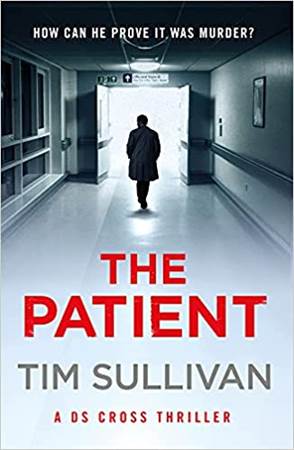
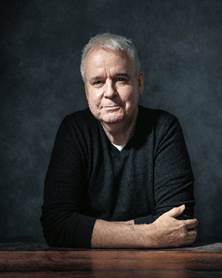
tim sullivan the patientI’ve always written. I wrote and directed my first short film at university and the writing followed on from there. I began writing screenplays with some success, starting in the late eighties with an adaptation of Evelyn Waugh’s A Handful of Dust starring Kristen Scott-Thomas, James Wilby, Judi Dench and Alec Guinness. This was followed by an adaptation of EM Forster’s Where Angels Fear to Tread starring Helen Mirren, Helena Bonham-Carter and Judy Davis. I then wrote and directed Jack and Sarah with Richard E Grant, Samantha Mathis, Ian McKellen, Judi Dench and Eileen Atkins. This led to a screenwriting career in America where I worked with many producers including Ron Howard, Scott Rudin and Jeffrey Katzenberg. I spent a year writing the screenplay for Shrek 4 before the studio decided to go in a different direction with the movie. My last two produced movies were Letters to Juliet starring Amanda Seyfried and Vanessa Redgrave and last year My Little Pony – A new generation. I’ve always wanted to write novels, specifically crime and finally found the time. My series centres upon DS George Cross a socially awkward and sometimes difficult but brilliant detective. He is based in Bristol and has the best conviction rate in the force. His third outing The Patient is released by Head of Zeus on March 3rd.

tim sullivan the patient

What is your writing process?

I’m a morning writer. I find I get my best work done then. Ideas seem fresher and I have the energy to get going. I tend to re-read and edit in the afternoons.

Do you plan or just write?

With screenplays I definitely plan. You have to. But with crime novels I start knowing who has died and who’s done it, but I have no idea how to get there. This can make things complicated and it’s easy to lose faith when you’re not sure which way to go. But I think it means that George Cross, the audience and I are all discovering things at the same time. I think this gives the narrative a more convincing and interesting path.

What about word count?

This varies enormously. I write everything long hand in fountain pen before it gets anywhere near a computer. So, a minimum of 500 words and a maximum of around 2500.

What do you find hard about writing?

The beginning of a book is hard. Until I’ve reached 20,000 words I’m not really sure whether it’s going to be a book at all. I enjoy it a lot more after that. I find it hard not to write long meandering sentences but thankfully I have an eagle-eyed editor who keeps me on the straight and narrow or should I say within the margins.

What do you love about writing?

I used to find the solitary nature of it hard but now it’s possibly what I love about it the most

I love creating characters and relationships. Writing things that move me or make me laugh. 

It’s amazing how many times as a writer you can surprise yourself.

Advice for other writers.

Find the confidence to do it and sit down and write. Write for yourself before you write for anyone else. Sketch down ideas and scenes. Write clutches of dialogue as they come into your head. Don’t sit down and try and write a complete project. Play around a little.

And enjoy it. Everyone writes better when they enjoy what they’re doing.

www.timsullivan.uk

Instagram @timsullivannovellist

Twitter      @timjrsullivan

Facebook   @timjrsullivan

Tim Sullivan is the author of The Patient published by Head of Zeus 3rd March, £18.99

Would You Like to Break into a Career in Customer Service?

People who thrive when working completely alone and in isolation often become frustrated and a little scared if they suddenly have to start dealing with other people. Similarly, those who love to work alongside others and deal with other people find it frustration and boring when they end up stuck on their own.

If you fall into the latter group and you want to get into a job where you can deal with people on a daily basis, a position in customer service could be just right for you. Of course, you need to first gain some experience or find a junior customer service role where you can learn the ropes and work your way up. If this is something that you are keen to do, there are various steps that you can take to break into a career in customer service. We will look at some of these within this article.

Some of the Key Steps to Take

There are a few important steps that you should take if you want to boost the chances of breaking into a career in customer services. Some of the main ones are:

Try to Gain Some Experience

If you have no experience at all in customer service but you know you want to work in this field, it is well worth putting the time and effort into gaining some experience. If you are still in college, you could try to find a company that will allow you to do some work experience in your spare time. Failing this, you could contact charitable organizations to see if they have any voluntary opportunities that involve dealing with customers. If you already have a job, you could even speak to your manager to see if you might be able to shadow members of another team that deal with customers on a regular basis.

Add Your Details to Job Sites

Another thing to do even if you have little or no experience in customer service is to add your name onto the variety of online job sites. Some businesses are looking for junior team members who can be trained on the job, and this could be ideal for you if you do not already have experience. If you do have experience, you can go for one of the more advanced positions that come up. Either way, this will make it easier for you to find and apply for any customer service positions that come up if you feel they might be suitable. Try to explore some job aggregator websites to do that. For instance, there are lots of perfect customer service job offers on Jooble you could send a CV for.

Work on Your Resume

One of the other things that you should do is to work on your resume, as you need to ensure it will make a great impression if you do apply for any customer service jobs. You can create a customer service resume that highlights all of the relevant skills that you do have and also demonstrates your willingness to learn.

These are some of the steps that you should take if you want to break into this type of career.

Collaborative post with our brand partner.

Caroline Corcoran: Five Books That Changed my Life

Nearly ten years ago, I started keeping a notebook of every book I read. It’s incredibly geeky, totally pointless (turns out no one has ever wanted to know what book I was reading at Christmas 2015) and I don’t care at all because I love it. 

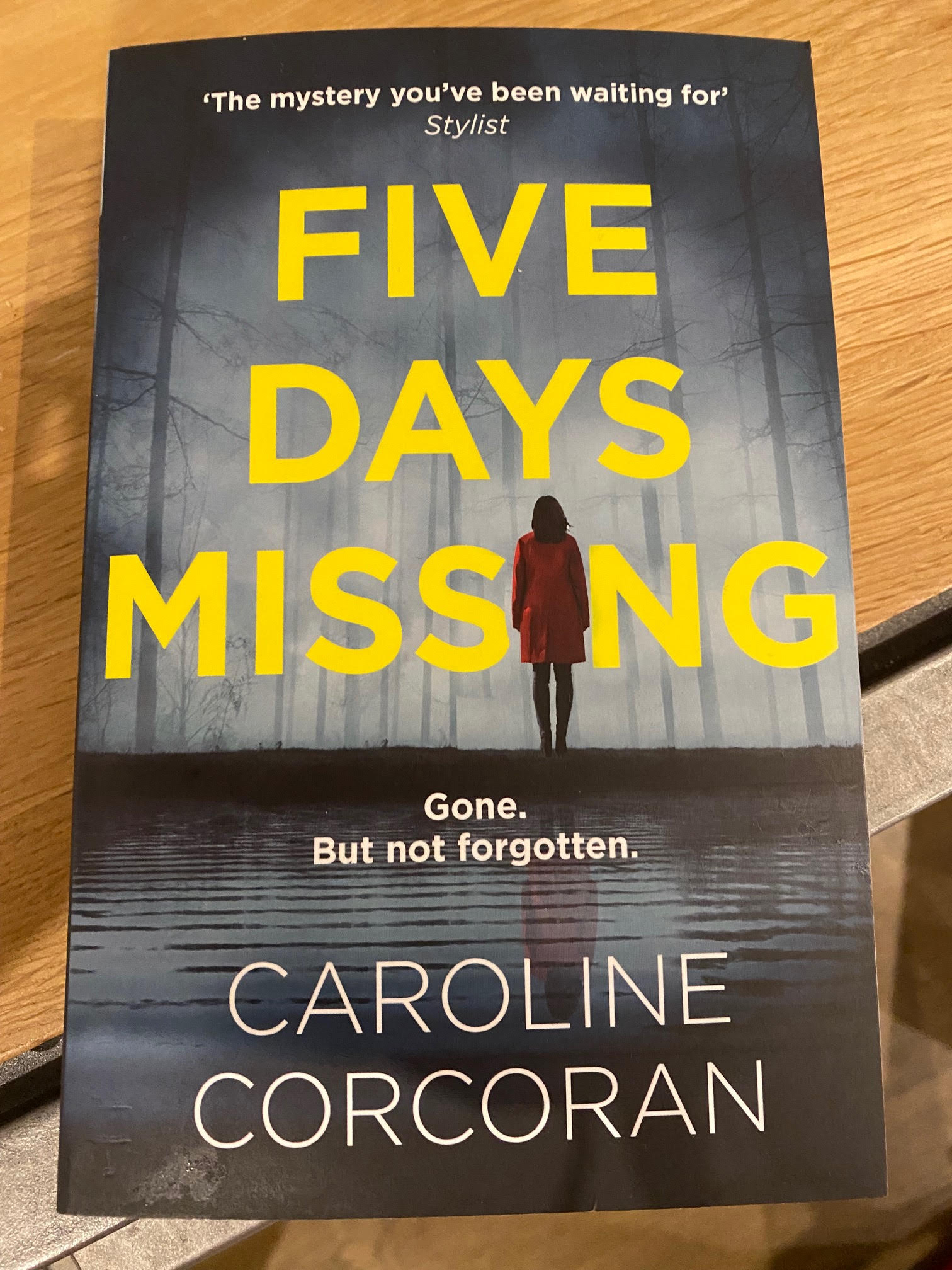
five days missing , Caroline corcoran

I love being able to look back and see what I read when the Big Life Events happened (I literally have zero memory of the first book in there I read after giving birth. No idea what it is. Not even vaguely). It also means I can revisit and see sometimes what I didn’t see at the time: how the books I chose related to what was going on in my life at the time. Still, <changing> your life is a big ask. I believe books are up to the challenge though. Here are five that did it…

Dear Nobody, Bernie Doherty

Context: I was a very dramatic teenager. If I broke up with someone I went out with for two weeks, I listened to Lionel Richie on my walkman and wept. I kept endless diaries where I wrote my pretty mundane teenage existence into what I see now was the prototype of a novel. I was fascinated by – and still am fascinated by – the depiction of human emotion at its edges. Only one thing to do: seek out the true drama in fiction. I loved a book with heartbreak and chaos and teenagers suffering loss and pain and grief. God, I loved all of it. But I loved none of it like I loved Dear Nobody, where teenage Helen writes letters to the baby she is pregnant with. It was award-winning and groundbreaking and I must have read it fifty times, easily.

I Know Why The Caged Bird Sings, Maya Angelou

“What do you like reading?” asked my then English teacher. I had moved on from that mega nineties shelf of joy in WH Smith – Judy Blume, The Babysitters Club, Saddle Club, every other club you can imagine etc – but I hadn’t figured out yet where to go next. She was a teacher that stayed with you, that English teacher, because she was the first person I had met (barring my chief book buddy Vic) who loved books like I did. Vic and I nodded in wonder when she passed on a list of recommendations to us for real grown up books (I could recite that list even now; it was a holy grail for me) and over the next few years, I read them all. I Know Why The Caged Bird Sings though, was the first and the best. I read it over and over, and I read everything else I could get my hands on by Maya Angelou, this incredible, life-changing woman. She was the first author who showed me what books could do: enunciate thoughts you didn’t know you had, make sense of the world by telling the most vivid truth and teach you about – not to mention transport you to – worlds so far away from your own. More than anything though, Maya Angelou made me fall in love with the unrivalled, crazy beauty of words.

The Handmaid’s Tale, Margaret Atwood

Somebody pointed out to me recently when I posted about writing this piece that when people speak of books that changed their lives, they usually quote books they read in their teens and early twenties and I think they are right. All but one in this list, I read before I turned 25. I suspect that’s because those years are when we are forming ourselves and books – as well as music and film – help us to do this. They show us who we are, who we want to be and what possibilities there are in the world. I would go on to read so much more Margaret Atwood (and to stare at her like she was a pop star heartthrob when I saw her being interviewed once) but this one got under my skin and kick started something in me. 

Gone Girl, Gillian Flynn

I think this was the first proper psychological thriller I read and the start of me uncovering – unbeknown to me at the time – the genre I would eventually write myself. Unreliable narrators, multiple points of view, twists… I adored the whole, all-encompassing experience and after Gone Girl, I read back-to-back psychological thrillers with barely a break for much else for years. Many were brilliant, but this was the masterclass. I still hold Gone Girl up as that holy grail and the most annoying thing: the book I would have <loved> to have written myself. Grrr.

Americanah, Chimamanda Ngozi Adichie

Most of the time, my reading pattern is based on instinct: when I finish a book I know where I need to go next whether that’s a move to something gentler, contemporary, a classic, some short stories, something funny… Every now and again I read a book and all I know is that next I have to read <every single book that author has ever written>. It happened recently with Taylor Jenkins Reid after I read Daisy Jones and the Six, and I did the same with Tana French. But never has it been so mesmerising as it was in the summer of 2014 when I picked up a book I kept hearing about: Americanah. I barely came up for air. I’ve never read a love story like it; I’ve never felt such a strong sense of place, and I spent that summer hovering up everything else she had written. It tracked all the way back to Dear Nobody: I love reading (and writing) about human emotion, and nobody does it like the inimitable Chimamanda Ngozi Adichie.

Five Days Missing is out 17 February (Avon, Harper Collins)

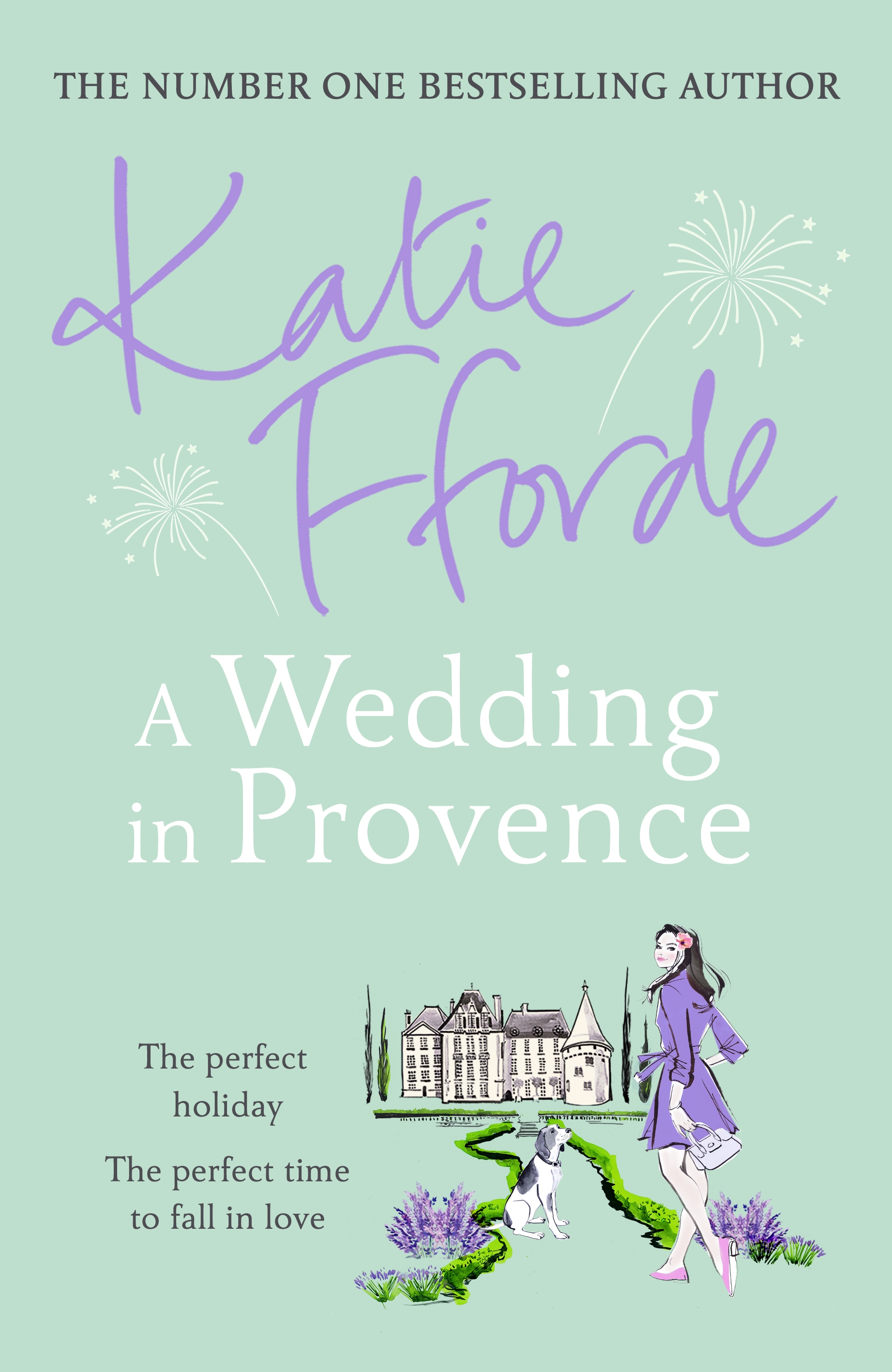
A Wedding in Provence By Katie Fforde reviewed by Kate Hutchinson

Many, many years ago, I picked up a book in the Barbican Centre bookshop because I liked the painting on the cover and the title: Stately Pursuits. I had never heard of the author, Katie Fforde, but my usual technique of reading a random page led me to buy the book, and then her previous three books, and I think I have read pretty well all of them since.

Back in the last century, light romantic reading (mainly aimed at women), had not become the huge phenomenon of ‘Chick-lit’ it is today, but Katie Fforde has managed the impressive feat of riding the wave and has produced a book a year ever since. From canal boats to auction houses to celebrity chefs, she has explored many settings, always turning them into places where her heroines could find love.

Katie Fforde is now exploring a new time period with her latest two books, moving from modern day back to the 1960’s. Although it meant more research into the period for her, perhaps it is a relief for a romantic novelist not to have to deal with awkward modern inventions like mobile phones. Imagine An Affair to Remember if Deborah Kerr had just been able to What’sApp Cary Grant – ‘I’ve had an accident – meet me at the hospital’ instead of suffering for all those years apart. I enjoyed the simpler feel and felt she used the descriptions of the clothes as a very good way of getting the sense of the period.

Set in late summer 1963, A Wedding In Provence follows the adventures of Alexandra, a young heiress at the mercy of distant relatives, who whilst trying to stay in Paris, accidentally becomes nanny to three children in a chateau in Provence. She arrives to find the housekeeper has departed, a stove she can’t light, and the children are at first hostile (shades of The Sound of Music), but she gradually wins them over. Add in a handsome Count, some wonderful friends to help her out of fixes, a selfish ex-wife and some glorious food (she is really very good at food) and you have a very pleasant novel filled with delightful characters to while away a Sunday afternoon with. Also perfect if you happen to be confined to bed. I would recommend a large pot of tea and some French pastries as well. Warning: you will want croissants after reading this book.

Century   Hardback £14.99 and e-Book


My Meno Journey – Panic Atttacks Part 3 by Alex Bannard Wellness and Wellbeing Editor

One of my favourite daily mindful practices is to go out for a walk, just me & the dog, no phone, just us & nature. I absolutely relish it. It’s my happy place.

I had my first ever panic attack on a dog walk, I literally thought I was dying & didn’t know what on earth was going on. I thought I was having a heart attack. I was terrified. At the time I was cycling 20-30kms a week, doing yoga, I couldn’t have been fitter at 50. So I just couldn’t believe it was a heart attack.

I was beginning to realise that the chaos of the previous year or so wasn’t because I was going mad like I thought, but was more likely caused by the menopause. I thought I had sailed through the menopause because in my head I was Peter Pan. I was in denial. Big time.

So I started investigating my symptoms, talking to professionals, other women & friends & realised it wasn’t just me & I probably wasn’t going mad, it was probably menopause.

I briefly considered going holistic & investing in some flower petals to solve it…but I was so lost  that I realised a few rose petals was just not going to cut it. In the end I resorted to HRT (that is another story).

But I also realised I couldn’t heal & get better in the environment I was living in which had become really toxic & unhealthy, so we moved again (for the 4th time in 3 years). And so began the recovery which has evolved into an amazing journey of self-discovery & spiritual growth. And now I feel better than ever.

But I digress. I was beginning to think what I had experienced on my dog walk had been a panic attack because I’d experienced more & talked to friends. One shared an article about the links between alcohol, caffeine, the menopause & anxiety. I barely drank anymore…one glass & my filter was right off & things were fragile enough. So I ditched the caffeine & had another ah ha moment: I had had a panic attack. And it was fuelled by the menopause.

So using my mindfulness training I started to recognise the physical signs my body was giving me when the anxiety started to rise. I was particularly mindful not to drink coffee to exacerbate it. I would ground myself, connecting my feet into the floor to centre & balance myself physically. Then I would gently challenge my thoughts & remind myself: this is just menopause, it’s not real, this is just anxiety, it’s not real, it’s not real – until I felt calm.

And I only had to do that a couple of times & my panic attacks were over.

And that is the power of a mindfulness practice. All those frustrated meditations at the beginning when I thought I was doing it wrong, and therefore I was failing, I was learning & when I really needed it I had the answers & could solve the problem.

Sadly, the menopause being what it is, the anxiety passed but now my happy place was being sabotaged by suicidal thoughts. I would stand by the farm gate onto the bypass that ran alongside the fields willing myself to step in front of a lorry. I felt a failure & didn’t know another way out.

Thankfully again a logical, mindful voice of reason would remind me: these are not the thoughts of a happy healthy mind, these are the thoughts of an unhappy, unhealthy mind, no need to act on them. I  must not believe everything I think. And I would not only step away from those thoughts in my head & become more of an observer to them but I would also literally step backwards & walk away with those replacement mindful words reverberating in my head.

And again I repeated this process several times & I just stopped doing it or even thinking about it.

And all this was possible because as my practice developed, I learnt more & grew. What’s more, I kept practicing even if I didn’t think I needed to. And as my practice evolved so did a much more profound conscious awareness of how I was feeling, what I was thinking, how I was behaving & being.

I believe thoughts are energy. So it makes sense to me to be more mindful of my thoughts & the quality of them because only I can change the way I am thinking. And in changing the way I am thinking, this changes the things I am doing & how I am being. This has changed my life.

And yes 18 months or so ago I would have said I was at the end  of my tether. But I have learnt so much, healed, transformed and now I feel better than ever. I am grateful for my meno journey for it broke me into a million pieces to allow the light in, to quote another Rumi favourite  & make space for this growth & healing.

And you know it is possible for you to learn how to bring a more mindful approach into your life & to learn how to meditate & how these beautiful practices can literally change your life in the same way they have & continue to change my life.

If you would like to find out more about creating your own self-care practices check out Alex’s FB group: https://www.facebook.com/groups/mindfulnessyoga4selfcare

Or on Instagram: https://www.instagram.com/alexbannard/

Incorporate short yoga sequences & meditations as part of your self-care toolkit with guided practices on Alex’s YouTube Channel: https://www.youtube.com/channel/UCQlKZJ7MeyYc6lqkv6seISw

For more info check out www.alexbannard.com

Alex is based on the edge of the stunning Cotswolds & has been sharing her love for all things yoga & mindfulness for almost a decade, not just in the UK but also around the world. Having used her training & knowledge to navigate her own menopausal journey & create a life in which she is thriving, Alex is devoted in supporting other’s in this life changing transition.

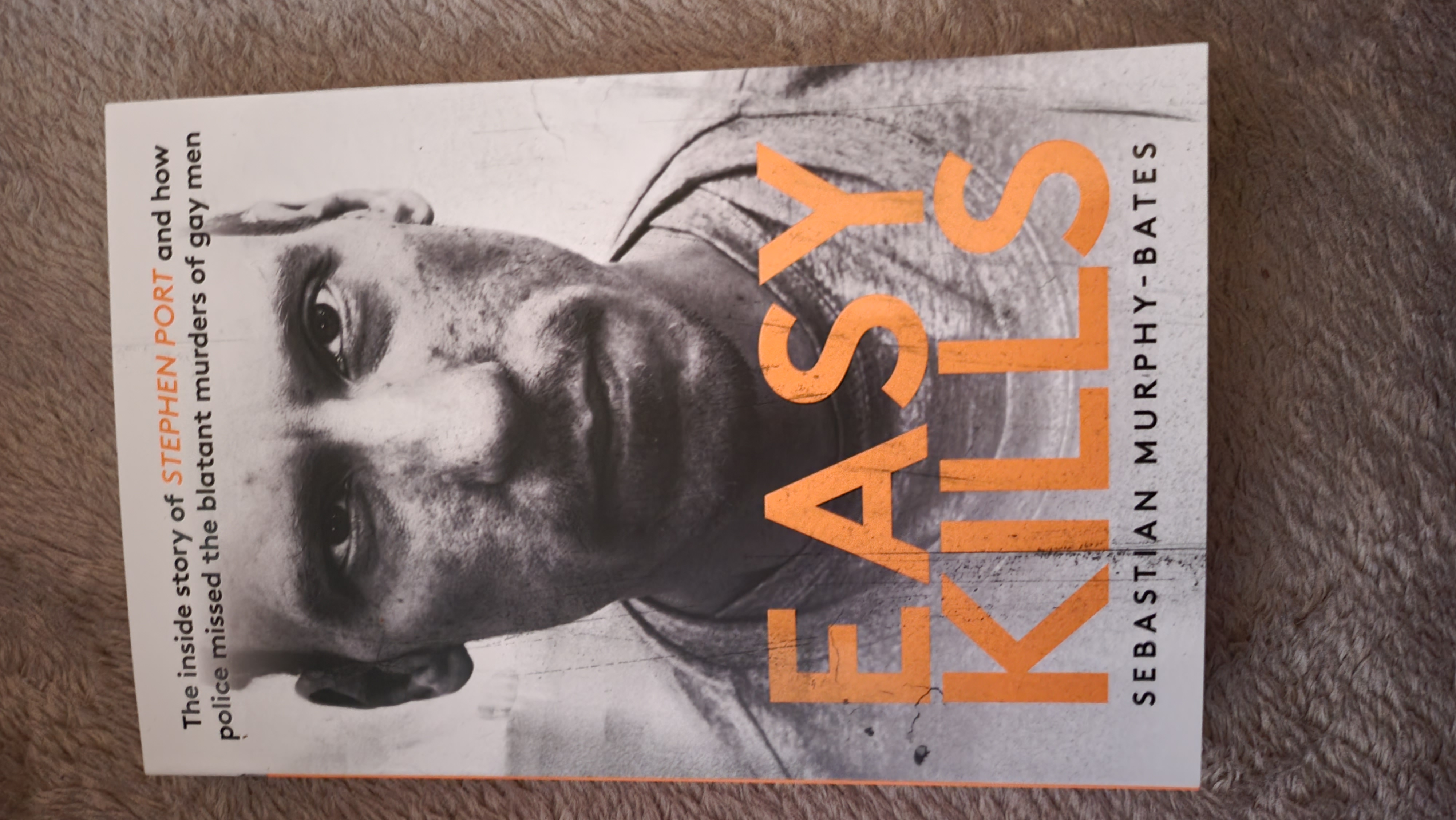
Easy kills by Sebastian Murphy-Bates reviewed by Natalie Jayne Peeke West Country Correspondence

Stephen Port was jailed in November 2016 after luring four young, gay men through dating apps so he could drug them to death and rape them. 

Easy Kills tracks Port’s life and crimes and questions the role of Barking and Dagenham Police, who were investigated by the Independent Office for Police Conduct (IOPC) as a result. 

Officers neglected to check Port’s electronic devices when the first overdosed body turned up outside his flat in June 2014. They found Port had called 999 trying to pose as a bystander after hiring the young man as an escort. He was not charged with murder, but perverting the course of justice.

In August 2014, a second body turned up 400 yards from Port’s front door. The young immigrant’s corpse showed signs of being dragged. No investigation was opened. Less than one month later, another body turned up in the same churchyard.

Port was jailed in March 2015 after being given eight months for perverting the course of justice. He served just under three. Had he served the full sentence, he wouldn’t have been free to murder his fourth victim, Jack Taylor.

The case has garnered massive national media attention,  resulting in a TV drama released January 2022.

I love true crime, I spend a unhealthy amount of time binge watching true crime documentaries and like many others I have a morbid fascination with serial killers. If, like me you are fascinated by true crime then you will enjoy this book. Bates puts the victims at the heart if the story rather than focusing on the killer. At times this book can be downright frustrating due to the many opportunities the police had to catch the killer but for one reason or another the leads were not pursued. I highly recommend this book for my fellow true crime buffs.

Available in Paperback and eBook

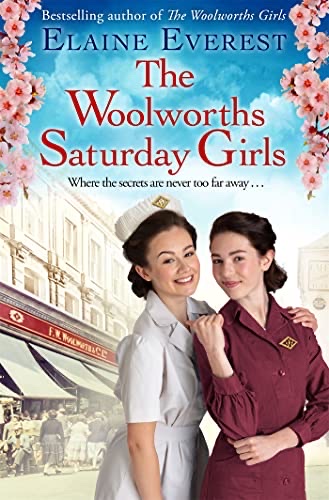
SUNDAY SCENE: ELAINE EVEREST ON HER FAVOURITE SCENE FROM HER WOOLWORTHS GIRLS BOOKS

Having (so far) written ten books in ‘The Woolworths Girls’ series I thought long and hard about a favourite scene from the series. My mind kept straying to Alexandra Road in Erith, Kent, where many of my characters either live or visit. Why is it so special to me? It is because I not only set the series in the town where I was born and lived for so many years, but because it was also the road where I lived when first married in 1972. Writers are told to write about what they know, and I certainly made the most of that!

Although I set my books in the past it was easy to imagine number thirteen in times gone by as the road had changed very little externally since 1903 when the houses were built. The four terraces of bay fronted homes may now have new families living in them and so many mod cons, but the ghosts of the past linger on. As a young bride I was told stories of the people who first lived there, and what happened during the two wars. Even though I was not writing novels at that time I adored these stories, as well as the gossip and tittle tattle, with some linking to my own family. I discovered two great aunts had lived at the top end of the road during the 1920s, and a couple only a few doors up from my house had a son who had been in the army with my dad. Across the road another neighbour informed me she had been ‘courted’ by my dad… It was almost as if my family had turned into my own saga! My only thoughts whilst living at number thirteen was that I’d really liked to have experienced the WW2 years living in the house as it survived apart from a wonky wall in the hall which occurred after a bomb dropped nearby in 1940.

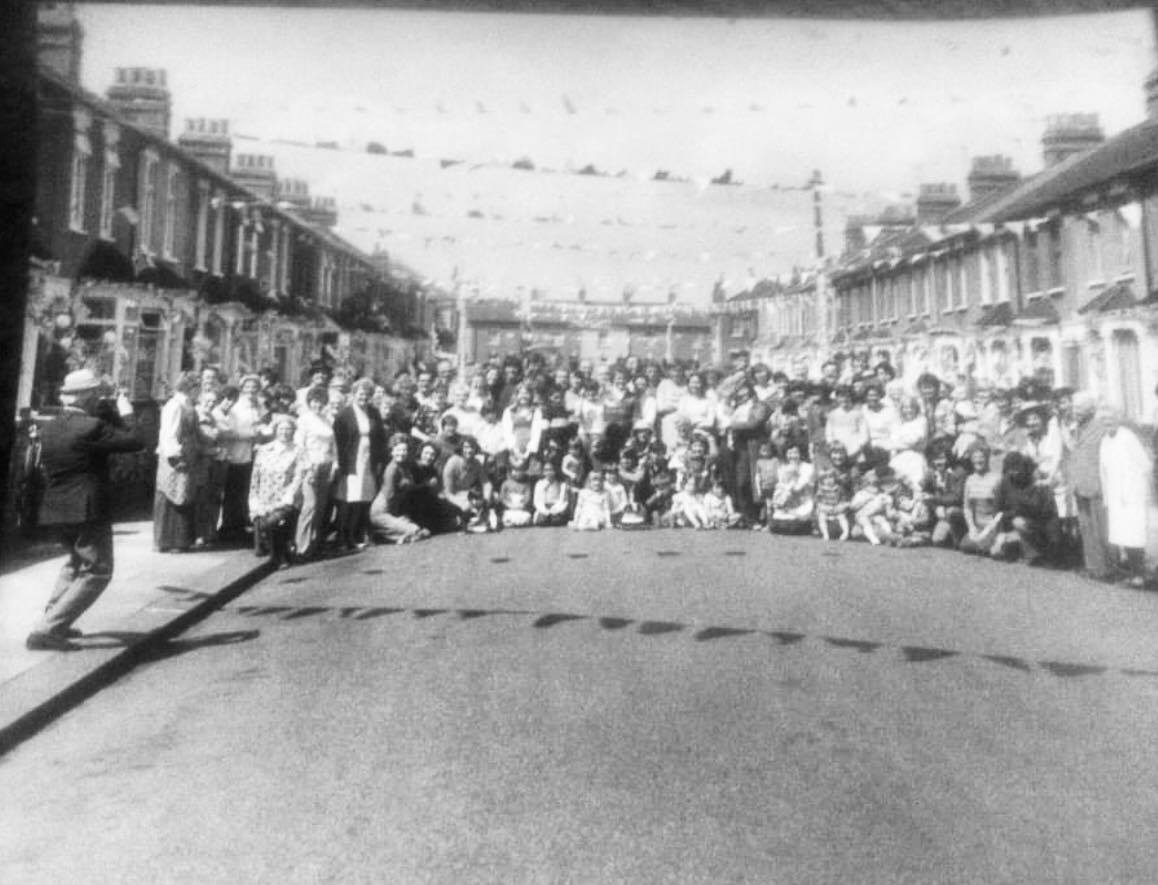
These days I devour any information about people who once lived in Alexandra Road. Fortunately, with being able to use Facebook, local groups have popped up where we can chat about our school years and living in the area of Slade Green and Erith. I’ve heard from three women who all lived in number thirteen at different time. I even chatted with the lady whose father had laid the awful multi-coloured floor tiles in the living room during the 1950s that were still there in 1972. What grabbed my attention most was the talk of street parties to celebrate, the end of wars, coronations of different monarchs, royal weddings, and our own much loved queen’s anniversaries. Alexandra Road won the best decorated street in the South-East in 1977 for Queen Elizabeth’s silver jubilee and I was there and part of the history of the road. I recall how every house was adorned in silver foil scrunched along the guttering, courtesy of a local meat pie factory. How sheets were dyed so we could make bunting that hung across the road between every one of the seventy-five houses.  It was a grand street party with trestle tables up the road and children in fancy dress. Not having children to dress up, my three dogs wore red, white, and blue ribbons attached to their collars.

Looking back, it is the road I remember most, and recalling the stories I wove around the lives of the families behind the lace curtains in those bay windows.