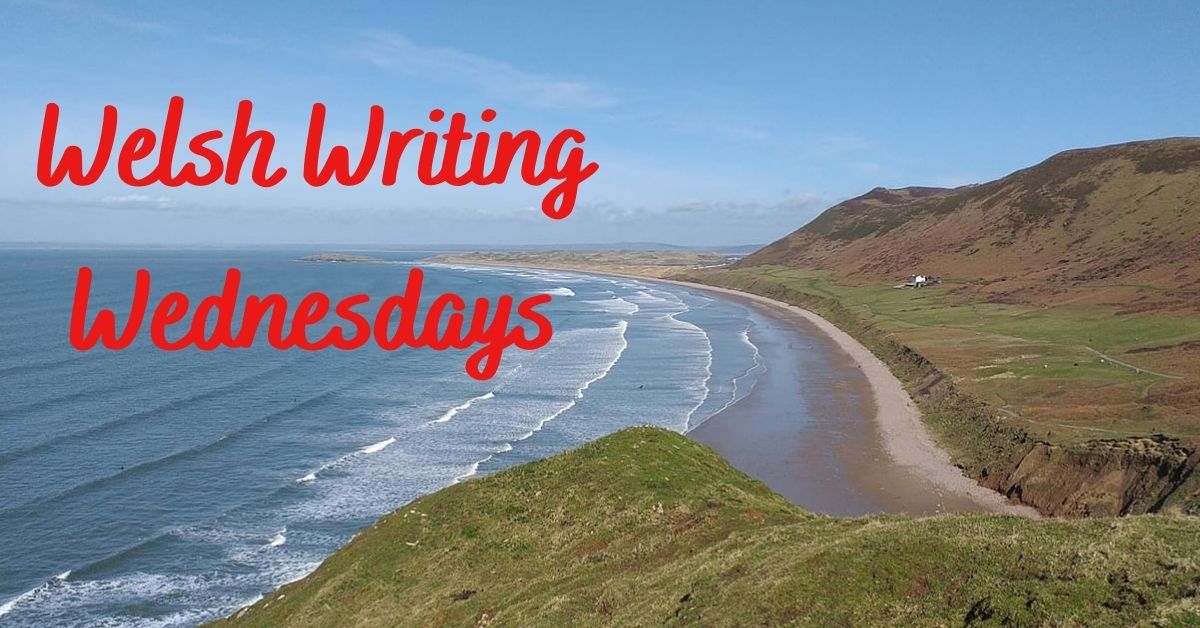
WELSH WRITING WEDNESDAYS: JESSIE CAHALIN AND THE NO SIGN BAR

Nobody followed me to the No Sign Bar, Swansea – a regular haunt of Dylan Thomas.  Seated next to the window, I searched inside my handbag for Collected Stories by Dylan Thomas. I found The Followers, a ghost story, hidden inside the anthology.

A ping from my phone confirmed a signal, but I ignored the emails. I sat in the bar Thomas renamed the Wine Vaults.  I read the opening lines of the story, but there was no sign of the beer I had just ordered.  Without anything to quench my thirst, there was nothing I could do apart from read on.  Between words, I felt compelled to search for two pairs of eyes outside of the window, but there was no sign of anyone.

Outside the window, ‘the rain spat and drizzled past the street lamps’. No one wore ‘squeaking galoshes, with mackintosh collars up and bowlers and trilbies’. Alas, the ‘rattle of bony trams’ was silenced long ago. Only the swish of car tyres, hum of engines and slamming of car doors filled the silence on the streets.  Gazing at the decaying red window frames, I did not see ‘a young man with his arm around a girl’. Instead, I glimpsed a young couple hand in hand dashing across the road while there was a break in the traffic.  Outside, there was a mass of coloured jackets and everyone wore jeans, leggings or trousers.  No one looked inside the tatty building. They didn’t seem to care that Dylan Thomas once frequented this watering hole.

Reading the short story, I pursued the followers, as they scurried through the alley.  Inside, No Sign Bar, I could smell the old musty wine cellar.  No one was responsible for the spontaneous spark of colour in the open fire. The pitted floorboards had been battered by tired and drunken feet for centuries. Words echoed around cavernous room. Perhaps, these were the words that inspired Dylan Thomas’s story The Followers: his only ghost story.  And I heard the rise and fall of the Welsh accent that probably escaped into the pages of Thomas’s mind, as he imagined the story.   I read the final sentence, ‘And we went our separate ways.’ I departed.

Near to Paradise Alley, I heard a voice echo.  ‘Spare some change, madam?’ The homeless soul was clutching a fleece blanket.  His watery, bloodshot eyes regarded me as he rolled himself a cigarette.  I spared him fifty pence, but this wouldn’t even buy him a beer. He caught the meagre offering with a grateful nod that punched my conscience.

‘Have you seen Leslie?’ mumbled the man. He looked at my handbag as I retrieved more change.I nodded.  ‘Only bread and jam in my handbag,’ I declared.

I ran to the car park. The rain drizzled until diluted my memory of the bar. I heard the distance tapping of footsteps and turned around. Thankfully, there was no sign of anyone following me. Checking Twitter, I did note I had two more followers.


No Sign Bar and The Followers

No Sign Bar is believed to be Swansea’s oldest pub and dates to 1690.  The wine cellars date back to the 15th century.  The name ‘No Sign’ originates from legislation of licencing when public bars had to have a recognisable sign.  This building was not public house and did not require a sign, hence was later given the name ‘No Sign’ to announce its presence!

Dylan Thomas frequented No Sign Bar, as a young man. No Sign Bar is featured as the Wine Vaults in Dylan Thomas’s story, The Followers.   Salubrious Passage, next to the bar, is referred to as Paradise Alley in the short story.


Joffe authors are in the running for The People’s Book Prize again, and there are some great books out this week.

Such a great collection of novels out this week. What about reading them all?

FEAR ON THE FENS by Joy Ellis is out nowTwenty years ago: A family is destroyed by tragic secrets.
A father who’s a killer. A brother who’s disappeared.
That is . . . until now? Detective Nikki Galena must find a man who’s been missing for two decades and unravel the painful past of a broken family before anyone else dies.   99p / 99c.


Murder at the Folly Roy Lewis.    OUT NOW — ONLY £1.99 / $2.99

A ruthless new boss shakes up Arnold’s quiet life at the council.  Now, he is saddled with a project he never wanted: the Ridgeway Viking Trust.   But is there more to the Trust than meets the eye?
Muck-raking journalist Alan Crickley seems to think so. He’s got the scent of corruption and he’s on the trail.

The Money Race by Paul Bennett.   OUT NOW — ONLY 99P / 99C

Follow the money, find the girl.
A local councillor’s daughter is missing, as well as several hundred thousand pounds of council funds.
But who’s responsible?    It’s up to Nick Shannon to find out.

Sister Joan Mysteries by Veronica Black . 6-8 Box Set excellent value at only 99p/99c

Sister Joan is a sharp and modern-minded heroine. Outstanding!” Publishers Weekly


Joffe  has told Frost Magazine  that The People’s Book Prize voting has begun and it’s great to  see so many Joffe Books authors represented in this year’s nominations.

Not one, but three Joffe Books authors are in this year’s collection and are hoping  to snatch that award. Last year’s winner, Victoria Dowd, is in the running again this year with the second novel in The Smart Woman’s Guide to Murder series, Body on the Island.

Joining Victoria are debut novelists Kerry Buchanan with Knife Edge and Lyn Yeowart with The Silent Listener.

Grab your copies of these amazing novels today and vote for your favourite here

Body on the Island by Victoria Dowd
Knife Edge by Kerry Buchanan
The Silent Listener by Lyn Yeowart


Poetry for Hopefulness | Bright Poems for Dark Days

bright poems for dark days, poems, hope, poets, hopefulA fitting release for this years National Poetry Day theme of choice, Dr Sutherland’s curated collection features poetry from across globes and generations to find the perfect words of affirmationpositivity or hopefulness to aid you in moments of need or stress.

🌸 Choose from 8 themes to fit your needs, from hope to nature & escape or joy to gratitude & comfort and more

🌸 Choose words and poems from literary greats, such as William Blake and Alfred, Lord Tennyson, to modern greats like Maya Angelou and Carol Ann Duffy to name just a few

🌸 With stunning full-colour, original illustrations from artist Carolyn Gavin (@carolynj)

bright poems for dark days

An anthology for hopefulness from William Blake to Warsan Shire

Dr Julie Sutherland
Illustrated by Carolyn Gavin

Bright Poems For Dark Days Published by Frances Lincoln | £12.99 | 19thth October 2021

We all have days when we find ourselves in need of some positivity and a few hopeful words of affirmation. This collection of poetry was carefully curated and compiled by bibliotherapist Dr Julie Sutherland, an expert in the healing power of words, along with original illustrations from Carolyn Gavin, make this beautifully-bound book a worthy aid to your mental wellbeing:

  • The collection is split into 8 themes: hope, resilience & courage, joy, nature & escape, love, tranquility, gratitude & comfort
  • A diverse range of writers and words are featured; from Oscar Wilde to Emily Dickinson, Robert Louis Stevenson to Maya Angelou, William Blake to Warsan Shire
  • The selections are accompanied by explanations and illuminating context that reinforces the positive mental health message
  • Combining uplifting lines of verse with joyful illustrations means this unique book can provide a much-needed dose of hopefulness and happiness in turbulent moments
  • Perfect as a thoughtful gift for someone in need or a resource of solace that can turned to whenever needed
Image


In difficult times, the words of others can lift us up.


Image


Bright, joyful art to inspire hopefulness is combined with a curated collection of poems, chosen to lift the spirits through the healing power of words.

Image


Dr Julie Sutherland is a writer and editor based in Ontario, Canada. She is a bibliotherapist for the ReLit Foundation, facilitating and presenting a wide variety of reading for well-being events in Canada, the US, the UK and online. She is passionate about the capacity of literature to effect change in the human spirit.

Carolyn Gavin is a painter, illustrator and designer based in Toronto, Canada. Vibrant, playful and happy are perfect words to describe her style. She is principal designer for Ecojot, a family-run eco-friendly paper business and also licenses her work for fabric, homewares and packaging. Find her on IG @carolynj (460k followers).

Baking Book Breaks Records. We love Jane’s Patisserie.

Jane’s Patisserie becomes fastest-selling baking book of all time

* Début book from blogger and Instagrammer Jane Dunn is instant UK number one bestseller

* Fans rocketed in lockdown

* Sales are ahead of débuts by the likes of Jamie Oliver, Nigella Lawson and Paul Hollywood

 Jane’s Patisserie,

Jane’s Patisserie, a début book from baking blogger Jane Dunn, has become the UK’s fastest-selling baking book of all time. I can definitely see why this book is so popular: it is full of delicious and easy-to-make treats. Get a copy now. My mouth was watering as I turned the pages. I will be doing a lot of baking.

28 year-old Jane launched her blog and Instagram whilst training at cookery school, as a creative space for her to share her love of everything sweet, and her fans rocketed in lockdown. Her first book has gone straight to the number one in the UK Nielsen BookScan bestseller chart, selling a record 44,444 copies in just three days on sale. That makes it one of the fastest-selling non-fiction books since records began, ahead of first books by the likes of Jamie Oliver, Nigella Lawson and Paul Hollywood.

As more and more people turned to baking to seek comfort and create joyful food over the last 18 months, Jane’s down-to-earth nature and simple, customisable recipes have hit the spot. Her blog now has over 350,000 subscribers, alongside her 750,000 Instagram and 490,000 Facebook followers. Her mission is to make baking easy for everyone, to share, inspire, and spread a little joy.

Jane’s giant, gooey NYC-style cookie recipe has had over 1.5 million blog views, and her Mini-Egg version went viral over Easter. Her fans, including Stacey Solomon, Mrs Hinch and Zoë Sugg, love to make and share her recipes.

Jane’s Patisserie (Ebury Press, £20) includes 100 cakes, bakes and sweet treats, combining the iconic classics from her blog – NYC Cookies, No-Bake Biscoff Cheesecake, Salted Caramel Drip Cake and more – with new and exclusive recipes requested by her followers.

 Jane’s Patisserie,

Jane started her blog in 2014 whilst training at Ashburton Chefs Academy, and she now spends all her time developing recipes and sampling sweet treats. Her recipes have been featured in FabulousCosmopolitan and Heat, and she recently made her NYC Cookies on ITV This Morning.

Jane says: “I have always been obsessed with baking and all things sweet, so it’s such a joy to see people sharing and loving my recipes and drawing so much comfort from them.”

Find her at Janespatisserie.com on Instagram, Facebook, YouTube, and Twitter @janespatisserie


A Poet For Every Day of the Year By Allie Esiri

A Poet For Every Day of the Year is an essential buy. The concept of this book is so clever: every day there is a new poet to discover. A biography of the poet and one of their poems is there to discover for every day of the year.

This book is gorgeous on the outside and just as gorgeous on the inside. Perfect for adults and children. I cannot recommend this well-researched and luscious book enough. Get your hands on a copy now.

Award-winning and bestselling poetry anthologist, ALLIE ESIRI has lit an explosion of interest in poetry, through her carefully curated anthologies and exciting live performances.

Allie’s books have sold over 250,000 copies in hardback


·       Her three poetry collections, A Poem for Every Day of the Year; A Poem for Every Night of the Year and Shakespeare for Every Day of the Year have been chosen as Books of the Year by The Times, The Observer and New Statesman and they have featured in the top five poetry titles every year since 2016.


·       Allie has been announced as the Chair of Judges for the CLiPPA Awards 2021, following in the footsteps of Michael Rosen and Roger McGough. She is also a judge for The Trussell Trust Food for Thought poetry competition 2021.


·       A Poem for Every Night of the Year had its best sales year in 2020 – five years after publication.


·       In 2020, THREE of the top ten children’s poetry titles were curated by Allie, though her books are enjoyed by all ages


Allie is the NUMBER ONE author across children’s poetry in 2021.


A Poet for Every Day of the Year, Allie’s newest anthology, is published by Macmillan Children’s Books. It introduces readers to 366 of the world’s greatest poets, juxtaposing diverse, exciting, vibrant new voices alongside the enduring giants of the form, with fascinating mini biographies of each writer.


The day-by-day format inspires readers to make poetry as much part of their daily routine as breakfast or bedtime. It encourages them to discover theinspirational, the life affirming, the provocative and the entertaining in each and every day.


“Allie Esiri’s books take you by the hand with poems to restore you and make your toes tingle, that will take you away for a little while and home again, with your spirits a little higher than before.”

Helena Bonham Carter


Allie Esiri, on her new anthology, A Poet for Every Day of the Year:


Poetry at its best has always enabled us to see different worlds, or rather, our own world differently, without ever having to leave our home. It has articulated our muddled thoughts, given a voice to the voiceless and lent an ear to the otherwise unheard. But most of the anthologies we have at our disposal seem to view poetry as an almost exclusively white, western, male craft, almost untouched by women or anyone from another background or ethnicity. I think now is the time to redress this.

In this book, you’ll not only find a great poem for every day of the year, but you’ll also learn about the life, times, and work of each poet, and discover connections between writers that transcend the established canon and chronology.

I hope readers of all ages and backgrounds will be inspired by the poets they find within this anthology. As the mother of mixed-race children, I’m especially and personally proud to present a book that represents them, and countless other diverse readers like them.

A POET FOR EVERY DAY OF THE YEAR , poems, poets, books,  Allie Esiri

Poets featured in A Poet for Every Day of the Year include:


Maya Angelou

Elizabeth Barrett Browning

Brian Bilston

Eavan Boland

Lord Byron

William Carlos Williams

Lewis Carroll

Wendy Cope

Imtiaz Dharker

Georgia Douglas Johnson

Helen Dunmore

Bob Dylan

Louise Glück

Jackie Kay

Michael Rosen

Christina Rossetti

Stevie Smith

Ocean Vuong

William Wordsworth


ALLIE ESIRI is an accomplished curator and host of live poetry events, featuring some of our best-known actors – from Helena Bonham Carter to Dominic West – at the National Theatre, the Bridge Theatre, and major literary festivals.


She lives in London with her husband and three children.

The book is available here.

How I got a Literary Agent.

In January this year one of the most amazing things happened to me: I got a literary agent. Having an agent was always something beyond my wildest dreams, more than that, my agent is the amazing Susan Yearwood. Champagne popping time indeed.

I spent the months in the run up to Christmas researching agents and sending off submissions. I went through The Writers’ & Artists’ Yearbook with precision, choosing ten agents to send my book off to. I researched every agent heavily and Susan called to me. There are a few interviews I found in which Susan and her ethos resonated with me. I knew she was The One.  In fact, before her email asking to schedule a call with her, I had a dream she was my agent and we were being interviewed at a literary festival together.

In the end I sent my first novel off to a lot of agents and publishers. I got a lot of good feedback and a few full manuscript requests. I also got a wonderful rejection from Harper Collins, who read the entire thing and sent me four paragraphs of feedback. They even asked me to send them anything else I wrote. In the end Susan passed on my first novel, but she liked my writing enough to ask if I had anything else I could send her. Thankfully I did. I always write a first draft of a book and then get started on another one while I let the other one sit. Then I go back to it with fresh eyes, alternating my drafts. I did not think the other book was ready and had spent hundreds sending it off to a professional editing agency for feedback. By the time the feedback came back Susan had been my agent for three months! It may have been a waste of money, but I have no complaints.

Susan loved the book and took my on as a client after our phone call. I was a true pinch me moment. For anyone who wants an agent and does not have one yet I would say the following things:

  • Write a good book. Send off the first three chapters, along with a synopsis that really grabs.
  • Collate all of the writing you have done and any awards you have won. Write a paragraph about yourself that sells all you have to offer. Covering letters are important.
  • Get a copy of The Write”s and Artists’ Yearbook and research what agents work in your genre.
  • Start submitting.
  • Keep submitting.
  • Take rejection in your stride.
  • Listen to all feedback.
  • Redo your submission to suit various agents.
  • Start writing your new book.


Good luck!


6 Eyewear Styles That Are Back in Style

Classic fashion items always make a comeback. Their resurgence is because some pieces are just timeless, classy, fun, and something you can use time and again. The lens styles that have come and gone over the years are perfect for self-expression.

Glasses are a very practical accessory; they protect your eyes from the sun and correct your eyesight. But, they can also do more than just that; they can be the finishing piece to your outfit or project your personality. The evolution of eyewear has left you with a plethora of choices regarding what can work for you. Some glass styles are decades old, but there is a reason they have lasted so long.

1. Aviator 

Aviator glasses were initially made for pilots after goggles became unnecessary in the 1930s. But their commanding look soon had applications beyond the military. Most people look good in aviators, but they can be ideal for those with oval, square, and heart-shaped faces. They are a bold accessory that can fit any gender to give you a cool, rebellious, and classic look.

Aviators have a teardrop shape that narrows towards the cheeks. The lenses are also curvy and wide, which gives the user better protection from UV rays; they provide the most significant area coverage from sunlight. You can wear them in formal or informal attire, and you can pair them with your watch.

2. Wayfarer 

Wayfarer glasses typically come in a horizontal rectangular shape. They were initially sunglasses for men, but women have found value in them too. They generally fit anyone but can be best for those with oblong, oval, and round face shapes. 

When they came onto the market in the 1950s, Wayfarers were originally black but can come in a range of colors, which can match just about any skin tone. They are normally associated with fame, glitz, and glamour. Over the years, they have evolved to have subtle curves, giving them a smart and fashionable look. It’s why they have become a popular nerd accessory. 

3. Round Browline

Browline (sometimes called brown line) glasses are a popular style this year. The frame has a thicker and bolder upper part than the lower part. Naturally, they bring attention to the wearer’s browline and eyebrows. They were invented in the 1940s and were in vogue in the 50s and 60. Round browline glasses have styled some prominent brows, including Malcolm X and President Lyndon B. Johnson.

The heavy brow bar is ideal for professional women who want to project seriousness. The thick frame also makes them resistant to shock, so breaking them is a low risk. Wearers with a round or oval face and prominent forehead have the best features for browline glasses because the broadened brow can make your face a slightly wider and more square look. 

You can look bold and simple in them, and it’s a style that lets people know that you have a well-rounded personality. They have also regained popularity as part of a hipster look.

4. Rimless

Rimless glasses are a minimalist’s dream; they are a sleek, simple eyewear design that works with just about any outfit. The frame either attaches to the bridge or the temple to give you an experience that is light and doesn’t press hard on your face. 

They also work for those who don’t want to make a big statement regarding their eyewear. That is because rimless glasses have the advantage of taking attention away from your glasses. Rimless glasses are for you if you focus on your other accessories like earrings or necklace.

5. Cat Eye 

Cat-eye glasses draw the elegance and sensuality of felines to exude femininity. The frames have the allure of making a woman seem sexy, intelligent, and mysterious. Icons such as Audrey Hepburn and Marylin Monroe have adorned them over the years.

A pair of Prada cat-eye glasses can be a staple for any fashion-conscious lady, especially when they have a colorful wardrobe. You can wear them as part of a summer ensemble, a quirky look, or a vintage outfit; the choice is yours.

Cat-eye glasses work best for those with diamond-shaped faces. The narrow forehead and chin of a diamond face work well with cat-eye glasses, and the glasses also draw your face upwards, making you look younger.

Eye-Catching Styles

Eyes are the windows to the soul. So you can choose the view people to get the proper eyewear. Choose frames that will suit your face shape, skin tone, personality, and fashion. Remember, there is nothing wrong with having more than one pair, so you can be versatile.


Collaborative Post with our brand partner.

The Science of Yoga – part 2 by Alex Bannard Frost Magazine’s Wellness and Wellbeing editor

Last time we talked about how yoga can help manage stress & improve our mental functioning & wellbeing. We also talked about the delicate balance of the autonomic nervous system. Let’s take this a little further.

Relaxation occurs when our body & our mind is in a state of balance. Yoga helps create space in both our body & our mind which encourages balance & relaxation, creating inner peace, contentment, happiness & self awareness. It helps to reduce blood pressure & heart rate, increase oxygen utilization, improve digestion, the immune system, hormone balance & better neuro-muscular coordination.

If you practice yoga, you will know this just from stepping onto your yoga mat: a sense of peace & calm begins before you even start practicing as your body & mind are aware of what is to come.  The physical poses (asanas) in yoga all have different benefits, stimulating different systems in the body: standing poses strengthen leg muscles, open the hips, flex the back & improve circulation; forward bends are calming & restorative; backbends increase flexibility & mobility in the spine, stimulate the central nervous system & may help deal with negative emotions (possibly because we are opening the heart chakra – research into the chakras is still in its infancy so I’ll leave it there for now).

Do you remember at the beginning of the piece last time I was challenged about my claims regarding inversions? Let’s explore the claims behind the benefits of inversions. Dr. Fishman (remember him from part 1?) notes that inversions improve bone density which he attributes to the muscles working against gravity. Reversing the effects of gravity on the body has a profound physiological effect on the body. In 2000 NASA reported that when humans enter zero gravity it causes severe biomedical problems: the sense of balance is destroyed, blood floods upwards speeding up the heart, muscles waste & bone mass drops.

On earth, gravity weighs us down & as the years progress so does the damage: varicose veins & hemorrhoids, the heart falters & more. The ancient yogis called gravity ‘the silent enemy’.  So by inverting ourselves, we reverse the effects of gravity. Our body is made up of 60% water, when we upend ourselves, the tissue fluids of our lower body drain more effectively helping to clear congestion.

David Coulter who taught anatomy at the University of Minnesota said, “If you can remain in an inverted posture for just 3-5 minutes, the blood will not only drain quickly to the heart, but tissue fluids will flow more efficiently into the veins & lymph channels of the lower extremities & of the abdominal & pelvic organs, facilitating a healthier exchange of nutrients & wastes between cells & capillaries” Couldn’t have said it better myself.

There are 4 major systems in the body: cardiovascular, lymphatic, nervous & endocrine. Inversions give the heart a break but also challenge it in the opposite way to how it usually works. This means we are benefiting the circulatory system but in a very gentle but very effective way.

We used to think that inversions flooded the brain with freshly oxygenated blood but we now understand that the brain is protected from an influx of blood which would overwhelm its delicate structures. However, we now believe that inversions could affect the movement & production of cerebrospinal fluid which is the juice of the nervous system.  The lymph system, like the heart relies on muscular movement & gravity to facilitate its performance. When you are upside down the lymph system is stimulated which strengthens your immune system & starts to drain more effectively.

The effect of inversions on the endocrine system is the least well documented or understood. Some believe that the shoulder stand helps regulate the thyroid gland but it has not been proven; whilst the benefits to the pineal & pituitary glands from headstands have also not been confirmed…yet.  At the end of the day, a lot can be gained from being upside down, simply because by having a different physical view of the world can change our mental & emotional viewpoint too.

I think the important thing with inversions, whether you believe in their physiological effects or not, is not to rush into them. Take your time & only work with a good teacher who can guide you safely into & out of the poses. There are plenty of other ways you can practice inversions: legs up the wall (viparita karini) is deeply restorative & doesn’t tax the spine or the neck. Same with bridge pose (setu bada), downward dog, standing forward fold.

So there you have it, the science (in very lay-man’s terms!) behind the enormous positive effects practicing yoga can have on your body, brain, nervous system & immune system. Whilst we may not have ‘proved’ that yoga slows the aging process, if you stack up all the positive impact it does have it certainly suggests it could very well do so.

If you would like to put some of these scientific benefits to the test & practice yoga with Alex her YouTube channel offers free short classes for everyone & is available here: https://www.youtube.com/channel/UCQlKZJ7MeyYc6lqkv6seISw

Alternatively all of her classes are streamed on live on Zoom, for more information message her at alex@alexbannard.com   Free resources are also available on her Facebook page: https://www.facebook.com/AlexBannardYogaMindfulness   And her website is www.alexbannard.com

Alex is based on the edge of the stunning Cotswolds & has been sharing her love for all things yoga & mindfulness for almost a decade, not just in the UK but also around the world. Her mission is to help everyone discover a more mindful way of living & to encourage them to embrace regular self-care practices for a happier & healthier way of being.

Check out this Uplift video for more information:   https://uplift.tv/2017/watch-science-behind-yoga/

Or these articles for more science based facts:   https://www.yogajournal.com/practice/everybody-upside-down    https://www.gaiam.com/blogs/discover/the-science-behind-yoga   https://www.healthline.com/nutrition/13-benefits-of-yoga#section13