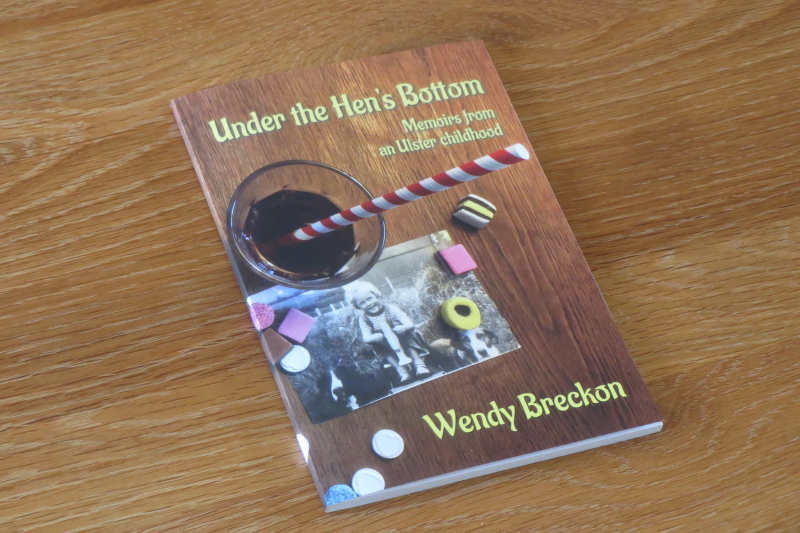
UNDER  THE  HEN’S  BOTTOM  by WENDY  BRECKON  


Review by Frances Colville

Under the Hen’s Bottom is a wonderful collection of short stories by author Wendy Breckon, detailing her memories of growing up in Northern Ireland in the 1950s and 1960s.  As the title suggests, these stories are witty, quirky and so engaging that the reader is immediately drawn into the author’s childhood experiences – from almost being born under a hedge, through holidays with her grandparents on their farm, to the building of friendships and early aspirations to be a writer and actress.


Wendy is a storyteller with a gentle touch and is particularly adept at bringing her characters to life.  The descriptions of time spent with her eccentric grandmother will make you smile, but there is poignancy here too, nostalgia for days gone by and some thought-provoking questions about the religious divide which existed at the time in Ireland.  As it says on the back cover of the book, the reader will be captivated from the moment they first turn the pages and start to share the experiences of this small child.


I was going to pick a favourite, but I actually can’t. Every time I think I have settled on ‘Voulez-vous’, I remember ‘Two Squares of Chocolate and a Floral Gazunda’ or ‘The Russian Princess’ or ‘The Lost Sheep’ or ‘An Honorary Catholic’ and the task becomes impossible.   So there is absolutely no substitute for buying the book and reading them all.


Under the Hen’s Bottom was published by Magic Oxygen on 6th July 2017 and is available (priced at £7) from Amazon or by emailing Wendy herself at wendybreckon@outlook.com

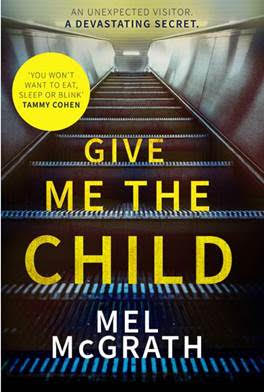
Give Me The Child By Mel McGrath Book Review

Give Me The Child drew my in immediately from the cover. Then the blurb drew my in further. As a mother I worried it might be horrible and depressing, but Give Me The Child is a clever and riveting psychological thriller. It leaves you guessing and is well written by an author who is clearly at the top of her game. Gripping and addictive: you will probably sacrifice sleep to race through it. A great book indeed.


Give Me the Child is an explosive thriller set against the backdrop of the 2011 London riots

Mel McGrath is the co-founder of the UKs top all-female London-based writing collective, The Killer Women, which has 19 members including Paula Hawkins and Erin Kelly http://www.killerwomen.org/who/

An unexpected visitor.

Dr Cat Lupo aches for another child, despite the psychosis which marked her first pregnancy. So when Ruby Winter, a small girl in need of help, arrives in the middle of the night, it seems like fate.

A devastating secret.

But as the events behind Ruby’s arrival emerge – her mother’s death, her connection to Cat – Cat questions whether her decision to help Ruby has put her own daughter at risk.

Do we get the children we deserve?

Cat’s research tells her there’s no such thing as evil. Her history tells her she’s paranoid. But her instincts tell her different. And as the police fight to control a sudden spate of riots raging across the capital, Cat faces a race against time of her own…

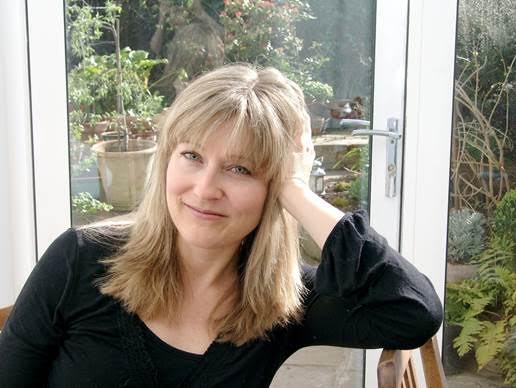
Mel McGrath is an Essex girl, the author of the critically acclaimed and bestselling family memoir Silvertown. She won the John Llewellyn-Rhys/Mail on Sunday award for Best Writer Under 35 for her first book, Motel Nirvana. She has published three Arctic mysteries featuring the Inuit detective Edie Kiglatuk under the name MJ McGrath, the first of which, The Boy in the Snow, was shortlisted for a CWA Gold Dagger.

In the last year she has been one of the founders and moving lights of the website Killer Women, which has rapidly established itself as one of the key forums for crime writing in the UK. This new standalone marks a change in direction

Give Me The Child By Mel McGrath is published on the 27th July and is available here. http://amzn.to/2tFKiAR


Want a reason to switch to PDF? Here are 3

For the longest time, PDF was only used in official environments or by those working in professional environments and created content intended for the consumer base. Normal computer users didn’t really care that much about PDF but that’s a mistake as the PDF format is one of the most versatile things you can expect from a computer. If you’re looking for reasons to ditch your current format solution and get into using PDF, check the top reasons we have selected below.

Accessibility and compatibility

If you’re looking for something that is compatible with any kind of OS and also comes with an amazing accessibility feature, PDF is definitely for you. PDFs can be accessed through Google’s Chrome and that means that a PDF file is accessible from any computer regardless of whatever other software is installed on that PC. That’s something you can’t really say about other formats and it could be one of the reasons why you choose PDF. Even if you’re not big on Microsoft’s Windows and use a Mac, you can still find a PDF reader for Macintosh, so there are no compatibility issues.

Security

Security is often times neglected when it comes to text files. That’s because people aren’t aware of the fact that they can actually use a password for their files. That is, of course, if they use PDF. People are also oblivious about how many people actually want to read their personal information. If you keep your data in a PDF file and lock it with a password, no one would be able to intrude on your private space. It’s a feature that’s missing from other major formats so it’s an obvious benefit that comes with using PDF.

Security needs to be at an all time high right now due to all the increasing threats and activities going on online. Whether it’s phishing or ransomware, there will always be malicious entities looking to get access to your files. Keep them safe with a password.

Versatility

The third important feature that you need to know about is the versatility that comes with PDF. No matter what you want to edit, you have access to e every aspect of it. This makes it very convenient to just open a file and start editing away when something isn’t exactly how you want it to be. Other formats will be trickier to edit, not to mention more frustrating. But there’s no point in struggling with other platforms when using PDF can be so easy.

So there you have it, three perks that represent the essence of PDF. If you were thinking of using PDF before or only now have started pondering on the idea, it’s best to keep these factors in mind as they might be decisive in how you choose your preferred format.


By Steven Hawk

Review: The House They Grew Up In

The House They Grew Up In
Minerva Theatre, Chichester
Until 5 August
Box Office: 01243 781312 www.cft.org.uk

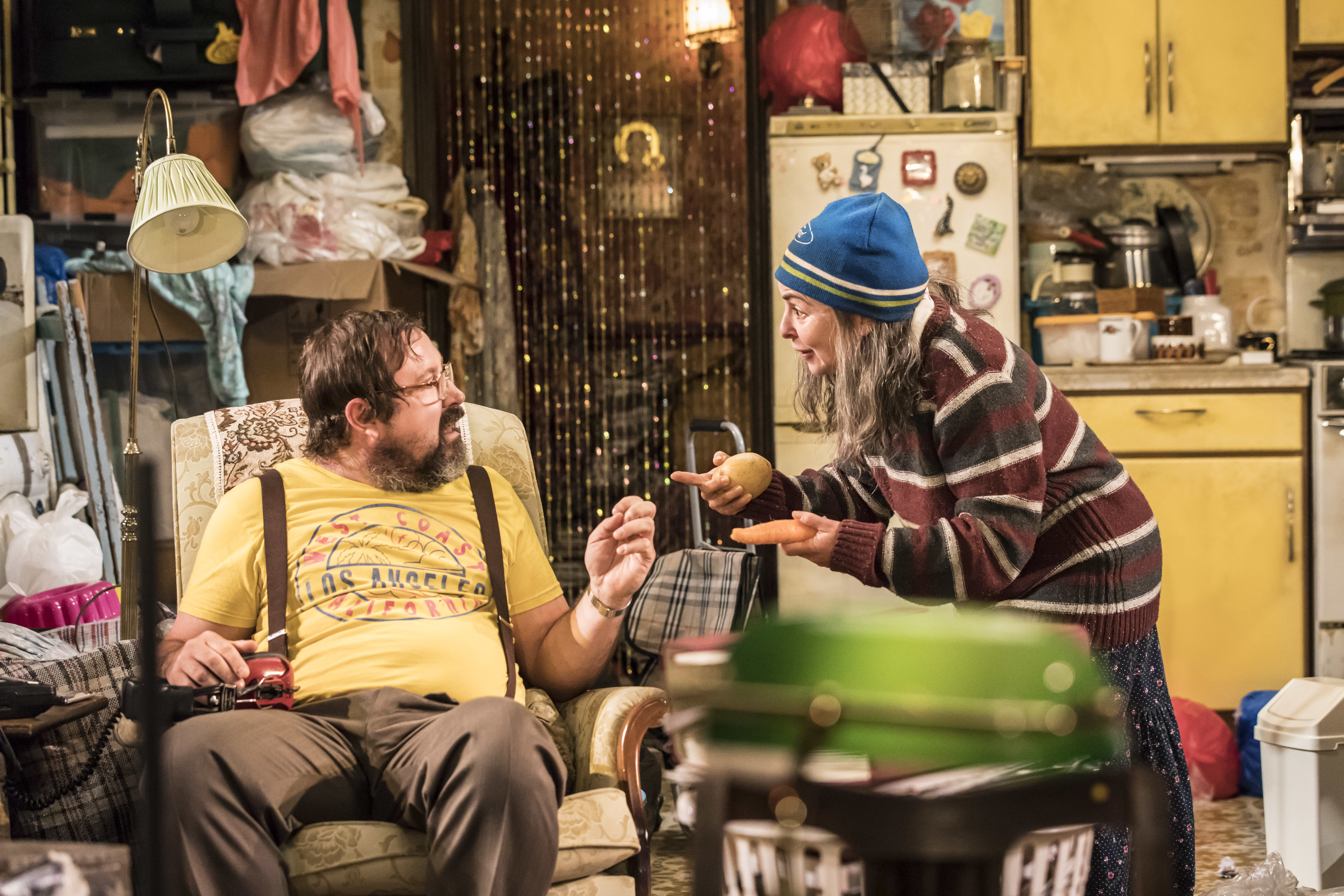
Photo Credit: Johan Persson

Deborah Bruce’s new play, a co-production with Headlong, manages to be both entertaining and deeply moving. It’s a tale of our time. Middle-aged brother and sister Peppy (Samantha Spiro) and Daniel (Daniel Ryan) live in the house they grew up in amid floor-to-ceiling clutter (Max Jones’s claustrophobic set design is marvelous). Isolating themselves, autistic Daniel spends his days recording a precise log of every passing moment in his diary. Highly strung and obsessed with art history and Cambridge University, Peppy leaves the safety of their nest only for food and, later, to visit Uncle Manny to try to find out why he didn’t make his regular Christmas visit. But the arrival of the little boy next door into their co-dependent lives (superbly played by Rudi Millard on press night) triggers a terrifying change in their reclusive existence, with the police, social workers, neighbours and journalists forcing the much-feared outside world upon them.

Remarkably, what seems certain to be the inevitable conclusion takes a happier turn. Jeremy Herrin’s thoughtful direction and Bruce’s accomplished writing allow Peppy and Daniel to be heard and understood, ultimately earning our compassion and making us feel uncomfortable at failing to feel and extend it sooner.

Beautiful and bitter sweet, the tragedy of the optimistic ending is that in the real world Peppy and Daniel would be the exception rather than the rule.

With superb performances, especially from Spiro and Ryan, this a thought-provoking and fascinating play that deserves a wider audience than its short run in Chichester will generate.

Give Me The Child Extract: The Hot New Thriller of The Summer

We have a treat for you: an exclusive extract of Give Me The Child. A stunning thriller from Mel McGrath. You can read our review tomorrow.

CHAPTER ONE

My first thought when the doorbell woke me was that someone had died. Most likely Michael Walsh. I turned onto my side, pulled at the outer corners of my eyes to rid them of the residue of sleep and blinked myself awake. It was impossible to tell if it was late or early, though the bedroom was as hot and muggy as it had been when Tom and I had gone to bed. Tom was no longer beside me. Now I was alone.

We’d started drinking not long after Freya had gone upstairs. The remains of a bottle of Pinot Grigio for me, a glass or two of red for Tom. (He always said white wine was for women.) Just before nine I called The Mandarin Hut. When the crispy duck arrived I laid out two trays in the living room, opened another bottle and called Tom in from the study. I hadn’t pulled the curtains and through the pink light of the London night sky a cat’s claw of moon appeared. The two of us ate, mostly in silence, in front of the TV. A ballroom dance show came on. Maybe it was just the booze but something about the tight-muscled men and the frou-frou’d women made me feel a little sad. The cosmic dance. The grand romantic gesture. At some point even the tight-muscled men and the frou-frou’d women would find themselves slumped together on a sofa with the remains of a takeaway and wine enough to sink their sorrows, wondering how they’d got there, wouldn’t they?


Not that Tom and I really had anything to complain about except, maybe, a little malaise, a kind of falling away. After all, weren’t we still able to laugh about stuff most of the time or, if we couldn’t laugh, at least have sex and change the mood?

‘Let’s go upstairs and I’ll show you my cha-cha,’ I said, rising and holding out a hand.

Tom chuckled and pretended I was joking, then, wiping his palms along his thighs as if he were ridding them of something unpleasant, he said, ‘It’s just if I don’t crack this bloody coding thing…’

I looked out at the moon for a moment. OK, so I knew how much making a success of Labyrinth meant to Tom, and I’d got used to him shutting himself away in the two or three hours either side of midnight. But this one time, with the men and women still twirling in our minds? Just this one time? Stupidly, I said, ‘Won’t it wait till tomorrow?’ and in an instant
I saw Tom stiffen. He paused for a beat and, slapping his hands on his thighs in a gesture of busyness, he slugged down the last of his wine, rose from the sofa and went to the door. And so we left it there with the question still hanging.

I spent the rest of the evening flipping through the case notes of patients I was due to see that week. When I turned in for the night, the light was still burning in Tom’s study. I murmured ‘goodnight’ and went upstairs to check on Freya. Our daughter was suspended somewhere between dreaming and deep sleep. All children look miraculous when they’re asleep, even the frighten- ing, otherworldly ones I encounter every day. Their bodies soften, their small fists unfurl and dreams play behind their eyelids. But Freya looked miraculous all the time to me. Because she was. A miracle made at the boundary where human desire meets science. I stood and watched her for a while, then, retrieving her beloved Pippi Longstocking book from the floor and straightening her duvet, I crept from the room and went to bed.


Sometime later I felt Tom’s chest pressing against me and his breath on the nape of my neck. He was already aroused and for a minute I wondered what else he’d been doing on screen besides coding, then shrugged off the thought. A drowsy, half-hearted bout of lovemaking followed before we drifted into our respective oblivions. Next thing I knew the doorbell was ringing and I was alone.

Under the bathroom door a beam of light blazed. I threw off the sheet and swung from the bed.

‘Tom?’

No response. My mind was scrambled with sleep and an anxious pulse was rising to the surface. I called out again.

There was a crumpling sound followed by some noisy vomiting but it was identifiably my husband. The knot in my throat loosened. I went over to the bathroom door, knocked and let myself in. Tom was hunched over the toilet and there was a violent smell in the room.

‘Someone’s at the door.’
Tom’s head swung round.
I said, ‘You think it might be about Michael?’
Tom’s father, Michael Walsh, was a coronary waiting to happen, a lifelong bon vivant in the post-sixty-five-year-old death zone, who’d taken the recent demise of his appalling wife pretty badly.

Tom stood up, wiped his hand across his mouth and moved over to the sink. ‘Nah, probably just some pisshead.’ He turned on the tap and sucked at the water in his hand and, in an oddly casual tone, he added, ‘Ignore it.’

As I retreated into the bedroom, the bell rang again. Whoever it was, they weren’t about to go away. I went over to the window and eased open the curtain. The street was still and empty of people, and the first blank glimmer was in the sky. Directly below the house a patrol car was double parked, hazard lights still on but otherwise dark. For a second my mind filled with the terrible possibility that something had happened to Sally. Then I checked myself. More likely someone had reported a burglary or a prowler in the neighbourhood. Worst case it was Michael.

‘It’s the police,’ I said.

Tom appeared and, lifting the sash, craned out of the window. ‘I’ll go, you stay here.’
I watched him throw on his robe over his boxers and noticed his hands were trembling. Was that from having been sick or was he, too, thinking about Michael now? I listened to his footsteps disappearing down the stairs and took my summer cover-up from its hook. A moment later, the front door swung open and there came the low murmur of three voices, Tom’s and those of two women. I froze on the threshold of the landing and held my breath, waiting for Tom to call me down, and when, after a few minutes, he still hadn’t, I felt myself relax a little. My parents were dead. If this was about Sally, Tom would have fetched me by now. It was bound to be Michael. Poor Michael.

I went out onto the landing and tiptoed over to Freya’s room. Tom often said I was overprotective, and maybe I was, but I’d seen enough mayhem and weirdness at work to give me pause. I pushed open the door and peered in. A breeze stirred from the open window. The hamster Freya had brought back from school for the holidays was making the rounds on his wheel but in the aura cast by the Frozen- the midnight light I could see my tender little girl’s face closed in sleep. Freya had been too young to remember my parents and Michael had always been sweet to her in a way that


his wife,who called her‘ my little brown granddaughter’,never was, but it was better this happened now, in the summer holidays, so she’d have time to recover before the pressures of school started up again. We’d tell her in the morning once we’d had time to formulate the right words.

At the top of the landing I paused, leaning over the bannister. A woman in police uniform stood in the glare of the security light. Thirties, with fierce glasses and a military bearing. Beside her was another woman in jeans and a shapeless sweater, her features hidden from me. The policewoman’s face was brisk but unsmiling; the other woman was dishevelled, as though she had been called from her bed. Between them I glimpsed the auburn top of what I presumed was a child’s head – a girl, judging from the amount of hair. I held back, unsure what to do, hoping they’d realise they were at the wrong door and go away. I could see the police officer’s mouth moving without being able to hear what was being said. The conversation went on and after a few moments Tom stood to one side and the two women and the child stepped out of the shadows of the porch and into the light of the hallway.

The girl was about the same age as Freya, taller but small-boned, legs as spindly as a deer’s and with skin so white it gave her the look of some deep sea creature. She was wearing a grey trackie too big for her frame which bagged at the knees from wear and made her seem malnourished and unkempt. From the way she held herself, stiffly and at a distance from the dishevelled woman, it was obvious they didn’t know one another. A few ideas flipped through my mind. Had something happened in the street, a house fire perhaps, or a medical emergency, and a neighbour needed us to look after her for a few hours? Or was she a school friend of Freya’s who had run away and for some reason given our address to the police? Either way, the situation obviously didn’t have anything much to do with us. My heart went out to the kid but I can’t say I wasn’t relieved. Michael was safe, Sally was safe.


I moved down the stairs and into the hallway. The adults remained engrossed in their conversation but the girl looked up and stared. I tried to place the sharp features and the searching, amber eyes from among our neighbours or the children at Freya’s school but nothing came. She showed no sign of recognising me. I could see she was tired – though not so much from too little sleep as from a lifetime of watchfulness. It was an expression familiar to me from the kids I worked with at the clinic. I’d probably had it too, at her age. An angry, cornered look. She was clasping what looked like a white rabbit’s foot in her right hand. The cut end emerged from her fist, bound crudely with electrical wire which was attached to a key. It looked home-made and this lent it – and her – an air that was both outdated and macabre, as if she’d been beamed in from some other time and had found herself stranded here, in south London, in the second decade of the twenty-first century, in the middle of the night, with nothing but a rabbit’s foot and a key to remind her of her origins. ‘What’s up?’ I said, more out of curiosity than alarm. I smiled and waited for an answer.
The two women glanced awkwardly at Tom and from the way he was standing, stiffly with one hand slung on his hip in an attempt at relaxed cool, I understood they were waiting for him to respond and I instinctively knew that everything I’d been thinking was wrong. A dark firework burst inside my chest. The girl in the doorway was neither a neighbour’s kid nor a friend of our daughter. She was trouble.I took a step back. ‘Will someone tell me what’s going on?’ When no one spoke I crouched to the girl’s level and, summoning as much friendliness as I could, said, ‘What’s your name? Why are you here?’

The girl’s eyes flickered to Tom, then, giving a tiny, contemptuous shake of the head, as if by her presence all my questions had already been answered and I was being obstructive or just plain dumb, she said, ‘I’m Ruby Winter.’

I felt Tom’s hands on my shoulder. They were no longer trem- bling so much as hot and spasmic.

‘Cat, please go and make some tea. I’ll come in a second.’

There was turmoil in his eyes. ‘Please,’ he repeated. And so, not knowing what else to do, I turned on my heels and made for the kitchen. While the kettle wheezed into life, I sat at the table in a kind of stupor; too shocked to gather my thoughts, I stared at the clock as the red second hand stuttered towards the upright. Tock, tock, tock. There were voices in the hallway, then I heard the living room door shut. Time trudged on. I began to feel agitated. What was taking all this time? Why hadn’t Tom come? Part of me felt I had left the room already but here I was still. Eventually,foot steps echoed in the hallway.The door moved and Tom appeared. I stood up and went over to the counter where, what now seemed like an age ago, I had laid out a tray with the teapot and some mugs.‘Sit down, darling, we need to talk.’ Darling. When was the last time he’d called me that? I heard myself saying, idiotically, ‘But I made tea!’ ‘It’ll wait.’ He pulled up a chair directly opposite me.
When he spoke, his voice came to me like the distant crackle of a broken radio in another room. ‘I’m so sorry, Cat, but however I say this it’s going to come as a terrible shock, so I’m just going to say what needs to be said, then we can talk. There’s no way round this. The girl, Ruby Winter, she’s my daughter.’


Disco Pigs reviewed by Paul Vates

Disco Pigs:

The Trafalgar Studios, London


“a visceral, in-your-face, angry play”


There comes a point, once in awhile, when you’re watching a play and you realise you’ve been daydreaming and you glance at those around you for reassurance – are they still rapt by the show or are they slightly dazed, too?


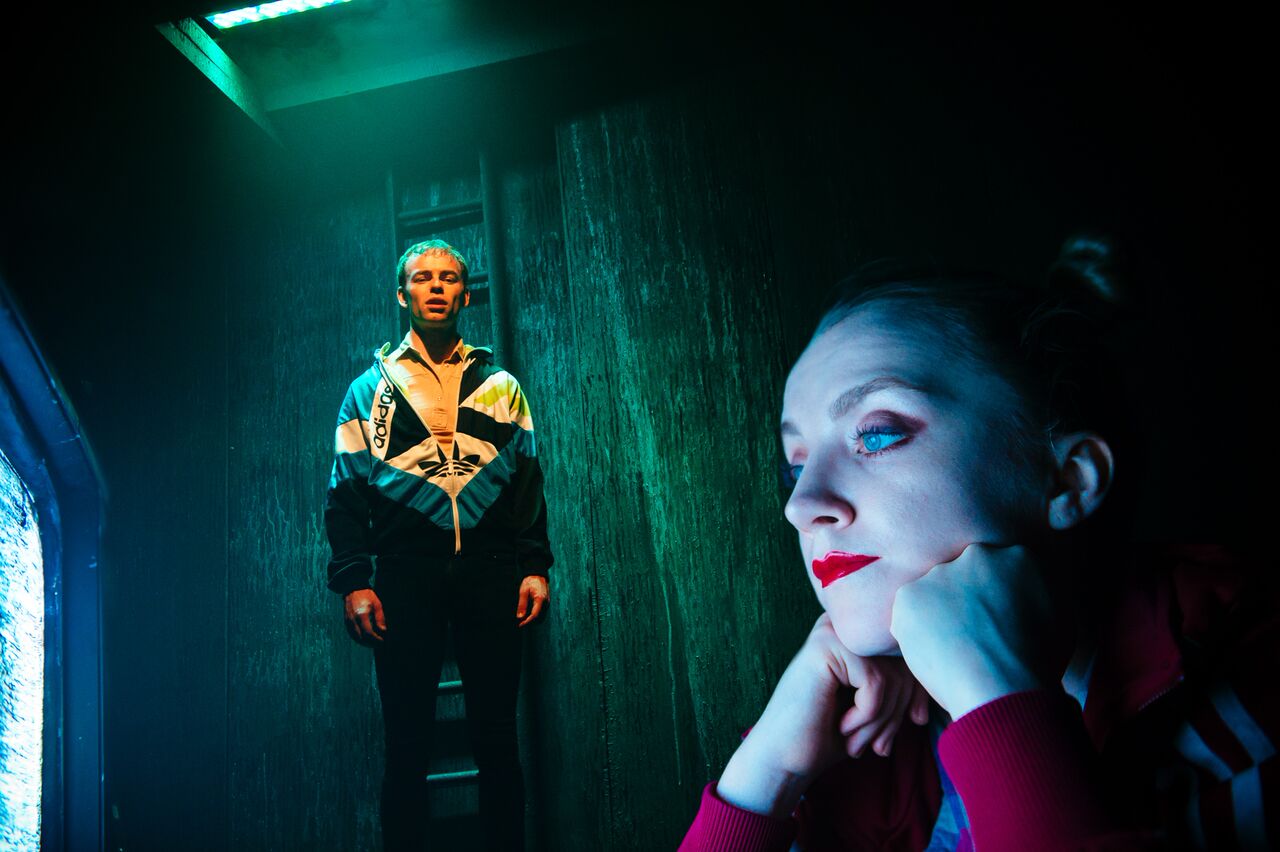
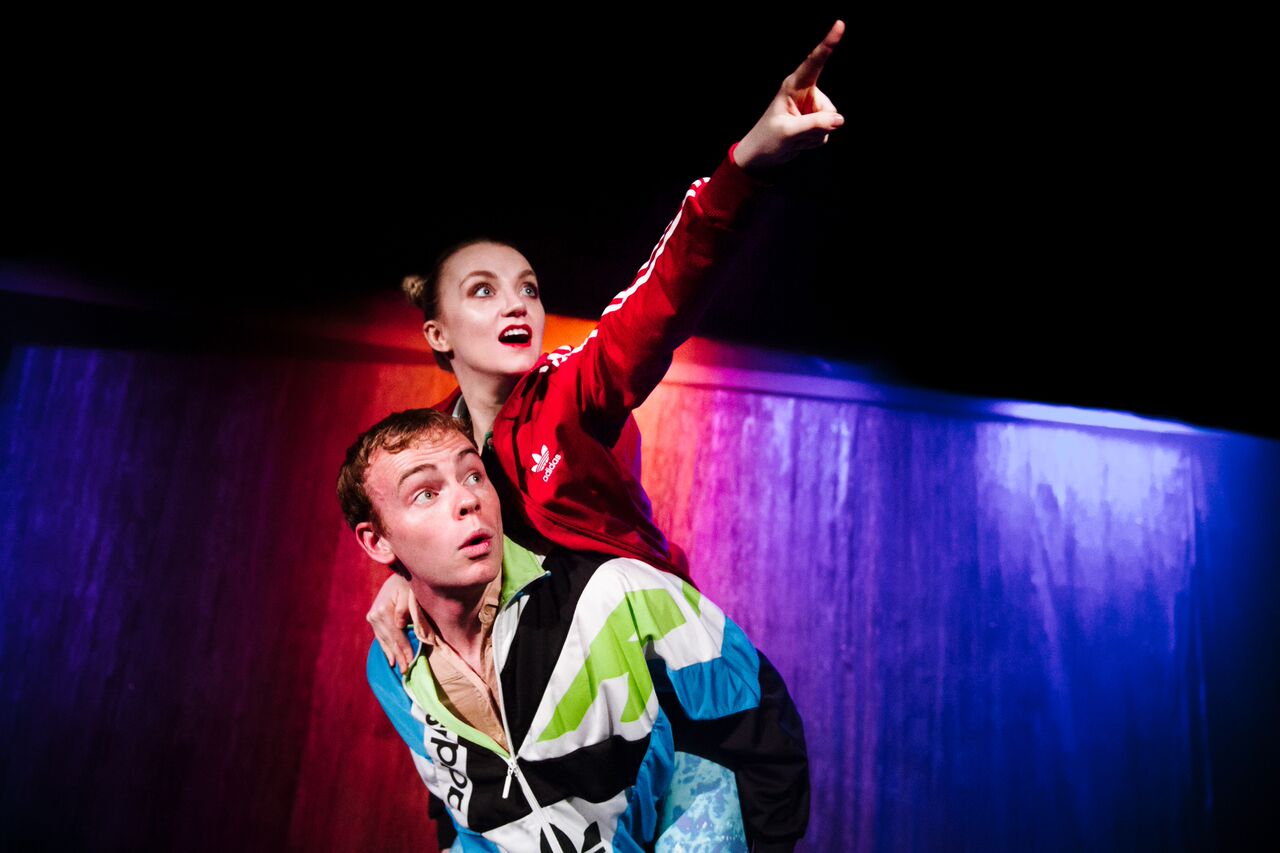
Evanna Lynch and Colin Campbell play Runt and Pig, two characters born at the same time on the same day in the same hospital. A lifelong friendship begins and they grow up together, even creating their own language – which is almost English and once the ear tunes into it, one senses the cleverness of Enda Walsh’s script.

They grow into teenagers and move around the stage with enormous energy, miming props and creating situations that channel their youthful energies until it spills over into violence and its awful consequences. All very well, but this raw recklessness produces a couple of surprisingly unlikeable people and I began to wonder why the play was being performed again. This is the 20th anniversary production and, never having seen it before, I considered whether it has dated well. John Haidar’s direction is precise and physical within the black box staging (designed by Richard Kent) and, although Lynch and Campbell don’t hold back in their performances, the abiding memory of the play for me is the technical side – a stunning soundtrack from Giles Thomas and a constantly evolving lighting design by Elliot Griggs.

Disco Pigs is a visceral, in-your-face, angry play that leaves subtlety behind. It felt like we were being shouted at. Tender moments were fleeting, but when they did occur, they were brilliant and left me craving for more.


Production Photographs are by Alex Brenner


Performances until 19th August 2017

Monday – Saturday at 7.45pm

Thursday and Saturday matinees at 3pm


Running time is 70 minutes (no interval)


Location: Trafalgar Studios, Whitehall, London

Tickets: www.atgtickets.com/venues/trafalgar-studios

or in person from the Box Office or by calling 0844 871 7632


Produced by Tara Finney Productions

Twitter: @tara_finney, @TrafStudios, #DiscoPigs20


Notes: Age recommendation is 14+


Review: Fabulous Fiddler

Review
Fiddler on the Roof (until 2 September)
Chichester Festival Theatre
Box Office: 01243 781312 www.cft.org.uk


Photo credit: Johan Persson

Heart, humour and world-class performances are just some of the elements that make Daniel Evans’s big summer musical an absolute belter. Add to that terrific musicians, Alistair David’s thrilling choreography and Lez Brotherston’s cleverly conceived set, which makes the very best use of Chichester’s unique stage, and you have a show that has all the hallmarks of a West End transfer.

The story of Tevye, a poor dairyman with five daughters, it is 1905 and in Russia an uneasy sense of impending change is in the air. But on a poor shtetl Tevye is more immediately concerned with finding husbands for the three eldest of his girls. Alas, despite his best efforts to keep with tradition, it seems that they are determined to follow their hearts rather than their heads, or indeed the advice of Matchmaker Yente (gloriously played by Liza Sadovy).

Omid Djalili is superb as Tevye. Radiating warmth sufficient to melt a Moscow frost in January, he convinces absolutely as the ordinary family man who is not without his shortcomings. In his regular exchanges with God (Dajalili’s stand-up career is much in evidence here), and later as he sings the touching Do You Love Me? to his wife, he reveals a touching vulnerability.

Tracy-Ann Oberman as his wife Golde is equally impressive. A feisty lioness who knows her old man better than he knows himself, it is an inspired pairing.

The singing overall is outstanding. From sweet and soaring to joyous and rousing, Tradition, the opening number, is nothing short of an emotional musical wallop to the gut.

A stupendous ensemble effort, this is a revival that feels both fresh and relevant. Delivering the theatrical triple of laughter (the dream scene is as clever as it is riotous), tears, and food for thought, it is the latter of the whole shebang that is the production’s ultimate strength.

A sharp reminder of how political and social unrest continues to throw lives into disarray, the final moments are heartbreakingly poignant.

Why Not Try Essential Oils For Some Common Medical Problems? by Dr Kathleen Thompson

Some plants have therapeutic properties, and some modern medicines are derived from plants – for example digoxin, and anti-cancer drugs, such as taxotere and vincristine. Ayurvedic medicine draws on the many medicinal plants in the Indian rainforests and our grandmas all knew of herbal remedies, such as peppermint for an upset stomach and camomile for a good sleep.

If you have a serious illness you should consult your doctor. Modern medicines have been rigorously tested, and are formulated to deliver a consistent, safe and effective dose.

However, for some conditions you could consider essential oils as an alternative – and why not enjoy Mother Nature’s help, when it is safe to do so?

Puressential invited Frost to a lunch and presentation on their essential oils, which, importantly are high quality, natural and/or organic and are classified as botanically and biochemically defined (EOBBD)).  Some of their products are described below:

Purifying Air Spray

Purifying Air Spray contains 41 essential oils and, in a laboratory setting, kills various viruses, bacteria, fungi and mites. Although this testing doesn’t translate directly to the home, the spray could benefit room atmosphere. It certainly smells lovely and I would rather use this than a chemical-based home fragrance.

Rest and Relax Air Spray

I have used lavender sprays for jet-lag in the past.  The Rest and Relax Spray contains twelve essential oils, chosen to sooth, relax, and aid sleep. I tried my sample before bed and it I certainly felt well-rested the next day.

Anti-Lice and Lice-Repellant

If you’re reading this on the tube, this is the moment where you lift your head from the head-rest and sneak wary looks at your neighbours’ heads.

I remember the misery of having to coat my young children’s hair in a noxious-smelling chemical, for hours, only to find it often hadn’t even worked. And this is the problem – head lice develop resistance very quickly.

Puressential repellent spray contains ten essential/plant oils and no synthetic pesticides. It killed lice, larvae and the eggs during laboratory testing. It is necessary to use it with a ‘nit comb’ (supplied) for best effect. As with any lice treatment, there are no guarantees, but at least it is a natural, pleasant product, and an alternative worth considering.

Interestingly, ‘selfies’ are contributing to an increase. Lice only spread when heads are in close contact – just a gap of 6 cm seems to protect. Puressential sell a repellent spray, which, in laboratory tests, repelled 2/3 of lice by that critical 6cm, 95% of the time. The effect lasted up to 24 hours, so you could use as a daily protective spray for your kids’ hair, particularly when there is a school outbreak. It doesn’t give 100% protection, but may reduce infestation risk.

Puressentials make other products too, including for muscular pains – which can be found on their website http://www.puressentiel.com/uk/

By Dr K Thompson, author of From Both Ends of the Stethoscope: Getting through breast cancer – by a doctor who knows

http://www.amazon.co.uk/dp/B01A7DM42Q http://www.amazon.com/dp/B01A7DM42Q

http://faitobooks.co,uk

Note: These articles express personal views. No warranty is made as to the accuracy or completeness of information given and you should always consult a doctor if you need medical advice