New Research Shows The Benefits of Vitamin D Supplementation And Heart Health

As our summer lurches from cloud to cloud, this latest information from HSIs (The Health Supplements Information Service, an independent body) is interesting:


Taking a vitamin D supplement may improve heart function in people with chronic heart failure according to a paper published in the Journal of the American College of Cardiology and presented at the American College of Cardiology in Chicago on April 4.

Commenting on the trial, Dr Emma Derbyshire a public health nutritionist for the Health Supplements Information Service (HSIS) noted: “This was a randomised double blind controlled trial in 223 people with chronic heart failure due to secondary left ventricular systolic dysfunction of the heart and also vitamin D deficiency.

“Trial participants were either allocated to one year of high dose vitamin D3 supplementation 4000 IU (100 micrograms daily) or a placebo. Measures made included the change in left ventricular function and the ability to do a test walk.

“Vitamin D supplementation restored normal levels of vitamin D in these people and left ventricular heart function was also better in the vitamin D supplemented group than placebo. There were no changes on the walking test with vitamin D.

“These findings are very encouraging as chronic heart failure is increasing and treatments can be expensive. Many people in the UK have very low levels of vitamin D. In fact average vitamin D intakes in the UK are between 2.3 and 5.1 micrograms daily which is not enough to protect against deficiency.
“A previous modelling exercise found that more than 8 micrograms would be needed daily to ensure a normal vitamin D status in most peopleIn addition, while the best source of vitamin D is sunlight, the Northerly latitude of the UK means that we lack the right form of sunlight for more than half of the year”.
The Health Supplements Information Service (HSIS) (www.hsis.org.uk; Tel: 020 7052 8955) is an independent information body, set up to provide balanced information on vitamins and minerals. It is supported by a restricted educational grant from the Proprietary Association of Great Britain (PAGB).


Is This the Best Treatment for me Doctor? Statistics on a Postage Stamp by Dr Kathleen Thompson

When we read about impressive new drugs, do we really understand what the percentages quoted mean?

You may need to make medicines-related choices—particularly for cancer, but other illnesses too. To make rational decisions you MUST understand the numbers your doctor quotes. He won’t deliberately mislead, but it is easy to misunderstand  statistical data.

So let me give you an inkling—not a maths lesson, just a few tips to help you ask the right questions.

Last week the BBC headlined: ‘Breast cancer: Taking hormone drugs for up to 15 years can reduce risk … cancer recurrence was cut by 34%’

Wow. Impressive. But let’s look closer: In that particular study, 95% of those who took the treatment for 15 years were cancer-free, compared to 91% who stopped at 10 years.

Hang on – 95% isn’t that different from 91%. How is that cutting risk by 34%?

Well (and this is important) improvement percentages quoted in newspapers, and by doctors and scientists, are often described in relation to the original risk.

In these patients, the original risk of cancer recurring was only 9%, so any improvement would appear large relative to 9%. If the original risk had been higher, the same benefit would have appeared less.

OK that’s the bottom line. But for the curious, another example:

Relative Risk Reduction (RRR) is a statistic often used to describe drug benefit. It is what it says—the reduction in risk (eg risk of death, or disease recurrence) relative to the original risk, ie the actual risk improvement divided by the original risk.

cancerriskreduction2

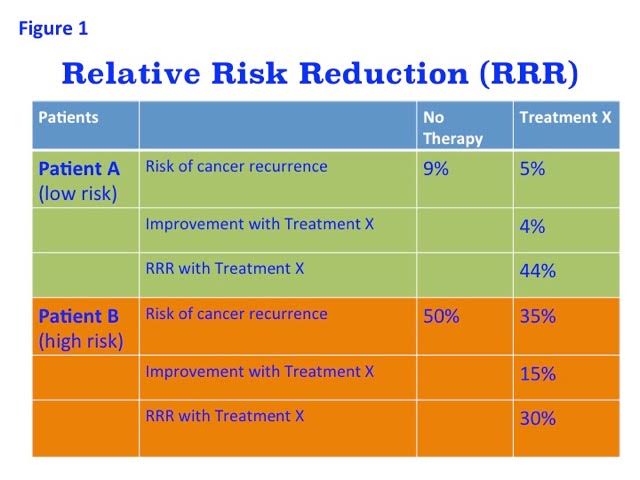
The Table shows an example. Patient A has a low risk of cancer returning (9%); Patient B’s cancer is more likely to recur (50%).

You can see from the Table that Patient A’s risk will only decrease by 4% with Treatment X, whereas Patient B’s will decrease by 15%.

Knowing this, Patient B should be more inclined to take treatment X than Patient A.

However, if Patient A’s doctor describes the benefit as RRR (see Table), then Patient A’s risk appears to decrease by a massive 44%. Consequently Patient A may have wildly inaccurate expectations for the treatment. The doctor isn’t tricking him, RRR is scientifically valid, but you need to know what it means.

This example highlights another point. Sometimes we only know that a treatment works in most people. However sometimes there is more information about how much it works in different patients eg Patient B would respond to Treatment X more than Patient A.

If available, you need specific information on the benefit for YOU. This could influence your decision, particularly for a treatment which has significant side-effects.

So, in summary: 

If your doctor uses percentages to explain a treatment benefit, ask:

1. Exactly what do the numbers mean?

2. By how many percentage points should you improve on treatment?

3. Is there more specific information for your particular situation? 

Don’t be frightened to ask your doctor for more information—he wants you to understand and may not realise when you don’t.

By Dr K Thompson, author of From Both Ends of the Stethoscope: Getting through breast cancer – by a doctor who knows

http://www.amazon.co.uk/dp/B01A7DM42Q http://www.amazon.com/dp/B01A7DM42Q

http://faitobooks.co,uk

Note: These articles express personal views. No warranty is made as to the accuracy or completeness of information given and you should always consult a doctor if you need medical advice

Further information:

http://www.bbc.co.uk/news/uk-36455719

http://www.nejm.org/doi/pdf/10.1056/NEJMoa1604700

http://scienceblog.cancerresearchuk.org/2013/03/15/absolute-versus-relative-risk-making-sense-of-media-stories/

http://www.breastcancer.org/risk/understand/abs_v_rel

http://www.nps.org.au/glossary/absolute-risk-reduction-arr


Potentially Hazardous Nanoparticles Found in Powdered Baby Formula

Very important information for our American cousins who have children.

Nanoparticles linked to potential health hazards were found in popular powdered baby formula products, according to a first-of-its-kind report released today. Scientists found unlabeled and under regulated nanotechnologies in six out of six formulas tested, including Gerber, Enfamil, Similac and Well Beginnings products currently on store shelves.

Friends of the Earth’s report, “Nanoparticles in Baby Formula: Tiny new ingredients are a big concern,” details new findings from independent lab research and compiles data from health impact studies on nanoparticles. Nano-sized structures and particles of potential concern were found in all six of the baby formulas tested, including: nano-hydroxyapatite (nano HA) in needle-like and non needle-like form, nano titanium dioxide (TiO2), and nano silicon dioxide (SiO2) (the nano TiO2 and SiO2 results demonstrated possible presence).

“This technology is moving from the lab to the marketplace without sufficient regulation, safety assessment and labeling,” said lead report author, Ian Illuminato, health and environment campaigner with Friends of the Earth. “It’s of real concern that these tiny particles are used in hundreds of consumer products, and now in infant formula, with minimal to no oversight. Companies and regulators must take extra care with a product fed to the most vulnerable among us.”

“Few health impacts studies have been done upon nanoparticles. Yet we have concerns about potential health impacts,” commented Tracey Woodruff, PhD, MPH, with the Philip R. Lee Institute for Health Policy Studies at the University of California, San Francisco. “Some nanoparticles are ‘needle-like’ in structure. This is concerning. We don’t know if they can possibly penetrate cell walls and migrate to other parts of the body, or cause harm when inhaled. The problem is, there hasn’t been enough research to suggest that using the types of nanoparticles found in  this infant formula study  is absolutely safe.”

Mark Mitchell, MDMPH, chair of the National Medical Association’s Commission on Environmental Health agreed. “We know that our federal and state chemical regulatory systems are broken and have failed to protect our patients from illness resulting from product ingredients introduced into the marketplace before adequate health studies have been conducted. Babies’ bodies are developing and can be especially vulnerable to exposures from hazardous materials. As a physician working with low income communities and communities of color, I am concerned that this new information on powdered baby formula may indicate disproportionate impacts on vulnerable populations.”

“The failure of FDA to protect infants and mothers from the presence of potentially harmful nanoparticles in baby formula is mystifying,” said Lynn Kersey, executive director of Maternal and Child Health Access. “I know that not all powdered baby formula was tested, but the presence of these nanoparticles in these specific products is concerning to those of us working with low income families who may be more likely to use powdered formula. This means potentially disproportionate impacts on low income people and families of color.”

Lisa Archer, director of the Food & Technology Program at Friends of the Earth and herself a mother, wants federal agencies to protect the public: “Like many parents and caregivers, I had to feed my child formula. I am outraged that these poorly studied, virtually unregulated and unlabeled nanomaterials are present in infant formula when there are suitable non-nano ingredients that have been used for decades and don’t carry the same risks. The FDA must act immediately to put a moratorium on the use of nanomaterials in formula and other food until they can be proven safe, and are regulated and labeled. In the meantime, formula companies must immediately commit to not use these materials.”

Gerber is owned by Nestle, Enfamil is own by Mead Johnson, Similac is owned by Abbot Laboratories, and Well Beginnings is owned by Walgreens.

Friends of the Earth and eight other groups have sent letters to the FDA urging immediate removal of formulas with nanomaterials and for a moratorium on the use of these materials in formula until safety assessment, oversight and labeling are established. They also sent a letter to OSHA advocating for better protection of workers who may be exposed to nanomaterials. A letter was also sent to formula companies demanding that they stop using nanomaterials in absence of safety assessment, regulation and labeling. Advocates are urging consumers to sign a petition demanding this action from companies.

For more information on nanotechnology, visit www.foe.org/nanotechnology/


baby, shared parental leave, feminism, equality, childcare, leave, maternal, work, working mothers, lean in

Top Tips on Reducing Sore Muscles after Your Workout

Whether you’re a Gym Bunny or a Fitness Newbie, you may have heard the term DOMs floating around the gym a fair few times. Yes, that achy feeling you get the day after a workout when you can’t go down the stairs without assistance or as I like to call it, a Muscle Hangover. As a Personal Trainer, this has become a word engrained into my vocabulary on a daily basis and for numerous reasons. Top of the list is that it is the number one excuse from clients, especially beginners to training who complain this is why they no longer wish to carry on with their workout regime and on the flip-side, others claim to be not working hard enough if they don’t have DOMs. So let’s debunk DOM’s or as it is more widely recognised, ‘Delayed Onset of Muscles Soreness.’

Firstly, DOMs can occur anywhere and to anyone no matter how experienced or beginner you are. Some can’t live with it, some swear by it, in any case, if you have been recently exposed to unfamiliar or intense physical activity, chances are you will experience this soreness. Let us dispel the myth that this is a build up of lactic acid in the muscles, that’s generally not the case and even so, does this really answer your question as to what DOMs are and how to get rid of it? Probably not. So let me start with an explanation which is easier to digest, DOMs appear to be the product of inflammation caused by connective tissue micro trauma, the small tears we make in our muscles when training. This in turn can be productive if you’re trying to build your muscle groups however, extreme soreness can also be counterproductive and hinder your training abilities… in training much like your diet, there is an everything in moderation approach. Despite the fact that we may not be able to get rid of DOMs completely we can certainly help to reduce them and with summer coming up and many a marathon to be run, we popped in for a masterclass with Nelsons® arnicare® arnica Cooling Gel and Top YouTube expert Lucy Wyndham-Read, to provide us some much needed muscle relief tips.

Lucy Wyndham-Read

Lucy Wyndham-Read

Cool down stretches are a must and exercise expert Lucy Wyndham-Read advises us on a few crucial cool down stretches.

IT band stretch – It’s very important to carry out this stretch after exercising as it helps to realign the body and avoid the risk of injury. Stand up straight with one leg crossed over the other and then lean towards the top leg. You will feel a stretch along the side of the other leg, so hold for 30 seconds and then repeat on the opposite leg. Remember to breathe deeply the whole time.

Hip flexor stretch – This stretch is similar to a lunge but requires you to leave your knee on the floor with your opposite foot out in front. Make sure your hips are aligned, pointing straight ahead to avoid any rotation in the pelvis. Press the toes on your back foot into the ground as well as your knee and your front foot to activate the lateral hip stabilisers. Hold for a minute and then repeat on the other side.

Sitting calf stretch – Sit on the floor with one leg straight out in front of you. Place a towel around your foot and gently pull your toes towards you until you feel a stretch in your calf. Hold for 30 seconds and then repeat on the other leg. You can also rub Nelsons arnicare arnica Cooling Gel into your muscle, as it contains grapefruit and menthol which help to cool and revive.

Standing calf stretch – This is a classic stretch for the calf muscle which is ideal for doing after you’ve worked on your legs. Stand facing the wall, just under arms distance away from it. Hold your arms out in front of you and place your palms against the wall. Keep your feet parallel and take one leg back as if about to lunge. Bend your front knee and press through your back heel. Hold for approx 30 seconds and then switch legs.

And if you want to stretch along with Lucy, check out her YouTube channel;


As well as stretching, you can also help to reduce DOMS by using soothing creams or gels. We recommend specially formulated Nelsons® arnicare® arnica Cooling Gel. This non greasy formula is ideal for massaging into tired legs after a workout combining the natural benefits of arnica with the refreshing sensation of grapefruit oil and menthol to cool and soothe the skin. We just loved taking the time out to pay our body some much needed stress relief and being allowed to indulge in a little massage after a heavy workout to relieve our tired limbs.

Nelsons® arnicare® arnica Cooling Gel is priced at £5.40 for 30g and is available from Holland & Barrett, Superdrug, Boots and Amazon. Visit Arnicare for more information.

So no more excuses guys. Don’t forget your stretches, arm yourself with Nelsons® arnicare® arnica Cooling Gel and love your workout.

Varidesk Soho Review: Is Standing Up The New Sitting Down?

varideskreview

Standing up is the new sitting down. Well, almost. The trend for working while standing up is not going away. It has numerous health benefits and you can burn 52,000 calories per year if you use it daily. It also decreases neck and lower back pain, lower blood pressure and help prevent heart disease.

With this in mind we reviewed the Varidesk Soho. Varidesk specialise in sit/stand desks.The Soho is their smallest standing desk model, with just enough space for the mobile minimalist who needs a stand up desk that’s just the right size for their laptop or tablet and easy to move and manage. It’s a single, flat deck that’s 76.2cm (30″) wide, and pops up or folds down in just seconds, making it a true sit-stand desk.

varideskreviewpic

So what did we think? It came well packaged which is always a plus. When we took it out we noticed how good it looked. It is well made and it looks high end. The instructions are on a removable plastic film on the desk. It is heavy but not too heavy. It is easy to work, moving up and down effortlessly and without any juddering when you get the hang of it.

The Varidesk is easy to use, and is flat enough to be stored away easily. It looks good and is adjustable so it will suit every height. It is also small enough to work in a cubicle if you don’t have your own office. You can fit a laptop and a mug of tea on it. We are sold. We think it is a great piece of engineering and a fantastic product. It costs £150 and is available from Varidesk. We are not sure if we will be standing up all day, but we will definitely be incorporating it into our working day.

varidesk varideskreviewblacksoho

  • Free delivery
  • 76.2cm (30″) wide for laptops or tablets
  • Single deck
  • Holds up to 4.54kg (10 lbs)
  • Sits on top of existing desks and cubicles
  • Sturdy and stable even when fully extended

http://uk.varidesk.com/laptop-standing-desk-VARIDESK-for-laptop


Snake Oil or Medicine? by Dr Kathleen Thompson


Every day we read on the Internet, in newspapers or in magazines about wonder drugs. With all these miracle cures around it is surprising that so many of us still suffer illness. Surely we just need to pop one of these pills and all will be well?

But maybe, just maybe, some of these potions can’t cure cancer, can’t make people with arthritis dance in the streets and can’t make you lose ten inches off your waist-line in a week?

If you have incurable cancer, or constant arthritic pain, you wouldn’t want to miss a useful treatment. So how can you know whether claims are genuine or snake oil?

Approved medicines are tested in numerous clinical studies, usually in thousands of people. Study data are scrutinised by regulatory authorities (FDA in USA and EMA in Europe) before doctors can prescribe them.  Thus there is firm evidence that they work, and a great deal is known about side-effects or safety issues.

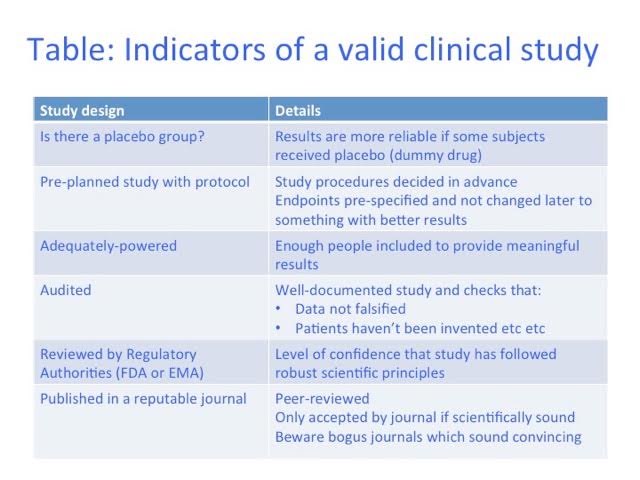
However, anything can be advertised on the Internet – Google has no truth filter.  Impressive-sounding study results may not be scientifically sound. So here are some clues to help you assess them (See Table): Snake Oil or Medicine? by Dr Kathleen Thompson tableplacebo

1. Has the ‘medicine’ been tested against placebo (dummy medicine)? If people believe they are receiving a beneficial treatment, they often feel better, regardless. Most studies should include some patients who only receive placebo, to make sure any benefit is due to the real medicine.

2. Measures of benefit (endpoints) should be chosen before a study starts. Eg an influenza medicine may measure fever. If fevers don’t improve, one can’t then change the endpoint to, say, sore throat, just because these improved more. Some symptoms will improve by coincidence, and it isn’t valid to cherry-pick the best results. This is often done in unregulated ‘studies’ and can make a treatment look better than it is.

3. Always check how many people were tested. If a study only had two patients, and one received real medicine and one placebo, even if the patient on the real medicine did better, it could have been due to chance. Statisticians calculate how many patients are needed to give a reliable result. Unregulated studies rarely include enough people.

Unapproved studies are not always checked, so there is more opportunity to ‘cheat’—results may be changed, ‘patients’ invented, or data from any patients who didn’t improve may be removed. Where the study was performed, and by who, may give reassurance on this, or not.

A respectable study will be written up as a report, and will be published in a good scientific journal. Be careful though – some ‘journals’ have impressive titles but are not what they seem. You can check them on Cite Factor (see below) to be sure.

I hope this helps you decide what you can believe. If in doubt, do ask your doctor’s opinion. And remember, if something seems to good to be true – then it may well be exactly that.

By Dr K Thompson, author of From Both Ends of the Stethoscope: Getting through breast cancer – by a doctor who knows

http://www.amazon.co.uk/dp/B01A7DM42Q http://www.amazon.com/dp/B01A7DM42Q

http://faitobooks.co,uk

Further information:

http://www.citefactor.org

https://clinicaltrials.gov/ct2/info/understand

Note: These articles express personal views. No warranty is made as to the accuracy or completeness of information given and you should always consult a doctor if you need medical advice


British women are damaging their health with weekday diets and weekend bingeing

fitness-get healthyBritish women could be seriously damaging their health by sticking to strict diets during the week and binging at weekends, according to health experts.

Researchers have discovered a “feast or famine” culture with the majority of young women aged 18 to 40 (80 percent) restricting their diet during the week, only to overindulge at the weekends on junk food and alcohol.

Unsurprisingly, the survey showed Monday is the day women consume the least, with as many as one in ten consuming as little as 1,000 calories on the first day of the week.

A further one in twenty stick to a dangerously low calorie intake of 500 calories a day from Monday through to Thursday.

But on a typical weekend, the majority of women (83 percent) admitted they over indulge, with one in ten consuming 3,000 calories per weekend day (average) – with a further one in twenty admitting to binging on 4,000 calories or more on a Saturday or Sunday.

In terms of alcohol consumption – the average number of drinks consumed on a typical weekend evening (3 drinks) was more than three times the amount drunk on an average week night (less than 1 drink, 0.7).

Nutritionist Karen Poole said: “For many of us the weekend is typically a time to kick back, relax, catch up with friends and enjoy a little indulgence. Sometimes though it can simply mean too much of a good thing.

“If, at the weekend, you ramp up your junk food calorie, refined carbohydrate and alcohol intake, then you are looking at a potential sugar overload and your body will have to work hard to deal with the major increase in blood glucose levels, storing any excess for the future.

“Bodies function better with a regular varied diet of lean protein, essential fat and fresh vegetables providing a rich supply of vitamins and minerals.”

The report also revealed that a weekend of excess leaves 47 percent of women feeling tired and ill-equipped to deal with the busy week ahead.

The triggers for entering into a “binge” were also revealed, including a stressful week at work (40 percent), office cakes and treats (18 percent), a Friday takeaway (24 percent) and a Saturday morning fry up or bacon sandwich (27 percent).

83 percent admitted that on the whole, they are guilty of weekend excess when it comes to food and alcohol.

A further 77 percent said they wished they were more moderate with their health habits and indulgences.

Yesterday a spokeswoman for Spatone, which commissioned the survey among 2,000 women said: ‘’The working week can be long and tiring enough but if you’re also not eating a consistently healthy and balanced diet you may find your energy levels might suffer as you’re not getting enough vitamins and minerals to maintain normal energy function.

“Allocating time for rest, healthly eating and exercise throughout the week rather than dieting at the beginning of the week and then becoming unhealthy towards the weekend, can make it much easier to maintain energy levels and reduce tiredness and fatigue.

“Those who can’t get their iron requirements from dietary sources alone could consider taking a natural food iron supplement like Spatone”.

Interview with Fitness Expert and Trainer Adrian Collins by Kris Martinez

Interview with Fitness Expert and Trainer Adrian Collins by Kris MartinezAdrian Collins is one of the best trainers in the fitness industry. His exercise plan, ‘The Social Butterfly Programme’ has been featured in the Mail Online and The Sunday Times Style Magazine. The programme, which is 6-8 weeks is completely personalised to suit individual goals and promises to fit around the schedules of busy professionals.

Being a busy person myself, I was eager to learn more about  the programme and how it works.

When I arrived at Adrian’s gym near Old Street station, I was expecting  to be thrown into a hardcore army style workout, but it was the exact opposite of that.  Instead, Adrian had me do a few simple exercises, which he used to assess my posture. Knowing nothing about me, Adrian was able to deduce that I used to dance. He was also able to see areas where I was tight.

After assessing my posture,  Adrian took me through a few exercises that would not only help me reach my goal of toning up, but also help with my posture issues.

Adrian took the time to get to know me and find out what my goals were. His style of training is brilliant. He uses a mix of pilates and strength training, which keeps things fun and interesting. He also gave me exercises to do on my own time that help with my posture issues. If you are in the London area, I definitely recommend checking him out. For those of you who live elsewhere, Adrian also offers online training. Prices start at £380.

collinsfitness

After our work out, I had the opportunity to ask Adrian some health and fitness questions.

1. What is your theory behind the Social Butterfly Program?

I created the Social Butterfly Program as being a city based trainer I know how hectic people’s lifestyles are. It’s the perfect regime for city dwelling, party loving people with busy social schedules. It’s completely personalised to your goals.  Wether it’s focusing on s desired body type, re alignment or shaping up for a special event, it’s tailor made to make you look fantastic and stay motivated.

2. What do you say to people, who say they don’t have the time to workout?

Time management is needed here.  Usually from my experience being able to fit in a workout in your day structure without making it too much of an inconvenience is key. Try a morning workout HIIT before work or on your lunch break having your meals around this in preparation.. This is why I promote a 15/20 min HIIT to my clients to achieve on their off days from training with me.

3. What tips do you have for people who don’t have access to a gym?

It’s not necessary to have to go and use a gym to create a good workout routine. Many of my clients don’t have gym memberships I use a private hired studio or train in parks or at homes.  There are some great outdoor spaces for working out, try finding a hill or a flight of stairs is one of my recommendations, as you can really get a burn on different intervals using these. And there is a lot you can do with your own body weight for exercises. It is affordable to purchase some basic workout equipment these days. I like using resistance bands with clients which helps with more pull exercises etc..

4. What is the best way to tone up?

Consistency – sticking to a routine and keeping your food clean… This combined with a good resistance based program can work wonders on toning your structure.

But this all relates back to goal setting if you put your mind in the right place and follow a consistent routine with your eating habits sleep and shocking up the exercise program this can create a snow ball effect to your metabolism

5. What is your favourite type of workout and why?

It depends on my mood and if I’m aiming for a specific goal. From boxing pad work to heavy lifting and squating to Pilates.  I rate the Pilates reformer highly, if I’m feeling a bit tight from weights I like the challenge this machine brings when doing specific exercises. Once you get past the basics there are some full on moves which can really challenge your body.

Interview with Fitness Expert and Trainer Adrian Collins by Kris Martinez2

6. What are good pre and post workout snacks?

I try and avoid the idea of snacking (the body works on digestion of foods with insulin response, snacking can screw this up and forces you to hit insulin spikes etc), But you do need to fuel your workouts and get the right ingredients in within 45mins, post workout to optimise muscle recovery.

Key foods that help promote a fuel efficient workout are apples, almonds and post work out protein and carb are needed for muscle recovery. Look to keep this clean as poss if you want to optimise muscle tone, I find white fish or a breast of chicken with sweet potatoes or basmati rice with good greens for fibre to help get this ingredient through your digestive system in optimal time and ease.

7. What exercises do you recommend to get rid of love handles?

Assessing your diet, getting the correct sleep pattern and with an optimal exercise program in place will all help to rid this area if that is your goal.  Targeting muscle groups in isolation can be great for specific toning and look but, if you are unfamiliar with targeted exercises I wouldn’t recommend isolation as there are implications to the rest of your kinetic chain if your technique isn’t spot on. So, for this I would recommend compound exercises and a good Pilates balance / alignment and core routine to help support your structure before upping exercises for isolation..

8. What is your favourite exercise and why?

Again this always changes dependant upon where I am with my own training routine at the time. I do like compound exercise such as deadlifting as this hits my whole body. But, I also enjoy sports as exercise such as swimming, surfing, snowboarding…

9. If you’re out having a drink, what is a good choice to go for?

Other than water! If you tend to have the “occasional” alcoholic beverage try sticking to clear drinks, champaign, vodka tonic… And also try slipping water in between to stay hydrated as this will really have a difference in how you feel the next day. Clear drinks give your digestive system an easier time in dealing with the toxins and the extra H20 helps the system flow these toxins quicker.

10. If your goal is to shed some weight and tone up, how many times a week do you recommend working out? And how long should your workouts be?

Quality rather than quantity, I’ve always said.  Ask yourself next time you hit the gym is this challenging for me? How much time am I spending on moving or am I sat here on my phone breaking my workouts not concentrating on my exercise/movements. Yes there is a key amount of days and time you want to spend in optimising your weight toning goals, that is why I have most clients I see on the Social Butterfly Program take on the intense level with three to four sessions a week.  I also, encourage them to take on the 15 minute HIITs on the days we don’t train usually over the weekends for optimal metabolism boosting effects.

For more workout reviews, interviews, and delicious recipes be sure to follow my blog, at Fit About Town.