Business of Books: Behind the Best-seller Jane Cable Meets Rosanna Ley

the-business-of-books-interviewswithjanecableThis week I am especially delighted to welcome one of my favourite writers, best-selling author Rosanna Ley.
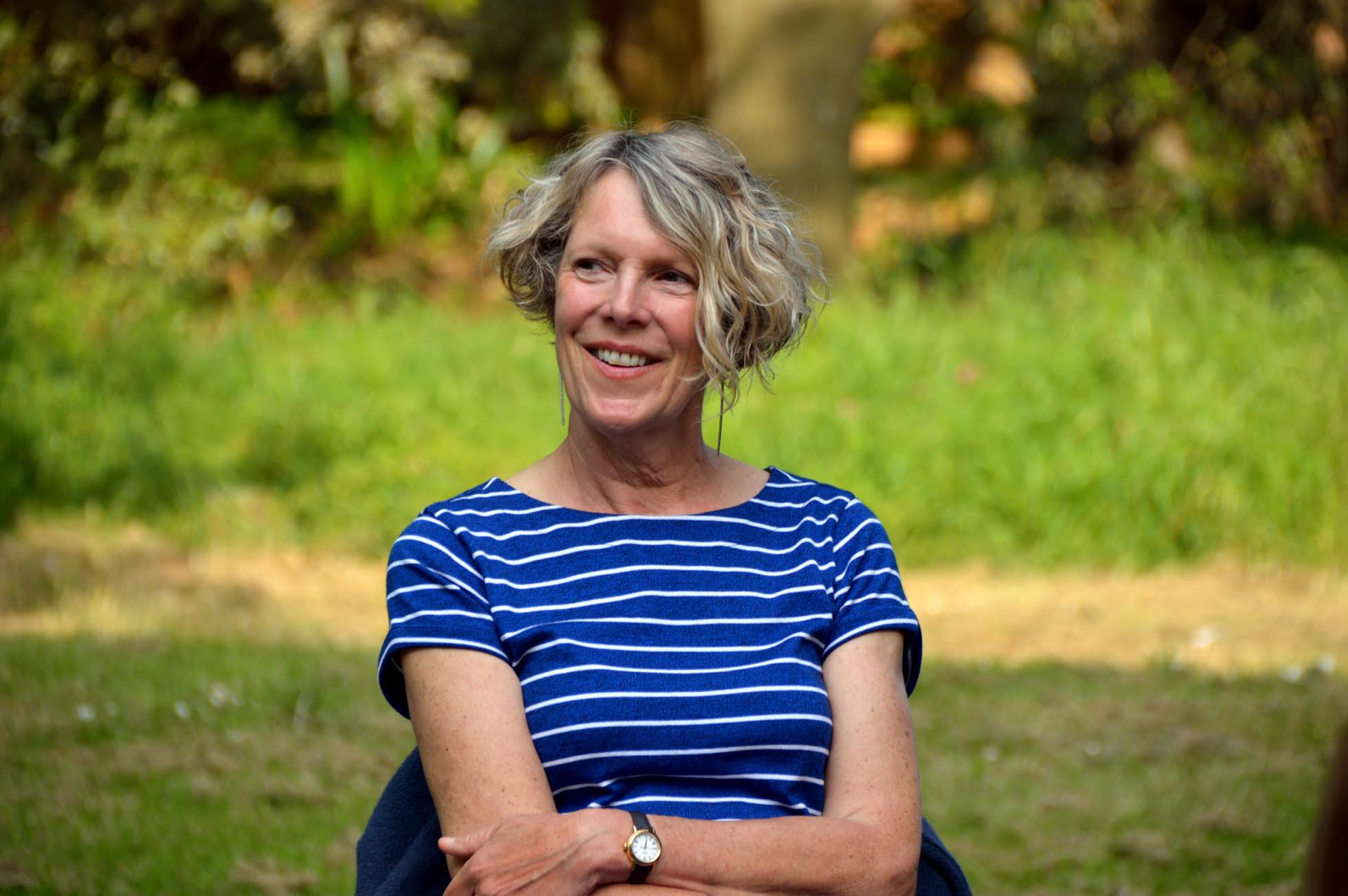
BUSINESS OF BOOKS- Behind the Best-seller rosanna ley

1)      How much of your working life does the business of books take up?

Pretty much all of it! I work full time from home: writing, researching, editing, writing publicity material and taking part in events and occasionally doing a manuscript appraisal for an author (I used to do more of these but now although I’d love to, I simply don’t have the time). I also run an annual week’s writing retreat in Andalucia in July for around 12 writers at finca el cerrillo which I adore. It’s a haven of tranquillity and it’s so good to work with other writers. I used to do a lot more tutoring of creative writing and also working with community groups on therapeutic writing but I have had to let this go. Very reluctantly. But writing and editing a book a year (of around 130,000 words) is very time-consuming!

2)      What’s your business model to earn a living from writing?

I’m not sure that I have a business model at all. I’m fortunate in that I do earn a living from writing. It’s hard in these days of low advances and competitive deals from independent publishers, not to mention the number of authors who self-publish who have to work so hard to earn from their books. I would certainly consider running creative writing courses as a good way to supplement income, and there are appraisal agencies who take on experienced readers to give constructive feedback on writing for authors who go down this route. Apart from that, my model would be to keep writing, keep publicising and hope that your work is eventually recognised. Just keep getting it out there…

3)      What do you write and what do you consider to be your major successes?

I write novels often described as ‘commercial women’s fiction’ which are contemporary but also contain elements of the historical. They offer a bit of mystery and some romance and are set in stunning locations such as Sicily and Sardinia (as well as my home turf of West Dorset and also Cornwall). I have also set novels in Cuba, Burma, Morocco and Barcelona. Yes, I like to travel… My books are often called ‘holiday reads’ because of the locations I choose, but I like to think they offer a bit more than that…  I like to include some (hopefully) thought-provoking subject matter and I like to explore human relationships and the ‘tangled webs we weave’. My biggest paperback success has been ‘Bay of Secrets’ which takes on some rather dark and hopefully intriguing subjects centring around the Spanish Civil War when a woman from Dorset in 2012 goes looking for her birth mother. My biggest e-book success was ‘The Villa’ which is about three generations of women and their journeys – one to find her lost love, one to discover the secrets of the past and one to find her own sense of self!

4)      Tell me about your latest project.

The project I am currently working on is entitled ‘Her Mother’s Secret’ and is set in Belle-Ile, a small island off southern Brittany, France. It centres around Colette, who left the island when she was eighteen and who returns when her mother Thea is ill in order to care for her and help run Thea’s flower shop. I have finished the first draft and am doing some editorial work on that now. We are also looking at cover ideas. I am also doing some publicity work for ‘Little Theatre by the Sea’ which is out in hardback with Quercus already and will come out in paperback on June 1st. This book is about restoration and change. Faye travels to Sardinia to take on the project of re-designing the little theatre and finds much more than she ever bargained for…

Rosanna Ley is the best-selling author of The Villa, Bay of Secrets and Little Theatre by the Sea. Her books are published by Quercus.
Festival Fun: Jane Cable puzzles over how best to publicise a local event

the-business-of-books-interviewswithjanecableI don’t know if it’s just me, but as a writer I’ve become so locked into digital marketing that asking me to promote something tangible and local leaves me scratching my head.

Although Chindi Authors were always going to run a series of events at this summer’s Festival of Chichester I hadn’t really envisaged joining in. For a start, I would be in the middle of a long distance house move. But since the arts’ editor of the local paper persuaded me to take part it has kind of become my Chichester swan song.

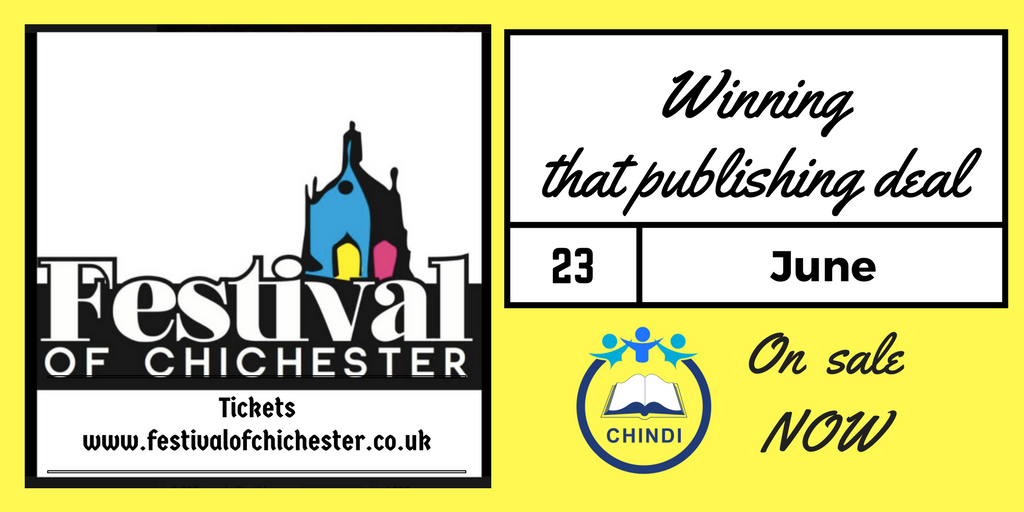
Chindi are running six events in all. We kick off with a crime writers’ panel on 20th June, the next night host a ghost walk around the city, followed by an indie publishing panel on the 22nd and on the 23rd I’m going to talk about how starting my writing career as an indie helped me to win my publishing deal. On Saturday 24th we have two events planned: a creative writing workshop during the day and a wine & words quiz in the evening. The latter came about because our festival home is the function room above Hennings, Chichester’s independent wine merchant.

As ever, children’s author Christopher Joyce is the moving force behind the project. As ever, I was two steps behind him, nodding enthusiastically. As a result of this enthusiasm I find myself taking part in the indie panel, hosting the editing table, and if numbers dictate helping him to run the creative writing workshop. But numbers are the thing – bookings for our events are starting to come in, but they are not all as popular as we hoped.

Some of this is to do with being part of a festival. The upside is being featured in their programme, on their website and across their social media (in theory – the last time they tweeted anything was two weeks ago). The downside is that there are so many great events for people to choose from, so how do we make ours stand out?

FESTIVAL FUN Jane Cable puzzles over how best to publicise a local event

We need to reach local readers and writers – mainly writers – and they are a limited audience. The local papers are being supportive but how else do we make sure they know about our events? Twitter is a massive stage for this sort of thing and although we have lovely Canva graphics to post we need to make sure we are using the correct hashtags. So perhaps social media isn’t the best approach.

Our email newsletter goes out next week and features the events so hopefully that will help increase the numbers. At least the audience is targeted locally and we know they love books.

As a group we decided against leaflets because everyone hates giving them out, but I think this could have been a mistake. We have a poster in the window of Hennings, and I have designed one for my own event which will go into the library and anywhere else I can persuade to take it. Although we are a group and we all promote each others’ events our biggest responsibility is to our own. And from my point of view, local promotion is something I’ve lost the knack for.

Actually, event or not, being visible in the locality of your book, or where you live, is an essential part of the author’s marketing toolkit. People are always so much more interested when they feel they may be able to recognise something of their own lives in your work it’s vital we don’t become so focused on the global horizon we forget our own back yards.

For more information about spoken word events at the Festival of Chichester look here: http://festivalofchichester.co.uk/spoken-word/


Business of Books: Jane Cable interviews designer and digital marketing specialist Aimee Coveney

the-business-of-books-interviewswithjanecableBUSINESS OF BOOKS: BETTER BY DESIGN

Jane Cable interviews designer and digital marketing specialist Aimee Coveney

What is your book-related job or business?

I started out by opening my own freelance design consultancy after finding my niche of working with industry professionals and directly with authors themselves. I am now co-founder of Bookollective and run the Design and Digital Marketing areas of the business. As part of this, I regularly design book covers, websites and promotional material, as well as running social media campaigns and blog tours. I see design and digital marketing as increasingly appreciated areas of the publishing sector, with many having put these on the back burner for years. Design is key to visually presenting yourself as an author and also transitions over to the marketing of your work both on and offline. Digital marketing is regularly misused, but its values are increasingly apparent to authors and professionals. When understood and targeted correctly it can quickly grow your visibility and credibility within the marketplace.

 Jane Cable interviews designer and digital marketing specialist Aimee Coveney

What is the most rewarding part of it?

I love hearing back from authors and publishers on how much they love a design; especially book covers. After what can be years of writing their book, it can often be an emotional moment seeing it in its final ‘wrapping’. I think independent authors sometimes feel their writing doesn’t deserve a professional design and when they decide to take that route, it is an honour to be the person to work with them and create something that visually represents their hard work. Publishers are always passionate about books and I love their enthusiasm for good design.

On the digital marketing side, I love finding new opportunities and contacts for both authors and Bookollective as a business. There’s no greater feeling than building on something you feel strongly about and helping others to do the same. Interacting online, sharing knowledge and the Bookollective mission to create a community within the publishing industry is a reward in itself.


What do you consider to be your major successes?

With a vast amount of books being published every day, it is always a success when one you represent gets favourably acknowledged in some way. This year I was thrilled to win a cover design award and also seeing my expertise recognised with an article in the UK’s bestselling writing magazine. Bookollective was also ‘Start-up of the Week’ in The Bookseller which was a fantastic accolade. It’s been a busy and exciting start to the year and I can’t wait to see what else it will bring.


Have you always loved books and what are you reading at the moment?

Absolutely! I can vaguely remember being delighted at winning a book whilst in nursery: it’s one of my earliest memories. I grew up reading classics such as Beatrix Potter and Judy Blume before being brave enough to read outside of my comfort zone and now enjoy a wide array of genres. At the moment I am reading Asking For It by Louise O’Neill; an emotional roller-coaster for me. I don’t read every book that I work with, but I am a self-confessed book hoarder!


Bio: Having enjoyed years in the publishing industry, Aimee’s award-winning experience means she is well-placed to offer top advice on the design and online marketing of your book/s. Aimee regularly contributes articles for the ALLI Self-Publishing blog as well as other publishing related websites and magazines. Aimee is a Partner Member of The Alliance of Independent Authors. 

To find out more about Bookollective’s services for authors and publishers, visit her website bookollective.com

You can connect with Aimee on social media: 

Twitter: @authordesigner / @bookollective   Facebook: @bookollective  

For further information, authors & publishers can email: aimee@bookollective.com


The Business of Books: Bursting the Book Bubble

the-business-of-books-interviewswithjanecableJane Cable on Bookbub and other promotions

Another You has been on promotion again; partly thanks to Endeavour Press and partly off my own bat. When I heard the price would be dropped to 99p/99c for a good chunk of April in readiness for a Bookbub promotion I thought it would be worthwhile experimenting a bit myself.

I had heard very good things about Kindle Daily Nation (https://kindlenationdaily.com/). Very strong in the US market (where I’m not), they offer a number of sponsorship packages which start from $30 but I opted to splash out on one where Another You would be the only book featured in the mailshot. I’ve often found that the best way to sell my books is to offer a free excerpt and to do this costs $120. I uploaded my details and held my breath. Far from being the impersonal web-based process I expected soon I was receiving friendly emails from the team in New England who designed a great mailshot which showcased my book perfectly.

Did it work? Yes, in that the book shot briefly back up the Amazon.com charts and Endeavour were able to tell me that it sold 26 copies on the day of the promotion. Not nearly enough to pay for it, although more would have sold over the next few days, but overall the increased profile meant the experience was a positive one.

bookpromotionPR publicity

A week or so later Another You was featured on Author Shout’s Cover Wars (http://authorshout.com/cover-wars/). I had applied a few months before so the timing was purely co-incidental and I thought the promotions would bounce off each other well. Any author can apply, but be aware – this competition is far more about social media presence than the cover itself.

I normally work really hard on social media to make the most of every promotion I do and this time I could see it paying off straight away. I shared the link to the voting on the bookish Facebook groups I’m a member of, to my author page and on my personal Facebook account. I tweeted it every day. In Cover Wars you can vote every 24 hours and so many friends and fellow authors rallied around to do this I was knocked out by the support. It was neck and neck until the end, but I realised that the other author vying for top slot was in America so I had a last morning to gather votes before the competition closed. My strategy worked and Another You became Author Shout’s book of the week, featuring on their website and in their own social media. But whether I sold any more copies because of it I can’t really tell.

So on to Bookbub (https://www.bookbub.com/home/). Authors who have been featured rave about it, it isn’t cheap and there is a selection process to go through. Is it worth the hype? The answer is an emphatic yes.

Endeavour booked the promotion for the UK, Canada, Australia and India. It was so effective that within hours I had my first Amazon best-seller label, for 20th century historical romance in Canada. Unlike when the book was available free these were real sales to genuine new customers. A week later the book is still doing pretty well there and in Australia. In the UK it shot up to 400 in the Kindle UK charts and is still selling strongly and in the top 50 for women’s historical fiction.

So, what have I learnt? Strive for the best – save your pennies or beg your publisher and try for a Bookbub slot. And when you do decide on a promotion, harness all your social media resources and work as hard as you can to maximise the impact. Otherwise your time and money are likely to be wasted.


Business of Books: Jane Cable talks to author & book designer Christine Hammacott

the-business-of-books-interviewswithjanecableJane Cable talks to author and book designer Christine Hammacott
 
How much of your working life does the business of books take up?
The business of books is extremely varied these days. Being an author doesn’t just involve writing a book. It can involve research, editing, marketing and promotion, social media, blogging, events and book festivals, to name but a few – anything that can help raise your profile.
I’m an author and also a book designer. I run my own graphic design consultancy and spend a lot of time working on logos and brand development across all media both in print and online. Three years ago, I joined forces with a couple of other writing friends to set up a indie-publishing co-operative. We’ve published seven titles so far including my own book. As a result of this I’ve been asked by other authors if I would design their covers. So two years ago I added book design to my portfolio of offerings and word seems to have spread as I’m now constantly working with other authors.  
My writing is a lot less disciplined than the design side, as I’m forced to write around family commitments, often snatching time at the laptop or with notepad and pen in car parks and corridors while my daughter is at one of her out of school activities. It isn’t ideal but it’s a one way of ensuring I have some regular time to write.
Jane Cable talks to author and book designer Christine Hammacott
What’s your business model for earning a living from books?
As far as earning a living from my writing goes I’m a long from doing that. I’m not convinced I’d actually like to solely write, although I would like to address the balance better. In an ideal world I’d like to spend the mornings writing and the afternoons designing with a walk with the dog in between.
I really enjoy designing book covers. My first job after art college was working for a publisher doing just that. I turn an author’s manuscript into a marketable ‘product’ that is visually appealing and conveys the genre and essence of the book. It can be quite difficult getting this across sometimes to an author but it’s important for a potential buyer to know immediately what they are buying and whether they want it. 
I think authors like working with me because I’m an author too and therefore understand where they are coming from and that their work is precious. A lot of them haven’t published before and part of my role is to gently hand-hold them through the process.
What do you write and what do you consider your major successes?
Years ago when I first started writing, I entered a Writing Magazine short story competition and won first prize. That success gave me the confidence to believe in my writing and undertake something larger. I now write psychological suspense. I enjoy finding out how ordinary characters cope in extraordinary situations. My debut novel is about a young woman who just want’s to get back to some sort of normality after a devastating fire that has left her homeless and a neighbour dead. Only she then finds she has a stalker and begins to fear for her safety. It’s a genre I particularly like as it’s very easy to imagine myself in the protagonist’s position and that makes it scary.
Tell me about your latest project
I’m working on another psychological suspense. This one is set in the New Forest and is all about living with consequences, morality, family relationships and how easily a situation can get out of hand. 
 
 
facebook   christinehammacott.author/
twitter @ChrisHammacott
 

The Business of Books: The Taxman Cometh… Or Does He?

the-business-of-books-interviewswithjanecableJane Cable on taxing income from writing

The first royalty cheque, the first receipts from Amazon – those are exciting moments for any writer. But in the slightly bewildered ‘wow – someone’s paid to read my book’ moment, whether you need to pay tax on the income is the furthest thing from your mind.

First let me say that taxation – any form of taxation – is a minefield. The volume of legislation is massive and while HMRC guidance is helpful and now provided in reasonably understandable lay terms, it is still easy to fall foul of the rules – or at very least not take full advantage of them. If you even think you might need professional advice then talk to an accountant – preferably a qualified one. Most offer free initial meetings and if you can’t find one by recommendation then the ICAEW’s Business Advice Service is a good place to start: http://www.businessadviceservice.com/

Assuming you haven’t set up a company for your writing business then your earnings from the business of books will be classed as self employment. This means that you won’t be taxed on your income, but on your profit. In broad terms, many costs which relate solely to your writing will be allowable for tax, including book production, marketing, attending conferences and agents’ fees. The list is not exhaustive but a good first question to ask yourself is ‘did I do that only for my writing business and was it necessary to do it?’ If the answer is yes, then you are more than half way there but the reality is that a good accountant will be able to maximise what you claim because they will know the laws inside out.

For the tax year just started, things will be quite a lot simpler for the majority of writers who have self employed earnings of under £1,000 per annum. Here I am talking about gross income, before any expenses. This is because the government has introduced a new limit below which HMRC doesn’t even need to know about it. The exception to this is if you already complete a tax return but even then the rules are relatively simple and you can read more about them here: https://www.gov.uk/guidance/tax-free-allowances-on-property-and-trading-income

The Business of Books- The Taxman Cometh… Or Does He?

Of course another issue is whether you are trading or not with your writing, or if it’s just a hobby. Working out when a writer crosses the line is a matter of judgment – and case law – and everyone’s circumstances will be different. The key ingredient is whether you are doing it with a view to making a profit (one day, if not now) but once you actually start selling books, then you probably are.

There is a good chance you might be trading before that day, but this is where the waters become unbelievable muddy. Why would it matter, you may ask yourself, because if I don’t have any income then I’m not making taxable profits. The answer is that you might be making a taxable loss which can be used to reduce the tax on your other income. And this is where professional advice is essential because it’s also where HMRC can become mighty interested and in 2015 they won a landmark case where a tax tribunal decided that someone who had a full time job but poured money into a hobby they loved was not trading so couldn’t claim tax relief. Even though they made a little income from it. Even though they had a professionally designed website. It struck me at the time that the circumstances were pretty similar to most authors when they set out in their writing careers.

The new £1,000 tax free allowance will undoubtedly make things easier for those setting up many businesses, including writing, which can only be a good thing. But remember it’s only half the story. And never, ever, mess with the Inland Revenue!

Please note that this article only points out general rules and should not be used as a substitute for professional advice.


The Business of Books: Passion For Publishing

the-business-of-books-interviewswithjanecableThis week I’m genuinely excited to welcome Karen Sullivan, the powerhouse behind the most talked-about independent publisher in the UK
 

1)   What is your book related job or business?

I am publisher and owner of Orenda Books, an independent publisher that specializes in literary fiction, with a heavy emphasis on crime thrillers and about half in translation. We turned ‘two’ last November.


2)   What is the most rewarding part of it?

In all honesty, all of it is rewarding. It is a genuine privilege to be in a position to work with talented authors from around the world, and to bring them and their brilliant books to readers. The Orenda list is very much my own taste, and I account to no one, so while I can often feel quite exposed when a new book comes out, it makes the positive response all the more exciting. With each little success, there is more attention paid to the list as a whole, and everyone benefits. 


I love the thrill of finding a new book, and working with authors from the moment a book is signed, right through the editing process and then onto marketing and PR and even sales … none of the original excitement is diluted en route. One of the most moving and satisfying parts of my job is publishing debuts, making some often very long-held dreams a reality. I work incredibly long hours, but as we inch towards increasingly strong book sales across all formats, shortlists for awards, mainstream press, invitations to prestigious festivals, and fantastic endorsements from highly regarded authors, every challenging moment is worthwhile and I am in a constant state of wonder that this is mine!


karen sullivan, writing, publishing, Jane cable

Credit: Ian Patrick


3)   What do you consider to be your major successes?

There have been many! It was fabulous to be shortlisted (twice) for the Nick Robinson Newcomer Award at the Independent Publishing Awards. Watching Ragnar Jonasson’s debut novel Snowblind knock The Girl on the Train off the number-one kindle spot for the first time was unbelievable (sorry, Paula!), as were the exceptional sales of the Dark Iceland series. We’ve had three books selected for the excellent WHSmith Fresh Talent promotion (Amanda Jennings’ In Her Wake, Agnes Ravatn’s The Bird Tribunal ­[translated by Rosie Hedger] and Matt Wesolowski’s Six Stories), and The Bird Tribunal was a Radio 4 Book at Bedtime. Ragnar’s Nightblind won Most Captivating Crime in Translation at the Dead Good Reads Awards at Harrogate, and In Her Wake was shortlisted for Most Recommended Read. Louise Beech’s How To Be Brave was a Guardian Readers’ Pick, as was Ragnar’s Blackout. David F. Ross’s The Last Days of Disco was sold for stage to the Scottish National Theatre, and to Random House in Germany. It was the first-ever book that I published, and a massive boost! 


There are more of these ‘individual successes’, but I suppose the most exciting thing is to see the company grow. We quadrupled turnover in less than two years, and Orenda Books is definitely becoming a recognizable name both with readers and in the trade. Every positive review (and there are thousands), every bit of support from the ‘community’, every opportunity to bring my brilliant authors to festivals and events and bookshops, has added to the thrill of it all.  


4)   Have you always loved books, and what are you reading at the moment?

I have always been a reader. My dad was transferred a lot when I was young, and books were my solace and my friends. I would take a dozen books out of the library every week and be transported! When I was about eleven, I read a novel where the protagonist got a job in a publishing house, reading the slush pile. I couldn’t believe it! That was a job? And here I am! I always have a few books on the go. I’m reading Stav Sherez’s The Intrusions and Sarah Perry’s The Essex Serpent at the moment, plus first drafts by Orenda authors, including Louise Beech’s Maria in the Moon and Michael J. Malone’s House of Spines. All are AMAZING!


Karen Sullivan is founder and publisher of independent publisher Orenda Books, and a Bookseller Rising Star for 2016.

The Business of Books: Ready, Steady – Write!

the-business-of-books-interviewswithjanecableJane Cable on writing competitively

Writing is not generally a competitive pastime; in fact, as I was saying in my last column, it’s a mutually supportive one. Yet writing competitions are forever popular and it’s probably the one time that pencils are sharpened into threatening points as we pit our wonderful words against those of our peers.

Doing well in competitions has shaped my writing life. Being a finalist in the Alan Titchmarsh Show’s search for a People’s Novelist gave me the confidence I needed to pursue my career as an author. Winning Words for the Wounded’s Independent Novel of the Year in 2015 led to representation by an agent and my first publishing deal.

There is no doubt that having a competition win on your CV helps get you noticed in all sorts of ways. Not only by agents and readers, but by sites like Bookbub and Ereader News who are impressively picky about the books they take for promotion. And as with everything else, practice makes perfect.

The Business of Books- Ready, steady – write!

Many competitions have an entry fee which funds not only the prizes but the running costs. Some, like the Words for the Wounded prize, exist to raise money for charity. Others help to fund literary festivals, but there is no doubt that entering enough of them to become really good at it can cost a small fortune.

This is one of the reasons that Frost editor Catherine Balavage and I are delighted to support a new free to enter competition, The Cornish Writing Challenge. Organised by short story writer Vikki Patis, the competition is open to writers everywhere but the entries must be either set in Cornwall or have a Cornish main character. There are four photographs for inspiration and full details can be found on Vikki’s The Bandwagon blog here: https://dracarya.wordpress.com/2017/04/04/cornish-reading-challenge-cornish-writing-challenge/

The judges are Vikki, Cornish author Angela Britnell, Catherine and me. The winning entry will be published in Frost and the writer interviewed on The Bandwagon. Highly commended entries will be published on The Bandwagon too.

So, how should you go about winning such great prizes and adding an impressive line to your writing CV? First and foremost, follow the rules. Don’t send 1,600 words when the maximum is 1,500. Make sure your entry is submitted before 27th May. The basics, really.

Choose your photographic prompt and use it – either literally or figuratively, but don’t half forget about it and slip it in at the end. It will show. But you are allowed to think outside the box and use the image as creatively as you wish.

Think your story through before you start to write. With a novel you can afford to ramble on a bit in a first draft, but a short story needs to move swiftly and smoothly from beginning to middle to end. It’s so much easier to do this when you know where you’re going from the outset.

Once your draft is down, edit it so that every single word counts. They don’t have to be long, difficult or showy words – in fact it’s often better if they’re not. But each one needs to have its place and contribute to the story. And don’t forget spelling and grammar because nothing grates on a judge more than sloppy writing.

Most of all, enjoy the journey and when you have a story you’d be proud to see in print, upload it to The Bandwagon website. Vikki, Angela, Catherine and I can’t wait to read it.