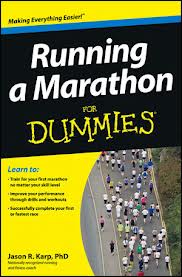
Running a Marathon For Dummies | Book Review

runningamarathonMarathons are hugely popular now. It seems everyone I know is doing one. Although I have yet to join in, this book has made me feel inspired. Unfortunately injuries are rife as people underestimate just how hard it is. Enter Running A Marathon For Dummies. An incredibly informative book which covers everything you could possibly want to know about running a marathon.

What I found particularly interesting was chapter three: Understanding the Physiology of Marathon Running. It tells you all about your heart and what happens when you are running. How the heart pushes blood through your body and how your muscles carry you 26.2 miles. (the length of a marathon) It is completely fascinating and essential knowledge for those serious about running.

The book also has brilliant tests like the one to tell you how high your arch is. It gives you recommendations on what gear to buy. It also tells you how to stay strong and healthy. This book will hopefully make any injuries less common, in fact an entire chapter is dedicated to recognising and avoiding common injuries and also has the treatments in case the worst happens. You will also be educated about your body and what it goes through. It has a good amount of exercises with a step-by-step guide on how to do them.

It also helps you train with running drills, the tools to help you create your own training preparation and it also gives you training programmes. An excellent book for everyone from the beginner to the more experienced. Jason Karp really knows his stuff. I loved this book. An excellent guide.

Running a Marathon For Dummies by Jason Karp,

With record numbers participating in marathons worldwide, whether you are a beginner or an experienced runner, this title provides tips and techniques to help improve stamina, speed and overall health. Taking the reader all the way from sitting on the couch through to their first marathon and beyond, it also contains advice for practiced marathoners as to how to continue improving performance.

Understanding IBS

flickr-3705507804-hdWhat is it?

Dr. Wendy Denning, GP and one of Tatler’s top 150 private doctors for the last three years, explains: “Irritable Bowel Syndrome (IBS) is a sporadic and unpredictable disruption of the digestive system. Everyone suffers the odd upset, but if you regularly experience painful abdominal spasms, bloating, or attacks of constipation or diarrhoea, then you could be suffering from IBS.”


Causes

Dr. Denning, says: “Doctors are not exactly sure what causes IBS, and symptoms can vary in type, frequency and severity from person to person. However the condition can be painful, embarrassing and inconvenient to deal with. IBS occurs when the nerves and muscles of the bowel are not working properly. The bowel can become extra sensitive to pain and easily or frequently upset, and, unfortunately, IBS is a chronic condition – often recurring after long periods of calm.”


Symptoms

  • Abdominal pain and cramping – often relieved by emptying your bowels
  • A change in your bowel habits – such a diarrhoea, constipation, or both
  • Bloating and swelling of your abdomen
  • Excessive wind
  • An urgent need to go to the toilet
  • A feeling that you need to open your bowels even if you have just been to the toilet
  • A feeling you have not fully emptied your bowels
  • Passing mucus from your bottom


Stats

  • IBS affects 15-20% of the population, particularly women aged 20-4
  • 25-50% of all hospital gastroenterology appointments are for IBS
  • Studies have shown that approximately 2/3 of IBS patients have at least one food intolerance and some have multiple intolerances
  • Over 50% of those surveyed* had missed work with almost one quarter of 24-34 year olds taking over a month off
  • 43% reported their IBS impacted their confidence, with 24-34 year olds most severely affected (46%), and well over 1/3 (38%) reported low mood
  • 1 in 10 said that their condition had significantly impacted their love life


Treatments

  • The YorkTest IBS Diet Programme includes analysis reaction to more than 158 different food and drink ingredients. The new programme is specifically designed for IBS sufferers because it provides a personalised list of suitable low FODMAP foods which take into account your food and drink intolerances, the low FODMAP diet has been shown to be effective in reducing IBS symptoms.
  • Eliminate foods that patients are intolerant to
  • Probiotics
  • Eight glasses of water per day
  • Advice on eating + / – digestive enzymes
  • Stress reduction
  • Exercise
  • Glutamine
  • Fish oils
  • Cut down on FODMAP foods


*OnePoll survey of 1,000 IBS sufferers

Peter Dinklage joins Cruelty Free International to call for US ban on animal testing


Peter Dinklage is photographed for Cruelty Free International, sending an appeal across the U.S. to support the global organization committed to ending cosmetic tests on animals

pd1

Following Europe’s cosmetics animal test ban in March, Emmy and Golden Globe award winning actor Peter Dinklage has become an ambassador for Cruelty Free International to call for an end to cosmetics tests on animals in the USA, as part of the non-profit’s mission to end product testing on animals worldwide.
Peter Dinklage, known for his show-stealing role as Tyrion Lannister in Game of Thrones states: “I am so pleased to support Cruelty Free International and be part of the global campaign to end cosmetics tests on animals. It is unacceptable that animals continue to suffer around the world, including the United States of America, for the sake of beauty. I appeal to the USA to follow the European Union’s lead and end animal testing for cosmetics.”

Peter posed in a Cruelty Free International t-shirt to raise awareness of the continued cruel use of animals to test everyday beauty products and toiletries from soap to toothpaste.


Peter Dinklage joins Cruelty Free International celebrity supporters Joss Stone and Global Ambassador Ricky Gervais, who starred in a video launching the global organization last year


Animal tests involve rabbits, guinea pigs, mice and rats who can be injected, gassed, force-fed and killed for cosmetics. Animal tests for new cosmetics are now banned in the European Union and in March, new animal tests for every cosmetic product to be sold in Europe were also brought to an end. This significant historical milestone was achieved after over twenty years of campaigning by Cruelty Free International’s founding organization, the BUAV.


Peter Dinklage and Cruelty Free International are joining forces to bring about a ban in the U.S., following Europe’s lead and moving the U.S. off the global list of countries that still allow animals to be used in painful and fatal test to develop beauty products.


www.crueltyfreeinternational.org/en/around-the-world/usa

Sunday Times Rich List 2013: Who Made The List

SIR PAUL McCARTNEY IS WEALTHIEST MUSIC MILLIONAIRE, WITH £680 MILLION FORTUNE IN 25th ANNIVERSARY SUNDAY TIMES RICH LIST 

ADELE TOPS LIST OF YOUNG MUSIC MILLIONAIRES WITH A £30 MILLION FORTUNE 

McCARTNEY TOPPED 1993 MUSIC RICH LIST, WORTH £400 MILLION, AND HAD £80 MILLION IN 1989 

adele pregnant. tom cruise and kate holmes divorcing. The 25th anniversary Sunday Times Rich List, to be published on April 21, 2013, will reveal that Sir Paul McCartney is the country’s richest performer, topping the list of the 50 wealthiest music millionaires in Britain and Ireland. He has a £680m fortune, which is shared with his wife Nancy Shevell.

McCartney, 70, has topped all the charts for the country’s wealthiest musicians since The Sunday Times Rich List began in 1989, when the former Beatle was worth £80m. By 1993, the McCartney fortune had grown to £400m.

Aside from starring roles at the Queen’s diamond jubilee and closing the opening ceremony for the London Olympics, McCartney’s On the Run tour grossed $57m from 18 dates in 2012. The tour has helped add £15m to his fortune, which, at £680m, includes £150m for wife Nancy Shevell’s stake in her father’s New England Motor Freight trucking operation.

Profits from his hugely successful stage shows, such as Phantom of the Opera, Evita and Cats, have helped to boost composer and theatre owner Lord Lloyd-Webber’s fortune by £30m to keep him in second place in the Music Rich List, worth £620m. Lloyd-Webber also held second place in the 1993 Rich List of the top UK music millionaires with a £200m fortune, ahead of Elton John, who is now worth double his 1993 wealth of £120m.

The Sunday Times only started to measure wealth in Ireland as part of its annual Rich List in 1997.

THE SUNDAY TIMES RICH LIST 2013

THE 50 WEALTHIEST MUSIC MILLIONAIRES IN BRITAIN AND IRELAND

This list excludes music company owners and producers

Music rank2013 Name 2013 wealth 2012 wealth
1 Sir Paul McCartney and Nancy Shevell £680m £665m
2 Lord Lloyd-Webber £620m £590m
3 U2 £520m £514m
4 Sir Elton John £240m £220m
5= David and Victoria Beckham £200m £190m
5= Sir Mick Jagger £200m £190m
7 Michael Flatley £191m £192m
8 Keith Richards £185m £175m
9= Olivia and Dhani Harrison £180m £180m
9= Sting £180m £180m
11 Ringo Starr £160m £160m
12 Roger Waters £150m £120m
13 Sir Tim Rice £149m £144m
14 Sir Tom Jones £145m £140m
15 Eric Clapton £140m £130m
16 Rod Stewart £130m £120m
17 Phil Collins £115m £115m
18= George Michael £105m £100m
18= Robbie Williams £105m £100m
20= David Bowie £100m £100m
20= Ozzy and Sharon Osbourne £100m £95m
22 Brian May £95m £90m
23= Chris Martin and Gwyneth Paltrow £90m £72m
23= Roger Taylor £90m £85m
23= Charlie Watts £90m £85m
26 Enya £87m £86m
27 David Gilmour £85m £85m
28= Jimmy Page £80m £75m
28= Robert Plant £80m £80m
30= John Deacon £74m £70m
30= Noel and Liam Gallagher £74m £65m
32 Pete Townshend £70m £40m
33= Engelbert Humperdinck £65m £65m
33= Mark Knopfler £65m £65m
35= Gary Barlow £60m £50m
35= Barry Gibb £60m New
37 Nick Mason £55m £55m
38 Sir Cliff Richard £52m £52m
39= Guy Berryman £50m £40m
39= Jonny Buckland £50m £40m
39= Will Champion £50m £40m
39= Brian Johnson £50m £50m
39= John Paul Jones £50m £45m
39= Kylie Minogue £50m £45m
39= Van Morrison £50m £50m
46= Jay Kay £45m £40m
46= Bernie Taupin £45m £45m
48= Mick Hucknall £40m £40m
48= Sade £40m £40m
50 Sarah Brightman £36m New


In the 1993 Sunday Times Rich List, Paul McCartney was also Britain’s richest performer with a £400m fortune. There were 15 music millionaires, see below, in the 1993 Rich List which measured the wealth of the 400 richest people in Britain, with David Bowie ranked 15th in the music list worth £20m.

The only two musicians to appear in the first Sunday Times Rich List of 200 names published in 1989 were Paul McCartney, who was worth £80m, and Elton John, with a £40m fortune.


THE SUNDAY TIMES RICH LIST 1993

TOP UK 15 MUSIC MILLIONAIRES

Excluding music company owners and producers

Music rank1993 Name 1993 wealth
1 Paul McCartney £400m
2 Sir Andrew Lloyd Webber £200m
3 Elton John £120m
4 Mick Jagger £90m
5 George Michael £80m
6 Keith Richards £70m
7 Mark Knopfler £60m
8 Cliff Richard £45m
9 Bernard Taupin £35m
10 Dave Stewart £30m
11= George Harrison £25m
11= Rod Stewart £25m
13 Bill Wyman £24m
14 Phil Collins £22m
15 David Bowie £20m


Adele tops the 2013 Young Music Rich List, of entertainers aged 30 and under, see below, with a £30m fortune. With the continued worldwide success of her album 21, this is a 50% increase on the £20m fortune the Oscar-winning singer-songwriter topped the Young Music Rich List with in 2012.

New entries to the Young Music  Millionaires Rich List, each worth £5m, include singer-songwriters Emeli Sandé, aged 26, Ed Sheeran, 22, and all five members of One Direction, Niall Horan, 19, Zayn Malik, 20, Liam Payne, 19, Harry Styles,19, and Louis Tomlinson, 21.

One Direction have become Britain’s richest boy band, with combined wealth of £25m. This puts them just £1m ahead of the combined wealth of the four members of JLS, Jonathan (JB) Gill, 26, Marvin Humes, 28, Aston Merrygold, 25, and Ortisé Williams, 26, who now share a total fortune of £24m, being each worth £6m.


THE SUNDAY TIMES RICH LIST 2013

YOUNG MUSIC MILLIONAIRES IN BRITAIN AND IRELAND

AGED 30 AND UNDER

Music rank2013 Name 2013 wealth 2012 wealth
1 Adele £30m £20m
2 Cheryl Cole £14m £12m
3= Leona Lewis £12m £12m
3= Katie Melua £12m £12m
5 Florence Welch £9m £7m
6= Charlotte Church £8m £8m
6= Jessie J £8m £5m
8= Lily Allen £6m £6m
8= Nadine Coyle £6m £5m
8= Duffy £6m £6m
8= Jonathan (JB) Gill £6m £5m
8= Marvin Humes £6m £5m
8= Aston Merrygold £6m £5m
8= James Morrison £6m £6m
8= Nicola Roberts £6m £5m
8= Oritsé Williams £6m £5m
17= Niall Horan £5m New
17= Zayn Malik £5m New
17= Liam Payne £5m New
17= Emeli Sandé £5m New
17= Ed Sheeran £5m New
17= Harry Styles £5m New
17= Louis Tomlinson £5m New


The 25th annual Sunday Times Rich List – the definitive guide to wealth in Britain and Ireland – is published on April 21 in a special 104-page supplement, which profiles the 1,000 richest people and families in the UK and the wealthiest 250 in Ireland. The list is based on identifiable wealth, including land, property, other assets such as art and racehorses, or significant shares in publicly quoted companies. It excludes bank accounts, to which the paper has no access. This year, a £75m fortune is required to make it into the top 1,000 in the Rich List.

The Sunday Times Rich List 2013 is compiled by Philip Beresford, the leading authority on British wealth, and edited by Ian Coxon.

The Sunday Times Rich List

Economics of crowd-sourcing under spotlight

A team headed by an economist at the University of Portsmouth has won £750,000 to establish why people give up their time to help scientists better understand some of the biggest mysteries, from searching for the cure for cancer to trying to understand the galaxies that fill our Universe.

Dr Joe Cox, of the Portsmouth Business School, will lead a team from Oxford, Manchester and Leeds Universities and colleagues from Portsmouth’s world-leading Institute of Cosmology and Gravitation, to find out more about the people who volunteer to help online science projects.

The grant for the three-year project was awarded by the Engineering and Physical Sciences Research Council (EPSRC) as part of the Research Councils UK digital economy theme.

Dr Cox said: “Hundreds of thousands of people all over the world are giving their time to help find a cure for cancer, or to better understand the nature of the Universe, or patterns of global warming, but we don’t yet have a detailed understanding of the processes that drive these initiatives, which are more complex than they may first appear.

“The growth of the digital economy has dramatically affected the ways people interact with each other and engage in different activities, but little is known about the changing nature of volunteering and crowd-sourcing in this context.

“This grant will allow us to formulate new economic models to explain the choices, motivations and behaviours of digital volunteers.”

The project will also investigate ways in which volunteering can be optimised and sustained through strategic interactions and interventions on the part of the managers of these resources.

Dr Cox will be working with Dr Karen Masters of the Institute of Cosmology and Gravitation at Portsmouth to study the Zooniverse (www.zooniverse.org), a highly successful and diverse cluster of online citizen science and crowd-sourcing projects inspired by the success of Galaxy Zoo and now includes more than 20 projects including  Cell Slider  and Seafloor Explorer. Volunteers on these initiatives give up their time to interpret and classify data of scientific interest, ranging from images of distant galaxies to weather patterns and cancer cells.

Dr Masters is project scientist for Galaxy Zoo.

She said: “We hope this grant win will help us to understand how to improve the volunteer experience on Zooniverse projects so that people can feel confident they are contributing to real science when they spend time on our sites, and also gain the maximum enjoyment from the experience.”

Dr Cox said: “Technology has made it possible for the average person on the street to make a real contribution towards our understanding of the universe, the modelling of climate change and the development of a cure for cancer.

“Our research will show how these initiatives can encourage more people to volunteer, as well as enhancing the depth of their engagement, which will help to push the boundaries of scientific knowledge and create significant social value.”

The findings will be of “considerable interest” to web communities and the broader voluntary sector, he said, and is likely to also have significant implications for commercial projects that make use of crowd-sourcing, such as Amazon’s Mechanical Turk.

The research partners include Dr Chris Lintott, Oxford University, Dr Anita Greenhill, University of Manchester, and Dr Gary Graham, University of Leeds.

Shameless Q and A with Jody Latham

LIP Shameless BG _A2Jody Latham talks about reprising his role as Lip Gallagher in the final series of Shameless. Episode 8 will be broadcast on Tuesday 16th April at 10pm on Channel 4.

How important has Shameless been to you in the context of your career?

Oh wow! It’s been a massive part of my career. I’ve been acting for 15 years, and I was first involved with Shameless ten years ago. I was the first person ever cast on the show. In fact, I was the first person ever to be seen for the show, weeks and weeks before we started shooting. I’d been working for a few years before I started Shameless, but it was the biggest thing that I’d done. It put me out there. It’s opened the door for many other opportunities as well. It’s so true to life, people can relate to it. And it set the example for so many other shows to follow. It’s been a huge privilege to be part of it.

When you were started on the show you were only 20 years old. Do you feel that you learned quite a lot in those early years?

Yeah. 20-years-old is considered quite young. I was just out of my teens, living in Manchester, on my own in an apartment, for the first time. I was a kid at the time. Now I’m about to be 30 years old. So in that time I’ve grown as an actor, as a person, as a father, as a man. I hope I’ve grown up quite a lot since I started on Shameless. It’s been a massive part of my life, not just in career terms. I’ve lived and breathed it. I’ve done high profile shows like EastEnders, The Fixer, I’ve made music videos with Tulisa, and yet 99 per cent of the people who recognise me do so because of Shameless. It’s always about Lip and Shameless, even now. A couple of years ago, when I’d been out of the show for a while, I found it a bit annoying, but then I thought “You know what? Shameless is a massive institution in people’s lives.” Some people have grown up with it – watching it aged 10 or 11, in their bedroom when they’re not supposed to – and they’re now 19 or 20. I do get people coming up to me saying they used to watch it in their rooms with headphones on because their parents wouldn’t let them see it.

When did you begin to realise you were in a show that was going to be a success?

To be honest, I knew from reading the script. I knew what Paul Abbott was capable of. I knew how massively respected he was even before Shameless transmitted – he’d been involved in The Lakes, Clocking Off, Band of Gold, all these massive shows. Everything he touched seemed to turn to gold, so I knew it was going to be huge. I read it and knew how controversial it was – storylines about gay 15-year-olds and that. Right from reading the scripts with all these huge storylines going on, I just knew it was going to be massive from day one. It was naughty and controversial and artistically brilliant.

When you were in the show originally, you filmed a lot with Gerard Kearns (who played Ian). Did you form a close relationship?

Yeah, we did. We were into similar music and similar films, and we came from quite similar backgrounds. We were also both strong, opinionated characters. We were definitely close, and I still speak to him every now and again. And I’ve got a massive amount of respect for him as an actor, and as a father, and with how he’s done in his career. He started off in amateur dramatics, like me, with no formal training, and he’s straight in there, doing it, and doing a really good job. That was the thing about Shameless, the younger members of the cast were all just raw talent, nobody had been trained. I think it may have been Gerard’s first ever part. It was all about finding new faces, no star names, making it seem more real. And it made stars out of the cast – Ann-Marie Duff, James McAvoy, Dean Lennox Kelly, Maxine Peake. Me! [Laughs uproariously]. Being in a show like that has allowed us to go on and make good, strong British dramas, and in some cases films – even blockbuster films, with McAvoy! So we’ve all done really well out of it.

There’s now a US version of the series. Have you seen it?

I watched the first couple of them, yeah. It was really weird! It was interesting, seeing it set in a different environment, but it was literally word for word the same as the English version, and I just found that really bizarre. I believe it’s a huge success over there, particularly the second series.

Why did you decide to go back for the last series of Shameless?

Because they asked me! I’d shared my desires to go back and do a little bit more, and they came back to me with an idea, and we just thought “Yeah, let’s do it.”

What’s it been like, being back?

Brilliant. It was quite emotional. It’s been five or six years since I’ve been there, so it was a real trip down memory lane. One irony was that the first scene I shot when I was back in the studio was exactly where I’d shot my last ever scenes when I left. So that was quite random.

Are a lot of the same faces still there, among the cast and crew?

The crew’s almost completely different – there’s a few from the original, but not many. But in terms of the cast, there’s quite a lot of the old gang there. It didn’t feel unfamiliar, put it that way.

Are any of the other old cast members coming back?

Yes!

What’s happened to Lip since we last saw him?

I don’t know how much I can tell you. But Lip and Frank basically bump into each other on the street. Frank quickly discovers that this might be where Lip actually lives. So it turns out that Lip could be a lot closer to Chatsworth than everyone was led to believe. I think I can say that without giving the game away.

Lastly, how much of you is there in Lip? Are you like him?

I don’t think so, not really. When I was younger, I liked to think I was clever, and I liked to think I was popular with the girls, but I’ve grown up a lot now. I’m not as cocky as I used to be!

Interview courtesy of Channel 4

The Sunday Times Rich List 2013

Roman_Abramovich_wins court battleIt seems that whether you become rich really is in the stars. Apparently Gemini’s are more likely to become rich according to The Sunday Times.

HOROSCOPE WEALTH LEAGUE TABLE

The star signs of the 1,000 richest people in Britain


Gemini              9.9%

Capricorn          9.6%

Aries                 9.4%

Taurus              8.9%

Leo                   8.6%

Sagittarius          8.2%

Cancer              8.0%

Pisces                7.9%

Libra                 7.8%

Aquarius            7.7%

Virgo                 7.5%

Scorpio              6.5%


People born under the star sign Gemini – between May 22 and June 21 – have the best chance of making a fortune, according to the 25th anniversary edition of The Sunday Times Rich List. Just under 10% of the 1,000 richest people in Britain are Geminis, the Rich List will reveal when it is published on Sunday April 21.


The survey found that the richest Geminis include diamond billionaires Nicky Oppenheimer, 67, and Laurence Graff, 74, performers Sir Tom Jones, 72, and Sir Paul McCartney, 70, Slavica Ecclestone, 54, the ex-wife of Forumula One chief Bernie, and 37-year-old TV chef Jamie Oliver.


Eighty-two-year old motor racing billionaire Bernie Ecclestone and Nancy Shevell, McCartney’s third wife, were both born between October 24 and November 22 under Scorpio, the star sign that is least likely to bring huge wealth. However, Shevell has her own personal fortune from a stake in her family’s transport business in the US. Another Scorpio billionaire is the Chelsea Football Club owner, 46-year-old Roman Abramovich. Jamie Oliver’s, wife Jools, 38, was born in November under the sign of Sagittarius, which accounts for 8.2% of the people in Britain’s richest 1,000 this year.


Geminis have topped the Rich List horoscope league for three years in a row, with Capricorn and Aries just behind in second and third places. The Duke of Westminster, 61, Britain’s wealthiest landowner, heads the list of the people born under Capricorn, between December 22 and January 20. Ireland’s richest woman, Hilary Weston, 71, was also born under Capricorn. The Rich List millionaires born under the sign of Aries, between March 21 and April 20 include Lord Sugar, 66, Lord Lloyd-Webber, 65, Sir Elton John, 66, Irish telecoms billionaire Denis O’Brien, 55, and 62-year-old bookmaker Victor Chandler.


The Sunday Times Rich List, first published in 1989, is the definitive guide to wealth in Britain and Ireland.


Katy Perry teams up with UNICEF and visits children in Madagascar

Beautiful and talented singer/songwriter Katy Perry has visited Madagascar to bring attention to the situation of children in the tropical island country, one of the poorest in the world and still recovering from a political crisis that began in 2009.


“In less than one week here in Madagascar, I went from crowded city slums to the most remote villages and my eyes were widely opened by the incredible need for a healthy life – nutrition, sanitation, and protection against rape and abuse – which UNICEF are stepping in to help provide,” Perry said.

NYHQ2013-0166 NYHQ2013-0174


“I am grateful to UNICEF for giving me the opportunity to see first-hand how their programmes make a real difference in children’s lives. Support for UNICEF is saving children, I am a witness to it.”

On her first visit in support of UNICEF, Perry saw a full range of programmes, from education, nutrition, health and child protection to water, sanitation and hygiene.

Beginning her trip in a slum area of the capital Antananarivo, she visited a child protection centre and met abused and abandoned children and young mothers receiving support and counseling. More than three out of four children in Madagascar live in extreme poverty, making them vulnerable to exploitation.

Most international donors have frozen development aid following the 2009 crisis, forcing the government to make drastic cuts in public spending and resulting in large parts of the population not having access to basic health care and primary education. Perry visited a UNICEF supported pre-school and a primary school built to enable children to go back to school.

At the Sahavola pre-school, 117 boys and girls between the ages of 3 and 6 receive a quality early education and learn the importance of thinking creatively and working collaboratively. They are also encouraged to participate in health and hygiene practices at an early age. To promote proper hygiene and sanitation, UNICEF constructed latrines and sinks at the pre-school, where Perry took in hand washing with the children.

The old village primary school, made from sticks and with a thatched roof, was destroyed by one of the tropical cyclones that hit the island every year. It was replaced by UNICEF with a solid, cyclone-resistant building.


Schooling rates in Madagascar are alarmingly low. Only three children out of every 10 who start primary school complete the cycle. Two-thirds of teachers have not received any formal training.


UNICEF and national school authorities are working to improve the situation through school construction and providing learning materials, training for teachers and supporting community action plans for education.

“An education is an incredible opportunity here. I visited a very remote community, where children and teachers walk for 45 minutes just to get to school. This is a testament to how appreciative they are about their education,” said Perry in the UNICEF- supported primary school in the village of Ampihaonana.

In the nutrition centre in Androranga village, Perry learned about UNICEF’s efforts to tackle another serious problem of the country – chronic malnutrition. Half the children in Madagascar are chronically malnourished, putting the country among the six worst in the world for chronic malnutrition.


Poor maternal nutrition, poor feeding practices and poor food quality contribute to the failure of these children to reach their full potential mentally and physically. The centre, run by a community health worker, identifies cases and works with village mothers to improve children’s nutrition, including focusing on the importance of exclusive breastfeeding during the first six months of a child’s life.