Criminology: A Very Short Introduction

criminology

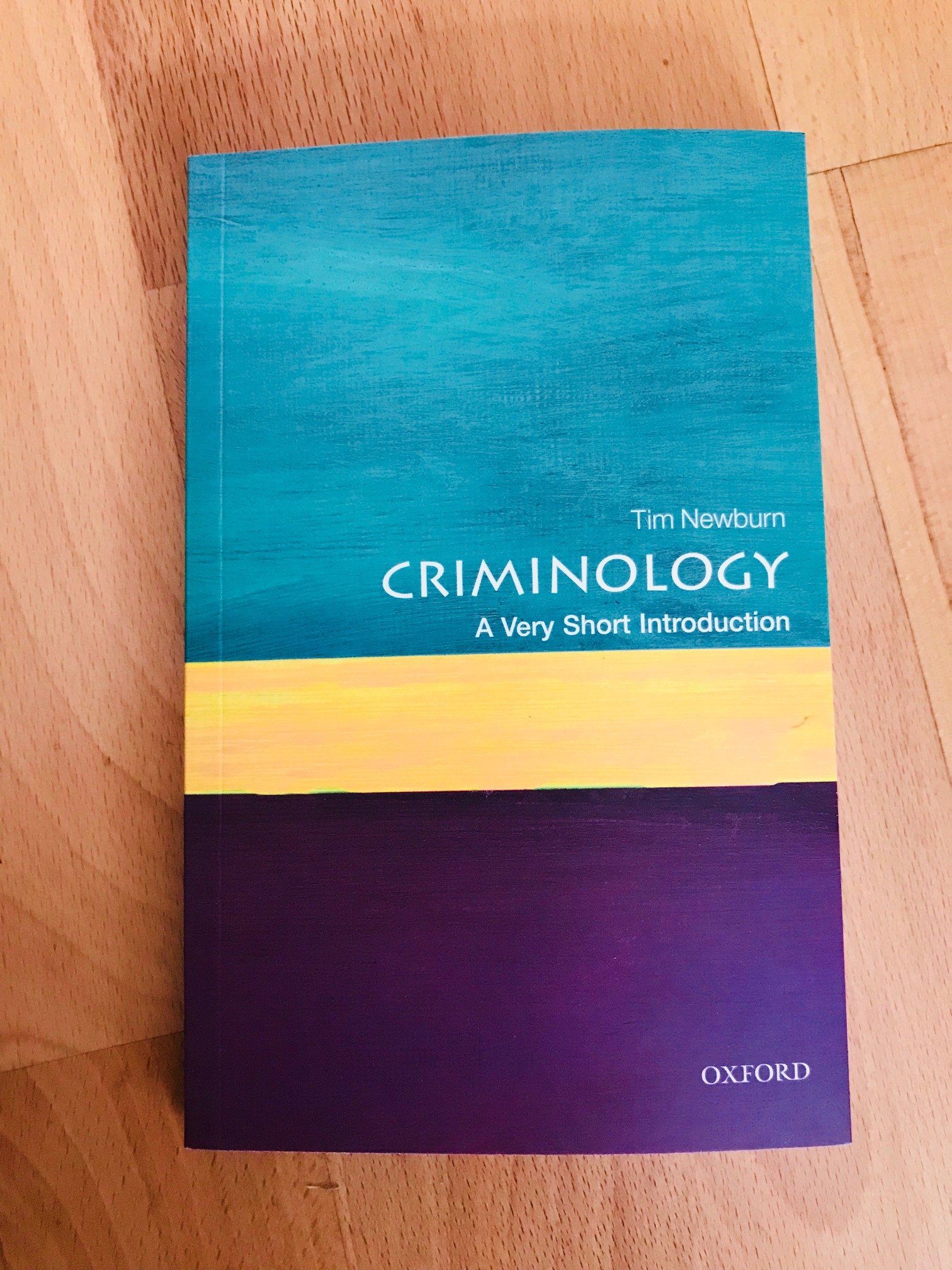
These Very Short Introduction books are a great way to learn about hundreds of different subjects in an in-depth way. This one on criminology is fascinating stuff. Perfectly written and endlessly fascinating. Essential reading for anyone interested in crime.

Crime is big news. From murder to theft to drug gangs, crime and criminal justice affect the lives of millions of people worldwide. Hardly surprisingly, crime has been pushed high up the public policy agenda across the world. But how can we measure crime, or evaluate the effectiveness of preventative measures? Does the threat of prison reduce someone’s likelihood of reoffending, or would rehabilitation be more constructive?

In this Very Short Introduction Tim Newburn considers how we can study trends in crime, and use them to inform preventative policy and criminal justice. Analysing the history of the subject, he reflects on our understanding of crime and responses to crime in earlier historical periods. Considering trends in crime in the developed world, Newburn discusses its causes, exploring the relationship between drugs and crime, analysing what we know about why people stop offending, and looking
at both formal and informal responses to crime. Newburn concludes by discussing what role criminology can plausibly be anticipated to have in crime control and politics, and what its limits are.

ABOUT THE SERIES: The Very Short Introductions series from Oxford University Press contains hundreds of titles in almost every subject area. These pocket-sized books are the perfect way to get ahead in a new subject quickly. Our expert authors combine facts, analysis, perspective, new ideas, and enthusiasm to make interesting and challenging topics highly readable.

Available here.

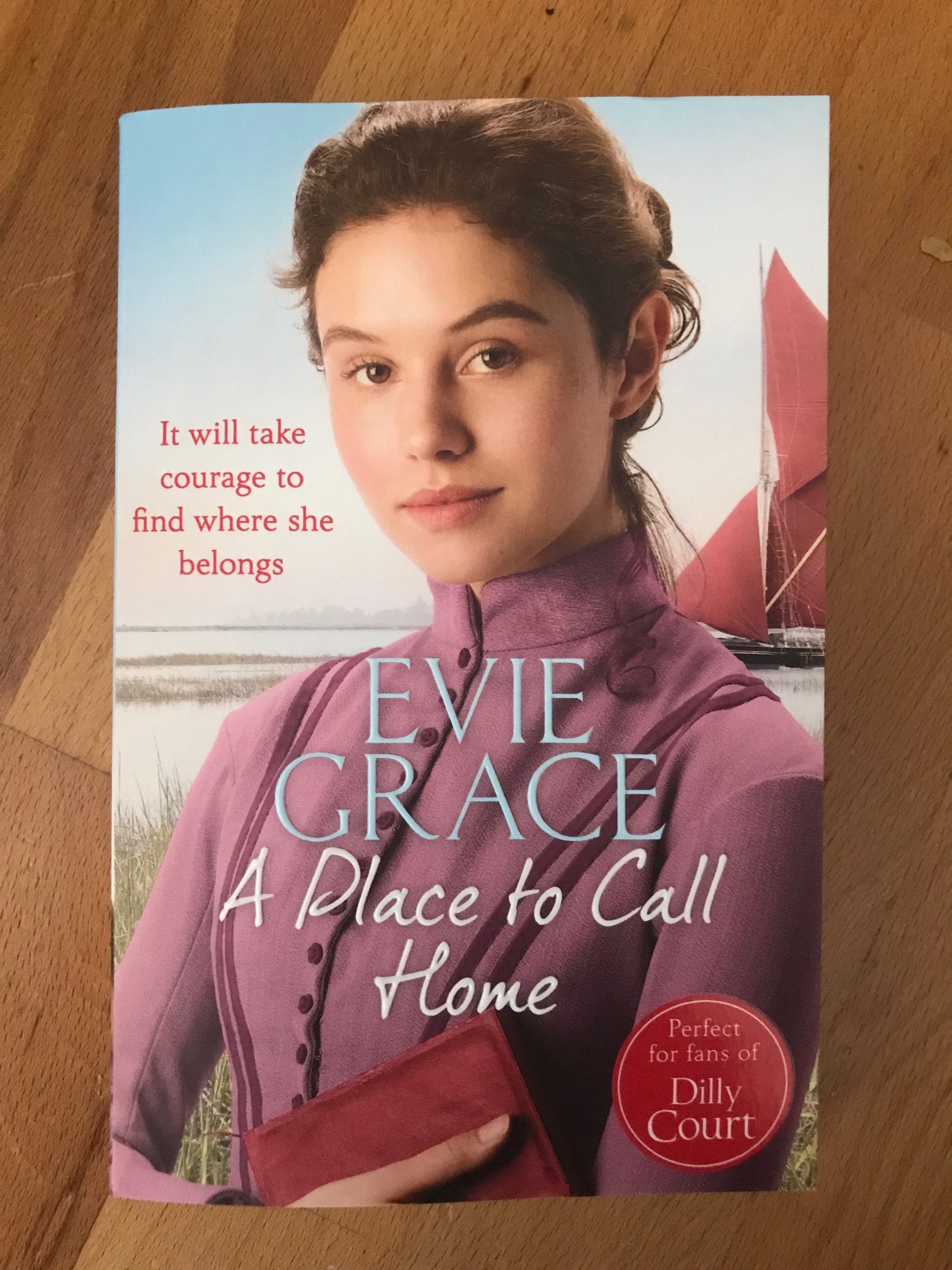
A Place To Call Home By Evie Grace | Recommended Reads

a place to call homeA perfect conclusion to this riveting saga. Get a cup of tea and dig in. The book equivalent to a great Sunday night drama.

THE THIRD AND FINAL SAGA IN EVIE GRACE’S MAIDS OF KENT TRILOGY.

East Kent, 1876

With doting parents and siblings she adores, sixteen-year-old Rose Cheevers leads a contented life at Willow Place in Canterbury. A bright future ahead of her, she dreams of following in her mother’s footsteps and becoming a teacher.

Then one traumatic day turns the Cheevers’ household upside-down. What was once a safe haven has become a place of peril, and Rose is forced to flee with the younger children. Desperate, she seeks refuge in a remote village with a long lost grandmother who did not know she existed.

But safety comes at a price, and the arrival of a young stranger with connections to her past raises uncomfortable questions about what the future holds. Somehow, Rose must find the strength to keep her family together. Above all else, though, she needs a place to call home.

Available here.

BUSINESS OF BOOKS: FIRST, LAST, EVERYTHING – MAGAZINE FICTION WRITER WENDY CLARKE

My very first piece of writing advice wasn’t from a writer or about writing but it was advice that would one day help me in my writing career. I was twenty-two and had just taken up my first teaching position at a junior school with open-plan classrooms divided only by bookcases. Being very new to teaching, and still finding my feet (or my voice, if you like), I was always looking for ways to make my teaching more effective. In the classroom area next to mine was a more experienced teacher who, because of the way the classrooms were laid out, could easily be heard. I was impressed with her control of the class and the attention the children gave her. Realising it was something in her voice (her tone, her inflection, her choice of words) I decided that if I copied her style of teaching, I too would achieve success. How naïve! Of course, it was a disaster – a bit like being on stage and being cast in the wrong role.

Back in the staffroom at break time, the teacher I’d been trying to copy could tell something was wrong. When I told her what had happened, she was very kind, sitting me down and making me a coffee before telling me that no two teachers taught in the same way and the children wouldn’t expect them to. In time I would find my own voice. One that I felt comfortable with. One that would be true to me. When I started writing for magazines, I remembered this advice. I didn’t try to copy the style of any other authors, I just wrote stories I loved – in my own way. My first sale came quickly and I have that teacher to thank!

The most recent piece of writing advice I received was from the writing community on social media. It was during a period when I had become disillusioned with the long and tortuous road you needed to travel in order to get your novel published. With magazine writing, you write a story, sub it, forget about it and start on another. There is no middle man (the agent) and, because I have several stories being considered at one time, it feels as though things are always happening. With a novel, you submit to agents and then wait, sometimes many months, for the inevitable rejection. Even if an agent requests the full manuscript (which happened to me six times) it can be months before hearing anything… if at all. In fact, I am still waiting. The readers of my Facebook post heard my sorry tale. Their advice was to submit directly to the publishers who accept manuscripts without the need of an agent. I did and it’s the best advice I could have been given.

Finally, the piece of advice I’d like to pass on is easy. Be kind to yourself. Set reasonable goals (if that’s the type of writer you are) and don’t beat yourself up if you don’t manage to achieve them. Also have breaks from your writing. If I go on holiday, I leave my writing equipment behind. The rest recharges my battery and helps me put my writing into perspective. This doesn’t mean that my brain isn’t still working behind the scenes though. Often, when I switch off from writing, an idea for a story, or the answer to a difficult plot problem, will float into my head as if from nowhere. Writing isn’t something to be forced but to be enjoyed and, if it isn’t, maybe it’s time to ask ourselves why we’re doing it.


Wendy Clarke has had over two hundred short stories, and two serials, published in national women’s magazines such as The People’s Friend, Take a Break Fiction Feast and Woman’s Weekly. She lives with her husband in Sussex and has just finished writing her debut novel.


https://wendyswritingnow.blogspot.com/

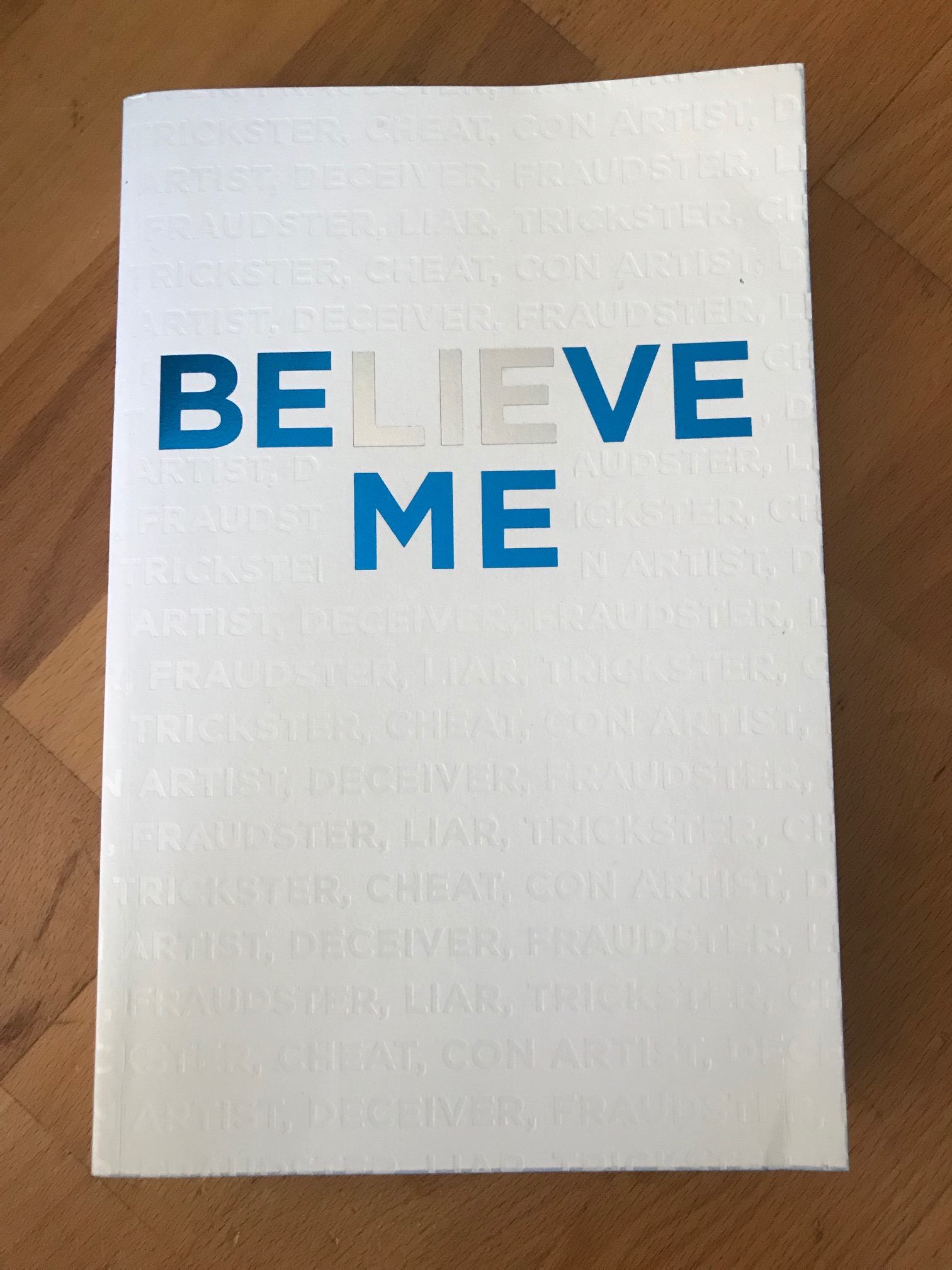
Believe Me By J P Delaney | Book of The Week

believe me JP Delaney

I found it impossible to book this book down. I do not even read much crime thrillers as I get upset about the high female body count, but this book is so well done and does not feel gratuitous. Despite the horror of the crimes. If your love Gillian Flynn and Paula Hawkins you will love this. A pitch perfect psychological thriller.

A British drama student, in New York without a green card, Claire takes the only job she can get: working for a firm of divorce lawyers, posing as an easy pick-up in hotel bars to entrap straying husbands.

When one of her targets becomes the subject of a murder investigation, the police ask Claire to use her acting skills to help lure their suspect into a confession. But right from the start, she has doubts about the part she’s being asked to play. Is Patrick Fogler really a killer . . . Or the only decent husband she’s ever met? And is there more to this set-up than she’s being told?

And that’s when Claire realises she’s playing the deadliest role of her life . . .

Available here.

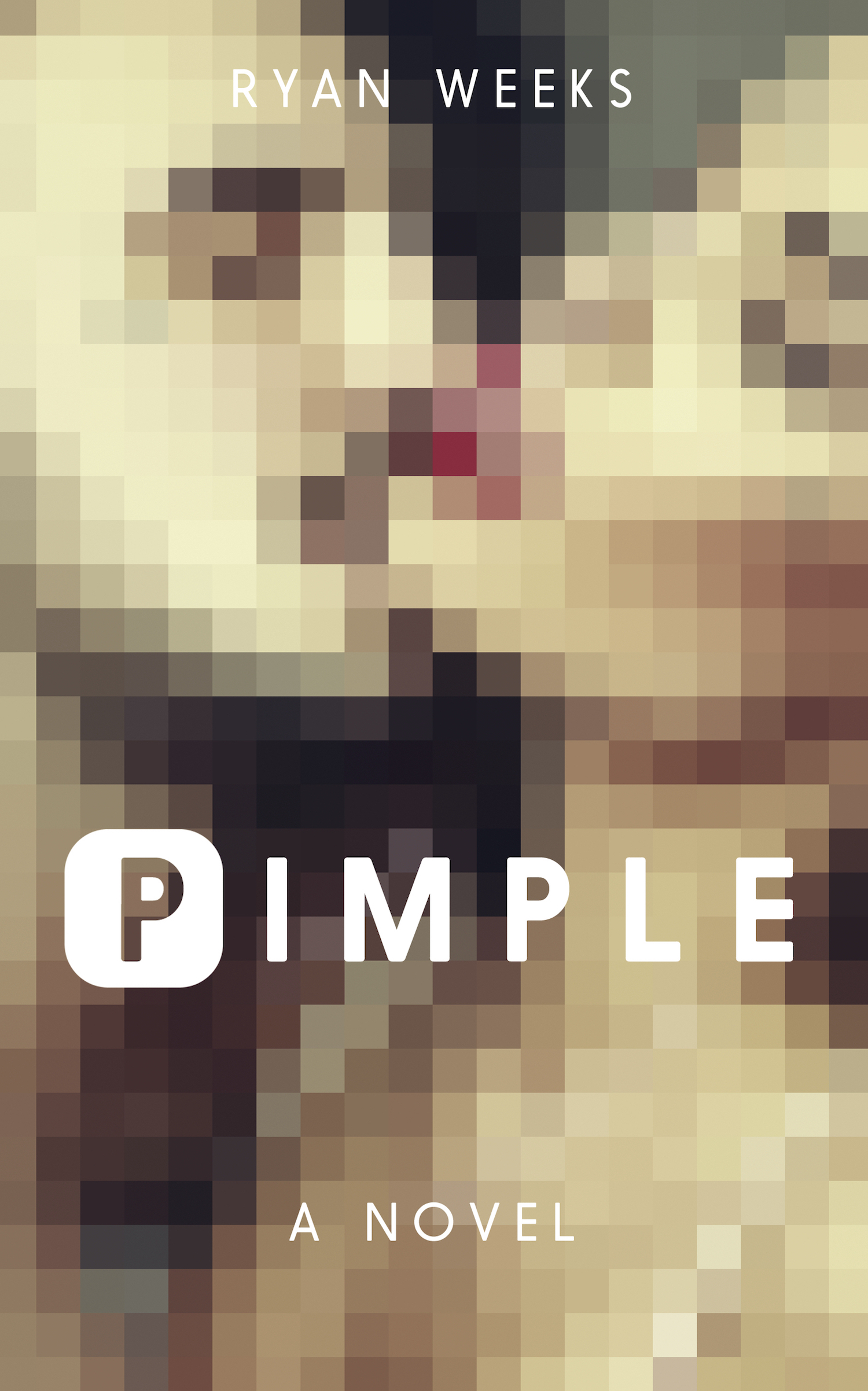
Book Review: Pimple, by Ryan Weeks

Ryan Weeks’ debut novel paints a disturbing picture of the sex industry fuelled not by drugs and organised crime but by download speed.
By Lucy Bryson for Frost Magazine
With shades of Black Mirror, the hit Netflix series, Pimple is a brave debut novel by the tech journalist, Ryan Weeks. In it, he transports us – hopefully for the first time – to London’s underworld where pimps, prostitutes and criminals abound. It explores what would happen if this shady cast of characters were thrust in the neon glare of the internet and the impact of ‘disruptive technology on society.

Pimple sees tech insiders take on the sex industry by creating an app that puts sex workers and clients directly in touch with one another, Uber-style.
With an insider knowledge drawn from his years as a mover and shaker within the world of ‘FinTech’ (or financial technology), Weeks casts a sideways glance at the buzz terms and behaviour of those involved in game-changing tech but isn’t afraid to confront tough questions about accountability.

The sex industry is a controversial subject to cover, and it’s very much to the author’s credit that Pimple doesn’t descend into tawdry imaginings of sexual encounters. Rather, it’s a thoughtful and stylishly-written novel that looks at the lives of four very different people – Annie, the tech-savvy young woman who creates the app; Elena the sex worker that signs up for what she hopes will be a safer and more profitable way of doing; Emerson, a disgusting pimp who violently object to the loss of income; and the police officers enforcing the laws that ban prostitutes and pimps from plying their trade.

Annie, the book’s main character, is a techy-savvy millennial looking for a new challenge after her financial start-up is bought out by a High Street bank. Looking for something morally rewarding, she begins to imagine ways in which she could use technology to stem a rise in violent crime against female sex workers in the city. With the help of close friend Veronica, she develops a revolutionary new app that is to throw an already dangerous situation into chaos.


The first chapters of the book outline the women’s attempts to launch the app on the street worker scene, and before long prostitutes begin to sign up in their droves – accustomed as they are to the abusive pimps, these vulnerable women find themselves suddenly in a more powerful position. Able to pick and choose her clients (rated on a 1-5 scale, as are the prostitutes) and her rates, Annie feels a cautious sense of liberation and independence. But neither the pimps nor the police are happy, and events spiral dangerously out of control, as several fraught chapters lead to a violent conclusion.

This is not a book that will appeal to all tastes. The stylised language sounds a little forced at times – particularly in the dialogue between Annie and Veronica – and some readers will baulk at the idea of a book about Millennials and their ‘tech-talk’. But Weeks is unafraid to poke fun at his own generation and its presumed pretentiousness, making this a more humorous read than the subject matter may suggest.

Weeks succeeds in conveying a sense of impending doom, and fans of the thriller genre will find a lot to enjoy here; the book crams a lot of tension, twists and turns into little over 200 pages.

But Weeks also poses some challenging questions about sexual exploitation and the impact of technology on society – questions which readers are likely to be pondering long after they’ve put the book down.

Ryan Weeks is the editor of AltFi.com, one of the leading news and intelligence resources for ‘fintech’ (financial technology) in the UK. Pimple, explores the dramatic consequences of technological disruption. It is out now through Amazon UK priced £10.99 in paperback and 99p in ebook.

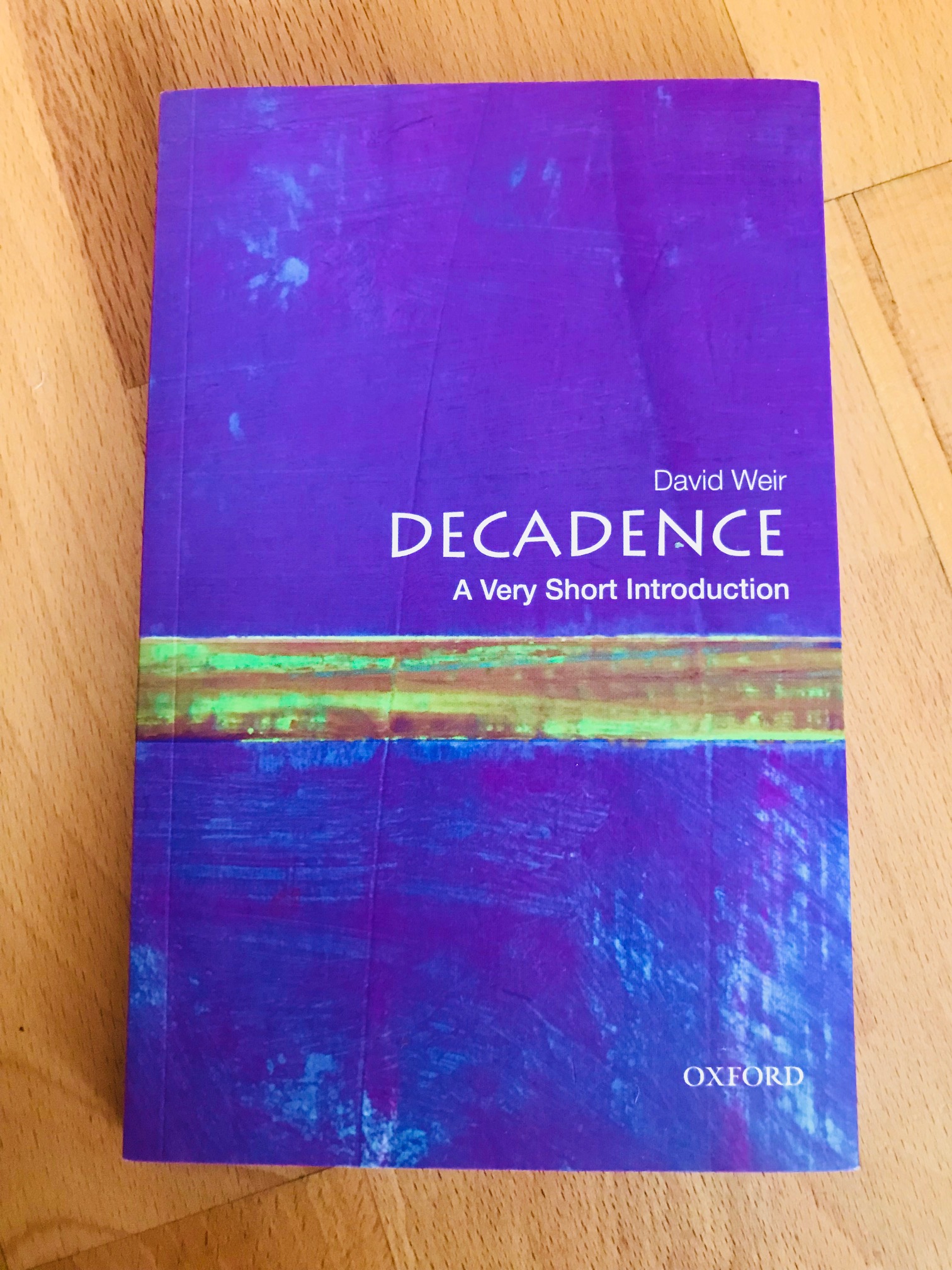
Decadence: A Very Short Introduction By David Weir

A great short read on decadence. A real eye opener which makes you think. We loved it.

The history of decadent culture runs from ancient Rome to nineteenth-century Paris, Victorian London, fin de siècle Vienna, Weimar Berlin, and beyond. The decline of Rome provides the pattern for both aesthetic and social decadence, a pattern that artists and writers in the nineteenth century imitated, emulated, parodied, and otherwise manipulated for aesthetic gain. What begins as the moral condemnation of modernity in mid-nineteenth century France on the part of decadent authors such as Charles Baudelaire ends up as the perverse celebration of the pessimism that accompanies imperial decline. This delight in decline informs the rich canon of decadence that runs from Joris-Karl Huysmans’s À Rebours to Oscar Wilde’s The Picture of Dorian Gray, Aubrey Beardsley’s drawings, Gustav Klimt’s paintings, and numerous other works.

In this Very Short Introduction, David Weir explores the conflicting attitudes towards modernity present in decadent culture by examining the difference between aesthetic decadence–the excess of artifice–and social decadence, which involves excess in a variety of forms, whether perversely pleasurable or gratuitously cruel. Such contrariness between aesthetic and social decadence led some of its practitioners to substitute art for life and to stress the importance of taste over morality, a maneuver with far-reaching consequences, especially as decadence enters the realm of popular culture today.

ABOUT THE SERIES: The Very Short Introductions series from Oxford University Press contains hundreds of titles in almost every subject area. These pocket-sized books are the perfect way to get ahead in a new subject quickly. Our expert authors combine facts, analysis, perspective, new ideas, and enthusiasm to make interesting and challenging topics highly readable.

Decadence: A Very Short Introduction is available here.


Necessary Evil: How to Fix Finance by Saving Human Rights | Book of The Week

necessary evil finance

When I first received this book I worried it might be bias. There was no need. It is well researched and balanced. Full of fascinating facts and persuasive argument. A compelling and thoughtful read.

Finance is the evil we cannot live without. It governs almost every aspect of our lives and has the power to liberate as well as enslave. With the world’s total financial assets–valued at a staggering $300 trillion–being four times larger than the combined output of all the world’s economies, there is, apparently, plenty to go around. Yet, while proponents of finance-driven capitalism point to the trickle-down effect as its contribution to wealth redistribution, there are still nearly a billion people across the globe existing on less than $2 a day; 14 percent of Americans are living below the official poverty line; and disparities in wealth equality everywhere have reached unprecedented levels. Evidently a trickle is not enough.

How can this be when so much wealth abounds, and when finance is supposedly chastened and reformed after its latest global crisis? How, especially, can it be in an age when human rights are more loudly proclaimed than ever before? Can the financial sector be made to shoulder more of the burden of spreading wealth, reducing poverty, and protecting rights? And if so, what role can human rights play in making it happen?

In answering these questions, David Kinley draws on a vast array of material from bankers, economists, lawyers, and politicians, as well as human rights activists, philosophers, historians and anthropologists, alongside his own experiences working in the field. Necessary Evil shows how finance can shed its conceit, return to its role as the economy’s servant not its master, and regain the public trust and credibility it has so spectacularly lost over the past decade–all by helping human rights, not harming them.

Available here.

TAKE FOUR WRITERS: TEACHING, THANKING, VENTURING, BOPPING

CLAIRE DYER… TEACHING

This month I want to talk about what teaching teaches me. Like many other authors I don’t actually spend ALL my time sitting in splendid isolation in a writing garret. In fact, I spend precious little time actually writing, as life tends to get in the way!

And, one such distraction is teaching Creative Writing at Bracknell & Wokingham College. Whilst I relish the chance to encourage and inform my students, what is of perhaps greater benefit to me is the chance to practise what I preach. In my Beginners’ classes we cover the basics tools of writing and in my Improvers and Advanced classes, we take this up a notch. And what I find is that in teaching these topics I get a timely reminder to apply the techniques we cover to my own writing.

I also give my students examples of my early work to critique and this shows me how awful some of the stuff I used to produce actually was! A salutary reminder to keep the writing muscle flexed and working and mark my own writing much as a teacher would: 6 out 10 Claire, could do better. See me after class!


LUCY COLEMAN…. THANKING

It’s been a month in which to be very grateful and to say thanks, by running a series of competitions for my amazing readers.

With Lucy Coleman’s ‘The French Adventure’ wearing best seller flags in the Holiday Romance charts in Australia and Canada, hitting #53 in the main UK Kindle chart, and #1 in the iBooks Romance chart, I did celebrate.

One glass of wine, toasted by my other half, then straight back to work because it’s been a month of non-stop writing.

Next up? 4th September 2018 Lucy’s second novel will be released. Still no cover and the excitement builds… but I can share the title for the FIRST time: ‘Snowflakes Over Holly Cove’.

My Christmas stories are never solely about Christmas, but this one has a dusting of snow and a lot of heart. And it was written last summer, but it wasn’t quite as hot as this July!


ANGELA PETCH… VENTURING

Writers live within their heads most of the time, amongst imagined scenes and characters. In Italy, far from distractions, I have plenty of time to dream up plots and conflicts. But sometimes, like a tortoise, I need to pop my head out of my carapace and venture into the real world.

So, last week I boarded a plane from Bologna for Leeds and my first RNA Conference. All apprehensions were swept away as soon as I entered Leeds Trinity University and was warmly welcomed. It was a buzzing weekend, packed with interesting and sometimes hilarious talks (how to write sex scenes foremost), food and wine a-plenty and many new friendships. How good it was to talk writing without the fear of boring non-writers. I pitched to three different publishers and came away from Bookouture and Harper Collins with encouraging advice.

Back in Sussex, I joined self-published fellow CHINDI authors as we held our ghost tour around the fascinating seaside town of Littlehampton.

This tortoise is almost ready to retreat again. But first of all, I have granny duties. Our fifth grandchild is due any day now. I feel a children’s story coming on.


JACKIE BALDWIN… BOPPING

Hello again! The first half of this month I spent in Greece hiking, swimming and reading books, which was a welcome change. A few days after I returned it was time to go to Harrogate Crime Festival! I was also lucky enough to be invited to read at Noir at the Bar on the Thursday evening along with some amazing authors. The venue at The Blues Bar was packed with readers, writers and bloggers so the audience was amazing!

Highlights of the festival for me included hearing John Grisham interviewed by Lee Child and bopping away to ‘Fun Lovin’ Crime Writers,’ including Val McDermid and Mark Billingham, I also loved the New Blood panel. I shall be sneaking new books into the house the way other women sneak in shoes!

I had such a great time that I have already paid a deposit for next year!