Jacqueline Waggett PacaPod Founder Interview

We interviewed Jacqueline Waggett, founder of the amazing PacaPod changing bags. A must for all parents.

PacaPodfounder sketch

How did you come up with idea of the PacaPod?

I never even had a baby bag, I created a mock-up first PacaPod with different bags inside and thought this was a really good solution to getting out the house quickly when you had a precious window of opportunity between feeds, sleep, changes!


What makes it different?

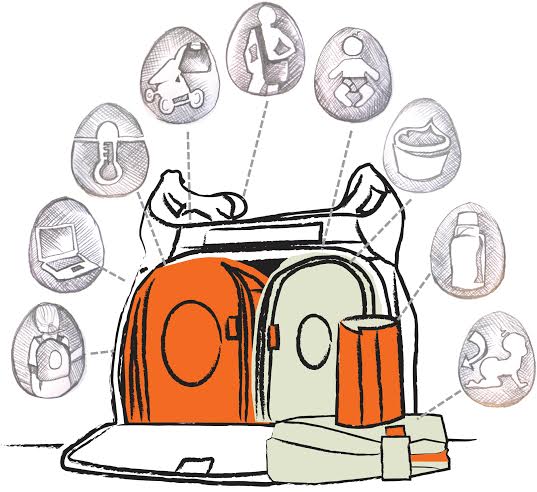
PacaPod bags contain a unique ‘baby organisation system’ with two detachable pods to store feeding and changing items which keeps them hygienically apart and organised so there’s no panic rummaging for lost wipes or dummy. All three elements can be used on their own, clip onto a buggy and great for sharing with a partner, travelling or dropping at nursery – it’s very versatile and more than a bag it’s a toolkit for parents.


Was it hard getting the design right?

I held “focus groups” – basically having a bunch on my new found NCT friends around for a coffee and asking them to bring their changing bags with them and tell me what they loved and hated about them. The passion these ladies had about their bags just blew me away and I realised that everyone had the same frustrations as me and that I was really onto something. My background as an outdoor clothing designer for high profile brands meant that I had the tools to and knowledge to bring a product to market, so from those early discussions I designed a bag that would incorporate all the requirements necessary for the perfect baby bag – basically the PacaPod 3 in 1’ baby organising system’  was born.  Using my previous experience and contacts I sourced some factories to make bags, made samples, and held more focus groups, field tested and amended the bag again and again until the feedback from parents was just right.
pacapod

Do you have a favourite bag?

I use a PacaPod everyday even though my children are not in need of a baby bag as it makes a great work bag. I use the parent section for paperwork and laptop, the feeder pod for my lunch and the changer pod for all my odds and ends, make up and so on. So it depends when you ask me – right now I love the Sydney leather messenger.


How hard was it getting the business off the ground?

When I spoke to nursery retailers about the concept to gain industry feedback and I was told there were too many bags out there already!  But my gut feeling and the response from other mums told me it would work – so I took the plunge and booked a stand at the Harrogate nursery trade show in 2008, ordered the goods, set up a website and started selling! From the first idea to the launch at Harrogate it took just one year. Looking back it’s hard to believe I achieved so much, especially as I had a one year old and I was pregnant with my second child at the time.


What was the biggest challenge?

The early days and the legalities of launching a brand and protecting the copyright, patents, trademarks and testing standards required for the nursery industry on such an unusual product was a real education because there was nothing like it before in the market! Just to give you an idea the lining in the feeder pod alone is tested to the same degree as a dummy. It has taken years and a good deal of financial investment to ensure the product is protected worldwide and when you are self-funded re-mortgaging your house twice with two small children certainly takes its toll on the nerves.


When did you realise you had gotten it right?

Probably at that first trade show when we had such amazing feedback and great orders!


What is the high point so far?

When I see the bags out and about and people take the time to let us know how they love their bag.


For me it’s about people and places, helping people with babies to go places!


Our PacaPod review will be up soon. They are available from johnlewis.com and mummyandlittleme.co.uk


Is The Drive For ‘Quality’ Killing Education?

educationIs the consistent drive for higher quality or at least the control of quality effectively killing our educational efforts? It’s a question that has sparked some very heated debates among parents and among educators.

Quality should be the driver of education, working to improve FE at every level. Some would argue that the push for quality, rather than the delivery itself is distracting us from the mission at hand and additionally detracting from the level of education that we provide. In and of itself, quality is not detrimental. It is, and should be an integral provision of education that our country currently needs. With the right staff, and the right approach, we can use quality as the driving force for improved education on every level.

At any level, it’s the quality of educators that will determine the success of students. Lecturers, support staff, educational management and even non-academic support should all be aligned with the same focus; delivering and supporting a curriculum that leads to success.

Before we can improve education, the system within any FE organisation should be analysed to determine its effectiveness. This should involve benchmarking, as well as competition analysis. Benchmarking will determine the capabilities of courses and modules, as well as the support structures around them. Academic results only tell part of the story, because it’s the function of the whole organisation that leads to these results. Competition analysis can indicate where processes are working, and where they are failing. Studying competing universities, polytechnics, and private FE providers can provide insight in to why a particular system is failing, and adapting successful strategies to an underperforming institution can help to improve quality and deliver results.

Quality of leadership will be the determining factor in the improvement of education through the quality of FE providers. Directors, vice principals, and principals etc. will continue to play a key role in the decision-making process. They will offer tips and assistance in strategy and focus, and have the task of driving these strategies through their leadership teams. Through the trickle-down effect, lecturers, leadership, assessors, trainers, and other support staff will all have the responsibility to drive strategies that eventually result in improved education for students.

Because quality is a huge focus in education, from a government, and private institutional level, there is currently a high demand for skilled individuals in all areas of education. Academic and vocational lecturers of the highest quality are required to deliver learning in a way that is engaging to the current generation of students. Apprenticeship assessors and trainers are also required to facilitate learning and grade competency in the trade industries outside of traditional academia.

There is even a need for high calibre guidance counsellors, and student support professionals. These are the people who will be able to gauge the effectiveness of any FE institution, because they are the ones who can view the structure holistically, right down to the experience of students.

A strong leader will be able to build the right teams consisting of professionals from all areas, while fostering the change required that will raise quality in their institution. Are you prepared to raise standards in further education?

As a senior educator, it will be your drive that raises the bar when it comes to quality in education. Whether you’re tenured in your current role, or seeking your next opportunity as a senior FE professional, a market leader in academic recruitment has a lot to offer you. At Morgan Hunt, their vastly experienced education team have the knowledge and inside view of market shifts to help you discover the roles where you can make a difference, or to find the professionals that you need to assist you in delivering excellence at your current facility.


Mothers Face Employment Struggles After Having Children

keeping children entertained on car journeysNew mothers are reluctant to return to work after having a child, with new statistics revealing that 28 per cent did not go back to their previous employer and only 6% felt the desire to start their own business (6%).

The research comes from a brand new study conducted on behalf of Diddi Dance, a pre-school dance company. It has highlighted that mothers are often faced with the tough decision of whether to return to employment – 12 per cent of mothers said that their career was restricted after having a child/children, and a third (34%) did not want to spend time away from their child/children.

Concerns of mothers about returning to work are flexibility, which is vital with the very spontaneous nature of parenting (17%), and location, as travelling up to two hours a day is not a feasible option for some parents

This being said the research showed there were also aspects that mothers were not concerned about, as of those who returned to work only 8 per cent felt they were treated differently, and even less (6%) felt they were not treated fairly by their employer.

Anne-Marie Martin is a Diddi Dance franchise owner and mother of 2 young children – she explained the troubles of mothers like herself who she speaks with on a daily basis:

“There are so many factors when thinking about returning to work practically, but also emotionally. Childcare is one of these issues, as it’s not only very expensive, but the waiting lists tend to be quite long. In addition, not all providers are flexible with long or antisocial working hours. Commuting long distances means the time away from your child/ren can build up. It also makes you think about whether you should be leaving them for long periods of time from such young ages. Needs must though and returning to work is sometimes not an option a lot of parents are able to turn down.”

Do you have children and want to return to work or do you want to work for yourself?


The Privileged Are Always One-Step Ahead, Right? By Josh Edwards

We have been reminded in the press recently, that the privately educated and the rich seem to get a better deal than the rest of us – but why is this?  Perhaps it is to do with the social network they are able to build. The cliché, ‘it’s not what you know but who you know’ certainly has some truth to it.

Let me give you an example. Pretend for a moment that Beatrice’s father Edward has just floated his new tech company on the NASDAQ, and made a fortune. Beatrice bumps up from a comprehensive to a private school in Windsor, where she is surrounded by oil magnate heirs and the like. Overnight she has entered a network of potential contacts. Opportunities will arise, and it is probable that Beatrice will be in a better position than the rest of us.

We cannot blame the elite and the privileged for accessing the doors that are open to them for surely we all would, in a similar position. For the majority of us, however, who are on the other side of that white picket fence, how can we compete?

For me it was about using the opportunities that arose around me. For the people who know me, the past three years of my life has been a mixture of both University and Starbucks.


 While working for Starbucks I soon realised that customers from a multitude of backgrounds come into the store, in search of their caffeine fix. It became apparent to me that I could kill two birds with one stone, I could both work and network at the same time.

While some customers would rather order their coffee with a minimal amount of personal interaction, others would engage in conversation.

2

I made an effort to remember names and in time found some to be genuinely interested in my plans, even offering me opportunities to enhance my C.V and further my career. Through networking with customers, I have been offered a number of open doors, including the opportunity to write for Frost, – the online magazine you are reading now – and I have become involved with the charity Words for the Wounded (W4W), and now help look after publicity and all social media.


 I have been able to talk about my work with Frost and W4W during a recent interview and it has definitely enhanced my application – and given me something different to talk about, not to mention improving my skill base and my understanding of how different organisations work.

So if you are in a similar position and work in an environment where you meet a variety of people,  have an open mind. I have found generosity from customers in spades. Are the rich and privileged one step ahead? Probably, but it doesn’t mean the rest of us are too far behind.


A Day in the Life of Tracy Baines

traceybaines


My life is full of distractions, it always has been. It’s one of the hazards of working from home. These days the distractions are mostly delightful and indulgent. First of all we have a new puppy, Harry, a springer spaniel and for the time being his needs come first. At the moment he’s snoozing in his bed at my feet but mostly he’s biting at my files and books and I am constantly telling him NO. He’ll learn.

harry

Once I’ve fed him and myself I’ll get to work on something easy like a blog post, just to get the writing flowing. If I start with emails it’s all too easy to get distracted so I leave that for later when I need a brain break.


I’m working on a book about my experience with my daughter’s eating disorder and the effect it had on the family. It was the kind of book I needed when we discovered how ill she was. It’s hard work as it brings back the awfulness of the situation so after about an hour I’m looking for something lighter to play with.  I might edit a couple of chapters of my novel or work on the second Nelly’s Jellies picture book for children, or an article or short story. I write for magazines such as You, (South Africa), That’s Life Fast Fiction, (Australia) and most of the UK women’s magazines.


After lunch my daughter usually appears with my grandchildren, Elsie and Hadley. The kettle goes on and we sit and chat and generally let the grandkids call the tune. So it might be CBeebies with Mr Bloom and Show Me, Show Me, or an hour in the garden. Sometimes my son comes over with his wife and my grandson, Huxley, and then the house becomes full and noisy and before long I want to escape to the quiet of my office and get back to work.

grandchildren I tend to use the afternoons for admin or going out for lunch with my husband. I can’t say long suffering husband as it’s been the other way around for years and now it’s my turn to pursue my writing career. When he goes out to the golf club  I might work for an hour or two in the office, editing a short story unless I’m teaching in which case I might arrive early to class and work on something or catch up on reading and research. I try to use as many ‘bits’ of time as productively as I can to work on my writing as for years that was all that was available to me. I think that’s why short stories are perfect if you don’t have a lot of time to write. You don’t have to hold so much in your head all and yet you have the satisfaction of seeing your work in print. A quick fix if you like.


University Fees-ability by Josh Edwards

Another period of A-level results has passed and thousands of students will be heading to University over the next 4 weeks.  But is a degree strictly necessary? For many it isn’t. It wasn’t for me initially, but as my career aspirations altered, a degree became the minimum requirement for my next goal.

universityfees

Three years ago, I decided to end a successful career in retail and become a student, studying Education. I became poor overnight and left behind a lifestyle of exotic holidays, new cars and weekly shopping trips to Topman. So how can university be financially possible for the majority of young people?

This is how I did it. I applied in 2011, just before the Government planned to increase tuition fees. Although the increase in fees would not have necessarily discouraged me, if I wanted to avoid paying up to nine thousand pounds a year I had to bite the bullet and submit my UCAS application.   Knowing my parents would not be able to financially support me, and aware that my maintenance loan would not be enough to live on, I had to work out how to support myself.

Josh Edwards

Luckily, my local Starbucks was recruiting so I decided to attend the day of open interviews. It went well and I was asked to start the following week. Although, somehow I had convinced people that I was a coffee lover, I wasn’t at the time. A great number of awkward coffee tastings followed, but that is another story. I soon realised that Starbucks was a revolving door for students, with many working weekends and between lectures which enabled us to earn extra cash. Throughout my three years at University, I typically worked between 16 and 25 hours a week. Without being able to work part-time, for me, University just would not have been possible.

university

For most, student loans are an inevitable part of the University experience, especially now. Only the very fortunate are able to leave University debt free. Many are put off by the huge sums of money they have to borrow, but I considered it to be a risk free investment. Only a small percentage of the loan is taken from your pay-check based on your salary, and repayment starts when you are earning twenty-one thousand pounds or more a year. If it all goes pete-tong and you never quite meet your earning potential, then you never have to pay the loan back.

I expect thousands of students will be in the same boat I was in three years ago. So if you need some extra money to help you through university, why not check out your local Starbucks, or Costa, or anywhere else that accommodates student hours. As well as helping financially, it’s good for your cv, and is fun.

I am now a graduate, with a degree under my belt, and a more than manageable level of debt. I am on the job trail, and who knows, I might get back to that sun-filled, fun-filled lifestyle, or just head towards a mortgage, or even both. Either way, I have had three years of mind stretching education, and have acquired great coffee making skills which keep me going in between interviews. Life is good.


Kay Cunningham: Wedding Make Up Artist | Weddings

On the day of my wedding I had not only spent the previous night without any sleep, but only had three hours sleep at most on the eve of my wedding. None of this mattered because of the magic of Kay Cunningham. An incredibly talented make up artist who did my wedding make up. None of my guests noticed I was basically a zombie and said they could not tell I had such little sleep. Everyone said I looked radiant. I didn’t, but the make up sure did.

wedding, weddings, wedding venue, wedding make up artist, London, wedding planning

Photo credit: Holly Thomas

wedding, weddings, wedding venue, wedding make up artist, London, wedding planning

Photo credit: Michael Yardley

wedding, weddings, wedding venue, wedding make up artist, London, wedding planning

Photo credit: Holly Thomas

Kay is very talented and has worked for pretty much everyone of note, including Trish McEvoy, Versace Cosmetics, Guerlain Cosmetics, Prescriptives, Chanel, Dior and Givenchy. She was very friendly and it was great having a girlie chat with her. She is also a fashion designer and is a senior writer and beauty editor of www.l3magazine.com, which is published in the USA. Wow. Multi-talented.

She made me look amazing on my wedding day and my skin looks great in all of the wedding photographs. No mean feat considering the lack of sleep and the stress of the day. She is amazing. Snap her up now.
www.makeupbykayce.com

Kay is interviewed in The Wedding Survival Guide: How To Plan Your Big Day Without Losing Your Sanity, the only wedding planning book you will ever need, written by our editor Catherine Balavage.


Enter The Prestigious Blogger Awards

blog, awards, enter, now, Exciting news: The UK’s most prestigious blogger awards are back to celebrate the very best talented industry professionals and individual bloggers from the lifestyle industry. What are you waiting for? Enter from Monday 1 September 2014.

Entries for the National UK Blog Awards will open on Monday 1 September 2014 and provide a unique opportunity for bloggers from the lifestyle industry to be recognised nationwide.


The first ever National UK Blog Awards took place in April and achieved huge success with over 900 bloggers entering the awards and 16,000 members of the public voting to determine which blogs deserved a finalist spot


Alongside the category for the lifestyle industry, bloggers will have the chance to enter into 13 other categories including automotive, education, health and events, whilst members of the public can also nominate their favourite individual or company blogger.


Gemma Pears, director of the National UK Blog Awards, said: “The UK Blog Awards provide a unique opportunity to be acknowledged and recognised as a true knowledge provider within your industry.


“Blogging is growing increasingly important in the UK; it’s a great way to position yourself as an expert in your field to build your credibility, as well as being able to showcase your knowledge whether you’re blogging as an industry professional or simply because you love to write.


“Awards are a hugely powerful marketing tool. They give you and your business immediate credibility and set you apart from the industry norm.


“Whether your blog is your business, a hobby or it’s part of your daily working tasks, a good blog can really help develop your client’s trust and helps close the gap between the ‘you’ and ‘ them’.”


You can enter your own blog or nominate a blog at www.blogawards.co.uk from Monday 1 September 2014, with entries closing on Friday 31 October.


The UK Blog Awards are on the look-out for expert judges from the lifestyle industry to help decide which bloggers will be announced as finalists prior to the awards evening in April 2015.