My Writing Process Joe Thomas

psycho, joe thomasWhat you have written, past and present

I am the author of a quartet of standalone but connected novels set in São Paulo, where I lived for ten years – Paradise City, Gringa, Playboy, and Brazilian Psycho. I have also published Bent, a historical crime novel set in Soho in the 1960’s and behind the lines in Italy during the Second World War, based on the life of war hero and notorious detective Harold ‘Tanky’ Challenor, who was in the SAS with my grandfather.

What you are promoting now

My latest novel, Brazilian Psycho, is an occult history of the city of São Paulo from 2003 – 2019, told through the lens of real-life crimes. It reveals the dark heart at the centre of the Brazilian social-democrat resurgence and the fragility and corruption of the B.R.I.C economic miracle; it documents the rise and fall of the left-wing – and the rise of the populist right.

The novel features the chaos and score-settling of the PCC drug gang rebellion over Mothers’ Day weekend, 2006; the murder of a British school headmaster and the consequent cover-up; a copycat serial killer; the secret international funding of nationwide anti-government protests; the bribes, kickbacks and shakedowns of the Mensalão and Lava Jato political corruption scandals.

psycho, joe thomas

A bit about your process of writing

I am a crime novelist interested in fiction based on fact, inspired by true stories of structural inequality. My fiction addresses the discourses of power and the specificity of crime, why something happened precisely where it did, and is an attempt to illuminate the reasons why. 

I tend to plan my novels loosely and read a good deal before beginning the writing. Once I have a defined structure, then I write in earnest. At this point, I will research, plan, and write at the same time. What this means is that I write one section of a novel and read around the section that follows. I find that this keeps everything fresh! 

In terms of structure, I tend to think in units of time, so do I want each chapter or section to cover a day, a week, six months, etc. As so much of what I write is based on reality, these units of time are often defined for me; I simply follow what happened and when! I find this both an anchor and liberating, too, in terms of having that tightly defined framework to exploit fictionally.

I want to be thought of as a writer pushing the form and writing political, meaningful, literary crime fiction. My goal is to build a body of work and I am very lucky to have the opportunity to do just that.

What about word count?

I have a very irritating habit: whenever I stop writing, or even pause for a moment, the word count has to end in either zero or five. I will tinker with sentences for this to be the case! In some ways it helps with editing; in others it is likely counter-productive!

What do you find hard about writing?

Having to overcome my own irritating habits! I used to think that I had to write first thing in the morning to produce anything of quality; since having a son – who is now twenty-months old – I am learning to use any part of the day I can. This is not always easy!

What do you love about writing?

I love that the days when I do it feel better than the days when I don’t.

Brazilian Psycho by Joe Thomas is out now in hardback by Arcadia.


How to Fix Properly Crawl Space Problem?

Are you having problems with your crawl space? If so, it’s probably time for it to be inspected. A wet crawl space floor can lead to a variety of problems for the home if you haven’t had it inspected. An often-ignored crawl space problem can lead to mold growth, damage to the structure of the home, as well as possible health hazards for the family. When a crawl space begins to leak, it’s important to immediately fix the problem. While waiting could result in further damage, it will also put you and your family at risk.

How to Fix a Crawl Space Problem in St Louis?

Most often, a homeowner tries to address crawl space repairs on their own without the proper tools or access to the right information. When this occurs, many homeowners discover that they were incorrectly doing something or were not working in the correct area.

This often leads to costly mistakes that could have been prevented. In some cases, a homeowner may try to tackle a crawl space problem on their own and find out that the problem is much larger than they originally thought. This can be especially true if a homeowner is inexperienced in crawl space maintenance.

Eliminate Mold:

How to Repair Crawl Space Problems in St Louis By hiring a professional company to help with crawl space repairs in St Louis, homeowners will eliminate mold from their homes in as little as three days. This time is significantly better than waiting for the mold to grow and only discover later that it had already spread into other parts of the home’s interior.

A professional company will use modern technology to safely repair various portions of a crawl space using environmentally safe products. These methods will also leave the crawl space completely free of mold and other harmful bacteria.

How to Properly Treat a Crawl Space Foundation?

When it comes to crawling space repairing in St Louis, there are two main options for addressing the problem. One option consists of removing the soil surrounding the foundation. This process is referred to as “scavenger cleaning.” The other option is to treat the soil surrounding the crawl space by using professional contractors who specialize in crawl space foundation repairs. If the foundation has been damaged, the professionals will install durable steel frames around the area to prevent future infestations.

Work Properly:

It is important to note that there are many different options when it comes to crawling space repairing. When seeking assistance for basement mold removal in St Louis, it’s a good idea to have a plan in place. There are several options when it comes to repairing a foundation. For one of these options to work properly, the foundation must be made level. To achieve this goal, it’s important to hire professionals who know how to accurately grade and level individual walls and footers.

Regardless of which type of foundation repair one chooses, St Louis mold removal professionals should be hired to ensure the job is done properly and up to code. Foundation repair can not only improve the quality of life for residents but can help prevent other structural problems from occurring. If foundation problems are detected before they become severe, a foundation specialist can make the necessary changes, get your house inspected, and restore your foundation to its original function and state.

 Collaborative post with our brand partner. 

Every author’s dream is to have a novel optioned for screen – so read on, and also enjoy a glimpse of Joffe Books offers of the week. .

HAIRPIN BRIDGE by Taylor Adams, is, say Joffe Books, the must-read thriller of summer 2021 Only 99p/99c (half price for a limited time) 

Three months ago, Cambry drove out to Hairpin Bridge in Montana, and jumped two hundred feet to her death. She left behind a vague suicide note and no answers.  Lena, her estranged twin sister, is convinced Cambry was murdered. Lena heads to Montana to get answers from the highway patrolman who was the last person to see her sister alive — but she already knows he’s a liar.
Now Lena is trapped in the middle of nowhere with no one around and no phone signal . . . And an angry armed highway patrolmen.


Murder as predicted. by Linda Mather @ 99p/99c

 Sounds interesting, so if you are you looking to discover your next favourite mystery series…
Wait no longer – meet your new favorite private detective and astrologer, Jo Hughes

Along with perenial favourite:

Helen H Durrant with Dead Sorry, a classic novel, with endless twists and turns @ £2 / $3.99

The past comes back to haunt them.

Twenty-five years ago, a schoolgirl was attacked. Now, the mother of one of the girl’s attackers is found murdered on the Hobfield housing estate. Written on the wall in the victim’s blood is the word “sorry”.  Crikey. 

And now for even more exciting news from Joffe Books – and it’s every author’s dream.

THE SILENT LISTENER by Lyn Yeowart has been optioned for screen by Deanne Weir of WeirAnderson Films. Deanne Weir is a former media lawyer and executive turned producer, investor and company director. She is passionate about storytelling, change-making and gender equality.

Deanne is very excited about about Yeowart’s work to the screen: ‘First and foremost, The Silent Listener is a cracking read, a complex multi-layered story that leaves the reader thinking well beyond the last page.

‘As a genre piece, whether you call it a gothic psychological thriller, or a murder mystery with gothic themes, there is definitely a global market for well-made stories of this kind.

‘By bringing the story to screen, we can make it accessible not just for those who have loved the book, but for a whole new audience who may then turn back to the book to go even deeper into Joy’s world. ‘

THE SILENT LISTENER by Lyn Yeowart is available on Kindle and paperback next week.

For more information about the huge range of Joffe Books available, go to here

Sowerby Sports Village, courtesy of Hambleton District Council, is leading the way with its wildlife areas

Early days when just created

I think most of us are all well aware by now of the importance of setting aside land for wildlife, or at least, including wildlife in our own plans for the garden, with a special nod to bees.  Hambleton District Council developed land for recreational purposes  in 2016 as part of the Sowerby Gateway masterplan. Consequently,  not only does the Sports Village play host to several football teams at once, there is a cycling and running track, with a mountain biking pathway running alongside and…

So importantly in this day and age, this forward thinking council decided on planting not just for humans, but for wildlife. Therefore along one edge of this sports and recreational area  are posts with birdhouses.                .       

and throughout the village there are trees galore, hedges, and  so so importantly wild plants and grasses carefully planted along the periphery. These are left to flourish  until the autumn, then cut back, to return  bigger and better the following year.

As I walked along the mountain bike trail, all I could hear were birds and bees, but no cottonwood trees! The  hawthorn, dog roses and other hedging shrubs were fit and  healthy and the wild flowers had bloomed in abundance.   Frost Magazine applauds this careful use of land which balances the mown grass required by the middle section for  the team sports, with the needs of the wildlife. And let’s face it, for our wellbeing too.


Mountain bike trail guarded by wild flowers, daisies and cow parsley.

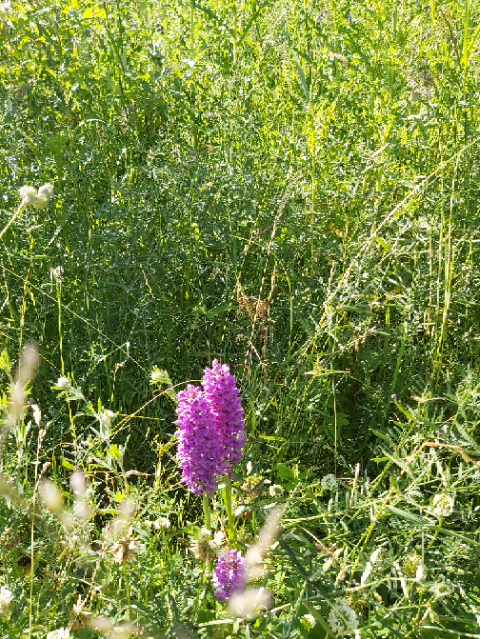
The wild flowers  are numerous, including cow parsley, comfrey, dog roses, herb-robert, oxe-eye daisies. I saw campion, vetch, a multitude of grasses, clumps of clover, purple and white, and poppies, of course. Much like some babies, the wild areas were a bit bald in their first year, but now, here  they are, strong, determined.


They say patience is a virtue and never more so with gardening, even wildlife gardening. The hum of the bees along the track,  alternates with the cheers of the spectators as the school teams battle away.  Much like our wildlife  has to battle these days. For them, though, it is a battle for their very existence as more and more  land is taken for development.

So what can be done? I note that many councils are turning mown verges into wildflower areas – hooray. I have already shown how Hambleton District Council have created an oasis of enlightenment and common sense at the Sports Village, so onto us, as individuals. Let’s face it, even if we are restricted to pots on a balcony, we can, each, still  grow plants with bees, butterflies and wildlife in mind.

 Remember that bees are crucial to our existence, so preferably no pesticides, create ground level holes in fences –  if possible – so that hedgehogs can travel through.  Bees need pollen and nectar. They love cowslips, herbs, plus campion, comfrey which can be grown at the back of a bed,  nepeta, honeysuckle, herbs, lavender, digitalis, pussy willow, hawthorn,  forget-me-not and on and on. Buddleia is such a useful shrub, beloved of bees and butterflies alike, and so easy to grow. But listen, you can find out more from the internet or library.

Ah, don’t forget bees also need water. Make sure the birdbath is kept replenished.

We all know of, or have experienced  some organisations,  housing developments and indeed people, who are lagging behind in their understanding of the need to create a balance between human and wildlife needs. In a new development I visited, I was therfore delighted to find that many residents are growing bee and wildlife friendly plants in their gardens. Frost Magazine was invited to ‘come in, have a look’, and here are some  images.

Sage, rosemary and Old English roses.   Nepeta, poppies, roses.                                      Honeysuckle.

Most had birdbaths, bird feeders,and forget-me-nots in spring, along with the usual bulbs. Honeysuckle, nepeta, Old English Roses, digitalis, buddleia, lavender and herbs all flourished. The  murmur of bees, and the flight of the butterflies, not to mention birds at the feeders was a sight and sound to behold, even in the smallest garden.


Frost Magazine sounds a huge hooray for  Hambleton District Council and the owners of the gardens we visited, and would give them a medal, (if there was such a one) for their thoughtful and balanced  designs, and would urge our readers to consider nature in their own planting schemes. There is not a moment to lose. And let’s have more verges, and set aside spaces for wild flowers, shrubs. It’s not too much to ask, I feel for the world our children are growing up into.


ARRAN Sense Of Scotland -A Very Special Treat – by Award Winning Author Dr Kathleen Thompson

Imagine the wind on your face, waves splashing over your bare feet on the sand, the gush of waterfalls cascading down heather-covered mountains, or the smell of meadow flowers as you walk through long wet grass. There’s something so special about raw nature isn’t there? It calms the spirit and raises our happiness levels just by being. So how fabulous that ARRAN Sense Of Scotland’s mission is to transport this into our homes?

Based on the beautiful and unspoilt Isle of Arran, Scotland, its senior management appreciate the physical and emotional healing powers of nature and are passionate about bottling it. They have created a range of luxurious products – for bath, body and hair plus fragrances for yourself and for the home.

Now imagine you’re returning from a walk in the rain. You can smell the wet rose petals, musk and floral citrus of the cottage garden and the woody aroma of the logs piled ready for the open fire inside. Put that experience in a bottle and you have ARRAN Sense Of Scotland’s new range After The Rain. I was delighted to test the shampoo and conditioner and it really was a pleasure. The subtle woody fragrance takes you to the wilds of Scotland and both the shampoo and conditioner were gentle and nourishing. My hair was very smooth afterwards, even while still wet. In fact I keep stroking it as I write because it feels so soft and silky, and I can still smell that haunting fragrance. Just £16 each for a very generous 300 ml bottle is extremely reasonable for such a beautifully presented top quality gift and for the same price you can also buy a matching shower gel.

ARRAN Sense Of Scotland boast that their products contain highest quality ingredients and the hair and skin products have moisture-retaining pro-vitamin B5 (pantheon) to maximise shiny hair and soft skin – and you really do feel the benefit.

If you need a lovely gift for someone special – ARRAN Sense Of Scotland have a fabulous and diverse choice, including the most beautiful large candles, all available in After the Rain and attractively presented and wrapped with signature tissue and ribbon. You get a free hand cream with orders over £40, so you can always keep this for yourself (after all, you deserve some luxury too).

Check out the ARRAN Sense Of Scotland website. Being outside in nature is so good for the soul, but if your busy life won’t let you get away, this is an enjoyable way to give yourself a reset.

By Dr K Thompson, award-winning author of From Both Ends of the Stethoscope: Getting through breast cancer – by a doctor who knows

http://www.amazon.co.uk/dp/B01A7DM42Q http://www.amazon.com/dp/B01A7DM42Q

http://faitobooks.co.uk

Note: These articles express personal views. No warranty is made as to the accuracy or completeness of information given and you should always consult a doctor if you need medical advice.

Alex Bannard’s Mindfulness Series: Week 10: Thoughts are just thoughts – with a fabulous medition, FREE as always.

Frot Magazine is so grateful to Alex Bannard for her Mindfulnes series and delighted that when time permits she will be joining us for a Menopause Series and probably Yoga too.

When I first started practicing mindfulness & meditation it was in a very self-led, self-taught fashion. When we moved to Bangkok I was blessed to meet a wonderful French woman, Violaine, who is a practicing Buddhist & taught meditation.

It was a fantastic experience. I relished our time together & learnt so much. One day we were talking about the concept that thoughts are just thoughts, they aren’t necessarily fact & they don’t define us.

I found this to be immensely liberating because for years I had been plagued by way too many unhelpful, unhealthy & unpleasant thoughts. Finally, I felt free – they were just thoughts, not real & they didn’t define me, hurrah! What a relief!

Mindfulness encourages us to take on the role of the observer to our thoughts instead of getting swept away in the narrative & down the rabbit hole with a train of thought before we even know it, a bit like Alice down the rabbit hole.

Becoming more aware & paying attention to what we are thinking, how we are feeling & behaving we can start to question the truth in thoughts that pop up. After all, most of us wouldn’t entertain the thought that we are a multi-coloured flying elephant dancing around in a glittery tutu, the thought is ridiculous enough for us to discount.

But many of us will happily indulge the I’m not good enough, I can’t do this, it’s not fair, I’m unlovable, I’m useless dialogue that arises in our mind without questioning it. But they are just thoughts. They aren’t fact. Mindfulness gives us the space & time to question such thoughts.

Our mind often catastrophizes a situation – a bad day becoming a bad life when it is in fact just a bad day, which is a perfectly normal & acceptable part of life. Mindfulness helps to remind ourselves that pain is a normal part of life, suffering is optional.

Both approaches are simply a choice, choosing to recognize unhelpful, unhealthy thoughts & then choosing not to accept them as fact. But it’s a practice too – being mindfully aware of these kind of thoughts & not acting on them but recognizing them as just thoughts.

Meditation helps us to gain this distance from our thoughts by observing the nature of our mind. Even people who have been practicing meditation for a while will happily acknowledge that thoughts are always arising in our mind no matter how much meditation we do. We can’t stop our mind from thinking thoughts, it’s what our mind does but we can stop those thoughts from controlling us.

The thoughts aren’t going to stop but we can choose to change our relationship to them. Freedom isn’t not having thoughts, freedom is changing our relationship to them, seeing them as just thoughts & not reality. You may still get the thoughts but you no longer believe them because you know your reality is right here right now in the present moment, not in the string of thoughts. Over time as you question the validity of unhelpful thoughts they eventually quieten down – this is one of the beautiful benefits of meditation & mindfulness: that inner critical voice starts to quieten.

Let me demonstrate all this by sharing an experience. Last summer I was in the midst of the menopause & really struggling with extreme anxiety & panic attacks. Initially I had no idea that anxiety & panic attacks were linked to the menopause (when oestrogen levels drop it can spike adrenalin which can causes anxiety & panic attacks.) The first panic attack I experienced I thought I was having a heart attack & it was terrifying.

Once I understood what was going on I was able to use my mindfulness practice to help me. One day out on a dog walk I could feel another panic attack brewing. So I literally stopped & talked myself down saying things like: this is just anxiety it’s not real, this is just menopause, this isn’t real & eventually I calmed myself…  & have never had a panic attack since. It was as simple as acknowledging that no matter how terrifying the experience felt, it wasn’t real.

This idea that our thoughts are simply that – thoughts & they don’t define us was incredibly liberating for me & so it was easy to grasp as a concept.  But not for some people, who feel that they are intrinsically their thoughts. A useful analogy I find is the mirror: our thoughts are like our reflection in the mirror – what we see in the mirror isn’t us, it’s just our reflection, so it is with our thoughts.

Sometimes it is hard to settle our mind in meditation especially if we have a lot going on, our mind can feel really scattered (apparently we have more than 6,000 thoughts a day so it’s not surprising!). This week’s meditation is the letting go free-flow meditation. Allowing our mind to go wherever it wants to helps it to settle quicker than if we try to control it. To get your free copy of this meditation simply email Alex at Alex@alexbannard.com quoting FROSTFREE.

Alex is based on the edge of the stunning Cotswolds & has been sharing her love for all things yoga & mindfulness for almost a decade, not just in the UK but also around the world. Her mission is to help everyone discover a more mindful way of living & to encourage them to embrace regular self-care practices for a happier & healthier way of being.

If you would like more information on how to practice mindfulness, meditation & yoga message her at alex@alexbannard.com.

For free resources check out her Facebook group: Mindfulness & Yoga for Self-Care, here is the link: https://www.facebook.com/groups/MindfulnessYoga4Relationships

Alternatively please check out her website: alexbannard.com

WELSH WRITING WEDNESDAYS: ALEXANDRA WALSH ON APPLYING MYTHS TO FICTION

Wales is a land rich in mythology and here Alexandra Walsh explains how she researched and applied some of it to her latest novel.

In The Wind Chime, my main character Amelia Prentice is sent on a quest by her dying mother, Joan. Requesting Amelia should tidy the attic of their family home before she made any decisions about selling it, Amelia discovers a box of Victorian photographs, with a hand-drawn family tree. The annotations on the back of the images names them as the Attwater family from Cliffside in Pembrokeshire.

Amelia has never heard this name before but she is intrigued by the family and is drawn to the youngest daughter, Osyth Attwater. When she discovers Osyth’s journal among her mother’s papers, she feels compelled to visit Cliffside and find out more.

The Mythology

At night, the Attwater family of old would gather on their veranda, listening to the wind chime and watching the sun set into the roaring ocean. They told each other stories and Osyth revelled in the tales her Uncle Noah wove around them, using them as a guide to her life.

In order to make to create Osyth’s interior life, I drew on tales far and wide. These included old fairy stories, local legends and Celtic mythology. At the beginning of the book, Osyth is in her late teens and is letting go of her childhood as she enters the adult world, yet she cannot fully abandon the magical world of her childhood. Throughout, I was aware the tales needed to fit in with Osyth’s story rather than distracting from it, so the fairies invited to join the party were chosen with great care.

Tylwyth Teg was the most important tale. This is the Welsh translation for the Fair Folk or Fairy Folk and their magical home can take a number of forms, from the underground land reached through the doorways of the Celtic stone circles or in mysterious green lands that can be glimpsed off the Welsh coast. Osyth is fascinated with Tylwyth Teg and it is from here she draws on other magical creatures who are her talismans and protectors as she discovers bitter family secrets.

It is during the celebrations of a family wedding, Osyth’s aunt, Hannah, tells the story of how the world of the Fair Folk was created. It is the tale of a woman who hid her children from Jesus when he visited her home as she was ashamed of her fecundity. However, when she searched for her family later, there was no sign of her children. She was told God had taken them as a punishment for hiding the gifts he had bestowed upon her. In the legend, these children were taken underground and became the ancestors of all the creatures in the Land of Tylwyth Teg.

While dressing for this wedding, Osyth references Gwenhwyfar, the fairy of the White Moon Shadows. This fairy dances through the world leaving tiny white flowers in her wake. White flowers became a theme throughout the story, including the name of her perfume, White Rose, from the perfumiers, Floris.

The most interesting creature I discovered was the gwrach-y-rhibyn, the witch of death from Welsh mythology. This terrifying creature with her red eyes, green-tinged skin and dark leathery wings, gathered the souls of the dead and would visit houses whenever a death was imminent. It calls to mind the Irish banshee, which considering the close proximity of the two coastlines is unsurprising.

I hope this small insight into the fairies and their world will make your reading of The Wind Chime – and Welsh mythology – more interesting.


Helen Hart of SilverWood Books has inspired us with her thoughts on ‘Sharing the Beauty of Your Memories’ 


Frost Magazine is delighted that Helen Hart of SilverWoodBooks has found the time to share her extraordinarily helpful insight into memoir writing. Over to you, Helen.

Writing your memoir can be a truly cathartic experience, where an author will give meaning to specific parts of their life.

Books are a fantastic tool for research and can help ensure that mistakes in history are not repeated. You might have some amazing experiences that need to be shared, and the lessons you’ve learned could help others who are new to similar roles. Your family might also be keen to hear more about your professional life. For many authors, a book is a fantastic legacy to leave your loved ones and the younger generation. So what are the options for writing your book if you need to protect the privacy of the people you’ve worked alongside?

We often speak to budding writers who are unable to share their past due to their past careers. When you’ve had a lengthy career in a sector like public service, you’re under the obligation to protect your colleagues and peers by keeping silent, even after you’ve left office. This can make writing your memoirs seem like an impossible task. However, we believe there are ways to bring your memoirs to life in an intriguing and unexpected way.

It is advised to focus on one or two main themes from your experiences, rather than listing your entire autobiography. Even if you are telling a true-to-life story, it pays to think like a fiction writer and draw the reader in from the opening word.

Sometimes the best stories can still be told after enough time has passed to protect those involved, as shown in the dramatic televised BBC series, The Serpent. So, it is possible for you to write your book or draft a series of journal entries to work with an editor, as long as you hold off on publishing your memoirs until the appropriate time. If the parties involved are still in the public eye, you may want to wait as much as ten years before telling your story.

Another way of protecting those who feature in your career experiences is to write your memoirs as a work of fiction. Johnny Tudor had personal experience of writing the biography of Welsh singer and performer, Dorothy Squires, the former wife of Roger Moore. From working on that book, he understood how personal memories can cause pain and suffering to the people involved. From his varied experiences, Johnny reached a point where he wanted to write his memoirs, but turned to fiction to free up his creativity. The setting of the book remains a true reflection of the Welsh valleys, however, he amalgamated his own experiences with those of his childhood friends, creating dynamic characters for his book, Peg’s Boys.

Fictionalizing your memoir gives you the room to develop more than one book, in which you can alter the timings of events and create even more vibrant characters. If you write a straightforward memoir, your book will appeal to homeland readers who are interested in your former career. However, if you write a gripping story with global appeal, your audience stands to become much wider, provided you put the time and effort into promoting your book. You can also use a pseudonym for your book, if you wish to remain completely anonymous, creating an author brand to promote and sell the books without revealing your identity.

Writing a memoir will leave you with a beautiful legacy for future generations. Everyone can become an author. Everyone has their own story to tell. Let your imagination flow and grab a pen.
Helen Hart of SilverWood Books https://www.silverwoodbooks.co.uk/