NEW beactive PROJECT ON A “COLLIDER” COURSE with SCI-FI SUCCESS

BRAND NEW beactive PROJECT ON A “COLLIDER” COURSE with SCI-FI SUCCESS

Multi-award-winning trans-media production company “beActive” have released another ingenious cross-platform creation, “Collider”, on Monday 4th of June 2012!

The new sci-fi concept will be available in various formats, spanning comics (print and digital), live-action web-series, app/online game, graphic novel and eventually becoming a feature film, to be released in 2013.

The first of the weekly series of eight webisodes are available exclusively on Frost Magazine first and then on beActive’s You Tube channel and stars BAFTA award-winning Scottish actor Iain Robertson of Rab C. Nesbitt and Basic Instinct fame.

The edge-of-your-seat action sees Iain’s character, Peter Ansay, a quantum physicist who is ostracised by the scientific community after issuing warnings about the dangers of The Hadron Collider.

Peter takes matters into his own hands when he breaks into CERN, the facility on the Franco-Swiss border, to sabotage the collider and accidentally transports himself and five others to 2018 where the post apocalyptic world is racked by natural disasters and at war with the “Unknown”. The six time travelers now have to fight to discover how they got there, how to survive and most importantly, how to get back to the present!

beActive’s co-founder and CEO Nuno Bernardo said: “Collider is a real sci-fi spectacular! By transporting the viewer into another dimension we are really able to delve into each of the characters pasts and follow their journey as they fight to return back to their present time.”

Follow the rise of Collider at:

www.facebook.com/colliderworld

and on Twitter; @beActiveMedia

Jack Bowman On Directing Stephen Fry and the Wireless Theatre Company.

from left to right: Jack Bowman, Stephen Fry, Sue Casanove, Nick Lucas, Adam Hall, Mariele Runacre Temple.

Jack Bowman, actor (he plays Jamie in my film Prose & Cons), director, writer and all-round brilliant guy recently directed Stephen Fry. He was then lovely enough to give Frost Magazine the low-down;

What was it like directing Stephen Fry?

An enormous honour and incredibly exciting! No, really, even my dad was impressed, which doesn’t happen that often…! One of the most amazing things about Wireless Theatre is how willing Mariele Runacre Temple – the artistic director – is to give good, new talent a chance. It was a combination of her trust in me and pure luck which meant this project AND Stephen’s involvement in it happened to be the one that ended up on my slate as a director. When Mariele forwarded me the email, I couldn’t believe it, honestly, I just couldn’t. And what’s lovely is, this isn’t a one-off – it’s happened to other directors as well; it’s a massive testament to the quality of the work in attracting the best talent and ethos of what Mariele instills in Wireless Theatre from the top down.

Were you nervous?

I don’t think I ever was – though once the initial excitement passed, however, there was more a nervous concern that something might occur which meant it wouldn’t happen. He’s got QI, he’s been filming the Hobbit, hosting the BAFTAs, writing a new book, Tweeting constantly, he’s about to appear at the Globe… and so on. He makes the hardest-working people look lazy. He has such amazing energy and work ethic. But would something happen? Would something else come up? And yet, it all came to pass with the exact timing, as scheduled, some four months previously by his brilliant reps. Who knows what they are doing, to the hour four, months from now? That’s a man who has a brilliant agent and keeps a perfect diary. Wonderful.

Was it intimidating?

It could have been, as the man is a national treasure. However, I know a few people who have worked with him before and assured me I had nothing to worry about, that he was a lovely man and a true gent – And no-one gets to be a national treasure unless they are anything but wonderful as a person. And he was! Ultimately, thanks to the experience I’ve gained from Mariele and working with her and at Wireless, I know how to direct my actors and what she expects from them. Also, the quality of the new writing means we’re always able to offer great scripts to great actors, known or unknown. Once you have the experience of having met and worked with 160+ actors, passionate about what they do, passionate about Wireless, and often wanting to return time and time again, you quickly realise that there’s no difference between a ‘name’ and anyone else. We work so hard to look after our various casts, and it pays off. Everyone, barring Stephen, in the session was returning cast, so that made things easier, each was playing a returning character, and I’ve all worked with them elsewhere. I know what Adam Hall, Nick Lucas and Sue Casanove can do and trusted them all. It’s another fun day with good, talented friends.

And then, suddenly, you realise that five years of Wireless have gone by, now Stephen Fry is in the studio coming along to play too. Yet you never feel worried or intimidated in any way. He’s another addition to what’s been a very happy, transitory and ever-growing, professional family.

What I have to do – as part of that family at that particular time as a director – is to serve the script by getting the best out of the cast. If you approach and support any actor with that attitude, that sense of play, then you have nothing to fear from anyone. With that in mind, just before we began recording, I simply asked Stephen if he had any ideas on how he wanted to approach his opening scene, and he simply said, “no, I’ll do it and you tell me what you’d like.” And that’s how it worked – he’d do a blissfully wonderful take, and once he hit his stride, I’d give him the freedom to play around some more. There’s one scene that I wish I could tell you more about, but in it Stephen started ad-libbing and we were all in hysterics. The words, “oh God,” have never made me laugh so much…

How did you get him to do your project?

Right at the very, very start, when Mariele Runacre Temple first launched the Wireless Theatre Company five years ago, she started to write a list of people to approach – and Stephen was the very first person she asked to be involved, given his love of the spoken word. However, he’s an incredibly busy man, and despite a lot of support from his agent, we began to wonder if it would ever happen.

Then Sue Casanove revealed she had an idea for a sequel for her audio comedy, We Are Not The BBC, which I directed last year. The central gag of We Are Not The BBC features Christopher Timothy, of All Creatures Great And Small and Doctors, sending himself up. So, I asked Sue who she was thinking of in that sort of role for the next installment and she said, “Stephen Fry.” Knowing it had been tough until now, I thought, “it’s going to be tough, but if Sue’s script lives up to the quality of the first one, we might just stand a chance here you know…” We had a meeting in London, she knocked some ideas back and forth and off she went, back to Wales.

A few months later, the script arrived and I was blown away. Sue had knocked it out of the park – I couldn’t put it down. I text her straight away, saying, “if the first one was A New Hope, this is your The Empire Strikes Back.” By that, I mean, this wasn’t as good as the first one, which was great, it was better, absolutely better than what had come before. It was so, so clever; darker, smarter, more ambitious. She’d told me where it might head, yet I didn’t see this coming. Having evolved from what she’d told me, beyond what I imagined, it gripped me from start to finish.

And I let Mariele know that maybe, just maybe, this might be the one Stephen might say yes too. Mariele dispatched it to his agent, we waited nervously and then, some months later came the message, out of the blue – Stephen loves the script. He’s free for one hour, June 6th, it’s in his diary.

Were you a fan prior to the recording?

Oh gosh yes! Who isn’t? Yes, I grew up with him from the days of Blackadder as a child. However it’s been wonderful to watch him have such an amazing career since – A Bit Of Fry And Laurie, Me And My Girl, Wilde, Bright Young Things, QI… The funny thing though, my favourite Stephen Fry memory is not one most people may even remember, but it’s the time he affected me the most deeply. He was presenting the BAFTA Film Awards that followed 9/11, and in his final speech of the evening, he spoke from the heart and talked about the need for film to spread hope and love across the world, as it would enrage the heart of anyone who struck out in anger in the way we’d seen on that terrible day. There’s so much to love that man for, and his work, yet that for me is the pinnacle.

Tell us about the project.

It’s called We Are The BBC, and is a sequel to We Are Not The BBC, which saw a Welsh Am-Dram group try to record a BBC-style audio play while the politics and egos threaten to topple the production, not to mention confuse poor Christopher Timothy. A lot. We Are The BBC picks some time later, when Stephen, playing himself, wins a BAFTA for his performance in a script by a promising new celebrity writer who used to belong to the same Ad-Dram group. However, it’s quickly clear that all is not as it seems and Stephen finds himself at the centre of the intrigue as things start to unravel…

And, touch wood, we’ll have another name joining the project next week too… But I can’t say anything yet.

How long did it take?

Wireless works exceptionally fast and Mariele always runs a slick studio – something that often surprises anyone new to Wireless! We had a professional cast and crew and Stephen’s exceptionally good at what he does; just as well, because we were allowed one hour of his time! Even with several retakes, we were able to get Stephen’s material all down in 40 minutes. Not only did he respond wonderfully to direction, he did that rare thing and with each note; he’d elevate it into something even better. Combine that with the well-oiled Wireless machine, and it was job done – which was just as well as he was straight off to record QI that afternoon after finishing with us. What’s even more extraordinary was on arriving, he apologised, revealing that he was suffering from flu symptoms. Yet he still turns in a barn-storming performance. When you see that happen first-hand, you realise why he’s as loved and respected as he is.

Do you think Stephen will stay in contact?

I hope so! At the very least, I’d love him to follow Wireless, Sue and myself on Twitter -@wirelesstheatre, @suecasanove and @realjackbowman, in case he reads this! At best, we’d love him to come back sometime in the future and work with Wireless again, even if it means we have to find an hour of our time five years from now. It was an amazing pleasure!

Who else do you want to work with?

ooh, well… On my list as a director… Michael Sheen, David Suchet, David Tennant, Sir Derek Jacobi, John Simm, Adrian Lester, Dame Judi Dench, Tom Hollander, Simon Russell-Beale, Samantha Bond, Imelda Staunton, Paterson Joseph, Joanna Lumley, Benedict Cumberbatch, Peter Firth, Bill Nighy, Keeley Hawes, Patrick Stewart, Idris Elba… Also, one day, I’d love to direct or act alongside or write for Sophie Aldred. I can 100% tell you I would not be here today if it wasn’t for her inspiring me into acting, and would love to repay her until the end of time.

I know Mariele would love to work with Rik Mayall, who’s amazing. Again, who remembers his 90’s anthology series, Rik Mayall Presents? Three specials, and two of them broke your heart…

The thing to strive for, though, is that even if I’d love to work with X, the questions always have to be, “are they right for the role,” “does casting them serve the story?” There’s no point in shoe-horning in X for the sake of it, because then you don’t do the script any favours, the cast any favours and your reputation any favours. The right actor gets offered the role because they’re right for the part. Simple as. It’s tough, as recently two real heroes of mine have recently turned down the chance to work with Wireless on our acclaimed Springheel series. They were perfect fits for the material and you see that rare thing of a dream part for one of your dream actors, hope for the best, cross your fingers, ride your luck… and it doesn’t quite happen, often because of scheduling. However, you just have to say, ‘it’s always for a reason, and you have to remember that’, and when you look back on what happened, rather than what could have been, it always worked out for the best. I cannot wait for what Wireless Theatre and Mariele ends up sending my way next time.

We Are The BBC, starring Adam Hall, Andrew MacBean, Sue Casanove, Nick Lucas and Stephen Fry will be available to download from www.wirelesstheatrecompany.co.uk later in 2012.

It is written by Sue Casanove, directed by Jack Bowman and produced by Mariele Runacre Temple for the Wireless Theatre Company.

Michael Fassbender on Being Poor and Oscars.

Michael Fassbender has done a fascinating interview with the Hollywood Reporter. You can read the full article at the link, but here are a few good quotes.

On how he survived years of struggle: “I would say to myself, I’m good enough. That became my mantra.”

ON GOING NUDE, MEETING SEX ADDICTS AND USING YOUTUBE TO HONE HIS CRAFT
Fassbender says what attracted him to the role of Brandon, a sex addict in the Fox Searchlight indie drama Shame– produced by See Saw Films and Alliance–was the chance to explore the desperate search for connection; playing a young Jung in A Dangerous Method allowed him to morph into a historical character. “I was a bit worried that I’d perhaps bitten off more than I could chew,” he says. “But I’m always interested in trying to investigate different personalities. I want to keep myself guessing and keep the fear element alive, so that I don’t get too comfortable.” Jeremy Thomas, a producer on Dangerous Method, says Fassbender who was director David Cronenberg’s first choice to play Jung read the script over and over again, even during production, something Thomas has never seen an actor do. “It’s one of his secret weapons,” he says. Fassbender says he’s grown deft at using YouTube to study accents (his own is Irish) or to watch a grainy interview with an elderly Jung. For Shame, he met with recovering sex addicts: “One man had the same intimacy issues that Brandon had, so it was very helpful to me, and I was very grateful that he opened up.” Additionally, he says there was no time to feel too self-conscious when shooting Shame, says Fassbender. It helped that director Steve McQueen kept the set intimate. “We moved very fast. We shot it in 25 days, so I kind of had to get over it and get on with it,” he says.

THE ACTOR ONCE LIVED WITH REJECTION, A HOLE IN HIS WINDOW
The son of two restaurant owners, Fassbender moved to London at 19 and attended the Drama Centre. “It took me a while to come to grips with how expensive London was. My parents helped me out, but we never had a lot of money,” he says. “So it was very sticky the first three or four years between paying drama school fees and surviving. The first place I lived was a studio I shared with a Brazilian girl. We weren’t seeing each other or anything, but I remember there was a big hole in the window and it was so cold in the winter.” Fassbender’s first acting role of note was in HBO’s Band of Brothers, which aired in 2001. He was confident it would lead to other offers. It didn’t. “I came to Los Angeles and did auditions for television. I made a terrible mess of most of them and I was quite intimidated,” he recalls. “I felt very embarrassed and went back to London. I got British television jobs intermittently between the ages of 23 and 27, but it was very patchy.” Between roles including a Guinness commercial (in which his character swims from Ireland to New York) and a one-off, Agatha Christie’s Poirot, he took odd jobs to survive, unloading trucks or bartending. He even did market research. “I had to call people who had filed complaints about the Royal Mail and see if they were happy with how their grievances were dealt with. Most of the time they weren’t,” he says. All along, he says, “My goal was for acting to become my main income. I would say to myself, ‘I’m good enough.’ That became my mantra.”

Robert Pattinson; ‘I don’t mind getting naked’.

Robert Pattinson has told The Sun that he does not mind getting naked and stated that it is ‘more difficult for actresses’.

In an interview that should delight his many female fans the 26-year-old Twilight star says; “I don’t really have a problem with those scenes or nudity in general. I think it’s more complicated for actresses who are worried about how those scenes can be exploited by the media and how naked photos are constantly getting posted on the internet.”

Pattinson was talking about his role in Cosmopolis. The film is directed by David Cronenberg.

He says: “The sex scenes with Patricia [Patricia McKenzie] were more difficult.

“It was kind of strange but in the script we were supposed to climax at the beginning of the scene then have this discussion afterwards.

“But David had the brilliant and inspired idea to have us talk while we were having sex.”

He also said that he was grateful to be offered the role and his hopes of breaking away from the Twilight franchise.

He says: “When you’re part of an immensely popular film franchise like Twilight, it tends to overwhelm anything else you’re doing while those films are still part of the public consciousness.

“Now at least a film like The Hunger Games is gaining a lot of attention. That’s a good thing for me because I can break free from a certain perception that’s been formed about me through my character in Twilight.

“It’s ironic but I was offered the part in Cosmopolis on the last day of shooting on Breaking Dawn. It was an incredible feeling to be getting a call from David Cronenberg at that particular moment.

“It also reminds me that I should be very grateful for what the Twilight films have done for me.”

He also says; “It’s up to you to make the most out of your life.” Obviously a wise man.

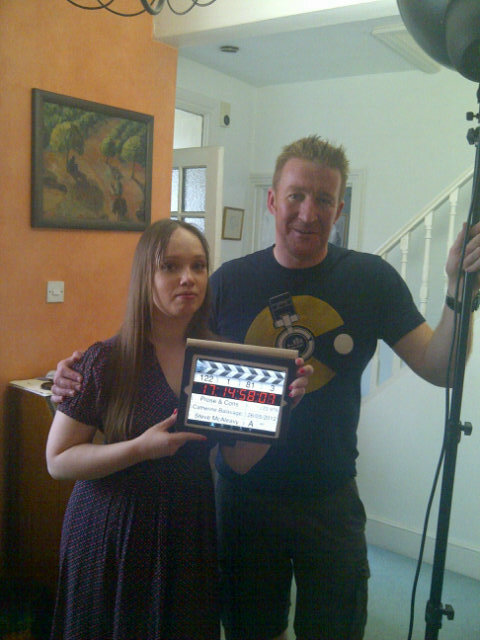
And Action! The Making of Prose & Cons.

So we finished with the first location for Prose & Cons. We have 53 scenes in the bag. 53 scenes. That’s 50% of our movie. Almost. The most surprising thing was how easy it was. Not that it wasn’t hard, it was. It just took me so long to make a film that I guess I thought it would be nearly impossible. It was hard work, but if you work hard it’s no biggie.

Steve McAleavy and Catherine Balavage direct Prose & Cons

Steve was amazing. We are filming on a Canon 60D and Steve is operating it. Steve is the producer/editor/co-director and all-round great guy. Steve and I both have equipment but we mostly used his. He has a lot of Phillip Bloom stuff, and a Fig rig. I haven’t asked how much it all costs and I don’t think he wants me to; adding all of that up will only be painful.

The first actor to turn up is Lynn Howes. Lynn is not only talented but very professional. She knows the script inside out, is good with continuity and thinks of the little things that no-one else does. Jack Bowman plays her boyfriend in the film. Jack is perfect as Jamie. He is very talented and Jack is also fun.

Next up is Bo Wilson. Bo plays her part beautifully. She has a day job as an editor at the Evening Standard, gets up at 5am but still manages to get to Kingston in the evening and give a brilliant performance.

We filmed in Kingston, a beautiful area. We didn’t do too many takes and the actors were professional. Although I feel that because I cast some of my friends they don’t show the proper amount of respect for me as the director. I try to be firm and tell myself; hey, at least they turned up.

Clea Myers came and played my aunt. Clea is in a poignant scene in the film and she is an incredibly giving actress. In acting it matters to act opposite someone else who is talented. The better the actor the better you will be. Clea is obviously a film actress of note. She is one of the most talented people I have ever worked with. Acting on film is thinking, but thinking hard. I read that in Mel Churcher’s book, and it is spot on.

Before we start filming I realise that our of all of the scenes we are filming I am in about 90% of them. That is a lot of lines. Directing and acting is not necessarily hard. As long as you watch the footage back and change if it is not working.

One of the actors drop out at the last minute and we have to deal with the stress of casting while we are dealing with the stress of filming. Fun. Luckily, after a few calls the wonderful Monty Burgess stepped into the breach. He gave a wonderful performance and I cannot imagine anyone else doing the part.

Steve doesn’t have any crew but still manages to do brilliant shots. Steve says that the next time he wants crew and at one point says he doesn’t know why he indulged me: “We should have made a short”. he says. He’s joking. I think.

We had a brilliant time. When you make a film you become like a family. Few things went wrong apart from a broken lens cover (not the lens, thank god), a broken HDMI cable and a parking ticket.

I am very excited about filming the rest of Prose & Cons. I will keep you all updated and get Steve to write something to.

Prometheus | Film Review


This film is clearly a prequel, although Ridley Scott at one point denied it. Long awaited and much discussed, when the trailer was released a while back the internet went mad. The film is visually stunning and has brilliant performances by Michael Fassbender and Noomi Rapace. Rapace plays a driven and intense scientist who’s longing for a child is used against her and twisted in a horrific way. Fassbender is an android made to look like a humanoid so he doesn’t scare the crew.

This film comes 33 years after the first Alien movie and has some elements of the previous movies; a crew on a ship called Prometheus with an android, a scene like the alien coming out of John Hurt but much more icky.

There has been some complaints that the film is slightly predictable, but what monster movie isn’t? It is a monster movie for god’s sake. Prometheus is beautifully made, well acted, thrilling and entertaining. Is also has excellent production design and incredible visual effects. It is an ambitious and impressive film. Definitely worth a watch.

Adam Deacon Profile | Film

In the film Payback Season, actor, director, writer and BAFTA-Orange Rising Star award winner Adam Deacon plays the lead role of Jerome Davies, a young man who has risen above his harsh beginnings of life on a council estate to achieve celebrity status as a premier league footballer.

Adam describes the role: “Jerome is living the high life, he’s got the lovely car, the penthouse flat, but fundamentally his family are still living on a council estate, and he has to go back there. I think Jerome’s dilemma is trying to balance his old life with the new life. Old friends start appearing and before you know it he’s involved in extortion. Jerome has tried to leave that life behind him. For me, it was really nice to play a ‘normal’ character; I wouldn’t call Jerome humble, but he’s just trying to do his thing. I also enjoyed playing a character who spoke proper English,” he laughs. “I am not playing the typical ‘d’you get me Blud’ thing, we were actually asked to tone it down.”

“I think it’s a great story as well, you don’t often get to hear about what happens to people on the other side, and I am sure this sort of thing goes on…it’s a great part to play especially after Anuvahood. It’s also nice to get a romantic role, in some of my films I get a girl, it all goes wrong and I’m gone, so it was really good to have a proper romance for once, and Nichola is a lovely girl as well,” he says.

“I definitely believe it’s a story that needs to be told; I am strong believer in films having a proper story, it’s no good just having a kid running round with guns and knives, we have to start thinking out of the box”

Deacon is currently writing another comedy film. “I made a lot of films last year for other people, and this year I have kind of got my heart set on an Adam Deacon film,” he laughs. “These are exciting times.”

Deacon has come a long way from his Stoke Newington School where he was deemed “a joker”, his natural antipathy to academia exacerbated by the “madness” at home. At 12, noticing his enjoyment of music and drama classes, his head of year suggested he apply for the weekly after-school course at the nearby Anna Scher School. He took a Saturday job to pay for a preparatory summer school and was immediately fast-tracked on to the course by Scher herself, who he portrays as a cross between a mentor and a fairy godmother.

“She’d get the rowdiest London street kids – who were in trouble with the police and stuff – and get them to read scripts properly,” he says. “There were kids there with jobs on EastEnders but she never let anyone act starry, or do stuff for money: she wouldn’t let kids do adverts before they were 16, in case they didn’t know what they were selling. I owe everything to that woman. If that opportunity hadn’t been there for me at a young age, I might have ended up inside,” he says ruefully.

Deacon, from Hackney, East London, began acting at the age of 12. His early career included work with Y Touring Theatre Company, with which he appeared in a number of tours including Cracked by Nicola Baldwin.

Deacon made his name as the lead in Noel Clarke’s Adulthood and co-starred in West 10 LDN, a Kidulthood-like TV program made by Noel Clarke. He has also starred as ‘Bones’ in an MTV show called Dubplate Drama. His next role was in 4.3.2.1, a heist movie, released in June 2010 which also starred Tamsin Egerton, Emma Roberts and Noel Clarke, who directed the film.

Recently Adam co-wrote, co-directed and played the lead role in Anuvahood, which was released on March 18, 2011. The film is described as, ‘A pulls-no-punches, coming-of-age story centering on one directionless hopeless shotter, who finds his true worth in the face of urban adversity.’

Adam has featured in various music videos including; Bashy’s “Who wants to be a Millionaire” and Chipmunk’s Chip Diddy Chip. He is also a musician and musical performer most noted for his two tracks on the soundtrack to Adulthood. The tracks are: ‘Adamhood’ and ‘On It 08’.

His television roles include The Boarding School Bomber and more recently The Royal Bodyguard starring David Jason.

Nuno Bernardo Interview; On Collider

Nuno Bernardo describes Collider as “Lost meets Terminator”. At Frost Magazine we are super excited about this multi-media story. Nuno is very inspirational and, according to BBC, “Nuno Bernardo is a leading world expert in New Media”.We also have the web series exclusively before anyone else does, so keep an eye out for it and check out our interview with the creator.

Catherine Balavage: How did the idea for the project come about?

It came about more than two years ago. We had been doing lots of projects, and the thing that connects all of our projects is that they are multi platform, in digital and online media. They start on the web and they move to television shows, etc. We had made Sofia’s Diary that also used this format of the multi platform We decided we wanted to make a new journal, but [do] something that we hadn’t done before. So we came up with a story that was about six characters that wake up in the future. They never met, they have nothing to connect them, and they need to learn to work together and to overcome the challenges of being in a place that is a possible colloquial world.

We started with hiring some writers from different backgrounds. We had a script writer, we had a comic book writer and we developed a story further. Changes changed and the characters changed, and the universe around the story was evolving . One year ago we were comfortable with the world we were creating and then we moved ahead. Then we started developing the comic book, developed a feature film , started developing some games and then the story started to get in shape.

Do you think in the future all films will become multi-platform? Is it possible for a film to just be a film?

I think it is. If you had asked anybody three or four years ago if a black and white movie [The Artist] could be done commercially everyone would have said no. I think there is always space for nicely told stories. A good, nice story in just one medium. You can also do the same in different mediums. The advantage if you do something in multi-platform is it works for marketing. You get different opportunities and different windows for your story but also at the same time different ways to connect with your audience. No everybody watched or reads the same story in the same way. The multi-platform allow you to create different experience. If someone wants to go and watch the film at the cinema they can just go and buy a ticket and watch the movie. If they want to play a game on a more interactive level, or they can read a novel or a comic book. We don’t want to exclude any medium. It is not saying that any medium doesn’t work alone. We are trying to create experience that are more in-line [with the fact] not everyone reads the same story or watches the same story in the same way.

Was it hard working with all of the different writers?

Yes. Because what was more important for us in the first year of developing the story was trying to get different writers who knew the story well, trying to write for a format, bringing roles of this world, bringing characters, bringing ideas and at this point everyone was working as a stand alone. It was like a big brain storm if you want because what we were looking for was more and more ideas, and some if them would contradict each other, but others were more complementary. After this first year of a chaotic process we somehow said; “okay this makes sense, this can interact, and connect with the other part of the story”. So then we start collaborating and after that moment everyone starts working together based on the same story and the same skeleton.

Have you taken anything from real life and put that into the story to create this fantasy world?

We kept with this, we based our concept, the starting point was the real Hadron collider experiments. and the fact that man, mankind are trying to replicate god or replicate the beginning of the universe. We picked [up] that experiment where they try and replicate the black hole and replicate the actual big bang event. What if all of these experiments are not just experiments and they are putting the world out of balance? Based on this theory we then developed our own story.

What happened in the process was around the same time last year, we were working full time on the project and we hired a film director to start working on the feature film. One or two weeks after we hired him he emailed us and said; ‘You guys are genius”. And on his email he put a link to an article that was published on CNN, and was all around the world, and on news agencies, about this guy that went to CERN and started to protest because he said he was from the future and all of the Hadron collider experiments were very dangerous. The director thought it was marketing genius to create these news stories to create a buzz about the project, but, no, it was just a coincidence that someone went there and protested. There is someone in the world with the opinion that these experiments at CERN may be creating some chaos and some problems to the planet.

Have you cast? Did you cast first or write first?

No. The casting is still ongoing. We cast the web series which will be out at the end of next week. And we cast one of the characters, which is the part of the scientist, Peter, who discovers this big problem, and we cast Ian Robertson the Scottish-English actor to perform the role. We are now at the process…we had a casting session last week in London, we are casting the other five characters of the story and we hope to have the cast finalised by the end of June.

What kind of inspiration have you taken from other Sci-Fi and time travel projects. Did you give the writer any reference points?

In our marketing pitch materials we call this Lost meets Terminator. In the first place dropping six character in an abandoned island, in this case it is not an abandoned island. It is in the future in a place that isn’t known and in a time that isn’t known with no way to control the environment that surrounds them. There are all of these challenges and interactions from a story point of view, and from the other point of view, what six people will do together to overcome their difficulties. So that is the part that you can pick that story and adapt it to other type of movies. We want to adapt six people in an unknown and challenging environment to the sci-fi framework.

Watch Collider Preview here.

How do all of the parts link together?

We have a time line. Our story start in September 2012 and the narrative goes to 2018. So what we have is these two narratives where, through this period through six years, lots of stories, sub-plots and characters will have lives in present times and in the future. What we did was to divide this time in small chunks of story so we have the web series. The web series is an initiative, which starts the story is when Peter is fired from CERN and he tries to alert the world of what is going on and then when nobody listens to him he tries to sabotage the Hadron collider and without knowing it, it creates a time machine that makes him and five other characters jump to the future.

So it is this moment of present time, when all began. and then we have each comic book which tells the background story of each of the characters. Because in the feature film the characters have already been featured but they have a past or a present and things happen to them that have an impact in the future. So this next story where things happen in 2012, 2013 in the comic books so the audience can know a little more about the characters.

Then we have a game. The game is the stuff the characters have to do in the feature film so ahead of the feature film you can get familiar with the character’s , the location, the setting and the mission of the characters and you can do it yourself by playing this game.

Each piece of content tells a little bit more and the big story line which we created over the six years, and all the elements are part of this timeline. Of course you have to be very careful of each element so if you just want to watch the web series you will be able to watch the web series and enjoy it as a stand alone, if you just want the comic series you can read about the beginning, middle and end, and if you just want to watch the movie you can just go to the theatre and buy your ticket. You can watch the movie and you will understand the story. But of course if you pursue all of these pieces of content you will have a better grasp of the story and know the characters much better, and you will be more engaged with the universe that we are creating.

Whereabouts are you filming?

We start shooting mid September and we are shooting the movie in Dublin, Ireland.

Tell me a bit about you

Yes, I started to be active ten years ago and my previous experience was first in the advertising world so I was doing producing ads and then I worked for interact television company where we worked in the late 90’s, early 2000’s. We were trying to do the first interactive television. It was when the internet bubble just exploded so most of these interactive [projects] weren’t done. We see them coming back nowadays with the television being connected with the internet, When this interactive television project ended I based my experience in advertising and because some of our clients at the time started to worry about the internet, and that viewers where not watching the ads on TV anymore they started feeling that the world was changing and just putting ads in traditional media was not enough anymore.

Communities and sub communities were developing. Cable TV was exploding and expanding throughout Europe, so in 2002 we put these two expertise together to create a company that specialised in entertainment that was multi-platform and that was focused in telling stories on different platforms, and benefited from the tools and the relationships that audiences had with different platforms to tell a better story.

How did you get funding?

Initially we had some venture capital when we started the company and, with our success and the fact that some of our multi-platform shows are being sold around the world, in TV and publishing, and mobile and licensing in different platform that we distributed our content, recently we managed to secure additional funding from Jill Banks in Portugal that allows us to fund and self-fund from the development and the early parts of this project.

So it is web series, comic, games in that order? What is the scheduled time-line?

First release of the projects is the web series, the comic and the game will all be released by June 4th and we have a second game planned in the Fall. We also are shooting a film in September for a 2013 release. We are also working on a follow up to the comic books. So between now and to the end of 2013 we have a schedule, a planning of releasing the different content, sub-plots and characters. So this time-line which is our universe between 2012 and 2018 we are working on a novel so different products will come out based on this project about one character and then two characters or one moment in this journey.

Are the people from CERN involved?

They are not involved but if the story gets popular then they will probably not be very supportive of the story [laughs] It doesn’t portray them in a a bad way but it creates a story which says that what they are doing will probably create problems with the planet. So if I was them I would probably not be happy with the story. So we are not working with them.

Thank you Nuno