Actor Interviews: Rakesh Dasgupta

Actor Interviews- Rakesh DasguptaWhat made you become an actor?

It all started while I was in school. I never really had any friends to talk during my school days. I was experiencing domestic violence almost everyday; I could not find anyone to listen to me. I was getting bullied at school. All these experiences started giving me depression at that age and I was so helpless. But I always loved to watch movies and I liked portraying those characters I saw in the movies. Its hard to explain but when I used to portray the characters in front of the mirror I used to (kind of) become those characters from within which helped me for that short span of time to forget everything surrounding me. I found this to be a very helpful technique to stay away from my depression and the unwanted ambience. As time progressed, I just got hooked up with this acting.

Did you train and if so where?

Sounds weird but I must say my initial training started in front of the mirror. Being a commerce graduate I never had any formal acting qualification. Until 2013 when I started taking informal acting and accent removal classes in Sydney with some of the experienced actors.

Career Highlight

Instead of taking names of some of the projects that I have worked on, I would like to consider my career highlight to date being given the opportunity to go to Hollywood and perform in front of the film directors and casting directors. Also getting representation offer from one of the leading agencies in USA during my first week in Hollywood was something completely unexpected. (Well its a different thing that I could not accept the offer for having no work rights in USA)

Lowest Point

Those first days in Sydney when I did not have a place to live and was visiting Salvation Army to ask for food as I didn’t have any money with me. I don’t want to speak too much on my lowest points in life as I think people who want to pursue acting, want to become actors and have big dreams would get discouraged and scared listening to my past. So I would prefer to keep this point short.

Hardest thing about being an actor

1. Getting job – you can be an acting degree holder from the best acting university in the world and you might have the best acting talent but you might not get any acting job. If you ask me why, I don’t have that answer. It’s the way it is. 2. Uncertainty of the future – as an aspiring actor you never know where you will end up in the next 5 or 10 years time; you can end up with stardom or you can just end up with nothing. 3. No financial security – In the early stages of acting career, it does not pay you much, if at all to make both ends meet. It’s very likely that you might just end up with one meal a day as that’s all you would be able to sometime afford being an aspiring actor.

Do you make enough money from acting, if not, what else do you do?

At this stage of my career I do not make enough money from acting to pay all my bills. As such I have to do other stuff like working in supermarkets, gas stations, doing gardening work etc etc. I prefer these kind of odd jobs instead of a full time desk job because they provide flexibility to attend auditions and shoots.

Best and Worst audition

Best audition – When I had four days time to practice my lines which is quite unusual to get such a long time to prepare a script. I knew my lines and moves to perfection and was very satisfied with the way I performed in the audition room. The casting director appreciated my performance and I was so convinced about getting that role but guess what, I didn’t get the role.

Worst audition – I was driving to this audition and my car broke down in the middle of the highway. I had to get my car towed to the nearest gas station and then I got a cab and was able to reach the audition venue just on time. It was summer and I was profusely sweating. I went to the audition room and I couldn’t recall half my lines; I left the script in my car which made me look so unprofessional. I came out from the audition room dejected with no hope. Two days later my agent informed me that I got that role.

Advice for other actors

Firstly you should only pursue acting if you enjoy the actual art; If your reason to pursue acting is to become famous, you got a bad news coming – you are in the wrong business. Do not have a back up option because if you have a back up option you are basically preparing for failure. Acting is a business in which ‘YOU’ are the product that you sell, so maintain yourself (a good physique is always an asset in the acting business). When you are an aspiring actor you will get naysayers coming by default who will tell you that it cannot be done – just ignore them. Most importantly, you have to honestly believe in yourself that one day you will become a successful actor; Well, if you don’t believe in yourself, who else will.

What is the most important thing for actors to do to improve their career?

Practice Practice Practice! Practice your art, work on your art whole year, not just two days before going to an audition. Doesn’t matter if you practice lines in front of the mirror in your room, in the middle of the beach or in an acting school, but do something everyday to improve your confidence level.

Role Models

Arnold Schwarzenegger, Sylvester Stallone, Dwayne Johnson, Johnny Depp


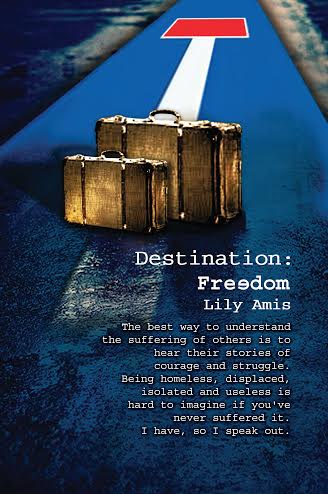
Interview With a Refugee. Destination: Freedom Author Lily Amis Tells All

lily amis, author, refugee

Author Lily Amis

What inspired you to write the book?

When I went through difficult times as a teenager in my early years in Switzerland, I always knew that I would someday share my story with others. I just felt that what my mom and I were experiencing as war-refugees was beyond normal and that I had to become the voice for other silent suffers like us. I felt it was my duty to share our story.

Also as a teenager drawing and painting was my way of self-therapy. But through long-term unemployment the older I got the more writing became my way of self-therapy.

refugeecrisis

You experienced many setbacks. Some were because of war, bureaucracy and  medical reasons. What was the hardest and what did you learn from it?

The hardest setbacks were and still are dealing with bureaucracy. As a kid I was an outsider as a refugee. Than the older I got I felt unwanted as a foreigner. And today as an adult I still feel unwanted and not integrated because of stupid bureaucracy.

That’s why I always say once a refugee, always a refugee. Once a foreigner, always a foreigner. The problem is that I feel homeless and lost. Even though I speak fluent German, Swiss German, English and Farsi where ever I go, I feel invisible, like nobody takes notice of me.

I learned from early years on to fight for my right and this hasn’t stopped until now and yet. I’m still fighting for my right, for my freedom and my acceptance!

refugee

You use Asiacity and EUcity instead of the names of the countries. Why is this?

I used Asiacity for Iran because unfortunately I feel specially these days when you say you’re Iranian you have to deal with injustice and discrimination. People have a negative view on my birth country. They believe what they see and hear by the Media and think my country is evil.

To be honest I was afraid that readers wouldn’t show interest in my story because they don’t like my country. Which is a shame, because my birth city Tehran is actually a great city and Iranian people are the most loving, friendly and helpful people.

I used EUcity for Swiss because I didn’t want to point my fingers out on Swiss and blame them for what the refugee law has done to us. Because the law is similar in most European countries and our suffer could have happen anywhere else to. And we see that now more than ever daily on the news.

What do you think of the current migrant crisis?

There are no words to describe my feelings. I have mixed feelings. I watch the news daily and it breaks my heart to see so many desperate people, young, old, families, children coming to Europe with completely false hopes and expectations. They have NO idea that becoming a refugee basically means giving up on your life, your future, hopes, dreams and goals. You leave your identity, pride and dignity behind for NOTHING in return.

It is also the prove of Karma. Twenty-eight years ago my mom and I left our home because of war. And nobody showed any compassion. Instead we were punished with bureaucracy.

Today Millions of refugees are coming from all kinds of countries and finally EU has to act and the Refugee Law has to change. The governments finally realize that the Refugee law as it was until now can’t function any longer. They have to find a fast and human solution to integrate these people in EU ASAP. That was what I always wanted to achieve with my story: Change the Refugee law which is now happening by a higher power.

Should people use the term refugee rather than migrant?

I don’t understand why people make such a big issue out of these two words. For me a refugee is someone who’s fled from war to stay alive. For me these people are war-refugees who have lost everything they have because of war.

Than we have economic-refugees. For example people from East Europe. They have not much and wish to have a better life and future. Which is absolute legitimate. After all we all are just short visitors on planet earth and should have the same rights for a happy life.

For me Migrants are people who have a life. But for whatever reason they decide to leave their home country and start a new life in another place. They do it legally with Visas by Embassies.

So in other words all the people that we see now coming are Refugees and not Immigrants. Why? Because they have lost their existence and have no place to go back to.

What got you through the tough times?

My mums devoted Love, support, care and believe. She’s an incredibly strong woman. I admire her strength and trust in God. Also my art work was a big help. Drawing and painting was my way of getting through tough times.

I have two examples that I like to share with you. Both were done in 1996, the original size is 50X70 cm. One is expressing that my only hope to ever feel Freedom is death! And the other one is expressing how I felt as a Refugee in Switzerland.

What can be done to help refugees?

I waited for this question for twenty-eight years. The refugee law must be updated ASAP. It can’t go on like this anymore. Toying with peoples destinies must take an end. The whole process of taking or not taking refugees in must be handled faster and fair. And finding a human solution is easier than the EU believes.

Depending on the country the people are coming from and why the decision whether to take them in or not can be done in a short matter of time. It shouldn’t take fifteen years to get a proper residence permit like in our case. It shouldn’t be necessary to get married without Love just to be able to have rights.

And when the EU countries accept these people they should give them a fair chance for a normal life and future. First of all treat them with respect and not like a disease. Understanding, caring, compassion and support MUST be the main priority.

Secondly when they start a life in a new country, they should have all the possibilities that are the fundament for an independent and fearless Life. Such as education and work opportunity.

Because Education means independence and independence means liberty.

Let them become the next Albert Einstein, Freddy Mercury, Bob Marley, Billy Wilder, Marlene Dietrich or Sigmund Freud. Don’t stop them from improving just because of stupid laws and injustice.

But the best HELP of all would be to STOP the War & Weapon business by reach and greedy countries. Than we wouldn’t have any refugees at all. Every human being could stay at home and live a fearless, normal life without suffer and pain.

You returned to your home country. How did that feel?

The title of my book is “Destination: Freedom”. When you read the book you assume that I found my freedom in EUcity (Switzerland) by leaving my hometown Asiacity (Iran). But actually the opposite was the case. When I returned to my hometown Tehran after fifteen years I felt Freedom for the first time in my entire Life. Even though the circumstances were terrible and sad, I was happy and free. I felt welcomed and not like an outsider anymore.

When will the other books be out and what can we expect?

The second book “Definition of Freedom” will be out soon. It is ready for print in English and in German. I think the readers of my first book “Destination: Freedom” will be very surprised to read how my life continued as a former-refugee.

“Definition of Freedom” is a cry for help and the perfect example of how the future of a refugee kid will look like if EU don’t put an end to the refugee system and change the rights of Refugees. Otherwise the future of innocent refugee kids like me are damaged forever and filled with personal and professional setbacks.

Would you believe me if I tell you that it took me twenty-seven years to be finally a naturalized “Swiss”? And that nothing has changed and I’m still desperately looking for Freedom? A place where I feel home, welcome, accepted and integrated? Would you believe me if I tell you that I’m still struggling and fighting for a “normal” life? Well these are just a few topics that I’m sharing with my readers in the second book of the trilogy.

What is next for you?

I’m hoping to find Freedom in a country where I feel welcome.

I’m praying to be able to breathe and live an independent life without fear of existence and the future.

I wish to continue my writing and use my voice for the voiceless. I want to help other sufferers specially Woman who have to deal with issues such as long-term-Unemployment, fear of existence, bullying, emotional and sexual harassment, burn out, depression, social isolation, loneliness etc. which are the topics of “Definition of Freedom” and my third book “Definition of Love” which I’m working on right now.

Interview With a Refugee Destination- Freedom Author Lily Amis Tells All book review

Destination: Freedom is a warts and all book which tells the brutal truth about being a refugee. Lily Amis does not censor herself at all. You learn about her frustration as bureaucracy stops Lily and her mother integrating into their new environment. They escape unimaginable horrors and are held back instead of being helped. If they were helped and given visas they could work and pay tax in the country they arrived in (Switzerland). I hope people in power read this book and some changes are made. This book is timely with the current refugee crisis the world is currently facing. An interesting read from a brutally honest writer.

Destination: Freedom is available here.


An Interview With The Incomparable Salley Vickers by Margaret Graham

I read Miss Garnet’s Angel a while ago now, and absolutely loved it and thought it would be fascinating to interview Salley Vickers, the author. At last I’ve managed to find a window in her busy life, and here she is to answer questions for Frost Magazine. What’s more you can hear her talking about The Boy Who Could See Death on 29th September at the Windsor Literary Festival.

An interview with the incomparable Salley Vickers   by Margaret Graham 1

You had an interesting but complex childhood, and felt that you had a sense of some unspecified task to fulfill. Did that sense drive you? Does it still?

Yes, I think it does. My parents imbued me with a feeling that one should work for the general good. In my case, that is best done by conveying my attitude to life through my writing.  But also they endowed me with a strong sense of the basic equality of all, and what people seem to like in my novels is finding aspects of their own hidden being there, which gives a sense of being understood.  I feel sure this is part of the power of a good novel – the capacity to make us feel known and perceived in our most private recesses of being.

An interview with the incomparable Salley Vickers   by Margaret Graham 2

Most of us grow up with parents defined in some way by their past. If it is a traumatic past, it can lead us to have an enhanced ‘political’ sensitivity, in order to weave our way through the rocks. We learn what to reveal, and what to hide. 

This is a skill I notice in your books, so would you agree that we authors write out of our past?

Inevitably, we write out of our conscious but, more powerfully perhaps, unconscious experience. The novel I have just completed, (‘Cousins’ published Viking March 2016) explores the way trauma recurs through a family history, even if the past is unknown to those in whom it re emerges. Nothing fascinates me more than how memory, both conscious and unconscious, lives on beyond the limits of any individual life.

You write with grace, but with ‘political’ care, holding back information, and then revealing. It gives an implicit tension. So – perhaps authors are not just influenced by their past, but trying to make some sense of it?  What are your thoughts on this?

I am sure I write to discover what I already ‘know’. What we think we know, what we know we don’t know and what we know but ignore are very common human conditions which I often explore. A previous career as a psychoanalyst has taught me to reflect on these levels of seeming ‘knowledge’.

Or are we just story tellers, or both?

Everything is story, in my view. Even science is a series of superseding stories. We are hard wired to make sense of experience through narrative. In analysis the work is to find a more workable version of the story a person tells themselves about their life. A writer’s job is to follow a story that has its own organic truth and is not a ‘truth’ imposed by the author’s own prejudices or intent.

How did you start your writing career? With short stories, or straight into Miss Garnet’s Angel?

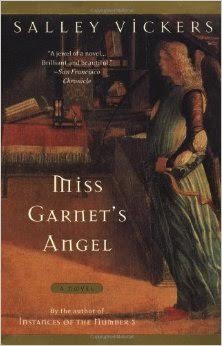
Miss Garnet's Angel

Miss Garnet began life as a short story and just grew. I had no idea of publishing it. Like much of real significance in my life it was a happy accident – as were both my wonderful children.

How do you work? Do you have the germ of an idea, spend time thinking and then planning? I ask this because your novels are multi-layered. They are  psychological, mythical, in some ways fairy tales, but grounded ankle deep in reality. I believe I would need to think, and plan, and know where I was going, and what I wanted to say to achieve this level of complexity, and present it, as you do, in such an accessible way.

I never never plan.  I hear a voice, revisit a much loved place, recover a memory and then let imagination, memory, sudden encounter, whatever accrue around it, rather like the grit of sand that through a nacrotising effect becomes a pearl. The excitement of writing for me is not knowing what is going to happen. I never know the end of a novel, or a story, until very near the end and then it is often a major surprise.

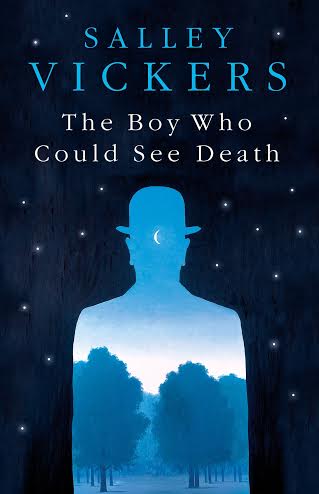
theboywhocouldseedeath3

Do you enjoy writing or do you find that starting a novel is daunting because until you have finished it, you have half a foot, or more, in their world? I ask this because once I start, I find that I need to ‘be’ the characters. Well, not even need to be, I am, the characters. Someone once said, that an author is writing their life story so absorbed do they become in the world of their characters. 

I love it once I’m in it. I tend to spend the first part of a book in a restless state of acute anxiety. Then once I get over a certain sort of hump I really let rip and can write for very long hours. But your unnamed authority is right: it does become one’s own life story and I think much of the excitement comes from living out a life that is both one’s own and yet not one’s own. I write out of myself lives I have never lived but live through writing them.

Of all the books you’ve written, which is your favourite?

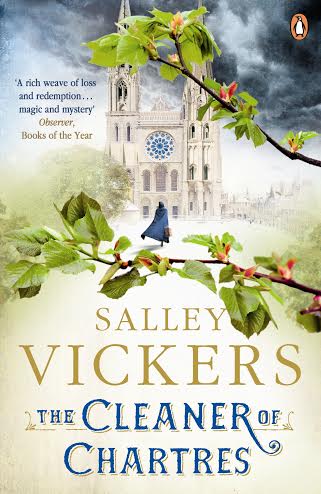
Probably the last one I have written – but if you point a gun at my head it would have to be either  ‘The Other Side of You’ or ‘The Cleaner of Chartres’.

pic 4 The other side of you

Have other authors influenced you?

Oh yes. Many. I grew up in a reading household, for which I am ever grateful, and had read all the classics by the time I went to university. Henry James,   George Eliot, Trollope, Conrad have all influenced me. Also Beatrix Potter on whom I learned to read and from whom I learnt about cadence (if you listen to Beatrix Potter the prose is exquisitely cadenced).

pic 5 Beatrix Potter

But of more contemporary authors, Penelope Fitzgerald and William Maxwell are my heroes. Penelope Fitzgerald did me the great honour of endorsing Miss Garnet shortly before she died. I’ve not had a higher or more precious encomium since.

ic 6 Penelope Fitzgerald

What next? 

Cousins and after that it’s a secret, even from myself

What do you do when you are not writing?

The usual introvert’s pleasures: read, walk, talk to friends, listen to music, go to the opera/ ballet.

What brings you joy?

Children (this is boast but I am reliably informed by my grandchildren that I am very good indeed at playing), birds, poetry, dancing, and I must confess also …. shoes…

pic 7 shoes

Salley Vickers is talking at the Windsor Literary Festival on 29th September at 7.00 pm. She will be discussing The Boy Who Could See Death. The boy is question is Eli, who is an ordinary lad with an extraordinary gift, or is it a curse?

For more information:

http://tickets.windsorfestival.com/Sales/Autumn-2015/Tuesday-29th-September/The-Boy-Who-Could-See-Death/The-Boy-Who-Could-See-Death


Anna Friel Interview for The Saboteurs

Anna Friel interview for The SaboteursWhat can you tell us about the series?

It’s following in the footsteps of the great Scandinavian television – it’s very much revered. It’s about how the Norwegians stopped Hitler from building a nuclear weapon by the production of heavy water. They sabotaged the factory that produced something called heavy water that had the potential of creating a German atomic bomb. It should be a very, very well-known story but it’s not.

You play Julie Smith, how would you describe her? What attracted you to the role?

After getting the script I flew to Norway and met with the writer. The fact that it was a Danish German British and Norwegian production was just incredible. It’s an incredibly different process to ours – it’s amazing what they do.

I play a fictional character and the only girl who’s surrounded by men, so we knew she had to have a lot of guts and strength. I really admired that it’s an alternative take on a love story too, with Leif Tronstad (played by Espen Klouman-Høiner) the fact they never get together is really heart-breaking.

The director uses music very cleverly in his work and I think it’s really emotive to the character. It showed a very gentler side to a hard exterior.

What was it like being part of such an international co-production, and with lots of different languages spoken amongst the cast?

I’ve always wanted to go to Norway, to see the Northern lights – it’s one of my dreams – and I just thought the cast was incredible. In literally a green room full of men I was the only woman, I often find myself in that situation – I must be a boyish girl at heart! But they were great, I joined in with all their banter and they were so welcoming.

Were you familiar with the story before taking on the role and did you do any research on this period in history to prepare?

I wasn’t aware of the story but I did some research, read books about the team that went on the journey and I am familiar with the time – I think this is my third job that’s set in the 1940’s.

As the series is based on an important moment in history, were you anxious about taking on the role at all?

You’re anxious when you take on any job but I knew that I was in incredibly capable hands. They got the top actors from other countries and I really love now that they’re mixing the British actors with the Danish and the American actors with the British and that we’re all becoming a bit more international. They all have very different approaches and I’ve been in the industry now since I was sixteen years old, I Iove learning from other cultures and from different actors’ approaches.

Was there training involved before filming? Did you have to do any stunts?

I didn’t really do any stunts but getting into that uniform was sort of like one! There is a scene where I use a gun and have to hit every target so there was some training for that. Weirdly enough my last few jobs have been military and my next job is also military.

What was the shoot like, did it take you to any interesting locations?

Norway and Prague doubled for Scotland, our base, and the huge factory. So I think if you added it all up I’ve spent a year and a half of my life there – Gracie (my daughter) has spent 6 months of her life in Prague so I knew it very well. Our director of photography was absolutely incredible, a real genius.

What’s your favourite memory from the set?

It’s probably when we used something called an opticopter, which is like a drone. They all had this toy for the first time and it has a little camera so it could fly up and do these big sweeping shots. I remember about 4 or 5 years ago you’d have to get a huge crane out to film scenery like that and it was very time consuming but that day everyone was so excited despite it being freezing cold!

The Saboteurs starts on Friday 19th June at 9pm on More4


Interview with Dame Judi Dench and Finty Williams

Interview with Dame Judi Dench and Finty WilliamsOn election day, on May 7th, at 8:25pm, More4 is showing The Vote, a play by James Graham, set in a polling booth during the last 90 minutes before the polls close. The play, which will be screened live from the Donmar Warehouse (at the end of a two-week run), is a unique and ambitious project featuring a cast of over 50, including some stellar names. Chief among them is the acting royalty that is Dame Judi Dench, and her daughter, Finty Williams, who play, appropriately enough a mother and daughter.

Meeting the pair in the quiet opulence of a library in a central London hotel, their bond and mutual affection is immediately palpable, as is their excitement about this remarkable play. Here, they discuss politics, plays and passion, and revel in the joys of working together.

Can you explain a little bit about the concept of The Vote?

F: James Graham and Josie Rourke came up with this idea to set a play in a polling station in Lambeth. They wanted to get a cross-section of people who would come into a polling station in an area like that. So it’s an extraordinary, 52-person event, and we’re a small part of it.

J: It’s impossible to get us all on stage at the same time. Just for the curtain acll.

F: It’s really extraordinary, we did the curtain call yesterday. I found it quite emotional. Seeing all those people on that stage.

J: It’s thrilling.

So, in that respect, is it completely unlike anything you’ve ever done before?

F: Yes!

J: Well, it’s not completely unlike anything I’ve done, because I’ve done the York Mystery Plays three times, and that’s a cast of an enormous amount of people all together, all rehearsing in bits and then getting it all together. This is nothing like that, in content, but I suppose in the working process it’s reminiscent of that. But we only came into it the week before last.

F: We thought we were starring in an epic! And then we saw the first run-through and realised we’re actually in fifteen minutes.

You’re in it longer than most…

F: We are, actually. And we’re very lucky, because we’re in it at the end.

Who do you play?

F: Amazingly, we play mother and daughter. We keep saying “Do we look like mother and daughter?” People look at us as though we’re mad.

J: And we play mother and daughter of the same name: Christine Lola Metcalfe.

F: And the same address.

J: Which is what causes the confusion in the play.

Although you’ve acted together before, is this the first time you’ve played mother and daughter?

F: I’ve been ma, as a younger person.

J: And you’ve been my daughter before. Only on film, though.

F: Oh yes, in Mrs Brown – we did that!

What was it that attracted you to the project?

F: Selfishly, we wanted to work together. But it’s amazing to be part of something that’s so exciting, that people who aren’t in it are so excited about. And at such an extraordinary time, as well. How lucky is that? And to be in a play by James, directed by Josie.

J: And for thirteen performances. It’s a part I’ve waited for all my life, I think. Being with Fint, and to open on one day and twelve days later to close. It’s thrilling.

F: The excitement never goes then.

J: It never goes, because you’re always nervous and always frightened. But it’s a real one-off, it’s exciting and innovative.

And it’s the first time you’ve performed at the Donmar for almost 40 years?

J: Yes. My husband was the first company into the Donmar, with Schweik in the Second World War in 1977, and we followed with…

F: You can say it…

J: I’m not saying it! We followed with the Scottish Play straight afterwards. Although I’ve been to the Donmar, of course, I haven’t played there again. It’s very nice being back there, although much of it I don’t recognise. I recognise the theatre itself, but not anything backstage. We were all in one dressing room back then, the whole company. You certainly couldn’t do that now.

F: It would be tricky to get 52 of us in one dressing room.

Finty, I read that you are most on edge when your family come and see you perform. Does that still apply when your mother is watching you from the other side of the stage?

J: We’re never the other side of the stage. We stick completely together!

F: It’s just about the people who you love the most, whose opinion you value the most. When they come and see it, that’s always a nerve-wracking thing, whether it’s ma, or my boyfriend, who’s an actor, or my son, or very close friends.

J: It’s always that night that you want to go best.

F: And you inevitably come out and go “Oh, but last night it was so much better!”

When you go and see each other in something, are you brutally honest afterwards, if it’s called for?

F: Ma is… this is like a therapy session! I think ma is more honest than I am sometimes. But we have a sort of understanding that if you haven’t enjoyed it then you appreciate the fact that the other person’s got to go on and do it for however many more weeks, and then you can be honest about what you thought of the play, or somebody else in it, or whatever, after they’ve finished.

On election night, the play is going to be broadcast live on More4. What’s that prospect like? Is it nerve-wracking? Do you even still get nervous?

J: Do I get nervous? Yes I do! I get nervous about putting one foot in front of the other. And more so as the years go by! But it’ll be very exciting, because it goes right up to ten o’clock.

F: So we’ll hear the actual exit polls at the end of the show.

J: And then there is a party that goes on all night. And breakfast for the survivors. I very much doubt I’ll be there by then. But, especially this time, what on earth is that night going to be like?

It’s filmed by fix rig cameras. Does that mean they’re very unobtrusive? Will you have performed with them in situ before the night itself?

F: I did The Scottish Play at The Globe…

You see, you can’t say it either…

F: I’m only not saying it because ma’s not saying it! Anyway, that was filmed.

J: I can’t tell you how obtrusive they are. I don’t think we’ll do a performance with them before the final one. We do camera rehearsals. But I don’t think there’s an actual performance with the punters in.

F: I think if you’re on of those actors who constantly looks out at the audience, you might notice them. But I try not to look. Do you?

J: Always try not to look.

There are some incidental scenes that take place in the play that will happen during the ad breaks of the More4 screening. Presumably that means the whole thing will have to be meticulously timed?

F: Yeah. I’m not going to worry about that.

J (laughing): That’s absolutely not our concern, is it?

F: I’m just going to say the lines, and hope we don’t take too long over them.

It’s a wonderful cast, isn’t it?

F: It’s extraordinary.

J: It’s a lovely cast.

F: One of my greatest friends from drama school is in it – Ghiv Chahidi. It’s taken us 21 years to work together. Although he’s worked with ma, and he’s worked with my boyfriend. But we’ve never worked together. And we end up standing next to each other at the end. But it’s amazing people, extraordinary to watch. You say the script is funny – and it is – but it’s genius, what certain people are doing with it. Proper comedic genius. It’s amazing.

What do you think The Vote is saying about the election, and about democracy in general?

J: I don’t know. It’s going to say a lot of different things to a lot of people, I think. It’s an across-the-board look at the situation at the moment and, in a way, how chaotic it is.

F: It’s such a diverse cross section of people who go into the polling station. It sounds naïve, but I’d sort of not really appreciated that you’d get that sort of cross section of people just coming in to one polling station.

J: Or not coming in. We’ve not said about that. All the people who are not going to vote. And feel no responsibility about it whatsoever.

Have you discussed among yourselves how you think your individual characters would vote?

J: My character votes Conservative. I’m settling for that. That’s the kind of person she is. And she’s appalled that her daughter turns to her and says “What do we vote?” She’s a dyed-in-the-wool Conservative.

Are either of you particularly political?

F: My boyfriend is. He’s been out canvassing for Labour. He’s really passionate about it. He’s desperately trying to get me and my son more politically-minded.

J: I have political views, and I voice them, and get very, very angry about things. In my family, we were advised not to talk about religion or politics when we were young. And so we’ve all been able to be very diverse and do what we wanted to do. And see other people’s points of view. Some of them more than others.

F (laughing): We like to see everyone’s point of view, apart from those who don’t agree with us.

It’s an extraordinary political moment. Are you excited about this election?

F: Slightly fearful.

J: Yes, I think I’m fearful. I’m curious about it. But I’m appalled, in a way, about the apathy there is about it. Someone said to me the other day “It’s the most boring election campaign that there’s ever been,” which I have to agree with, I’m afraid.

F: When they start picking up on how many kitchens people have… Really? Is that something that is going to sway people?

J: I heard a programme this morning saying that no-one goes out with a soapbox anymore, because there’s actual fear of doing that. It was interesting. There is a kind of behind the glass attitude to it all now – and actually not talking to people, not engaging with people. Saying the same things over and over again. It’s all election speak now. That’s not what it should all be about. I heard some young people talking, saying nobody talks a language they understand. No-one addresses what they’re thinking about. And indeed they don’t.

After you’ve performed on May 7th, what will you do…

J: Lie down!

Will you sit and watch the election into the early hours?

J: There’s going to be this big party, and breakfast.

F: I’m going to be at the party all night. I will stay there.

Will there be screens? Will it be a political thing?

J: Oh, I think definitely.

F: I’ll be there. I’ll be one of the ones having breakfast.

What’s the best thing about working together?

J: Shorthand. And the fact that we like it so much. We don’t have to pretend that we like it. We actually like it. Michael used to have an expression. He used to say “There are some jobs you run to do.” And for all the fear of having three days’ rehearsal for this, it is a job I run to do, and I can’t wait to actually have that thing of being onstage with Fint.

Was it the same sort of experience for you when you worked with Michael?

J: Yes, it was. You’re frightened for the other person too, so it’s double fright. We did Mr and Mrs Nobody, and Mikey said “We’re going to have such a blast doing this. Lots of laughs, and it’s not very long, so then we’ll get to go home.” Well, it was the hardest thing you can imagine. It was thrilling to do, but we were so tired at the end of the evening.

F: And the learning was tricky, wasn’t it? Ma used to be upstairs in our house with me, learning lines. Dad would be downstairs. We’d have a running supper, it would go round the house.

Was it things like doing lines with your mum that inspired you into the same line of work?

F: No. I don’t know if it’s the same thing if you’re the daughter of a brilliant brain surgeon, who is incredibly good at what they do, works with incredible people and – not quite the same for the brain surgeon – gets to wear great costumes. That’s inspiring. And ma makes it great fun. I spent most of my teenage years in the National Theatre. Mum would go on to do a scene in Hamlet, come back, get changed to go back on and do another scene, and she’d come back and I’d be wearing her entire first costume in the dressing room. That was what I loved. And to hear the applause at the end for her. That still really gets me. That’s the person I love, and they’re being appreciated by all these people. I watch Britain’s Got Talent, and someone’s there saying they’re proud of their parent or their daughter, and then they get a standing ovation, and I’m in floods of tears. It’s a really deep-seated pride.

J: Fint originally wanted to be an acrobatic nurse. And we were very, very keen. Michael said “You’ve got to do it.” Can you imagine? Swinging up the ward to take somebody’s temperature upside down. Absolutely thrilling.

How did you feel when she revealed her intention to go into acting?

We were incredibly excited about it, and said “I suppose it was inevitable.”

What are the roles that have meant the most to you over the years?

J: Over sixty years!

F: Anything at The Globe, because it’s just the best. Playing Maria in Twelfth Night at The National. Ma did a play called Entertaining Strangers when I was about 14, which totally changed my life, I loved it so much. It was directed by Peter Hall, and it was in the Cottesloe. And I remember saying to ma “If I coukld just be in a play directed by Peter Hall at the Cottesloe, I’d be the happiest person in the world. And when I was doing Bedroom Farce, that he directed, which was another big favourite, he asked me to audition for Maria in Twelfth Night in the Cottesloe. And I got the job, and I came out and phoned ma, and I stood on the phone to ma outside the National howling, literally howling. And later on, we were rehearsing for it, and it was all wonderful, and we were doing Malvolio’s letter scene, and they’d picked up a load of letters from the props store, and I opened a letter, and it was one of the letters that had been used in Entertaining Strangers all that time before. That was probably the best. Ma, 60 years, go for it!

J: It’s really for people, for actors and actresses and the company and the director of course, that you remember things. Plays I did with Mikey. When we got the chance to work together it was thrilling. Not so thrilling when we did The Merchant of Venice, a play I don’t like very much. We were just married, and I turned to him and said “I speak too long; but ’tis to peize the time, To eke it and to draw it out in length, To stay you from erection.” And it’s ‘election’ of course. At which point, the Royal Shakespeare band just put their instruments down and had to walk off.

I loved playing Anthony and Cleopatra, because I was an unbelievably unlikely choice to play Cleopatra. I loved every minute of it. And I loved working with Peter. And I loved A Little Night Music, getting to sing and do Cabaret.

F: There was also an amazing show she did called The Gift of the Gorgon, which she didn’t have the best time doing, it was a very tricky play. But it floored me. Amazing.

Are there any particular parts that either of you would particularly like to play?

J: I never know what part I should do. I can never think if what I’d like to do, I wait until somebody says “This is a part you ought to have a go at.” Fint?

F: I want to play Miss Adelaide in Guys and Dolls. Really badly. And I’d like to work with [boyfriend] Joe, properly. Like ma got to do with dad.

J: Perhaps we could all be in a play together.

F: We could age-up Guys and Dolls, and you could play Miss Adelaide.

J: No, no, no. I’d be an old person, sitting in a chair watching. Tapping my foot to the music.

If you could work on one other project together, what would you choose?

J: I like a new play.

F: Something where we have a big entrance at the end, down a big fl… actually, not down a big flight of stairs.

J (laughing): I could come down in a lift.

F: You could have a Stair Lift. And we could be wearing wonderful red dresses cut up to the thigh.

J: That would be very, very good!

F: And an amazing dance number. Maybe I’ll do the dance number. You can just stand still and do something extraordinary in the middle.

The Vote is on Thursday May 7th, at 8:25pm, More4

With thanks to Channel 4. 



Emma Dyson Interview: Acting Advice From Spotlight’s Career Expert

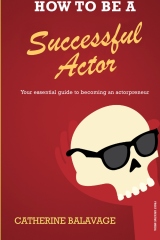
acting tips, acting career, acting, advice, book, how to be a successful actor, quit, Catherine BalavageI interviewed a lot of great casting directors, actors, directors and experts in the acting industry for my book How To Be a Successful Actor: Becoming an Actorpreneur. One of those interviews was with Emma Dyson who gives actors career advice for Spotlight, the main casting site for actors and casting directors. Spotlight is also the essential casting site for actors, if you are not in it, you are invisible. An extract from the interview is below. Read it and learn.

Emma Dyson works for the main casting website for actors in the United Kingdom, Spotlight. She also does one-on-one talks for Spotlight members to give them career advice.

So tell us about you.

I’ll tell you a bit about my background. I trained as an actor at the Guildford School of Acting in the 1990s and then, having got the training out of my system, I quickly realised I couldn’t be an actor. I probably didn’t have the talent or the perseverance or the backbone. Then I was an agent for six years. Then I left being an agent thinking that I would go into a different career, something entirely different, but every job that I was getting was pulling me back to the business so first of all I was working at my old drama school back at Guildford, I was the personal assistant for Peter Barlow who was the then assistant director, and then I left two weeks into the job because he was leaving. Subsequently a casting director put me in touch with Thea from United Agents, and I was temping at United Agents sort of off and on for about six months which is when I got the job here at Spotlight being the PR manager.

I used to do castings within the agencies and get the Spotlight breakdown and put roles and the actors that fit them together. It was interesting, having worked in an agency, because the first point of contact that you do in casting work is Spotlight. Now I am very happy here as PR manager and I go to the drama schools and talk about acting and Spotlight member benefits. How to get a good CV and photo, what type of letters to write to casting directors, agents. Time and time again they are incredibly green. They are in their final year of drama school and have hardly written any letters to agents or casting directors. They leave thinking ‘Here I am, come and get me!’ it just doesn’t work out like that. It’s really important and I empathise that it is very important to write letters, to hopefully reach your future employer, who will, across the course of your career, become your friends, and keep re-employing you.

acting, acting advice, acting book, how to be a successful actor, actorpreneur, auditions, castings, casting breakdown, how to be an actor, It is such a shock when people leave drama school. They don’t really know what to do.

I know and it is such a shame. They go to Central, LAMDA and RADA. Those are very central London schools. They get so spoilt for choice because it’s awash with agents and casting directors, it carries the kudos of being at the best drama school. Where I was at Guildford  we were terribly cut-off  despite the facts it’s only a twenty minute train journey, but, we felt very cut-off.  It’s a shame that schools that are not in central London get kind of left out and not thought of. There are some interesting actors in regional schools. The Welsh college is a very good school with a lot of good courses and a brilliant reputation. Conversely Rose Bruford has some really good students and that is in Kent.

I think you have got to train, you have got to workshops, you have got to keep classes going. Try to teach yourself as many skills and techniques as possible because the more skilled you are as an actor the more you should work. I always like the actors who go into musical theatre, straight theatre, film and do a bit of everything,  And what we are noticing is that there is more of a vogue for musical theatre and films are being made from those musicals. I know of a few film directors who are making films which are musicals. It is kind of a renaissance or a nod to the 1950s. The MGM sort of musicals. Musicals are very popular.

So learn to sing

Learn to sing if you can, and if you can dance then I think you will probably work all the time.

Daryl Eisenberg, an American casting director, told me two things when I met her: One, you are not special. Don’t think you are more special than anyone else and are just going to make it,  and two, whatever is stopping you from getting a job, remove it.  So if you can’t dance then learn to dance, etc.

I think that is just a roundabout response to what I just said. If you do just keep yourself as skilled and as tuned in as possible then you will get work. You have to do as much theatre as you can and as much film as you can. Not only that but I extend it to: if you are a London actor or a London based actor see as much art as you can, culturally exploit everything which is on your doorstep. Because I think that tunes you in to everything. It keeps you aware of what is current. You pick up on working trends and that reflects across the arts.

Tell me about Spotlight events,

Yeah, we do events. Being PR manager. ..We did one in October in conjunction with the London Film Festival. I got three casting directors. I got Karen Lindsay Stewart and Lucinda Syson. It was held at the British Film Institute and it was chaired by Pippa, my boss, and myself, it was just about how to become a working actor, keeping your CV up to date, how to get an audition, and also I do seminars where I talk a lot about being a working actor, how to network, all of those things, and at Spotlight offices on every Monday we have Spotlight Mondays where I operate 20 minutes chats with people who are stuck in their careers. They are incredibly popular. They always sell out very, very quickly. And the seminars are sometimes in conjunction with Actors Expo or other bodies. We just hold little seminars in house.

How do you break through?

I think it depends because some actors burn out very quickly, and other actors, they see an opportunity and they become very successful and popular when they are in their forties. So I think it just depends because there is so much reliance on good luck and you have to have a lot of charisma, a lot of talent. But then the rest of it is luck. I think you can make your own luck, but a lot of it is out of your control. Probably one of the reasons that I didn’t become an actor was because I couldn’t stand being in a career with no control.

To answer your question, I think it depends on many things. They have to have a good agent behind them and the rest of it I think is luck.

What is the most common mistakes actors make?

Not being proactive, not writing letters to casting directors. Even with a good agent you should still do your own work. Not looking after themselves, not working out, not eating well, not networking, I think all of these things, the actor has to do that. It is part of their homework.

How many actors are on Spotlight?

Just over 40,000


For the rest of the interview, and great interviews from our acting industry professionals get your hands on a copy of How To Be a Successful Actor: Becoming an Actorpreneur now.


Chuffing brilliant! The Railway Children Theatre Producer Tristan Baker Talks

The Railway Children on stage at Kings Cross, London

The Railway Children on stage at Kings Cross, London

Theatre producer Tristan Baker talks about the show where the West End’s heaviest leading lady is not only delighting audiences of all ages, but is also inspiring marriage proposals …

Take one of the best loved books and films of all time. Add a vintage steam engine, a superb cast and mix well. While the ingredients are blending, crack on and build a theatre from scratch, including a railway track, against the clock. Add a dash of blind panic and garnish with lashings of Edwardian style. Serve to critical acclaim and enchanted audiences of all ages.

That’s the simplified version of how The Railway Children came to life at its new home in London’s Kings Cross. The unabridged version involves so many technical challenges that you could travel from London to York on old rolling stock in the time it would take to tell. Certainly one of the show’s producers reckons that the team who made it happen deserve their share of the five- star reviews.

“I am very proud of the team,” says Tristan Baker, with feeling. “In five weeks they built a one-thousand seat, purpose-built, theatre from the ground up, including laying a train track. It meant working around the clock to get the show on – they were sometimes laying track in the rain at 2am – but they did it.”

And when he says it’s a purpose-built theatre Tristan isn’t exaggerating. Walking around the venue on King’s Boulevard with him, the detail is extraordinary; from the state of the art heating system (to ensure maximum audience comfort), to the unique railway platform stage. Located behind King’s Cross Station, the site has been loaned by Google and will one day be Google HQ. But for now it is home to The Railway Children – “a steam engine rather than a search engine,” laughs Tristan, explaining that the objective was to create not just a show, but an experience.

“It is very site specific. From the moment you arrive and pick up your tickets you are in Edwardian England.” Bang on cue a group of costumed front of house staff surge forwards to greet members of tonight’s audience, directing them to the foyer, which is a perfect replica of an Edwardian station waiting room.

“Our front of house team are all carefully selected and trained to give the audience a really wonderful and authentic experience,” says Tristan, navigating a path through an excited party of teenagers and a group of middle-aged ladies who have come up from Cambridge for a day of shopping, lunch and theatre.

Undoubtedly it is a show with universal appeal. An average audience comprises dating couples, families (from toddlers to great grandparents and all the generations in between), tourists, students, WI ladies, book clubs, Guides and Scouts – people of all ages.

“They are all transfixed,” says Tristan, adding: “I think adults experience it on a different level. Maybe they remember the film from when they were children, or perhaps reading the book, but as adults they realise the political and emotional aspects of the story.” Leaping nimbly up the steps of the bridge that separates the two platforms (the audience sit either side of the track) he stops and looks fondly up at the hefty leading lady, her paintwork gleaming under the lights. “And who can fail to be excited by a three-hundred ton steam train arriving on stage?”

He’s got a point. The magnificent engine is breath-taking. Dating back to 1896, complete with a vintage carriage, this grand old lady is, quite literally, the West End’s biggest diva. Transported from the National Railway Museum in York on a low loader, even her arrival was the kind reserved for superstars as, like the most illustrious celebrities, she arrived with a police escort.

Adapted by Mike Kenny, The Railway Children was first produced by York Theatre Royal at the National Railway Museum, York in 2008. Two sell-out seasons were followed by a transfer to Waterloo Station, where it opened in the former Eurostar terminal and again enjoyed smash-hit success, bagging the 2011 Olivier Award for Best Entertainment along the way. And steaming into Toronto in 2011, Canadian audiences also fell in love with this stage version of Edith Nesbit’s classic story.

Telling of three children whose lives change dramatically when their father is mysteriously taken away and they are forced to relocate from London to a cottage in rural Yorkshire with their mother, the book was first published in 1906. Exciting, with plenty of adventure and drama at its heart (“what happens to the children is quite awful but they are resilient and make the best of their situation”), heading the current cast is Caroline Harker as Mother and comedian and actor Sean Hughes as Mr Perks.

“Sean has just joined us and he brings a joyous warmth to the role,” says Tristan, agreeing that ‘joyous warmth’ pretty well sums up the feeling that audiences go away with.

And it seems that The Railway Children also inspires romance. “We do get a lot of couples coming to the show on date nights and we have recently received a request for permission to make a marriage proposal from the train,” smiles Tristan, as we take our seats.

Long before we reach the end of the last act, with the heart-rending ‘Daddy, oh my daddy!’ line, the reasons for the production’s success are abundantly clear. With ‘wow!’ factors at every turn, this much-loved classic story has been transformed into chuffing brilliant theatrical experience. Whether you’re eight or eighty, it’s one that should not be missed.

Come on now! All aboard!

Vicky Edwards

THE RAILWAY CHILDREN

King’s Cross Theatre, Goods Way, King’s Cross, London N1C 4UR

Currently booking until 6 September 2015

Box Office 0844 871 7604

Website www.railwaychildrenlondon.com

Facebook www.facebook.com/railwaychildrenlondon

Twitter @TRCKingsCross

Google+  plus.google.com/+RailwayChildrenLondon

Frost Editor Catherine Balavage Interviewed By Writing Magazine

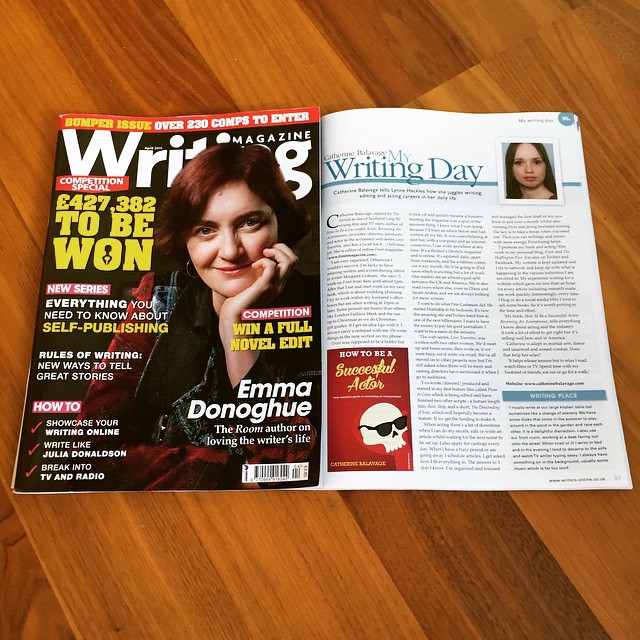
If you have ever been curious about Frost Magazine editor Catherine Balavage’s writing day then grab a copy of the April 2015 edition of Writing Magazine. Catherine is interviewed by Lynne Hackles. She talks about Frost, writing books and her acting career.

Catherine Balavage, my writing day, writer, writing, magazine, interview, acting,

Catherine is not the first Frost team member to be interviewed by Writing Magazine, contributing editor Margaret Graham was also interviewed about her writing day in a prior issue.

Head down to a newsagents and get your copy now. Available at WHsmith.co.uk, Waterstones.com, all good newsagents or the Writing Magazine website.