Gillray’s Steakhouse & Bar | Restaurant Review – Part 1: The Bar

The bar at Gillrays

Gillray’s Steakhouse & Bar is situated in a five star hotel, the London Marriott. Which is in turn located in the former seat of London’s government, County Hall, just across Westminster bridge from the Houses of Parliament. Walking up to the hotel to get to the restaurant, one’s breath is taken away by just how beautiful it is. It is so full of class and elegance that you almost feel it is from a different era.

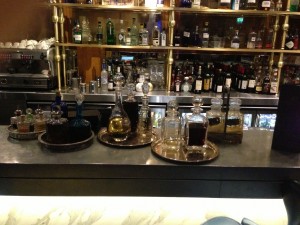
The hotel itself is beautiful. The stuff dreams are made of and as we walk into the restaurant our first view is of a gorgeous English Gin bar, with riverside views of the Southbank. The bar is based on 18th-century social and political caricaturist James Gillray.

The Perfect Martini


We talk to Carlos, the bar room manager. Carlos is friendly, passionate and knowledgeable. It’s clear that no expense has been spared and a huge amount of effort has been put into every last detail. Gillray’s Steakhouse & Bar has 35 English gins, and it will soon be ‘over forty’. Only the very best make it onto the menu. The bar looks wonderful, almost like some fantastic chemistry cocktail laboratory.  Everything has been done to an exact science to ensure perfect quality and it comes across in the taste of the cocktails

The menu is fascinating and separated into eras, Georgian, Victorian, Edwardian, contemporary and modern Britain. Each era has its own brilliant Gillray caricature. Although the specialty is Gin there is a huge range of many different cocktails. A full menu can be found here

I ask Carlos for a recommendation and have the St James Martini, something I already had my eye on. It comes in the most perfect glass, looks great and tastes divine. If you love martini’s, make sure you try one.

My colleague has a ‘First Kiss’, made up of Hendrick’s gin with peppermint, lemongrass tea tincture, shaken with lime juice, sugar and fresh pineapple. The result is a delicious, refined and refreshing. One of the best cocktails he has ever had.

The ‘First Kiss’ cocktail

The cocktails were fairly expensive. Most of them are around £10.

However this a real experience. It is something unique that you will remember and it fully justifies the cost. Anyone who loves cocktails must try it, and everyone else should go at least once for the experience.

Having finished off our cocktails we head off to the restaurant area behind the bar. You will be able to  read a full review of the restaurant part of Gillray’s Steakhouse & Bar very shortly.

Part 2 here


Dr Robert by Lee Miller | Fashion

Check out these wonderful photos from Dr Robert by Lee Miller’s fashion Show held at the University Women’s Club in London, May Fair.

S DEAN PHOTOGRAPHY and SEE-LI photography.

TEDxEaling

Ted Talks are now famous, and when they came along to Ealing I went along with my film business partner, Steve McAleavy.

We had a brilliant time and there was some really brilliant talks. TedXEaling was brought to Ealing by Chris Jones, film director and owner of Living Spirit pictures. Below is some of the people who talked at the event. I had a brilliant time and met some amazing people.


Sebastien Foucan: Our relationship with fear

Sebastien Foucan is the founder and creator of freerunning. Sebastien is well known for his views on the philosophy behind freerunning and is an ambassador for the discipline in many countries across the globe.

Seema Anand: The Art Of Seduction

The ancient arts of Courtesanery and Seduction were once treated as high philosphy, with divine and academic associations. Dr. Seema Anand explores how these narratives have been lost and in the evolution of their vocabulary, the implications have changed. Working with the range of what ‘story’ can mean to an individual Seema facilitates the learning processes of ‘telling’, ‘listening’, ‘acknowledging’ and ‘rejecting’ the narratives that make up our lives and our social interactions to enhance communication, build links and open dialogue.

Jarred McGinnis: Writing is the Only Magic I Still Believe In

Jarred McGinnis will share his passion for stories and demonstrate the power of words from Speech Act Theory to the genius that is the children’s book ‘That’s Not My Pirate’. Jarred is an American living in London, and the co-founder of the literary variety night, The Special Relationship. His fiction has been commissioned for BBC Radio 4, and appeared in journals in the UK, USA and Ireland. He is wickedtomocktheafflicted.com. In addition to writing fiction, he holds a PhD in Artificial Intelligence.

Eve Hazelton: Film Director of Photography

How does light and shadow impact on our understanding of story? As a Director of Photography, it is Eve’s job to visualize a story and use the tools of her craft to translate that into a film. With the stereotype of a DoP’s role to be all about camera’s, Eve explores how other area’s of her job are equally, if not more important. Eve is the Director of Photography and Editor for Realm Pictures, an independent film company based in the UK. Her’s are the eyes which reveal the stories that the team at Realm want to tell.

Linda Potgieter: A purpose driven life

Linda Potgieter has enjoyed a rewarding 22 year career predominantly focused on designing and delivering communications solutions. Director of a locally based training and consulting firm, she has spent the past eight years designing and delivering communication and negotiation training across 14 countries. Linda’s inspirational delivery style is driven by her passion for the human connection within negotiations.

Chris Atkins: Lies and Truth – How to get to the truth of a story by telling lies

Chris’ first doc, Taking Liberties, is about the loss of civil liberties in the UK and is a polemical and entertaining theatrical feature. In June 2007 the film was released theatrically and was one of the highest-grossing documentaries of 2007. Chris was nominated for a BAFTA – The Carl Foreman Award for best writer, director or producer in their first feature film. He has since produced a slew of controversial documentaries for both cinema and TV.


Dekay: Urban Poetry

Dekay will perform a rap from her latest album and teach us about storytelling in a different form. Dekay is an unsigned rapper/songwriter/producer from Camden, North West London. With a back catalouge of 3 mixtapes and an album, Dekay has been battling, rhyming and shotting cds in the endz for the last 8 years.


Daniel Sloss: It’s just a story

Scotland’s Daniel Sloss is currently one of the fastest rising stars of UK comedy. He started doing stand-up aged 16, has appeared on numerous TV shows including ‘Michael McIntyre’s Comedy Roadshow’ plus his own BBC show ‘The Adventures of Daniel’ and tours extensively thoughout the UK as well as internationally.He will be talking about how comedy is a series of short and truthful stories.


Will Brooker: Tales of the Dark Knight

After 73 years in popular culture, Batman has become more than a corporate product and commercial property; he also belongs to generations of readers and fans who circulate their own stories around him, and keep his legend alive. Will Brooker is Director of Research in Film and Television at Kingston University, London. He is the author and editor of several books on popular culture and audience, including Batman Unmasked, Using the Force, the BFI Film Classics volume on Star Wars and, most recently, Hunting the Dark Knight: 20th Century Batman.

David Varela: Throw your Story from a Plane

David Varela is a London-based writer and producer. He has written for film, theatre, radio, magazines, ebooks and games, creating some of the world’s most exciting transmedia projects along the way. These include Lewis Hamilton: Secret Life (for Reebok), Xi (for Sony PlayStation) and most recently The Seed, a transmedia story combining four plays, a treasure hunt and online characters, as part of the London 2012 Cultural Olympiad. He is currently developing an original drama series for Channel 4.

Emily James: Shooting Outlaws without Hurting Anyone

After her first broadcast commission, The Luckiest Nut in the World (C4, 2002), the Guardian asserted “Emily James is a genius”. Following the experimental Don’t Worry, (C4, 2004) and What Would Jesus Drive?, (C4, 2006) Emily’s attention has now shifted to feature documentaries, acting as Executive Producer on the acclaimed The Age of Stupid (2009). Her feature directing debut, Just Do It: A tale of modern day outlaws screened in over 45 independent cinemas across the UK in Summer 2011.

Richard Newman: Inspire and Motivate People with PRO

Working with 17,000 people across 45 countries Richard discovered there is a story-telling method that motivates all of us, called the PRO system. His team have helped clients win business worth over £1.6 billion, working on pitches and presentations to make them stand out from the crowd. Clients include the McLaren Formula 1 Team, KPMG and IBM. Recently he has been working with 20th Century Fox and Warner Brothers, to promote their TV shows about body language.

Julian Friedmann: The mystery of storytelling

How we tell stories seems to be a mysterious process that millions around the world want to be able to do, but 99.9% effectively fail. Why is it so hard for storyteller and audience to be one? What we communicate can change the lives of the writer and the audience. However, why stories matter and how to tell them better may not be as mysterious as it seems. Julian Friedmann has worked with writers for over 40 years; he believes understanding that storytelling is more about the audience than the writer will result in better storytelling.

Martin Lee: The Story Of My Shame

The redemptive power of ‘story’ for both businesses and people.

Martin Lee is a director of 26, the business writers’ collective that exists to inspire a greater love of words in business and in life. In his day job, he is a co-founder of Acacia Avenue, a boutique qualitative research consultancy whose purpose is to make business recommendations to its clients as long as they are in the interests of their customers. Before taking to agency life, Martin worked in the book business, culminating in being the Marketing Director at Waterstone’s.

Linda Haysman: The Costume Designer

What story does the clothes you wear tell? Linda Haysman is an experienced Costume Designer and has worked in theatre, film and television. Linda will be exploring story telling through Costume Design and it’s effect on audience perceptions.


TEDxEaling 2012 Hosts and Entertainers

Chris Jones – Filmmaker, author and TEDxEaling creator

Having made feature films, an Oscar shortlisted short film, written seven books on filmmaking, run the London Screenwriters’ Festival and subsequently trained literally thousands of filmmakers and screenwriters around the world, TEDxEaling themes on ‘Story’ was both a logical AND challenging step for Chris. He will be introducing TEDxEaling and looks forward to sitting in the audience with you.

Walter Lewis: TEDxEaling Master Of Ceremonies

Walter is an established actor, voice artist and corporate trainer.  He has worked in TV, film, and theatre on both sides of the Atlantic, and has been a long-standing member of the The Reduced Shakespeare Company.  Other credits include: “Red Badge of Courage” (Naxos Books), “Never the Sinner” (Manchester Library), “East of Eden” and “Auntie Mame” (BBC Radio), “1408” & “The Dark Knight”. As an American living in the UK he loves the British sunshine…


Catherine Arton: Casting Director

Firing your creative synapses. Catherine Arton is a casting director, motivational speaker, director, and story teller of old. Having studied English Literature at University and Acting at LAMDA, Catherine has a true passion for story and story telling. Catherine will use some of her own specially devised techniques and ideas to help the conference attendees to get into the best possible mindset for the TEDx conference.

Camellia’s Tea Shop | Review

Camellia’s Tea Shop has a lot going for it; a great location in central London, a great view and a good variety of tea. So, then, why was it one of the worst places I have ever drank in, in London? Let me start….

As I walked into Camellia’s Tea Shop the friend I was meeting was nowhere to be seen. I had a walk around so I could decide where to sit. I finally make up my mind and I am approached by someone I think is the manager, who is rude and condescending. She asks me if I am having tea, something I think is rather obvious in a tea room, I say ‘yes’ very politely. She points to the smallest and most out-of-the-way table and says that I should go sit there. I decide not to create a scene as my friend will be here soon, so I smile and I go and take this table.

I take a look at the menu and I just have a normal tea as I am not a huge fan of most herbal tea. By this time my friend has arrived and I go and order a drink for her too. I pay £3.50 for each tea. My friend likes her tea but mine, well, it really was the worst tea I have ever had in my life. Which is quite an achievement. For a brief moment I actually think the milk they gave me might be off as it tastes so disgusting. I couldn’t even finish it.

It is a shame that Camellia’s Tea Shop does not live up to its potential as it could be a great tea room. The service is awful, the staff are rude and the tea is the worst I have ever tasted. Avoid at all costs.


Brigid Hains On The Launch of Aeon | Interview

Why did you set up Aeon?

Paul and I set up Aeon because we believed that we live at a point in history when people are questioning their own and their society’s values and beliefs, and in our view the only way to work through this is by having open conversation and debate about questions that matter deeply to people.


What is the main aim of Aeon?

To foster conversations about significant questions that go to the heart of contemporary dilemmas and interests: whether that be understanding the latest news about the Higgs Boson, wondering how we mark important moments in our lives, or thinking deeply about the meaning of work and leisure. Our topics range very widely, but our interests are unified by a particular ethos, or tone. We want Aeon to be a place that people visit, and spend time online, where they feel confident that each essay will be stimulating, and some will have the capacity to shift their perspectives altogether.


You have some brilliant essays coming up. Can you tell us about some of the highlights?

We have a wonderful lyrical essay on Bristlecone Pines – the world’s oldest living beings – and their prospects under climate change, by young science writer Ross Andersen. A searing memoir of life as a fostered adolescent and how a wild raccoon saved her sense of self by Lauren Slater, an award-winning essayist. A spirited defence of metaphor and inspiration by Jay Griffiths, author of the Wild; and a searching, deeply personal account of what it is like for Arab women facing the post-revolution world today by Amal Ghandour. A highly varied collection!


What do you think the most important news story this year has been?

In the spirit of our commitment to many perspectives, and the many qualities that make us human beings, I couldn’t say there has been one dominating story. Our desire is to get beyond the news and into the questions that lie behind the daily news cycle: from the lives of Arab women living through revolutions  to the consequences of climate change; questions of sexuality and gay rights in Uganda or the culture wars that are part of the US election.


How do you get your writers?

We do a huge amount of research and discussion within the editorial team. The initial point of contact varies: sometimes one of our editors will approach a writer they have worked with before; sometimes we cold-call somebody we’d love to have writing for us, and sometimes we are approached by writers who have something for us.


Describe a typical day.

Right now we are in the middle of launch so we have a great deal going on. The longer rhythms of commissioning essays and working with our writers to get the essays right goes on all the time. So every day we are in correspondence with writers, working on drafts, researching possible stories and researching pictures (which are very important to our highly visual site).

At the same time as this we meet every day to discuss the day to day management of the website, and the kinds of responses we have had to each essay. Every day we also connect to our social media communities, as well. If we are serious about conversation, we need to be agile and responsive to our readers as well as commissioning work that we believe in ourselves.


Tell us a bit about you

I’m originally trained as an environmental historian, and also have an academic background in anthropology. I’ve always had wide intellectual interests, especially in science, environment and historical topics. For a very long time Paul and I have both been interested in how ideas work in the world – both through people’s personal experiences and also through social action and wider discussion – so Aeon is very much an expression of that mutual interest. On a personal note, I’m Australian, I’ve been living in London for most of the past 6 years (I’ve also lived briefly in New York) and Paul and I have a daughter who is 11.


Aeon is an online magazine. Do you think print is dead?

Not at all! I love print, both in magazine and book form. However the digital space offers a fluidity and reach that cannot be matched in print for a new magazine like ours. As new devices come on the market, digital will be able to offer something closer and closer to the immersive reading of print. There are things that print still does very well – the ultimate balance between the two is hard to predict.


What is Aeon’s business model? How do you think you will make money?

Our business model is to spend the first year or so investing significantly in the magazine in order to build up a strong following or community of interested people – readers, writers, artists and photographers. Once we have established that reach we will start to build opportunities for generating revenue. We are not sure what forms these will take and are watching closely how other publications are doing so – from micro-payments for articles, to higher levels of service for subscribers, live events, and online fora.


What advice do you have for people who want to get into publishing?

I’m not sure that I have any particular advice for people who want to get into publishing – but for those who are interested in writing for a magazine like Aeon I can say: know you subject very well, and read deeply into it if that’s appropriate. Authentic personal experience married with significant technical or empirical knowledge is a powerful combination. Write often, but with discipline and seek advice and help with your writing. And approach us with a pitch if you think you have something that’s right for us!

Mark Potts Cinema Six Interview | Raindance 2012

The Raindance Film Festival was as brilliant as ever, and we have an exclusive interview with Mark Potts, director of one of the festival’s films, Cinema Six.

1. What made you want to be a filmmaker?
– It was probably a few things. First, The Blair Witch Project. It’s embarrassing to admit, but that got me into it initially. My friends and I took my dad’s Hi-8 camera and made a parody of it. It was a little over 2 hours long. I edited it with VCRs and honestly, I cannot really remember how I set it up. It was two VCRs connected to a television and the camera and somehow it worked. But from there, my high school Spanish teacher encouraged my friends and I to do a public access show, and we did that. Then, I started working at a movie theatre, met Cole, and it just clicked. That theatre was my second home and I loved being there. And the feeling I got being there and immersing myself in films and just escaping life made me fall in love with cinema. I wanted to give someone else that experience, that escape, and some relaxation.

2. Tell us about yourself
I’m currently living in Los Angeles but am from Oklahoma. My partner in crime, Cole Selix, and I met in Enid, Oklahoma while going to school together and working at the movie theatre. We started Singletree Productions in 2006 and have made, literally, 100s of shorts and four features (most can be seen on singletreeproductions.com, even the first three features.) I am married to Hailey Branson-Potts, who works at the Los Angeles Times and she is a million times funnier and smarter than I am but don’t put that in the story because then she’ll be a dick about it.

3. You were co-writer and director of Cinema Six. How did you find directing your own work?
Cole and I have been directing our own stuff for years, so it isn’t too difficult for us now. If anything, while directing, we discover all the things we missed while writing and it creates this odd paradox of feelings where we feel like good directors but bad writers. But a lot of that is because Cole and I are always changing stuff, trying to make it better, trying to make things snappier, funnier, more emotional. And that’s why we asked a lot of the guys who worked on it to come aboard because we trust their opinions and tastes and wanted them to help make us better.

4. Tell us about Cinema Six.
Cinema Six has been around for about nine years. Cole and I first started talking about it while working in the movie theatre back in 2003. Of course, at that time, the script was really just un-connected scenes of us messing with customers and complaining about customers and being jerks to customers. Since that point, Cole and I have moved multiple times, gone to college, gotten married, had kids (Cole has two awesome kids, I have a pug) and have gone through some big changes which all can be seen in the version of the film now. It’s a love letter to the cinema and a commentary on growing up and just doing whatever you have to do to be happy.

5. What was the hardest thing about making the film?
Oddly enough, there wasn’t anything too difficult about making the film. The two biggest things were the budget because we were very limited and finding the perfect movie theatre. We needed a theatre that was older, not that flashy, and still ran film. It’s hard to find film theatres, which makes me sad. For me as an actor, the hardest part was remembering lines. I don’t memorize lines, which is terrible. Brand Rackley and John Merriman, the other two leads, are as professional as you can get and they were always prepared even as far as to tell me my lines. It was embarrassing but also humbling to know I had two friends and actors that cared enough to do that and not give me too much shit for it.

6. Where did you get the funding?
We received our funding from Reilly Smith and some of his family and friends. They chose to believe in all of us and I will forever be in their debt. There isn’t a day that goes by where I don’t pray to God we make their money back. They deserve it because they took a chance on some young filmmakers who just wanted to talk about growing up and tell vulgar jokes. I can never thank them enough.

7. How did it feeling getting into Raindance?
It was shocking and awesome! I was dumbfounded by the news and still kind of am. I am incredibly upset I couldn’t make it as well. But, we did make a special video Q&A that we hope people stay and watch. It answers a lot of questions. Not really.

8. What advice what you give to others filmmakers?
The best advice I have is to keep making things. Just keep making, even if it’s bad. We made many, many bad things. We still do. But we’re always making something and you learn something from every video and every mistake. Watch movies, read screenplays, make stuff.

9. You co-wrote the script, can you tell us about your writing process.
Cole and I have written scripts together for over six years. Our process is pretty solid now. When we get ideas, we talk about them for a long time. We throw around jokes and scene ideas and if we still love it months later, then we feel like it’s worth writing and trying to make. This process has weeded out many, many ideas and I love doing it. Just talking things through and seeing what sticks. When we’re at a point that we want to write it, we’ve talked about it so much that it really just needs to be put on paper, so I write it all out, then we get to ripping it apart and fixing it.

10. What’s next for you?
I’m hoping to start another feature next year. I have a few ideas and none of them are like Cinema Six, which excites me. They are all funny, but much, much darker.

The Man on Her Mind

The Man on Her Mind is a subtle comedy exploring the reality of relationships against the imagination of the soul.


Set in the heart of Manhattan, Eleanor anxiously waits for her lover in her 32nd floor studio flat as she disgustedly deletes the countless voice messages of another suitor, Leonard.


Never knowing when boyfriend Jack will arrive, once the confident banker breezes into the room, the chemistry between the pair’s evident as they flirt over a glass of wine and he affectionately calls her ‘Nellie’.


Jack’s forced to hide in the bathroom as Janet, Eleanor’s older sister, pops by to get the gossip on her love life and quizzes her on why she’s not returned her neighbour’s calls.  


Sibling rivalry is evident in the interaction; Janet wants to make Eleanor jealous of her ‘perfect’ suburban family life, mocking her sister’s tiny flat and sporadic lifestyle.


The scene then cuts to Leonard’s house.


A slightly nervous character, the audience sees the cluttered state of his mind with dozens of large boxes still waiting to be unpacked despite him moving in several months ago.


Janet and her husband Frank invite themselves in (he tends to leave it wide open) and do their best to find out more about their neighbour who they’ve already marked as Eleanor’s perfect match.


However, once the couple leave, Leonard’s girlfriend confidently strolls down the stairs.


And surprisingly, it’s Nellie, the imaginary concept of Eleanor.


Similarly, Leonard is the physical embodiment of the subconscious Jack.


Ironically, the real Eleanor hates the real Leonard, but somehow he’s manifested himself into her imagination as the perfect man Jack.


And Nellie has been formed from Eleanor, the girl Leonard desperately tried to call and hoped to date. 


Once the imaginary Nellie and Jack meet, they play the part of guardian angels, willing their real selves to start a relationship.


And it’s only a matter of time before Eleanor drops her defences and gives Leonard a chance where they both discover they’re truly soul mates.


Written by Alan Hruska and directed by Bruce Guthrie, the pair have composed an original and enigmatic stage production at Charing Cross Theatre for the autumn.


Amy McAllister, who played both Nellie and Eleanor, was the standout actress, delivering a charismatic performance, adapting her persona to fit both the real and imaginary characters.


The themes of love and rivalry were wonderfully played out and the serious idea of what’s real and what’s imaginary was handled with a refreshing comedic twist.


The Man on Her Mind is showing at Charing Cross Theatre till 27 Oct 2012.

www.charingcrosstheatre.com.


SUDA Thai Birthday Party

I love Asian food so I was very happy to receive an invite to SUDA Thai’s first Birthday Party. This brilliant Thai restaurant is in the heart of Convent Garden. The restaurant has two floors and the decor is no expense spared. The food is brilliant as are the cocktails and champagne.

We were even given recipes to take home and shown how to cook See Krong Gae Yang Takrai – lemongrass- marinated rack of lamb with papaya salad.

Happy birthday SUDA, and thanks for the invite.

SUDA, St Martin’s Courtyard, WC2E 9AB. 020 7240 8010.