Life On Planet WWF By C.Y. Chong Book Review

lifeonplanetwwf

Life On Planet WWF by C.Y. Chong gives an insight into the workings of one of the world’s largest conservation organisations. Far from being a boring business book it has amusing stories about various royal families and even an archbishop. It is an interesting book which is outright funny in places. It certainly is entertaining and fun as well as being well written and easy to read. I actually managed to read it in a few hours. The stories about Prince Philip are my personal favourite. Did you know that Buckingham Palace has a library and a copy of every book published goes there? I certainly didn’t. There is a lot to be learned from this book and I found it very enjoyable.

An interesting memoir that amuses and entertains in equal measure.

C.Y. Chong’s captivating and insightful revelation about what it’s like to spend over two decades at WWF.

This light-hearted collection of memoirs tells the compelling story of a company executive who walked away from global corporations and immersed himself in the world of non-profit – in this case, WWF, one of the world’s largest conservation organisations.

After years of working in the corporate sector, C.Y. Chong decided to pursue a new avenue of work. He joined WWF International as a finance manager and was soon promoted to Director of Finance – however, this book is about his non-financial experiences…

Life on Planet WWF follows Chong as he travels and tells of a myriad of interesting and unforgettable happenings – being attacked by a mad crow being one. From fitting the letters ‘WWF’ into a television interview as many times as possible, to having cocktails with HRH Prince Philip, he recalls visits to conferences, field projects or other events – each anecdote providing a unique insight into some of his truly extraordinary experiences at WWF.

This book makes an interesting read for anyone thinking about a career outside the corporate sector as well as for the five million supporters of WWF and everything it stands for.

Life on Planet WWF: From Archbishops to Belly Dancers – My Time at WWF is available here.

Family First Aid For Babies And Children

post natal depression, PND,By Tracey Taylor, first aid spokesperson for the British Red Cross who will be speaking at The Baby Show taking place from the 23rd-25th October at Kensington, Olympia 

Being a parent means you never quite know what’s around the corner. Children are naturally inquisitive which means lots of exploring and discovering is normal. Of course with that comes the inevitable little bumps, bangs, trips and tumbles. While most of the time that quivering bottom lip can be vanquished with a hug and appearance of their favourite cuddly toy, it’s always important to have a little first aid know-how. That way, if you were faced with a more serious emergency situation, you’d have the skills and confidence to be able to help. Here are my top first aid tips for families:

1. Firstly learn first aid in whichever way suits you best! Anyone can learn it, it’s easy to recall and the confidence it will give you is invaluable.

2. Go on a baby and child first aid course such as the British Red Cross baby and child first aid course. Take your family and friends along and you’ll all leave with miles more confidence and with the skills to be able to take action in an emergency situation. Plus it’s really easy to learn and you’ll have an experienced trainer there to support you throughout.

3. You don’t need a first aid kit. There are lots of everyday items that you can use in an emergency; cold milk is great to cool a burn if you don’t have access to cold running water, or frozen peas wrapped in a tea towel is ideal to sooth a bump to the head.

4. Burns and scalds are common in toddlers as the little explorers don’t always know what is safe to touch or not – at times we need eyes in the back of our heads! If your baby or child burns themselves, cool the burn under cold running water for at least ten minutes. Whilst cooling get someone to call 999 for an ambulance if necessary. Once the burn has been completely cooled, cover it loosely with cling film or a clean plastic bag and ensure you get your child checked out.

5. Febrile seizures can happen in younger children and babies when they become too hot – which can happen as a result of a fever. If your baby or child is red-faced and hot to touch and they arch their back, stiffen their body and have clenched fists, this may be a febrile seizure. The key thing you need to remember is to protect them from injury and reduce their temperature. While this would be a scary situation for you to deal with it’s worth remembering that it normally appears worse than it is and most children make a full recovery once they have cooled down.

6. Bumps to the head are common for little ones and are normally nothing to worry about. A blow to the head may result in the baby or child having pain or a headache. There may be a bump on their head and they may look pale. Firstly, get the baby or child to rest and apply something cold to the injury (e.g. frozen vegetables wrapped in a tea towel). If you are concerned that it may be more serious, if they become drowsy or vomit or their condition deteriorates, call 999.

7. Meningitis is a common concern for parents and one we get asked about frequently. Signs to look out for if your baby or child is unwell are; flu-like symptoms, a headache and a high temperature. They may also complain of a stiff neck and be sensitive to light. If you suspect meningitis call 999 – trust your instincts!

8. Bee stings are common in the warmer months and, while they are not harmful, can be scary for little ones. When an insect sting is visible on the skin, a credit card can be used to scrape it away. Using the edge of the credit card, drag it across the skin. This will remove the sting. Using a credit card or your fingernail is preferable to using a pair of tweezers as they can squeeze the sting and actually inject more position into the casualty.

9. Always make sure you keep harmful substances like alcohol, drugs (prescription or non-prescription) and chemicals (including household cleaning products) out of children’s reach. If they do swallow something harmful establish what they have taken, when and how much. Then call 999 right away.

10. Download the baby and child first aid app. Packed with useful information, animations and tips, it’s first aid at your fingertips.


IWC Schaffhausen Hosts Private Screening In Celebration Of The British Film Institute

Thursday 15th October saw a host of British talent and London influencers, gather together for a Champagne reception and private screening hosted by IWC Schaffhausen.

                Held in celebration of The British Film Institute, guests enjoyed a Champagne and canapé reception hosted at The Langham Hotel, before being escorted to the iconic Regent Street Cinema for a private screening of The Lobster – a London Film Festival featured BFI funded film, introduced exclusively on the night by Clare Stewart, Festival Director of the BFI London Film Festival.

                 The evening saw attendance from a host of rising British talent, including Fresh Meat’s Zawe Ashton, The Tudors’ Tamzin Merchant and Penny Dreadful’s Harry Treadaway – all seen enjoying Laurent Perrier Champagne in The Langham Hotel’s Palm Court before being led theatrically by lantern-light to the Regent Street Cinema. Fellow actor Sam Hoare was also overheard on the night expressing how much he had enjoyed this year’s London Film Festival – especially following the recent success of his wife, Romola Garai, in Suffragette.

                    Distributed by Picturehouse and released to the public on Friday 16th October, The Lobster features an all-star cast including Colin Farrell, Rachel Weiz, Lea Seydoux, Ben Whishaw and Olivia Colman, and won the Jury Prize at the 68th Cannes Film Festival.

VIP attendees included: Zawe Ashton, Tamzin Merchant, Harry Treadaway, Charlotte Wiggins, Sam Rollinson, Lady Kinvara Balfour, Sabine Roemer, Sam Hoare and Sarah Ann Macklin

The guests dines on gravlax, honey-mustard dressing and pumpernickel, Scotch beef tartare, truffle and rocket, Cauliflower mousse, piquillo peppers and capers, Ticklemore sable, Crisp confit duck pancakes and cinnamon, Five spice pork belly and pickled cucumber, Cèpe arancini and parmesan cream, Crisp blue prawns with coconut and lime accompanied by Laurent Perrier Champagne and Moscow Mule cocktails


About IWC Schaffhausen & The British Film Institute

For the second year, IWC Schaffhausen is supporting the BFI London Film Festival in partnership with American Express® as Official Time Partner. The 59th Edition of the Festival will run from 7th to 18th October 2015. A highlight in the UK’s cinematic calendar and a globally recognised event which draws some of the most celebrated talent from the film industry; the BFI London Film Festival previews a selection of the greatest offerings in film for the year ahead. The partnership with the BFI London Film Festival follows IWC Schaffhausen’s long tradition of supporting film-making projects – a tradition which is evidenced by its established partnerships with the Tribeca Film Festival, the Zurich Film Festival the Dubai International Film Festival and the Beijing International Film Festival, and which demonstrates IWC’s passion for film.

Book Review: In Their Own Words – Women who served in World War ll

In their own words_Cover_POD 6.70_30.4.15_Layout 1 RachelVogeleisen-059

IN THEIR OWN WORDS
WOMEN WHO SERVED IN WORLD WAR ll

By Rachel Vogeleisen

ISBN: 978-1-86151-394-6 Paperback £12.99
Published 19 OCTOBER 2015 by Mereo www.mereobooks.com

As the traditional time for Remembrance approaches here is a book that is not only apt, but is simply a beautifully presented and fascinating glimpse of history from a female perspective.

A professional photographer specialising in portraits, Rachel Vogeleisen’s fascination with the Second World War was sparked by her childhood discovery that her grandfather found himself having to fight for the Germans against Russia. The culmination of ten years of research, In Their Own Words is a collection of portraits and testimonials recording the experiences of twenty-one women who volunteered during World War II. Interviewed by Rachel, the accounts have been left as far as possible in the women’s original words, so that their voices can be heard clearly and faithfully.

Including accounts from those who served in the ATS, ATA, WRNS, WAAF and as members of the Land Army, what is significant is that these women are some of the last alive to speak about their wartime experiences.

A talented photographer with a distinct talent for capturing the spirit of her subjects, Vogeleisen’s portraits complement each woman’s account. From top secret work at Bletchley Park to flying Spitfires, it’s an extraordinary and extremely humbling look back at a time in history when people were made of sterner stuff. It is also a celebration of women in old age – their wisdom, wit, warmth and fortitude.

Detailing their extraordinary work, much of it behind the scenes, the women featured in this book are among many whose incredible efforts went unrecognised. It was not until 2005 that their contribution to the war effort was recognised with a memorial dedicated to the women of World War Two in Whitehall, London.

Highly recommended.

Sample quotes:

“I was not allowed to tell my family about my role at Bletchley Park until the 1970s, as I was bound by the Official Secrets Act. There was absolute secrecy surrounding our work. When we were trained, we were told not to ask questions; do what you’re told, do this, that and the other, and don’t ask why.”

“My only interest in flying was through my boyfriends; all were pilots in training. No one flew before the war unless they were very wealthy. Where we are in this part of the country, we are surrounded by airfields; Little Rissington, Aston Down and Kemble. I was reading The Aeroplane, a monthly magazine, still going, and it said that the ATA had run out of qualified pilots and they were training ab initio. I applied and got in; at the time I didn’t even drive a car!”

“My sister broke one Spitfire; she tried to land with a crosswind, a tyre blew off and she touched with the undercarriage, but she said, “All I broke is a fingernail!” “

About the author:

Rachel Vogeleisen was born in Alsace, France. A keen history student, World War ll was a strong subject for her while at school – “but I can’t remember my history books mentioning the role of women once! How could we imagine a country at complete stand still because the men were called to war? The Women who choose to get involved wanted to do their bit for the country; they felt it was their role to help. I wanted to meet these women, hear their stories and give them some recognition. This book will tell you some of their stories and give you a glimpse of how they are still standing proud today.” Rachel is a photographer. She lives in Ealing, London.

Seven Seas Perfect 7 Review

perect7forwomenIf you are in your thirties you probably remember Seven Seas from their coder liver oil tablets. Which were probably given to you by your parents. Things have changed however and now Seven Seas Perfect 7 is here. We thought we would try it out.

What they say:

“Seven Sea nutrition experts have identified 7 key needs for women and developed those into Perfect7 Woman.

Perfect7 is a unique blend of marine oils, rich in Omega-3, and key vitamins and minerals.
Perfect7 contains marine oils to help maintain normal heart and brain function, and vitamins and minerals to help contribute to reducing tiredness and fatigue.
One of the external signs of a healthy body is good skin, Perfect7 Woman is designed to provide you with nutrients to help maintain normal skin and nails from the inside.
HOW TO USE
There are two supplements, a vitamin tablet and a fish oil capsule, packaged in purple and silver blister cards. Take one of each every day with a cold drink.”

What we say:

Supplements will have different effects on different people. Although there is some controversy that says taking supplements does not  make much of a difference we liked Perfect 7. This is what our tester said: “My hair looked better and my nails grew faster. I really liked Seven Seas Perfect 7 and I will continue to use it”. So there you go, a stamp of approval. 


Available from boots.com and other chemists.


Plantar Fasciitis by Dr Kathleen Thompson

With all those modern-day labour-saving devices, can we put our feet up and enjoy life? No, we are told to shed our sedentary life-style and get fit. But at what cost?

Having spent many Sunday afternoons, patching up sports injuries in A&E departments, the price often seems high.

Besides acute injuries acquired on rugby pitches or tennis courts, our new-found fitness enthusiasm can have more insidious effects, particularly if we dash out, after sitting at a computer for eight hours, to pound the tarmac in our new go-faster runners. We often forget to allow our bodies to gradually adjust and strengthen, pushing ourselves to train too fast and for too long.

This can all take its toll on our fascia. Which is …?

Fascia is an unsung hero. Much of our body is held together by fascia—fibrous sheets and cords under skin, around muscles and organs, forming a framework and providing structure.

Normally it has a smooth surface, allowing muscles to glide over each other. However if strained, it becomes sticky, lumpy and tight. That’s when we start to notice it.

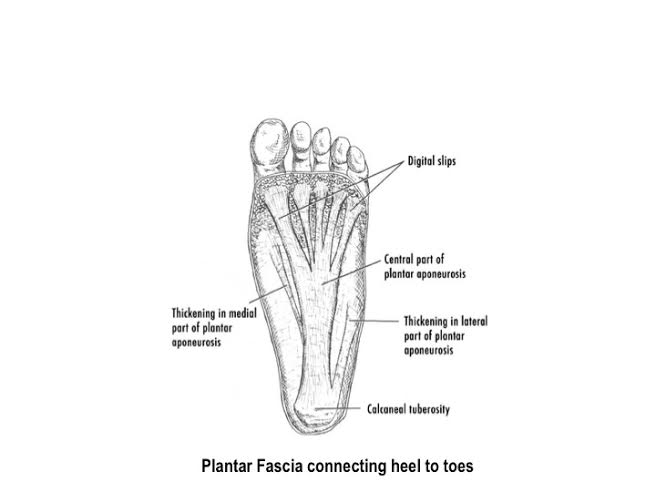
The plantar fascia lies underneath our soles, connecting our heel bone to our toes, and supporting our foot arch. Plantar Fasciitis by Dr Kathleen Thompson3

We usually neglect our poor feet, which carry our weight and absorb intense and rapidly changing forces during many sports.  The plantar fascia struggles to support and maintain foot shape during these activities, but if it is strained, it develops small tears and becomes inflamed.

The first sign is pain under our heel, which, counter-intuitively, is usually worse on getting out of bed, and paradoxically improves when warmed up by exercise. However don’t be fooled. You need to rest your foot to recover. If you don’t you could have chronic problems.

It is most frequent in women, aged 40-60 years, and is induced by long-distance running, walking or dancing,
 obesity and occupations involving standing or walking.

Importantly, the root cause may be elsewhere in the leg, the plantar fasciitis being a manifestation of poor biomechanics and abnormal walking/running movement.

Besides resting, anti-inflammatories, such as ibuprofen help. Most people recommend stretching the plantar fascia, and, importantly, also the Achilles tendon and the calf, as tightness in these may aggravate the plantar fascia. Night splints can maintain stretching whilst you sleep. Others advise against stretching the fascia itself whilst it is inflamed.

Ice massage is useful, for example, rolling your foot on a frozen orange.  The massage is quite painful, and the ice has a numbing effect. Personally, I recommend buying a quarter bottle of Prosecco. Drink the contents, half-fill with water and freeze, then roll your sole on the frozen bottle (the Prosecco takes your mind off the pain).

Shoe arch supports ease the fascia, or your therapist may use strapping.

The fasciitis will eventually settle, but may take up to two years. Steroid injections, give temporary relief but weaken the fascia in the long-term.

So what inspired me to write about this? Let’s just say, I’m rolling my foot on a frozen Prosecco bottle as I write.

Further Information and References:

http://www.mayoclinic.org/diseases-conditions/plantar-fasciitis/basics/definition/con-20025664

http://www.runnersworld.com/tag/plantar-fasciitis

http://www.kttape.com/instructions/plantar-fasciitis/

Note: These articles express personal views. No warranty is made as to the accuracy or completeness of information given and you should always consult a doctor if you need medical advice


National Seafood Week – A perfect Recipe

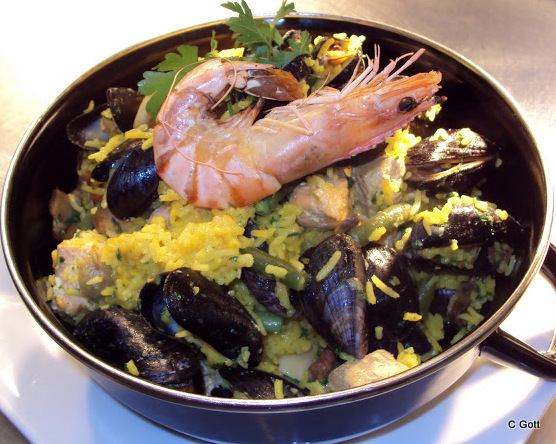
Did you know it’s the last day of National Seafood Week and the middle of National Curry Week? Who makes these arbitrary decisions? Does anyone care? Well, it is Friday today and I have gone for a fish and seafood recipe, for that Spanish masterpiece the Paella. Now like a lot of classic recipes Paella, at first glance may seem pretty daunting, but I assure you just keep in mind all you are really cooking is rice, and with that statement I have annoyed the entire Spanish nation.

I really love rice and it is easy to cook if you follow the basic rules. The principle about making a good paella is very simple, much like a risotto you want to drive as many of the flavours from the stock and accompanying ingredients into the rice. There are many myriad of varieties of paella and a huge number of ingredients that go into different regional recipes, some call for chicken, rabbit or snails, but this recipe is for a great paella, perhaps the greatest, Paella de Marisco or Seafood Paella.
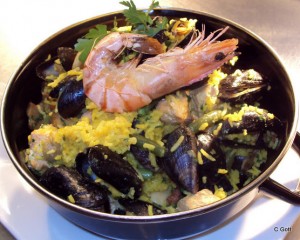
Seafood PaellaIt is really important to use the right rice, many Spanish people use a short grain variety called Bahia, grown in South & South-eastern Spain. It requires around two times its own volume in cooking liquor. For that extra special Paella, there is a variety of rice called Bomba – this is a slow growing rice that absorbs three times it’s own volume when cooked without falling apart. As Paella is primarily about the flavours of the stock being absorbed into the rice, this is a particularly excellent variety, although it can be quite expensive. About a 100g of rice per person, Bomba or standard paella rice will give a good main-course size portion, which means 1Kg of rice will make a Paella for around ten people.

Your Paella pan, the name Paella is a Catalan derivative of an old French word for pan, should be a sturdy and made of polished steel, and to care for it follow the technique as you would for a steel wok. The reason there are so many different sizes of Paella pan is because it is important not to create a Paella that is too deep. Your final Paella needs to be a “dry” rice and having the dish too full will not allow any excess cooking liquor to evaporate out once cooked. As a basic rule of thumb, a paella should not be deeper than the rivets for the handles on the paella pans. Traditionally paella is cooked over an open fire as you may have seen in Spanish fiestas or festivals. The way to achieve that really authentic Paella is to allow me to introduce Sofrito and Socorat.

The Sofrito and the Socorat
The Sofrito and the Socorat are not characters or events in Don Quixote. They are the key to you making an outstanding classic Paella. The sofrito is a fried tomato paste, do not worry if you don’t like tomato – you will never know it’s there. It adds a rich sweet note to the finished Paella. The scocorat is perhaps the most highly prized part of a paella. It is the dark caramalised rice that sticks to the bottom of the pan.

 
Seafood Paella                                               serves 4 to 6

150 gr cleaned Squid
250 gr Monk fish fillet,
100 gr good quality Smoked Chorizo Sausage, very finely diced
12 Prawns, the bigger the better, peeled and de-veined
4 Crayfish or Gamba’s , as big or bigger than the prawns
500 gr approximately fresh Mussels, washed and scrubbed
Sweet Paprika (Pimentón Dulce)
100 gr cooked Butter Beans
2 Red peppers, thinly sliced
A generous quarter teaspoon Saffron Threads
Paella Rice, one cupful per person
Seafood or Fish Stock, approximately twice as much as the rice
4 cloves of Garlic, peeled and very finely chopped
1 large Spanish Onion, peeled and very finely chopped
1 small tin of chopped Tomatoes
Peas (as many as you like)
A glass of quality Dry White Wine
A really generous glug of good quality Olive Oil
Sea Salt and freshly ground Black Pepper
Freshly chopped Parsley

A large 6 person Paella pan

In a small heavy-bottomed saucepan, place the diced chorizo sausage and generously cover with olive oil, heat until the oil just starts to bubble then turn down to lowest setting and keep on the lowest possible simmer for thirty minutes. Be careful not to have the sausage on a high heat and burn the chorizo, the aim is to slowly confit the meat in the oil to release the delicious flavours. Remove from heat and cool, then store in airtight container in the fridge. This can be made up to a week ahead of time. This braised chorizo is great gently re-heated in stews, casseroles, with chicken, as a garnish to monk fish, sea bass and oysters. As with many recipes some people are probably shaking their heads at the addition of chorizo to a seafood paella but once you smell the heavily flavoured oil sizzling in your pan I think you will be convinced.

Score and cut the squid into cubes about two centimetres each and then slice the monk fish fillet into finger thick escallops. Heat a generous serving spoon of the flavoured chorizo oil in the paella pan, when the oil is smoking add the prawns and crayfish, sauté for a minute or two then remove and put to one side. Next, put the squid in the pan and fry until light golden brown. Remove and add to the prawns.

For the sofrito
In a little further oil gently sauté the onion for five minutes without colouring. Add the tin of chopped tomatoes. Turn up the heat and cook the tomatoes with the onion until it reduced into a very thick dark red paste. Stir continuously to prevent the sofrito from sticking and burning, but reduce it right down.

Add the chorizo, garlic, saffron and a teaspoon of paprika and stir everything around before adding the rice. Stir well ensuring every grain of rice is covered in the sofrito. Pour in the fish stock, wine, pepper slices, around a ½ teaspoon of salt and plenty of freshly ground pepper and bring it up to the boil and simmer. After 10 minutes of cooking add the butter beans, peas, prawns, the crayfish and the mussels. Cook for an extra 5 minutes until almost all the liquid has been absorbed. Occasionally gently shake the pan to prevent the large ingredients from sticking to the bottom of the pan, DO NOT STIR.

For the socorat
Turn up the heat to full for no more than a minute or so. You will hear the rice start to “pop”. After a short time “popping” (30 seconds or so) turn off the heat completely. Interestingly this is how popped rice cereals made without the fish flavouring!

Resting is important for the final flavours to develop and for the rice to finish cooking . If you want to decorate you paella with extra pre-cooked prawns and mussels on the half shell, then this is a good time to add them so they can warm through. Cover with a double layer of foil and leave it to rest for ten minutes. Serve with lemon wedges and parsley straight from the pan.


It’s All Kicking Off by Paul Vates

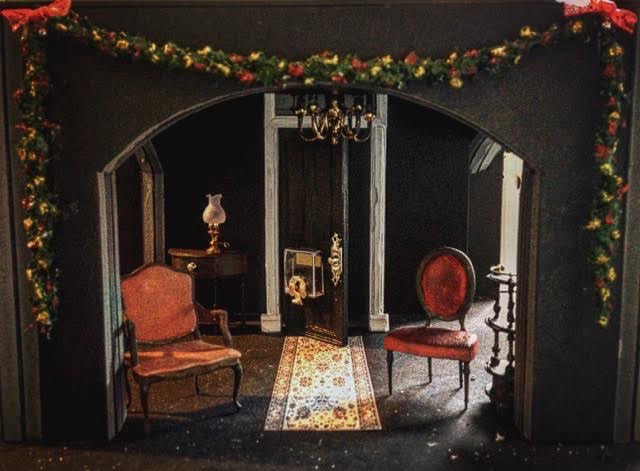
So, the saga continues. Trying to show how one ‘puts on a play’ creaks ever onwards. At a secret venue, which for the purposes of continuity, we shall call a pub, there was a production meeting where the remarkable Katie Unsworth-Murray produced her design for the set. It literally fits into a shoebox and she has made it all to scale.

pic 1 set design

(Shoebox design by Katie – including the chandelier)

She even produced a tiny chandelier, which allowed me to inform her that ‘electricity hasn’t been invented yet’. I promised that I wouldn’t mention that to anyone (oops!).

Once you’ve advertised for actors wishing to audition for a production of A Doll’s House, it is only polite to be there and welcome them in. ‘Once more unto the breach’ came to mind as we entrenched ourselves into The Barons Court Theatre. Director Kevin Russell, for New Dreams Theatre, sat me down and gave me a list of names. These people would, at thirty-minute intervals, arrive and audition for us.

If you read my last article about finding the lead actress for the part of Nora (and Alexa Matthews accepted our offer), then you’ll have some idea what Kevin had already had to do to get to this stage.

Even so, a collection of characters wandered in that would have made P T Barnum gasp in horror. Amidst the drunk Irishman, the bizarre Chuckle Brother impression and the born-again Christian seeking new converts, we did manage to find a wonderful bunch of actors, all worthy of the three parts up for grabs. So, the full cast is now complete:

dollshouse2

The cast:

Alexa Matthews (Nora Helmer), Paul Vates (Torvald Helmer), Julia Florimo (Kristine Linde)

Brian Merry (Dr Rank), Cathryn Brayshaw (Helene), Ramzi DeHani (Nils Krogstad)

Still at the end of the audition day, we returned above ground, into the light, for a drink in The Curtains Up pub that sits atop the theatre. As we discussed the colourful collection of actors on offer, like a couple of football pundits on a Saturday afternoon, taking into account the results, the teamwork aspects and the skill and style on show, the Irishman shadowed us in between his pints – he had decided to linger for a few when he discovered the bar…  For all I know, he may still be there.

As an aside, rehearsals have begun on a relaxed basis between Alexa and myself (I’m playing Torvald, her husband). Kevin has taken us through all the major scenes between us, allowing us to get a grasp of the whole thing before the whole company assembles.

pic 3 Paul Alexa Pre-rat

(Alexa as Nora – possibly before the unexpected visitor)

It has all gone quite smoothly, apart from when a rat scurried through the room – eye contact that afternoon was at a minimum as every shadow became our rodent critic.

pic 4 paul

(Alexa – having noticed the ratty critic?)

Now there is only one thing left to do – full company rehearsals!

We’ll soon meet and with a frisson akin to a school playground, we’ll begin assembling the play. Then – and only then – will Kevin utter his trademark phrase: It’s All Kicking Off!

A Doll’s House by Henrik Ibsen will be performed from November 3rd to 22nd at Barons Court Theatre, west London. Call the box office direct on 020 8932 4747 or email londontheatre@gmail.com to reserve seats.

www.newdreamstheatre.co.uk

Facebook: New Dreams Theatre

Twitter @KevinNewdreams