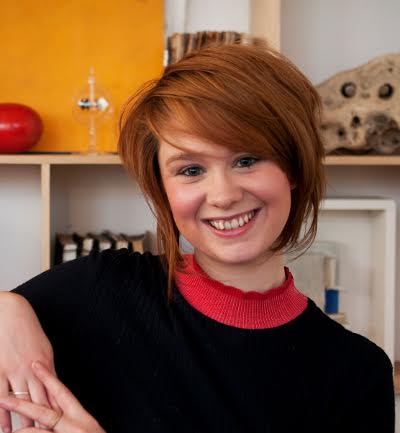
30 Days of Gratitude Day Eight #30daysofgratitude

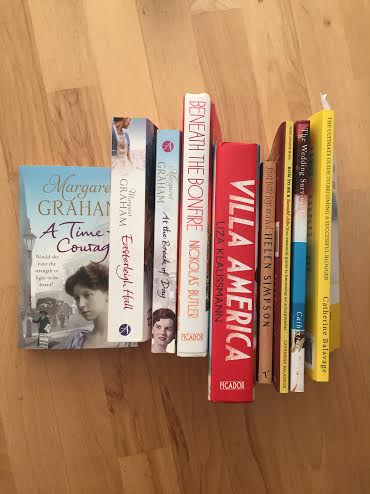
Today I am grateful for books. I have loved reading all my life. There are very few pleasures in life as great as reading a good book. My love of reading has also given me a career that I love, and broadened my view of the world. Reading is great for the imagination and it makes you smarter. Some of these books are written by Frost contributing editor Margaret Graham and some others were written by me. Margaret is a bestselling author for Random House so she is on another level. I hope I get there one day.

good books, author, writer, Margaret Graham, Catherine Balavage, bestselling author

Catch up on other days:

Day 1.
Day 2.

Day 3.

Day 4.

Day 5.

Day 6.

Day 7.

What are you grateful for?


Words for the Wounded Host Their Annual LitFest Literary Festival

Words for the Wounded Host Their Annual LitFest Literary Festivallogo

Great excitement – Words for the Wounded which raises funds for wounded troops and veterans by creating  opportunities for aspiring writers and readers is holding its annual LitFest again on April 16th.

The WforW LitFest Day will be held as always at the lovely Downley Community Centre, School Close, Downley, High Wycombe HP13 5TR
10.00am to 5.00pm.

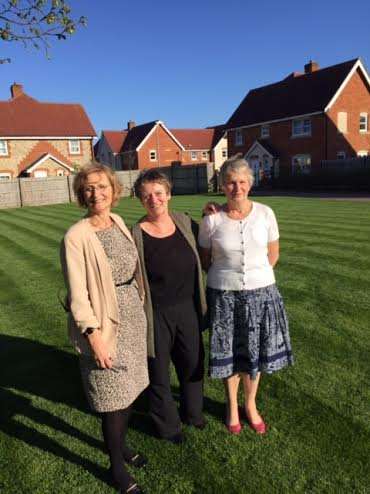
As everyone knows by now, the three grannies, Margaret Graham,  Jan Speedie (both Frost Magazine writers) and Penny Deacon absorb all the costs of the charity and therefore 100% of everything they raise goes to where it should.

Words for the Wounded Host Their Annual LitFest Literary Festival

The speakers this year are:  Sunday Times No 1 bestselling author and a patron of WforW –  Elizabeth Buchan talking about her work.

Words for the Wounded Host Their Annual LitFest Literary Festivalelizabeth buchanan

Jemima Hunt, editor and literary agent, and director of The Writers’ Practice with advice on editing your work and attracting an agent.
Tracy Baines, successful women’s magazine  short story writer with tips about getting published.

Catherine_Balavage_023
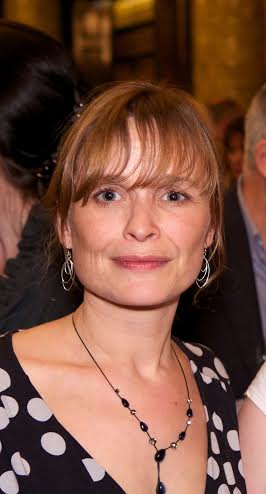
Further excitement as Catherine Balavage, blogger and editor of Frost Magazine will be joining the day to talk about blogging, running a magazine, and her various successful books.

Paul Vates, the brilliant actor, and friend of Words for the Wounded, will be reading from the work of our speakers.

Sharon Bennett will be displaying her art.

Cost £35 (which includes lunch with wine, morning coffee and afternoon tea)

For Tickets, send a cheque or postal order to: (cheques payable to Words for the Wounded)
Words for the Wounded
12 Woodcote Green, Downley, High Wycombe, HP13 5UN
Please include a SAE

Trains from London are frequent, and there are taxis for the 10 minute journey.

www.wordsforthewounded.co.uk

Caitlin Moran Interview

Caitlin Moran InterviewHow did you find the whole experience of making series one?

Oh God, it was amazing! I’ve always worked on my own, so first of all working with my sister, who I’d always suspected was a genius, and indeed turned out to be – not least because about two weeks into the process I realised I had no idea how to produce a plot or use the script-writing software. She knew how to do it all, having written plays for years and had loads of stuff on up in Edinburgh. And then bringing it to a team and making it happen. In a way, it was always obvious that me and Caz would work together, and do something about our family, because that’s what we used to do when we were kids. We’d have Sindys and play Sindy games, and write scripts, and making clothes for the Sindys by wrapping bits of tinfoil around them and putting pins in their ears to make little stud earrings. And when you make a TV show, you don’t have to at any point wrap Rebekah Staton in tin foil and put pins in her ears, because they’ve got a wardrobe department who actually put clothes on them. You’ve suddenly got all these resources.

Sometimes you come up with an idea that people look very scared about. In series one, we just wrote the sentence “The dog is having a poo” and it turned out to take half-a-day to film. You have ten fully-grown professional people standing around in the cold in Manchester, watched by passers-by, waiting for a dog to drop its biscuits. Such is the awful, evil power of a writer that you can just sit in the warm and write “The dog is having a poo” and suddenly you’ve ruined someone’s day.


Having worked in front of and behind the camera, which do you prefer?

Oh god, no question. You may have noticed that I’m not on television at all now. I presented a TV show when I was 18, and at the time, and I only did that because if you’re offered a TV show when you’re 18, of course you’re going to say yes. But I knew I was a terrible presenter. And this posh voice that I’ve got now – I just started speaking in it as soon as I went on camera, because I was so nervous, and I’ve never been able to break out of it since. Literally, before I went on camera, I had a very broad Wolvo accent. I felt I couldn’t be me on television, and there was a very posh girl on set called Isabel, and she seemed really confident, so I just copied Isabel’s voice. And I’ve literally not been able to shake it since, so you can tell how traumatic an incident it was that it still marks my voice almost 30 years later. It’s just horrible; I don’t know how actors do it. The whole thing of a room going silent and everyone waiting for you to do a thing on camera, and every minute is money. My job is the exact opposite of that. I sit on a chair, nobody has a clue what I’m doing, I’m in my pyjamas, eating sardines out of the tin with my fingers, chain smoking and singing and wandering around talking to myself. That’s my preferred working environment

Do you prevaricate an enormous amount, working from home?

I know a lot of writers who will sit in front of a blank page, or spend all morning hovering between the keys in their keyboard, but I’ve always had so much work I just can’t do that. I’d go mad. I run on anxiety anyway, I’ve always got five or six things on the go, and I’ve worked since I was 13. I come from a poor place, and I’m running from a nameless horror. So every day, I have something to do, and if I haven’t done that then I’m fucked, because I have to do twice as much the next day. I’ve never missed a deadline. I file early.

Were you pleased with the reception of the first series of Raised By Wolves?

Oh God yeah, it was amazing. I’m always waiting, with everything I do, for someone to come up and kick me up the bum and say “Get back to Wolvo.” And it was just across the board amazing reviews. The cover of the Guardian Guide was me and my sister and the two people who were playing us. That’s a pretty surreal moment. Then it broadcast in Canada a couple of months ago, so we started getting all these messages from Canada, asking what all these British slang words meant. And we’re in the process of doing it in America now as well, which is incredibly exciting. It kind of makes more sense there, because home education is much bigger there, and that whole prepping for the apocalypse thing that Della is doing, that’s massive there.

You mentioned getting tweets from Canada. How did the show go down in the bear pit that is Twitter over here?

When the show was on, I just couldn’t go on to Twitter – that’s just a short way to madness – but my husband was filtering it every night, and I had literally four bitchy comments, which, as a woman on Twitter is extraordinary. Given that you can be a woman on Twitter and come on and say “I love you all, here’s a pound, everyone,” and someone will just go “Shut up you fat bitch #mensrights”. So I was astonished.

We did it out of so much love. We love those girls. We want it to reach families like that, working class matriarchs, weird teenage girls, fat teenage girls, angry ginger lesbian girls, weird freaky Goth girls. They never get served anywhere. As a woman, it just does your eyes so much good to see people who look like that on your telly. Often on telly even something that’s really edgy has got women on it who are really toned, and if they’re really stressed, they’re in a little vesty singlet and tiny pants and they’re sitting on their bed with their hair in a bunch and glasses on to look intellectual but still looking hot. And to see someone who’s just dressed in rags and talking about wanking is just so different. Big girls, both in personality and stature, doing stuff and not really doubting themselves and being triumphant. We still don’t have enough of that.

You bust quite a few taboos in the series. Do you enjoy that?

I’ve never seen a taboo that I didn’t want to grab and pull out into the open whilst banging on a pan with a spoon and going “Here’s a taboo, let’s talk about the taboo.” What are taboos? They’re just things that we’ve decided, for whatever reason, we don’t talk about. To which I would add the word “…yet.” Why don’t we? It’s insane that American Pie has gone through eight iterations, an entire franchise based on a man having a wank in a pie, and yet female masturbation is never spoken about. And if you look at teenage girls in this generation, and how fucked up they are sexually, and the majority of their sex education is coming from porn, and it’s all from the male viewpoint, there’s nothing about what you want, you’re just some cock-vessel for some horrible porn star. So to have a teenage girl who looks like that, waking away her grief, trying to encourage her uptight sister to follow suit in a graveyard at a funeral – no, sex is funny!

Are you very conscious of the responsibility you have to younger female viewers when you’re writing the series?

Oh God, constantly. I was raised by media and culture, which is why I’m so hyper-aware of what there is and what there isn’t. And when I wrote How to Be a Woman, I thought it would maybe sell to women of my age, but it was all teenagers who bought that book. It was an astonishing array of girls – really fucked up girls, girls who’d self-harm, girls with eating disorders, girls with anxiety, girls with depression, and then really brilliant beautiful girls who didn’t know what to do with their energy, girls who were ashamed of their sexuality, just this massive parade of girls who didn’t see themselves anywhere, and felt incredibly vulnerable, and would grab on to one thing – one book or CD or film – and that gives them the first tiny platform they’ve got to start building their personality. And I think so much of what women see on television or in magazines makes them feel awful or hectored or lectured to or that their life is a massive fucking to-do list. I’m so conscious of the need to make jokes about it. And when we’ve finished laughing about it, we need to plan the revolution, because I’m not going to have another generation of girls growing up feeling as fucked up and unhappy about themselves as I did.


After the success of series one you’ve got you’re the difficult second album syndrome. How did you find writing series 2?

Actually a lot easier – because we knew things like don’t write ‘a dog has a poo.’ We tried to write a scene with a swan and were told not to. Basically, don’t do anything involving livestock. That’s probably a good rule for life anyway. And we knew how to plot things; we became better at that, mastering the technical side so that it worked as a drama as well as a comedy. But whenever anyone gives an answer like that in interviews that I read, I think “That’s incredibly boring, tell me a funny anecdote about you going out and doing a shit load of poppers on Canal Street and falling off a table.” And I did that as well.

So what can fans expect from the series?

Their dad is back, so we get to see how he and Della met, why they broke up, why their kids are how they are. He’s not in it that much, he’s like a wandering albatross that floats into the series but floats back out again, revealing a couple of interesting things. Otherwise – Germaine has become worse! The revelation at the end of the last series that not only would she not have to pay for sex, but that people would pay her for sex, that she could be a prostitute – this has been the bolt of good luck that is all Germaine needed to become truly insufferable. In episode one, she does something so disgusting that everyone presumed it was me, but it was actually Caz’s idea. Germaine has come up with a life hack for attracting boys that is appalling. Aretha has taken her destiny into her own hands and realised that being educated at home is not going to get her out of that house – particularly for the two jobs that she really wants, which is either to be a hermit or a lighthouse keeper. So she goes out and finds a mentor who becomes really important to her. And the person we have in to play that role is such a hero of ours; we are so thrilled to have her on the show. And we also see where Della works, and her boss, who is the other person we are so excited to have on the show. He is amazing, it was his first TV, and we immediately went away and wrote him a bigger part. In three years he’ll have his own sitcom.

Della is an amazing character, beautifully played by Rebekah Staton. When you wrote her, did you mean her to be so sexy?

No! We’d written her as someone quite small, angry and compact, just scrubbing her front doorstep and hating everyone and being very proper at all times. And then Bex came in for the audition and said “I’m just going to drop this in – I’ve just done a film with Clint Eastwood, and I want to play Della like Clint Eastwood.” Her dad was a preacher as well, and I think she plays Della as a cross between a preacher man and a cowboy. And she just brought this incredible physicality to it. To have her to write for is a true, true privilege. She’s amazing. You can just throw anything at her. She has such talent. On set she’s amazing. I’ve visited a lot of sets in my time. The king of being on set has always been David Tennant. On Doctor Who, he knew everyone, was talking to everyone, he’d bring the whole mood up, he’d have lunch with everybody, he’d be joking the whole time. Bex is the only person I’ve ever seen who’s even better than David Tennant. In between every take she’s so funny; it’s like a proper stand-up routine. And she goes round hugging everyone, and she’s looking after all the kids at the same time, she’s like a mum to them. And she’s messing about, and then suddenly she’s standing up delivering these huge speeches, and she’s word-perfect every time. I don’t know how he does it.


How important is Wolverhampton in the show. Could it take place anywhere else?

No. It’s a very specific humour that the Midlands has. A friend of mine told me that people from Wolverhampton are what Scousers think they are – very dry, very downbeat, resilient, with a wry humour.


You took press on a tour of Wolverhampton before series one. What was that like?

That was amazing. There was one main highlight. Wolverhampton has a massive chapter of the Hell’s Angels – I think the biggest one in the UK. They had a huge club house on Penn Road, it was a terrifying big gothic house with huge gates. And I was explaining to people on the tour bus about this big scary house, and we pulled up opposite, and they’d taken the gates down, had a really lovely sculpted garden, a netball court and a tennis court. It had all been done up. So I explained that it must have been sold, and the guy who worked for the local paper went “no, no, they still live there!” The Hell’s Angels were gentrified. Sarah Beeny must have been in there and given them a lovely colour scheme, all Farrow and Ball.

So do you fancy yourself as a tour guide?

Yeah, it was really good fun. But it’s made easier by the fact that Wolvo has the biggest concentration of characters anywhere. We had a tramp who loved on the roundabout, and had a tent there, and he was there for so long that the council wired him up to the mans, so he could have a fridge, a telly and a satellite dish there. When he died, people found out he’d been a Polish airman in the war, and had been in a concentration camp, where he’d been terribly traumatised, so he didn’t want to be around people any more. So he lived on this roundabout. And there are loads of Sikhs in Wolverhampton, and their philosophy is that anyone who decides to be a hermit is a holy man. So people from the Sikh community would leave him food every day, which he hated, because he didn’t like spicy food, so he complained about it. That’s so Wolvo. Then there was a guy called Barry the God, who walked around with a gold cup on a chain, and who had apparently seen God; there was The Cowboy, who walked around dressed as a cowboy at all times; there was The Preacher Man, who wore a bowler hat and would get on the buses and start reading the bible to everyone. It’s a very interesting place, is Wolvo.

Interview with thanks to those at Channel 4.

 

Best Chinese New Year Ever by Alex Bannard – Bangkok Correspondent

The year of the monkey.

Best Chinese New Year Ever by Alex Bannard - Bangkok Correspondentgoldentemple1


My first Chinese New Year (well not my first, I’m 45, there have been many) but the first I have celebrated was amazing, energizing and inspiring, spiritual and serene. Since I arrived in Bangkok I have wanted to do a cycle tour of the city. A very good friend invited me up join her and her cousin. On the day we realized our tour coincided with Chinese New Year and were a little doubtful of whether being bound for Chinatown on saddle was such a good idea. We couldn’t have been more wrong.


We arrived at the Follow Me headquarters a little late but we were welcomed warmly & joined by a Japanese girl who was in Bangkok over the weekend for work. We were dispatched to watch an amusing induction movie on cycle conduct before wobbling out of the drive and heading off.


Navigating the narrow soi’s was at times precarious especially if there was on-coming traffic either on foot or 2 wheels but we soon got the hang of it. Our first stop off was at a local Wat home of a primary school. The King, Rama 6 was educated at Oxford over 100 years ago and travelled around Europe. He saw children being educated in schools initiated the building of primary schools in the same grounds as the temples, the monks becoming the teachers. To this day many of these schools survive today. Matthew our guide, was educated in such a school.

pic 2 Thew


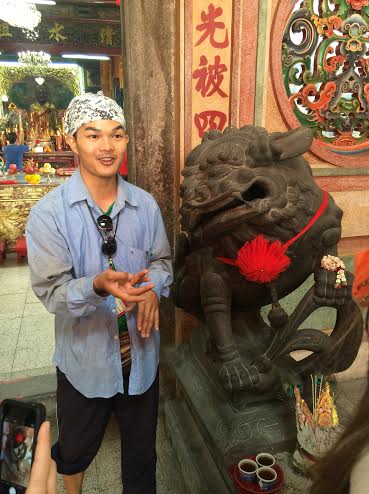
Matthew’s Thai name is Thew meaning good view, a fitting name since he was born to be a guide and gave us a great insight and view of Bangkok, full of knowledge and very entertaining. He proceeded to tell us about his 15 days training as a monk, common in Thailand and a huge honour.  He was 25, the lessons he learnt and the 15 days immersed in the spiritual life of a monk changed his life.


pic 3 customs house


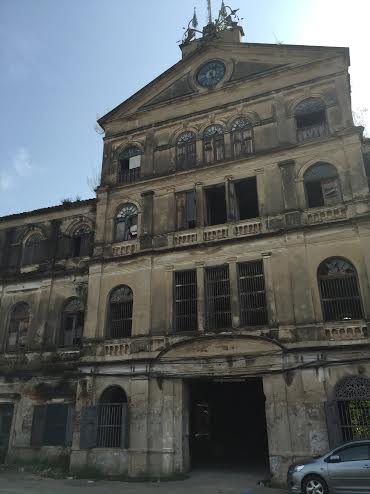
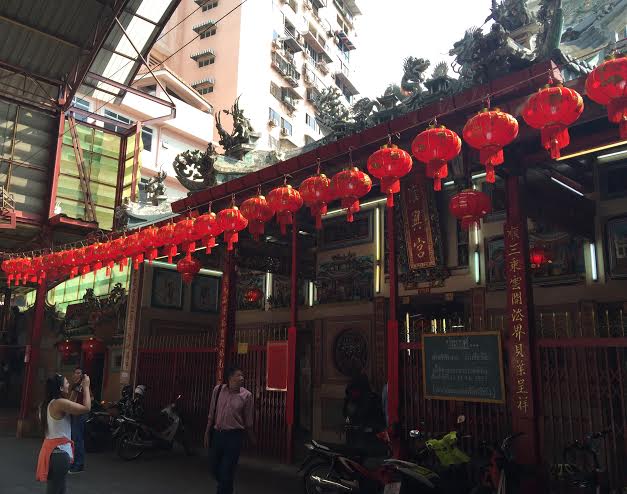
Next stop was the old customs house along side the river. Now derelict it is soon to be renovated into a luxury hotel. We made our way past the modern post office, the old British embassy. Then we went to the Chinese temple which was amazing.


pic 4 chinese temple


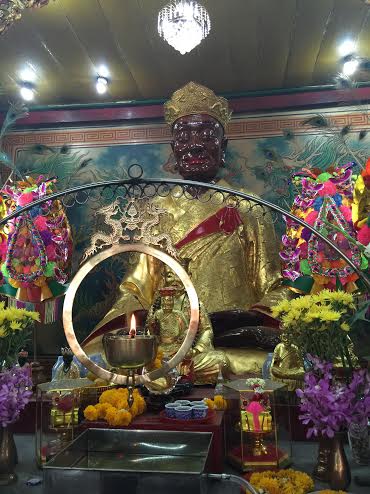
The Doctor Buddha resides in this temple, so called because of his healing hands during his lifetime.


pic 5. doctor


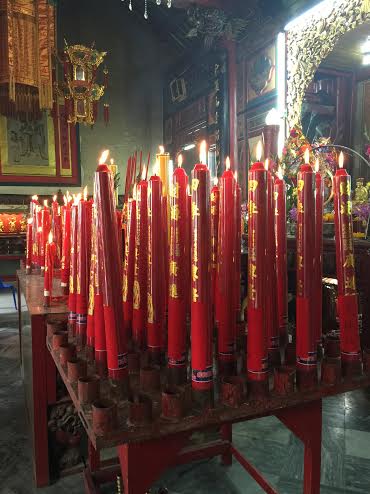
Locals who desire better health will pilgrimage to this temple but on Chinese New Year, the temple was buzzing, incense filled the air & tall thick red candles bought by local families, labeled with the family name burned brightly.


pic 6 candles


It was a very special moment to celebrate the dawning of the year of the monkey 2259 (2016 on the Gregorian calendar).

We cycled into Chinatown. Red lanterns adorned shop alcoves. Banners hung across the street and almost everyone was either dressed in traditional Chinese dress or red. The atmosphere was electric, carnival like. And it was barely 10am.
pic 7 shopping in Chinatown


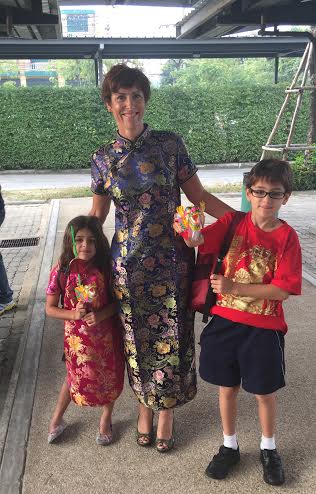
I needed to buy Chinese New Year costumes for the kids and myself so we could join in the celebrations at school and got very lucky with some great purchases. Then I got the kids a Chinese New Year dragon…when in Rome and all that. Talk about taking multi-tasking to the next level.


pic 8 flower market - lotus flowersjpg


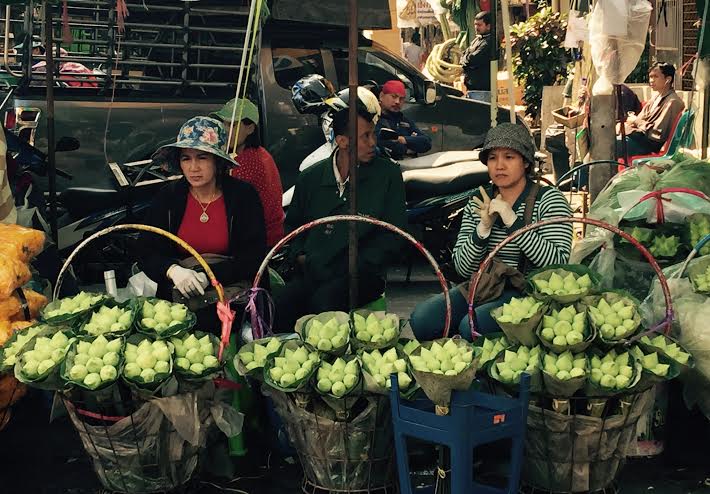
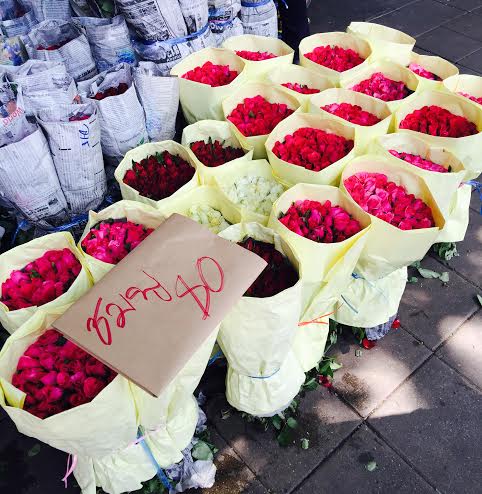
The next stop was the flower market. The flower market runs 24 hours a day. It is divided into the offerings section and the wedding section. Don’t get them confused and take flowers from the wrong section to the wrong event, it could get awkward. We saw 50 roses for 80bht approx £2 and other Valentine treats, such as roses styled out of Ferrero Rocher, a perfect Valentine’s treat for Mr P.


pic 9 roses


Then we loaded the bikes on the river taxi to go across the river to another local Wat, The Royal Temple. Not known on the tourist circuit since it nestles next door to and is overshadowed by the Arun Wat but since this is enfolded in scaffolding rendering it hugely underwhelming, Matthew took us next door.


pic 10 Royal Wat


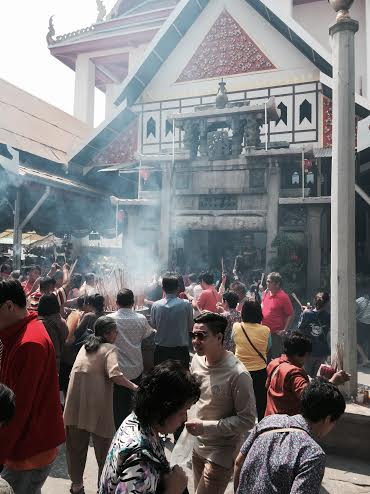
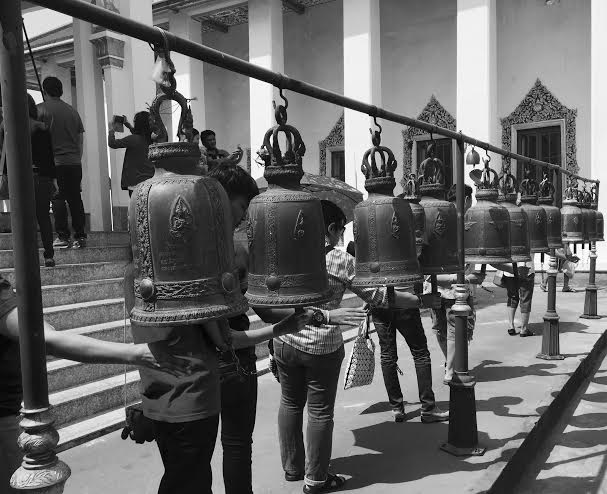
This fabulous set of temples is usually quiet during the week but since it was Chinese New Year it was absolutely bustling. The air was again heavily incense infused, the bells ringing in our ears as the worshippers cleansed their spirits by chiming every bell.


pic 11 ringing


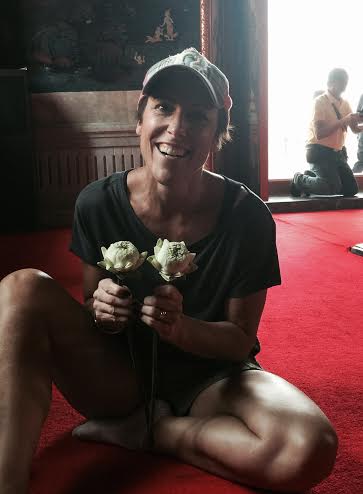
Matthew gave us each 2 lotus flowers and showed us how to fold the lotus leaves to reveal the flower, a wonderfully therapeutic exercise, almost meditative in its essence.


pic 12 Folding Lotus Leaves

Then we made an offering to the Buddha of the flowers and wound our way back to our bikes through the throng.


Back on the saddle we wove through more Soi’s glimpsing snatches of Thai life: small dark shop openings; flashes of flatscreen TV’s through part open doorways; women sitting on wooden seats watching the world go by; kids playing bare foot in the street; family members asleep on the floor and lots of greetings of ‘Sawadee ka’ and ‘Happy new year’. It was marvelous.


Every so often through the tour we would venture onto the main roads and on the way home we certainly navigated the busiest roads, 3 and 4 lanes in both directions but it was not as treacherous as I thought it would be. The smaller roads, where cars has slowed to allow us through were more so as the moped drivers whizzed through the gaps, reminding everyone who really is king of the road in Bangkok.


Back at base we were awarded an ice cream and the possibility of a foot spa in the pool of tiny hungry fishes, I declined this with my sights set on Dean and Delucca round the corner and a well deserved New York style lunch for a change, but is a great tour, a totally different way to explore and experience Bangkok with or without the added festivities of Chinese New Year.


pic 13.frostbangkokcorrespondent


Later that week, the kids and I headed to school adorned in our Chinese New Year outfits for a morning of welcoming in the year of the monkey. In Foundation Stage the children made lanterns, lucky money and ribbons amongst other traditional crafts. The girls cavorted with their ribbons along to videos of professionals doing the same before we headed to the Chinese New Year assembly. A wonderful celebration showcasing the best of Bangkok’s Chinese music, Kung Fu & off course the finale with the Chinese Dragons. Next year we’re planning to join the Chinese Dragon Parade and party in Chinatown.


pic 14 Golden Budha


www.followmebiketour.com/


Gillian Holmes, (aka The Editor) Responded to Frost’s Request for Help Writing a Synopsis

Synopsis: A brief summary of the plot of a novel, motion picture, play etc. by Gillian Holmes

Meet Gillian Holmes – literary editor By Margaret Graham1


A very talented friend of mine sent me the synopsis of the novel she was writing for her Creative Writing MA. Her tutor had sent her away with a flea in her ear, and she came to me with no real idea of what she’d done wrong.
As a veteran of synopses of nearly twenty years standing, I saw immediately that she had made a very common error. Namely, she’d forgotten what a synopsis is. She thought she needed to show her thinking behind the book, and give the reader a flavour of what was to come. Consequently, she had managed to give far too much information, while also giving too little.

How is that possible?


  1. She wrote a lot about her main character, while neglecting the plot.
  2. She had included lines from the book, but with no context, they were irrelevant.
  3. She had tried to illustrated the themes in the book, but neglected the plot.
  4. She had tried to illustrate the humour in the book by describing the occasional amusing scene. But she’d neglected the plot…


Do you see where I’m going here? So when you sit down to write your synopsis, always remember that  this is not a creative work, so don’t try to be too clever. Clarity is everything.


So what do agents and editors want from a synopsis?


  1. They want 1500 words or fewer.
  2. They want an elevator pitch – a couple of lines that outlines the concept. The concept is a very strong consideration for all agents and editors, so make it snappy and memorable. For example, let’s take a recent bestseller – The Husband’s Secret. A happily married woman with three children discovers that her husband murdered a young girl when he was a teenager.
  3. A brief summary of the plot, key moments, key events, and main characters so they can see the arc of the story and judge whether the structure seems sound – leave out complicated sub plots, it will only bog you down in unnecessary detail.
  4. The end – and that means the end. Don’t hold anything back, this is not a cover blurb.


And that’s it. Easy peasy.
If you’re wondering about my friend, I sent her back to rewrite her synopsis several times. But it was worth it. She got an A for it in the end.

Gillian has been an editor for mainstream publishers for twenty years. Now she runs her own editorial agency.
To contact Gillian:  gilliansholmes@hotmail.com


Early Chapters by Gillian Holmes of The Editor | Get Published

Meet Gillian Holmes – literary editor By Margaret Graham1

Frost is delighted to have an editor of Gillian’s calibre to help aspiring authors. It’s particularly apt, because the fundraising Independent Author Book Award, run by www.wordsforthewounded.co.uk is open for entries until 6th March 2016.


Last year’s winner, Jane Cable, is now represented by the Caroline Sheldon Literary Agency as a direct result of the competition. Felicity Trew of the Caroline Sheldon Literary Agency is judging this year’s Award.


So over to Gillian:


Early Chapters


It’s tough being a writer, and we editors appreciate that. I have never written a book – if you don’t count the half-written romance with a Daniel-Craig-as-Bond-type hero, but the least said about that the better. So all writers who have the tenacity and commitment to complete a novel have already earned my full admiration.


However, on the other side of the coin, having worked as an acquiring editor, a reader for literary agents, and a reader for competitions, you can appreciate, I’ve probably read more than my fair share of opening chapters and synopses. And sometimes I stop within half a page. It sounds brutal, but when you have a lot of manuscripts to read, you simply don’t have the time or the inclination to read on to see if it improves.


So here are ten tips to help you catch the eye of the judges.


First the Don’ts:


  1. Please do not, and really I mean this, open with a dream. Ask any editor/agent/reader. There is nothing more irritating than to be pulled into some action, only to find it’s not real. Can I add here, do not ever use dreams as a way to move the plot forward. Please.
  2. Do not open your book with backstory… if we don’t know the characters, how can we be interested in their backstory?
  3. Do not start the book with a minor character. No matter how good the writing, as soon as the reader realises that the character they have been reading about disappears by chapter 2, they will give up.
  4. Do not open with your character doing mundane stuff – getting ready for work, having breakfast, unstacking the dishwasher, going out the door – because although you may think it’s a great contrast with the explosive action that comes later, the reader may never know that. They’ll have given up just as your character is locking their front door.
  5. Do not mince your words. Starting any book with exposition and/or long descriptions of the character or location can be mind-numbing for the reader. Dive in, all will reveal itself as the book unfolds. Speaking of long descriptions: watch out for flowery language and too many adjectives. Having to wade through paragraphs of wordy prose before you even get to the story is frustrating and time-wasting.


Now the Dos


  1. Give the reader a snappy opening line that immediately intrigues.
  2. The submitted chapters should be the very best they can be, so I would suggest you hire an editor/copy editor. It can be an expensive business, but do it for just these three chapters in the first instance. It makes a huge difference to the reader, and could give you some useful advice for the rest of the book.
  3. Keep the pace moving and don’t get bogged down in irrelevant detail.
  4. Introduce us to your characters – the reader needs to be invested in them from the start.
  5. If you’re sending a prologue as part of your first three chapters, make sure it’s relevant and interesting, not just a convenient way to give backstory.

Soon I will be giving you some hints on writing the synopsis.


gilliansholmes@hotmail.com

www.wordsforthewounded.co.uk
http://www.carolinesheldon.co.uk


An interview with Gillian Holmes – editor by Margaret Graham

Meet Gillian Holmes – literary editor By Margaret Graham1

Gillian Holmes – aka The Editor – has been working in publishing for nearly twenty years. She started out at Quarto, working on craft books and worked with many publishers, and finally

Arrow Books where she edited many bestselling authors, such as Katie Flynn, Dorothy Koomson, Amy Silver (aka Paula Hawkins), Cathy Woodman, Margaret Graham, Lisa Lynch, and many others.
Gillian now has her own editorial agency, The Editor, and over the following two weeks, she will be giving advice on the first three chapters, and the synopsis. This might well prove useful for any of you who are thinking of entering the Words for the Wounded Independent Author Book Award. Last year’s winner is now represented by Felicity Trew of the Caroline Sheldon Literary Agency. Felicity is this year’s judge. (more details www.wordsforthewounded.co.uk)

Frost asked Gillian more about herself.

What are your passions?


My main passion is reading. My parents moved around the world a lot and because I went to boarding school, I didn’t have many friends at home. So books stopped me feeling lonely. Well, that and my musical box (no music as all tapes warped due to the tropical climate) which I would play while I pretended to be a ballerina. Quite sad considering I have never had a ballet lesson in my life.


I also love to swim. An early morning swim will usually set the day up perfectly. I find solutions to all sorts of problems in the water – including problems with the book I’m working on at the time. Oh, and I am a massive QPR fan; this affliction has taught me forbearance and patience.

An interview with Gillian Holmes – editor by Margaret GrahamQPR2

What do you read?


I read widely and according to my mood. I usually have several books on the go. I read women’s fiction when I want to be engrossed in someone else’s life. For those days when I’m tired, I read romance – contemporary or historical. It’s comforting and always cheers me up. I also really enjoy real-life tales of derring-do like Agent Zig Zag. Also, Samuel Pepys’s diary is a big comfort read for me; he always makes me laugh. I like crime for when I’m bored, I particularly like books with a long-running characters, so Jo Nesbo and Lee Child are great favourites. Recently I’ve discovered a new character to follow in Tony Parsons’ Max Wolfe: tortured single father, boxer and policeman. What’s not to love? And finally, I adore historical novels. I used to raid my mother’s collection of Georgette Heyers and Jean Plaidys, but my absolute tip top favourite was Katherine by Anya Seton. Last year, my aunt researched our family history and, thrillingly, she discovered Katherine is our grandmother (great great etc). I was in actual heaven! Personally, I think this is the most interesting fact about me. If my friends had ever heard of her, I’m sure they’d agree.


What do you love about what you do?
I have never managed to write a book, so I admire and respect authors enormously. Books have been my constant companion throughout my life, so to read one in the rough, and help an author shape it to be the very best it can be, is enormously satisfying. Editing is very subjective, so as an editor I must never lose sight of the fact that this is not my book, so I need to set my ego aside. Just because I’d do it differently, doesn’t mean I should advise the author to do it my way. An editor has to be a different person for every book they edit and work within the parameters of the author’s style and vision. I like that challenge, and if an author seems genuinely happy with my suggestions and work, I’m thrilled. I love knowing that I have helped create something without actually having to do all the work. I’m a bit lazy, you see.


The first three chapters or so are important in drawing in the reader. 

What would be your first piece of advice?
Firstly, your first line needs to grab the reader’s attention and set the tone of the book. Don’t save your best line for half way through the first chapter, or even half way through the book. Get it out straight away so the reader wants to keep going. Then the challenge is to follow through on that promise. Try not to fill the first chapters with backstory and description. Always remember you’ve got another 70,000 words plus to fit that in. Just keep it moving. Hook us in and don’t let us go.


I find a synopsis difficult. Will you be helping Frost readers with this? If so, in a nutshell, what should a synopsis do?
Yes, absolutely, because having worked as an acquiring editor, an agent’s reader and a reader for competitions, I know how important a good synopsis is. Firstly, remember why you’ve been asked for it and who you’re writing it for. Usually it’s for a competition or a submission to an agent/publisher. They want the synopsis because, if they like the first three chapters, they want to see how you’ve developed the rest of the book. It will give them a clear overview of the concept and structure, and often determine whether they will want to see the rest. They don’t want irrelevant detail and descriptions, and they don’t need dialogue. And most importantly, they DO NOT want you to leave a cliffhanger. Finally, keep it short – 1500 words or fewer.

pic 3 books

Will you ever write a novel?
I’m not sure. I have a butterfly mind and I tend to get bored quite quickly. Writing a whole book would entail me concentrating on one thing for far too long. Having said that, I did write half a book once – it was a romance inspired by my crush on Daniel Craig (I know, I know, I’m a sad cliché). The heroine (who wasn’t at all based on me, not at all) rescued him from some dastardly kidnappers. I got so involved with my characters (well one in particular) that I expected him to email me to let me know what happened next. Sadly, he never did, which I know he regrets.


pic 5 daniel craig


Or a short story?
Short story writing is a very particular skill and not at all easy to do. I might try it one day, though. The great thing about short stories is they can be just as satisfying as a good novel, but they don’t take as long to read.


Your favourite book as a child?
I had two. Ballet Shoes by Noel Streatfield – I wanted to be Posy so badly, that when I had my daughter I (briefly!) considered it as a name. And A Little Princess. I went to boarding school when I was very young, so I related. Which is a little dramatic of me, as I was treated perfectly well by the school and, disappointingly, I never did discover that I owned some diamond mines.


What question would you like to be asked?
How does your husband Daniel feel about the fact that your career as a prima ballerina keeps you away from home so much?

To contact Gillian. gilliansholmes@hotmail.com
To find out more about The Independent Author Book Award: www.wordsforthewounded.co.uk
Words for the Wounded are also holding a LitFest on April 16. www.wordsforthewounded.co.uk


Meet Gillian Holmes – Literary Editor

Meet Gillian Holmes – literary editor By Margaret Graham1

Gillian Holmes


Frost is delighted that Gillian Holmes of the editing house, The Editor, will, over the next few weeks, advise Frost’s readers on writing successful first chapters, and that tricky beast the synopsis.


The timing is particularly apt because the charity Words for the Wounded (sponsored by Frost Magazine) has launched its 2016 Independent Author Book Award  for self published books – fiction or non fiction/e-book or physical.  which is due to close on 6th March. Last year’s competition was won by Jane Cable, who as a result is now represented by Felicity Trew of the Caroline Sheldon Literary Agency.

Meet Gillian Holmes – literary editor By Margaret Grahamfelicitydrew2 Felicity Trew


It is Felicity who is judging the Words for the Wounded competition this year, so flex those fingers, sharpen your imaginations and let Frost, and Gillian, help you along the way.


Gillian Holmes  has been working in publishing for nearly twenty years. She started out at Quarto, working on craft books – applique and decoupage was very popular at the time and she’s endeavoured to forget everything she learned about those skills over the years.


She quickly moved on from that nightmare to work at Simon & Schuster where she worked with authors such as Jackie Collins, Ben Elton and Sean Hughes. As well as doing quite a lot of football, the X Files and books about UFOs.


Then on to Carlton, working on illustrated non-fiction and TV tie-in novelisations – the Coronation Street novel is a particularly proud moment. The entire 40 years in a novel.


But with three children, life in-house became difficult, so she worked as a freelance editor, copy editor and proofreader for various clients, before moving back in-house to Arrow Books six years ago, where she edited many bestselling authors, such as Katie Flynn, Dorothy Koomson, Amy Silver (aka Paula Hawkins), Cathy Woodman, Lisa Lynch and Margaret Graham, and many others.
Gillian is really looking forward, over the next few weeks, to helping those of you who are working on a novel, or perhaps to inspire those who are not, to do so.

For more information about the Words for the Wounded Independent Author Book Award, and the charity which raises funds to help in the recovery of wounded service personnel, go to www.wordsforthewounded.co.uk

Gillian has now set up her own concern, The Editor: gilliansholmes@hotmail.com