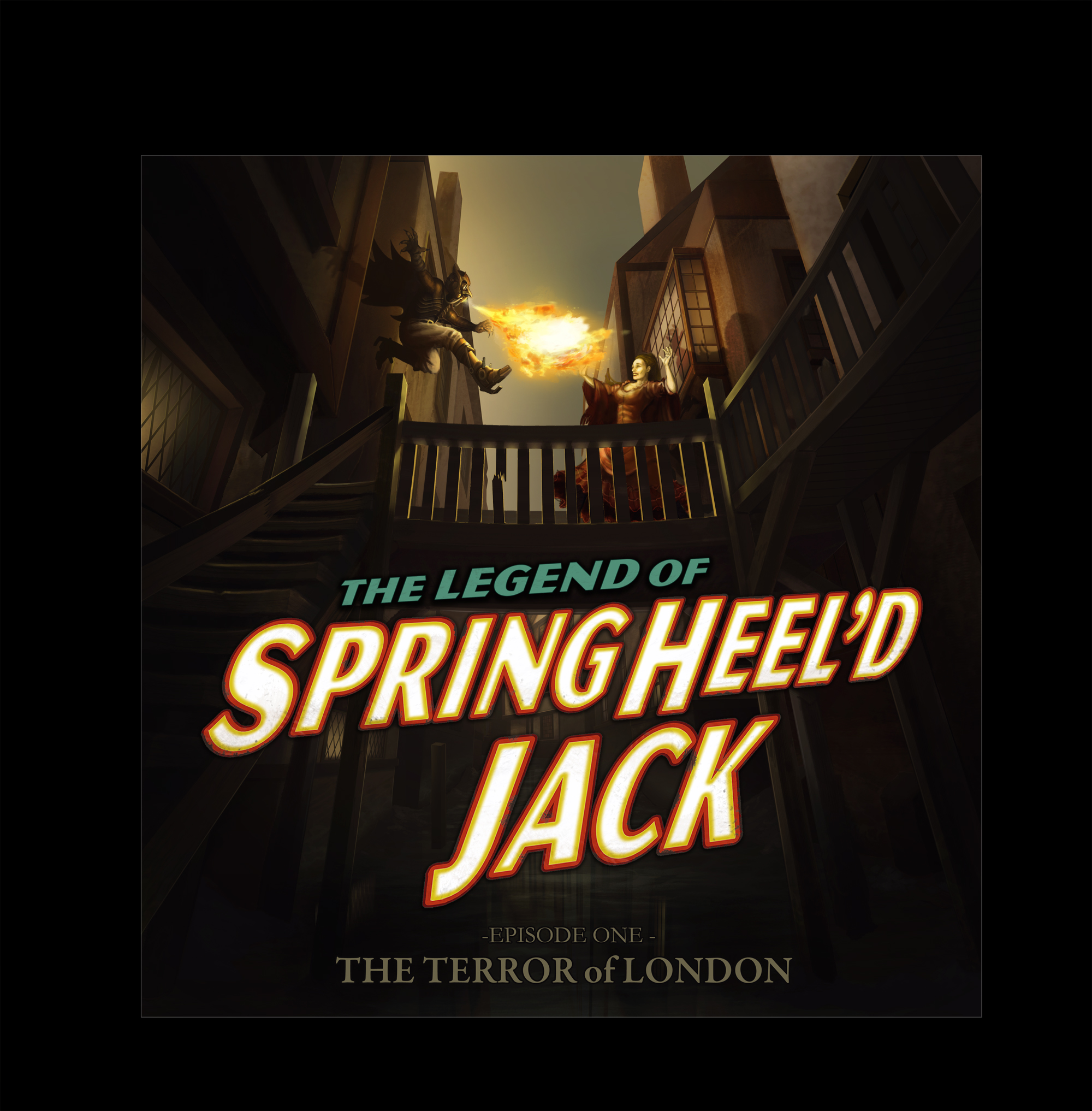
 This interview with Robert Valentine and Jack Bowman*, writers of The Legend Of Springheel’d Jack, was conducted over a quiet pint in The Ostrich Inn, Colnbrook.
RV = Robert Valentine
JB = Jack Bowman (who uses the pen name “Gareth Parker”)
Q. So, the second, three-part series of The Springheel Saga: The Legend of Springheel’d Jack – is under way. Where and when does the story continue from Series One, in The Terror Of London?
RV: The Springheel Saga: The Legend Of Springheel’d Jack, picks up seven years after the events of Series One [The Strange Case Of Springheel’d Jack], with the murder of thirteen-year-old pickpocket Maria Davis, who was long said to have been the only person who Springheel Jack ever killed. By this time Springheel Jack is no longer just a London phenomenon but is being seen up and down the country.
JB: And by this point, by the time of The Terror Of London, you’re more likely to see him appearing on stage in a Penny Gaff than in a dark alleyway. It’s 1845, Queen Victoria is well-established in her position as monarch, and Victorian society as we tend to think of it is taking shape. The new series is going to take Jonah Smith into some much darker places.
RV: Starting with the stench and gloom of Jacob’s Island, Bermondsey…
Q. The first series was very faithful to the history of the 1837-38 attacks and sightings. Is this also true of The Legend Of Springheel’d Jack, or have you developed the story with more creative freedom this time?
RV: Our mission statement has always been to follow the history, whether documented or apocryphal, as closely as possible. The Maria Davis incident is a part of the Spring-heeled Jack mythology rather than the true history, but we thought it was important to honour it anyway. Also, it was supposed to have occurred in 1845 and we were very excited to explore Jack’s transition into a folk character around this time. So I wouldn’t say we’ve had more creative freedom on Series Two because we’ve always had that, but I would say we’ve had fewer historical incidents to act as our guide-rope; the original case included an awful lot of solid sightings, but by the 1840s Jack had become a less tangible figure. So rather than a string of attacks, his increasing fame as a pop culture figure is the historical development we explore in this series; the case is over but the legend is growing. Hence the title!
JB: Certainly this time around, the history and the mythology becomes a little less specific; The Strange Case Of Springheel’d Jack dealt with a very strict series of recorded historical events and we took the decision to follow them reasonably accurately. This time, we were slightly freer to tell our story without the need to hit so many historical points.
RV: As long as our story kicked off with Maria’s murder, and took place under the umbrella of 1840s ‘Springheelmania’ – so penny gaffs, penny dreadfuls, Victorian journalism, Jack usurping the Devil’s role in Punch and Judy shows, etcetera – we were otherwise free to continue the story of Jonah Smith’s obsessive quest.
JB: Indeed. Last time we said Smith was going to enter his Ahab phase, and here it starts to happen.
Q. What other cultural influences are felt on this series, both in the series and on your approach to writing it?
RV: Peter Ackroyd’s fantastic book, ‘London: The Biography’ was a big influence on us again. The first series portrayed London as a vision of hell, and had a very infernal image system. This time around we try to present London as a theatre, and everything is given that slant. Also, last time the story was a police investigation and this time – without giving too much away – it’s a more Hitchcock-esque ‘Wrong Man’ thriller. If our audience spots one or two hints of ‘The 39 Steps’ or ‘North By Northwest’ as we go along, that’s not a coincidence!
JB: A few of our personal cultural concerns also remain; there’s our continued love of the British pub in there, and a celebration of London. There was also a lot of fun debating what historical elements could come into play; for example, the now lost Bartholomew’s Fair becomes a very important backdrop in Episode Two, while the breaking of the Portland Vase in the British Museum was part of the original treatment, as was Chough and D’Urberville. But sadly, we couldn’t make those elements work and they got dropped. RV: Interestingly, when we sat down to work out the details of Series Two, our early assumptions were that the story would take place in a theatre, and we were were quite worried that it would end up too much like the brilliant 1977 Doctor Who serial, ‘The Talons of Weng-Chiang’, which takes place at the very end of the 19th century and involves sinister goings on in a Victorian music hall. Luckily, we were rescued by history because in 1845 we were too early for the music hall; this was the time of the Penny Gaff, or Victorian pub theatre. Nevertheless, we remained wary of including anything that might evoke ‘Talons’. It was an anti-influence!
Q. Were you surprised by the response to the first series?
RV: Yes, it was lovely!
JB: Oh yes. That was amazing, and we’re thankful for it every single day.
RV: To be quite honest, I was surprised Series One turned out as well as it did; it was everything we’d hoped it would be back when we didn’t realise what big a task it was going to be!
Q. What was the writing process like this time around?
RV: The writing process differed slightly on Series Two and Three, mainly because Jack was directing Andrew Shepherd’s play, The Shakespeare Conspiracy, and overseeing the remixes of Series One, which was a mammoth project, so he had less time on his hands. We wrote the treatment as before, but I wrote the first draft of most scenes and then sent them to Jack and we did the back-and-forth that way. They were a lot faster to write than Series One because by that time we’d more or less perfected our formula.
JB: We also had the outlines for Series Two and three mapped out before they were commissioned. In fact, it’s fun looking back on the original outline for them, just a few lines long, written in 2008. All of this meant it made the process more efficient, and we’ve slightly tweaked the formula for Series Two because our aim was to tell a bigger story than Series One but with the need for fewer actors. Having said that, our cast was still huge on this one! I feel we made Mariele [Runacre Temple, Producer]’s brain explode last time with the size of the cast, and either we made her head explode a little less on Series 2 or by now she was used to it. Anyway, Rob hit on a brilliant idea that not only helped tell the story, but made it far easier to write, and that was to employ a narrator… James M. Rymer, played by John Holden-White.
RV: Which in a funny way brings us back to the history again, as we wanted a narrator and sidekick character to represent all the Victorian journalists who essentially created the legend of Springheel Jack. Rymer – who was in real life not only a journalist but also the creator of ‘Varney the Vampire’ and ‘Sweeney Todd’ – is the embodiment of all that. He was also meant to be a little bit like the writer Beauchamp in the Clint Eastwood western ‘Unforgiven’; a man steeped in the legend of his own time who suddenly finds himself face- to-face with the reality. As a device, having a narrator really helping the theme of storytelling that permeates Series Two. Whether it helped keep the cast numbers down is another matter!
JB: I saw no evidence of Mariele’s brain exploding this time, so I think we did good!
Q. How different is the world of 1845 London to 1837 Clapham?
RV: The Great Famine is going on in Ireland, so there’s a great Irish influx. And the telegraph has recently been instrumental in the arrest of a murderer called John Tawell. So times are definitely a’changing.
JB: The Metropolitan Police, and the idea of there being police in London at all, starts to feel like it’s an everyday, normal thing – which it wasn’t in 1837. Even the City Of London now has it’s own police force. Everything is creeping towards the London we know today; railway stations, trains, the birth of a metropolis.
RV: But there’s still a long way to go!
JB: As you’ll see when we get to Series Three.
Q. You had an amazing cast in the first series; who is returning, who is new?
RV: We’re delighted to have Christopher Finney return as Smith, who is now a Detective Inspector and a darker, more obsessed figure than he was the first time around. Also, Jessica Dennis returns as Charlotte Fitzrandolph which is wonderful. It would have been awful to bring Charlotte back and then not have Jessica be free to play her!
JB: Yes, she drops back into things when Smith least expects it, as only Charlotte can! This time around though, we’ve lost Hooks, so Smith is more of a lonely figure, but there are many new faces, including his sidekick Rymer (John Holden-White), the tough, gruff Inspector Garrick (Neil McCormack), magician Cuthbert Leach (Nicholas Parsons), magical assistant Lizzie Coombes (Josephine Timmins), impresario Oscar Snitterfield (Jeremy Stockwell) and the mysterious Punch and Judy man, Elijah P. Hopcraft (Andrew Shepherd). Sadly, as I said, we had to lose Chough and D’Urberville, who were the only other characters we planned to bring back, but that doesn’t mean you won’t be hearing Ben Whitehead return at some point…
Q. What was it like to work with Nicholas Parsons?
RV: It was an honour, and we were extremely fortunate to get him.
JB: I was directing another Wireless Theatre production called We Are The BBC in which Nicholas appeared with Stephen Fry, both playing themselves. It was during the talks with Mariele about that, that he asked if we had any other dramatic roles he could sink his teeth into, and Mariele immediately offered him this. And yes, he’s seen as the host of Sale Of The Century, and the chairman of Just A Minute, but to me, he was the doomed Reverend Wainwright in Doctor Who [The Curse Of Fenric]. A wonderful dramatic performance there.
RV: We had desperately hoped to get him in for Series One, so it was lovely not only to finally get our man, but also give him a meatier role than we originally had in mind. I can’t think of anyone better to play a Victorian stage magician, to be honest.
JB: It was a very straight forward day – first, I directed him for We Are The BBC, then Rob took over for The Legend Of Springheel’d Jack. It was a very efficient two and bit hours – as that’s all he was free for – as you’d expect from a National Treasure.
Q. Jeremy Stockwell appears to be channelling the spirit of Ken Campbell in his performance as Oscar; what was the thinking behind this? Was it his idea, or yours?
RV: The ghost of Ken Campbell has loomed large over the project; I just have a feeling it would have been something he might have enjoyed. Had he not passed away suddenly in 2008 we would have tried our darnedest to find a part for him somewhere.
JB: I knew Rob had always wanted to cast Ken Campbell in SHJ; however, he passed away before we even got close to finishing scripting Series One. However, I know Jeremy Stockwell very well, and I also knew he’d been directed by Ken. He tells such wonderfully silly stories about that man! And while we were filming a documentary together for BBC Four, it was then I discovered Jeremy could not only channel a flawless Ken Campbell, but was also planning a stage show where he would be playing him. So I pulled him to one side, mentioned the idea of him ‘being Ken’ in Series Two, and he loved the idea. I love working with Jeremy, and Jeremy loves playing Ken, and Rob got a Ken Campbell performance for SHJ, and Mariele laughed like a drain. It was perfect. I think you’ll love him.
Q. Finally, The Legend Of Springheel’d Jack launches with along with the new-look Wireless Theatre; what was the thinking behind that?
JB: Wireless Theatre has always continued to grow and expand, and it’s reached a point now where it has to find new ways to keep going for the years ahead. Everyone at Wireless Theatre prides themselves on producing and broadcasting modern Radio Drama for a modern world. And because of that, we are determined to keep audio theatre alive and well by creating original, exciting radio productions through fresh new writers and acting talent, and to do so, the model of Wireless Theatre has to change. However, it was Mariele’s idea to put The Legend Of Springheel’d Jack right at the heart of it all – and we couldn’t be more excited for The Springheel Saga and Wireless Theatre. Roll on the 6th December!
Our The Springheel Saga – Series 2: The Legend of Springheel’d Jack Review is here.

 Movie equivalent of Dead Sea Scrolls found dumped in skip