The Sunday Reeds | Music Profile

The Jesus and Mary Chain Meets Marianne Faithful: It’s Australia’s The Sunday Reeds.

Their new EP ‘Amour Tragique’ on Heartgun Records


Release Date: 1st August 2014

Format: Digital Download 

 TheSundayReedsPic1

L-R: Jeremy Russell, Romana Ashton and Drew Jones.  Photo by Rex Francis


The Sunday Reeds, named after Melbourne’s celebrated patron of the arts Sunday Reed, are Romana Ashton and Drew Jones.  Though forming in 2009 as a duo, they soon started playing live as a three-piece and are regularly joined on stage by drummer Jeremy Russell.


Their first release ‘Drowning in History’ (2009) caught the attention of UK indie label Squirrel Records leading to extensive touring across Australia, the UK and Europe, during which bridges were burned, relationships ended and nervous breakdowns became commonplace.  At one point the founding duo spent three days in Paris where the most romantic city in the world became an ironic backdrop for a particularly bitter relationship break up, one that culminated in their latest EP ‘Amour Tragique’ (Tragic Love).


A collection of five songs that detail doomed romances and love lost, ‘Amour Tragique’ combines the grittiness and angst of ‘90s grunge with the pop sensibilities of ‘60s pop, rock ‘n’ roll, a good measure of old fashioned blues and ‘80s new wave/post punk.


With contralto female vocals likened to Marianne Faithfull and Shirley Manson, and a rock ‘n’ roll swagger reminiscent of The Rolling Stones, The Kinks and Nirvana, The Sunday Reeds skillfully combine the most exciting elements of rock ‘n’ roll to create lyrically rich, infectiously melodic songs with a sound distinctly their own.


‘Amour Tragique’ will be launched at The Old Bar, Melbourne on Saturday July 5th.


Videos for the singles taken from the EP ‘Jean-Luc’ (a song about the tumultuous relationship between Jean-Luc Godard and Anna Karina) and ‘Something About You’ (a dark pop song about love and loss) will be released later in 2014.


Discography


Amour Tragique (EP 2014 – Heartgun Records)

Drowning in History (LP Vinyl Re-Release) (2013 – Heartgun Records)

Kill This Party/Fall from Grace (Single – 2012 – Heartgun Records)

Dark Rainbows (EP – 2011 – Squirrel Records UK)

Drowning in History (LP – 2009-Squirrel Records UK)


Sainsbury’s Blanc de Blancs Brut NV Champagne Review

We have been reviewing a lot of champagne here at Frost Magazine. It is a pretty awesome job made even better when you get a bottle of really good stuff to review. Enter Sainsbury’s Blanc de Blancs Brut NV Champagne. A crisp, dry, delicious, delicate and floral champagne made solely from the chardonnay grape. It comes from family producer Duval-Leroy. It is an excellent champagne, with good breadth, freshness and a dry finish. It is also very well balanced. 


 Sainsbury's Blanc de Blancs Champagne NV review


This bottle may be Sainsbury’s own brand but it is just as good as the expensive brands. Really stunning.


All champagne comes from the champagne region in France because it creates the best sparkling wines in the world. It is blessed with a unique combinations of conditions. If it comes from somewhere else, it isn’t champagne. Prosecco comes from Italy, Cava from Spain. You probably already knew that, but worth noting.


£22.50 from Sainsbury’s.


Clements Ribeiro AW14 Preview

We love Clements Ribeiro and wanted to bring you a preview of their beautiful clothes. Our top three picks are below.

Eclectic and feminine, the Clements Ribeiro style is a direct reflection of such a mix, subverting traditional fashion elements with wit and intelligence, their deceptively simple designs are both easy and unconventional. Colours, prints and materials are used in unexpected, innovative ways. Rather than revelling in excess, their mix and match approach strikes a fine balance between eccentricity and elegance – the designers like calling it ‘studied imbalance’. Their ‘Bohemia’ has become a reference within British Fashion, their influence spread worldwide.

image006

www.clementsribeiro.com


Make Your Home Beautiful With 10 Quick & Easy Storage Life Hacks

LS-Shelf-storage, life storage, To make your home beautiful for Summer, dust off those cobwebs and take a look at these ten quick and easy life hacks from LoveSpace to help declutter your home, organise your world and make the most of your space:


1. Don’t just use the space under the stairs to store boxes – add a desk shelf to turn it into a space saving office area.

2. Old perfume boxes or cereal boxes cut in half are perfect dividers for your draws to store your smaller items like makeup, jewellery, creams or hair accessories.

3. Use curtain hooks on a wardrobe rail for your handbags, making each one clearly visible.

4. Thread your ear phone, mobile charger (in fact any type of electrical wire!) through each end of a clothes peg to keep them nice and tidy and untangled.

5. Stuff old tissue boxes with all your old plastic bags and keep under the sink to save space and keep everything neat and tidy.

6. Use shower curtain rings to hang your scarfs through, and then attach all to a hanger – one hanger = all your scarfs!

7. Use chalkboard paint on a kitchen wall to write to-do lists, and messages to do away with the need for messy bits of paper.

8. Recycle jam jars and pasta sauce jars for candle holders, or to store paperclips, staples or any other little knick-knacks – Glue the lid to the underside of a table or shelf and simply twist the jar off to access what’s inside.

9. Mount a tension rod inside cabinets beneath your sink to hang your cleaning bottles on, providing more space below.

10. Take the lid off tin cans, paint the outsides to make them pretty – glue to them to a bathroom wall, then roll up hand towels and insert to create a funky storage solution?


Chains of Logic “Age of Progress”

Band/Artist: Chains of Logic
Location: Houston, Texas, USA
Styles: Dubstep, Electronic, Experimental
Similar to/RIYL: The Future Sound of London, Skream, Datsik, Squarepusher, Rusko
CD: Age of Progress
Release date: 6/15/2014

Members/Instruments: Jesse Stephens AKA JSteev
Production: Jesse Stephens AKA JSteev

10277686_605185989588996_933729989834926982_n

www.chainsoflogic.com
https://twitter.com/chainsoflogic

Bio:
Chains of Logic creates electronic music infused with an emotional edge. Music that can not only move you physically, but also mentally.

Age of Progress is the second full length album release from Chains of Logic. It is an exploration of the human condition in our rapidly changing times. It is being released worldwide by Houston, Texas based DropForge Records in both physical and digital formats.

JSteev, the producer behind Chains of Logic has been making computer based, electronic music for over 20 years under various monikers. He has also spent time playing bass in the clubs and bars in the Houston and Galveston area.


Diabetes… It’s Not Too Late To Take Control

Nexus PR have wonderful people there, so when I got notification to go one of their events, I was only too happy. I met Nicky, Emma and Isla at The Balthazar, 4-5 Russell Street, which is a beautiful restaurant, with a naturally beautiful venue room. On entering the upstairs venue room there was an amazing piece of technology, which did an instant scan of your retina and could do a 3D image of your retina and show exactly where, if any, issue involving the retina is! To say it quick would be an understatement and it was well used over the course of the afternoon.


There was a genuine point to having the eye testing equipment, which was not the solo piece of medical advice there, as they had blood pressure testing too! Things attributed to Diabetes, but either overlooked, or ignored by the person with it! Simply health Advisory Research Panel (ShARP) were the company supporting the event and Speaking on behalf of ShARP was the exceedingly talented Dr Gill Jenkins.  Who is a practising GP (in Bristol) with special interests in lifestyle health, in particular around obesity, smoking, diabetes, heart disease, lipid management and joint health. Dr Jenkins has a breadth of medical experience since qualifying in 1981, including psychiatry, cardiology, rheumatology and emergency medicine. Her skills are not just in medicine, but whilst her Pilot’s license wasn’t needed in the event, it just goes to show how remarkable she is. After Dr Jenkins, was Dr Ralph Abraham. Dr Abraham specialises in diabetes and Endocrinology; lipid disorders; heart disease prevention. Dr Abraham Trained at Kings College Hospital, St Mary’s Hospital and St Bartholomew’s Hospital as an academic physician turning to full time private practice in 1984. Founded London Medical in 1991.


Rounding things up was Francesca Marchetti. Francesca is a self-employed optometrist working in the West Midlands/Warwickshire area, for both multiple and independent practices. She has previously worked as a part time lecturer/clinical demonstrator at Aston University. Francesca works at the “Midland Eye Institute” in their refraction clinics. She has recently been appointed secretary to the Warwickshire LOC (Leaders in Oncology Care) and is an AOP (Association of Optometrists) Councillor for the Midlands. Dr Jenkins started the proceedings by listing the reason behind Diabetes Mellitus. Poor sugar control can lead to:


  • Higher risk of heart disease.
  • Peripheral vascular disease.
  • Stroke.
  • Kidney damage.
  • Erectile issues
  • Nerve damage.

I think that the penultimate reason alone is a reason for males to make sure their blood sugar levels are kept in check! The stats may bore the general public, but they are a correlation of information compiled to show how far and how long this disease has been going! Mitigating factors can contribute to diabetes, such as high blood pressure, obesity, age, reduction in activity levels and unsurprisingly denial. Dr Jenkins said that the number of pre-diabetes has tripled since 2003, which is shocking by any means! If you had millions of pounds (sterling) and it tripled in 10 years, I am sure that you would not be upset. However, that figure is attributed to the number of people. The strange thing is that people are not really educated about diabetes! We all either know someone, or have a family member with it, but yet people are not bothered about such a debilitating disease. They are not in the knowledge of how they can lose their sight or limbs down to diabetes and it is often too late when they are in a situation that threatens to do just that! Bariatric (weight loss) surgery has shown to reverse the condition in 86% of people with Type 2 diabetes.


This proves that sufficient diet can also do this, however, many people with this condition are not motivated enough to change their diet sufficiently. The NHS spend £13.8 billion per annum treating people with diabetes. Believe it, or not, that figure is conservative! That doesn’t take into account complications, or other treatments extenuating from this. Dr Jenkins also explained that whilst some young people get Type 1 diabetes, it is usually virally activated and out of the total amount of people that have diabetes, about 85%-95% are type 2! I suppose that was as good a point as any to make way for Dr Abraham to speak, as trying to prepare yourself for more frightening stats is not easy! He started by saying, “If you have pre-diabetes it’s silent. There are no symptoms and a shocking number of people are in this position and are sleep walking towards serious health problems. It is particularly important to be aware of your risk of developing Type 2 diabetes, especially if you’re overweight, or have a family history of diabetes.” ShARP did a series of surveys and found that 53% of adults questioned had convinced themselves they were at no risk of developing Type 2 diabetes. 49% were displaying potential signs of diabetes. And the amazing figures kept coming! 76% with potential diabetes had not mentioned it to their doctor. 38% believed their symptoms were not serious. 18% disliked seeing their GP and 14% turned to the internet for advice over their GP… Exercise is one of the easiest way to attack pre-diabetes.


Almost 21% of adult never, or rarely, work up a sweat working out. Diet also works well, so that in tandem with exercise is a great combination. A Mediterranean diet, high in fruit, vegetables, monounsaturated fats, grains, legumes, nuts, lean meat and moderate intake of dairy foods has been found to reduce the risk of developing diabetes by as much as 83%. Dr Abraham made an excellent analogy referring to the amount of glucose that is in the modern human’s body. Just for reference, it is in nearly everything you eat… even things like Beef burgers!! It’s an industrial compound… which we happen to ingest. Anyway, the analogy was this, “If you think of putting glucose in a hot pan, it will start to turn to liquid then bubble and then solidify and become brittle. If you apply that to the human body and 30-40 years of glucose in your body at 37 degrees Celsius then it is similar to caramelising.” Given or lifestyle, we should be looking at what we eat better and how we take care of ourselves! We are not the same as our forefathers and their diet was different! They worked, because it was fundamental to survival and was an everyday occurrence. Given how we, as modern humans, take all this for granted, we should be more vigilant and aware of the things we do and do not do. Looking at the whole picture, Dr Abraham stated a Nine Care Process to check yourself.


  • Blood pressure.
  • Weight.
  • Smoking status.
  • Cholesterol – blood checks.
  • Hba1c blood checks (long term sugar level).
  • Eye checks including Retinal Screening.
  • Feet check – peripheral pulse loss from vascular damage and sensory loss from nerve damage.
  • Kidney check – including renal function blood tests – especially creatinine and eGFR.
  • Urinary Albumin.

Most people would not associate any of these with diabetes, but it is often the start of pre-diabetes and on to a more serious Type 2 diabetes. The most interesting things about these events are the fact that many stats scare, but you find one subject that just rattles you and leaves you thinking, “I’m sorry… say that again!” for me it was the St George’s University of London research that patients with foot ulcers are also more likely to die from heart disease, or a stroke! Yep, I had to do a double take when that was mentioned! How often do we check our feet, or take anything happening to them seriously? Remember that the accumulation of negligence and ignorance is the main reason people suffer from diabetes. I was hoping that the effervescent Francesca Marchetti would be able to get the shock from my system… well, it is a talk on diabetes and she is the eye specialist… I only hoped that it would be. Many of us had already had or eye scans before sitting down, so many of the people in the room were secretly hoping a picture similar to their eyes didn’t appear… thankfully one didn’t! Diabetic patients are at more risk from glaucoma (increased pressure in the eye). The retina needs a constant supply of blood, but high blood sugar levels can cause blood vessels to become blocked, or leak! This damages the retina and stops it from working!


Blood leakages are easier to detect than plasma leakages, but both are damaging to the retina if supply is lost! Everyone that has diabetes should have an annual eye exam. A bleed in the eye is often a reflection of one in the body, or brain. Francesca stated that in England alone, 1280 people a year go blind because of diabetic retinopathy. That also tends to be down to poor systematic diabetic control. Francesca passed around some glasses to imitate stages of cataracts and retinopathy, which shows how annoying it must be for people with these symptoms. Cataracts can occur 10-15 years earlier in patients with diabetes. Surgery can prevent further damage, but at the moment there is no cure for retinopathy. Francesca also started dropping starts which should not exist, by right, but the human animal is a strange creature indeed! About 48% of people with diabetes have never had their eyes checked… I wonder how many without diabetes would fit into that demographic. A third of people with diabetes will develop renal disease because of the damage to the small blood vessels in the kidney. A woman is 8 times more likely to develop kidney disease, but for men it’s 12 times more likely! Men just need to stop being so “macho” and just get checked!! Kidney disease kills 21% of people with Type 1 diabetes and 11% of those with Type 2! Because high blood pressure is more common amongst diabetics, this all adds to the complications and enhances the danger. Elevated AGE (Advanced Glycation End)  have been linked to a host of problems including:


  • Coronary artery disease
  • Liver damage
  • Formation of amyloid plaques, which lead to Alzheimer’s
  • Impaired kidney function
  • Extensive brain damage from strokes

Apart from the link between AGE and dementia, evidence suggests that getting diabetes in middle age increases the odds of a form of brain damage associated with dementia. Brain scans from the Mayo Clinic confirmed that having blood sugar problems can literally shrink the brain, with diabetics having an average of 2.9% less brain volume than those without the condition. Midlife diabetes was also associated with an 85% rise in micro-strokes. I always think that “micro” doesn’t extend the seriousness of the stroke! It is serious enough to shut down functions of the body, which means it should be taken seriously and not ignored to the point it becomes debilitating. Francesca finished off by some facts that don’t look good for our future, if this is not stemmed as a disease and even things like depression can be detrimental to the condition doing its own damage along with the disease. Thankfully the meal was ready to cheer up the crowd.


The sad thing is that we need events to make people aware, but maybe the media can make things better! The awareness needs to be wider afield and not just a quick advert telling how wonderful a product is to eat (or drink), but actually letting people know more about it!  Whilst many are aware of the dangers of modern additives and excess sugar, feeding it to your family does not help the situation. We got to chat to the specialists during the meal from The Balthazar and Francesca said thatthe UK has a National Eye Health Week! I didn’t even know!! It is from 22nd September – 28th September this year and if you have never  had an eye check, or are overdue one, that would be the best time as any, so you have no excuse about forgetting, or  being too busy. It is a weeklong and you have had more than enough warning. From the wonderful women of Nexus to the wonderful speakers of this event, is association with ShARP.


Dr Jenkins can be found at www.sharppanel.co.uk/sharp-experts/dr-gill-jenkins

Dr Abraham can be found at www.londonmedical.co.uk/en/consultants/ralph-abraham

Francesca Marchetti can be found at www.college-optometrists.org

Details for The Balthazar can be found at www.londontown.com/LondonInformation/Dining/Balthazar/7bc84/

Goat's Cheese and Tomato Medley.

Goat’s Cheese and Tomato Medley.

Lamb Cutlets with Sauteed New Potatoes and Veg

Lamb Cutlets with Sauteed New Potatoes and Veg

Lemon Cheesecake with Raspberry and Cream

Lemon Cheesecake with Raspberry and Cream


And don’t forget that National Eye Health Week is from 22nd September – 28th September 2014. Thank you Nicky, Emma and Isla at nexuspr.com


Michael Caines Grilled Turbot or Brill With Sweet Potato Chips & Mushy Peas

turbotrecipe

Prep time; 45 minutes/ 1 hour


Serves 4 


Ingredients 

4 x 130g fillets of brill or turbot skin off

1kg Sweet potatoes

100ml Olive oil

1 large sprig of lemon thyme

1 sprig of rosemary

1 Lemon


Mushy peas

400g frozen peas

50g unsalted butter

1 clove of garlic crushed

Salt and pepper


Method 


Sweet potatoes need to be peeled and cut into chunky chips. Now place them into a pan and cover them with water. Bring to the boil and cook for 3 minutes, strain off and leave to air dry in the colander.  Now place these into a roasting try and sprinkle with olive oil. Pick off the leaves from the lemon thyme and rosemary and chop finely, sprinkle the herbs over the sweet potatoes, mix well and season with salt and pepper.

Place into a preheated oven at 180°C for approximately 20-30 minutes.


Mushy peas, take the peas and cook in boiling salted water until soft, then strain them from the water and blend them in a food processor until a coarse puree with the butter and garlic. Place them back into a pan, season with salt and pepper and keep warm with a lid on top.


Grilling the fish, take a non-stick tray and brush with olive oil, lay the fillets onto the tray and season with salt and pepper, then drizzle with olive oil.

Pre-heat the grill and then place the fish under the grill, but not too near the heat as its better to cook it slowly until cooked through, this should take around 8-10 minutes, but it will depend of the thickness of the fish.

Once cooked, squeeze some lemon juice over the fish and some picked lemon thyme leaves, and then serve onto the plate with the sweet potatoes and mushy peas.

Uniform Foodies App
Chef Michael Caines and Uniformdating.com, the UK’s top dating site for uniformed singles, have partnered up to develop an app dedicated to uniformed professionals favourite foods!


Following a national survey to find out the UK’s uniformed professions favourite dishes, Michael Caines has develop these dishes into a range of delicious, easy-to-make recipes. All these, and many more recipes are available on the Uniform Foodies recipe app.


Uniform Foodies is available on iTunes iOS, 69p
Please click here

First World War For Dummies Dr Seán Lang Interview

I was very excited to interview Dr Seán Lang, author of First World War For Dummies. Dr Lang has written a great book, you can read our review here. He also gives great answers in the interview below. Enjoy!
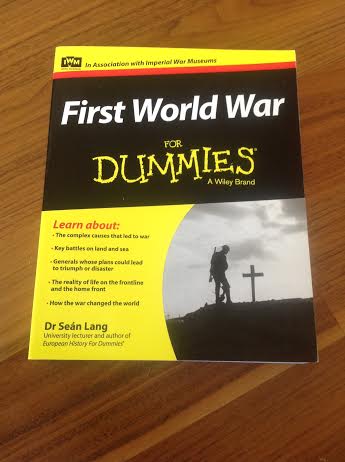
firstworldwarfordummiesbookreview

How long did it take to research and write the book?

Not easy to say, because in a sense I have been reading up on the FWW for years, and teaching it to university students for the past four or five years. There was a tight turn-round schedule for the book, especially as the “for Dummies” process involves submitting chapters as you write them, rather than submitting a whole manuscript. The writing itself took about six months.

What is your writing process?

It’s different for the “For Dummies” series because of the very close process of collaboration with the editor. Then not only are there always some academic experts who review your text, but with this book, because of the partnership with the Imperial War Museum, their experts vetted it too. So you have to get a balance between what is academically respectable and what is comprehensible to a wide readership.

The readership is very different from that of a standard academic article or even a textbook: you’re writing for people who might not normally pick up a book, or who might even be a bit scared of them. I’ve seen people taking FD history books off the shelves in bookshops like WH Smith (ie a shop where they might not have gone in to buy a book) and hesitating a long time before deciding whether to buy it or to put it back – and I’ve seen people do both. So I think of the book not in terms of something primarily for people who already know a lot about the war, but rather in terms of the sort of book I would turn to if I needed a quick briefing on something about which I know nothing and of which I have scary memories from school – physics, say, or fairly advanced mathematics. You have to go to where people are and take them forward, not stand where you are and expect them to come to you.

Being a lecturer obviously helps, but did you learn anything that surprised you when writing the book?

There are always part of the narrative which you didn’t know much about before starting to read up for the book – elements of the war in Africa, for example, or the epic journey of the crew of the German raider “Emden”. But I think the greatest surprises lay in some of the images in the IWM’s collection, which we used for the illustrations. We tend to see only a limited range of types of photos from the war – trenches, recruits, women in factories and so on – so it was very refreshing to see images from around the world, some of them quite dramatic.


In the parts of tens you list First World War poets and writers, do you have a personal favourite?

I think probably RC Sherriff, author of “Journey’s End”. Joan Littlewood, who devised and directed “Oh! What a Lovely War” in 1964, loathed the play and wouldn’t allow anyone to mention it in her presence, but I think it is a much more authentic voice from the front line than she managed. It’s a play about a group of officers in 1918 and it captures that loss of schoolboy ideals we associate with the trenches. Sherriff went to the grammar school in Kingston across the road from the one I went to, so maybe there’s a sense in which I see him as the First World War equivalent of me.

A lot of women got their first taste of real work during the first world war, do you think that had a lasting difference?

There’s a lot of debate about this one among historians, because the liberation and emancipation of war work very quickly disappeared when the men came back home and resumed their old jobs, so some people say that the change for women was illusory. There’s also a certain irony in the fact the sort of work that women did in the FWW was often the very sort of work Victorian social reformers had been trying to rescue them from. But yes, I do think the change was long lasting, even if it wasn’t immediate. It made it clear that men and women were all part of the same fighting nation, and that women, whether they were in the factories or whether they were bringing up children at home, had a part to play in the national war effort just as the men had. That idea swung back into action in the Second World War, of course. That in itself effectively smashed the old Victorian idea that men and women inhabited “separate spheres”, both metaphysically and in reality. That idea has never revived, at least not in British society, so yes, I think the war made a lasting difference for women.

What can be learned from World War I?

That’s too big a question to answer fully, so I’ll give just a couple of things that can be learned from it, though I ought to start with a lesson that can’t be learned: I heard someone during this year’s centenary commemorations saying something like “We must learn from this war so it never happens again”, and I thought “Have you never heard that there was a Second World War? It has happened again”. I think the lessons that can be learned include: a) political leaders must avoid playing games of bluff, because that is effectively what was happening in 1914, and everybody’s bluff got called, with disastrous results. b) People always go into war assuming it will be like the Last One (whichever that one is) and it never is, but seldom have expectations about the likely nature of a war been so completely wrong as they were in 1914. So, if you go to war, assume it will be a hundred times worse than you expect. And remember that your decision will mean that a lot of people now alive will soon be dead.

What do you think is the lasting legacy of World War I?

There’s no strict hierarchy about these things, of course, but I would rank the First World War’s legacy as even greater and longer-lasting than the Second’s – after all, the SWW was itself a legacy of the FWW. For example, all the problems that blew up in the Balkans in the 1990s were almost directly a legacy of the FWW. So is the continuing and growing crisis in the Middle East, including Israel-Palestine, resurgent Islam etc. The Middle East (itself a European term) was a backwater before the FWW, when the Europeans carved it up, with all the consequences we are still living with. Ireland’s troubles go back a long way, but the specific issue of Northern Ireland – an issue which never quite goes away – is a direct legacy of the FWW. Above all, a) the Russian Revolution and the formation of the Soviet Union were both precipitated by the FWW (it is arguable that Russia would have had a revolution without the FWW, but there’s also a good case for saying that it wouldn’t have happened without a war to bring things to a head), and b) it was the FWW that first got the United States acting as a Great Power, well outside its own back yard, starting the process of American global action which still dominates the world.


D-Day just had its 70th Anniversary, as time goes by is there a danger of people forgetting what happened, and the lessons learned?

Yes, there is such a danger. Schools and local communities do a very good job of keeping the memory of the FWW alive at the moment, but we can’t assume that will go on for ever: firstly, it is noticeable that Islamist protests against western involvement in Iraq and Afghanistan seem to have taken the form of assaults against FWW symbols – desecrating war memorials, burning poppies, and so on. That might indicate that the commemoration of the FWW could become divisive in future, rather than welding the nation together, as it has done so far. But even if it doesn’t, just think of the children currently going on school trips to the trenches. Their teachers are old enough, except perhaps the very youngest, to have known people who lived through the war – grandparents and so on – so the human link is still there. But in forty years’ time, in 2054, those pupils will be the teachers and parents: they won’t have that direct link, and their children and pupils will be even further removed from it. The FWW will be about as close to them as the American Civil War or the Crimean War are to us. Now, okay we still acknowledge the losses and suffering in those wars, so it may well be that the memory of the FWW will still be kept alive, but it won’t be on anything like the scale of current commemorations. Lastly – and I hate to point this out – future generations may well have wars and disasters of their own to commemorate, which will push the 20th century world wars out of the picture.

Do you think the first World War was avoidable?

Yes. Totally. I think the fall into war in 1914 was entirely avoidable. There are some wars in history which probably had to be fought – the SWW, civil wars, wars against revolutionary regimes, for example – and others which were entirely avoidable, like the US/British ‘War of 1812’, or the Crimean War, but the FWW is the worst. The crisis that provoked it was entirely solvable – assassinations, even of Archdukes, do not usually provoke wars – and the Great Powers HAD solved far more dangerous crises in the years before 1914. But among some statesmen in 1914 there was a certain eagerness that this time they should get a war out of it, and among some – notably in Berlin but also in Vienna – there was a determination that nothing should get in the way of their desire to have a war. You remember that Israeli Eurovision song, “A Little Peace?” Or even John Lennon’s “GIve Peace a Chance?” Well, in 1914 there were some statesmen who thought in terms of having “A Little War” or wanted to “Give War a Chance”. They had no idea of exactly what that war would be like, but they bear a very heavy responsibility nevertheless.

What’s next?

I’m also a playwright. A short play of mine called “The Road Less Travelled” which is set in 1914 and is a reflection on the outbreak of the war has been picking up good reviews and awards recently and will be published soon; I’m also writing a play called “1914: Assassination Before Lunch” which will be performed in Cambridge in October.

First World War For Dummies