The five things filmmakers can learn from Kickstarter by Andrew Harmer

The five things filmmakers can learn from Kickstarter (and visa-versa The five things Kickstarter creators can learn from filmmakers). By a filmmaker in the middle of a campaign!


Hello, I’m Andrew Harmer, the writer-director of the Fitzroy. Right up front I want to say we are currently slap bang in the thick end of a Kickstarter campaign.


Here’s the elevator pitch for the film.


The Fitzroy is a live action black comedy set in an alternative post-apocalyptic 1950’s. The world is covered in a poisons gas and the last place for a traditional seaside holiday is The Fitzroy hotel an abandoned submarine just of Margate.


This list isn’t necessarily the five things we have done, but it is the five things we would do (or be prepared for) if we started over again! Kickstarter, like film making is a constant learning curve and this list might well change by the end of the campaign.


  1. Tell the most interesting story.

You only really get one shot at a Kickstarter campaign or making a film. Sure you might do another one or another dozen but then a bus might also hit you! So you better make this one count and make it the best it can be.


And that means telling the best story you can.


A film has to be the very best ‘version’ of that story you can possibly tell. The most interesting, dramatic and honed story possible.  Nobody want’s the B plots to be more interesting than your focus so make sure you are telling the most interesting story.


The same goes for a Kickstarter campaign. You need to hook people into your campaign and to do that you need a great story (as well as a great product). And I don’t just mean the story you are selling, I mean the story behind the project. YOUR story. Your struggles, the adventure you have been on to get to this point. Is your idea based on a life altering brush with death? Did you witness a moment of kindness between an old man and his wife on the buss while riding the bus to work? It doesn’t matter what it is, just make sure it’s interesting and told the best way possible.


2) Be yourself.

Let your personality shine. I like films where I can ‘see’ the personalities of the filmmakers. I don’t always like those personalities, but I would much prefer to see an idiosyncratic film than a pixel pushing blockbuster with no heart. I truly believe a soul of a film comes from the people who make it. While it is being made it absorbs the personality and characteristics of the director (if they want it to). And I want to see that. Film is a personnel experience a conversation between the viewer and the director.


Same goes for Kickstarter, but to an even larger degree. The old adage ‘people invest in people’ is true. You have to put yourself out there. It’s scary but you have to share your passion, fears and hopes. Sure you might end up looking like a fool but if you don’t put yourself out there people will just turn off. But word of warning – don’t try to be something you’re not. If you’re funny be funny but if you are not don’t even try. Cool and hip? That’s fine but if you aren’t don’t force it. People can smell it, and it stinks. No bullshit. Just be yourself and people will engage with you.


3) Do it quick.

Okay this is straightforward. Kickstarter is on the web so you don’t have long to tell your story. Minutes, if you are lucky but seconds in reality. So you better make your page accessible, clear and your pitch video SHORT and to the point.


Same goes for the film (unless you’re Terrence Malick) edit, edit, edit. Cut the fat and edit that script so it’s tighter than a drum. All through the film and into post production, if it doesn’t move the story on then it goes. Don’t waste people’s time.


Word of warning though don’t jump the gun and rush head first in to it. With both Kickstarter and films make sure you are ready, that everything is prepared. And even if you think it is –  it probably isn’t. Do it quick but make sure you are prepared.


  1. Know your audience and engage with them.

Kickstarter is social, very social. It is a direct link between creators and their audience and in my humble opinion a very powerful tool. But before you start a campaign you must identify the audience you are targeting. This could be fairly obvious, your family and friends, people with ipods, hardcore gamers, Teddy Ruxpin fans. Whatever your audience you need to identify them, find them and engage with them.


Film-makers need to do the same thing. There’s not a one size fits all film. Everyone has different tastes and yes you can try to create a film that appeals to as many people as possible and the mass market. But I prefer films that are aimed at… well… me and my tastes. There is a distinct risk when trying to appeal to everyone that you can water down a story. Be specific and know your audience.


  1. Take it seriously and have respect.

Both Kickstarter and filmmaking are, at the end of the day, businesses and you are asking for people’s time and money. That is not to be taken lightly. Sure you are hopefully giving back to them in the form of entertainment or in the case of Kickstarter some sort of reward. When people give you their hard earned money you have a responsibility, a contract to deliver on your promises and work your boney ass off to make sure you do.


If I can tell someone has put their heart and soul in to a project or a film it means a lot to me as an audience member and it pays dividends.


  1. Be flexible and learn to adapt.

Just like this list! It was meant to be five and we end up with six? It’s not a problem just not what I was expecting when I started writing. It took me by surprise. Your Kickstarter project is an organic beast, it is going to change and develop as the campaign progresses. It is going to throw you some curve balls, stuff you planed will fail and other avenues and opportunities will suddenly appear. You can’t let the setbacks knock you, you just have to keep moving forward and be open to any new possibilities.


I can’t think off anything that is more applicable than that to film making! Be flexible and make it work.


So that’s it, that’s what I have learnt so far, and who knows what is around the corner. Hopefully we can reach our target and make an awesome film. If I heed my own advice, we just might!


If you would like to see how we are doing on our campaign please check it out. www.thefitzroy.com/ks any advice or support in spreading the word would be warmly welcomed.


The Fitzroy – The Final Week on Kickstarter

A post-apocalyptic comedy about the last
refuge for a seaside holiday
www.thefitzroy.com/ks

The final week of the Kickstarter Campaign

The Fitzroy, is black-comedy live action feature film set in a post-apocalyptic 1950’s, on board The
Fitzroy hotel, a leaky submarine beached just off Margate – the last refuge for a traditional summer
holiday

Written and Directed by Andrew Harmer and Produced by Liam Garvo & James Heath, the team
behind Dresden Pictures.

Short Synopsis:
Set in an alternative post-apocalyptic 1950’s, The Fitzroy hotel, a derelict submarine beached just
off Margate, is the last place for a traditional summer holiday.

Bernard, the hotel’s bellboy, cook, maintenance man and general dogsbody faces a constant battle to
keep the decaying hotel airtight and afloat.

But when he falls in love with Sonya, a murderous guest, he is thrown into a world of lies,
backstabbing and chaos. As Bernard struggles to hide her murders from the other guests and
suspicious authorities, the hotel literally begins to sink around him.

As his world implodes, Bernard must choose between the woman he thinks he loves and the hotel
submarine that is keeping them all alive.

THE FITZROY: ONE WEEK TO GO

The Fitzroy, Kickstarter campaign really caught alight in the last week. On Tuesday 11th December
we were delighted to be announced by Kickstarter as their ‘Project of the Day’ and featured on the
home page spotlight for the whole day, this led to over a £7,000 increase in pledges. Kickstarter
followed this up on Thursday 13th December by naming The Fitzroy as ‘Projects we Love’ in their
weekly newsletter, with the subject line ‘Hotel Submarine’. This went to everyone registered on
Kickstarter, and over the next 24 hours resulted in 200+ new backers.

To create The Fitzroy, Dresden Pictures are looking to raise £60,000 through Kickstarter. We’ve
had some incredible support and at the time of writing have raised 83% of the target, an incredible
£50,000. We really couldn’t be happier and now we are looking for one big final push to get us over
our goal.

The campaign finishes Sunday 23rd December at 6pm GMT. For The Fitzroy to happen we need
to reach 100% of our target by this time or we don’t get any of the money and none of our generous
backers will be charge and lastly the film simply won’t get made.

THE STORY SO FAR
One of the key reasons why we believe Kickstarter have got behind the campaign is due to our
eagerness to engage the audience throughout the campaign in new and original ways.
In the first weekend, The Fitzroy team was out in full force at the Sci-Fi London Post Apocolympic
event on Nov 9th & 10th chatting to the patrons about the project, its rewards and raising
awareness. This was followed by an open invite shindig, in Hoxton, London at the Underbelly on
Nov 19th and had the film’s soundtrack producers, the Green Rock River Band (GRRB) playing
their mean doom-folk sound.

On the weekend of 8/9th December we were brave (maybe foolish) enough to take on making a
short film in 48 hours based on ideas provided and voted for by our followers on Twitter and our
friends on Facebook – we called it the Mini-Fitz Challenge!
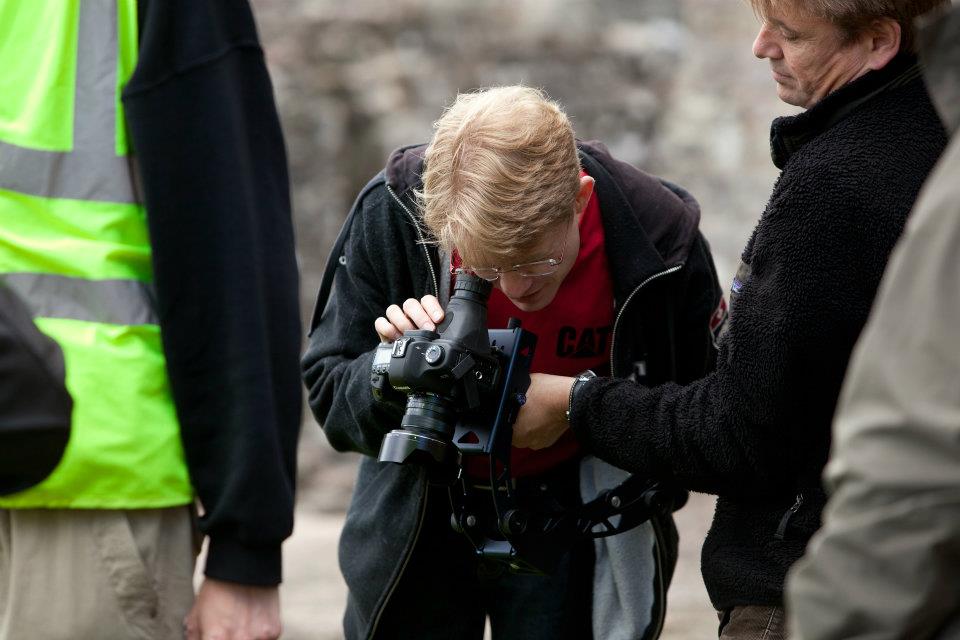
Still from the ‘Choke Mate’ shoot.

We wanted to give something back, so asked our fans for their favourite idea, prop, location and title
as well as calling them out to help out as cast and crew. The end result was a five minute film ‘Choke
Mate’ that premiered online on 10th December. It’s a much darker piece than the feature film but
one we are all very proud of achieving with no budget and very little time – check it out for yourself:
https://vimeo.com/55276148

On Sunday 16th December we went street busking, with the fantastic GRRB on the London South
Bank. We tapped into a new audience as the crowds gathered round and GRRB soon sold out of
albums. The band got a brilliant reaction from fans. The video of highlights from the day will be going
live in the last week of the campaign.
‘GRRB’ busking on South Bank

We really want The Fitzroy to be a film made by people who like us, at heart, are film fans. We want
them to be part of it and share the experience with us. For example, one of the cool rewards is an
animated cartoon version of you or your loved one, which will inhabit the opening title sequence.
We’ve really tried to tailor the Kickstarter rewards to be as exciting as possible. Our rule was if we
wouldn’t pledge for it, then how can we ask others to. So we feel there are some great rewards in the
form of posters, DVD box sets out of a Beach Survival kit and gas mask props from the finished film!
The full list is viewable on our Kickstarter page, as well all other details on The Fitzroy.
View the Kickstarter video for The Fitzroy

The DIRECTOR AND PRODUCERS
Writer & Director Andrew Harmer
James Heath (Producer), Andrew Harmer, Liam Garvo (Producer)

Midnight’s Children | Film Review & Interviews

Midnight’s Children is an ambitious and sprawling film. Based on the celebrated 1981 Booker Prize-winning novel by Salman Rushdie and adapted by Rushdie himself, it is thoroughly enjoyable. It is visually stunning and allows itself time to tell it’s story.

Filmed in Sri Lanka and spanning several decades, the film is something of a history lesson. The surrender of the Pakistani army and the subsequent creation of Bangladesh is filmed incredibly well. No overplaying of the situation and a good overtone of respect. Although I knew the history surrounding this time it was great to see it on screen. History is too often forgotten.

The film starts with Saleem telling how his grandparents met, then his parents, until we come to his birth on the stroke of midnight on the day of India’s new independence from the United Kingdom in 1947.

I loved that this film takes it’s time to really tell the story, but it is not filler, it has a good length. The actors are all brilliant and the film is beautifully shot. This film may be a history lesson, but it is an entertaining one. An ambitious film which has payed off.

Definitely one to watch.


“Born in the hour of India’s freedom. Handcuffed to history.”


Spanning decades and generations, celebrated Canadian filmmaker Deepa Mehta’s highly anticipated adaptation of Salman Rushdie’s Booker Prize®–winning novel is an engrossing allegorical fantasy in which children born on the cusp of India’s independence from Britain are endowed with strange, magical abilities.


Midnight’s Children follows the destinies of a pair of children born at the stroke of midnight on August 15, 1947, the very moment that India claimed its independence from Great Britain — a coincidence of profound consequence for both. “Handcuffed to history,” and switched at birth by a nurse in a Bombay hospital, Saleem Sinai (Satya Bhabha), the son of a poor single mother, and Shiva (Siddharth), scion of a wealthy family, are condemned to live out the fate intended for the other. Imbued with mysterious telepathic powers, their lives become strangely intertwined and inextricably linked to their country’s careening journey through the tumultuous twentieth century.


IN CINEMAS DECEMBER 26TH  


INTERVIEW WITH DIRECTOR DEEPA MEHTA

Why this book? This story?

I first read Midnight’s Children in the winter of 1982 in Delhi. I distinctly remember talking about the wonder of it all with a friend while we walked around Lodhi Gardens. It had an enormous impact on me. It uncannily echoed my own upbringing, and for a novice filmmaker in the early ‘80s the book seemed to read like a movie – full of cinematic language and rooted in popular Indian cinema. The novel’s fearless dark humour combined with its affection for all human foibles stayed with me. Salman and I often talked about working together. One night, over dinner, I asked him who had the rights to Midnight’s Children. He said he did. I asked to buy them and he sold the option to me for one dollar. It was not premeditated; it was just gut instinct.


What is the movie about?

It is a coming-of-age story, full of the trials and tribulations of growing up, and of the terrible weight of expectations. What separates it from other similar thematic films is that this coming of age story is not only about a boy but also about his country, both of whom are born at the very same time at a pivotal point in Indian history. Saleem’s journey as our vulnerable, misguided hero is always intertwined with the struggles of the newly independent India, as it finds its own voice in the world.


Art by its very nature is political and I believe that Midnight’s Children says something important and universal about survival, freedom and hope.


Why this movie now, for you?

There is a saying – luck favours the prepared. The choices that I have embraced in life and the movies that I have made previously have certainly given me the technical and emotional confidence to tackle an epic about my homeland, but in many ways, I felt that I was learning the filmmaking craft all over again. My desire to make this film came from a gut instinct. I knew I wanted to do it but it required a huge amount of chutzpah to then wrap my head around actually filming it. I think that my producing partner David Hamilton’s dedication and leadership really did make it possible. Some of the most meaningful decisions in life are based on that indiscernible feeling of just knowing it’s time. And it was.


My core team: design, camera, wardrobe, editing were all available and wildly keen to work on Midnight’s Children, as was the wonderful ensemble cast. But I think the most vital factor of all is the pure delight and fun of working with Salman, and how profoundly in synch we are about the heart of the story. Salman and I have both made our homes in the Indian Diaspora; I in Canada, he in Britain and America, and we have similar complicated intertwined roots in India. Those shared perspectives and memories, plus his creative generosity and wit, kept me, and the movie, going. Salman once said, about Indian born artists who have emigrated, “ Our identity is at once plural and partial. Sometimes we feel that we straddle two cultures; at other times, that we fall between two stools. But however ambiguous and shifting the ground may be, it is not an infertile territory for a writer to occupy.”


Is this film a “love letter to India”  from you?

Salman has often said that the book is his love letter to India. I hope the film reflects the same sentiment. The last lines are, “The truth has been less glorious than the dream. But we have survived and made our way. And our lives have been, in spite of everything, acts of love.” The story, in its detail, becomes universal in its message of love and redemption.


How did you and Salman work on the adaptation, and what are the key changes from the book?

After Salman sold us the option to the book, he agreed, reluctantly, to write the screenplay. The book is inherently visceral and cinematic; the problem is length. The novel is 533 pages long and first drafts of the script were 260 pages. Early on, at our most important script meeting, Salman and I both brought handwritten lists of the dramatic moments which absolutely had to be preserved. One might spot some karma or magic at work here – our lists matched, in almost every way. The ruthless surgical decisions about cutting had to be Salman’s alone: whole swathes of story and characters – gone. And then the intricate balance of what to shape, change, or add was our shared task. I suggested scenes, moments, emotions. Drafts went back and forth as they do. Painful cuts continued to be made right up to shooting and also in the cutting room. We preserved and protected the central thread of the story and tied it always to Saleem.


The biggest changes from the book are that Saleem and Shiva are now inextricably linked throughout and Shiva is given greater prominence; the story builds towards the Saleem-Parvati- Shiva triangle. Recalibrating and reshaping the last scenes during the Emergency and afterwards are important shifts, but it would ruin the ending to say anything further about those specific changes. We also deleted the overall narrator (from the novel), and in its place Salman wrote a spare, precise, evocative voiceover, which he performs – wonderfully.


How did you prepare for Midnight’s Children?

I have the terrible reputation of spending my down time not moving unless I have to. Devyani, my daughter, has often said that her mum’s favourite exercise is “turning the page of a book”! Well, a slight exaggeration but somewhat true. All that changed about six months after Midnight’s Children was green lit. I found an empathic, encouraging trainer and went to the gym every day (reluctantly!) before production. I felt I needed every bit of stamina and awareness, and this physical preparation was perhaps the most essential of all. This film, more than most, because of its sheer scope was going to need not just my focus but also my stamina. The wisest decision I made.


Preparation with the cast is a given. A month before shooting there was an intensive workshop in Mumbai with the actors and me, led by my friend Neelam Choudhry, a theatre director from Chandigarh. This was not a rehearsal of the script; it was work based on the Natya Shastra, a treatise written in India in the 4th century AD about the art of drama, which includes a rasabox or grid of nine essential mental states and emotions: love, repulsion, bravery, cowardice, humour, eroticism, wonderment, compassion, and peace. This intensive work knitted us together as a group and grounded us in the emotional arcs of the film.


I don’t use shot lists or storyboards; the actor motivates my camera. From the actors I know what the emotional centre of the scene will be and then we shoot it. By now my long time DOP Giles Nuttgens and I have a finely honed shorthand.


But the most important preparation (except perhaps for the gym!) was meticulously planning the world of the movie. In Midnight’s Children we meet four generations over five very distinct time periods; there are three wars, 64 locations, and 127 speaking parts, plus animals, babies, snakes, cockroaches [Well, that didn’t really work out. Our cockroach wrangler failed]. And everything in the world of the film had to be shipped or found or designed or built in Sri Lanka. My closest ally and second brain/eyes is always my brother Dilip, who is responsible for the entire “look” of this film. He fought for authenticity in every aspect of the movie: visuals, historical period, class, accents, religious backgrounds…no detail too large (wars, helicopters, parades) or too small (ants, lizards) to escape his scrutiny. There is no one else whom I fully trust who knows the historical landscape and the “real” India, and who could create all of this flawlessly and with such a passion for accuracy and for beauty.


Did you have any filmmaking touchstones or influences as you planned the shooting of Midnight’s Children?

During the script process I thought a lot about classic elegant films like The Leopard, which is also a historical/political film. As we got closer to shooting Midnight’s Children and I got more inside the script and the energy needed to keep the story going, I began to think about movies like The Conformist – movies with tougher and more immediate storytelling. All along Giles and I planned on a traditional camera department, and many extra tracks and dollies had been shipped to Sri Lanka. A week before shooting I realized that we had to ramp up the energy of the movie, keep constantly moving psychologically, always have a sense of immediacy and fluidity, and free ourselves from time consuming set ups. There was just too much to cover. So we ditched most of the equipment and Giles shot almost the entire movie handheld, up close, intimate, and full of energy. This was a major liberation for all of us, especially because I do all of my blocking with the actors right on set.


How did you want to deal with the magic or magic realism elements?

I always wanted to show the fabulist as realism. I never wanted masses of CGI and visual effects; there are some effects in the movie, but pretty minimal. I wanted the fantastical elements to be grounded in reality. Salman has described the Children as “gifted or cursed with telepathy”. It’s up to audiences to draw their own conclusions about Saleem’s experiences, his loneliness, his vivid imagination and the Children’s corporeal reality.


The movie intentionally plays around with time shifts, foreshadowing, dreams and witchcraft. The most significant magical item is probably Parvati’s basket of invisibility, yet it is used in very practical and credible ways. Or at least Picture Singh believes so…and magicians are the last to believe in real magic. For me the film magically changes the definition of family. By the end of the movie, Saleem’s concept of family (and perhaps ours) is truly transformed.


How did you pull all the aspects of this complex story together in the edit?

When we came back from the shoot my editor Colin Monie and I knew Midnight’s Children had to be constructed in stages, and that we had to get each stage right before we moved on. These stages were:

1) The flesh and blood: Saleem and the character/family saga stories had to be shaped first;

2) Then the history-wars-time periods had to work within the overall story and be clear;

3) Then the theme, politics and what the film says about India, had to be woven in

…and that actually is how the movie came together: cut by cut, screening by screening.  From intimate personal story – to family saga – to epic.


We protected the personal, the intimate, and the emotional core of all the characters inside this roomy canvas, full of disasters, wars and shattering events. That was not always easy, nor was figuring out how much of the history and politics to include. This is a movie for audiences all around the world who will have very differing amounts of knowledge about India and we did not want to over explain, or under explain.

Deepa Mehta


****************************************************************************


ON  T H M A K I N G   O F   M I D N I G H T C H I L D R E N SALMAN RUSHDIE


Deepa Mehta and I agreed to work together to make a film of Midnight’s Children on June 9th, 2008. I was passing through Toronto on the North American publication tour for The Enchantress of Florence and had dinner with Deepa on my one free evening. She asked me who had the rights to Midnight’s Children; I replied that I did; she asked me if she could film it; I said yes. It was as simple as that.


Four and a quarter years later, the film of the “book that was impossible to film” is finally finished, and I’ve had quite an education in what it actually takes to get a film made. I’ve learned, for example, that when some potential financial backers tell you that they totally adore your book, they 100% love your script, they worship Deepa, and they are totally committed to helping us get our film made, this is what they mean: “Hello.”


Over the years, before Deepa, David Hamilton and I started on our journey together, more than one attempt to film Midnight’s Children had foundered. There are so many ways a film can fail to get made. Consequently, I’ve developed a great respect for anyone who gets any film made and puts it out there. I’ve also come to feel – and I am not ordinarily a superstitious or mystically inclined individual – that it was right that those earlier attempts to film my book failed, so that this one could succeed. One might almost use the word “karma.”


I’m happy that we were able to retain complete creative control of the project and to make the film that Deepa and I wanted to make. Nobody told us how to write it, cast it, shoot it or cut it, so there’s nobody else to blame, and that’s exactly the way we both wanted it to be.


Years earlier, Hanif Kureishi had told me of his happy collaboration with Stephen Frears on My Beautiful Laundrette, and Paul Auster had said much the same about working with Wayne Wang on Smoke and Blue in the Face. I had long hoped that I might some day encounter a filmmaker with whom I could have such a close, happy, fruitful working relationship. Deepa Mehta was the answer to that dream.


From our first script meeting, we found we were almost uncannily of one mind about how to approach the adaptation. When I suggested dropping the novel’s “frame narration” in which the protagonist, Saleem, tells his story retrospectively to the “mighty pickle woman” Padma at the Braganza Pickle Factory, Bombay – dropping it because it was too “literary” a device which, on film, would constantly break the audience’s emotional engagement with the characters – Deepa said, “I was going to suggest that but I thought you wouldn’t like it.” And when I showed her my first list of scenes we needed to include to make it a true adaptation of the novel, she produced her own list, and the two were almost identical.


We did much of the casting together in Bombay, and even when we weren’t in the same place at the same time we discussed actors together, watched clips of their work, grew excited about some and rejected others. When Deepa thought of the then relatively unknown Satya Bhabha for the lead role she sent him to meet me and only after both of us had seen, in him, the sweetness and vulnerability we were looking for, did Deepa formally offer him the role. We met with a number of Bollywood titans, to whom I had to “narrate” the film in their homes and even in their stretch limousines; but we agreed, in the end, to avoid casting those Bombay ultra-stars who were unfamiliar with working as part of an ensemble cast. Instead, we chose wonderful actors, highly acclaimed wherever Indian films are seen, who left their egos at home and gave us their all.


It has been an extraordinary experience to watch my novel brought to life by so many talents working in harmony. Dilip Mehta’s production design, with its meticulous eye for period detail, re-created the world of Midnight’s Children, much of it drawn from my own childhood memories, so vividly and accurately that there were moments when I gasped – see, there was my father’s old Rolleiflex! And look, there were my grandmother’s ferocious geese! Giles Nuttgens’s magnificent camera photographed a world that was both epic and intimate, which was afterwards given rhythm and shape by Colin Monie’s editing; Nitin Sawhney’s score lifted scene after scene to new levels, adding layers of emotion; and above all Deepa Mehta’s kindly, ferocious direction orchestrated it all and made a film that’s true to the spirit of the original novel, but that also, I think, possesses its own authority, and establishes itself as a work of art in its own right.


And now it’s done, and it’s for others to judge what we did. This is the gamble of art: to make the work you want to make and then offer it to its audience, and to hope that it will touch them. When that happens, with a book or film, it’s the best feeling in the world.

Salman Rushdie


HISTORICAL BACKGROUND TO MIDNIGHT’ S CHILDREN

Midnight’s Children is an epic movie based on a novel drenched in the history of India. While the characters are almost always fictional, the major events, wars, and seismic power/political shifts are not. In order to give extra historical context for the movie we asked a friend, Professor Deepika Bahri, who teaches at Emory University, where Salman Rushdie is Distinguished Writer in Residence, to write a brief essay about some of the historical aspects, as they intersect with our story.


———————

“Handcuffed to history”, Saleem Sinai is the designated Midnight’s Child whose fate will mirror that of the nation as he finds himself center stage at major events in the history of the region. Right at the core of Midnight’s Children are the two signature events in modern Indian history that are joined, like the clock hands at the midnight hour (Saleem’s birth) on August 14/15, 1947: the partition of British India, and the independence of India and Pakistan. After some 150 years of colonial occupation, the British left India divided in two on the basis of religion, with Pakistan as an Islamic state led by Governor General Mohammed Ali Jinnah, and India a secular democracy under Prime Minister Jawahar Lal Nehru. Muslim leaders who advocated Hindu- Muslim unity and dreamt of an undivided nation free from British rule are represented in the film by the fictional figure of Mian Abdullah. The movie presents an intricate metaphorical rendition of events that are vastly more complicated in the historical record. The murder of Mian Abdullah and the concealment of his secretary Nadir in the basement signal the muffling of resistance to

Partition. Scholars do not agree on the causes or reasons for Partition, but they recognize that it left behind unresolved boundary issues, and set the stage for decades of conflict in modern South Asia. Also left unresolved, like Amina’s longing for her first husband, Nadir, was the nostalgic hankering for a united subcontinent–a dream that would gradually fade from historical memory.


The movie’s unusual hero Saleem is our way through this fractured history. A cruel school teacher points to Saleem as a study in “human geography”, his face and nose “the [Indian] Deccan peninsula hanging down” and the stains and birthmarks on either side of his face the Western and Eastern wings of Pakistan. Some 1000 miles of Indian territory separated these two regions. Apart from nation-status and a majority-Muslim population, the two wings shared little either by way of language or culture, eventually separating into two nations in 1971 with Indian intervention. In the years following Partition, India and Pakistan would fight two other wars in 1947 and 1965, largely over the fate of Kashmir (where the film begins on the beautiful Dal Lake). The two nations remain deadlocked over a volatile Kashmir to this day.


India-Pakistan Wars

Although Saleem’s story is tied most closely to the modern nation of India, Rushdie’s novel and screenplay conveniently and brilliantly place him center stage for major events in the entire region, including in Pakistan, and later, Bangladesh. After Jinnah’s death in 1948  (we see his photo is on display in the medical clinic in Karachi) and the assassination in 1951 of its first Prime Minister, Liaqat Ali Khan, Pakistan suffered decades of political and economic instability, with democratically elected governments struggling to complete their terms. In 1958, President Iskander Mirza suspended the constitution (lines echoed in the movie): shortly afterwards, the military sent President Mirza into exile and the Army Generals assumed control of a military dictatorship. Eleven-year old Saleem is at hand to participate in the plotting of this bloodless coup at the dinner table, having been exiled to his aunt Emerald and uncle General Zulfikar’s household in Rawalpindi, the military headquarters of Pakistan.


By the time he is seventeen in 1964, Saleem is reunited with the rest of his family in Karachi. The Sinai family’s forced departure from Bombay in search of a fresh start in Pakistan is destined to be ill fated; they perish a year later in a bomb attack during the next Indo-Pakistan war – the second futile war over Kashmir which ended in a stalemate and small tactical victories for India. Saleem survives the bomb attack, but he is brained by a fateful, silver spittoon which was presented to his mother Amina and her first husband before Partition. He awakens in a Pakistani army hospital six years later in 1971, “remembering nothing,” ready to be thrown into the next major event in South Asian history: East Pakistan’s secession from the Western half of Pakistan.


The Birth of Bangladesh

Less than a quarter century after the formation of Pakistan, its Eastern wing, aided by India, would break off to become the sovereign nation of Bangladesh. The outcome of the 1970-71 elections in Pakistan had strained the already fragile relations between its eastern and western sections to a breaking point. The Awami League, which advocated autonomy for the more populous East Pakistan, swept the elections to gain an overall majority. Faced with the unacceptable prospect of a national government led by an East Pakistani leader, then President Yahya Khan postponed the National Assembly session, leading to massive insurgency in the East. Negotiations to form a coalition government broke down and a devastating civil war ensued. India’s third Prime Minister, Indira Gandhi (Nehru’s daughter), decided to intervene on the side of Bangladesh, defeating Pakistan quickly and decisively in 1971. Naturally, Saleem is present to witness Pakistan’s surrender to India and the birth of Bangladesh, before he is magically returned to India in Parvati’s basket of invisibility.


The Emergency

India’s victory over Pakistan catapulted Prime Minister Gandhi to unprecedented heights of popularity. In 1975, however, she was found guilty of electoral fraud, prompting calls for her immediate resignation. Gandhi’s response was to manipulate the Indian Government to declare a State of Emergency, citing threats to national security and a crisis in law and order. In the 21 month long period of suspension of elections and civil liberties during the Emergency the nation’s claim to democracy was tested in the extreme. Saleem and the other Midnight’s Children, the “promises of independence,” bear the brunt of historically recorded excesses during the Emergency: forced sterilization, the razing of slums, the incarceration of opponents, and the torture of detainees. These abuses, which are shown in the film, continued until an overconfident Indira Gandhi called the next elections in 1977, with every expectation that her party would win. Instead, it was soundly routed. India had chosen democracy, and has continued on that often bumpy, but courageous path, ever since. As does our film’s hero Saleem, who in the end embraces a tougher optimism, and recreates a family which includes many of the factions and faiths of his beloved India.

Deepika Bahri

————-


Deepika Bahri is Associate Professor in the English department at Emory University. She is the author of Native Intelligence: Aesthetics, Politics and Postcolonial Literature and editor of two collections of essays, Between the Lines: South Asians and Postcoloniality and Realms of Rhetoric: Inquiries into the Prospects of Rhetoric Education. In 1996 she edited Empire and Racial Hybridity, a special issue of the journal, South Asian Review. HIV/AIDS in developing countries is a secondary research interest. She also maintains an extensive Postcolonial Studies Website. Her current book project examines representations of racial and cultural difference in literature.

 

Les Miserables Movie Musical Exclusive Review

Les Miserables’ movie musical – screened for cast and crew members at the Odeon Cinema in London, Leicester Square on the 4th of December 2012 – soon to be released in the cinemas.


I was lucky enough to be invited to the cast and crew screening of ‘Les Miserables’ on the 4th of December 2012 at the Odeon cinema in London, Leicester Square.


In a speech, held before the screening, award winning British film and television director, Tom Hooper, did thank all the cast and crew in the cinema making his dream come true.


Sir Cameron Mackintosh admitted that it had been their dream to make a movie musical and the fact Tom Hooper asked him on this amazing project was a really good thing as the director came up with an amazing vision of how he wanted it. Tom had in fact suggested disaggregating all the scenes for filming purposes to then put them back together in the movie. Mr Mackintosh admitted making a movie and especially a movie musical takes so much more work than putting together a theatre production. He funnily mentioned how the lack of sleep was a constant thing during the production!

The film musical had just been completed before the screening and Mr Hooper ironically wished he could have had a couple of hours more to do some extra touches.

Les Miserables’ movie has already had the Guildhall screening in the USA where it received a great feedback but now, the main aim is to bring the production in London.

In between the mentions in Hooper’s speech, Simon Hayes and his team for the sound department and all the post production team which did an amazing work, the costume department – which had to really work out the choice of fabrics so that the microphones would not be inhibited – Steward Hilliker took care of this. The camera team which had to film several scenes with multi-cameras; it was a real challenge. Really, a great team work. Also, Hugh Jackman’s remarkable and poignant performance of Jean Valjean cannot be left unmentioned.


The live sung movie musical is much more emotionally bounding than the old school movie musical version where actors used to mime the singing on a pre-recorded track. I found the movie as poignant as the live staged version. In the theatre it is great to be present and literally breath the performance but unless you are sitting in the very first rows, you hardly get to see the actors expressions when in the movie musical you can clearly see their eyes and facial expressions. This works amazingly to get into the actors’ deep feelings highlighted by remarkable close ups that, on the big screen together with the musical effects, make the audience unavoidably feel exactly how the characters felt whilst singing those lines live to the cameras (see video link below).

The movie respects the same sequence of events of the original Boublil – Schönberg musical theatre score. The musical and emotional tension is not released till the ‘Master of the House’ entertaining scene where we even see a featured Father Christmas!

Pablo Bubar – one of the many cast members who attended the screening – explained to me how, for the revolution scene, he had been called on set for 6 days, working 13 to 14 hours per day. Crew members worked even more than 17 hours per day.


The movie produced by Working Title Films (Sarah Radcliffe and Tim Bevan) will be released on the 25th of December 2012 in the United States and on the 11th of January 2013 in United Kingdom.

Might this movie be the landmark for more live sung movie musical productions to come celebrating really good acting and filmmaking and I bet cinemas will be full again!


http://www.imdb.com/video/imdb/vi2587403289/


Written by Paola Berta


The Hobbit: An Unexpected Journey

Ahead of the release of The Hobbit: An Unexpected Journey, We have a new, exclusive video of director Sir Peter Jackson and The Hobbit cast on how New Zealand was transformed into Middle-earth for the film.

The video is a guided tour of Middle-earth by the actors on location.

Air New Zealand, the official airline of Middle-earth, has been giving passengers The Hobbit experience as soon as they step onboard with its latest safety video , which stars Sir Peter Jackson, actor Dean O’Gorman, great grandson of J.R.R, Royd Tolkien and Gollum himself.

The Hobbit: An Unexpected Journey is released in cinemas in the UK on 13 December. For more Air New Zealand Hobbit assets see airnzhobbitmedia.com. Video courtesy of Air New Zealand.

Skyfall {Film Review}

*WARNING! MAY CONTAIN SPOILERS!*


After the underwhelming reaction to Quantum of Solace in 2008, critics and audiences were worried for the James Bond series. It left us feeling cold and empty, much like the character of James Bond that was portrayed on-screen. So there was a lot of work needed to bring the franchise back on its own feet and convince audiences there’s enough room for Bond to keep going! With Sam Mendes hired as the director of the 23rd Bond film, people started raising their eyebrows and their curiosity peaked as more talent were hired to the project.

Now celebrating 50 years of Bond (longest running movie series in history), the main questions on our minds were; does this Bond film deliver a respectful tribute to the series (more so than Die Another Day celebrating 40th anniversary in 2002) and do the filmmakers make up for their mistakes from Quantum and bring back the Bond we’ve been waiting for? The answer to both of those questions is a solid YES! Bond IS back!

The film ignores the events that have happened in the previous two films and goes straight to a different film altogether. The story starts with Bond (Daniel Craig) in Istanbul on the hunt for a missing hard-drive that contains names of every agent in terrorist organisations around the world and is accompanied by Eve (Naomie Harris). Meanwhile, M (Judi Dench) overhears their progress but the mission goes horribly wrong as Eve accidentally shoots Bond as ordered by M and the assassin escapes with the hard-drive. Months later, M and MI6 get attacked from a mysterious terrorist that seems to have a grudge against her. Bond eventually returns to England and is recruited back on the field. He then follows a trail that leads him to Shanghai and to an anonymous island where he meets Silva (Javier Bardem).

The film has all the trademarks of what you expect from a James Bond film; the one liners, the beautiful Bond girls, the stunning locations and the egomaniac villain. Unlike the typical plot where the villain holds the world to ransom or plans to start a World War; Silva has a personal vendetta up his sleeve and makes his character more threatening (even his presence is felt before he shows up). Through-out the film, Bond is treated like an old relic in a 21st Century world. It’s a daring but interesting question Sam Mendes not just puts to the character of Bond but even asks the question as mentioned earlier; is Bond still relevant in today’s generation? To which M delivers a speech in a meeting that time is inevitable but the soul still goes strong. Basically referring to the franchise and something I admire that a blockbuster even asks that question.

Daniel Craig excels as Bond, delivering the witty wisecracks like he’s able to do it blindfolded. He has definitely moved on from being cold and calculative to a Bond that is likeable but still retaining the efficiency as a double-0 agent. Judi Dench really delivers a great performance as M, even bringing more meat to the character than she ever has been since her debut in GoldenEye. She feels the weight as her time is nearly up but also feeling responsible for her recent actions. Her scenes with Daniel Craig are one of the highlights, as they interact with each other as they’re mother and son they both never had. Both Naomie Harris and Bérénice Marlohe really do check the list on being a Bond girl; they are both absolutely stunning! Harris makes Eve a convincing character, showing being a field agent isn’t all that glamourised and there are consequences to her actions. Though the weakest part of the film are the Bond girls, they don’t have enough screen-time to feel beneficial or make an impact to the story (especially with Marlohe’s Sévérine). Ben Whishaw as ‘Q’ made an impressive performance, making his take on the character his own but still retaining what we love about ‘Q’ (requesting Bond return a gadget in pristine order). His first scene with Bond establishes the type of relationship they will have; a banter between the old and the new but no matter on their differences, they still go hand-in-hand. Though Javier Bardem as Silva steals the spot-light and delivers one of the most memorable Bond villains in the series’ history. He brings the same intensity as he performed the character of Anton Chigurh in No Country for Old Men but also making Silva very flamboyant which makes it very fun to watch and can tell Bardem is having a blast playing the role.

The film looks absolutely breathtaking and no surprise it is shot by Roger Deakins (previous credits include True Grit (2010), The Assassination of Jesse James by the Coward Robert Ford and The Shawshank Redemption). One of the many things that have been improved from Quantum is; the action sequences are wide and stationary so we can tell what is going on (further proving that you don’t need to make it hand-held and have kinetic editing to make your action scenes to be intense). One particular scene that made my mouth drop was when Bond follows the assassin he encountered earlier in Shanghai, leads up to a skyscraper and the entire floor is only lit from neon lights from opposite buildings. It really shows Deakins’ talent and I applaud Mendes on applying this amount of artistic license in a Bond film (and has my vote for Best Cinematography during the awards season). Thomas Newman replaces regular Bond composer David Arnold and delivers a classic Bond score but also feels very modern (using synthesizers when Bond arrives in Shanghai).

Overall; Sam Mendes delivers a Bond film we’ve been waiting for and actually feels like what a Bond film should! The entire cast and crew should be applauded to their work, bringing the top of their game and truly showing respect to the series. My personal favourite blockbuster of 2012 and one of the best Bond films ever made. Highly Recommended!

5 out of 5

The Master | Film Review

Paul Thomas Anderson has a lot to live up to. By the time he was thirty years old he had Boogie Nights and Magnolia under his belt establishing him as the most talked about new American filmmaker of the 1990’s next to Quentin Tarantino. Five years ago his magnificent fifth picture, There Will Be Blood, was heralded by many critics as one of the finest, if not the finest film of the new decade. He has found himself being compared to the likes of Robert Altman, Martin Scorsese and even Stanley Kubrick as a new titan of American cinema. In cinefile circuits his new release The Master has been awaited with the sort of fan fever saved for comic book blockbuster adaptations. Interest has been particularly stoked since rumours circulated that the film would focus on the early years of the controversial religious sect Scientology and its mysterious founder L. Ron Hubbard. But nothing is ever as it seems. Anderson has sidestepped the obvious headline grabbing to deliver a film that is everything we expect from him; virtuoso, frightening, mysterious and with its heart on its sleeve.

It’s the end of World War Two and things are not right for Freddie Quell (Joaquin Phoenix). An alcoholic Navy Veteran, who has been left psychologically scarred by his experience in conflict and with an unhealthy lust for women, is sent into the civilian population and told that he and his like are now America’s future. Yet Freddie’s bad habits soon find him drifting from drink to drink, woman to woman and utter desolation. One night he drunkenly stumbles across the path of Lancaster Dodd (Philipp Seymour Hoffman), the self appointed leader of ‘The Cause’, a philosophical movement that claims to be able to cure ailments and trauma by recalling the past lives of individuals by billions of years. Dodd is fascinated by Freddie (and his homemade liquor) and invites him along with ‘The Cause’ entourage to spread the word across post war America. Though Freddie finds initial solace in Dodd’s teachings it isn’t long before doubts and scepticism rear their heads and a psychological tug of war begins between the two men.

From its fractured opening it’s clear that Anderson is playing to his own rules. Much talk has been made of the fact that the film has been shot in 65mm film stock and blown up into 70mm as opposed to the industry standard of digital filming and projection. I was lucky enough to see the film in its original stock format and found it well worth the effort. The texture and colours practically radiate off the screen whilst Anderson’s measured direction (in contrast to the frenetic nature of his early work) allows us to soak in the atmosphere in every long, meticulous take. This is once again accompanied by a stunningly unconventional score from Radiohead’s Jonny Greenwood that constantly wrong foots expectation yet completely puts you in the characters’ mindset. When it comes to the particulars of the narrative, Anderson is not one to speak down to an audience. There Will Be Blood was discussed as an examination of the birth of capitalism and commentary on America’s dependence on oil yet he never forces those ideas down your throat and he certainly doesn’t do it here. All the build up has focused round the Scientology issue but at its heart The Master is far more about the uncertainty of post-war America, a clash of class ethics (Dodd is the entrepreneur, Freddie the blue collar everyman), the horrors of post traumatic stress disorder and perhaps even a doomed platonic love between two outsiders attempting to find their way in a new world. Anderson has once again used an epic canvas to create a searing intimate portrait.

It is in the clash between Freddie and Dodd that the crux of the drama takes place. In terms of narrative it is the least constricted of Anderson’s work and so much responsibility lies upon Phoenix and Hoffman’s performances and it’s a responsibility they rise to tremendously. Opinion remains divided on Phoenix’s bizarre faux sidestep into being a rap artist but it’s great to have him back channelling the raw, dangerous and oddly charming energy that made his name. He is simply stunning as a man whose sheer facial expression alone speaks volumes about his character and what he has seen. He enters the frame a figure of snarling, contorted anger barely suppressed beneath the surface slurring words out of one side of his mouth refusing to confront the issues bubbling away within him. In one frighteningly surreal sequence, Freddie is brought along to a socialite dinner and physically resembles a wild animal that has somehow been forced into human attire. Brilliant, subtle touches (reaching out to a hostess’s necklace) add layers to the complexion and bring Freddie alongside the other brilliantly damaged souls of Anderson’s filmography. However ‘big’ Phoenix’s performance is, it is matched with a mercurial subtlety from Hoffman, who works as a perfect counterbalance to Freddie’s volatile nature. He manages to make plausible the idea that people can be drawn to such bizarre notions through a stunning portrayal of charming and infectious joie de vivre that make everyone gravitate towards Dodd and his teachings. However far from just a kind father figure (a recurring theme for Anderson) Dodd is capable of showcasing a spiteful darkness when his theories are criticised. His brief outbursts at dissenters are terrifying as they are short. Watching the two actors together is genuinely like watching lightening in a bottle and several scenes between them are as exciting and emotionally draining as any major action set piece from this year’s summer blockbusters. One scene recalls De Niro’s meltdown in Raging Bull as when both men are briefly jailed, they use their separate confines as the opportunity to rail against one another. Freddie hurls accusations of lies whilst Dodd repeatedly taunts him, ‘I’m the only one who likes you!’ For all of the films fractured, episodic nature it builds up to a surprisingly moving tale of a failed relation between the men. Their final scene, which would otherwise sound bizarre on page, becomes almost unbearably tragic. Though the film is dominated by the two male leads we also have a string of effective supporting performances most notably Amy Adams as Dodd’s ever present wife Peggy. Rapidly becoming a firm fixture on annual awards nomination lists, Adams wonderfully subverts her good, All-American girl image for something far more straight faced and even chilling. Though seemingly first merely a supportive arm to support Dodd, Peggy is gradually revealed to be far more akin to a Lady Macbeth of the story driving her husband on, urging him to go on the attack and in one telling (and quite scary) scene, displaying a sexual dominance over her husband before chastising his relationship with Freddie.

Anyone looking for easy or cathartic payoffs may very well be disappointed. There’s none of the raining frogs of Magnolia or descent into homicidal madness of There Will Be Blood. Instead Anderson chooses to end on a quieter and extremely ambiguous note. Dissenters will argue that the film ask more questions than it provides answers and question where it leaves the characters at the finale. I’m personally delighted to be confounded when the questions are this deep and the execution is this flawless. It arguably represents a maturity in Anderson’s style compared to his rapid multi stranded early epics. He is refusing to repeat himself and has cemented his reputation as one of America’s finest mainstream filmmakers. This is cinema at an absolute pinnacle and I cannot recommend it enough. I’m a devotee of The Master.

Vanessa Bailey & Richard Perryman on Three Days Film | Film interview

When I interviewed Vanessa Bailey and Richard Perryman about their new film, Three Days, we had so much fun and laughed so hard. Vanessa has co-written and is starring in the age gap romance alongside Richard who is fresh out of drama school. Vanessa is beautiful and talented but doesn’t seem to know it, as is Richard. They are both also wonderful company and building quite a following for their film which will start shooting early next year. To find out more, read on….

;

Tell us about your character.

Richard Perryman: ‘I am playing James, a recent graduate, a young guy who does odd jobs. He is flyering for a jazz club and has a care-free lifestyle. He is not really looking for love but just by chance it happens. We were talking about this earlier. It just happens and he is not looking for a long term thing. It just happens to him and he can’t really get away. [laughter]

Vanessa Bailey: [laughing] He can’t really get away! These two characters are not the two people you would expect to see in a relationship. Not just with the age gap, which does sometimes happen, but also with their personalities. She is no a cougar, she is not predatory. She hasn’t been walking around looking for impressionable young leafleters to drag back to her hotel room. He’s not a lad.

;

Richard: It’s not a trophy for him.

;

Vanessa: It is just a sexual connection between them.

;

Richard: Well, not the main one.

;

Vanessa: [laughing] No, not the main one. It is about two real people. It is about finding what that connection would be and how it would work out in real life. They are not caricatures. It is not about romantic cliches. If two people really did connect, how would that work. Can it work?

;

Richard: Can that relationship last or is it just a fling?

;

Vanessa: And we don’t know the answer yet.

;

Richard: I think they are probably both going into it thinking it is just a fling. And not expecting to find that they actually fall in love.

Age gap relationships are popular in film at the moment. Why do you think they are popular and what is your favourite?

Vanessa: I really liked the ITV one, Leaving, although I kinda thought they had stolen our thunder because we had written the script before it came out. What appealed to me about that one, and about Three Days, is most of the other films, the age gape in The Graduate isn’t that big. There is only six-years between them because they are playing up and down. So what I really liked about the ITV one was that they had Helen McCrory who is really gorgeous. They were able to make the audience believe. It was a slightly different story and it was about self-improvement. That one would be my favourite because it was anchored in real life. You can recognise it in real life. Whereas with the other ones, they are lovely stories, but they are not real.

;

Richard: I have only seen The Graduate. I think with that one he has that relationship thrust upon him. It is much darker. She is more of a cougar and she reels him in. This is more of a chance. It is a more filmic story.

;

Vanessa: It is more of a romance. It is not dark in any way. Which is more challenging. There is no gender game. It is more, ‘why has this happened and what should we do with it?’.

;

Why do you think there is still a stigma attached to the older women/younger man thing?

Richard: There has been a rise in those type of films. I think there is a stigma attached but it is becoming less and less. There is still that taboo and it is still fine with older men and younger women.

;

Vanessa: Again, we were talking about that earlier. I think with the older man and younger women, largely they are a physical manifestation of his success and being sexually attractive to women. It is more of a trophy thing. It is interesting because, as you said, the storyline is really popular. We have 1,300 people following us on Twitter. We have no media, no trailer, nothing really about the film, but I think the story has lots of appeal. We have a lot of different people following us. Younger girls, 17 or 18 years old and older men.

;

We had a guy who said when I was in my 20s I had a relationship with a women who was 20 years older than me because it is common. See I am 43.

;

Richard: And I am 22.

;

Vanessa: Oh my god it has gotten bigger! What is that gap?

;

Richard: 21 years.

;

Vanessa: Yes, 21 years. That is quite a big gap.

;

Richard: It’s not that big.

;

Vanessa: Oh, bless you. We can make it work. But I think people are really fascinated by that. I am not going to name names but I had a lot of people say I had this relationship with this women who was 20 years older than me. It is really interesting. It does actually happen but I don’t think film shows that as much as the older guy.

;

Another issue with younger men with older women is the fertility issue….

;

Vanessa: Yes, I think that is true. It doesn’t work quite as well from a family point of view, biologically the other way around. Maybe some women are at the point when they don’t want to have kids.

;

Richard: I think going into that relationship they won’t really think about it and then when they did the pressure would start adding on to it. Like, ‘what do we do?’

;

Vanessa: I was talking to some friends about it and they were like, ‘lucky you’ and then I was thinking, no, because in reality when you are an older women it is hard. You have insecurities.

;

Richard: Yeah, you were saying to me that when we go out people will be like, ‘Your son is waiting for you’ or ‘Is that your mum?’ or something. Which would be really tough.

;

Vanessa: [laughing] There is always a 21-year-old girl around the corner and you are getting older, and you look older, and the point of this, of Three Days, is also when older women are portrayed in films they don’t look their age. They have had all of that plastic surgery and they don’t look their age. I do look my age [she doesn’t] so it is not like, yeah, she is a hot 43 but she looks 33. She is just 43. So there is that whole physical insecurity.

There is also this myth that is spread that men get better looking as they get older but women don’t. It places a lot of pressure on women and it also happens a lot in film. Then when you do get a part it is not a really good part. In this film it is a women in a really good role, which could actually have a lot of significance.

;

Vanessa: And that is the great thing about indie film. You have raised a great point actually and that is the good thing about Three Days. There are not the parts out there that actresses my age necessarily want to play. You get typecast in commercials and then you have to wait until you are 75 to play a dowager in Downton Abbey. There is a massive gap in-between. You are just wandering around wondering what you are going to do. A few of us do have a natural look so you are not going to get the barmaid parts or the cougar parts. So I kind of wanted to come up with a part that a lot of women my age would want to play because it is interesting and it is fun. There is a massive gap for older actresses.

;

How did you come on-board

;

Richard: I didn’t really do anything.

;

Vanessa: That is the joy of Twitter. I am going to write a book. Instead of the Joy of Sex I am going to write The Joy of Twitter, and [to Richard] you are probably too young to even know the book. It was out in the 1970s. [to me] You know the book? [Yes, I know the book] See, women know the book.

;

So, Twitter, we were looking for someone. I was looking at showreels because I love watching showreels. I saw Richard’s headshot and someone tweeted a link to a short film he was in called Emmeline, which was gorgeous. So I stalked him. I asked him to be in a film with me.

;

Richard: I got an email asking me if I wanted to be in the film. We met up for a coffee. Then I wanted to do it. She reeled me in. We were both on the same page in terms of character and what we wanted for the film.

;

Vanessa: What clinched it was that halfway through we were talking about the dialogue and how we wanted it to be really natural, and be very real and he said it should be like ‘Before Sunrise’, which is my favourite film. At that point I was really hoping he wanted to be in the film.

;

So it was the power of Twitter and short film. And the mocha that I bought him that I then drank.

;

Richard: Yeah, I had a latte and she had my mocha.

;

Vanessa: Start as you mean to go on.

Tell us about the process of the film so far.

Vanessa: It has been a long time actually, nearly a year. I wrote it. I wrote a really bad script originally. I sent if to Jon Rennie, our director, and basically what he did was he rewrote it from a cinematic point of view. Jon said he liked the story but this is how he thought the physical journey of the film would go. We have beautiful locations we are filming in. Then he gave it back to me to fill in the dialogue. We knew we had Huw onboard who is just phenomenally good.

;

The film is quite like Notting Hill on acid. Huw Walters (Cinematographer) and Jon and myself all worked on Bubbles [an excellent short film. See it] Our composer had seen Bubbles and asked us if we had a composer. Then I looked at his credits and I was like, wow. He has worked with the BBC, with Tom Jones, with loads of people.

;

Our hair designer, Jason Hall, also asked to come onboard and he had done London Fashion Week. He was also from twitter. He contacted us and asked us if we needed a hair stylist.

;

The producer, Sam Smith-Higgins, was following the film since it started on Facebook and she said she would really like to collaborate and asked if we had a producer. She has an entire production company that she is bringing with her. The Executive Producer, Suzie Boudier, has been a constant source of inspiration.

;

The great thing about this film is that everyone has come on-board because they really want to make this film rather than just a film. It has been a really long process. I am really excited.

;

How did you approach funding.

Vanessa: We will be crowd funding in February. Consolidating everything in March and then we are shooting in April. We are looking at different crowd funding options at the moment.

;

Tell us about you.

;

Richard: I just graduated from E15 from a contemporary theatre course. I set up my own theatre company with a couple of friends called Antler. We took two shows up to Edinburgh.

;

Vanessa: Who have got some amazing reviews. Should I quote some of them? Richard excels in dry humour. That is what it said.

;

Richard: We got some lovely reviews. Since then I have done a short film with the same company. I was lucky to be a part of that. And from that I got this. Which is great and exciting.

;

Vanessa: I am completely different. No training. I am a teacher. A music specialist whatever that means. I came out of it after I had my children and decided I wanted to be an actress. So I did a lot of background work just to get into the scene and I was lucky to break that rule that you never become an actor after being an extra. I managed to get there. I have managed to blag my way to some good jobs so far.

;

You are so self deprecating

Vanessa: Yes I am. But I have no reason to be here. Once I got Spotlight and a DVD I sent it out and Sam [Samantha from Simon & How, out mutual agent] was the first person to give me an audition. I absolutely love it.

;

Do you think the age of the actor is dead and you have to be an actorpreneur and do your own projects.

;

Richard: I have only ever done my own projects. So I think, yes, you can’t really trust anyone else to do anything for you. You have to do it yourself. If you are lucky enough you will be handed lots of jobs. It is the luck of the draw. If not you have to go out and do it yourself. [to Vanessa] Like you are doing.

;

Vanessa: All actors know that it is a really small pool that people fish from. Especially in television. It is hard and it is not going to talent unfortunately. You see people who work regularly who are not good and lots of people who are very talented who don’t get any work. So, yes, I do think you have to be an actorpreneur.

;

Richard: I am very bad at selling myself because I am not on Twitter.

;

I often lose roles to people who are more famous or someone’s girlfriend.

;

Vanessa: Yes, that is frustrating. I can see the other side of that. We all work with people we know because it is better the devil you know.

;

Richard: Then that creates those little cliques who work with the same people and you can’t break into it.

;

That is why I left Scotland. I had to commute from Glasgow to London because there was the group of Scottish actors who always got work and I could not break into the industry.

;

Vanessa: There are a couple of casting directors who fight it. A casting director said to me that he was sick of seeing the same faces in television over and over again.

;

And you do. You see the same faces over and over again. We need pioneers who are bringing new faces in and trying to get people seen.

;

Richard: But we are a little family. [We all have the same agent. Samantha at Simon & How]

;

That’s right.

So is the process to make a short and then a feature film.

;

Vanessa: I would love to. I would love to make a feature. Are you playing footsie with me Richard?

;

Richard: Yes, I am getting into character.

;

Vanessa: Two things with the short film. Firstly, I would like it to get into festivals. But also it is like a calling card. Hopefully people will see this. When we had one of our first meetings with Jon and Huw you could very much see the potential of the film and the ensemble cast. I would love to make a feature film.

;

Richard: It has the potential to be a great British film.

;

Vanessa: I am such a champion of British film so I would love to make it into a feature.

;

What are you shooting on?

;

Vanessa: I’m not sure. I have left that to Jon. Not film. Because it is too expensive. We want to do a few different takes on this film and we don’t want to worry about how expensive it would be. I know Jon was talking about filming on mono. So a combination I think.

;

What’s next?

;

Richard: I just graduated. I am not sure what is next. I am just putting myself out there.

;

Vanessa: You are developing….

;

Richard: Oh yeah, with my company, Antler, we are constantly developing work. Putting things together and trying out new ideas.

;

Vanessa: Everything at the moment is Three Days. Then hopefully after that it will be the festivals. [Vanessa also has a lot of acting work coming up. Including a part in Southcliffe and some short films]

;

Thanks Vanessa and Richard.

;

Director: Jon Rennie @jon_rennie
Writers: Vanessa Bailey, Jon Rennie @vbaileyactor @jon_rennie
Producer: Sam Smith-Higgins http://www.redbeetlefilms.co.uk/ @SamSmith-Higgins
Executive Producer: Suzie Boudier @Superboooo
Cinematographer: Huw Walters http://vimeo.com/user4428776 @huwcamera
Composer: William Goodchild http://www.williamgoodchild.com/ @WGoodchildMusic
PR: FireflyPR http://www.firefly-pr.com/ @FireflyPR

Hair Design: Jason Hall http://www.jasonhallhairdressing.co.uk/ @Jhhair