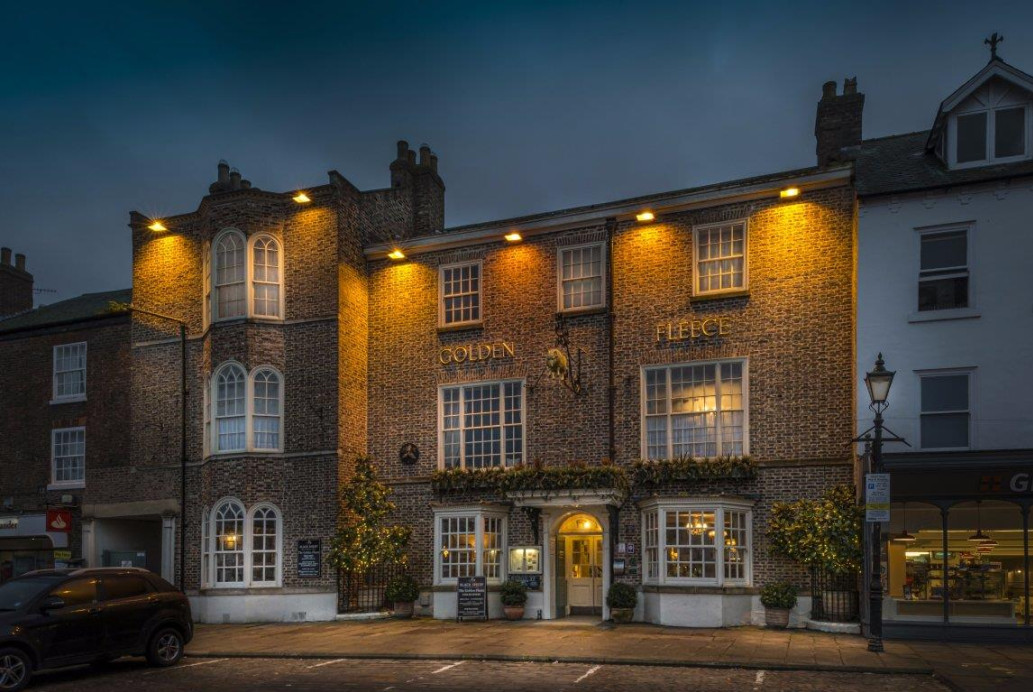
The Golden Fleece Hotel, Eatery and Coffee House, Thirsk – is the place to go. by Milly Adams

Our 2018 Christmas was a bit of an experiment. We’d seen the family earlier in December and rather than rush around over Christmas we all decided to stay put.

We moved to Thirsk five months ago, as my roots are in Washington, near Newcastle, and we’d wanted to move up north for ages so in a gap between grand-children we made a run for it.

From Thirsk there is an excellent train service to London, as long as you book well in advance unless you’re a millionaire, so it’s perfect. But what of Thirsk itself? Familiar to many through James Herriot’s books and the TV series All Creatures Great and Small, The Yorkshire Vet, not to forget The Heist, Thirsk is a wonderfully friendly, quirky and interesting market town, and set within glorious countryside.

But back to Christmas. So, here we were, in Thirsk for Christmas – where to eat? I had met a visitor from London walking her dog a few months previously who was up from London, and staying  at The Golden Fleece and enjoying it. A hotel that welcomes dogs? It shouts, welcome, don’t you think. So, we decided to take a punt and choose it for Christmas lunch.

Dating from the 1500s with some of the original features still in place including an inglenook fireplace, The Golden Fleece is believed to have its origins as a private house. However, it was in 1810 that George and Mary Blythe started the hard work that established it as one of the north’s most iconic coaching inns.

Set on the market place and ideally placed for the coach services running along the Great North Road it accepted guests disembarking the coaches at all hours of the day and night, with stabling for 60 horses. The railway arrived in Thirsk in 1841 but The Golden Fleece, nothing daunted, still held sway under the control of William Hall, George Blythe’s great nephew. William extended the clientale to include the townsfolk, and tourists visiting the area.

Still keeping The Golden Fleece in the family, William Hall’s son, William Wellbank Hall had the PR sense to provide a grand luncheon in 1911 for a mix of Europe’s great and good who were competing in a stage of one of the world’s car rallies. Royalty in the guise of Prince Henry of Prussia, and literary royalty – Arthur Conan Doyle – pitched up, amongst others. It wasn’t until the closing stages of the 1st World War in 1918 that The Golden Fleece was sold out of the family.

Just as The Golden Fleece had attracted the coaches in former times, the PR coup of the luncheon of 1911 continued to draw early motorists to The Golden Fleece even under new ownership, though by now the stables were converted to garages, two of them with pits for mechanics to do running repairs on their cars.

In 2015 the hotel was acquired by The Coaching Inn Group, and has undergone a major refurbishment to meet the needs of today’s market while respecting and retaining many features of its fascinating heritage.

So this is The Golden Fleece – but let’s get the lowdown on our Christmas lunch.
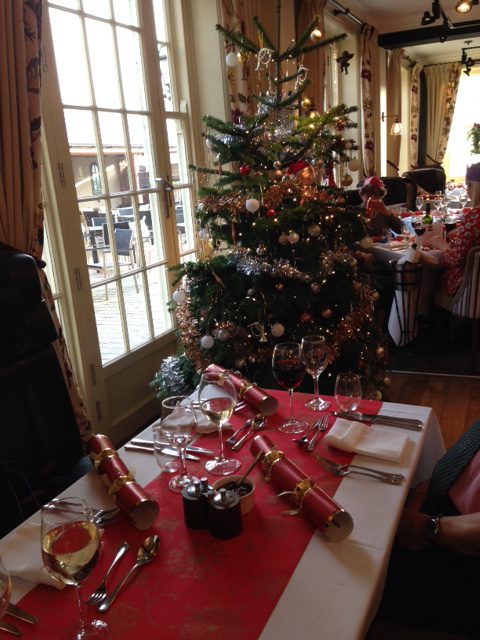
We booked well in advance, since our stomachs are of supreme importance to us, and we chose our meal ahead of time. There were two sittings, and we chose the first at 12.30.

I did worry slightly that the ambience would be rather stiff and posh, and Dick kept running round his finger round his collar because he is an anti-tie man these days. Our friend and neighbour, Catherine, made up our party of three, and requires gluten free which sometimes catering finds a pain at these busy times; what’s more, they let that pain be known. So, all in all,  it was with slight trepidation we set off

So was it posh and were they grumpy? Emphatically not. It was huge fun, with a Christmassy décor, and the most amazing crackers on the table,  so elegant were they it seemed a sin to pull them, but pull them we did. For how could we not wear paper hats? The manager circulated, totally accessible and chatty, the staff were efficient, and great fun, Dick relaxed, Catherine enjoyed her gluten-free food, I sipped my wine, gobbled my food, and looked around and saw that everyone was chatting, and laughing, and having the greatest time. What’s more the ages ranged from children to oldies like me – oh no, never you, I hear you shout – and all were having a really good time.

And as a plus we live near enough to walk home, so could have that extra glass of fizz. We had coffee in the lounge looking out over the square and did rather envy those who were staying the night. From all accounts they were loving every minute.

I do like to pick out something that didn’t work, to show I’m not easily impressed, but I can’t. We all loved it, so much so that Catherine is having her birthday lunch there very soon.

ps Look out for the duty manager, Gabriel. She’s great.

The Golden Fleece Hotel, Eatery and Coffee House, Market Place, Thirsk, North Yorkshire YO7 1LL Phone@ 01845 523108. goldenfleece@innmail.co.uk

Reservations: 01845 438300    reservations@innmail.co.uk

www.goldenfleece.com

Dogs are welcomed but only in certain bedrooms. They are not allowed in the restaurant but are in the lounge etc.

Milly Adams is a bestselling Arrow, Random House, author.
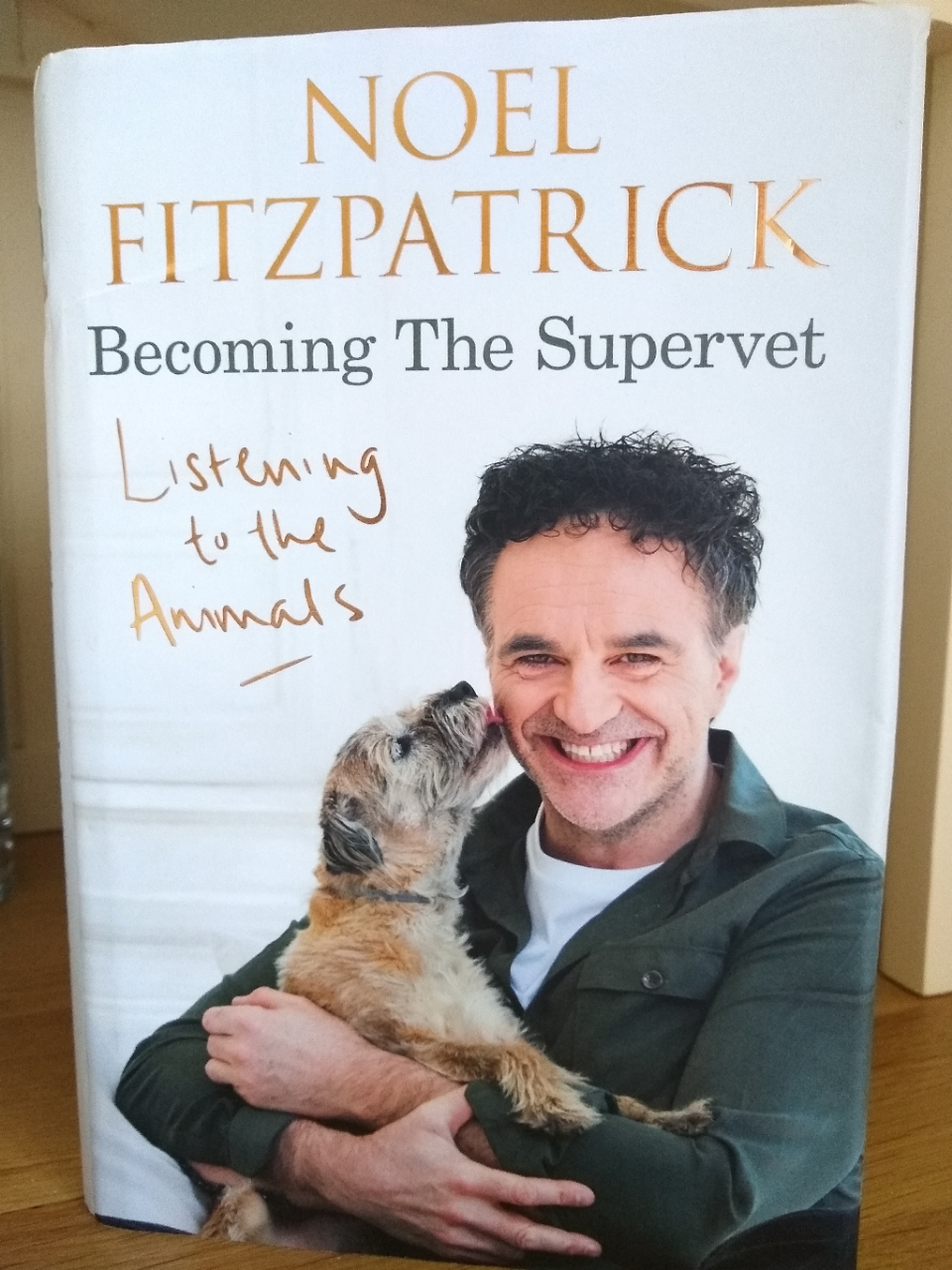
 

Listening to the Animals – Professor Noel Fitzpatrick reviewed by Milly Adams

Listening to the Animals – becoming the supervet.


Being asked to review Listening to the Animals was a no brainer. I LOVE this bloke. The very thought of him makes me smile, and this memoir by the fantastic Noel Fitzpatrick is imbued with the man we see on the TV. Whimsical, fast talking, full of memories, full of love and strangely full also of self-doubt.

I had the impression this was written as he darted here and there in Fitzpatrick Referrals dodging from one operation to another, and stopping, breathless, to write the next few pages. it is written with immediacy, and honesty. We travel with him from his beloved parents’ farm to school where bullying of this ‘culchie’, a lad from the bogs,  was unremitting.  Noel Fitzpatrick decided early on, though, that he had a choice – to make the most of this education in order to achieve his dream of working with animals in spite of the agony of his day to day existence, or to accept the general opinion that the culchie would come to nothing.

So on he struggled, and no wonder self-doubt became a dominant emotion, in the face of this behaviour. Nonetheless, at this school he received a good education, one which allowed him to strive towards his dream, a dream sustained by his  dog Pirate who was his comfort during his lonely struggle, and of course, his family unaware though they were of the bullying.

Fitzpatrick’s writing is lyrical, raw, humorous, heartbreaking and inspiring. I couldn’t put it down, and hardened book reviewer and author though I am, I cried, and I cheered, I was awestruck.

Is there anything this amazing man can’t achieve?

As the founder of a charity for ill and injured veterans Words for the Wounded I long for this orthopaedic excellence – a prosthetic limb fused directly into the bone of an amputated limb – to reach our veterans as a matter of course. Indeed, I noted in the Bucksfreepress.co.uk recently that  a young man found just this treatment in Australia. Please may it soon reach here, and if Noel Fitzpatrick has anything to do with it, it will. God bless the man.

Becoming The Supervet by Noel Fitzpatrick. pub Trapeze hb £20 ebook and audiobook available.

Read it, love it.

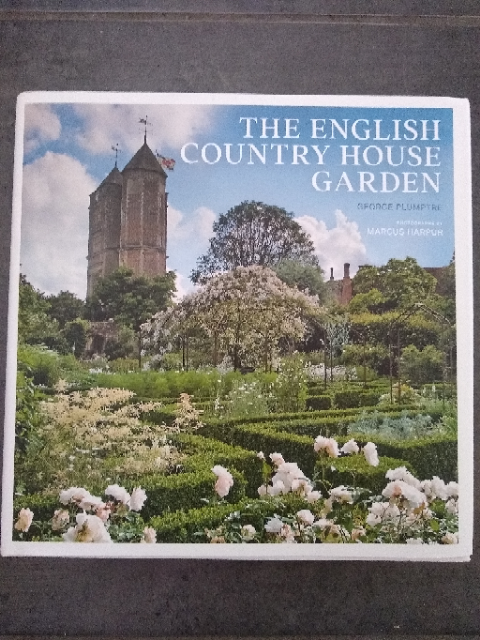
The English Country House Garden by George Plumptre, Photographs by Marcus Harpur

At Frost we’re hopelessly obsessed gardeners, though none of us aspire to an English Country House Garden. We do however most certainly visit, examine, envy and love them.

We love this book too. It is one for the coffee table, but not just for appearances’ sake, it is for dipping into, losing yourself in, finding inspiration, finding calm.

Stroll amongst the images of high yew hedges, the topiary, and traditional planting with oodles of old English roses, the white gardens, the herb gardens… Yes, somehow quintessentially English this book digs deeper and introduces us to the owners, and the stories behind the making of the 25 gardens; the struggles, the obsessions. We learn about the ins and outs of the grand, the personal, the discreet, the private. Its like peeking from the top of a bus into other people’s worlds. The photography covers the gardens throughout the seasons, and somehow captures the nature of the owners as it is reflected in the gardens. I now have a long, long list of places I have to visit this year.

This book is a treat. Keep it with you. Admire its text and images, and visit, visit and cherish the sheer existence of these glorious gardens.

My one disappointment is that Heligan is not included, but then we have followed its rebirth from its early days, so perhaps we don’t need to know more, but maybe in a later issue.

The English Country House Garden by George Plumptre. Photographs by Marcus Harpur pub White Lion Publishing. hb £18.99

What it’s like to raise £3.5m and have a baby at the same time

 Rachel CarrellBy Rachel Carrell.
I set up my business, Koru Kids, to solve a huge problem. We’re aiming to profoundly impact the wellbeing of a million families, by totally reinventing after school childcare.
It is a massive goal. To even think about achieving it, we needed some big investors on board.
Makes sense, right?
Except that I was also pregnant.
Raising money in London from professional investors while pregnant isn’t easy. You have to have lots of meetings all over London—ideally, four or five a day. Every day was a scramble up and down the stairs of the Tube, arriving at each meeting just in time but very out of breath.  I took meetings right up until my due date, in a state of denial that a baby was soon arriving. In the evenings I did my whole normal day job, then tried to sleep before getting up and doing it all again the next day. For several months, before and after the birth, I was sleeping 4 hours a night and working until about 1am.
At 5:30 a.m. one Sunday I woke with advanced contractions. Alexander was born an hour later, and we both came home that day.
I resumed meetings the next morning at 9am—this time, by telephone. While my husband, Dave, held Alexander, I did my usual pitch with one small variation: “While running my previous company, I had a baby and noticed how difficult it was to find great childcare. Actually – well, I don’t want to freak you out, but I had another baby yesterday.”
My first in-person meeting was two days after the birth. I pumped breastmilk for Alexander, left him with Dave, spent an hour with the investor then zipped back home. For the next few weeks the three of us—Dave, Alexander and I—travelled to meetings together. I’d feed the baby on the way or in the reception, and do the meeting while Dave looked after Alexander. One time Dave took him off to the National Portrait Gallery nearby while I did my thing in the boardroom.
The process was arduous but in the end, it all paid off. The investment round exceeded expectations—raising £3.5m rather than £1.5m as we originally intended—and we were on our way to achieving our goal. Alexander and his big sister are doing really well too.
What kept me going was sheer bloody-mindedness, and commitment to our cause: Koru Kids needs to exist. The childcare system is inadequate and I’ve met hundreds of parents who are affected by it. People who can’t afford the care they know their children should have. Women who want to go back to work but can’t. Parents whose employers have agreed to part time work patterns but who can’t find the childcare to make it work. Families who are forced to leave London when they don’t want to. Parents who desperately want another child but can’t see how they’re going to manage.
The truth is, we all have challenges in our lives. My challenge was trying to do two difficult things at once. But other people have that too, with different challenges like bereavement, or mental health issues. Raising the money Koru Kids needed while also having a baby was the hardest thing I’ve ever done, but it’ll all be worth it when we’ve built the childcare system I know we need.

Matador ranked as the top self-publishing service provider


Company Directors: Jeremy Thompson & Jane Rowland

Frost Magazine has a soft spot for Matador as it is enormously helpful to one of Frost’s favourite charities, Words for the Wounded and its Georgina Hawtrey-Woore Independent Author Award, and through WforW we know some of its authors’ books, and fine looking and produced beasts they are too.

It was great news, therefore to hear that:  Matador has pipped Amazon into second place as the best self-publishing service provider in the self-publishing sector of The Independent Publishing Magazine’s Publisher Index.

Matador has been ranked as the best self-publishing service provider, knocking Amazon Kindle Direct Publishing (KDP) off the top spot for the first time, and being rated ahead of big names like IngramSpark, Kobo and Smashwords by The Independent Publishing Magazine (see: www.theindependentpublishingmagazine.com/2018/11/publishing-service-index-november-2018-with-notes.html).

With over 25 years in the industry, Matador, part of Troubador Publishing Ltd, offers authors a range of self-publishing services, from editorial and production, marketing and distribution to ebooks and audiobooks. As the UK’s most widely recommended self-publishing services provider, Matador has moved up to the top spot in the Independent Publishing Magazine’s Publisher Index, which rates self-publishing companies on measures such as customer feedback, the quality of books published, the range of services and the quality of customer service.

The Independent Publishing Magazine produces a ‘Publisher Service Index’ twice a year, in which it independently ranks over 80 self-publishing companies worldwide. Matador have consistently been in the top three of the rankings for five years, alongside the industry ‘big boys’, but in November last year they took the coveted top spot for the first time.

‘We offer a bespoke and high-quality self-publishing service, with a wide range of options for authors, with a team of 24 committed professional staff and a strong emphasis on customer service, quality and producing books that are indistinguishable from those published by mainstream publishers. We are delighted that we have been recognised as the top choice for self-publishing authors serious about their writing and publishing projects. We’ve been helping authors for over 25 years and the publishing landscape has changed significantly since then, so we are thrilled to be at the forefront of helping authors produce and sell quality books. We’ve always been one of the most highly recommended companies, but now it’s wonderful to be recognised as such by an independent industry source too.’ comments Jeremy Thompson, Matador’s Managing Director

Matador publishes over 600 new titles a year for self-publishing authors, but also offers bookshop distribution and trade and media marketing to its authors. The company is selective in what it takes on for self-publishing, preferring to concentrate on quality rather than quantity. Matador is part of Leicestershire based Troubador Publishing, an independent UK publisher offering a range of publishing options to authors. They also organise a range of events for authors, including the annual Self-Publishing Conference (April 27th 2019)

For more information: matador@troubador.co.uk


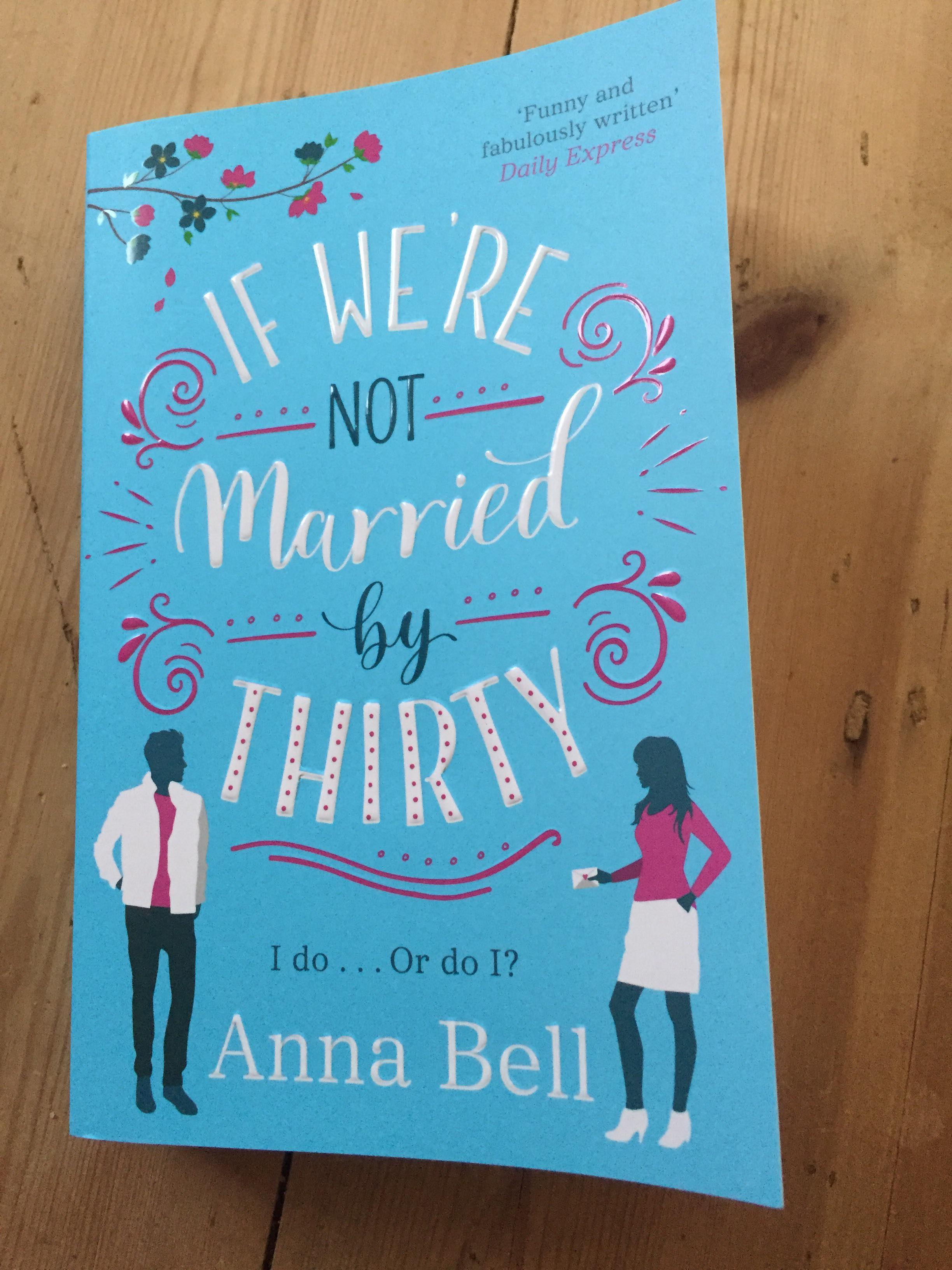
If We’re Not Married by Thirty by Anna Bell

If We're Not Married by Thirty - Anna Bell

If you’re looking for a fun and uplifting read for the dark days of January If We’re not Married by Thirty by Anna Bell might very well be the book for you.

Lydia and Danny make a pact at a friend’s wedding – if neither of them are married by thirty they will marry each other. And here Lydia is, 30 and still single with a job that’s heading nowhere. Her friends are already settled and living life to the full so when she gets the chance of a free holiday to sunny Spain there’s nothing, and no one, to hold her back

Then, out of the blue, she bumps into Danny. Could Lydia’s back up man really be her happy ever after?

Will they? Won’t they? Should they?

There are shining performances by Lydia and Danny’s mothers, supporting characters that add great fun and levity to the relationship.

A brilliantly funny, romantic and effervescent read.   Perfect for fans of Lindsey Kelk and Sophie Kinsella.

Paperback  £7.99 

Published by Zaffre,

Anna Bell was a military museum curator, before turning her hand to fiction. She is the author of the bestselling novels, It Started with a Tweet and The Bucket List to Mend a Broken Heart and is a member of the Romantic Novelists’ Association’s New Writer’s Scheme. Anna lives in the South of France with her young family and energetic Labrador.


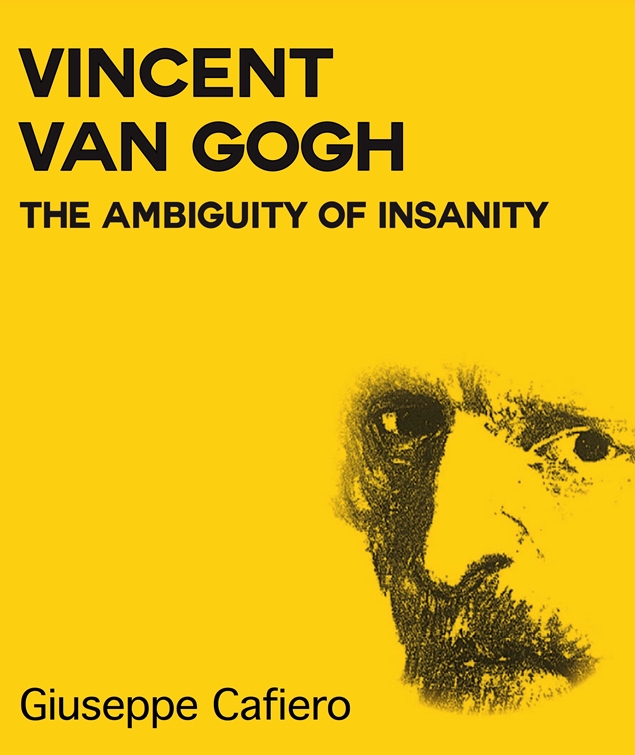
This Week’s Must Read: Vincent Van Gogh, The Ambiguity Of Insanity

Vincent Van Gogh’s turbulent and tragic life story is told with compassion and wisdom in Giuseppe Cafiero’s exceptional work of bio-fiction, writes Lucy Bryson.

By Lucy Bryson

This fascinating audiobook from prolific writer Giuseppe Cafiero provides a nuanced account of the life and times of one of the greatest painters of the 20th-Century. It sheds fresh light on the ways in which the artist’s life and works were shaped by people, places – and by a dangerously obsessive personality.

Loosely based around the correspondence between Van Gogh and his brother Theo – here portrayed as one of very few constantly supportive figures in the troubled artist’s all-too-short life – Van Gogh, The Ambiguity of Insanity presents Van Gogh’s life as a fictional series of chapters, each shaped by a particularly meaningful woman and by the place where the Dutchman was living at the time. Cafiero creates a portrait of a man both proud and vulnerable, reclusive yet deeply desirous of emotional, artistic and physical companionship.

Beginning with his early life on the Dutch-Belgian border, born to a pious pastor father and staunchly religious mother in a “sterile, oppressive land, burdened with gossip, ill-feeling and sickness“, Cafiero goes on to present Van Gogh’s life in 10 chapters, each of which takes as a focus a specific woman – be she an unrequited love, a lover, family member, model or muse – who was instrumental in shaping the troubled artist’s life.

Cafiero’s audiobook paints a stark yet vivid picture of an obsessive, psychologically vulnerable man, prone to extremes of emotion that led him to dark and troubled places. He was, we learn, driven by obsessions, which were often seemingly at odds with each other: an obsession with religious piety; with erotic love; with redemption; with artistic perfection; with family ties and with friendship (Vincent is seen to be hugely emotionally affected by the collapse of his friendship with fellow artist Gaugin). Suffering the pain of rejection on numerous occasions (and often as a result of inappropriate fixations), Van Gogh was perhaps overly dependent on his more stable brother Theo, who supported him both financially and emotionally throughout Vincent’s turbulent life and until his premature death at the age of just 37.

But we discover that Van Gogh’s emotional and artistic life was shaped not only by the women he encountered, but also by the places he lived, studied and painted – from the glamour of Paris to the decay of London’s insalubrious back streets. Van Gogh travelled extensively in his 37 years, and was apparently deeply susceptible to external influences.

The book follows Van Gogh’s long and painful mental unravelling and his sad journey towards apparent suicide (it has never quite been an open and shut case, and some people still maintain Van Gogh was murdered…). As its title suggests, this book shows that ‘insanity’ is not a constant, easily identifiable condition, but rather a spectrum, and something that may be more or less apparent at different life stages. Cafiero’s passion for his subject matter is evident (as is his painstaking research) and he has taken care avoid sensationalism. 

Vincent Van Gogh, The Ambiguity Of Insanity is a powerful, thoughtful account of a fascinating figure in art history. 

Vincent Van Gogh, The Ambiguity Of Insanity by Giuseppe Cafiero (Rowanvale Books), is out now as an audiobook on Amazon UK, Audible or iTunes.

Q&A with Italian author Giuseppe Cafiero

Giuseppe Cafiero is pioneering the ‘bio-fiction’ genre with meticulous research and masterful storytelling. Frost Magazine finds out more about what drives and inspires him, and his plans for the future.

Frost Magazine (FM): You have become known for your bio-fictional accounts of the lives of authors. What made you turn your attention to the life of an artist? 

Giuseppe Cafiero (GC): My main interest in the life of Vincent Van Gogh is in his humanity. In attempting to understand the man and his art, I have focused on the women and the places which played an essential part in his development. In my opinion, no previous biography has concentrated so specifically on these two factors, which I have used to provide the framework for my account.

FM: Van Gogh is more typically portrayed as the stereotypical ‘tortured genius’ – do you think that is an oversimplification? 

GC: Certainly. The vital factor in Van Gogh’s life was his obsessive determination to become a painter. It is impossible to understand man without investigating the nature of this obsession.

FM: How did researching the book alter your understanding of Van Gogh and his work (if at all) and did anything about his relationships or personality surprise you?

GC: I was surprised by the obsession as a subtle and tragic illness that inexorably consumed man. He was driven by a passionate determination to express himself through colour: above all with yellow as a symbol of life and spirituality.

FM: Who is the book likely to appeal to, and what do you hope readers will take away from reading it?

GC: The book is for lovers of Van Gogh and those who try to understand how madness can be a creative means. The long and painful progress towards suicide, the desire for extinction once madness turned out to be a painful companion and certainly not the source of hope.

FM: Why did you choose to base each of the chapters around a woman and a place in Van Gogh’s life? Was it a clear choice as to which females and locations to include?

GC: The book really focusses on Van Gogh’s obsessions: the obsession with redemption (his mission among the miners of Borinage and his relationship with Sien); the obsession with friendship (the failure of his relationship with Rachel in Arles); the obsession with a selfishly tormented spirituality (the relationship with the Kee Vos in Etten); the obsession with the sun of southern France (Madame Ginoux in Auvers); and the obsession with family love (her relationship with her sister-in-low Johanna in Paris).

FM: This title seems to have a more straightforward narrative than other titles in the Ambiguities series. Was this a conscious decision?

GC: Yes, of course. I had to tell the life of Van Gogh, the women he met, the places he frequented, the paintings he painted year after year.

FM: Van Gogh produced some of his finest works while his mental health was at a low (for example Starry Night). Do you think his mental health issues were integral to his genius as an artist?

GC: Van Gogh’s life was a moving struggle to find his way as an artist. He managed to express at the end of his life and through a tender and overwhelming madness, a pictorial proposition in which the colours are an unimaginable beauty.

FM: Are there any other titles planned in the Ambiguities series? And how would you summarise the series for readers who are not yet familiar with the books?

GC: Certainly. I have written books on the ambiguity of Gustave Flaubert, Edgar Allan Poe, Virginia Woolf and Mario di Sa Carneiro. Ambiguity is just a way of seeing some writers from a particular perspective: in their imagination and their desire for imagination.


WRITING IN THE NEW

Jane Cable sets out her plans for Frost for 2019…

Much as I’ve loved hosting Business of Books over the last couple of years, it’s definitely time for a change. Two changes in fact, but more of the second one later.

Readers with very good memories may recall that in the autumn I went on a mini retreat with four writer friends. It was a comment from Kitty that started it – just as we were leaving – she said we’d become sister scribes. So I began to ponder what that could mean.

The world over women are particularly good at giving other women support. We excel at cooperation, collaboration, sharing the champagne and handing out the tissues (or the gin). We celebrate, we commiserate, we coax, we cajole – in short, we are there for each other.

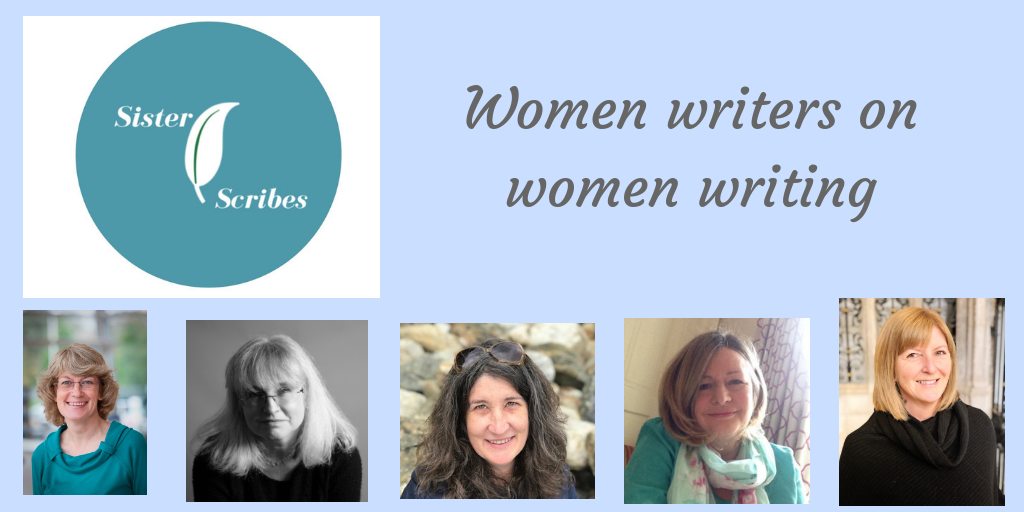
So this year I’m sharing my Frost columns with my Sister Scribes. Over the next few weeks everyone will introduce themselves, and in the coming months we will all introduce other sisters from the world of words; women whose contributions to our writing lives are important to us. Women who want to share their passion for writing for, by, and about women.

So, the Sister Scribes are:
Cassandra Grafton has her roots in Austen-inspired fiction and is a Jane Austen Literacy Foundation ambassador. Published by Canelo from this year.
Jane Cable is a long term contributor to Frost. Indie author published by Sapere from this year.
Kirsten Hesketh’s first novel landed her an agent. Hopefully a deal will follow soon.
Kitty Wilson walked straight out of the RNA New Writers’ Scheme into multiple offers. Writes hilarious romcoms for Canelo.
Susanna Bavin writes elegant, well-researched sagas. Published by Allison & Busby.

We met because we are all members of the Romantic Novelists’ Association, but that doesn’t mean the columns will all be about romance as our network of contacts spreads far and wide. Within the genre we cover a broad church, from sagas to romcoms and a great deal in between. There will be plenty of interest for readers and writers alike, with our first guests including my own long time buddy Carol Thomas on marketing collaboration and Cassandra’s co-author Ada Bright on what it’s really like writing together.

So that’s the first change. The second is an additional column on the last Wednesday of every month to replace the popular Take Four Writers. I will miss Angela, Claire, Jackie and Lucy but it’s time to offer a different perspective and I’m delighted that Sapere Books has offered to provide it.

Every month one of the Sapere team will give an insight into their publishing year. Editorial Director Amy Durant is as delighted about it as I am: “I am very excited to be offered this chance to give readers and writers a unique perspective into what life is like at Sapere Books. We are still a very new publisher and we have lots of exciting projects and developments launching this year – including publishing two of Jane’s books – so there will be plenty of news to share. As a small team we have the flexibility to change strategies at the drop of a hat, if something interesting pops up, so even I don’t know yet what I’ll be writing about in six months’ time, but I hope you will enjoy reading about Sapere Books’ journey in our second year of trading.”

So what will I be doing with all this extra time? I’m hoping I’ll be able to review more books for Frost and even branch out into travel and history related articles. Plus, as Amy has reminded me, I have two books out this year…