Health Benefits of Quitting Smoking

Depending on the level of addiction, some people find quitting smoking easier than others. Once you have gotten rid of the cravings and cough, you will be well on your way to a healthier lifestyle.

The method of quitting varies dependent on the person. One may find that they can just simply not smoke without much mental recourse. Another person might benefit from smoking cessation medication. Others may find it more useful to switch to vaping, such as with tobacco e liquid from 88vape, to begin their quitting process from the toxins, while still retaining the nicotine. 

Regardless of the method chosen, it cannot be denied that quitting smoking has a tremendous effect on the level of health of a person, and is always recommended.

Dental Benefits

Smokers are more likely to suffer with problems in their teeth. These can range from bad breath to an increase in cavities, as well as an increased risk of oral cancers. One of the other commonly seen problems involves staining and yellow tinting of the teeth. 

Quitting smoking can help to prevent any further damage to the teeth. A dentist would not be able to erase the damage caused, but the sooner you quit, the more they will be likely to be able to repair your teeth, and the cheaper the treatment could potentially be. You will also be reducing your risk of developing the aforementioned oral cancers and, therefore, increasing your potential lifespan.

Lung Benefits

After just 8 hours of not smoking, your oxygen levels will start to normalise. By continuing to refrain from having cigarettes, you can then start to remove all the toxins from your lungs. In a mere three days, it is possible for your oxygen levels to start to rise, meaning you will find it easier to breathe. The knock on effect from this is that you can also feel more energised than you did when you were still a smoker. 

At 3 to 9 months smoke-free your lung function can be up by 10%, so the ability to breathe becomes easier still. Then, on reaching 10 years free from smoking, your risk of developing lung cancer will be at half of what it was when you still smoked.

Skin Benefits

Your skin can also be severely affected by your smoking habit. Not only does smoking cause yellowing, particularly of the fingers that most often hold the cigarette, but also premature ageing and early wrinkles and sagging in the skin. Quitting smoking can help to improve some of these changes, and make you look far more youthful than before.

Quitting smoking is undoubtedly the best option for you, whether you smoke 2 or 20 a day, and regardless of how long you have been smoking. There are many other healthier habits you could choose, rather than one that simply costs you money, makes you smell, and shortens your life. Giving up any addiction is never a walk in the park. There will be disappointments and relapses, but don’t be discouraged. Make use of the stop smoking medications available. However, even if you quit smoking, your lungs may still need a boost for detoxifying, and a good way to help them is by adding a lung health supplement to your diet. The benefits of finally going smoke-free will make a big difference to your health and social life at large.’ Speaking to a medical professional can help you find your way to a smoke free lifestyle.

Collaborative post with our brand partner.


Advice on still being a socialite when quitting smoking

If you’re in the process of quitting smoking but class yourself as a socialite — this quiz to discover your smoker profile from Nicotinell should help establish if you are indeed a social smoker — you may find yourself questioning what this will mean for your social calendar.

This guide will explain how you can continue to be a socialite without the need to smoke:

There are links between smoking and alcohol

Before we advise you about how you can continue to socialise while being smoke-free, it is important to point out the close link between smoking and drinking alcohol.

At the extreme, government data has found that up to 90 per cent of people who are addicted to alcohol will also smoke. Furthermore, smokers have been found to be more likely to drink and have a 2.7 times greater risk of becoming dependent on alcohol than non-smokers do.

In general, it is important to understand that both alcohol and nicotine act on common mechanisms found in the human brain.

When it comes to nicotine, the chemical compound will enter the bloodstream as soon as you smoke a cigarette and rapidly get transported to your brain. Once there, the nicotine will stimulate the brain by creating receptors which release chemicals that give a feeling of pressure. These receptors will increase in number as smoking becomes prolonged and your brain will become reliant on nicotine in order to release these feel-good chemicals.

However, the nicotine supply in your bloodstream will drop within 72 hours of your decision to quit smoking — those receptors won’t disappear that quickly though, so your brain’s chemistry will react to cause powerful cravings and strong emotional reactions. Persistence is key, as nicotine receptors will go away with time and your brain chemistry should be back to normal within three months of a quit.

In regards to alcohol, researchers believe this substance fosters feeling of pleasure. If true, this reinforces the effects of nicotine on the brain. There are suggestions that nicotine and alcohol will moderate each other’s effects on the brain due to the fact that nicotine stimulates while alcohol sedates.

Tips for socialising when on a quit-smoking journey

So, you have taken the first step and stopped smoking, but now face the dilemma of socialising in a scenario where you would have previously had a cigarette. Here’s how to stick to your goals and still have a good time:

Don’t put it off

You shouldn’t delay going out for a drink because you’re having doubts. Everything you did as a smoker, you can do as a former smoker. Holding off too long from social drinking after quitting can create a sense of intimidation. Plus, socialising with friends is an important part of your life. The sooner you teach yourself how to enjoy a drink or two without a cigarette, the sooner you’ll feel like your life is back to normal.

Have a pep talk with yourself

Where you go to enjoy a drink could very well trigger your smoking cravings. Before leaving the house or in the car, be mentally prepared by saying aloud, “I’m a former smoker.” Or try, “I don’t smoke. I’m healthier and happier without cigarettes.” The main point is to remind yourself that you’re a former smoker and that you don’t need to light up anymore.

Aim to have a social get-together where no smoking is involved

Instead of going to a place where people are likely to be smoking, why not invite your group of friends to your house instead? You can celebrate your smoke-free success with them. You’ll be able to control what is served which can help stop those triggers and completely avoid cigarettes in your smoke-free home.

Enjoy time with non-smokers

Non-smokers and friends who will be supporting your decision to stop smoking will definitely help. Who you choose to hang out with can help support your ex-smoking status. Slip-ups can occur when quitters are in the company of other smokers who may not be aware of how to support their quit attempt.

Invite a quit buddy to join you

A friend or family member can prove a huge helping hand as your quit buddy, so be sure to invite them along to whatever social event you’re attending. A quit buddy is someone who supports your quit. Should you encounter old smoking friends who ask you to join them, make sure they are aware of your situation so they can be respectful. Not only that, you’ll also have your quit buddy to hang out with.


How To Improve Your Chances of Getting Pregnant

baby, fertility, getting pregnant, Some woman get pregnant easily but for others it can be a long and difficult journey. Now I want to start this article off with pointing out that I am not a doctor, but I have researched the subject and I got pregnant as soon as my husband and I started trying. I have combined what I learned with some tips from friends, some of whom did not get pregnant for a while but persevered.

Have Regular Sex.

Sperm can live inside you for seven days. The sperm travels up the fallopian tubes to “wait” for the egg to be released. If you ovulate during this time you can get pregnant at any point during those seven days. The NHS recommend having sex every few days during ovulation.

Find Out When You Are Ovulating.

There is an abundance of calendars and apps to help you figure out when you are ovulating. Having sex when you are not ovulating may be fun but it won’t get you pregnant. The NHS website can help you figure out when you are ovulating.

Take Your Vitamins.

Make sure you are taking folic acid. It is best to take this for three months before you plan to conceive and make sure you take it throughout the pregnancy too.

Stop Smoking.

This is obvious. It has been proven in medical studies that smoking brings on the menopause by at least four years. It is also very bad for your baby. You should not smoke when trying for a baby and certainly not when you are pregnant.

Exercise.

I exercised for an hour five days a week and lost two stone before getting pregnant. It helped that I was also working out for my impending wedding. I went from a size 12 to a size eight. Exercise helped but the other thing is…

Diet.

I ate as healthy as possible. I did not eat a lot of meat and if I did it was organic. I eat a lot of vegetables and drank a lot of water. I cut down on alcohol, only having a glass if at a restaurant or at a special occasion. Read this article for more diet advice. More importantly I…

Quit Sugar

This was hard but I stopped having sugar in my tea. No chocolate, no added sugar, no fizzy drinks. I am almost positive that this was one of the main things that made a difference. Sugar affects your insulin levels and your insulin levels affect your health.

Lie flat for 15 minutes.

Lie flat for 15 minutes after sex to give the sperm a helping hand. I know many people who swear by this.

IVF

Have IVF. Consider IVF if you are over 35 and have been trying for a baby for six months or if you are under 35 and have been trying for over a year. IVF is a wonderful invention, giving many couples the chance at parenthood who otherwise would never have had children. Go to a clinic with a high success rate like  Posted in Beauty & Grooming, Featured, Life & Style, Parenting | Tagged , , , , , , , , , , , , , ,

The Stoptober Challenge: The Round Up

So it is over. No more Stoptober. I am pretty pleased with myself. I think it went quite well. I haven’t been smoking and hope this will continue. It is still hard sometimes but I have come a long way. I wobbled many times. I don’t want the hard work to be for nothing

Along the way I have done a lot of challenges. The first one was preparing for success and Boots UK pharmacist Angela Chambers gave some great tips. I wrote about this in my first post.

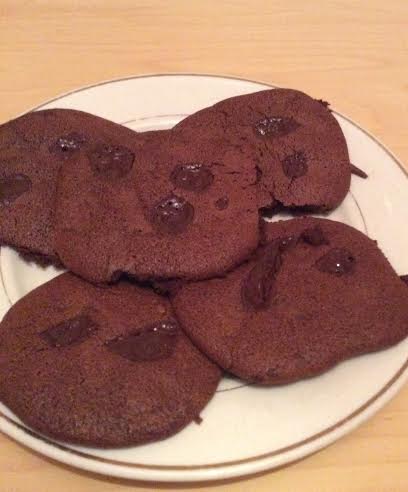
The second challenge was taste. Smoking dulls your taste buds so when you quit everything tastes better. For this challenge I baked. It was fun. Boots UK sent an exclusive recipe box packed with a bespoke recipe and all the ingredients I needed. I loved the end result and the taste was amazing.

bakingcookiesstoptober

I took part in a Twitter party which was hosted by Beautyandthedirt, Sexinlondoncity and Angela Chalmers who is a Boots Expert. This was between 1-2pm on October 16th. The Twitter Party was a lot of fun and I learned a lot. A lot of people got involved and I think it was a success. 


Next up I took some time to stop and smell the roses.

roses

To celebrate reaching my third smoke free week, and the return of my sense of smell, Boots UK sent me these gorgeous flowers. Smoking alters the way you smell things. The reasons to stop smoking keep building up. The flowers are also very beautiful. If you are also trying to stop smoking head to Boots UK Stop Smoking.


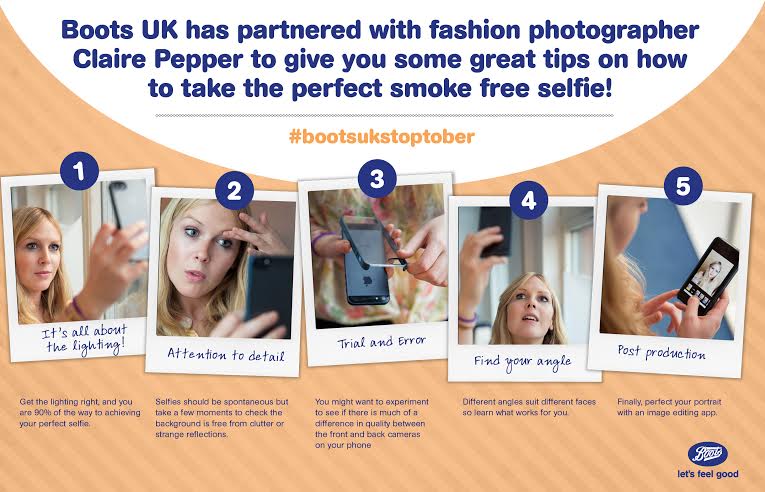
Challenge Four was all about how quitting smoking is great for your appearance. Smoking can impact your appearance, affecting your complexion, reducing the nutrients in your hair and leading to staining of the teeth, though luckily giving up smoking can reverse these changes. To celebrate this Boots UK partnered with leading fashion photographer Claire Pepper to develop some top tips on taking the perfect selfie.

perfecrtselfie

Fashion photographer Claire Pepper shares tips on how to take the perfect selfie 


It’s all about the lighting!

Get the lighting right, and you are 90% of the way to achieving your perfect selfie.  Ideally you want natural daylight, but if it is really sunny then move away from direct sun into a shady area.  If you are inside, find a window or the biggest, softest light source around and stand nice and close to it.  Always have the light source in front of you – side lighting is unflattering and back lighting doesn’t capture very well on most mobile phones.

Attention to detail

Selfies should be spontaneous but try to take a few moments to check the background is free from clutter or strange reflections. Also check your hair and make-up, and take a moment to consider the composition of your shot, and whether it would work best in landscape or portrait.


Trial and Error

You might want to experiment to see if there is much difference in quality between the front and back cameras on your phone.  Some phones have a much better quality camera on the back so take two snaps and compare them to see if one looks grainier.  Also try taking the cover off your phone – some covers can cause a bit of softening around the periphery of the image or can affect focus so give it a go and you might be surprised what a difference it makes.


Find your angle

Different angles suit different faces so learn what works for you – take lots of pictures to see what works – you can always delete any you don’t like!  Generally keeping your chin down is quite flattering and turning your face to one side works for most people.  Don’t forget to keep your eyes on the camera lens not the screen as it’s much more engaging.


Post production

Finally, perfect your portrait with an image editing app.  A specialist app like Camera+ gives you control over every aspect of the image, as well as giving you the option to add borders and captions.  If you are bored of using the same filters all the time try the VSCO Cam app that gives you a really wide selection and the ability to customise your selfie – you can achieve results that would take some time in Photoshop within seconds.  If you want to zap a blemish try an app like Facetune, but take it easy editing your face – it’s easy to go too far and it can look quite obvious.


Overall I feel great and stopping smoking was the best thing I have ever done. Try it and you won’t look back. Promise.


Sponsored Post


#bootsukstoptober 


Frost Writer Helen Takes The Stoptober Challenge

As challenges go, stopping smoking is a pretty huge one. Not only is smoking addictive but it eases stress for those who do it. But the benefits of giving up are vast: smoking is terrible for your health and takes years off your life, giving up is one of the best things you can do for your health, it saves money: cigarettes are now over £9 per pack and it stops your clothes smelling bad. Smoking even makes the walls in your house yellow so giving up would be life-changing.

fitness-get healthy

I want to give up to improve my health and save money. I will be stopping by keeping my hands busy, distracting myself, thinking of the reasons why I will be quitting. I also knit and that really helps by keeping both my mind and my hands busy. I also have an occasional snack. I also think about all of the things I could buy with the money I will save. I am finding a lot of help from Boots, who can help you with their Smoke Less Plan and their NikAssist range is great too. 


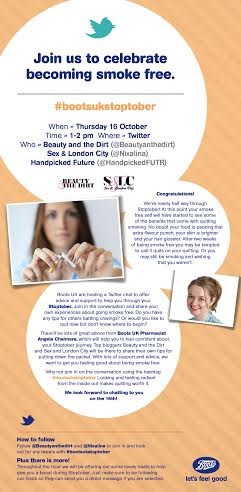
This is no easy challenge however, I have been smoking for decades and have given up a few times. I think Stoptober is amazing. A sense of community always helps when trying something. Smoking is a huge burden on the NHS, never mind the personal damage to health and finances. Most people love a challenge and this 28-day national stop smoking challenge is a brilliant one. I will be taking part in a Twitter Party with Beautyandthedirt and Sexinlondoncity. I hope you can join in too. This is happening between 1-2pm on October 16th. We can all do this together.

Bootstwitterinvite 

This is just my first post and I will update you with how I get on later in the month. I have been set a number of challenges and challenge number one is preparation. So I am preparing myself with the top tips from Boots UK Stop Smoking.


Boots UK pharmacist Angela Chalmers knows that the key to any form of success is often preparation and has prepared these top tips to help you embark on the first week of your smoke free journey. I have found them really helpful. If you want to ask Angela a question you can do so via our comments section.


Tip 1: Quit your own way 

When you begin your smoke free journey, it is important that you know your smoking habits and chose a time to quit that is right for you. Many people find that starting their quit journey on a Wednesday is easier than starting on a Monday. Luckily the first day of Stoptober falls on a Wednesday this year!


If quitting on the first day of Stoptober is not right for you, then choose a time or day in the first week that best suits your lifestyle. If you tend to be a social smoker, then choose a time to quit that doesn’t clash with a social gathering – for example quitting a day before your best friend’s big birthday or a close family celebration might not be the best time for you! Remember that Boots pharmacists are available to provide advice and support at any time and stage of your smoke free journey.


Tip 2: Know your smoking triggers 

Breaking a smoking habit is difficult as it’s often a part of your daily routine and something you may tend to do without even thinking about it. However, more often than not there are factors that can trigger these habits or make you want to smoke. For some people it goes hand in hand with a night out, for others it may be part of their morning coffee routine. It is important to know what your triggers are so you can put a strong plan of action in place to help you avoid them while you are on your smoke free journey.


Replacing your triggers with a different healthy habit can also help. For example, if you usually smoke after meals then maybe think about replacing that cigarette with a brisk walk to the end of your road or drinking a glass of water.


Many people worry about weight gain as they often confuse their cravings for hunger and increase their food and snack intake. If you’re worried about weight gain talk to a stop smoking advisor who can give you tips on eating right and exercising so that weight gain is minimal. Things that could help:


  • Drink an extra glass of water after meals to keep you feeling full
  • Snack on as many fruits and veggies as you want – something crunchy like baby carrots or an apple, can sometimes be very satisfying
  • Keep your hands busy with something besides food!


Tip 3: Swap smoking for a new hobby  

It is normal to get a little irritable when you quit smoking. Why not distract yourself by taking up a new hobby such as learning a new language, trying a new recipe or playing sport? By keeping yourself busy you are more likely to reach your smoke free goal as well as learning something new. Or you could simply get round to doing something you’ve been meaning to do for a while – clearing out your wardrobe, putting up a new shelf, even cleaning the windows?! Creating a list of all the things you want to do and then ticking something off that list (even the smallest thing) can you give you a great sense of achievement!


It’s also important to think positively (it’s easier said than done, we know!). However, rather than seeing quitting smoking as giving up something you love, taking up a new hobby or activity can help you to associate it with a new fresh start and a much more positive way of thinking that will help you to stay motivated.


Tip 4: Don’t give up giving up 

Many smokers try on more than one occasion to give up cigarettes. If you have a smoking relapse, try not to be disheartened. Instead, examine what caused you to smoke again, so that you can look out for the signs and find a way to overcome this on your next attempt. Remember that giving up smoking is not easy and celebrate each day that you remain smoke free. Sometimes a visual tracker can help. Why not buy a wall planner or calendar on which you can cross off each smoke free day so you can see how well you are doing and increase your confidence in yourself?


Tip 5: Reward yourself

Don’t be too hard on yourself! Giving up smoking is a huge challenge and each day that you stay smoke free is an achievement – something many people strive to achieve. In fact, 61% of smokers say quitting smoking is one of their lifetime’s ambitions so make sure your celebrate, perhaps by setting yourself small targets and treating yourself when you reach them.


Remember – one of the best benefits of stopping smoking (aside of course from the health improvements) is all of the money you will save! Use this to reward yourself with a treat or something fun. This could be a pampering new make-over to show of how great you look now that you are smoke free, a new wardrobe or even a weekend trip away.


#bootsukstoptober 

Sponsored Post.


Diabetes… It’s Not Too Late To Take Control

Nexus PR have wonderful people there, so when I got notification to go one of their events, I was only too happy. I met Nicky, Emma and Isla at The Balthazar, 4-5 Russell Street, which is a beautiful restaurant, with a naturally beautiful venue room. On entering the upstairs venue room there was an amazing piece of technology, which did an instant scan of your retina and could do a 3D image of your retina and show exactly where, if any, issue involving the retina is! To say it quick would be an understatement and it was well used over the course of the afternoon.


There was a genuine point to having the eye testing equipment, which was not the solo piece of medical advice there, as they had blood pressure testing too! Things attributed to Diabetes, but either overlooked, or ignored by the person with it! Simply health Advisory Research Panel (ShARP) were the company supporting the event and Speaking on behalf of ShARP was the exceedingly talented Dr Gill Jenkins.  Who is a practising GP (in Bristol) with special interests in lifestyle health, in particular around obesity, smoking, diabetes, heart disease, lipid management and joint health. Dr Jenkins has a breadth of medical experience since qualifying in 1981, including psychiatry, cardiology, rheumatology and emergency medicine. Her skills are not just in medicine, but whilst her Pilot’s license wasn’t needed in the event, it just goes to show how remarkable she is. After Dr Jenkins, was Dr Ralph Abraham. Dr Abraham specialises in diabetes and Endocrinology; lipid disorders; heart disease prevention. Dr Abraham Trained at Kings College Hospital, St Mary’s Hospital and St Bartholomew’s Hospital as an academic physician turning to full time private practice in 1984. Founded London Medical in 1991.


Rounding things up was Francesca Marchetti. Francesca is a self-employed optometrist working in the West Midlands/Warwickshire area, for both multiple and independent practices. She has previously worked as a part time lecturer/clinical demonstrator at Aston University. Francesca works at the “Midland Eye Institute” in their refraction clinics. She has recently been appointed secretary to the Warwickshire LOC (Leaders in Oncology Care) and is an AOP (Association of Optometrists) Councillor for the Midlands. Dr Jenkins started the proceedings by listing the reason behind Diabetes Mellitus. Poor sugar control can lead to:


  • Higher risk of heart disease.
  • Peripheral vascular disease.
  • Stroke.
  • Kidney damage.
  • Erectile issues
  • Nerve damage.

I think that the penultimate reason alone is a reason for males to make sure their blood sugar levels are kept in check! The stats may bore the general public, but they are a correlation of information compiled to show how far and how long this disease has been going! Mitigating factors can contribute to diabetes, such as high blood pressure, obesity, age, reduction in activity levels and unsurprisingly denial. Dr Jenkins said that the number of pre-diabetes has tripled since 2003, which is shocking by any means! If you had millions of pounds (sterling) and it tripled in 10 years, I am sure that you would not be upset. However, that figure is attributed to the number of people. The strange thing is that people are not really educated about diabetes! We all either know someone, or have a family member with it, but yet people are not bothered about such a debilitating disease. They are not in the knowledge of how they can lose their sight or limbs down to diabetes and it is often too late when they are in a situation that threatens to do just that! Bariatric (weight loss) surgery has shown to reverse the condition in 86% of people with Type 2 diabetes.


This proves that sufficient diet can also do this, however, many people with this condition are not motivated enough to change their diet sufficiently. The NHS spend £13.8 billion per annum treating people with diabetes. Believe it, or not, that figure is conservative! That doesn’t take into account complications, or other treatments extenuating from this. Dr Jenkins also explained that whilst some young people get Type 1 diabetes, it is usually virally activated and out of the total amount of people that have diabetes, about 85%-95% are type 2! I suppose that was as good a point as any to make way for Dr Abraham to speak, as trying to prepare yourself for more frightening stats is not easy! He started by saying, “If you have pre-diabetes it’s silent. There are no symptoms and a shocking number of people are in this position and are sleep walking towards serious health problems. It is particularly important to be aware of your risk of developing Type 2 diabetes, especially if you’re overweight, or have a family history of diabetes.” ShARP did a series of surveys and found that 53% of adults questioned had convinced themselves they were at no risk of developing Type 2 diabetes. 49% were displaying potential signs of diabetes. And the amazing figures kept coming! 76% with potential diabetes had not mentioned it to their doctor. 38% believed their symptoms were not serious. 18% disliked seeing their GP and 14% turned to the internet for advice over their GP… Exercise is one of the easiest way to attack pre-diabetes.


Almost 21% of adult never, or rarely, work up a sweat working out. Diet also works well, so that in tandem with exercise is a great combination. A Mediterranean diet, high in fruit, vegetables, monounsaturated fats, grains, legumes, nuts, lean meat and moderate intake of dairy foods has been found to reduce the risk of developing diabetes by as much as 83%. Dr Abraham made an excellent analogy referring to the amount of glucose that is in the modern human’s body. Just for reference, it is in nearly everything you eat… even things like Beef burgers!! It’s an industrial compound… which we happen to ingest. Anyway, the analogy was this, “If you think of putting glucose in a hot pan, it will start to turn to liquid then bubble and then solidify and become brittle. If you apply that to the human body and 30-40 years of glucose in your body at 37 degrees Celsius then it is similar to caramelising.” Given or lifestyle, we should be looking at what we eat better and how we take care of ourselves! We are not the same as our forefathers and their diet was different! They worked, because it was fundamental to survival and was an everyday occurrence. Given how we, as modern humans, take all this for granted, we should be more vigilant and aware of the things we do and do not do. Looking at the whole picture, Dr Abraham stated a Nine Care Process to check yourself.


  • Blood pressure.
  • Weight.
  • Smoking status.
  • Cholesterol – blood checks.
  • Hba1c blood checks (long term sugar level).
  • Eye checks including Retinal Screening.
  • Feet check – peripheral pulse loss from vascular damage and sensory loss from nerve damage.
  • Kidney check – including renal function blood tests – especially creatinine and eGFR.
  • Urinary Albumin.

Most people would not associate any of these with diabetes, but it is often the start of pre-diabetes and on to a more serious Type 2 diabetes. The most interesting things about these events are the fact that many stats scare, but you find one subject that just rattles you and leaves you thinking, “I’m sorry… say that again!” for me it was the St George’s University of London research that patients with foot ulcers are also more likely to die from heart disease, or a stroke! Yep, I had to do a double take when that was mentioned! How often do we check our feet, or take anything happening to them seriously? Remember that the accumulation of negligence and ignorance is the main reason people suffer from diabetes. I was hoping that the effervescent Francesca Marchetti would be able to get the shock from my system… well, it is a talk on diabetes and she is the eye specialist… I only hoped that it would be. Many of us had already had or eye scans before sitting down, so many of the people in the room were secretly hoping a picture similar to their eyes didn’t appear… thankfully one didn’t! Diabetic patients are at more risk from glaucoma (increased pressure in the eye). The retina needs a constant supply of blood, but high blood sugar levels can cause blood vessels to become blocked, or leak! This damages the retina and stops it from working!


Blood leakages are easier to detect than plasma leakages, but both are damaging to the retina if supply is lost! Everyone that has diabetes should have an annual eye exam. A bleed in the eye is often a reflection of one in the body, or brain. Francesca stated that in England alone, 1280 people a year go blind because of diabetic retinopathy. That also tends to be down to poor systematic diabetic control. Francesca passed around some glasses to imitate stages of cataracts and retinopathy, which shows how annoying it must be for people with these symptoms. Cataracts can occur 10-15 years earlier in patients with diabetes. Surgery can prevent further damage, but at the moment there is no cure for retinopathy. Francesca also started dropping starts which should not exist, by right, but the human animal is a strange creature indeed! About 48% of people with diabetes have never had their eyes checked… I wonder how many without diabetes would fit into that demographic. A third of people with diabetes will develop renal disease because of the damage to the small blood vessels in the kidney. A woman is 8 times more likely to develop kidney disease, but for men it’s 12 times more likely! Men just need to stop being so “macho” and just get checked!! Kidney disease kills 21% of people with Type 1 diabetes and 11% of those with Type 2! Because high blood pressure is more common amongst diabetics, this all adds to the complications and enhances the danger. Elevated AGE (Advanced Glycation End)  have been linked to a host of problems including:


  • Coronary artery disease
  • Liver damage
  • Formation of amyloid plaques, which lead to Alzheimer’s
  • Impaired kidney function
  • Extensive brain damage from strokes

Apart from the link between AGE and dementia, evidence suggests that getting diabetes in middle age increases the odds of a form of brain damage associated with dementia. Brain scans from the Mayo Clinic confirmed that having blood sugar problems can literally shrink the brain, with diabetics having an average of 2.9% less brain volume than those without the condition. Midlife diabetes was also associated with an 85% rise in micro-strokes. I always think that “micro” doesn’t extend the seriousness of the stroke! It is serious enough to shut down functions of the body, which means it should be taken seriously and not ignored to the point it becomes debilitating. Francesca finished off by some facts that don’t look good for our future, if this is not stemmed as a disease and even things like depression can be detrimental to the condition doing its own damage along with the disease. Thankfully the meal was ready to cheer up the crowd.


The sad thing is that we need events to make people aware, but maybe the media can make things better! The awareness needs to be wider afield and not just a quick advert telling how wonderful a product is to eat (or drink), but actually letting people know more about it!  Whilst many are aware of the dangers of modern additives and excess sugar, feeding it to your family does not help the situation. We got to chat to the specialists during the meal from The Balthazar and Francesca said thatthe UK has a National Eye Health Week! I didn’t even know!! It is from 22nd September – 28th September this year and if you have never  had an eye check, or are overdue one, that would be the best time as any, so you have no excuse about forgetting, or  being too busy. It is a weeklong and you have had more than enough warning. From the wonderful women of Nexus to the wonderful speakers of this event, is association with ShARP.


Dr Jenkins can be found at www.sharppanel.co.uk/sharp-experts/dr-gill-jenkins

Dr Abraham can be found at www.londonmedical.co.uk/en/consultants/ralph-abraham

Francesca Marchetti can be found at www.college-optometrists.org

Details for The Balthazar can be found at www.londontown.com/LondonInformation/Dining/Balthazar/7bc84/

Goat's Cheese and Tomato Medley.

Goat’s Cheese and Tomato Medley.

Lamb Cutlets with Sauteed New Potatoes and Veg

Lamb Cutlets with Sauteed New Potatoes and Veg

Lemon Cheesecake with Raspberry and Cream

Lemon Cheesecake with Raspberry and Cream


And don’t forget that National Eye Health Week is from 22nd September – 28th September 2014. Thank you Nicky, Emma and Isla at nexuspr.com

 

Knit Quit Kit Review: Can It Help You Quit Smoking?

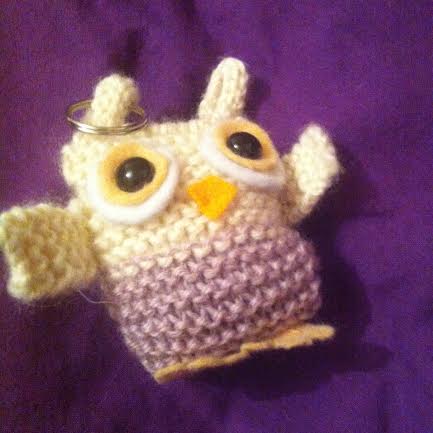
knitquitkitowlFrost came across this unique and gorgeous knitting product that was launched to help smokers quit whilst learning a new and very popular skill.

Inventor, Vanessa Bracewell, says: “I am not an experienced knitter and only started the wonderful craft/obsession 8 months and 5 days ago when I stopped smoking – after 30 years of burning my money and probably damaging my health…From experience, when quitting smoking it is impossible to concentrate on anything, including counting rows.”

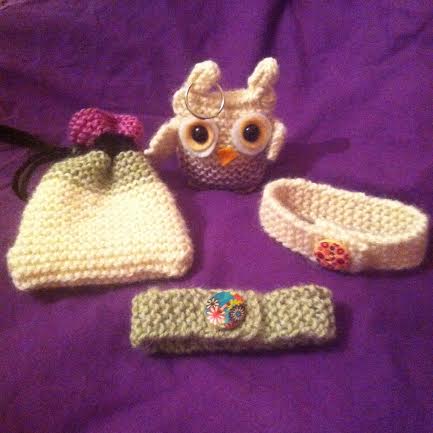
Included in the kit are three very easy projects using only cast on/off, knit stitch, increase, decrease and changing colour of yarn.

Everything needing to complete the three projects is supplied in the novelty cigarette style gift box. Includes extremely easy to follow patterns specially designed with tick boxes to keep track of your knitting.

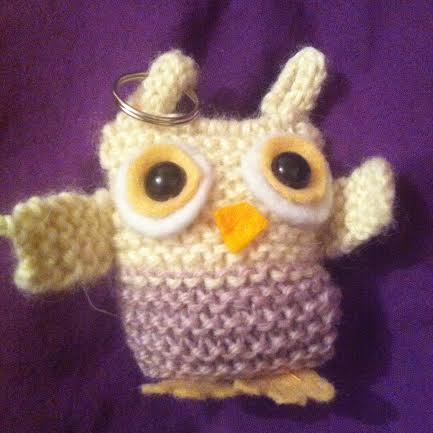
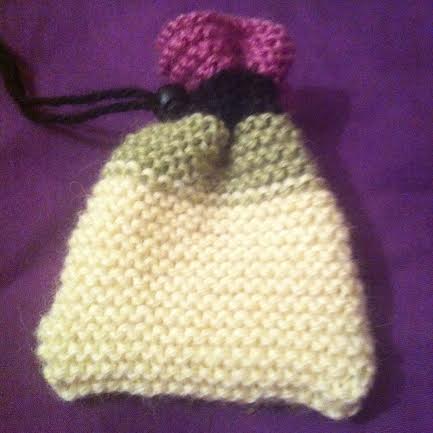
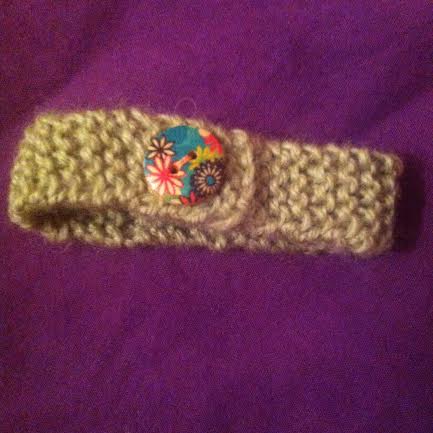
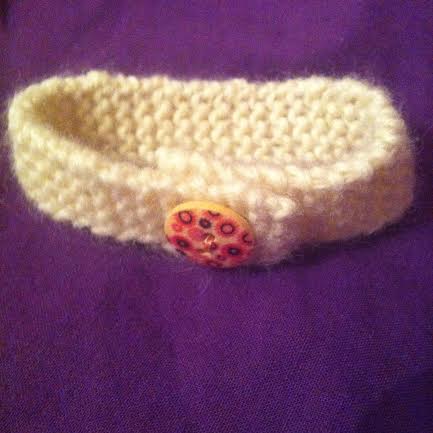
The patterns include: Bill the Owl Keyring (to offer wisdom and support in moments of stress and weakness) BFT Bracelets (Best Friends Together) one to knit for yourself and one to knit for your quitting smoking helper to thank them for their support and a practical drawstring Purse/Bag – to save your well earned money in.

www.knitquitkits.co.uk

Our writer, Helen, tried it out.

knitquitkit

knittedhat

knittedowl

knitting

knittingkit

knitkit

Helen loves knitting so we sent her the kit. Helen is also trying to stop smoking. She liked the look of the kit but found some of the knitting hard because of her eyesight. Shouldn’t be a problem for people with good eyesight.

She thought it was easy to do and the owl, bracelets and drawstring bag were all cute and unique. The kit looks great and comes with easy patterns. The colours are also beautiful but Helen thought it was a little pricey at £17.99.

Whilst knitting and doing the kit Helen did find her mind occupied. She has not managed to quit smoking completely but has cut down considerably. Good stuff.

Diane Kruger Beauty Tips

Diane KrugerThe incredibly stylish Diane Kruger has revealed her secret for beautiful hair at music festivals, “My hair is fine, so I use a spritz of Klorane dry shampoo for body,”

The gorgeous 36-year-old also said sleep is her secret weapon. ‘I try to get nine hours of sleep a night. It’s really that simple. Of course, it’s hard to do sometimes, especially when I am working, but I feel and look better when I sleep well. I also noticed a great improvement in my skin when I gave up smoking. There are no secret potions, though.’

Klorane dry shampoo should be sprayed on the roots and then massaged in. It gives a great body boost and I am a fan myself. Don’t spray to close to the hair or it will make your hair white. It costs £7.50 from John Lewis.